• 검색 결과가 없습니다.

Solution Plasma Synthesis of BNC Nanocarbon for Oxygen Reduction Reaction

N/A
N/A
Protected

Academic year: 2021

Share "Solution Plasma Synthesis of BNC Nanocarbon for Oxygen Reduction Reaction"

Copied!
5
0
0

로드 중.... (전체 텍스트 보기)

전체 글

(1)

한국표면공학회지 J. Korean Inst. Surf. Eng.

Vol. 51, No. 5, 2018.

https://doi.org/10.5695/JKISE.2018.51.5.332

<연구논문>

ISSN 1225-8024(Print) ISSN 2288-8403(Online)

Solution Plasma Synthesis of BNC Nanocarbon for Oxygen Reduction Reaction

Seung-Hyo Lee

a,*

a

Graduate School of Materials Engineering, Nagoya University, Furo-cho, Chikusa-ku, Japan

(Received 16 October, 2018 ; revised 25 October, 2018 ; accepted 29 October, 2018)

Abstract

Alkaline oxygen electrocatalysis, targeting anion exchange membrane alkaline-based metal-air batteries has become a subject of intensive investigation because of its advantages compared to its acidic counterparts in reaction kinetics and materials stability. However, significant breakthroughs in the design and synthesis of efficient oxygen reduction catalysts from earth-abundant elements instead of precious metals in alkaline media still remain in high demand. One of the most inexpensive alternatives is carbonaceous materials, which have attracted extensive attention either as catalyst supports or as metal-free cathode catalysts for oxygen reduction. Also, carbon composite materials have been recognized as the most promising because of their reasonable balance between catalytic activity, durability, and cost. In particular, heteroatom (e.g., N, B, S or P) doping on carbon materials can tune the electronic and geometric properties of carbon, providing more active sites and enhancing the interaction between carbon structure and active sites. Here, we focused on boron and nitrogen doped nanocarbon composit (BNC nanocarbon) catalysts synthesized by a solution plasma process using the simple precursor of pyridine and boric acid without further annealing process. Additionally, guidance for rational design and synthesis of alkaline ORR catalysts with improved activity is also presented.

Keywords : Solution Plasma, B and N doped nanocarbon, Oxygen reduction reaction, Catalyst

1. Introduction

Electrochemical oxygen reduction activity is an essential reaction in metal-air cells and fuel cells which are catalyzed on cathodes by commercial noble metal materials (e.g., Pt or Pd based). High Pt loading is required to secure the efficient ORR performance by overcoming the slow reaction kinetics of the cathode. However, the high cost and the finite resources of Pt as well as the short-term stability and inactivation by CO poisoning, have obstructed large-scale commercialization of the metal-air batteries and fuel cells [1-3]. One of the most feasible Pt alternatives is the carbonaceous materials, which have attracted considerable attention

either as catalyst supports or as metal-free catalysts in the electrocatalytic chemistry of oxygen [4-10].

Particularly, heteroatoms such as B and N doped nanocarbon can be regarded as alternative low-cost metal-free electrocatalysts for oxygen reduction reaction (ORR) [11]. Boron and nitrogen co-doping into carbon nanostructure has attracted immense attention because of their unique electronic structures with synergistic coupling effect between two elements, which also has been considered as possibilities to improve the carbon based metal-free catalysts for ORR activity. The mechanisms how B and N co-doping improve the electrocatalytic activities of carbons in ORR and critical role of two element for creating catalytic site on carbon are some underlying point to be fully understood, though.

Recently, discharge in liquid, in terms of solution plasma process, has attracted attention as applicable and effective synthesis method for heteroatoms doped carbonaceous materials by utilizing simple

* Corresponding Author:Seung-Hyo Lee

Graduate School of Materials Engineering, Nagoya University

Tel: +82-51-410-4264 ; Fax: +82-51-404-3985

E-mail: [email protected]

(2)

organic precursor (i.g. benzene, pyrrole, pyrazine, phenylboronic acid etc.). In addition, this facile method suggests several intrinsic merits for the industrial level of production and practical applications; one-step and short time procedure, processing at mild temperature and pressure and possibility for high yield [12,13].

In this study, boron and nitrogen co-doped nanocarbons (BNC nanocarbon) were prepared by solution plasma synthesis using the organic mixture as precursor without any pre and further treatment.

This study may offer new insight to the design and feasible synthesis of more enhanced carbon based catalyst for potential application in metal-air batteries and fuel cells.

2. Experimental procedure

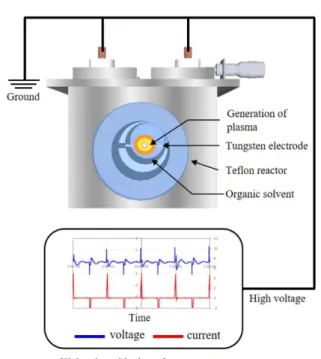
2.1 Synthesis of BNC nanocarbon by solotuon plasma Solution plasma synthesis was performed by using a pair of tungsten electrodes ( Φ0.8, purity 99.9%, Nilaco Corporation) shielded with an insulating ceramic tube placed in the center of the Teflon®

vessel with a gap distance of 1.0 mm (Fig. 1).

A bipolar pulsed power supply (MPS-R06K01C- WP1-6CH, Kurita, Japan) with variable pulse width and repetition frequency was used to generate plasma. The optimized conditions of the discharge were found to be 0.5 μs and 100 kHz, and 2 kV for

the pulse duration, pulse repetition frequency, and voltage, respectively. The discharge was produced during 5 min. in pyridne mixed with 20 mM of boric acid. From here, the obtained nanocarbon (NC) doped with N and N, B co-doped nanocarbon are denoted NNC and BNNC-20, respectively.

2.2 Material characterization

Morphology of nanocarbon was observed by scanning electron microscopy (SEM) using a JEOL JSM-6010LA microscope and transmission electron microscopy (TEM) using a JEOL JEM-2500SE microscope. X-ray diffraction patterns were carried out on a Rigaku Ultima IV diffractometer equipped with Cu K α radiation (λ = 0.154 nm). X-ray photoelectron spectroscopy (XPS) measurements were performed on a JEOL JPS-9010MC spectrometer with monochromatic Mg K α radiation (1253.6 eV) as an excitation source.

2.3 Electrochemical measurements

A suspension made with 5.0 mg catalyst, 480 μL ultrapure water, 480 μL ethanol, and 40 μL Nafion aqueous solution was sonicated until a homogeneous dispersion was obtained (5 mgmL

-1

). 10 μL of homogeneous suspension was applied onto a glassy carbon disk (3 mm diameter), resulting in a catalyst loading of 0.4 mg

cat

cm

-2

. Electrochemical measurements were carried out on an Hokudo Denko Inc., model HZ5000 electrochemical analyzer equipped with a three-electrode system in 0.1 M KOH solution. A platinum coil and Ag/AgCl (saturated KCl) were used as the counter and reference electrodes, respectively.

3. Results and Discussion

A typical TEM images of BNNC-20 in Fig. 2 reveals the a agglomeration and aggregation, and the distribution of particle size is in the range from 50 to 120 nm in Fig. 2(a). A high-resolution TEM image of BNNC-20 in Fig. 2(b) shows the presence of short-range order corresponding to (002) basal plane of graphite surrounded by disordered amorphous Fig. 1. Schematic illustration of the experimental set-

up for solution plasma synthesis

Table 1. The mass concentration of different atomes in NNC and BNNC-20

C (at.%) O (at.%)

N (at.%)

B (at.%)

NNC 90.1 4.7 5.2 -

BNNC-20 89.6 5.4 3.8 1.2

(3)

phase. In the EDS mapping, as shown in Fig 2(c), the B, C and N elements were homogeneously observed in BNNC-20.

X-ray phtoelectron spectroscopy (XPS) and was conducted to investigate the elemental composition and chemical bonding state. The XPS survey spectrum of BNNC-20 comprises of the peaks corresponding to carbon, oxygen, and boron elements (Fig. 3b). The XPS survey spectrum of BNNC-20 comprises of the peaks corresponding to carbon, oxygen, and boron elements (Fig. 3). From the XPS quantitative analysis, carbon, nitrogen, and boron content of BNCP-20 are 89.6, 3.8, and 1.2 at%, respectively as shown in Table 1. The XPS result is evidence that the nitrogen and boron atoms have been successfully doped into carbon framework.

Accordance with XPS, in the FT-IR analysis as shown in Fig 4, aromatic C-N, the C=N imine and the C≡N nitrile aroma were confirmed in both NNC and BNNC-20. Interestingly, the unique spectral feature is that B-O and B-C bonds were clearly revealed at only BNNC-20. From this result, it was suggested that the B-C skeleton and the B-O skeleton are incorporated in the material by synthesizing by adding a boric acid.

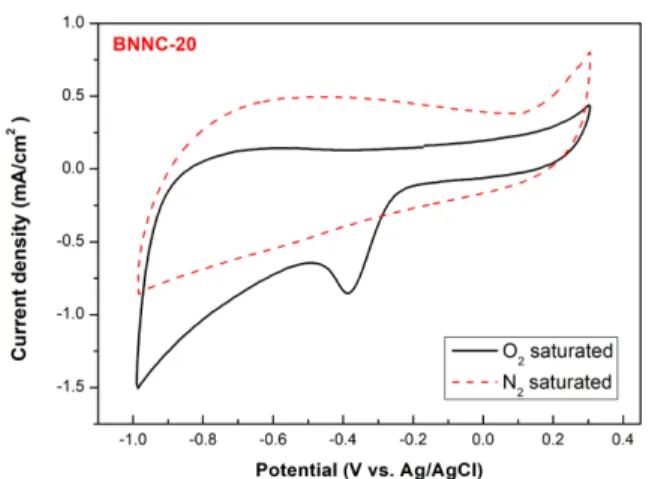
The electrocatalytic activity for the ORR of BNNC-20 was evaluated by cyclic voltammetry (CV) in both N

2

and O

2

-saturated 0.1 M KOH solutions at room temperature in Fig 5. The BNNC- 20 presented a featureless voltammetric current in the N

2

-saturated solution. In contrast, the CV curves of BNNC-20 in the O

2

-saturated solution displayed a well-defined cathodic peak at –0.4 V. It is confirmed Fig. 2 (a) Wide-field TEM images of BNNC-20 (b) High-resolution TEM image of BNNC-20 (c) STEM image of BNNC-20 and the distribution maps for B, C and N elements.

Fig. 3 XPS spectra of BNNC-20 and NNC. Fig. 4 FT-IR spectra of BNNC-20 and NNC.

(4)

that BNNC-20 have catalytic effect clearly positive shift in the cathodic peak of BNNC-20 indicated the enhanced ORR activity as shown in Fig 6. This improvement cab be regarded by boron doping effect.

To further examine the ORR activity, linear sweep voltammetry (LSV) measurements on a RDE were performed in an O

2

-saturated 0.1 M KOH solution at a rotation speed of 1600 rpm with a scan rate of 10 mVs

-1

. Fig. 7 shows that BNNC-20 has an onset closer to Pt/C than NNC. According to the dual doping condition, the ORR onset voltage progressively moves toward a more positive direction, and the small cathodic current density also increased. This result obviously indicates the enhanced synergistic activity of boron and nitrogen doped in nanocarbon.

4. Conclusions

We have reported a facile and effective approach to synthesize the nitrogen and boron doped nanocarbon using by solution plasma synthesis. Relatively good electrocatalytic activity could be attributed to the incorporation of nitrogen and boron atoms in irregularly stacked carbon nanocarbon. The disorder or defect by heteroatoms doped in irregular carbon may function as active sites for oxygen adsorption and activation the O-O bond cleavage. It is suggested that further investigation on dual doping of boron and other heteroatoms through the solution plasma synthesis can lead to the more efficient and advanced ORR catalysts for energy conversion and storage applications.

References

[1] J. Wu and H. Yang, Accounts of Chemical Research 46 (2013) 1848-1857.

[2] M. K. Debe, Nature 486 (2012) 43-51.

[3] Y. Nie, L. Li and Z. Wei, Chem. Soc. Rev. 44 (2015) 2168-2201.

[4] Y. Shao, J. Liu, Y. Wang and Y. Lin, J. Mater.

Chem. 19 (2009) 46-59.

[5] R. L. McCreery, Chem. Rev. 108 (2008) 2646- 2687.

[6] S. Pylypenko, A. Queen, T. S. Olson, A. Dameron, K. O'Neill, K. C. Neyerlin. B. Pivovar. H. N.

Dinh. D. S. Ginley. T. Gennett and R. O'Hayre, J. Phys. Chem. C 115 (2011) 13667-13675.

[7] I. Dumitrescu, P. R. Unwin and J. R. Macpherson, Chem. Commun. 45 (2009) 6886-6901.

[8] D. W. Wang and D. Su, Energy & Environmental Science 7 (2014) 576-591.

[9] N. Daems, X. Sheng, I. F. J. Vankelecoma and P. P. Pescarmona, J. Mater. Chem. A 2 (2014) 4085-4110.

Fig. 5. CV curves of BNNC-20 in N

2

(red dashed line) and O

2

-saturated (black solid line) 0.1 M KOH solution at a scan rate of 50 mVs

-1

.

Fig. 6. CV curves of NNNC and BNNC-20 in O

2

- saturated 0.1 M KOH solution at a scan rate of 50 mVs

-1

.

Fig. 7. LSV curves of NNC, BNNC-20 and 20% Pt/C in

0.1 M KOH solution at a rotation speed of 1600 rpm

and a scan rate of 10 mVs

-1

.

(5)

[10] Y. Zheng, Y. Jiao, M. Jaroniec, Y. Jin and S. Z.

Qiao, Small 8 (2012) 3550-3566.

[11] S. Wang, L. Zhang, Z. Xia, A. Roy, D. W. Chang, J. N. Baek and L. Dai, Angew. Chem. Int. Ed.

51 (2012) 4209-4212.

[12] G. Panomsuwan, S. Chiba, Y. Kaneko, N. Saito and T. Ishizaki, J. Mater. Chem. A 2 (2014) 18677- 18686.

[13] G. Panomsuwan, N. Saito and T. Ishizaki, Carbon

98 (2016) 411-420.

수치

Table 1. The mass concentration of different atomes in NNC and BNNC-20 C (at.%) O (at.%) N (at.%) B (at.%) NNC 90.1 4.7 5.2  -BNNC-20 89.6 5.4 3.8 1.2
Fig. 3 XPS spectra of BNNC-20 and NNC.  Fig. 4 FT-IR spectra of BNNC-20 and NNC.
Fig. 5. CV curves of BNNC-20 in N 2  (red dashed line) and O 2 -saturated (black solid line) 0.1 M KOH solution at a scan rate of 50 mVs -1 .

참조

관련 문서

In this study, we have deposited poly acrylic acid films on three-dimensional (3D) PCL scaffolds using plasma polymerization and then plasma-polymerized 3D

Component ratio and solid content of solution used in the duration time experiment by addition ratio of coco betain.. Component ratio and solid content of solution used

Solving the PDEs using separating variables and Fourier series and interpreting the solution... Solution

2) polymer reactions using a polymer as a carrier or support for some component of a reaction system (polymeric brominating and Wittig reagents, the Merrifield

시편-노즐 거리가 작을수록 더블 아크 발생률이 증가했으며 이로 인해 시편 상단면의 홀 면적과 더블 아크 향부의 면적이 증가. 시편 두께가 두꺼울수록 더블 아크

In future studies focused on antioxidant effect and active oxygen reduction in resistance exercise using thera-band will be conducted in-depth research that

- The magnetic pressure and plasma pressure each produce positive (outward forces) near the outside of the plasma...

photovoltaics, plasma remediation of greenhouse and toxic gases, and plasma destruction of hazardous wastes..  Low-temperature plasma production of nanoscale