• 검색 결과가 없습니다.

Prognostic Impact of Baseline High-Sensitivity C-Reactive Protein in Patients With Acute Myocardial Infarction Undergoing Percutaneous Coronary Intervention Based on Body Mass Index

N/A
N/A
Protected

Academic year: 2022

Share "Prognostic Impact of Baseline High-Sensitivity C-Reactive Protein in Patients With Acute Myocardial Infarction Undergoing Percutaneous Coronary Intervention Based on Body Mass Index"

Copied!
9
0
0

로드 중.... (전체 텍스트 보기)

전체 글

(1)

Korean Circulation Journal

Introduction

There is increasing evidence that higher levels of high sensitivity C-reactive protein (hs-CRP) is a marker of inflammation and a po-

Print ISSN 1738-5520 • On-line ISSN 1738-5555

Prognostic Impact of Baseline High-Sensitivity C-Reactive Protein in Patients With Acute Myocardial Infarction Undergoing

Percutaneous Coronary Intervention Based on Body Mass Index

Khurshid Ahmed, MD 1,2 , Myung Ho Jeong, MD 1,6 , Rabin Chakraborty, MD 2 , Kyung Hoon Cho, MD 1 , Doo Sun Sim, MD 1 , Young Joon Hong, MD 1,6 , Youngkeun Ahn, MD 1,6 , Daisuke Hachinohe, MD 1 , Myeong Chan Cho, MD 3 , Chong Jin Kim, MD 4 , and Young Jo Kim, MD 5

1

Department of Cardiovascular Medicine, Chonnam National University College of Medicine, Gwangju, Korea

2

Department of Cardiology, Apollo Gleneagles Hospital, Kolkata, India

3

Department of Cardiology, Chungbuk National University College of Medicine, Daejeon,

4

Department of Cardiovascular Medicine, Kyunghee University College of Medicine, Seoul,

5

Department of Cardiology, Yeungnam University College of Medicine, Daegu,

6
The Brain Korea 21 of Chonnam National University, Gwangju, Korea

Background and Objectives: Serum high sensitivity C-reactive protein (hs-CRP) is a marker of inflammation and may lead to the devel- opment of atherosclerosis, adversely affecting mortality. The aim of this study was to evaluate the relationship between baseline hs-CRP level and 12-month clinical outcomes in patients with acute myocardial infarction (AMI) undergoing percutaneous coronary intervention (PCI) according to their body mass index (BMI) status.

Subjects and Methods: Using data from the Korea Acute Myocardial Infarction Registry from November 2005 to September 2008, a to- tal of 8174 consecutive AMI patients were studied. Cox proportional hazard model revealed that higher baseline levels of hs-CRP was as- sociated with 12-month all-cause mortality (p=0.045). To further understand this association, patients were divided into 3 groups based on their body mass index: 1) overweight/obese, 2) normal weight, and 3) underweight patients. Then each group was stratified into quar- tiles based on their hs-CRP.

Results: In overweight/obese patients, Cox model showed significant association of hs-CRP with 12-month mortality when adjusted for age and gender (p<0.001), however, after adjustment with multiple covariates, mortality was highest in the 4th quartile {HR 2.382, (1.079- 5.259), p=0.032} though statistically insignificant (p=0.172). We observed no significant association of serum hs-CRP with 12-month mor- tality in normal weight (p=0.681) and underweight (p=0.760) patients.

Conclusion: Higher baseline hs-CRP level (≥4.08 mg/dL) in overweight/obese AMI patients showed significant association with 12-month all-cause mortality independent of other prognostic markers. (Korean Circ J 2012;42:164-172)

KEY WORDS: C-reactive protein; Overweight; Obesity; Body mass index; Myocardial infarction.

Received: July 5, 2011 / Revision Received: September 2, 2011 / Accepted: October 17, 2011

Correspondence: Myung Ho Jeong, MD, Department of Cardiovascular Medicine, Chonnam National University College of Medicine, 671 Jebong-ro, Dong-gu, Gwangju 501-757, Korea

Tel: 82-62-220-6243, Fax: 82-62-228-7174, E-mail: [email protected]

• The authors have no financial conflicts of interest.

This is an Open Access article distributed under the terms of the Creative Commons Attribution Non-Commercial License (http://creativecommons.org/licenses/

by-nc/3.0) which permits unrestricted non-commercial use, distribution, and reproduction in any medium, provided the original work is properly cited.

tential independent predictor of cardiovascular disease, as it may

play a role in the development of atherosclerosis, adversely affect-

ing mortality.

1)2)

Rate of obesity is increasing globally where stud-

ies have shown association of body weight as assessed by body

(2)

mass index (BMI) with clinical outcomes after percutaneous coro- nary intervention (PCI) in acute myocardial infarction (AMI) pa- tients.

3)

Previous reports have also indicated that hs-CRP level is correlated with BMI and fat distribution.

4)5)

The mechanism for el- evation of plasma hs-CRP in obese subjects could be through a high production of cytokines, e.g., interleukin-1β (IL-1β), interleukin-6 (IL- 6) and tumor necrosis factor-α (TNF-α), by excess adipose tissue which could induce high hs-CRP production in liver.

4)

Curently there is no data available evaluating the relationship between higher baseline hs-CRP levels, body mass index (BMI) sta- tus, and adverse outcomes in patients with AMI undergoing PCI.

Therefore, in the present study we attempted to assess the associ- ation between baseline hs-CRP level and 12-month clinical out- comes in patients with AMI.

Subjects and Methods

This retrospective study was carried out at The Heart Center of Chonnam National University Hospital, Korea. The permission to car- ry out the study had been sought from the hospital authorities (IRB No.05-49) and informed consent obtained from the patients. Patient medical documents were used to obtain the demographic data, clini- cal characteristics and relevant laboratory results. Patients were en- rolled in the registry after admission to participating hospitals with a suspected diagnosis of AMI.

Korea Acute Myocardial Infarction Registry

The Korea Acute Myocardial Infarction Registry (KAMIR) is a pro- spective, multicenter, observational registry designed to examine current epidemiology in hospital management and outcome of pa- tients with AMI in Korea. The registry included 52 community and uni- versity hospitals capable of primary PCI with one-year clinical follow up. Data was collected at each site by a well-trained study coordi- nator based on a standardized protocol.

6-8)

Study population

A total of 10974 consecutive patients with AMI (both ST-segment elevation MI and non-ST-segment elevation MI) undergoing PCI from November 2005 to September 2008 were assessed in this study. Patients with unknown BMI (n=395) and missing hs-CRP (n=

2405) data were excluded from this study; hence the total study population was 8174 patients. The aim was to evaluate the impact of baseline hs-CRP on 12-month clinical outcomes according to BMI status. Initially we studied this in terms of the total study popula- tion. Then, according to BMI categories suggested by the World He- alth Organization for Asian population, the total study population was divided into three groups that included 1) overweight/obese (BMI

≥23 kg/m

2

, n=5647), 2) normal-weight (BMI 18.5 to 22.9 kg/m

2

, n=

2246) and 3) underweight (BMI <18.5 kg/m

2

, n=281).

9)

Each group was then stratified into quartiles based on their hs-CRP levels.

Definitions and clinical endpoints

A final diagnosis of AMI was made by the European Society of Car- diology/American College of Cardiology (ESC/ACC) diagnostic criteria for AMI.

10)

BMI was calculated as weight (kg) divided by height squared (m

2

). Diabetes mellitus (DM) was defined as requiring the use of oral hypoglycaemic agent or insulin to lower blood glucose levels. Hypertension was defined as patient systolic blood pressure

>140 mm Hg and/or diastolic blood pressure >90 mm Hg at rest, over a series of repeated measurements, or after treatment with an- ti-hypertensive medications. For diabetics and patients with chronic renal disease, hypertension was defined as systolic blood pressure

≥130 mm Hg and/or diastolic blood pressure ≥80 mm Hg. Hyper- lipidemia was defined as patient total cholesterol level >200 mg/dL or treatment with a lipid-lowering agent. Coronary artery disease (CAD) was defined as patient having a history of myocardial in- farction (MI) revascularization procedure, or obstructive CAD.

Peripheral blood samples were obtained on admission using di- rect venipuncture. Blood samples were centrifuged and serum was removed and stored at a temperature of -700°C until the assay for sugar and proteins was performed. Absolute creatine kinase-MB lev- els were determined by radioimmunoassay (Dade Behring, Inc., Mi- ami, FL, USA). Cardiac specific troponin I levels were measured us- ing a paramagnetic particle, chemiluminescent immunoenzymatic assay (Beckham, Coulter, Inc., Fullerton, CA, USA). Twelve-hour fasting serum levels of total cholesterol, triglyceride, and low and high den- sity lipoprotein-cholesterol were measured by standard enzymatic methods. Blood sample for hs-CRP was obtained on admission and was analyzed turbidimetrically with sheep antibodies against human CRP; this has been validated against the Dade Behring method. Each group was divided into quartiles based on their hs- CRP levels. Overweight/obese quartiles were: first quartile <0.2 mg/

dL, n=1370, second quartile ≥0.2 to <0.82 mg/dL, n=1451, third qu- artile ≥0.82 to <4.08 mg/dL, n=1413 and fourth quartile ≥4.08 mg/

dL, n=1413. Normal-weight quartiles were: first quartile <0.2 mg/dL, n=548, second quartile ≥0.2 to <0.92 mg/dL, n=575, third quartile

≥0.92 to <5.23, n=563 mg/dL and fourth quartile ≥5.23 mg/dL, n=563. Underweight quartiles were: first quartile <0.31 mg/dL, n=

70, second quartile ≥0.31 to <1.54 mg/dL, n=70, third quartile ≥1.54 to <8.76 mg/dL, n=71 and fourth quartile ≥8.76 mg/dL, n=70.

Two-dimensional echocardiography was performed in all pa-

tients and left ventricular ejection fraction (LVEF) was assessed us-

ing a modified Simpson’s biplane method. The morphology in cor-

onary angiography was classified by criteria from the American

(3)

College of Cardiology/American Heart Association (ACC/AHA).

11)

The degree of coronary flow was classified by Thrombolysis in Myo- cardial Infarction (TIMI) score. The presence of left main coronary artery stenosis was defined as a luminal stenosis ≥50%. Multives- sel disease was defined as the presence of a lesion with >50% di- ameter stenosis in a non-infarct related coronary artery. Successful PCI was defined as TIMI flow 3 with residual stenosis ≤50% in the infarct related artery. In-hospital complications included atrio-ven- tricular block, bradycardia, ventricular tachycardia/ventricular fibrill- ation, atrial fibrillation, no reflow, dissection, cardiogenic shock, acu- te renal failure, metabolic acidosis/lactic acidosis.

Major advense cardiac event (MACE) were defined as all-cause death, recurrent MI, or repeat revascularization.

The primary endpoint of this study was all-cause mortality at 12-month clinical follow up. All data were recorded on a standardiz- ed, electronic, web based registry at http://www.kamir.or.kr.

Statistical analysis

SPSS 17.0 for windows (SPSS, Inc., Chicago, IL, USA) was used for all analyses. Continuous variables were presented as the mean±SD;

comparisons were conducted by one-way ANOVA test. Discrete variables were presented as percentages and frequencies; compar- isons were conducted by chi-square statistics. A p<0.05 was con- sidered statistically significant. Cox regression analysis was per- formed to identify a model with independent predictive factors including determination of a hazard ratio and its 95% confidence interval (CI) for each variable in the model. Cox analysis was per- formed to identify variables that most affected the hazard ratio of hs-CRP, with a cut off at p<0.20 for entry into the model.

Results

A total of 8,174 AMI patients, mean age=62.7±12.4 years and 76% male gender (n=6217), were stratified into quartiles based on their hs-CRP level to study their 12-month clinical outcomes. Tw- elve-month all-cause death and 12-month composite of MACE in- creased as the value of hs-CRP increased from 1st to 4th quartile.

Cox proportional hazard analysis showed 12-month mortality to be highest in patients of 4th quartile {HR=2.80 (1.335-5.873), p=0.006}

followed by 3rd quartile {HR=2.495 (1.186-5.248), p=0.016}. It was statistically significant among hs-CRP quartiles (p=0.045). Indepen- dent factors for 12-month mortality were age greater than 60 years, in-hospital complications, Killip class >1, use of statin, heart rate

>100 beats/min, N-terminal pro-B-type natriuretic peptide (NT- proBNP) >3000 pg/mL, left ventricular ejection fraction (LVEF) <55%

and creatinine clearance <60 min/mL (data not provided).

As the 12-month mortality was statistically borderline significant

among hs-CRP quartiles in the total study population, we sought to further evaluate this finding by dividing the total study popula- tion into three groups based on their BMI. Overweight and obese patients were grouped together as there was no baseline significant difference in their 12-month all-cause mortality (p=0.076, data not provided).

Overweight/Obese group

(n=5647, mean age=60.4±12.2 years, 75.2% male)

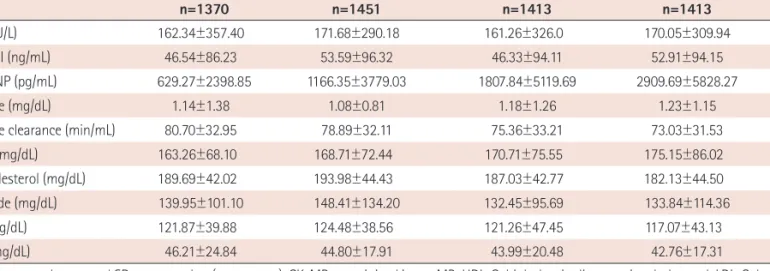
Baseline clinical characteristics and laboratory findings of this gr- oup are presented in Table 1 and 2 respectively. Overweight/obese patients with higher hs-CRP (i.e., 2nd, 3rd and 4th quartiles) were older, more often female, had higher Killip classes, heart rate and NT- proBNP; and had lower blood pressure, LVEF and creatinine clear- ance. They were associated with higher incidence of DM, hyperten- sion, CAD, heart failure and cerebrovascular disease. Statin use was not significant among the quartiles (p=0.702). As per past regular medication history, 7.15% of the patients at the time of admission were on statin (n=404).

Coronary angiographic findings are presented in Table 3. Multi- vessel involvement, ACC/AHA lesion type C, and Pre-PCI TIMI flow grade 0 were observed to increase with an increase in hs-CRP. Post- PCI TIMI flow grade 3 was nearly similar among all quartiles. PCI suc- cess rate decreased and in-hospital complication rate increased with increasing hs-CRP.

Table 4 shows the clinical outcomes during the 12-month follow- up. In-hospital death, composite MACE at 1 month and 12 months, and mortality at 1 month and 12 months were more frequent with increasing hs-CRP levels. Twelve-month mortality increased as the value of hs-CRP increased; 2.0% (n=27) in 1st, 2.5% (n=37) in 2nd, 4.4% (n=62) in 3rd and highest 6.6% (n=94) in the 4th quartile.

Cox proportional hazard model was implemented to identify the independent predictors of mortality at the 12-month clinical follow- up. Serum hs-CRP quartiles showed significant association with 12-month mortality when adjusted for age and gender (p<0.001).

With quartile 1 as a reference, the risk of 12-month mortality was

higher in the 3rd quartile {2.153 (1.369-3.384), p=0.001} and 4th

quartile {3.268 (2.129-5.016), p<0.001}. After adjustment with mul-

tiple covariates, 12-month mortality was highest in patients within

the 4th quartile compared to other patients {hazard ratio (HR) 2.382

(1.079-5.259), p=0.032} though statistical significance was not

achieved (p=0.172). Independent factors for 12-month mortality

were old age (>60 years), heart rate >100 beats/min, LVEF <55%,

creatinine clearance <60 min/mL and in-hospital complications. The

variables included in Cox model were age, male gender, heart rate,

systolic blood pressure, smoking history, history of hypertension, di-

abetes mellitus, coronary artery disease, cerebrovascular disease and

(4)

heart failure, LVEF, Killip classes >1, glucose, total cholesterol, tri- glyceride, creatinine clearance, NT-proBNP, left main and multivessel involvement, pre-TIMI flow grade 0, post-TIMI flow grade 3, ACC/

AHA lesion type C, PCI success rate, in-hospital complications and use of statin.

Normal-weight group

(n=2246, mean age=66.5±11.6 years, 68.6% male)

Patients were also stratified into quartiles based on hs-CRP level to evaluate their 12-month clinical outcomes. Patients with higher hs-CRP were found to be older (p<0.001), with increased heart rate (p=0.015) and higher Killip classes (p=0.002). They had more associ- ation with diabetes mellitus (p=0.019), hypertension (p=0.049), heart failure (p=0.001) and peripheral vascular disease (p=0.001). Creati- nine clearance, LVEF and high-density lipoprotein cholesterol de- creased with higher hs-CRP (p<0.001, p<0.001 and p=0.001 respec- tively). NTproBNP showed an increasing trend among quartiles (p<

0.001). Total cholesterol, triglyceride and low density lipoprotein- cholesterol (LDL-C) were also significant among quartiles (p<0.001, p=0.001 and p=0.001 respectively). They were more associated

with ACC/AHA lesion type C, multivessel involvement, pre-TIMI flow grade 0 and in-hospital complications. Twelve-month composite of MACE (p=0.009) and all-cause death (p<0.001) increased as the value of hs-CRP increased from 1st to 4th quartile. Cox proportional hazard model showed 12-month mortality to be statistically insig- nificant among hs-CRP quartiles in this group (p=0.681). The vari- ables included in the model were age, DM, hypertension, hyperlip- idemia, heart failure, peripheral vascular disease, smoking history, clinical presentation ST-elevation MI, total cholesterol, triglyceride, creatinine clearance, NT-proBNP, systolic blood pressure, heart rate, in-hospital complications, Killip class >1, LVEF <55%, pre-procedure TIMI grade 0 flow, ACC/AHA lesion type C, multivessel involvement, and use of statin.

Underweight group

(n=281, mean age=71.5±11.0 years, 64.4% male)

Patients from this study were additionally divided into quartiles based on hs-CRP level to study their 12-month clinical outcomes.

The variables included in the model were age, systolic blood pressure, LVEF <55%, glucose, total cholesterol, LDL-C, creatinine clearance, Table 1. Baseline clinical characteristics of overweight/obese patients according to levels of high sensitivity C-reactive protein

Variables  Quartile 1

(<0.2 mg/dL) n=1370

Quartile 2 (≥0.2 - <0.82 mg/dL)

n=1451

Quartile 3 (≥0.82 - <4.08 mg/dL)

n=1413

Quartile 4 (≥4.08 mg/dL)

n=1413 p

Age (years) 59.18±11.99 59.96±12.16 60.97±12.02 61.58±12.62 <0.001

Male gender, n (%) 1061 (77.5) 1113 (76.8) 1037 (73.4) 1032 (73.0) 0.010

Body mass index (kg/m

2

) 25.72±2.61 25.60±2.52 25.66±2.55 25.77±3.23 0.367

Systolic BP (mm Hg) 132.69±27.41 133.41±27.63 129.78±29.05 125.42±27.26 <0.001

Heart rate (beats/min) 74.40±17.45 75.71±17.18 76.82±19.44 79.23±26.27 <0.001

LVEF (%) 54.95±10.92 53.45±11.12 52.38±11.54 49.17±11.95 <0.001

Killip >1, n (%) 270 (19.7) 247 (17.0) 301 (21.3) 368 (26.0) <0.001

Past history, n (%)

Smoking 888 (64.8) 931 (64.1) 887 (62.7) 803 (56.8) <0.001

Diabetes mellitus 342 (24.9) 379 (26.1) 430 (30.4) 414 (29.3) 0.003

Hypertension 641 (46.8) 719 (49.5) 749 (53.0) 722 (51.1) 0.009

Hyperlipidemia 162 (11.8) 163 (11.2) 162 (11.5) 138 (9.8) 0.310

Coronary artery disease 243 (17.7) 177 (12.2) 196 (13.9) 203 (14.4) <0.001

Heart failure 6 (0.4) 10 (0.7) 27 (1.9) 20 (1.4) 0.001

CVD 51 (3.7) 71 (4.9) 71 (5.0) 98 (6.9) 0.002

PVD 5 (0.4) 6 (0.4) 13 (0.9) 15 (1.1) 0.054

Family history of CAD, n (%) 109 (8.0) 130 (9.0) 99 (7.0) 117 (8.3) 0.270

Statin use 1040 (76) 1127 (77.7) 1085 (76.8) 1087 (76.9) 0.702

Clinical presentation, n (%)

STEMI 886 (64.7) 963 (66.4) 898 (63.6) 917 (64.9) 0.470

Non-STEMI 484 (35.3) 488 (33.6) 515 (36.4) 496 (35.1) 0.470

Data are expressed as mean±SD or as number (percentage). BP: blood pressure, CAD: coronary artery disease, CVD: cerebrovascular disease, LVEF: left ven-

tricular ejection fraction, PVD: peripheral vascular disease, STEMI: ST elevation myocardial infarction

(5)

NT-proBNP, smoking history, heart failure, post-procedure TIMI gr- ade 3, PCI success rate, and in-hospital complications. Age, NT-pro- BNP, Killip class >1 and in-hospital complications increased with in- creasing levels of hs-CRP (p=0.006, p<0.001, p=0.009 and p=0.032 respectively), while creatinine clearance decreased with rising level of hs-CRP (p=0.001). Systolic blood pressure, LVEF, total cholesterol and post-TIMI flow grade III were statistically significant among the quartiles (p=0.043, p=0.023, p=0.038 and p=0.002 respectively).

Twelve-month composite of MACE increased as the value of hs- CRP increased from 1st to 4th quartile, but it was statistically in- significant (p=0.382), and twelve-month all-cause death showed no association among quartiles (p=0.079). Cox proportional hazard

model showed 12-month mortality to be statistically insignificant among hs-CRP quartiles in this group as well (p=0.760).

Fig. 1 shows adjusted survival curves of 12-month mortality in hs-CRP quartiles in (A) total study population, (B) overweight/obese group, (C) normal-weight group and (D) underweight group.

Discussion

This study demonstrated that higher baseline hs-CRP level (≥4.08 mg/dL) in overweight/obese AMI patients showed significant asso- ciation with 12-month all-cause mortality independent of other prognostic markers.

Table 2. Laboratory characteristics of overweight/obese patients according to high sensitivity C-reactive protein levels Variables

Quartile 1 (<0.2 mg/dL)

n=1370

Quartile 2 (≥0.2 - <0.82 mg/dL)

n=1451

Quartile 3 (≥0.82 - <4.08 mg/dL)

n=1413

Quartile 4 (≥4.08 mg/dL)

n=1413

p

CK-MB (U/L) 162.34±357.40 171.68±290.18 161.26±326.0 170.05±309.94 0.76

Troponin I (ng/mL) 46.54±86.23 53.59±96.32 46.33±94.11 52.91±94.15 0.11

NT-proBNP (pg/mL) 629.27±2398.85 1166.35±3779.03 1807.84±5119.69 2909.69±5828.27 <0.001

Creatinine (mg/dL) 1.14±1.38 1.08±0.81 1.18±1.26 1.23±1.15 0.005

Creatinine clearance (min/mL) 80.70±32.95 78.89±32.11 75.36±33.21 73.03±31.53 <0.001

Glucose (mg/dL) 163.26±68.10 168.71±72.44 170.71±75.55 175.15±86.02 0.001

Total cholesterol (mg/dL) 189.69±42.02 193.98±44.43 187.03±42.77 182.13±44.50 <0.001

Triglyceride (mg/dL) 139.95±101.10 148.41±134.20 132.45±95.69 133.84±114.36 0.001

LDL-C (mg/dL) 121.87±39.88 124.48±38.56 121.26±47.45 117.07±43.13 <0.001

HDL-C (mg/dL) 46.21±24.84 44.80±17.91 43.99±20.48 42.76±17.31 <0.001

Data are expressed as mean±SD or as number (percentage). CK-MB: creatinine kinase-MB, HDL-C: high density lipoprotein–cholesterol, LDL-C: low density lipoprotein-cholesterol, NT-pro BNP: N-terminal pro-brain natriuretic peptide

Table 3. Angiographic findings and procedural results of overweight/obese patients according to high sensitivity C-reactive protein levels  Variables

Quartile 1 (<0.2 mg/dL)

n=1370

Quartile 2 (≥0.2 - <0.82 mg/dL)

n=1451

Quartile 3 (≥0.82 - 4.08 mg/dL)

n=1413

Quartile 4 (≥4.08 mg/dL)

n=1413

p

Infarct-related artery, n (%)

Left main stem 15 (1.1) 14 (1.0) 26 (1.8) 22 (1.6) 0.14

Left anterior descending artery 626 (45.7) 679 (46.8) 620 (43.9) 665 (47.1) 0.46

Left circumflex artery 250 (18.2) 238 (16.4) 247 (17.5) 229 (16.2) 0.42

Right coronary artery 461(33.6) 496 (34.2) 478 (33.8) 472 (33.4) 0.94

ACC/AHA lesion type C, n (%) 556 (40.6) 584 (40.2) 629 (44.5) 686 (48.5) <0.001

PCI with stent, n (%) 1268 (92.5) 1351 (93.1) 1301 (92.0) 1290 (91.3) 0.212

Multivessel involvement, n (%) 656 (47.9) 764 (52.6) 813 (57.5) 848 (60.0) <0.001

Pre-PCI TIMI flow grade 0, n (%) 538 (39.3) 615 (42.4) 590 (41.7) 670 (47.4) 0.002

Post-PCI TIMI flow grade III, n (%) 1210 (88.4) 1281 (88.3) 1210 (85.6) 1252 (88.6) 0.004

PCI success rate, n (%) 1311 (95.7) 1361 (93.8) 1315 (93.1) 1321 (93.5) 0.004

In-hospital complications, n (%) 120 (8.8) 117 (8.1) 157 (11.1) 226 (16.0) <0.001

*in-hospital complications include atrio-ventricular block, bradycardia, ventricular tachycardia/ventricular fibrillation, atrial fibrillation, cardiogenic shock,

acute renal failure, metabolic acidosis/lactic acidosis, cerebrovascular event or infection/sepsis. ACC/AHA: American college of cardiology/American heart

association, PCI: percutaneous coronary intervention, TIMI: Thrombolysis in Myocardial Infarction

(6)

Over the past few years, it has become increasingly clear that in- flammation plays a pivotal role in cardiovascular disease, and in- creased circulating inflammation markers may be predictive of car- diovascular events.

12)13)

Among the inflammation markers available,

hs-CRP is one of the independent predictors of cardiovascular ev- ents.

14)15)

Adiposity is an inflammatory condition and IL-6, TNF-α and hs-CRP levels are positively correlated with adipocyte size.

4)15)16)

These cytokines induce insulin resistance in adipose cells by inhib- Table 4. Clinical outcomes and major adverse cardiac events (MACEs) during follow-up and at 12 months in overweight/obese patients

Outcomes, n (%)

Quartile 1 (<0.2 mg/dL)

n=1370

Quartile 2 (≥0.2 - <0.82 mg/dL)

n=1451

Quartile 3 (≥0.82 - <4.08 mg/dL)

n=1413

Quartile 4 (≥4.08 mg/dL)

n=1413

p

In-hospital death 14 (1.0) 17 (1.2) 31 (2.2) 47 (3.3) <0.001

The composite of MACE at 1 month 37 (2.7) 50 (3.4) 53 (3.7) 86 (6.0) <0.001

All cause death rate at 1 month 22 (1.6) 26 (1.8) 43 (3.0) 67 (4.7) <0.001

The composite of MACE at 12 months 121 (8.8) 136 (9.4) 149 (10.5) 197 (13.9) <0.001

All cause death rate at 12 months 27 (2.0) 37 (2.5) 62 (4.4) 94 (6.6) <0.001

1.000

0.995

0.990

0.985

0.980

1.000

0.995

0.990

0.985

0.980 1.000

0.995

0.990

0.985 0.980

0.975

1.000

0.995

0.990

0.985

0.980

0 100 200 300 400

0 100 200 300 400

0 100 200 300 400

0 100 200 300 400 Survival time (days)

Survival time (days)

Survival time (days)

Survival time (days)

Cu m ul at iv e su rv iv al Cu m ul at iv e su rv iv al

Cu m ul at iv e su rv iv al Cu m ul at iv e su rv iv al

hs-CRP quartiles (overweight/obese) p=0.172 Quartile 1&4 p=0.032

hs-CRP quartiles (under weight) p=0.760 hs-CRP quartiles

(total population) p=0.045

hs-CRP quartiles (normal weight) p=0.681

hs-CRP (quartiles) 1st quartile <0.2 mg/dL 2nd quartile 0.2-0.82 mg/dL 3rd quartile 0.82-4.08 mg/dL 4th quartile >4.08 mg/dL

hs-CRP quartiles (under weight) 1st quartile <0.31 mg/dL 2nd quartile 0.31-1.54 mg/dL 3rd quartile 1.54-8.76 mg/dL 4th quartile >8.76 mg/dL hs-CRP quartiles

1st quartile <0.2 mg/dL 2nd quartile 0.2-0.89 mg/dL 3rd quartile 0.89-4.53 mg/dL 4th quartile >4.53 mg/dL

hs-CRP quartiles 1st quartile <0.2 mg/dL 2nd quartile 0.2-0.92 mg/dL 3rd quartile 0.92-5.23 mg/dL 4th quartile >5.23 mg/dL

A  

C  

B  

D  

Fig. 1. Adjusted Cox proportional hazard survival curves for 12-month all-cause mortality and high sensitivity C-reactive protein (hs-CRP) quartiles in AMI

patients undergoing PCI in (A) total study population, overall p=0.045, between 1st and 2nd quartile p=0.093, between 1st and 3rd quartile p=0.015 and

between 1st and 4th quartile p=0.007; (B) overweight/obese group, overall p=0.172, between 1st and 2nd quartile p=0.213, between 1st and 3rd quartile

p=0.150 and between 1st and 4th quartile p=0.032; (C) normal-weight group, overall p=0.681, between 1st and 2nd quartile p=0.824, between 1st and

3rd quartile p=0.337 and between 1st and 4th quartile p=0.623; and (D) underweight group, overall p=0.760, between 1st and 2nd quartile p=0.293, be-

tween 1st and 3rd quartile p=0.469 and between 1st and 4th quartile p=0.658. AMI: acute myocardial infarction, PCI: percutaneous coronary intervention.

(7)

iting insulin signaling.

17)18)

CRP along with IL-6 and other cytokines/

adipokines could be deleterious on the arterial wall since it has been found to directly promote endothelial cell inflammation and ath- erosclerotic processes.

19)20)

Thus, the link between adiposity, plaque accumulation/progression/rupture and atherothrombotic events, especially AMI, might be explained by higher levels of systemic in- flammation and their chronic effect on coronary atherosclerosis over time.

Marsik et al.

2)

report that patients with CRP concentrations >5 mg/L at the time of hospital admission had a 50% to 330% increase in risk of death from any cause. This increase in risk was present in both short-term and long-term follow-ups, and rose in magnitude as concentrations of CRP increased to >10 mg/L. Another study by Koenig et al.

1)

deals with the issue of hs-CRP as a predictor of death in the monitoring of trends and determinants in cardiovascular dis- ease. Augsburg general population cohort in Southern Germany. In this prospective evaluation of 3620 initially healthy men followed over a 7.1-year period, 408 deaths occurred. After adjustment for age, smoking, hypertension, hyperlipidemia, diabetes, obesity and socioeconomic markers, those with baseline hs-CRP concentra- tions >3 mg/L had a 2-fold increase in risk of total mortality. Some studies have shown that higher BMI is associated with higher CRP concentrations even among young adults 17 to 39 years of age. These findings suggest a state of low-grade systemic inflammation in obese patients.

21)

As previously reported by Sutter et al.

22)

it is known that increased levels of hs-CRP are greatly associated with extensive tissue de- struction or infarct size. In such situations with more severe inflam- mation and extensive tissue damage, the relationship between ad- verse outcomes and CRP level might be considered independent from BMI status.

The present study shows that hs-CRP concentrations in the obese rise with increasing age, diabetes mellitus, hypertension, coronary ar- tery disease, heart failure and cerebrovascular disease reaffirming data from earlier studies.

23-25)

A prospective study by Bruci et al.

26)

on 329 patients with myocardial infarction at the time of admission showed CRP to be associated with a strong, positive graded increase in the risk of heart failure and death independently of known risk indicators. Ninety-four patients (29%) were in Killip class greater than 1 at presentation, and greater Killip class was associated with increased CRP. Interestingly, a study in Cairo by Fareed et al. noted that patients with hs-CRP -17 mg/L were prone to heart failure (at this value sensitivity=88%, specificity=51.2%). Our findings are in agreement with a recently published report that showed a trend to decreasing values of LVEF in relation to higher CRP levels.

27)

The sig- nificant relationship between CRP and LVEF suggests the implication of inflammatory mechanisms in left ventricular dysfunction and in

the pathogenesis of congestive heart failure, independently of the underlying atherosclerotic burden.

Angiographic findings of multivessel involvement, frequency of ACC/AHA lesion type C and subsequently higher pre-TIMI grade 0 flow, lower procedure success rate and higher complications sup- port the previous study findings on acute coronary syndrome that demonstrated multiple complex stenoses with high plaque burden suggesting a pan-coronary involvement.

28)

This study showed a negative relation of smoking with hs-CRP in the overweight/obese subset. The mechanism whereby smoking is related to CRP concentration is unclear, but it may be multi-facto- rial, involving bronchial injury, endothelial activation and systemic inflammation.

29)

Use of a statin is a negative predictor of 12-month mortality in total study population. However, there was no signifi- cant association of statin use and hs-CRP levels in higher BMI pa- tients though earlier studies have shown that statin reduces hs- CRP levels.

30)31)

This could be due to relatively small number of pa- tients on a statin at the time of admission (7.15%) or unavailability of follow-up hs-CRP data in our registry. Moreover, in Anglo-Scan- dinavian Cardiac Outcomes Trial: Lipid Lowering Arm trial neither ba- seline nor on-treatment CRP provided useful information about the efficacy of statin treatment to reduce cardiovascular events beyond LDL-C reduction.

32)

Study limitations

This study should be interpreted in the light of the following li- mitations. This is not a randomized trial, but a retrospective evalu- ation on a large-scale multi-center registry. Blood samples for hs- CRP were obtained at the time of admission, hence higher levels of hs-CRP in our study may not be associated with myocardial necro- sis.

33)

The time of onset and size of the myocardial infarction may also increase the hs-CRP levels. However, we did not determine the serial changes in hs-CRP concentration after AMI. Other inflam- matory markers, such as IL-6, TNF-α or Lipoprotein-associated Phos- pholipase A2 (Lp-PLA2) that could have added more robust evid- ence of other inflammatory pathways associated with poor out- come were not a part of this study. Extreme variations in hs-CRP levels that could have made a difference in standard deviation in each group have not been excluded from this study.

Conclusions

Higher baseline hs-CRP level (≥4.08 mg/dL) in overweight/obese

AMI patients showed significant association with 12-month all-

cause mortality independent of other prognostic markers. We sug-

gest further long term evaluation with serial changes in hs-CRP con-

centration after AMI and other inflammation markers to clearly

elucidate its role in more diverse population.

(8)

Acknowledgments

This study was performed with the support of The Korean Soci- ety of Circulation in the memorandum of the 50th anniversary of The Korean Society of Circulation. The authors thank Dr. Sumera K.

Ahmed for her contribution to this study.

Korea Acute Myocardial Infarction Registry (KAMIR) Study Group of Korean Society of Cardiology

Myung Ho Jeong, MD, Youngkeun Ahn, MD, Shung Chull Chae, MD, Jong Hyun Kim, MD, Seung Ho Hur, MD, Young Jo Kim, MD, In Whan Seong, MD, Dong Hoon Choi, MD, Jei Keon Chae, MD, Taek Jong Hong, MD, Jae Young Rhew, MD, Doo Il Kim, MD, In Ho Chae, MD, Jung Han Yoon, MD, Bon Kwon Koo, MD, Byung Ok Kim, MD, Myoung Yong Lee, MD, Kee Sik Kim, MD, Jin Young Hwang, MD, Myeong Chan Cho, MD, Seok Kyu Oh, MD, Nae Hee Lee, MD, Kyo- ung Tae Jeong, MD, Seung Jea Tahk, MD, Jang Ho Bae, MD, Seung Woon Rha, MD, Keum Soo Park MD, Chong Jin Kim MD, Kyoo Rok Han MD, Tae Hoon Ahn MD, Moo Hyun Kim MD, Ki Bae Seung MD, Wook Sung Chung MD, Ju Young Yang, MD, Chong Yun Rhim, MD, Hyeon Cheol Gwon, MD, Seong Wook Park, MD, Young Youp Koh, MD, Seung Jae Joo, MD, Soo Joong Kim, MD, Dong Kyu Jin, MD, Jin Man Cho, MD, Byung Ok Kim, MD, Sang-Wook Kim, MD, Jeong Kyung Kim, MD, Tae Ik Kim, MD, Deug Young Nah, MD, Si Hoon Park, MD, Sang Hyun Lee, MD, Seung Uk Lee, MD, Hang-Jae Chung, MD, Jang Hyun Cho, MD, Seung Won Jin, MD, Yang Soo Jang, MD, Jeong Gwan Cho, MD, and Seung Jung Park, MD

References

1. Koenig W, Khuseyinova N, Baumert J, Meisinger C. Prospective study of high-sensitivity C-reactive protein as a determinant of mortality:

results from the MONICA/KORA Augsburg Cohort Study, 1984-1998.

Clin Chem 2008;54:335-42.

2. Marsik C, Kazemi-Shirazi L, Schickbauer T, et al. C-reactive protein and all-cause mortality in a large hospital-based cohort. Clin Chem 2008;

54:343-9.

3. Kang WY, Jeong MH, Ahn YK, et al. Obesity paradox in Korean pa- tients undergoing primary percutaneous coronary intervention in ST- segment elevation myocardial infarction. J Cardiol 2010;55:84-91.

4. Devaraj S, O’Keefe G, Jialal I. Defining the proinflammatory pheno- type using high sensitive C-reactive protein levels as the biomarker. J Clin Endocrinol Metab 2005;90:4549-54.

5. Noh HJ, Kwon NH, Joo SB. Severity of coronary atherosclerosis; influ- ence of mtabolic syndrome risk factor clustering and hs-CRP. Korean Circ J 2006;36:802-8.

6. Sim DS, Jeong MH, Kang JC. Current management of acute myocar- dial infarction: experience from the Korea Acute Myocardial Infarction Registry. J Cardiol 2010;56:1-7.

7. Lee KH, Jeong MH, Ahn YK. Sex differences of the clinical character-

istics and early management in the Korea Acute Myocardial Infarction Registry. Korean Circulation J 2007;37:64-71.

8. Sim DS, Kim JH, Jeong MH. Differences in clinical outcomes between patients with ST-elevation versus non-ST-elevation acute myocardial infarction in Korea. Korean Circ J 2009;39:297-303.

9. WHO Expert Consultation. Appropriate body-mass index for Asian populations and its implications for policy and intervention strategies.

Lancet 2004;363:157-63.

10. Apple FS, Wu AH, Jaffe AS. European Society of Cardiology and Ameri- can College of Cardiology guidelines for redefinition of myocardial in- farction: how to use existing assays clinically and for clinical trials. Am Heart J 2002;144:981-6.

11. Kini AS. Coronary angiography, lesion classification and severity as- sessment. Cardiol Clin 2006;24:153-62, v.

12. Ridker PM, Rifai N, Rose L, Buring JE, Cook NR. Comparison of C-reac- tive protein and low-density lipoprotein cholesterol levels in the predic- tion of first cardiovascular events. N Engl J Med 2002;347:1557-65.

13. Ridker PM, Buring JE, Cook NR, Rifai N. C-reactive protein, the meta- bolic syndrome, and risk of incident cardiovascular events: an 8-year follow-up of 14 719 initially healthy American women. Circulation 2003;

107:391-7.

14. Ridker PM. Clinical application of C-reactive protein for cardiovascular disease detection and prevention. Circulation 2003;107:363-9.

15. Yudkin JS, Stehouwer CD, Emeis JJ, Coppack SW. C-reactive protein in healthy subjects: associations with obesity, insulin resistance, and en- dothelial dysfunction: a potential role for cytokines originating from adipose tissue? Arterioscler Thromb Vasc Biol 1999;19:972-8.

16. Bahceci M, Gokalp D, Bahceci S, Tuzcu A, Atmaca S, Arikan S. The cor- relation between adiposity and adiponectin, tumor necrosis factor al- pha, interleukin-6 and high sensitivity C-reactive protein levels: is adi- pocyte size associated with inflammation in adults? J Endocrinol In- vest 2007;30:210-4.

17. Bastard JP, Maachi M, Van Nhieu JT, et al. Adipose tissue IL-6 content correlates with resistance to insulin activation of glucose uptake both in vivo and in vitro. J Clin Endocrinol Metab 2002;87:2084-9.

18. Lagathu C, Bastard JP, Auclair M, Maachi M, Capeau J, Caron M. Chronic interleukin-6 (IL-6) treatment increased IL-6 secretion and induced in- sulin resistance in adipocyte: prevention by rosiglitazone. Biochem Biophys Res Commun 2003;311:372-9.

19. Verma S, Li SH, Badiwala MV, et al. Endothelin antagonism and inter- leukin-6 inhibition attenuate the proatherogenic effects of C-reactive protein. Circulation 2002;105:1890-6.

20. Wang CH, Li SH, Weisel RD, et al. C-reactive protein upregulates angio- tensin type 1 receptors in vascular smooth muscle. Circulation 2003;

107:1783-90.

21. Visser M, Bouter LM, McQuillan GM, Wener MH, Harris TB. Elevated C-reactive protein levels in overweight and obese adults. JAMA 1999;

282:2131-5.

22. De Sutter J, de Buyzere M, Gheeraert P, et al. Fibrinogen and C-reac- tive protein on admission as markers of final infarct size after primary angioplasty for acute myocardial infarction. Atherosclerosis 2001;157:

189-96.

23. Saito M, Ishimitsu T, Minami J, Ono H, Ohrui M, Matsuoka H. Relations

(9)

of plasma high-sensitivity C-reactive protein to traditional cardio- vascular risk factors. Atherosclerosis 2003;167:73-9.

24. Ryu SY, Lee YS, Park J, Kang MG, Kim KS. Relations of plasma high- sensitivity C-reactive protein to various cardiovascular risk factors. J Korean Med Sci 2005;20:379-83.

25. Araújo JP, Lourenço P, Azevedo A, et al. Prognostic value of high-sen- sitivity C-reactive protein in heart failure: a systematic review. J Card Fail 2009;15:256-66.

26. Bursi F, Weston SA, Killian JM, Gabriel SE, Jacobsen SJ, Roger VL. C-re- active protein and heart failure after myocardial infarction in the community. Am J Med 2007;120:616-22.

27. Alonso-Martínez JL, Llorente-Diez B, Echegaray-Agara M, Olaz-Precia- do F, Urbieta-Echezarreta M, González-Arencibia C. C-reactive protein as a predictor of improvement and readmission in heart failure. Eur J Heart Fail 2002;4:331-6.

28. Asakura M, Ueda Y, Yamaguchi O, et al. Extensive development of vul- nerable plaques as a pan-coronary process in patients with myocardi-

al infarction: an angioscopic study. J Am Coll Cardiol 2001;37:1284-8.

29. Tataru MC, Heinrich J, Junker R, et al. C-reactive protein and the severi- ty of atherosclerosis in myocardial infarction patients with stable an- gina pectoris. Eur Heart J 2000;21:1000-8.

30. Nissen SE, Tuzcu EM, Schoenhagen P, et al. Statin therapy, LDL chole- sterol, C-reactive protein, and coronary artery disease. N Engl J Med 2005;352:29-38.

31. Rao AD, Milbrandt EB. To JUPITER and beyond: statins, inflammation, and primary prevention. Crit Care 2010;14:310.

32. Sever PS, Dahlöf B, Poulter NR, et al. Prevention of coronary and stroke events with atorvastatin in hypertensive patients who have average or lower-than-average cholesterol concentrations, in the Anglo-Scan- dinavian Cardiac Outcomes Trial: Lipid Lowering Arm (ASCOT-LLA): a multicentre randomised controlled trial. Lancet 2003;361:1149-58.

33. De Beer FC, Hind CR, Fox KM, Allan RM, Maseri A, Pepys MB. Measure-

ment of serum C-reactive protein concentration in myocardial isch-

aemia and infarction. Br Heart J 1982;47:239-43.

수치

Fig. 1 shows adjusted survival curves of 12-month mortality in  hs-CRP quartiles in (A) total study population, (B) overweight/obese  group, (C) normal-weight group and (D) underweight group.

참조

관련 문서

The positive change pattern of CK-MB according to time on acute myocardiac infarction patient.. The positive change pattern of troponin-T according to time on

A study on the relationship between body mass index and the food habits of college students. Keilins respiratory chain concept and its

Based on the above results, participation in judo sports clubs has a positive effect on the body composition of elementary school students, which

Taken together the results of this study, has brought a change in the Step-Box exercise program, body composition, it had a positive impact on the changes in the strength, if

(Background) Gallbladder wall thickening(GWT) and gallbladder contraction are often observed in patients with acute hepatitis.. The incidence of acute hepatitis A

The negative mental health impact of COVID-19 has been examined in different countries, and findings suggest the impor- tance of monitoring and addressing fear and the level

DKA has been suggested to be a poor prognostic factor for glycemic control, as it exacerbates the depletion of pancreatic islet cells, 17) worsens residual β-cell function, 18)

Effect of I-A b and/or B7.1 expression on syngenic T cell proliferation in MLTC To evaluate the effect of ex- pressing allogenic I-A b and/or B7.1 on the allo-reactive T