Effects of Flipped Learning on the Learning of English Vocabulary
Woo Young Kim (Hansei University)
Kim, Woo Young. 2018. Effects of Flipped Learning on the Learning of English Vocabulary.
Korean Journal of English Language and Linguistics
18-4, 470-485. This study is designed to investigate the effects of flipped learning on the Korean university students’ learning of English vocabulary. The study is designed to investigate the effects on the immediate posttest and the delayed posttest. Besides the overall effects, it investigates the effects of flipped learning with respect to the types of vocabulary (i.e., receptive and productive), also through immediate and delayed post-tests. Sixty students who were enrolled a TOEIC class at a Korean university were divided into two groups: experimental group (i.e., the flipped learning group) and the control group (i.e., the traditional learning group with no flipped learning). The students’ pre- and post-test scores were compared and analyzed through the descriptive statistics and the independent sample t-test. The results of the experiment showed that the students’vocabulary scores improved for the flipped learning group, not for the control group who received the traditional vocabulary treatment, and the effects lasted two weeks after the treatment. In addition, the effects of flipped learning were found, regardless of the types of vocabulary.
Keywords: flipped learning, teaching method, vocabulary learning, receptive and productive vocabulary
I. Introduction
As the interest in English education has moved from form to meaning, vocabulary
learning, which was disregarded in comparison with the structure and grammar of
English, has become an important part in the learning and teaching of English. Many
teachers believe that the most effective way to learn vocabulary is to understand the
meaning or function of an unknown word in context while reading it. In other words,
the acquisition of word does not only mean learning the definition of the word, but it
is essential to learn the proper use of the word through context. Also, it may be
easier to learn words through the process of deducing the meaning of unknown words
using background knowledge.
Because there are so many words to be taught, it is often mentioned that it is most desirable to learn new words through extensive reading activities by those who claim the utility of vocabulary learning (Nagy & Herman 1987, Sternburg 1987). However, since the 1990s, many researchers on the acquisition of vocabulary have begun to talk about the limitations and problems of vocabulary learning. First of all, researchers point out that the biggest drawback of vocabulary learning is that the reader often ignores many words expected to be learned through reading in many cases. The reason for this is that readers tend to deduce only the meaning of the words they consider essential to understanding the given text, but do not pay much attention to other words (Hulstijn 1993). Another frequently mentioned limitation of vocabulary learning is that it is an inefficient process to acquire the vocabulary only by inferring the meaning of unfamiliar words in the EFL setting. In ESL situations, where English is used as a tool for everyday communication, new words exposed during reading frequently appear repeatedly in various discourse situations during daily life, so there is a high probability that words will be acquired incidentally.
However, it is unrealistic to expect the acquisition of vocabulary to occur naturally in EFL situations with little exposure to English. Once EFL learners have successfully deduced the definition of the unknown word, they do not engage in any cognitive activity to remember the words longer. Of course, if the meaning of an unknown word is successfully inferred with the help of context, and the word frequently appears while reading, it may be learned naturally without intentionally attempting to memorize the word. However, many vocabulary acquisition studies on regarding on EFL situations show that a certain word must be exposed to the word at least ten times to be preserved in long-term memory (Saragi et al. 1978). Therefore, many researchers have begun to recognize that learning vocabulary through reading in the EFL context, teaching the target words systematically can be a more efficient way to acquire them (Coady et al. 1997, Sokmen 1997).
In the 21st century, education using open-course is spreading widely. Demand for creative talent to solve a variety of problems has increased, and the shift in the educational paradigm of learning from an instructor to the learners has attracted attention (Davies and West 2013). One of the new teaching methods, flipped learning has recently received worldwide recognition as a model of education innovation in that it is considered a high potentially teaching method to effectively cope with various internal and external crises and to realize an educational vision for the future society.
Bergman and Sams (2015) define flipped-learning as an educational practice that
shifts the presentation lecture from the whole learning space to the individual learning space and transforms the entire remaining learning space into a dynamic, interactive learning environment
1.
Recently, interests in flipped learning have been rising as a new educational alternative. Flipped-learning is a learner-centered class that conducts pre-learning through video clips provided by instructors before classes, and performs discussion, and questions and answers. This type of teaching has been suggested as an alternative to solve the problem of traditional classroom, and has been recommended as an option to resolve the problem of the traditional classroom. It has the advantage of improving interaction between instructors and students, as well as allowing more discussion and questions and answers in class. Accordingly, research studies regarding the classroom application of the flipped learning are actively carried out in various academic fields around the world. (Bishop and Verleger 2013, Fulton 2012, Harvey 2014, Tucker 2012, Zappe, Leicht, Messner, Litzinger and Lee 2009).
Most of the previous studies in the field of English language teaching have generally focused on teaching models about learner's perception of the flipped classroom, and how to generally apply the models to the English language teaching class. Considering that EFL learners often have to learn the vocabulary in self-directed way before the class and that the amount of vocabulary they need to learn is enormous, the flipped-learning may provide a more useful way of learning vocabulary. If a learner studies vocabulary using self-directed manner ahead of the class through peer interaction, it is possible for learners to learn vocabulary effectively when they do reinforcement activities in class.
The present study aims to investigate the effects of flipped learning on Korean EFL learners’ learning of vocabulary. It is designed to compare between the traditional way of learning vocabulary and the flipped learning in both short-term and long-term learning of vocabulary. The study, especially, focuses on the effects of flipped-learning on learning two different types of vocabulary, i.e., receptive and productive vocabulary.
1 Flipped learning was a way of reversing the traditional teaching style, started in 2007 in Colorado, U.S.A. by two teachers, John Bergman and Aaron Sams.
II. Review of the Literature
1. Definition and Use of Flipped-Learning
Flipped learning is not an entirely new concept of classroom instruction. It is nothing more than an innovative implementation of learner-centered education in classroom lessons, which have been addressed more than educationally with the help of the technique of video production. Therefore, flipped learning has been directly or indirectly mixed with various discussions and practical experiences on the target classroom, teaching methods developed for a long time. The student-centered education method created by various educational background can be flipped learning.
This pedagogical method has been widely used such as flipped classrooms or flipped learning, inverted classes and so on in the field of education since the early 2000s.
The use of flipped learning is simple; the teacher creates the contents of the course
in order that students can study at home in advance. Students should check their
understanding through the related learning activities in class. Although it started from
the simple idea of preparing for lectures and doing homework in advance, this method
brings a natural change of both teacher and learners' role. Because the main subject in
the classroom changes from a teacher to a student, the student leads the class in the
classroom, while the one-sided lecture disappeared any more. Also, as a natural
result, the interaction becomes much active between teachers and students or even
among the students in the classroom. That is, flipped learning involves a shift of
learning methods, which students make more discussion and solve problems by asking
questions and answering each other. Various ways of using flipped-learning are
presented in Table 1.
TABLE 1
Various Ways of Flipped Learning
2. Previous Studies on the Effects of Flipped Learning
As mentioned in the introductory part, most of the previous studies in the field of English language teaching have focused on developing teaching models of flipped-learning and applying the models to the English language teaching class. In Korea, especially, many research studies have been designed to investigate the general effects of using the new teaching method and to measure the learners’ attitude to and satisfaction of the flipped-learning (Bang 2017, Cho et al. 2015, Kim et al. 2017, Pyo 2017, 2018, Yang 2017, Yim et al. 2017, etc.). For example, Cho et al. (2015) explored the effects of flipped learning in a test-based English classroom on their TOEIC scores. It also investigates the learners’ satisfaction with the flipped approach.
The results of the study showed that the majority of the learners who participated in the flipped class revealed their satisfaction and increased individualized learning. The study also showed statistically significant improvement in the TOEIC scores of the students of the flipped learning classroom.
Pyo, K.-H. (2017) tried to find variables influencing learners’ achievement and satisfaction in a flipped learning classroom. Through a survey questionnaire of 35
Ash (2012) The video lecture was viewed as homework and the classroomprovided experience-based learning and more intensive learning.
Bergmann and Sams (2012)
Classes performed traditionally in classrooms are outside the classroom, which means completing tasks.
Gannod, Burge and Helmick (2008)
Students are expected to conduct activities-oriented classes in class situations and to take lectures through media such as videos outside of the classroom.
Crompton, Dunkary and Iannakos (2014)
Use technology as a mixed educational environment and conduct activity-based instruction. At the time of the examination, the education is changed at the activity center, and the class is conducted outside the classroom by using other media such as video clips.
Hamdanet et al. (2013)
Before class, students learn the contents provided by teachers at their own pace online. In class, pre-learning contents are applied through discussion, discussion, problem-solving, and project learning.
Milman (2012)
Students understand concepts first through videos online before class also use educational methods to promote active participation and collaborative learning in the classroom.
English-major students, the study showed that the learners’ achievement was dependent upon the before-class participation and their satisfaction was accounted for by while-class participation. In other words, students’ online participation before offline classes led to their greater academic achievement, and that students’ active participation during class contributed most to their satisfaction in the flipped classroom.
In a successive study, Pyo, K.-H. (2018) investigated effects of the flipped classroom on university students’ academic self-efficacy in English learning context. The results of this study showed that the flipped classroom had a significant positive impact on students’ academic self-efficacy and that the flipped classroom provided the students with supportive learning environment.
Kim, Y. et al. (2017) investigated university students’ self-directed learning attitude and academic achievement in a flipped classroom at a university setting. The study showed that students felt positive about flipped learning in five characteristics of self-directed learning attitude, but that there were no statistically meaningful correlations between self-directed learning attitude and learning achievement.
Yim et al. (2017) tried to identify the effects of flipped learning program on Korean EFL college students’ English achievement and to examine the students’ satisfaction with their English class. The study showed that as students engaged in the flipped learning program, their level of academic achievement was statistically significantly improved. Also, the students showed high satisfaction in terms of their interest and participation in English learning through the flipped way.
Bang, Y. (2017) examined the impact of flipping the classroom on EFL students’
academic performance. According to the results, flipped learning is associated with significant improvement in the students’ academic achievement and students in the flipped classroom are highly positive in satisfaction, instructional effectiveness, desire to learn, and student engagement.
Only a few studies have focused on the acquisition of vocabulary through flipped
learning. One of the studies, Yang (2017), examined the effects of flipped learning on
university students’ acquisition of collocation. Students in the experimental class
watched a pre-online lecture about collocation before each class, and in class, the
students were asked to check the main points of the pre-online lecture by interacting
with peers. Pre-test, post-test, and two surveys were conducted to examine the
effects of the flipped learning and, also, improvement of students’ attitude towards the
flipped learning. The study showed positive results of flipped learning, suggesting the
needs for active adoption of flipped learning to foster students’ overall competence of
English as well as acquisition of collocation. Another study, Kang and Ahn (2015), investigated the effects of flipped learning on the learning of grammatical structures as well as vocabulary items. The results of the study showed that flipped learning was effective only for the learners’ acquisition of English vocabulary, not for the grammatical structures. This study, however, had no control group, which makes it hard to conclude on the positive effects of flipped learning.
III. Method
3.1 Research Questions
The purpose of this study is to investigate the effects of the new teaching method, flipped learning, on the learning of English vocabulary for university students and on their learning attitude to flipped learning. For this purpose, this study performed the flipped learning in a university class for ten weeks, after which the learners were given a vocabulary achievement assessment. Two more weeks after the instruction completed, a delayed posttest was performed to make it sure if the effects of the flipped-instruction would last. The vocabulary achievement assessment consisted of two different types of tests: a recognition test and a production test. The research questions selected for this study are as follows:
(1) Research Question 1: How does flipped learning affect Korean university students’ learning of English vocabulary?
(2) Research Question 2: Are the effects of the flipped learning maintained several weeks after the instruction?
(3) Research Question 3: Is there any difference in the effects of the flipped learning between the learners’ recognition and production of the vocabulary?
3.2 Participants
The study selected two intact beginning level TOEIC classes at a university in
Gyeonggi Province, Korea. One of the classes received flipped learning instruction and
the other class received vocabulary instruction in a traditional way. Each class had 30
learners and therefore a total of 60 students participated in this study. The TOEIC
class was conducted for a total of 30 hours with three-hour classes a week for ten weeks in total. When the ten week instruction had been performed, three participants were excluded from the experiment due to absence and lack of non-examination.
Consequently, there were 27 students in the experimental group and 30 students in the control group in the study. Most of them were the freshman in college, and most of them showed their interest or necessity in English. However, no participants in the study had had experience of living or studying in any English-speaking countries.
3.3 Instruments
Research instruments in this study consisted of vocabulary tests and questionnaires.
First of all, vocabulary tests consisted of a vocabulary pre-test, which was used to select target vocabulary of the instruction, and pre and post vocabulary proficiency tests, which were used to measure the learners’ knowledge of receptive and productive vocabulary. The vocabulary pre-test was given to the participants before the instruction and, according to the results of the test, 60 new vocabulary items (20 nouns, 20 verbs, and 20 adjectives) were chosen for the experiment of the study.
The pre and post vocabulary tests were designed to measure the learners’ ability of production as well as recognition of vocabulary items, and it consisted of the receptive vocabulary proficiency test and the productive vocabulary test. The receptive vocabulary proficiency test measured the learners’ vocabulary meaning recognition through 60 items using the vocabulary level test of Schmitt (2001). On the other hand, the productive vocabulary test adopted a recall test suggested by Read (2000), in which a translation of a sentence was given and the learners had to complete the sentence. An example of a productive vocabulary test is shown in Figure 1. The Cronbach’s alpha showed a high reliability of the vocabulary proficiency tests (.911 for the recognition test and .925 for the production test), which means that the tests were appropriate for the present study.
Figure 1. Example of productive vocabulary proficiency test
Write the appropriate word into the blank (start with the given spelling).1. The part-time workers are also el_______ for paid holidays.
시간제 근로자들도 유급 휴가를 받을 자격이 있다
( .)
2. ...
3.3 Procedure
The purpose of this study is to investigate whether flipped-learning has a significant effect on university students’ English vocabulary learning. The study was conducted for a total of 12 weeks, during which ten-week instruction of English vocabulary was performed and a delayed post-test was given two weeks after the instruction.
Before the instruction began, the vocabulary pre-test was given to the students who did not participate in this study to select 60 target vocabulary words for the instruction. The test was also used to check the homogeneity of the experimental group and control group.
The treatment of the study lasted for 10 weeks, during which the learners tried to learn a total of 60 target vocabulary words. During the 10-week experimental period, the experimental received vocabulary instruction based on the flipped learning. The control group also learned the same vocabulary ad the experimental group. The participants of the control group learned the meaning of the vocabulary through the cross-word puzzle with a Korean definition only. The crossword puzzle task was performed as a homework, and the learning vocabulary was reviewed and submitted to the next class. On the other hand, the experimental group of flipped learning similarly learned the materials containing the target vocabulary at home, and self-reflection journal to check their learning. In the school, after having brief question and answer time with the teacher about the learned vocabulary, three or four people made one group and collaborated on the crossword puzzle task, using the same material as the control group.
Right before and after the treatment, the participants were given the vocabulary test which tested their ability of recognizing and recalling the target vocabulary items. Two weeks after the treatment ended, the same vocabulary test which measured the delayed effects of the instruction was given to the participants. The delayed post-test included the same vocabulary items with the pre- and post-tests.
3.4 Data Analyses
In this study, SPSS Statistics 20 was used for data analysis. In order to verify the
significance of the mean comparison, the reliability was 95%, that is, the significance
was below .05, p<.05. Before the experiment, the homogeneity of the control and the
experimental group was verified by the independent samples t-test. The independent
samples t-test was also conducted to investigate the differences between groups in the pre-test, the post-test, and the delayed post-test.
4. Results
4.1 Flipped Learning and the Learning of Vocabulary
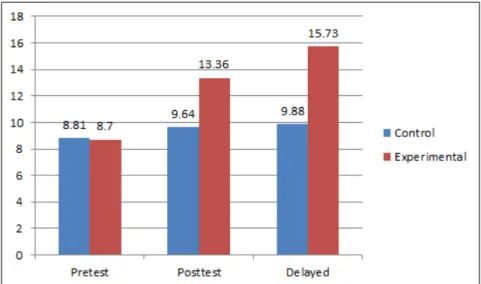
Figure 2 displays differences of means between the control group and the experimental group in the pretest, the posttest, and the delayed posttest. Almost no differences were found between groups in the pretest, but the differences between groups seem substantial in the delayed posttest as well as in the posttest.
Figure 2. Comparison of Means between Groups
Table 2 shows the comparison of means between the control group, the traditional
vocabulary instruction group, and the experimental group, the flipped learning group, in
both the pretest and the posttest. The mean of the control group in the pre-test was
8.81 and that of the experimental group was 8.70, which is not significantly different
from each other. After the treatment, however, the difference in the means of the
post-test is significantly different (9.64 for the control group and 13.36 for the
experimental group). The results indicates that the improvement of the experimental
group after the treatment was much bigger than that of the control group. In other words, the learners who received vocabulary instruction in the way of flipped learning accomplished the higher level in their vocabulary learning than the learners in the control group of the traditional classroom.
Table 2
Comparison between Control and Experimental Groups in Pre-Test and Post-Test
The present study also measured the delayed effects of flipped learning two weeks after the completion of the treatment. Table 2 shows the comparison between the control group and the experimental group in both the pretest and the delayed posttest.
As shown in Table 2, there is no statistically significant difference between the two groups in the pretest. However, the independent samples t-test in the delayed posttest showed a significant difference. The control group shows average of 9.88 in the delayed posttest, while the mean of the experimental group is 15.73, which is much higher than that of the control group. As shown in Table 3, the difference between the two groups in the delayed posttest is statistically significant (p=.004).
The results indicate that the effects of the flipped learning remained two weeks after the treatment had been completed.
Table 3
Comparison between Control and Experimental Groups in Pre-Test and Delayed Post-Test
4.2 Flipped Learning and the Learning of Receptive and Productive Vocabulary
The test items in the pre and post vocabulary tests consisted of two different types,
Test Group Mean SD
t p
Pre-Test Control 8.81 6.43
.006 .984
Experimental 8.70 5.25
Post-test Control 9.64 4.21
-2.877 .004
Experimental 13.36 4.64
Test Group Mean SD
t p
Pre-Test Control 8.81 6.43
.006 .985
Experimental 8.70 5.25
Delayed Post-Test
Control 9.88 6.87
- 2.775 .004
Experimental 15.73 4.26
receptive and productive. Table 4 shows comparison of the two groups’ learning between receptive vocabulary and productive vocabulary in both the pretest and the posttest. In the comparison of both the receptive and the productive vocabulary, the two groups were found to be homogeneous before the treatment. In other words, the participants of the two groups showed no statistically significant difference in the pretest of the receptive and the vocabulary. In the posttest right after the treatment, however, the learners in the flipped learning group showed more increase than the traditional group learners in the productive vocabulary test as well as the receptive vocabulary test (p=.001 in the receptive vocabulary test, and p=.025 in the productive vocabulary test). These results indicate that the learners who had the same vocabulary knowledge in the pretest achieved higher accomplishment in both the receptive and the productive vocabulary knowledge when they learned the vocabulary by using the flipped-learning than when they learned the vocabulary by the traditional lecture class.
Table 4
Comparison of Vocabulary Learning Between Receptive and Productive Items
5. Discussion and Conclusion
The present study was designed to examine the effects of flipped learning for short term and long term retention of English vocabulary. Specifically, this study focused on any differential effects of flipped learning on the two types of vocabulary, receptive and productive. The findings of the study can be summarized as follows:
(1) In the comparison between the control group and the experimental group in the posttest, only the experimental group showed statistically significant improvement in overall vocabulary learning.
Test Group Mean SD
t p
Receptive
Pre-test Traditional 5.35 1.02
.538 .560
Flipped 4.69 2.58
Post-test Traditional 5.56 1.93
-3.866 .001
Flipped 8.35 1.95
Productive
Pre-test Traditional 3.66 3.45
-.523 .623
Flipped 4.03 3.26
Post-test Traditional 3.97 3.32
-2.384 .025
Flipped 6.75 3.55
(2) In the comparison between the control group and the experimental group in the delayed posttest conducted two weeks after the treatment, the experimental group showed statistically significant improvement in overall vocabulary learning, while the control group did not.
(3) The significant effects of flipped learning were found regardless of the vocabulary type. That is, the significant improvement of the experimental group was found in the learning of both the receptive and the productive vocabulary.
The results mentioned above are regarded as confirming the effectiveness of flipped learning in Korean university students’ acquisition of English vocabulary, whether they are receptive or productive ones. The results is consistent with the findings of the previous research (Bergmann and Sams 2012, Winquist and Carlson 2014). Flipped learning is a new way of teaching or learning which can be substituted for the traditional way of English language learning.
The present study attempted to explore the effects of flipped learning on Korean university students’ acquisition of English vocabulary. As mentioned in the introduction, not many studies have tried to reveal the effects of flipped learning on the acquisition of vocabulary. Therefore, this study could be regarded as a starting point for future further research which will explore many aspects of English language teaching or learning, for example, grammatical structures.
Based on the findings of the present study, some suggestions for further research in the future can be presented. First, flipped learning should be refined with respect to many different points. That is, flipped learning can be realized in the classroom in many different forms, with many different types of activities or materials. It is almost impossible to define flipped learning with some specific teaching or learning activities, materials. Therefore, there should be much more research studies to find out appropriate types of flipped learning for many different aspects of language learning.
Also, the future research studies should focus on investigating which activities, online or offline, work better or worse for students learning English vocabulary or grammatical structures.
Second, the realization of flipped learning in the classroom is not a simple matter. It needs careful and deliberate planning and implementation. Also there are many different variables which affect the effectiveness of flipped learning in the classroom.
Therefore, future studies should be focused on more appropriate ways of conducting
flipped learning in the classroom level and on revealing the relationships between
variables which affect the effectiveness of flipped learning.
The present study reveals several limitations. First of all, this study lasted only 10 weeks, which might seem not enough to elicit the effects of flipped learning. With more in-depth plans and designs, the study could have revealed some differential effects of receptive or productive vocabulary. Second, the participants of the present study were all at an intermediate proficiency level. The participants’ proficiency in English might have affected the results of the study. Therefore, future studies should recruit participants from all the proficiency levels. Finally, this study only adopted vocabulary tests without any survey questionnaire which makes it possible to explore the learners’ change in their affective aspects regarding the flipped learning. With some other research instruments, the study might have been possible to gather more in-depth thoughts and descriptions about the flipped learning.
References
Bang, Youngjoo. 2017. The effect of flipped learning in an EFL classroom. Modern English Education 18(2), 87-107.
Bergmann, J., & Sams, A. 2012. Flip Your Classroom: Reach Every Student in Every Class Every Day. Eugene, OR: International Society for Technology in Education.
Bishop, J., and M. A. Verleger. 2013, June. The flipped classroom: A survey of the research. Paper presented at. 2013 ASEE Annual Conference, Atlanta, Georgia.
Retrieved on May 25, 2016, from the World Wide Web: https://peer.
asee.org/22585
Cho, Young Sang and Yoo-Jean Lee. 2016. Can flipped learning be applied to a test-based English classroom? Modern English Education 17(4), 181-200.
Coady, J. and T. Huckin. 1997. Second Language Vocabulary Acquisition. Cambridge:
Cambridge. University Press.
Davies, R. and R. West. 2013. Technology integration in school settings. In M.
Spector, D. Merrill, J. Elen, and M. J. Bishop, eds., Handbook of research on educational communications and technology, 4th ed. New York: Taylor & Francis Ltd.
Fulton, K. 2012. Upside down and inside out: Flip your classroom to improve student learning. Learning and Leading with Technology 39(8), 12-17.
Harvey, S. 2014. The flipped Latin classroom: A case study. Classical World 108(1), 117-127.
Hulstijn, J. H. 1993. When do foreign-language readers look up the meaning of
unfamiliar words? The influence. of task and learner variables. The Modern
Language Journal 77(2), 139-147.
Kim, Yenarae and Kyong-Hyon Pyo. 2017. A study on self-directed learning attitude and academic achievement in a flipped classroom. Studies in Linguistics 45, 423-455.
Nagy, W. E. and P. A. Herman. 1987. Breadth and depth of vocabulary knowledge:
Implications for acquisition. and instruction. In M. G. Mc-Keown & M. E. Curtis, eds., The Nature of Vocabulary Acquisition, 19-35. Hillsdale, NJ: Erlbaum.
Pyo, Kyong-Hyon. 2017. Variables influencing learner achievement and satisfaction in a flipped classroom. Studies in Linguistics 43, 345-373.
Pyo, Kyong-Hyon. 2018. Effects of flipped classroom on university students’ academic self-efficacy. Studies in Linguistics 49, 553-581.
Read, J. 2000. Assessing Vocabulary. Cambridge: Cambridge University Press.
Saragi, T., I. S. P. Nation and G. F. Meister. 1978. Vocabulary learning and reading.
System 6(2), 72-78.
Sokmen, A. J. 1997. Current trends in teaching second language. vocabulary. In N.
Schmitt and M. McCarthy, eds., Vocabulary: Description, Acquisition and Pedagogy, 237-257. Cambridge: Cambridge University Press.
Sternberg, R. J. 1987. Teaching critical thinking: Eight easy ways to fail before you begin. Phi Delta Kappa 68, 456-459.
Tucker, B. 2012. The flipped classroom. Education Next 12(1), 82-83.
Winquist, J. R. and K. A. Carlson. 2014. Flipped statistics class results: Better performance than lecture over one. year later. Journal of Statistics Education 22(3), 1-10.
Yang, Jungim. 2017. Effects of flipped learning on university students’ acquisition of collocation and attitude. New Korean Journal of English Language and Literature 59(1), 145-161.
Yim, Gana and Kyeong-Hee Rha. 2017. Effects of using flipped learning in the college setting on students’ English achievement and class satisfaction. Studies in Linguistics 44, 289-307.
Zappe, S., R. Leicht, J. Messner, T. Litzinger and H. W. Lee. 2009, June. Flipping the classroom to explore: Active learning in a large undergraduate course Paper presented at 2009 Annual Conference & Exposition, Austin, Texas. Retrieved on April 27, 2016, from the World Wide Web: https://peer.asee.org/4545
Examples in: English
Applicable Languages: English
Applicable Levels: Secondary, Tertiary
Kim, Woo Young
Professor, Dept. of English Hansei University
Hansei-ro 30, Gunpo-si, Gyeonggi-do 15852, Korea
Received: Nov. 18, 2018 Revised: Dec. 14, 2018 Accepted: Dec. 18, 2018