• 검색 결과가 없습니다.

A Study on the Self-Regulating Learning Ability of General English and Spanish Learners in the Flipped Learning Strategy

N/A
N/A
Protected

Academic year: 2021

Share "A Study on the Self-Regulating Learning Ability of General English and Spanish Learners in the Flipped Learning Strategy"

Copied!
8
0
0

로드 중.... (전체 텍스트 보기)

전체 글

(1)

A Study on the Self-Regulating Learning Ability of General English and Spanish Learners in the Flipped Learning Strategy

Myeong-Hee Shin

1*

, Pil Woon Kang

2

1

Professor, Talmage Liberal Arts College, Hannam University

2

Ph. D. Department of Spanish, Hankuk University of Foreign Studies

거꾸로 학습 전략에 있어서 교양영어와 교양스페인어 학습자의 자기조절 학습능력에 관한 연구

신명희1*, 강필운2

1한남대학교 탈메이지 교양교육대학 교수, 2한국외국어대학교 스페인어과 박사

Abstract The purpose of this study was to examine how flipped learning strategy affects learners' self-regulating ability in both general English and Spanish, based on the study hypothesis that self-regulating learning ability of general English learners will make a meaningful difference in comparison to that of traditional learning. The study was also focused on how flipped learning was related to learners' self-regulating ability. From September 10, 2018 to December 10, 2018, a total of 81 students in general English and Spanish were surveyed in which three sub areas of self-regulating learning (cognitive, motivational, and behavioral control) were considered, and which were divided into six sub-domains, a total of 65 items were composed. Although not very significant results were shown in the case of motivational control, both English and Spanish classes have statistically significant differences in cognitive and behavioral self-regulating learning abilities.

Key Words : Self-regulating learning, Flipped learning, Traditional learning, Cognitive control. Behavioral control, Motivation control

요 약 이 연구의 목적은 거꾸로 학습(Flipped Learning) 전략에 있어서 교양영어 학습자의 자기조절학습 능력이 전통 학습(Traditional Learning) 있어서의 자기조절학습 능력과 비교했을 때 유의미한 차이를 가져올 것이라는 연구 가설을 바 탕으로 본 연구에서는 교양영어와 교양스페인어에 있어서 거꾸로 학습 전략이 학습자의 자기조절능력에 어떠한 영향을 미치는지를 고찰해보았다. 2018년 9월 10일부터 2018년 12월10일까지 교양 영어와 교양스페인어 수강생 총 81명을 대상으 로 하였으며 사전 사후 자기조절 테스트를 통해서 1) 인지조절능력, 2) 동기조절능력, 3) 행동조절능력 세 개의 영역의 변화 를 고찰했고 3개의 영역은 6개 하위영역, 총 65개의 항목으로 구성된다. 연구결과, 자기조절학습능력에 있어서 동기 조절의 경우 유의미한 결과가 나타나지 않았지만, 영어와 스페인어 수업 모두 인지 및 행동조절 학습능력에 있어서 통계적으로 유의한 차이를 보였다.

주제어 : 거꾸로 학습전략, 전통학습, 자기조절능력, 인지조절능력, 동기조절능력, 행동조절능력

*Corresponding Author : Myeong-Hee Shin([email protected]) Received March 05, 2019

Accepted April 20, 2019

Revised April 01, 2019 Published April 28, 2019
(2)

1. Introduction

In a world full of knowledge and information, today's learners will not be able to predict the results of effective learning without their own active participation and control. Recently, self-regulating learning, which emphasizes that learners are masters of learning and where the active role of learners is important[1], has been an area of interest. If self-directing learning emphasizes the learner's leading free will, self-regulating learning emphasizes the learner's autonomous control.

In the tendency toward open education in the information age, the environmental design of self-regulating learning is drawing great attention, and it is necessary to learn and develop new knowledge and skills so that students can perform their own work based on the knowledge learned at university.

Self-regulated learning is seen as an essential ability to set meaningful learning goals and to strategically guide learners' own learning process in order to reach those goals [2]. The strategy used for self-regulating learning can be divided into three main areas [3]: First, the ability to control cognitive processes. Second is motivational control. Self-regulating learning can imply that it is inherently motivational, but it would be difficult to self-regulate learning without a motive that entails a goal. In relation to self-regulating learning, several scholars suggest variables in the aspects of motivation, such as "goal orientation" that see learning as a basic purpose-oriented activity, and "self-efficacy"[4], where learners believe can cope with a given learning situation and bring about successful academic achievement.

Third, behavioral control, which is a practical aspect of self-regulated learning, involves controlling learners’

behavior, managing time, and seeking help to effectively perform learning activities [5]. There are individual differences in these behaviors[6], and learners who are good at self-regulating learn effectively through various strategies.

Teachers should make use of diverse mediums in which learners can immerse themselves more fully in

the classroom, as well as encourage learning motivation so students achieve learning goals and create a learning environment in which they can participate actively in their own activities[7].

If so, what kind of learning environment should be created so that effective learning can be achieved? In the classroom environment of Korea, which is familiar with traditional teaching methods, the effectiveness of learning is not always evident[8] considering the amount of knowledge delivered, and yet the application of changing teaching methods is not very easy.

Recently, the attention of ‘Flipped learning’ has been increasing as learners are oriented towards the central classroom. Flipped learning reverses traditional teaching methods. The term “Flipped learning” was first introduced and used by two chemistry teachers at a school in Colorado, and since then this method has been utilized in a variety of subjects and assignments at various levels, from primary school to university[9].

Flipped learning is quite different from traditional

classroom where teacher lectures and learners'

assignment after the lectures. In pre-class, learners are

expected to watch the video lectures prepared by

professors in advance of the class, focusing on the core

curriculum knowledge and contents. In class, learners

discover key content, solve problems, and reconstruct

knowledge through learning activities such as

discussion and presentation [10]. If traditional classes

were focused on learning theory and basic contents, it

could be said that the purpose of flipped learning is to

devote a relatively large part of the theory application

and teacher's feedback or feedback among learners,

and the evaluation of learners' learning

performance[11]. In post class, students talk to their

team members about 1) what they learned and 2) what

they felt and 3) how to apply that learning to real life,

and the team leader organizes it and posts it on an

LMS (Learning Management System)[12]. Foreign

language classes are aimed at applying what they have

heard and learned through professors to actual

situations[13].

(3)

The reason why flipped learning is necessary in general foreign language learning is that the main goal of learning a foreign language is smooth communication. There are two main reasons why this study would compare Spanish learners rather than other foreign learners are as follows[14]. First, textbooks and training materials are not linked to direct

"talking" practice during speaking classes. Second, the teaching materials and teaching methods are not connected to practice speaking in person during speaking class. The flipped learning class model not only aims to practice "talking," but also to improve one's speaking ability regardless of the specialty of teaching materials[15].

The purpose of this study was to examine how flipped learning strategy affects learners' self-regulating ability in both general English and Spanish, based on the study hypothesis that self-regulating learning ability of general English learners will make a meaningful difference compared to traditional learning.

2. Materials and Method

2.1 Subjects

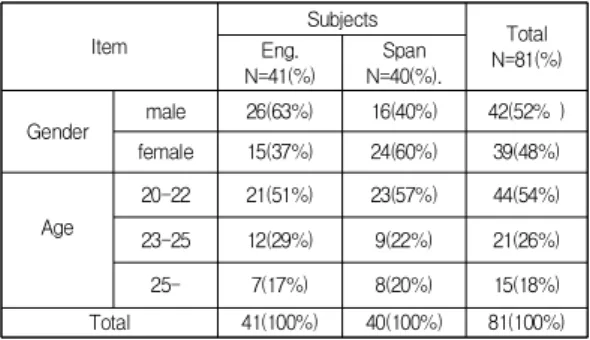
The subjects of this study were 81 learners, 41 learners who took a 2-hour elective English language learning course and 40 learners who took 2-hour elective Spanish language course. It was conducted for approximately four months, from September to December 2018.

Item

Subjects

Total N=81(%) Eng.

N=41(%)

Span N=40(%).

Gender male 26(63%) 16(40%) 42(52% )

female 15(37%) 24(60%) 39(48%)

Age

20-22 21(51%) 23(57%) 44(54%)

23-25 12(29%) 9(22%) 21(26%)

25- 7(17%) 8(20%) 15(18%)

Total 41(100%) 40(100%) 81(100%)

Table 1. General characteristics of subjects

Among the genders, 39(48%) for women and 42(52%) for men, there were more men than women and in Spanish class, women had higher distribution than those of English class. Looking at the distribution of age, learners between the ages of 20 and 22 are 21(51%) in English, far more than those between the ages of 23 and 25 (29%) and over 25 years of age (17%). In the case of Spanish class, learners between the ages of 20 and 22 are 23(57%) in English, far more than 9(22%) between the ages of 23 and 25 and 8(20%) over 25 years of age.

2.2 Process

The purpose of this study was to examine how a flipped learning strategy affects learners' self-regulating ability in both general English and Spanish. Among other foreign language courses in the Liberal Arts College, Spanish students whose class sizes, and ages are the most similar were chosen as study subjects.

The teaching design of this study is a

student-centered class using the Flipped learning

strategy. The main course consists of 1) pre-learning,

2) in-class, and 3) post-class classes[16]. At the

pre-class, video lectures will be taken to meet the

pre-learning objectives, which is a summary of the

contents of the lecture that is going on during class

time. Most of all, it is a step in which students should

participate, and the professor can give quizzes or

prepare presentations after pre-learning. Second,

during the main course, the first step is to link up

pre-learning, which starts by inducing learners to work

on quizzes or presentations in which the topics are

given to learners in advance. After a core lecture, a

class design is required to actively facilitate interaction

between teachers and learners, and between learners

themselves, through class activities such as discussion

and group presentations. In the post-class stage,

learners' peer-feedback and professor feedback are

presented and in groups they freely gather opinions on

what they learned, what they felt, and how to apply

(4)

what their new knowledge. This step allows learners to listen to other learners' opinions and reflect on the presentation or comments of the learners themselves or the group they belong to and is an important time for effective learning through modification.

2.3 Instrument

A self-regulating learning questionnaire [17] was used to measure the ability of self-regulating learning using the MSLQ (Motorized Strategies for Learning Questionnaire) scale developed by Pintrich and colleagues. The self-regulating theory model was also used as a component of cognitive control, motivation, and behavioral control. All Cronbach’s alpha levels were over .80, indicating the recommended criteria.

With the aim of the class being to perform basic learning so that the minimum basic communication of the end of the semester could be incorporated in the design of general English and Spanish classes, each class conducted the same Flipped learning strategy.

Variables Number of Items Cronbach's α

Cognitive 18 .892

Behavioral 22 .926

Motivational 25 .969

Table 2. Reliabilities

Items sub-domain(N) Item No.

Cognitive

Memory 1. 4. 6. 7. 11. 12.

15. 18. 19. 21. 22.

Understanding 2. 9. 16. 17. 20.

24. 25.

Motivational

Interest/motivation

28. 29. 31. 31. 32.

34. 35. 37. 39. 40.

41. 42. 43. 47.

Time/Energy inves. 30. 33. 36. 38. 45.

49. 50. 52. 54.

Behavioral

Time management

56. 57. 59. 62. 64.

67. 68. 70. 71. 72.

74. 84.

Learn persistency

60. 65. 66. 69. 75.

76. 77. 78. 79. 80.

81. 82. 83.

Table 3. The questions in the self-regulated learning

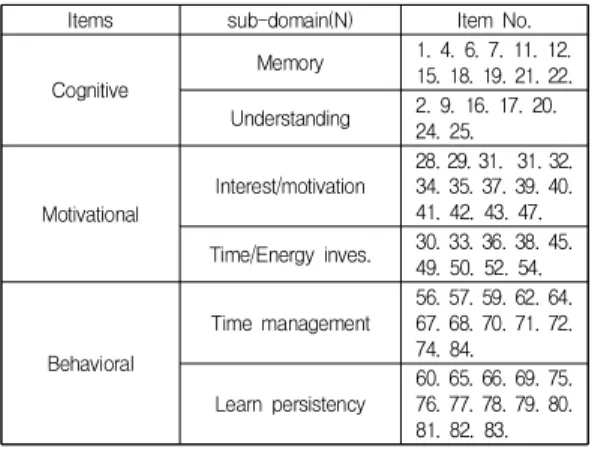
As shown in Table 3, the question classification of self-regulated learning was divided into six sub-domains in the three areas of cognition, motivational, and behavioral control, and a total of 65 items were composed.

2.4 Data Analysis

For the purpose of this study, the analysis on self-regulating learning ability and academic achievement of students in general English and Spanish was found through cross-analysis and t-testing

3. Results

In this study, the results on self-regulating learning of the students of general English and Spanish were shown as follows.

3.1 Cognitive control of self-regulating learning

In the item analysis for the self-regulating learning measurement, the cognitive control areas were divided into 1) self-regulated learning ability on memory of learning contents and 2) self-regulating learning ability on confirmation of understanding degree.

3.1.1 Self-regulating learning ability on memory of learning contents

Among the cognitive control areas, self-regulating learning on the memory of learning contents was the highest with 3.59 points, out of a total of 11 questions, question 11 about short-term memory (I try to remember as much as I can when I study).

Question 21 on content memorization (to memorize

as much as possible) was 3.37 points. Question 7 on the

summary question (when learning new content,

imagine and understand the situation associated with it

in mind) was 3.34 points, followed by question 6 (sound

memorization of notes or textbooks) on content

(5)

identification, which was the lowest with 2.27. Question 18 on content memorization (read and read textbooks, notes, etc.) shows 3.37 points for the English class and 2.95 points for the Spanish class. The English class is higher than the Spanish class and therefore a statistically significant difference (p<.05).

Item No. Course

English Spanish

p

1 summary 3.20±1.34 3.07±0.89 .50

4 give meaning 3.11±1.09 2.98±0.92 .57

6 memory 2.64±1.07 2.27±0.77 .07

7 sum-question 3.34±0.94 3.22±0.90 .60

11 short-memory 3.47±1.01 3.59±0.89 .60

12 give meaning 2.81±0.97 2.83±0.13 .92

15 give meaning 3.31±1.00 3.20±0.86 .67

18 memory 3.37±0.98 2.95±1.01 .05*

19 sum-question 3.35±1.03 3.15±0.92 .33

21 memory 3.37±1.04 3.22±0.93 .47

22 give meaning 3.37±0.96 3.10±0.86 .16

*p<.05, **p<.01

Table 4. Cognitive regulation: Self-regulated learning of learning contents

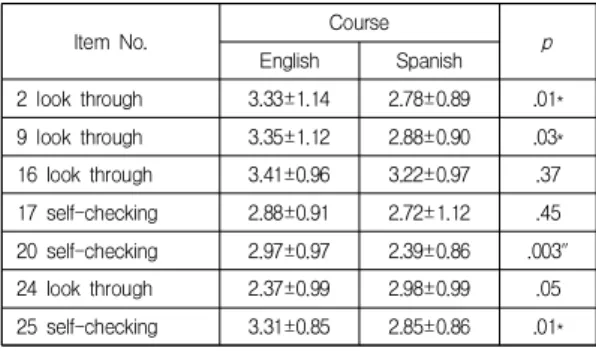
3.1.2 Self-regulating learning ability on confirmation of understanding degree Of the six questions on self-regulating learning on confirmation of understanding among cognitive control areas, question 16 (I start with ordering what to study from.) is the highest with 3.41 points. Question 24 (I decide in advance how much to study before I start to study.) and question 9 (I think in advance of how to study before I start to study.) are 3.37 and 3.35, respectively. Question 20 (I am concentrating on my studies, but I have to stop for a while to ask myself what the current content is.) on the self-check was the lowest, with a score of 2.97. Question 2 (I think in advance of what to study and how to study.) on looking through is 3.33 for English class, and 2.78 for Spanish class. Question 9 on looking through, resulted in 3.35 points for English class, and 2.88 points for Spanish class. There was a statistically significant difference between question 20 and question 25 (I check to see if I understand the content clearly while I am studying.) On the self-status check, the results were

2.97 and 3.31 for the English class, 2.39 and 2.85 for the Spanish class, respectively, and the English class was higher than the Spanish class (p<.05).

Item No. Course

English Spanish

p

2 look through 3.33±1.14 2.78±0.89 .01*

9 look through 3.35±1.12 2.88±0.90 .03*

16 look through 3.41±0.96 3.22±0.97 .37

17 self-checking 2.88±0.91 2.72±1.12 .45

20 self-checking 2.97±0.97 2.39±0.86 .003"

24 look through 2.37±0.99 2.98±0.99 .05

25 self-checking 3.31±0.85 2.85±0.86 .01*

*p<.05, **p<.01

Table 5. Cognitive regulation: Self-regulated learning of confirming understanding

3.2 Motivational control of self-regulating learning

In the motivational area of the questionnaire, measuring self-regulating learning, 1) self-regulating learning ability for satisfaction of interest and 2) self-regulating learning ability for time and energy investment were examined.

3.2.1 Self-regulating learning ability on satisfaction of interest

Of the total 13 questions, question 35 about self-effort (I will continue to study well in the future) was the highest with 3.83 points, and question 39 on interest and satisfaction (I feel proud when I know something new) was 3.75. Question 34 on interest and satisfaction (I focus on clear understanding of content) was 3.76 points, and Question 32 on values and beliefs (I can understand everything the professor teaches in class) was the lowest with 2.61.

Question 32 on values and beliefs showed a

statistically significant difference as the Spanish class

scored 3.06 points and the English class scored 2.61

points higher than the English class (p<.05).

(6)

Item No. Course English Spanish

p

28 study interest 3.51±3.98 3.48±0.94 .87

29 self-effort 2.98±0.86 2.94±0.96 .86

31 interest-satisf 3.17±1.32 2.27±0.77 .47 32 value-belief 2.61±0.78 3.06±1.13 .03*

34 interest-satisf 3.76±3.24 3.46±1.09 .54

35 self-effort 3.83±2.12 3.71±1.07 .61

37 value-belief 2.881±0.87 2.88±0.86 .82 39 interest-satisf 3.59±0.57 3.75±0.81 .37

40 value-belief 2.88±0.99 3.06±0.92 .37

41 interest-satisf 2.98±1.06 3.13±1.10 .47

42 self-effort 2.88±0.99 3.50±0.94 .16

43 interest-satisf 3.00±1.07 2.94±1.01 .79 47 interest-satisf 3.208±0.93 3.25±0.93 .78

*p<.05, **p<.01

Table 6. Motivation Regulation: Self-regulated learning of interest and satisfaction

3.2.2 Self-regulating learning ability on time and energy investment

Self-regulating learning on time and energy investment in the regulation of motivation is a total of nine questions. Question 49 on school role recognition (school life will play a significant role in my future) was the highest with 3.81 points.

Item No. Course

English Spanish

p

30 assign absorb 3.35±0.99 3.46±0.89 .56 33 assign absorb 3.67±0.94 3.41±0.89 .18

36 goal recog 3.19±1.23 3.39±1.09 .42

38 energy invest 3.54±0.98 3.56±1.02 .91 45 energy invest 3.00±0.97 2.73±0.86 .17

49 school role 3.81±1.07 3.68±0.94 .56

50 school value 4.25±1.05 3.68±1.04 .41 52 school value 3.40±1.05 3.37±1.10 .87

54 school role 3.60±1.03 3.78±0.94 .38

*p<.05, **p<.01

Table 7. Motivation Regulation: Self-regulated learning of investment of energy

Question 45 on energy investment (I know more about textbooks than other friends in my class) was the lowest with 3.00 points. However, the English class and the Spanish class showed no statistically significant differences (p<.05).

3.3 Behavioral control of self-regulating learning

The behavioral control area of self-regulating learning measurement was divided into 1) self-regulating learning ability with respect to time management and 2) self-regulating learning ability with respect to learning persistence.

3.3.1 Self-regulating learning ability on time management

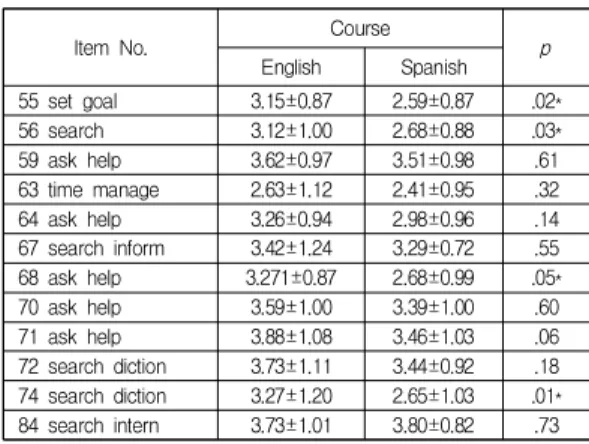
In the 11 questions of self-regulating learning on time management, Question 84 about searching the internet (if something is unknown while doing homework or studying) were the highest with 3.80 points. Question 63 of time management (I certainly set a study time to study effectively) was the lowest with 2.63. The general English class scored higher than the Spanish class, showing a statistically significant difference (p<.05).

Item No. Course

English Spanish

p

55 set goal 3.15±0.87 2.59±0.87 .02*

56 search 3.12±1.00 2.68±0.88 .03*

59 ask help 3.62±0.97 3.51±0.98 .61

63 time manage 2.63±1.12 2.41±0.95 .32

64 ask help 3.26±0.94 2.98±0.96 .14

67 search inform 3.42±1.24 3.29±0.72 .55

68 ask help 3.271±0.87 2.68±0.99 .05*

70 ask help 3.59±1.00 3.39±1.00 .60

71 ask help 3.88±1.08 3.46±1.03 .06

72 search diction 3.73±1.11 3.44±0.92 .18 74 search diction 3.27±1.20 2.65±1.03 .01*

84 search intern 3.73±1.01 3.80±0.82 .73

*p<.05, **p<.01

Table 8. Behavior Regulation: Self-regulated learning of time management

3.3.2 Self-regulating learning ability learning persistency

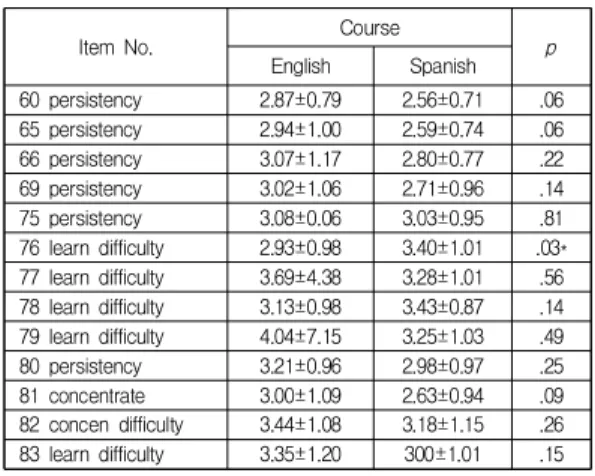
Question 79 on the difficulty of getting started (I

find it difficult to decide what to study from) was the

highest with 4.04. Question 60 on learning continuity (I

often practice my mind's study straight) was the

(7)

lowest with 2.87 points.

General English and Spanish classes showed statistically significant differences (p<.05).

Item No. Course

English Spanish

p

60 persistency 2.87±0.79 2.56±0.71 .06

65 persistency 2.94±1.00 2.59±0.74 .06

66 persistency 3.07±1.17 2.80±0.77 .22

69 persistency 3.02±1.06 2.71±0.96 .14

75 persistency 3.08±0.06 3.03±0.95 .81

76 learn difficulty 2.93±0.98 3.40±1.01 .03*

77 learn difficulty 3.69±4.38 3.28±1.01 .56 78 learn difficulty 3.13±0.98 3.43±0.87 .14 79 learn difficulty 4.04±7.15 3.25±1.03 .49

80 persistency 3.21±0.96 2.98±0.97 .25

81 concentrate 3.00±1.09 2.63±0.94 .09

82 concen difficulty 3.44±1.08 3.18±1.15 .26 83 learn difficulty 3.35±1.20 300±1.01 .15

*p<.05, **p<.01

Table 9. Behavior Regulation: Self-regulated learning of learning persistency ability

4. CONCLUSION AND DISCUSSION

The purpose of this study was to examine how flipped learning strategy affects learners' self-regulating ability in both general English and Spanish, based on the study hypothesis that the self-regulating learning ability of general English learners will make a meaningful difference in comparison to that of traditional learning.

Although not very significant results have been shown in case of motivational control, both English and Spanish classes have statistically significant differences in cognitive and behavioral self-regulating learning abilities. Time management and learning persistence, which should be maintained in the pre-class, is closely related to inducing learners' internal desire to participate in class activities, and determining whether they have a distinct goal orientation.

It is meaningful that students with well-defined goal orientation and intrinsic motivation for learning are well trained in self-regulating learning ability and are thus more able to learn on their own, which leads to

positive results in language learning. In the case of the liberal arts classes at university, we suggest ways to activate flipped learning to develop students’

self-regulating learning ability while considering the individual differences of learners. This would involve students being given the responsibility of controlling and choosing their own learning goals and processes and gradually moving away from passive learning attitudes, thereby stimulating interest or motivation in learning and increasing the opportunities for them to check their progress through self-examination.

Implementing such methods may help students and instructors achieve more effective learning outcomes.

As a follow-up study, we believe that more in-depth and positive results can be predicted if various teaching programs are developed that can specifically improve the cognitive, motivation, and behavioral control strategies of self-regulating learning and more detailed studies regarding curriculum development and instructional design are conducted with a focus on flipped learning.

In addition, continued follow-up research to provide students with many opportunities for application and research in various teaching methods to train their self-regulating learning skills are proposed.

However, it is somewhat difficult to generalize these results because the study was conducted with limited research subjects in one university.

REFERENCES

[1] B. J. Zimmerman. (1986). Becoming a self-regulated learner: Which are the key subprocess. Contemporary, Educational Psychology, 11, 307-313.

DOI: org/10.1080/00461520.1991.9653139

[2] D. W. Brooks. (1997). Web-teaching. Plenum Press.

New York & London.

[3] D. H. Schunk. (1995). Inherent details of self-regulated learning including student perceptions. Educational Psychologist, 26, 207-23.

[4] J. M. Magogwe & R. Oliver. (2007). The relationship

between language learning strategies, proficiency, age

and self-efficacy beliefs: A study of language learners in

(8)

Botswana. System, 35, 338-352.

[5] M. H. Yang. (2002). The Study on Conceptualization of Self-Regulated Learning using LISREL. The Society of Educational Psychology, 6(2), 259-290.

[6] J. Kuhl. (1985). Volitional mediators of cognition-behavior consistency: Self- regulatory processes and action versus state orientation. In: J. Kuhl and J. Beckmann, Editors, Action control: From cognition to behavior Springer- Verlag, Berlin, 101–128.

[7] H. J. Kim. (2011). The Structural Relationship among Teacher-student Relationships, Learning Motivation and Learning Flow. Sookmyung Women's University Ph.D. thesis.

[8] J. Bergmann, & A. Sam. (2012). Flip Your Classroom:

Research Every Student in Every Class Every Day.

Washington DC: International Society for Technology in Education.

[9] N. Hamdan, K. Mcknight & K. M. Arfstrom. (2018). The flipped learning model: A white paper based on the literature review titled a review of flipped learning.

Retrieved October 11, 2018 from

http://researchnetwork.pearson.com/wp-content/uploads/

WhitePaper_FlippedLearning.pdf.

[10] M. H. Shin. (2018). An Analysis of the Effects of On-Off line Convergence Learning Activities Based on Students’

Learning Styles. Journal of the Korea Convergence Society, 9(2), 86.

[11] J. Strayer. (2012). How learning in an inverted classroom influences cooperation, innovation and task orientation.

Learning Environments, 15(2), 2012.Society for education technology, 20(3), 103-135.

[12] M. K. Lee. (2014). Signification of Flipped classroom by sociology of classroom: Focusing on the experience of teachers, Korean Journal of Sociology of Education, 24(2), 181-207.

[13] J. B. Choi & C. Kang. (2016). A Study on Elements and Procedure of Instruction Consulting for Successful Flipped Learning, Journal of Engineering Education Research, 19(2).

[14] B. K. Kim. (2014). Development of Flipped Classroom Model for Teaching Profession Courses, The Journal of Educational Research, 12(2), 25-56.

[15] S. H. Yang. (2003). Materiales de multimedia para la enseñanza de la destreza de expresión oral del español, The Journal of Latin America, Seoul National University, 14, 134-151.

[16] J. B. Choi. (2013). The Development and Effectiveness of Smart Learning-Based Intrapersonal Intelligence

Enhancement Program using NLP Coaching Method, Chungbuk National University, Ph. D. Thesis.

[17] J. B. Choi & C. Kang. (2016). A Study on Elements and Procedure of Instruction Consulting for Successful Flipped Learning. Journal of Engineering Education Research, 19(2).

신 명 희(Myeong-Hee Shin) [정회원]

․2001년 : Vancouver College TESOL

․2008년 8월 : 한국외국어대학교 영어학과 문학박사

․2006년 ~ 2010년 : 건양대학교 조 교수

․2010년 9월 ~ 현재 : 한남대학교 부교수

․관심분야 : Cross cultural communication, Teaching methodology. Language learner's affective characteristics, etc.

․E-Mail : [email protected]

강 필 운(Pil-Woon Kang) [정회원]

․1995년 1월 : 스페인 마드리드 국 립 대학교 스페인 문학박사

․1989년 3월 ~ 현재 : 한국외국어 대학교 스페인어과 강사

․2000년 12월 ~ 2001년 11월 : 한국 외대 외국문학연구소 초빙 연구원.

․2000년 3월 ~ 현재 : 배재대학교 스페인어과 강사

․2016년 3월 ~ 현재 : 한남대학교 탈메이지교양교육대 학 강사

․스페인 황금세기 문학, 시학, 수사학,

․E-Mail : [email protected]

수치

Table  1.  General  characteristics  of  subjects
Table  3.  The  questions  in  the  self-regulated  learning
Table  4.  Cognitive  regulation:  Self-regulated  learning  of  learning  contents
Table  7.  Motivation  Regulation:  Self-regulated  learning  of  investment  of  energy
+2

참조

관련 문서

The purpose of this study is to analyze the interest and self-confidence of middle school students in learning English grammar and to examine the

The research for the participants shows that the animated English fairy tales did not contribute to the elementary learners' interest in English learning,

proficiency level, they enjoyed English flipped learning. Based on the study findings teaching implications in order to improve English flipped instruction for middle

This study examined the achievement, satisfaction and interest of an English grammar class based on flipped learning in order to find out the effect of

The purpose of this study was to examine Korean EFL middle school students and teachers' perceptions about learning and teaching English punctuation and

The purpose of this study is to investigate the effect of peer-mentoring on the achievement and learning attitudes of middle school students toward

The purpose of this study is to investigate the middle school students' motivation, self-confidence and attitude toward English learning in a team-teaching

The purpose of study are analyzing the effects of dance majors' self-management on dance performance ability, self-efficacy and concentration, In the future,