Article
The Impact of Flipped Learning on Cooperative and
Competitive Mindsets
Jung Eon Kwon1 ID and Hyung Rok Woo2,* ID
1 Department of Career and Education Consulting, Cyber Graduate School, Joongbu University, 305, Dongheon-ro, Deogyang-gu, Goyang-si, Gyeonggi-do 10279, Korea; [email protected]
2 Division of Interdisciplinary Industrial Studies, Hanyang University, 222 Wangsimni-ro, Seongdong-gu, Seoul 04763, Korea
* Correspondence: [email protected]; Tel.: +82-2-2220-2360
Received: 30 October 2017; Accepted: 26 December 2017; Published: 30 December 2017
Abstract: This study investigated the effect of flipped learning in business education, especially teaching corporate sustainability. Although the effect of flipped learning has been demonstrated in many education avenues, it is still rare in business education. To address this, we designed a flipped learning course for teaching corporate sustainability and implemented it in the autumn semester of 2016 at H University. The six classes of 157 university students were randomly assigned to treatment and control groups according to a pre-test–post-test control group design. The treatment groups were provided with the funnel experiment as pre-learning material based on flipped learning, but the control groups were instructed without it using the existing instructor-led ways. ANCOVA (analysis of covariance) was used to verify the difference between the pre- and post-test scores of the cooperative/competitive mindset to compare the two groups. The results revealed that the cooperative mindset scores in the treatment groups were improved more than those of the control groups. The competitive mindset scores in the treatment groups, on the other hand, were decreased more than those of the students in the control groups. These findings suggest that flipped learning methods may be a promising approach to enhance students’ awareness of sustainable management in business.
Keywords: business education; funnel experiment; corporate sustainability; cooperative mindset; competitive mindset; ANCOVA
1. Introduction
The instruction of business administration is by nature practical learning, as it focuses on understanding management principles which appropriately apply to real workplaces. The purpose of business education is to develop the capabilities and perspectives that will enable the learners to contribute to sustainable growth that is pursued by organizations [1,2]. As the turbulent world of workplaces call for a more holistic approach to business education, instructors have sought more effective methods beyond the previous, insipid teaching styles found in most textbooks [3].
Academic scholars and practitioners have sympathized with the necessities of effective business education, and have actively discussed the need for developing new methods for business education. Over the last 10 years, the introduction and application of examples of new business education methods have been presented. To overcome the limitations of instructor-led lectures, new education techniques have been introduced such as case studies (e.g., [4]), virtual lectures (e.g., [5,6]), e-learning (e.g., [7,8]), action learning (e.g., [9,10]), education using multimedia (e.g., [11–13]), and flipped learning (e.g., [14,15]).
Among these new techniques, flipped learning has been a successfully adopted technique. This technique involves the required instructional content being provided for students in advance
outside of the classroom, which requires the students to attempt to study it prior to in-class learning, and it meets the constructivist definition of learner-centered education [16]. Learning, from the constructivist perspective, is the process through which learners construct knowledge by themselves instead of receiving information passively [17]. In flipped learning, the emphasis is on learners actively participating in their own learning as the makers of meaning and knowledge through diverse interactions. In addition to increasing knowledge, flipped learning can positively change learners’ attitudes and thinking. As compared to other traditional learning, the differential effects of studying in a flipped learning setting were examined on self-efficacy beliefs, intrinsic motivation and learning performance [18]; creative thinking [19]; metacognition and critical thinking [20].
The present study introduced flipped learning into a business education course and sought to verify the effects and particularly took into account that there are difficulties and limitations in teaching the concept of sustainable business. While there are many varied interpretations of sustainability in business, sustainability generally addresses justice related to the economy, environment and society, beyond the classical competing interests [21]. Currently, due to the increasing uncertainty of modern business environments, the survival formulas of organizations are becoming more complicated. Accordingly, organizations are adjusting the directions and perspectives of corporate strategies to cope with the uncertainty appropriately and attempt to implement the principles of sustainability into their practices [22].
Under the mindset of sustainability, competitors are not merely a target to overcome, but rather are viewed as having the potential to be changed into a partner that shares the new values of cooperation and coexistence [23]. Furthermore, the new perspective of sustainability forced a reconsideration of business activities, only indiscriminately developing resources to pursue productivity and profitability without considering the potential external effects [24]. However, most business education does not reflect this change of the perspective. They employ the competitive perspective; engaging in instructor-led lectures cannot faithfully convey a sustainable point of view. The teachers instructing sustainability in business education are also being criticized, especially in that they preach merely declarative slogans [25], the “promotion of virtue and reproval of vice”.
In order to improve the effects of educational interventions on the learning of the concept of sustainable business, flipped learning using Nelson’s funnel experiment was employed and investigated in this study. This experiment was popularized after being introduced in Deming’s book [26], “Out of Crisis”, where he quoted Dr. Nelson, Director of Statistical Methods, Nashua Corporation. It has been used as a tool to demonstrate the means of over-control and tampering through marble dynamics [27,28]. It also can be interpreted as a lesson concerning unlimited competition or leadership [29]. By assigning the funnel experiment as homework prior to class, the present study aimed to verify the effectiveness of flipped learning in business education, that is, determine whether it is a helpful teaching method for students to recognize the problems that will be brought about by tampering and competition and to be aware of the importance of sustainability in business. Thus, the proposed flipped learning experiment was conducted to address the following research questions: (1) Is the effect of flipped learning also appropriate to business education as with chemistry,
engineering, algebra, nursing, and so on?
(2) What changes will students experience through the attainment of flipped learning for sustainability?
(3) Is Nelson’s funnel experiment effective as a pre-learning material for flipped learning?
The attempts and results of the present study can also provide implications for the developmental direction of sustainability education and the improvement of the business education process in universities.
2. Background 2.1. Flipped Learning
The existing instructor-centered or instructor-led classes presented as an education method suitable for industrial society are effective for mass communication of information, but are not suitable for leading creative knowledge and the socialization of knowledge required in the modern, information-oriented society [19,30]. Therefore, new educational approaches have been proposed to rectify the shortcomings of instructor-centered methods through the use of learner-centered methods, and flipped learning is a notable paradigm among these. It is a form of blended learning that inverts the order of lecture and assignment, often described more simply as ‘school work at home and home work at school’. In flipped learning, students study the instrumental content at home before the classroom, while the lecture time, which was traditionally conducted in the classroom, is now free to employ collaborative and hands-on activities such as discussions, exercise questions, and team projects in classrooms [31]. Recently, flipped learning has emerged as an effective teaching method that increases students’ interaction and deeper engagement [32].
Flipped learning has become popular since 2006, when it was used by Bergmann and Sams, chemistry instructors at Woodland Park High School in Colorado [33,34]. This high school, which is in a suburban area, had significant issues regarding absent students. These frequent absences led to difficulties for students to understand curriculum content and keep up with class progress. The two instructors took it upon themselves to develop the contents of the class in the form of video lectures and post them online. In other words, they used digital media to move the lectures to students’ homes and used interactive practices to move the traditional homework to inside their classroom. Through their pioneering efforts, their students were able to supplement their learning and their learning opportunities were enhanced. Flipped learning can also be termed “reversed instruction”, “blended learning”, “inverted classroom”, or “24/7 classroom” [34].
Bishop and Verleger [35] reviewed 24 studies and refined flipped learning, focusing on student-centered learning, which emphasizes “learning by doing”. The basis of flipped learning is active learning and builds over constructivism [36]. It embraces problem-based learning, peer-assisted learning, cooperative learning, and collaborative learning under active learning [37]. After all, flipped learning, which stresses the instructor’s role as a coach, is a pedagogical option to provide opportunities for interactive and dynamic engagement in the learning process [38]. Their role is not lecturing all the answers in the class, but observing, supporting students and providing feedback [20]. It is considered as an alternative to traditional teaching methods to improve the student’s motivation. The characteristics of flipped learning are identified with constructivist learning theory as better communication with the teacher during face-to-face class time; the participation of students in constructing their awareness; an emphasis on discovery, experimentation and verifying hypotheses; project work and enquiry-based learning methods; an understanding of the learning process through reflection and self-assessment [39–41].
Such flipped learning has attracted attention among educators and researchers as an innovative model which uses various technologies to mediate between teaching and learning [37,42]. Previous studies have found that over 80% of undergraduate students prefer the flipped classroom over existing traditional teaching methods [30,43]. An important advantage of flipped learning is to promote learners’ cooperation and innovation [44]. Furthermore, flipped learning was found to contribute positively to learners’ interaction and active learning [45], creative thinking [19], interests [46], learning performance [18,47], and behavioral and emotional engagement [48].
Despite the increase in literature regrading flipped learning, the research that applies flipped learning to business education has received relatively less attention [49]—especially in the disciplines related to corporate sustainability. Therefore, in this study, a flipped classroom was used to teach corporate sustainability in a business course using the funnel experiment and the results are examined according to the educational effects.
Sustainability 2018, 10, 79 4 of 15
2.2. The Funnel Experiment
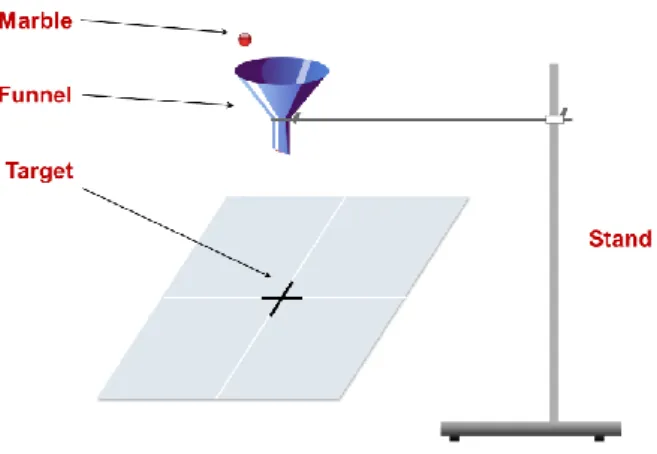
The present study used Nelson’s funnel experiment as the pre-class learning material for flipped learning. This experiment is a well-known subject often used to illustrate the adverse effects of tampering or over-adjustment [27,50–52]. To do this, it uses a funnel installed downward and at a fixed height above a table (see Figure1). A point on the center of the table is designated as the target, the “bull’s eye”. This experiment involves repeatedly dropping a marble into the funnel and tracking its landing positions. Before releasing each marble, participants can manipulate the funnel to get the marbles to come to rest on the target. However, it is not easy to achieve the objective and get the marble to come to a stop on the target. Even if the funnel is aimed precisely at the target, there are always to a certain extent uncontrollable variables—as is often seen when the marbles hit the table and bounce and roll off in random directions and various distances.
2.2. The Funnel Experiment
The present study used Nelson’s funnel experiment as the pre-class learning material for flipped learning. This experiment is a well-known subject often used to illustrate the adverse effects of tampering or over-adjustment [27,50–52]. To do this, it uses a funnel installed downward and at a fixed height above a table (see Figure 1). A point on the center of the table is designated as the target, the “bull’s eye”. This experiment involves repeatedly dropping a marble into the funnel and tracking its landing positions. Before releasing each marble, participants can manipulate the funnel to get the marbles to come to rest on the target. However, it is not easy to achieve the objective and get the marble to come to a stop on the target. Even if the funnel is aimed precisely at the target, there are always to a certain extent uncontrollable variables—as is often seen when the marbles hit the table and bounce and roll off in random directions and various distances.
Through the course of dropping the marbles, the following four adjustment rules are proposed for illustration purposes, which can be present in the common management behaviors of real workplaces [26,29,53].
Rule 1 (no adjustment to the funnel apparatus) is to leave the funnel as it is without moving it even if the position where the marble has stopped is not on the target. That is, after aiming the position of the funnel over the target at the beginning, the funnel cannot be moved again.
Rule 2 (move the funnel apparatus relative to the last position) is to adjust the funnel position each time in the opposite direction and by the same distance from the target. In other words, after each marble is dropped and come to a rest, the error is measured as the distance and direction of the marble away from the target. Then, in an effort to reduce the error, the funnel is moved from its current position in the opposite direction by the same distance as the previous error. Thus, this rule compensates for relative errors in the previous drop each time.
The same as for Rule 2, Rule 3 (move the funnel apparatus relative to the target) is also to adjust the funnel position each time in order to compensate for any error in the dropped marble compared to the target. However, this rule refers to the original target as a basis for the adjustment rather than the last position of the funnel. In other words, we must first move the funnel to the original target point each time, and then move it by the same distance in the opposite direction to the error.
Rule 4 (place the funnel apparatus over the last position) is to aim the funnel at the spot where the marble last came to rest. Under Rule 4, we center the funnel right over the resting position of the marble that was just dropped.
Figure 1. Nelson’s funnel experiment.
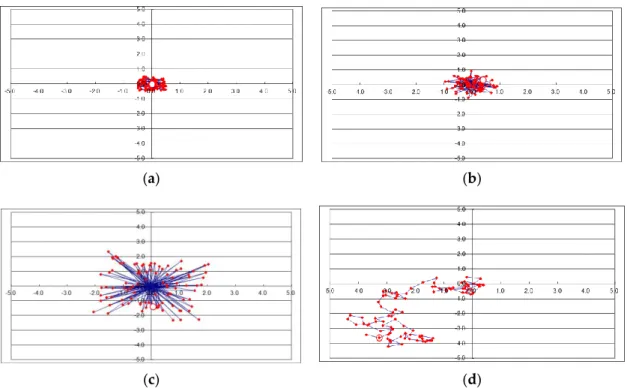
For this study, we developed a simulation tool using Microsoft Excel (Redmond, WA, USA) to make it easier for students to understand, which can be found in the supplementary material of this article. Using the material, Figure 2 shows the result after 70 consecutive drops from each of the four rules simultaneously for the same case. This result is not static because the tool randomly generates each case, and it reflects the inability to predict the direction and distance of a dropped marble bounced and rolled off the table. The scatter plot visualizing the results due to the rules will help to illustrate the differences between each rule.
Figure 1.Nelson’s funnel experiment.
Through the course of dropping the marbles, the following four adjustment rules are proposed for illustration purposes, which can be present in the common management behaviors of real workplaces [26,29,53].
Rule 1 (no adjustment to the funnel apparatus) is to leave the funnel as it is without moving it even if the position where the marble has stopped is not on the target. That is, after aiming the position of the funnel over the target at the beginning, the funnel cannot be moved again.
Rule 2 (move the funnel apparatus relative to the last position) is to adjust the funnel position each time in the opposite direction and by the same distance from the target. In other words, after each marble is dropped and come to a rest, the error is measured as the distance and direction of the marble away from the target. Then, in an effort to reduce the error, the funnel is moved from its current position in the opposite direction by the same distance as the previous error. Thus, this rule compensates for relative errors in the previous drop each time.
The same as for Rule 2, Rule 3 (move the funnel apparatus relative to the target) is also to adjust the funnel position each time in order to compensate for any error in the dropped marble compared to the target. However, this rule refers to the original target as a basis for the adjustment rather than the last position of the funnel. In other words, we must first move the funnel to the original target point each time, and then move it by the same distance in the opposite direction to the error.
Rule 4 (place the funnel apparatus over the last position) is to aim the funnel at the spot where the marble last came to rest. Under Rule 4, we center the funnel right over the resting position of the marble that was just dropped.
For this study, we developed a simulation tool using Microsoft Excel (Redmond, WA, USA) to make it easier for students to understand, which can be found in the supplementary material of this article. Using the material, Figure2shows the result after 70 consecutive drops from each of the four rules simultaneously for the same case. This result is not static because the tool randomly
Sustainability 2018, 10, 79 5 of 15
generates each case, and it reflects the inability to predict the direction and distance of a dropped marble bounced and rolled off the table. The scatter plot visualizing the results due to the rules will help to illustrate the differences between each rule.
Since most people want to make an effort to improve the error of the marble position in relation to the target, they tend to not evaluate Rule 1 as a good strategy. However, as shown in Figure 2, the results from the simulations are more disappointing in the case of Rules 2, 3, and 4 than Rule 1. Rule 1 is to not take any action even if an error occurs because there is no knowledge about the error and the error is not controllable. It is meaningful in that it accepts the error at the present level, acknowledges the cause of the error, and continuously adheres to or pursues the original purpose.
(a) (b)
(c) (d)
Figure 2. Results of the four rules. (a); (b) Move the funnel apparatus relative to the last position; (c)
Move the funnel apparatus relative to the target; (d) Place the funnel apparatus over the last position.
However, most experimental participants consider Rules 2, 3, and 4 to be more worthwhile with a view to reducing the uncontrollable errors due to the marble’s bouncing on the table. Deming [26] calls the actions taken to improve errors despite no knowledge of the cause of the errors as “tampering”. To review the three rules one by one in terms of the real world, Rule 2 is similar to shooting. People tend to check the results of shooting that are away from the target and correct their targeting while shooting. They offset their targeting by the errors of the position of bullet holes in relation to the target and expect that they would hit the target in new attempt. It can be likened to leaders in organizations, who respond recklessly to every situation or immediately intervene even in simple mistakes.
Rule 3 creates the shape like a bowtie as the funnel position is adjusted in the opposite direction and distance from the original target. It can be compared to the competition between rival nations to develop nuclear weapons who are immediately counteracting the previous acts of the opponent. They only tend to intensify their competition while checking the nuclear arsenal of their opponent. Rule 3 can be found in the infinite price competition in business, the competitive development of natural resources, and competitively rising trade barriers.
Rule 4 is similar to the telephone game, in which one person whispers a message to another and the next person delivers the message to another consecutively. It can be seen that when the message has reached the final person, the message has been distorted to the extent that one cannot accurately guess the original message. The adverse effects of a train-the-trainer program without employing regular standards corresponds to the foregoing. In cases where new workers or unskilled workers of an enterprise are educated and they educate their junior employees as instructors, if there is no principle or standard, the original intent of the education will gradually be distorted. Such is the case when competing countries or enterprises benchmark success cases indiscriminately without
Figure 2.Results of the four rules. (a) No adjustment to the funnel apparatus; (b) Move the funnel apparatus relative to the last position; (c) Move the funnel apparatus relative to the target; (d) Place the funnel apparatus over the last position.
Since most people want to make an effort to improve the error of the marble position in relation to the target, they tend to not evaluate Rule 1 as a good strategy. However, as shown in Figure2, the results from the simulations are more disappointing in the case of Rules 2, 3, and 4 than Rule 1. Rule 1 is to not take any action even if an error occurs because there is no knowledge about the error and the error is not controllable. It is meaningful in that it accepts the error at the present level, acknowledges the cause of the error, and continuously adheres to or pursues the original purpose.
However, most experimental participants consider Rules 2, 3, and 4 to be more worthwhile with a view to reducing the uncontrollable errors due to the marble’s bouncing on the table. Deming [26] calls the actions taken to improve errors despite no knowledge of the cause of the errors as “tampering”. To review the three rules one by one in terms of the real world, Rule 2 is similar to shooting. People tend to check the results of shooting that are away from the target and correct their targeting while shooting. They offset their targeting by the errors of the position of bullet holes in relation to the target and expect that they would hit the target in new attempt. It can be likened to leaders in organizations, who respond recklessly to every situation or immediately intervene even in simple mistakes.
Rule 3 creates the shape like a bowtie as the funnel position is adjusted in the opposite direction and distance from the original target. It can be compared to the competition between rival nations to develop nuclear weapons who are immediately counteracting the previous acts of the opponent. They only tend to intensify their competition while checking the nuclear arsenal of their opponent. Rule 3 can be found in the infinite price competition in business, the competitive development of natural resources, and competitively rising trade barriers.
Rule 4 is similar to the telephone game, in which one person whispers a message to another and the next person delivers the message to another consecutively. It can be seen that when the message has reached the final person, the message has been distorted to the extent that one cannot accurately
guess the original message. The adverse effects of a train-the-trainer program without employing regular standards corresponds to the foregoing. In cases where new workers or unskilled workers of an enterprise are educated and they educate their junior employees as instructors, if there is no principle or standard, the original intent of the education will gradually be distorted. Such is the case when competing countries or enterprises benchmark success cases indiscriminately without principles; they achieve results similar to Rule 4. Also worth mentioning, a common point between Rule 3 and Rule 4 is to forget the original target and to solely depend on the previous result.
2.3. Corporate Sustainability Education
Organizations are the fundamental cell of the social world in which we live [54,55]. Thus, their activities affect the economic, environmental and social dimensions of their context [56]. However, as business has been considered a major cause of social, environmental and economic problems since the 1990s, reflections have emerged on the traditional business model for investors focused on maximum short-term profits and the need for a more ethical and humane approach to business [57–59].
These phenomena are widely acknowledged today in words such as corporate citizenship, business ethics, corporate social responsibility, sustainable business, and corporate sustainability. Although the diverse concepts express their unique meanings, they commonly emphasize an interrelation between the competitive advantage of company and social influence, as well as moral obligations for the environment, economy and society [55,57,60,61].
Corporate sustainability is defined as “meeting the needs of a firm’s direct and indirect stakeholders without compromising its ability to meet the needs of future stakeholders as well” [62,63]. The principal stakeholders involve shareholders, employees, clients, suppliers, pressure groups, communities, and so forth. Companies have taken environmental and social issues into consideration in an interdisciplinary way. Implementing corporate sustainability in an organization always entails seeking a renewal of strategic management [63].
Traditional strategic management has a tendency to adhere to competitive perspectives that growth and survival only come from outperforming and beating competitors. From now on, competitive perspectives are not enough to embrace corporate sustainability. Corporate sustainability demands to be free from the competitive view that the aim is to fight against rivals for market share within a given industry. Coopetition, a compound term of cooperation and competition, even appears in many contemporary industries [23,64,65]. The revolutionary mindset of cooperative competition starts with the recognition of sustainability-based strategies that most of one’s own success can depend on the success of others [65,66].
Business education seems still immature for teaching these trends to improve socio-environmental performance beyond economic performance, such as the paradoxical coopetition promoting cooperation between the competing firms [21]. Schools are still used to teaching business as a “zero-sum” or “winner takes all” game and lack experience in considering it from the wider view of corporate sustainability. Therefore, it is indispensable that new teaching methodologies are developed to alleviate these issues and to promote the understanding of sustainability [24,67].
In this study, a flipped learning experiment was conducted to explore the alternative methodologies. To evaluate its effectiveness in sustainability education, the learning outcome was measured by students’ shifting cooperativeness and competitiveness mindsets. The learning outcomes associated with sustainability education have been focused on knowledge regarding sustainability as well as behavior towards sustainability and emphasized the affective attributes to connect both of them [24,68,69]. Researchers commonly categorize the types of attribute needed to achieve success in a social dilemma context as cooperativeness and competitiveness [70,71]. The two concepts are salient by definition, “whereas cooperative and prosocial people tend to maximize joint outcomes and to foster equality between the self and the other; Competitive and proself people tend to maximize the relative advantage over the other’s outcome” [71]. As both the cooperative and competitive mindset
are composed of three sub-dimensions termed beliefs, behavioral tendencies, and feelings, they are reckoned to be robust learning outcomes.
3. Flipped Learning Design and Data Collection
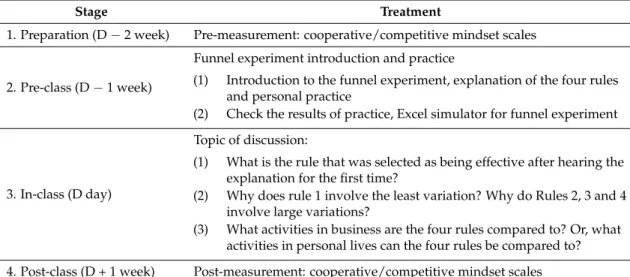
The aforementioned rules and implied understandings in the funnel experiment were applied to the design of flipped learning. The class was designed with the expectation that the students can effectively recognize the meaning and importance of corporate sustainability (see Table1). We took notice of Rules 3 and 4 and specifically anticipated that the students would detect the fact that the rules neglect the original mission or purpose and thus result in negative outcomes.
Table 1.Flipped learning flow chart.
Stage Treatment
1. Preparation (D − 2 week) Pre-measurement: cooperative/competitive mindset scales
2. Pre-class (D − 1 week)
Funnel experiment introduction and practice
(1) Introduction to the funnel experiment, explanation of the four rules and personal practice
(2) Check the results of practice, Excel simulator for funnel experiment
3. In-class (D day)
Topic of discussion:
(1) What is the rule that was selected as being effective after hearing the explanation for the first time?
(2) Why does rule 1 involve the least variation? Why do Rules 2, 3 and 4 involve large variations?
(3) What activities in business are the four rules compared to? Or, what activities in personal lives can the four rules be compared to? 4. Post-class (D + 1 week) Post-measurement: cooperative/competitive mindset scales
The lectures for the flipped learning were given to natural science and engineering students of H University that were taking compulsory undergraduate courses related to theories of business administration. The course was primarily taken by undergraduate students in their third and fourth year of study, and was used for a total of six classes. A pre-test–post-test control group design was used in order to measure the changes resulting from the experimental treatments [72]. This experimental study was conducted over three weeks during the 2016 autumn semester. The average number of students per class was 26.17, and the total number was 157. The course was composed of 16 sessions in total. Two of these sessions dealt with sustainability for organizations, for which the flipped learning was applied in this research. The classes were randomly divided into two groups to test the objective causal relationships of the learning effect. Three classes were operated as a treatment group, which received the flipped learning methods using the funnel experiments, and three other classes were used as control groups receiving instructor-centered methods.
In the preparation stage, the cooperative/competitive mindset of students was measured using 23 questions developed by Xie, et al. [73] and validated by Lu, et al. [71]. All of the students in the treatment group as well as the control group were blinded from the purpose of study by explaining it simply as a questionnaire for the thesis of a student in a doctorate course of H University. The cooperative/competitive mindset scales consist of 13 items for cooperative tendencies and 10 items for competitive tendencies. All items were assessed using a six-point scale. The six-point scale is known to have advantages for improving reliability and discrimination [74].
The funnel experiment was only given to the treatment group at the pre-class stage as homework. The students from the treatment group were provided with a simple explanation regarding only the funnel manipulation methods under the four rules and were instructed to practice by themselves. To help the students practice, the MS-Excel simulator for the funnel experiment was provided as it was in other research (e.g., [52,75]). Through this simulator, the students can accurately see the four rules
of the funnel experiment and estimate the experimental results independently. However, the effects of each rule and the meanings applicable to business were not explicitly explained.
During the in-class stage, the students from the control group were taught sustainability through an instructor-centered method, whereas the students from the treatment group discussed the business implications of the experiment having already completed it as the homework a week ago. After the students of the treatment group were divided into five or six teams by chance and came up with some topics, as shown in Table1, the results of their discussions were combined and presented by each team. At the end of the lecture, the instructor introduced the meaning of the term “tampering” as claimed by Deming. The instructor explained the necessity of not losing the original, absolutely pure purpose and to avoid excessive competition and the value with regard to Rules 3 and 4 in particular. Concepts such as sustainability and competition were clarified in linkage with the results of the discussion to complete the lecture.
In the post-class stage, the same surveys from the preparation stage were again given to the treatment group and control group. The purpose of these repeated measurements of a pre-test–post-test control group design is to compare whether the flipped learning instruction had an effect on the attitudes of the students before and after the experimental intervention [72,76].
4. Analysis and Results
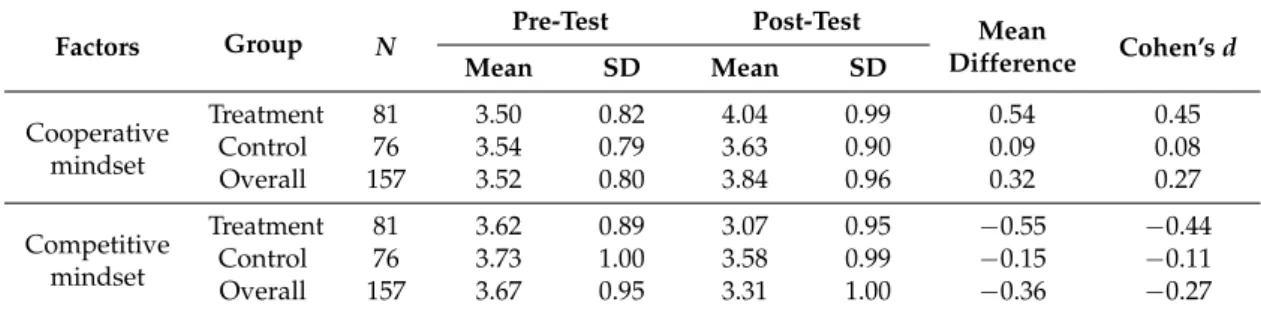
Of the 157 study participants, 108 (68.8%) were male students. The Cronbach’s reliability coefficients for the cooperative/competitive mindset scales were 0.87–0.93 in the treatment group and 0.86–0.94 in the control group. Since the results exceeded the general standard value of 0.80, the internal consistency of measures was judged to be acceptable [77,78]. Table2shows descriptive statistics including the mean, standard deviation, and mean difference in cooperative/competitive mindset between the pre-test and post-test.
Table 2.Comparison of cooperative/competitive mindset between treatment and control groups.
Factors Group N Pre-Test Post-Test Mean
Difference Cohen’s d Mean SD Mean SD Cooperative mindset Treatment 81 3.50 0.82 4.04 0.99 0.54 0.45 Control 76 3.54 0.79 3.63 0.90 0.09 0.08 Overall 157 3.52 0.80 3.84 0.96 0.32 0.27 Competitive mindset Treatment 81 3.62 0.89 3.07 0.95 −0.55 −0.44 Control 76 3.73 1.00 3.58 0.99 −0.15 −0.11 Overall 157 3.67 0.95 3.31 1.00 −0.36 −0.27
First, the following tests were conducted to verify the homogeneity of the treatment group and the control group. The mean difference in the pre-test score of the cooperative mindset (treatment group mean = 3.50, control group mean = 3.54) was not significant (t =−0.311, p > 0.05). The mean difference of the pre-test score of competitive mindset (treatment group mean = 3.62, control group mean = 3.73) was not significant (t =−0.713, p > 0.05). In addition, Levene’s tests of the homogeneity of variances were also nonsignificant for all the dependent variables: F(1,155) = 0.21, p > 0.05 in the cooperative mindset; F(1,155) = 1.29, p > 0.05 in the competitive mindset. This result implies that the sampling of the treatment or control group was not extracted differently in terms of the cooperative/competitive mindset.
Based on the results of the comparison between the results of the pre-tests and post-tests of the cooperative/competitive mindset, the effect of the flipped learning design used in the present study can be roughly understood. In the cooperative mindset, with regard to mean changes between before and after the classes, the treatment group showed an increase of 0.54 (pre-test mean = 3.50, post-test mean = 4.04; Cohen’s d = 0.45). However, the control group showed an increase of only 0.09 (pre-test mean = 3.54, post-test mean = 3.63; Cohen’s d = 0.08). In the competitive mindset, the treatment
group showed a decrease of 0.55 (pre-test mean = 3.62, post-test mean = 3.07; Cohen’s d =−0.44) and the control group was found to have a decrease of 0.15 (pre-test mean = 3.73, post-test mean = 3.58; Cohen’s d =−0.11). According to the guideline initially suggested by Cohen [79], such as small (d = 0.2), medium (d = 0.5) and large (d = 0.8), the mean differences in the treatment group between the pre-test and post-test regarding the cooperative/competitive mindset scores are near the ‘medium’ effect size [80]. Therefore, it can be estimated that the flipped learning design in the present study had the effect of increasing the cooperative mindset of the students while mitigating the competitive mindset.
To closely examine the statistical significance of the changes as such, an ANCOVA (analysis of covariance) was performed using the post-test scores as the dependent variable after setting the pre-test score as a covariate. Controlling the pre-test score as the covariate is known to increase statistical power by reducing the unexplained variance in the post-test score [76]. The mixed ANOVA (analysis of variance) were performed to confirm the basic two assumptions of the ANCOVA—the homogeneity of regression slopes and the homogeneity of variances of residual post-test scores. The interaction effects between time (pre-test and post-test) and group (treatment vs. control) were not significant: F(1,153) = 0.04, p > 0.05 in the cooperative mindset; F(1,153) = 0.03, p > 0.05 in the competitive mindset. Also, all the dependent variables were found to be not significant in Levene’s tests of the equality of error variances: F(1,155) = 0.58, p > 0.05 in the cooperative mindset; F(1,155) = 0.01, and p > 0.05 in the competitive mindset. These results suggest that our data reasonably met the two assumptions.
Regarding the cooperative mindset, as depicted in Table 3, the results showed significant differences in the pre-test and post-test between the treatment group and the control group (F(1,154) = 7.60, p < 0.01, η2 = 0.05). The practically significant effect size for an η2 value was recommended to be 0.04 for social science research area, with 0.25 considered a moderate effect [81]. The effect size of 0.05 on the cooperative mindset is at a practically significant level, which means that the cooperative mindset of the treatment group was improved compared with the control group by the flipped learning designed in the present study.
Table 3.ANCOVA for between-subject effects on cooperative mindset.
Source SS df MS F p-Value Partial η2
Model 8.38 2 4.19 4.72 0.01 0.06 Intercept 86.81 1 86.81 97.88 0.00 0.39 Pre-test 1.80 1 1.80 2.03 0.16 0.01 Group 6.74 1 6.74 7.60 0.01 0.05 Error 136.58 154 0.89 Total 2465.08 157
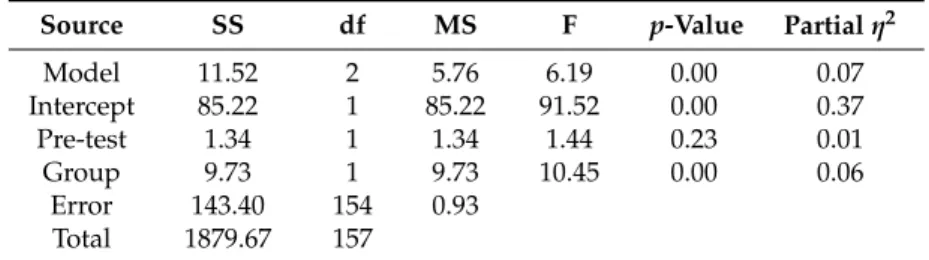
As for the competitive mindset, as depicted in Table4, the results indicated significant differences in adjusted post-test means between the treatment group and the control group, and these are significant (F(1,154) = 10.45, p < 0.01, η2= 0.06). Further, the effect size of 0.06 on the competitive mindset were at a practically significant level. This means that the flipped learning designed in the present study was significantly effective in reducing the competitive mindset as compared with the control group.
Table 4.ANCOVA for between-subject effects on competitive mindset.
Source SS df MS F p-Value Partial η2
Model 11.52 2 5.76 6.19 0.00 0.07 Intercept 85.22 1 85.22 91.52 0.00 0.37 Pre-test 1.34 1 1.34 1.44 0.23 0.01 Group 9.73 1 9.73 10.45 0.00 0.06 Error 143.40 154 0.93 Total 1879.67 157
In addition to examining the quantitative data, all students in the treatment groups participated in the semi-structured discussion with three questions, as shown in Table1. The students could present the lessons and their thoughts regarding what they had learned through the funnel experiment at the team discussion. Through the discussion contents, we found that they had recognized, in an entertaining manner, the limits of competition as well as the importance of sustainability through the experiment. Here are some examples from the discussions as stated by students.
“In rule 1, I was able to identify the importance of the real purpose . . . the mission in business. The ‘WHY’ should be kept unchanged compared to ‘HOW’ or ‘WHAT.’ In rule 3 and 4, it needs to be a higher concept, such as creating a new social value; not just winning in competition.” “This (experiment) was very fun. Similar to this experiment, too much resource development
can result in a ‘Butterfly Effect.’ Especially in natural development, we should be careful about unconditionally following or competing against rival countries or companies.”
“I learned the usefulness of benchmarking last semester. Benchmarking seems to be effective from a reasonable point of view. However, it is interesting that unconditionally following an advanced company is not always good benchmarking—at least not according to Rule 4.”
“Very impressive. I was able to see how terrible the consequences of unconditionally competing against a competitor are in Rule 3. The way to prevent bleeding competition is to keep your own principles.”
“This experiment showed us not to be glad now, but sad now. I saw the failure of ‘management by exception.’ Responding to all the deviations, without focusing on the high impact deviations, turned out even worse ... The unconditional diligence without exception was poisonous.”
5. Discussion
Although “flipped” is a recent buzzword in the education world [20], studies which have applied flipped learning to business education have been scarce. In this study, we examined the effectiveness of a flipped learning method supported by the funnel experiment in enhancing students’ understanding of the necessity of sustainability in business. The educational effect was measured as changes in the cooperative/competitive mindsets in the results from before and after the class, between the control groups taught with instructor-centered methods and the treatment groups that received the flipped-class intervention. The results from the present study showed that the cooperative mindset scores in the treatment group were more improved than those of the students in the control group. The competitive mindset scores in the treatment group, on the other hand, decreased more than those of the students in the control group. In the post-class discussions, the students also generated flexible ideas that had not previously been drawn from the studies involving the funnel experiment. Therefore, flipped learning can be regarded as a useful approach to change university students’ cooperative/competitive mindset related to sustainability in business.
In terms of engagement, our flipped learning classes received the best impression from students. We understand in two ways that a key driver of these mindset changes could be students’ engagement by the “fun” component. First, the funnel experiment employed as pre-learning material in this study can directly construct the gaming environment at home. This is clearly different from most flipped learning using short video clips of the course contents. In that cases, the contents of a lecture just moved from the classroom to a video clip, so our gamified simulator developed using Microsoft Excel can be more fun for students. It has been said that the participants grasped the exact meaning of the funnel experiment in a fun manner, by comparing the results of the simulation with those of the students’ own practice. It is well known that fun is a key antecedent of effective informal learning and plays a major role in engaging students in the learning process [82]. Accordingly, our pre-learning material providing fun for students could have educational advantages, such as intrinsic motivation and experiential learning [83].
Second, the component “peer learning” during in-class discussion could promote students’ creativity or critical thinking. As the implied meanings of the funnel experiment applicable to business were not explicitly explained before the in-class stage (see Table1), the students were able to exchange their free-spirited opinions during the in-class discussion. We suppose that the ambiguity of a question like, “What are the relations between this funnel experiment and business administration?” builds up a comfortable and open-minded atmosphere for discussion. In such an atmosphere, students are asked to discuss concepts with one another. This peer learning could promote conceptual learning effectively [19] and stimulate students’ creative thinking [84]. Based on the high student engagement, the teacher’s pedagogical instruction regarding corporate sustainability, competition, coopetition, etc., would have been fruitful.
The findings of this study contribute to business administration education from two perspectives. First, flipped learning can be seen as effective in business education, especially the education of corporate sustainability. The pedagogical effects confirmed in teaching corporate sustainability have practical implications, because there was a difficulty in relying on textbooks and instructor-led methods. Previous studies have indicated that flipped learning positively affected participating learners in terms of attitudes [44,85]. Flipped learning will be helpful in overcoming the disadvantages of the existing business education when its advantages are considered. Second, a hands-on simulator can play a sufficient role as the pre-learning material in flipped learning. Although most flipped learning has used online video content as pre-learning material, a simulation tool developed using MS-Excel to implement the funnel experiment was adopted in this study, which helped students to actively participate in classes with curiosity and interest because fun could promote the effectiveness of education [82]. It can be seen that excellent pre-learning materials such as funnel experiments should be continuously studied and developed to be applied more systematically to flipped learning.
Based on the limitations of the present study, the following suggestions are considered necessary for future studies. First, the present study was conducted with natural science and engineering students at a university for a total of six classes. To generalize the effects of flipped learning, future studies should be conducted in diverse academic subject areas. In particular, flipped learning is worthwhile for application with employees in organizations. Second, the effect of flipped learning focused on cooperative/competitive mindsets in this study in order to measure changes related to sustainability. It is fruitful to diversify measures such as academic achievement, credit and satisfaction in the classroom. Third, potential biases such as gender, interest, preference and so on can distort the results. Although we use randomization to control the bias through assigning and selecting participants by chance, a more rigorous research design is required to detect the pure effect of flipped learning with consideration of the characteristics of participants. Finally, the present study was conducted for just three weeks. Although we rigorously applied the pre-test–post-test control group design, future studies are needed to verify the concrete effects over long periods of time, such as changes in actual behavior for sustainability.
Supplementary Materials: The simulator for the funnel experiment, developed using MS-Excel, is available online atwww.mdpi.com/2071-1050/10/1/79/s1.
Author Contributions:Jung Eon Kwon proposed the research topic and wrote the manuscript. Hyung Rok Woo conceived the experiments and analyzed the data. All authors contributed equally to the development, implementation, and discussion for the present paper.
Conflicts of Interest:The authors declare no conflict of interest.
References
1. Anderson, L.; Mason, K.; Hibbert, P.; Rivers, C. Management education in turbulent times. J. Manag. Educ.
2017, 41, 303–306. [CrossRef]
2. Painter-morland, M. Philosophical assumptions undermining responsible management education. J. Manag. Dev. 2015, 34, 61–75. [CrossRef]
3. Karakas, F.; Manisaligil, A.; Sarigollu, E. Management learning at the speed of life: Designing reflective, creative, and collaborative spaces for millenials. Int. J. Manag. Educ. 2015, 13, 237–248. [CrossRef]
4. Syed, A.A.S.G.; Shaikh, K.H.; Naqvi, S.A.H.; Shaikh, F.M. Impact of case study method of teaching on the job performance of business graduates, in the case of business administration department IBA-University of Sindh-Jamshoro. Aust. J. Bus. Manag. Res. 2011, 1, 105–109.
5. Ladyshewsky, R.K. The virtual professor and online teaching, administration and research: Issues for globally dispersed business faculty. Int. J. E-Learn. Distance Educ. 2016, 32.
6. Whitaker, J.; New, J.R.; Ireland, R.D. MOOCs and the online delivery of business education what’s new? What’s not? What now? Acad. Manag. Learn. Educ. 2016, 15, 345–365. [CrossRef]
7. Veltsos, J.R. Gamification in the business communication course. Bus. Prof. Commun. Q. 2017, 80, 194–216. [CrossRef]
8. Clarke, T. The advance of the MOOCs (massive open online courses): The impending globalisation of business education? Educ. Train. 2013, 55, 403–413. [CrossRef]
9. Da Silva, A.B. Action learning: Lecturers, learners, and managers at the center of management education. In Human Centered Management in Executive Education; Lepeley, M.-T., von Kimakowitz, E., Bardy, R., Eds.; Palgrave Macmillan: London, UK, 2016; Volume 1, pp. 219–233, ISBN 978-1-137-55540-3.
10. Seeman, C. Action learning in business education: Goals, impact, and global perspectives. Tick. Acad. Bus. Librariansh. Rev. 2015, 1, 19–22.
11. Madden, L.T.; Smith, A.D. Using photographs to integrate liberal arts learning in business education. J. Manag. Educ. 2015, 39, 116–140. [CrossRef]
12. Mwombeki, A. Multimedia technologies for business education augmentation in higher learning institutions. Int. J. Comput. Inf. Technol. 2016, 5, 131–138.
13. Sheppard, M.; Vibert, C. Cases for the net generation: An empirical examination of students’ attitude toward multimedia case studies. J. Educ. Bus. 2016, 91, 101–107. [CrossRef]
14. Findlay-Thompson, S.; Mombourquette, P. Evaluation of a flipped classroom in an undergraduate business course. Bus. Educ. Accredit. 2014, 6, 63–71.
15. King, C.; Piotrowski, C. E-learning and flipped instruction integration in business education: A proposed pedagogical model. J. Instr. Pedagog. 2015, 16, 1–9.
16. Jarvis, W.; Halvorson, W.; Sadeque, S.; Johnston, S. A large class engagement (LCE) model based on service-dominant logic (SDL) and flipped classrooms. Educ. Res. Perspect. 2014, 41, 1–24.
17. Vygotsky, L.S. Mind in Society: The Development of Higher Psychological Progresses; Harvard University Press: New York, NY, USA, 1978; ISBN 0-674-57629-2.
18. Thai, N.T.T.; De Wever, B.; Valcke, M. The impact of a flipped classroom design on learning performance in higher education: Looking for the best “blend” of lectures and guiding questions with feedback. Comput. Educ. 2017, 107, 113–126. [CrossRef]
19. Al-Zahrani, A.M. From passive to active: The impact of the flipped classroom through social learning platforms on higher education students’ creative thinking. Br. J. Educ. Technol. 2015, 46, 1133–1148. [CrossRef]
20. Van Vliet, E.A.; Winnips, J.C.; Brouwer, N. Flipped-class pedagogy enhances student metacognition and collaborative-learning strategies in higher education but effect does not persist. Life Sci. Educ. 2015, 14, 1–10. [CrossRef] [PubMed]
21. Landrum, N.E.; Ohsowski, B. Content trends in sustainable business education: An analysis of introductory courses in the USA. Int. J. Sustain. High. Educ. 2017, 18, 385–414. [CrossRef]
22. Jerónimo Silvestre, W.; Antunes, P.; Leal Filho, W. The corporate sustainability typology: Analysing sustainability drivers and fostering sustainability at enterprises. Technol. Econ. Dev. Econ. 2016. [CrossRef] 23. Ritala, P.; Sainio, L.-M. Coopetition for radical innovation: Technology, market and business-model
perspectives. Technol. Anal. Strateg. Manag. 2014, 26, 155–169. [CrossRef]
24. Stubbs, W.; Cocklin, C. Teaching sustainability to business students: Shifting mindsets. Int. J. Sustain. High. Educ. 2008, 9, 206–221. [CrossRef]
25. Brundiers, K.; Wiek, A. Do we teach what we preach? An international comparison of problem- and project-based learning courses in sustainability. Sustainability 2013, 5, 1725–1746. [CrossRef]
26. Deming, W.E. Out of the Crisis; MIT Center for Advanced Engineering Study: Cambridge, MA, USA, 1986; ISBN 0-262-54115-7.
27. Sparks, R.S.; Field, J.B.F. Using Deming’s funnel experiment to demonstrate effects of violating assumptions underlying Shewhart’s control charts. Am. Stat. 2000, 54, 291–302.
28. Howley, P.P. Teaching how to calibrate a process using experimental design and analysis: The ballistat. J. Stat. Educ. 2003. [CrossRef]
29. Becker, C.M.; Glascoff, M.A. Process measures: A leadership tool for management. TQM J. 2014, 26, 50–62. [CrossRef]
30. Butt, A. Student views on the use of a flipped classroom approach: Evidence from Australia. Bus. Educ. Accredit.
2014, 6, 33–44.
31. Karabulut-Ilgu, A.; Jaramillo Cherrez, N.; Jahren, C.T. A systematic review of research on the flipped learning method in engineering education. Br. J. Educ. Technol. 2017. [CrossRef]
32. Covill, D.; Patel, B.A.; Gill, D.S. Flipping the classroom to support learning: An overview of flipped class from science, engineering and product design. Sch. Sci. Rev. 2013, 95, 73–80.
33. Sams, A.; Bergmann, J. Flip your students’ learning. Educ. Leadersh. 2013, 70, 16–20.
34. Bergmann, J.; Sams, A. Flip Your Classroom: Reach Every Student in Every Class Every Day; International Society for Technology in Education: Eugene, OR, USA, 2012; ISBN 978-1-564-84315-9.
35. Bishop, J.L.; Verleger, M.A. The flipped classroom: A survey of the research. In Proceedings of the 120th ASEE Annual Conference & Exposition, Atlanta, GA, USA, 23–26 June 2013; American Society for Engineering Education: Atlanta, GA, USA, 2013.
36. Franqueira, V.N.L.; Tunnicliffe, P. To flip or not to flip: A critical interpretive synthesis of flipped teaching. In Smart Education and Smart E-Learning; Uskov, V.L., Howlett, R.J., Jain, L.C., Eds.; Springer International Publishing: Cham, Switzerland, 2015; Volume 41, pp. 57–67.
37. Zuber, W.J. The flipped classroom, a review of the literature. Ind. Commer. Train. 2016, 48, 97–103. [CrossRef] 38. Nederveld, A.; Berge, Z.L. Flipped learning in the workplace. J. Workplace Learn. 2015, 27, 162–172. [CrossRef] 39. Sankey, M.; Hunt, L. Flipped university classrooms: Using technology to enable sound pedagogy. J. Cases
Inf. Technol. 2014, 16, 26–38. [CrossRef]
40. Wang, F.H. An exploration of online behaviour engagement and achievement in flipped classroom supported by learning management system. Comput. Educ. 2017, 114, 79–91. [CrossRef]
41. Gilboy, M.B.; Heinerichs, S.; Pazzaglia, G. Enhancing student engagement using the flipped classroom. J. Nutr. Educ. Behav. 2015, 47, 109–114. [CrossRef] [PubMed]
42. Sun, J.C.Y.; Wu, Y.T.; Lee, W.I. The effect of the flipped classroom approach to OpenCourseWare instruction on students’ self-regulation. Br. J. Educ. Technol. 2017, 48, 713–729. [CrossRef]
43. Davies, R.S.; Dean, D.L.; Ball, N. Flipping the classroom and instructional technology integration in a college-level information systems spreadsheet course. Educ. Technol. Res. Dev. 2013, 61, 563–580. [CrossRef] 44. Strayer, J.F. How learning in an inverted classroom influences cooperation, innovation and task orientation.
Learn. Environ. Res. 2012, 15, 171–193. [CrossRef]
45. Roach, T. Student perceptions toward flipped learning: New methods to increase interaction and active learning in economics. Int. Rev. Econ. Educ. 2014, 17, 74–84. [CrossRef]
46. Frydenberg, M. Flipping excel. Inf. Syst. Educ. J. 2013, 11, 63–73.
47. Bösner, S.; Pickert, J.; Stibane, T. Teaching differential diagnosis in primary care using an inverted classroom approach: Student satisfaction and gain in skills and knowledge. BMC Med. Educ. 2015, 15, 63–69. [CrossRef] [PubMed]
48. Elmaadaway, M.A.N. The effects of a flipped classroom approach on class engagement and skill performance in a blackboard course. Br. J. Educ. Technol. 2017. [CrossRef]
49. Bathula, H.; Lowe, K. The role of the flipped classroom in business education: Linking learning with the workplace. In Proceedings of the 29th Australian and New Zealand Academy of Management Conference, Queenstown, New Zealand, 2–4 December 2015; Australian and New Zealand Academy of Management: Queenstown, New Zealand, 2015.
50. Singer, G.; Ben-Gal, I. The funnel experiment: The Markov-based SPC approach. Qual. Reliab. Eng. Int. 2007, 23, 899–913. [CrossRef]
51. Reese, P. Instrument adjustment policies. NCSLI Meas. J. Meas. Sci. 2016, 11, 38–59. [CrossRef]
52. Hanna, M.D. Using a spreadsheet version of Deming’s funnel experiment in quality management and OM classes. Decis. Sci. J. Innov. Educ. 2010, 8, 137–142. [CrossRef]
53. Deming, W.E. The New Economics for Industry, Government, Education, 2nd ed.; MIT Center for Advanced Engineering Study: Cambridge, MA, USA, 1994; ISBN 9780911379075.
54. Benn, S.; Dunphy, D.; Griffiths, A. Organizational Change for Corporate Sustainability, 3rd ed.; Routledge: New York, NY, USA, 2014; ISBN 041569549X.
55. Bergman, M.; Bergman, Z.; Berger, L. An empirical exploration, typology, and definition of corporate sustainability. Sustainability 2017, 9, 753. [CrossRef]
56. Freeman, I.; Hasnaoui, A. The meaning of corporate social responsibility: The vision of four nations. J. Bus. Ethics 2011, 100, 419–443. [CrossRef]
57. Porter, M.; Kramer, M. Creating shared value. Harv. Bus. Rev. 2011, 89, 62–77.
58. Kramer, M.; Porter, M. Strategy and society: The link between competitive advantage and corporate social responsibility. Harv. Bus. Rev. 2006, 84, 78–92.
59. Montabon, F.; Pagell, M.; Wu, Z. Making sustainability sustainable. J. Supply Chain Manag. 2016, 52, 11–27. [CrossRef]
60. Choi, Y.; Yu, Y. The influence of perceived corporate sustainability practices on employees and organizational performance. Sustainability 2014, 6, 348–364. [CrossRef]
61. Bakos, L.; Dumitras,cu, D. Holonic crisis handling model for corporate sustainability. Sustainability 2017, 9, 2266. [CrossRef]
62. Dyllick, T.; Hockerts, K. Beyond the business case for corporate sustainability. Bus. Strat. Environ. 2002, 11, 130–141. [CrossRef]
63. Lozano, R.; Suzuki, M.; Carpenter, A.; Tyunina, O. An analysis of the contribution of Japanese business terms to corporate sustainability: Learnings from the “looking-glass” of the East. Sustainability 2017, 9, 188. [CrossRef]
64. Brandenburger, A.M.; Nalebuff, B.J. Co-Opetition; Doubleday: New York, NY, USA, 1996; ISBN 0385479506. 65. Sharma, M.G.; Singh, K.N. Servitization, coopetition, and sustainability: An operations perspective in
aviation industry. Vikalpa 2017, 42, 145–152.
66. Christ, K.L.; Burritt, R.L.; Varsei, M. Coopetition as a potential strategy for corporate sustainability. Bus. Strat. Environ. 2017, 26, 1029–1040. [CrossRef]
67. Cervantes, G. A methodology for teaching industrial ecology. Int. J. Sustain. High. Educ. 2007, 8, 131–141. [CrossRef]
68. Shephard, K. Higher education for sustainability: Seeking affective learning outcomes. Int. J. Sustain. High. Educ. 2008, 9, 87–98. [CrossRef]
69. Shephard, K.; Smith, N.; Deaker, L.; Harraway, J.; Broughton-Ansin, F.; Mann, S. Comparing different measures of affective attributes relating to sustainability. Environ. Educ. Res. 2011, 17, 329–340. [CrossRef] 70. Simmons, C.H.; Wehner, E.A.; Tucker, S.S.; King, C.S. The cooperative/competitive strategy scale: A measure
of motivation to use cooperative or competitive strategies for success. J. Soc. Psychol. 1988, 128, 199–205. [CrossRef]
71. Lu, S.; Au, W.T.; Jiang, F.; Xie, X.F.; Yam, P. Cooperativeness and competitiveness as two distinct constructs: Validating the cooperative and competitive personality scale in a social dilemma context. Int. J. Psychol. 2013, 48, 1135–1147. [CrossRef] [PubMed]
72. Dugard, P.; Todman, J. Analysis of pre-test-post-test control group designs in educational research. Educ. Psychol. 1995, 15, 181–198. [CrossRef]
73. Xie, X.; Yu, Y.; Chen, X.; Chen, X. The measurement of cooperative and competitive personality. Acta Psychol. Sin. 2006, 38, 116–125.
74. Chomeya, R. Quality of psychology test between Likert scale 5 and 6 points. J. Soc. Sci. 2010, 6, 399–403. 75. Olsen, T. Deming’s quality experiments revisited. Inf. Trans. Educ. 2007, 8, 37–40. [CrossRef]
76. Zientek, L.; Nimon, K.; Hammack-Brown, B. Analyzing data from a pretest-posttest control group design: The importance of statistical assumptions. Eur. J. Train. Dev. 2016, 40, 638–659. [CrossRef]
77. Fabrigar, L.R.; Wegener, D.T.; MacCallum, R.C.; Strahan, E.J. Evaluating the use of exploratory factor analysis in psychological research. Psychol. Methods 1999, 4, 272–299. [CrossRef]
78. Kaplan, R.M.; Saccuzzo, D.P. Psychological Testing: Principles, Applications, and Issues, 7th ed.; Thompson Wadsworth: Belmont, CA, USA, 2008; ISBN 978-0495095552.
79. Cohen, J. Statistical Power Analysis for the Behavioral Sciences, 2nd ed.; Lawrence Erlbaum Associates: Hillsdale, NJ, USA, 1988; ISBN 0-8058-0283-5.
80. Lakens, D. Calculating and reporting effect sizes to facilitate cumulative science: A practical primer for t-tests and ANCOVAs. Front. Psychol. 2013, 4, 1–12. [CrossRef] [PubMed]
81. Ferguson, C.J. An effect size primer: A guide for clinicians and researchers. Prof. Psychol. Res. Pract. 2009, 40, 532–538. [CrossRef]
82. Tews, M.J.; Michel, J.W.; Noe, R.A. Does fun promote learning? The relationship between fun in the workplace and informal learning. J. Vocat. Behav. 2017, 98, 46–55. [CrossRef]
83. Fabricatore, C.; López, X. Sustainability learning through gaming: An exploratory study. Electron. J. E-Learn.
2012, 10, 209–222.
84. DeHaan, R.L. Teaching creative science thinking. Science 2011, 334, 1499–1500. [CrossRef] [PubMed] 85. Enfield, J. Looking at the impact of the flipped classroom model of instruction on undergraduate multimedia
students at CSUN. Techtrends 2013, 57, 14–27. [CrossRef]
© 2017 by the authors. Licensee MDPI, Basel, Switzerland. This article is an open access article distributed under the terms and conditions of the Creative Commons Attribution (CC BY) license (http://creativecommons.org/licenses/by/4.0/).