Korean Journal of Microbiology (2019) Vol. 55, No. 4, pp. 428-431 pISSN 0440-2413
DOI https://doi.org/10.7845/kjm.2019.9122 eISSN 2383-9902
Copyright ⓒ 2019, The Microbiological Society of Korea
Genome sequence analysis of Sphingomonas histidinilytica C8-2 degrading a fungicide difenoconazole
Jun Heo, InCheol Park, Jaehong You, Byeong-Hak Han, Soon-Wo Kwon, Se-Weon Lee, and Jae-Hyung Ahn*
Agricultural Microbiology Division, National Institute of Agricultural Sciences, Rural Development Administration, Wanju 55365, Republic of Korea
살진균제 디페노코나졸을 분해하는 Sphingomonas histidinilytica C8-2의 유전체 염기서열 분석
허준 ・ 박인철 ・ 유재홍 ・ 한병학 ・ 권순우 ・ 이세원 ・ 안재형*
농촌진흥청 국립농업과학원 농업미생물과
(Received October 10, 2019; Revised November 5, 2019; Accepted Novemver 5, 2019)
*For correspondence. E-mail: [email protected];
Tel.: +82-63-238-3045; Fax: +82-63-238-3834
A bacterial strain C8-2, which can rapidly degrade a triazole fungicide difenoconazole, was isolated from an agricultural soil.
The genome of strain C8-2 was sequenced and compared with its non- difenoconazole-degrading relative, Sphingomoans his- tidinilytica UM2
T. The OrthoANI value between the two strains was 99.3% thus strain C8-2 was identified as S. histidinilytica.
The genome of strain C8-2 is composed of one chromosome and one plasmid, with a total size of 5,758,685 bp, a G + C content of 67.2%, 5,393 coding genes (CDS), 114 pseudogenes and 59 RNA genes. Strain C8-2 harbors seven aromatic ring- hydroxylating dioxygenases not found in strain UM2
T, and two of them showed high amino acid sequence identities (more than 96%) with the angular dioxygenases previously reported to hydroxylate the diphenyl ether group of 3-phenoxybenzoate, yielding 3-hydroxybenzoate and catechol.
Keywords: Sphingomonas histidinilytica, biodegradation, fungi- cide, genome sequence
Triazole fungicides, one of the most popular fungicide classes, are known to be relatively persistent in soils (Bromilow et al., 1999; Kim et al., 2003; Badawi et al., 2016). In the
previous study we isolated a bacterial strain C8-2 from an agricultural soil, which can rapidly degrade a triazole fungicide difenoconazole (Ahn et al., 2016). In the following study we found that Sphingomonas histidinilytica UM2
T, the closest relative of strain C8-2 (100% of 16S rRNA gene sequence identity), can’t degrade difenoconazole unlike strain C8-2 and conducted whole genome sequencing of strain C8-2 to in- vestigate the genetic difference between the two strains.
Whole genome sequencing and comparative genomics were
performed by the ChunLab, Inc., Seoul National University,
Korea. The sequencing library was prepared using PacBio
DNA Template Prep Kit 1.0 (Pacific Biosciences) according to
the manufacturer’s instruction. Subsequently the library was
sequenced using PacBio P6C4 chemistry in 8-well-SMART
Cell v3 in PacBio RS II (Pacific Biosciences). De novo assembly
was performed with PacBio SMRT Analysis 2.3.0 using the
HGAP2 protocol. Resulting contigs were circularized using
Circlator 1.4.0 (Hunt et al., 2015). The genome was annotated
by NCBI prokaryotic genome annotation pipeline (Version
4.9) (Tatusova et al., 2016). Homologous regions between
strains C8-2 and UM2
Twere determined and compared by
using comparative genomic method as described previously
Genome sequence of S. histidinilytica C8-2 ∙ 429
Korean Journal of Microbiology, Vol. 55, No. 4 Table 1. Genome features of Sphingomonas histidinilytica C8-2
Attribute Total Chromosome Plasmid
Size (bp) 5,758,685 5,632,576 126,109
GC content (%) 67.2 67.3 63.4
Total genes 5,566 5,436 130
Protein-coding genes 5,393 5,286 107
Pseudogenes 114 91 23
rRNAs (5S, 16S, 23S) 6 (2, 2, 2) 6 (2, 2, 2) -
tRNAs 50 50 -
Other RNAs 3 3 -
(A) (B)
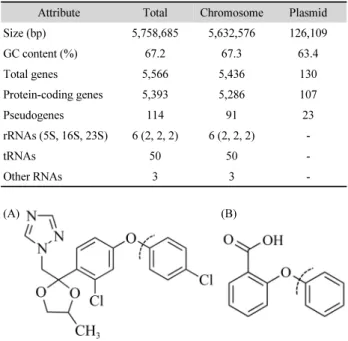
Fig. 1. Chemical structure of (A) difenoconazole and (B) 3-phenoxybenzoic acid. Dotted lines indicate the cleavage sites of (A) difenoconazole by strain C8-2 and (B) 3-phenoxybenzoic acid by Sphingobium wenxiniae JZ-1.
Fig. 2. Maximum likelihood tree based on the deduced amino acid sequences of dioxygenases present only in strain C8-2 and not in S. histidinilytica UM2
T(bold), and related dioxygenases obtained from the GenBank protein database. The tree and bootstrap analyses were performed with MEGA version 6.0 (Tamura et al., 2011). The scale bar indicates 0.5 substitutions per site.
(Chun et al., 2009).
The draft genome sequence was assembled into two contigs with a genome coverage of 157.31. The contig 1 is composed of 126,109 bp and self-circularized while contig 2 is composed of 5,632,576 bp and not circularized. Thus they are predicted as a plasmid and a chromosome, respectively. The genome of strain C8-2 has a total size of 5,758,685 bp with a G + C content of 67.2%, 5,393 coding genes (CDS), 114 pseudogenes, and 59 RNA genes. The genomic feature of strain C8-2 is summarized in Table 1.
Genomic similarity between strain C8-2 and S. histidinilytica UM2
T(FUYM01000000) was calculated using the ANI cal- culator at the EZBioCloud website (www.ezbiocloud.net) (Yoon et al., 2017). The OrthoANI value between the two strains was 99.3% and thus strain C8-2 was identified as S.
histidinilytica based on the recommended species demarcation (95~96%) (Chun et al., 2018).
Through the structure analysis of the degradation product of
difenoconazole by strain C8-2 we found that the cleavage site
430 ∙ Heo et al.
미생물학회지 제55권 제4호
of difenoconazole is located in the O-C bond of diphyenyl ether group in difenoconazole (Fig. 1A). Although degradation path- ways of difenoconazole by bacteria have not been investigated until now, those of diphenyl ether and its derivatives have been well investigated (Schmidt et al., 1992; Wang et al., 2014; Cai et al., 2017). The common initial step of the degradation of diphenyl ether is the dihydroxylation of one benzene ring by dioxygenase (Cai et al., 2017). Through comparative genomic analysis, it was found that 7 of the 75 dioxygenases of strain C8-2 are present only in strain C8-2 and not in strain UM2
T. The seven dioxygenases are present in the chromosome and two of them (locus tags EIK56_24095 and EIK56_24100) show high identities of amino acid sequences with phenoxy- benzoate dioxygenase alpha subunit (PbaA1) and beta subunit (PbaA2) of Sphingobium wenxiniae JZ-1 (96 and 100%, res- pectively) (Fig. 2) when sequence similarity was analyzed using the protein-protein BLAST on the NCBI server (www.
ncbi.nlm. nih.gov). It was reported that PbaA1 and PbaA2 dihydroxylate one benzene ring of diphenyl ether group in phenoxybenzoate, yielding 3-hydroxybenzoate and catechol (Wang et al., 2014). In this reaction, the cleavage site is identical to that of difenoconazole (Fig. 1B) thus the two dioxygenases of strain C8-2 are supposed to be involved in the difenoconazole degradation by strain C8-2.
Availability of the sequence data and the strain The complete genome sequence of Sphingomonas histidini- lytica C8-2 has been deposited to GenBank under accession numbers NZ_CP034356 and NZ_CP034357. The strain is available at the Korean Agricultural Culture Collection under KACC number 92145P.
적 요
트리아졸 살균제 디페노코나졸을 빠르게 분해하는 C8-2 균 주를 농경지 토양에서 분리하고 그 유전체 염기서열을 분석하 였다. C8-2 균주의 유전체를 디페노코나졸을 분해하지 못하 는 근연종 Sphingomonas histidinilytica UM2
T의 유전체와 비 교하였을 때 두 균주의 OrthoANI 값은 99.3%로 나타나 C8-2 균주를 S. histidinilytica로 동정하였다. C8-2 균주의 유전체는 1개의 염색체와 1개의 플라스미드로 구성되어 있으며 유전체
크기는 5,758,685 bp이고 G + C 함량은 67.2%이며 5,393개 의 단백질 암호화 유전자 및 59개의 RNA 암호화 유전자를 보유하고 있었다. C8-2 균주는 S. histidinilytica UM2
T에는 없는 7개의 dioxygenase를 보유하고 있었으며 이 중 2개는 3- phenoxybenzoate 를 3-hydroxybenzoate와 catechol로 분해하 는 angular dioxygenase와 높은 유사도(> 96%)를 나타내었다.
Acknowledgements
This study was carried out with the support (PJ01359601) of National Institute of Agricultural Sciences, Rural Development Administration, Republic of Korea.
References