
An Approach to Designing Visual Forms for Process Control Displays Based on Ecological Interface Design
Dong-Han Ham
**
Dept. of Industrial Engineering, Chonnam National University
Ecological Interface Design에 기반한 공정제어 디스플레이의 시각적 표현 설계 방법
함 동 한
**
전남대학교 산업공학과
Abstract
공정제어시스템과 같은 복잡한 시스템을 감시하고 제어하기 위한 정보 디스플레이를 설계하기 위해 두 가지의 세부적인 설계문제를 효과적으로 다루어야 한다. 정보디스플레이에서 표현할 정보의 내용을 파악하고 조직화하는 문제와 그 표현할 정보를 시각적으로 잘 표현하는 문제로 구분이 된다. Ecological Interface Design (EID)는 두 문 제를 다루기 위한 이론적 배경지식과 방법을 제공하는 정보디스플레이 설계의 틀이다. EID는 1990년대 초반에 그 개념적 틀이 소개된 이후에 그 유용성이 여러 작업영역과 직무환경에서 입증되어 왔다. 그러나 실제 현장에서 EID 의 개념을 활용하는데 있어 큰 어려움으로 지적된 것이 정보의 시각화를 위한 실용적이고 구체적인 원칙과 방법이 부족하다는 점이었다. 또한 EID 개념의 활용에만 집중할 경우 효과적인 정보 디스플레이 설계를 위해 고려되어야 하는 다른 설계 문제들이 쉽게 간과될 가능성도 높다. 이 점은 아직도 EID의 실제적 활용성을 높이는데 큰 약점으 로 지적된다. 이 논문에서는 EID의 개요와 장단점을 소개한 후에 이에 기반해서 정보 디스플레이 설계를 종합적으 로 다루는 데 도움이 될 수 있는 방법을 소개한다. 특히 이 논문에서는 기능적으로 추상화된 정보의 시각화 및 추 상화 관점에서 다른 단계에 있는 정보들간의 목적-수단 관계를 시각화해서 명시화하는 것을 강조한다. 또한 디스플 레이 설계 요소에 기반한 설계 프로세스 및 관련 설계 원칙 및 지침의 적절한 활용도 강조한다. 이 논문에서 제안 된 방법은 EID의 개념적 틀을 확장하면서 인간 중심적인 정보 디스플레이의 설계하는데 유용한 원칙과 방향성을 정립하는데 도움이 될 것이다.
Keywords : Ecological Interface Design, Abstraction Hierarchy, Process Control Displays, Human-System Interfaces, Information Visualization, Visual Form
1. Introduction
Information displays are one of human-system interfaces for process control systems. They present a range of data and information for monitoring and
supervising the state of those systems and also provide useful information for supporting human operators’ tasks. There have been many approaches to designing information displays for process control [1]. However, in terms of design problems, they have
†이 논문은 2012년도 정부(교육과학기술부)의 재원으로 한국연구재단의 기초연구 사업 지원을 받아 수행된 것임(과제번호: 2012042146)
†교신저자: 함동한, 광주광역시 북구 용봉로 77 전남대학교 공과대학 산업공학과 M․P: 016-417-4607, E-mail: [email protected]; [email protected] 2012년 10월 20일 접수; 2012년 11월 29일 수정본; 2012년 12월 5일 게재확정
Knowledge-Based Behavior
Feature Formation
Sensory Input
Automated Sensorimotor
Movements (Signs)
Recognition Association
State/Task
Stored rules for activities
Identification Decision Planning
Goals
Rule-Based Behavior
Skill-Based Behavior
Signs Symbols
Signals Actions
<Figure 1> The SRK Taxonomy of Human Performance Categories (Adapted from [11])
a common understanding that display design should be dealt with in separation of information content representation (what information should be offered through information displays) and visual form design (how information should be graphically presented on information displays) [3, 10]. Of those design approaches proposed so far, Ecological Interface Design (EID) framework has gained the most attention from academicians as well as actual designers in the industry. EID framework has a potential to facilitate human operators’ goal-directed and adaptive activities, in particular under unfamiliar situations, which are increasingly important to secure the safe operation of modern socio-technical systems such as process control systems [16]. The best advantage of EID is that it provides a conceptual basis and a relevant modeling tool for the two design problems respectively.
1.1 Ecological Interface Design
Two conceptual bases of EID are that invariant constraints of a work domain should be used for information content representation, and human operators’ cognitive competencies and characteristics should be considered for visual form design. The essence of EID is to identify relevant work domain constraints and then make those constraints, which are not visible to operators, directly visible to them with a suitable visual form [17].
1.1.1 Information Content Representation In EID, a modeling tool used for identifying and organizing work domain constraints is a goal-means multi-level hierarchy called AH (abstraction hierarchy) [15]. In general, an abstraction hierarchy consisting of five levels is useful for process control domain [11, 16]. Five levels are: functional purpose (FP), abstract function (AF), generalized function (GF), physical function (PF), and physical form (P). One level serves as a goal of its immediate lower level and, at the same time, as a means for its immediate upper level. Several studies showed that all of five-level information is needed to successfully control a process. What should be noted is that traditional displays usually do not show information at the AF and GF level. Thus, operators should infer this two-level information from the displays and this resulted in much cognitive load and poor task performance. In this regard, EID-based display has a good advantage because it shows all five-level information, which is analyzed by AH.
1.1.2 Visual Form Design
EID uses SRK (Skill, Rule, and Knowledge) taxonomy as a modeling tool for visual form design.
Human operators have different modes of controlling their interaction with the environment and cognitive
resources as well as their subjective preferences [11, 13, 15]. As shown in Figure 1, SRK taxonomy defines three different levels of human cognitive control [13]. It specifies three ways that human operators’ thinking and actions may be guided by the invariant constrains, which can be identified by the use of AH, in the work domain. Each level of cognitive control in SRK framework is based on a different type of operators’ internal representation [11].
Skill-based behavior (SBB) requires on-line, real time control based on tacit knowledge that cannot be verbalized by operators. It represents skilled performance that can be conducted without conscious attention or control. In terms of the role of the information observed from the environment, for the control at the skill-based level, the sensed information is perceived as time-space signals, continuous, quantitative indicators of the time-space behaviour of the environment. The performance at this level may be guided by value features acting as cues or signs activating automated sensorimotor patterns.
Rule-based behavior (RBB) depends on the availability of convenient cues to release acts, cues that are only conventional signs with no functional significance. It uses consciously ‘if-then’ rules mapping between a familiar perceptual cue in the environment and the appropriate action. In general, stored rules are derived from procedures, experience, instruction or previous problem-solving activities. No reasoning is required for the control at the rule-based level. At this level, the information is typically perceived as signs. The information perceived is defined as a sign if it serves to activate or modify predetermined actions or manipulations.
Signs refer to situations or proper actions by convention or prior experience; however, they do not mean concepts or functional properties of the environment.
During unfamiliar situations where no know-how or predetermined rules are available, the control of performance needs to be goal-controlled and knowledge-based. In these situations, a goal is explicitly established and then a proper plan is formulated, based on the understanding of the functional properties of the environment and the
prediction of the effects of a plan considered. Thus Knowledge-based behavior (KBB) requirers serial, analytical reasoning based on a mental model that is a symbolic representation of the relevant constraints and relationships in the environment. To support such a functional reasoning, conscious, focal attention is required. To be useful for functional reasoning, the information from the environment is perceived as symbols at this level. Signs used for the RBB refer to percepts and rules for action; however, symbols refer to concepts related to functional properties and can be used for reasoning by means of a suitable representation of those properties.
EID prescribes that a display should support these three ways at the same time. Moreover, it should encourage the use of skill- and rule-based behavior, and support knowledge-based behavior that is usually employed under unpredictable situations. For this, EID has three design principles: (1) displays should be directly manipulated to support SBB, (2) displays should have one-to-one mapping between work domain constraints and visual forms to support RBB, and (3) displays should exhibit all of the five level information of AH to support KBB.
1.2 Display Design Factors and Task -Oriented Information
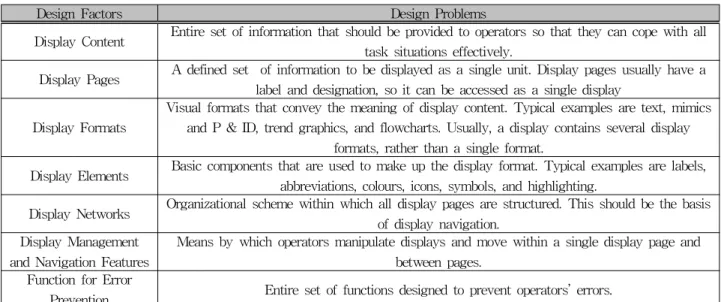
As proved in several studies, there is no doubt that EID is a good design framework. However, taking display design factors into consideration, it has a room for improvement. Design factors refer to elements or objects constituting displays. We can summarize display design factors as follows: display content, display pages, display formats, display elements, display networks, display management and navigation features, and function for error prevention [1]. EID does not address all of such design factors, so that EID should be improved to cover all of them.
In particular, although EID has three design principles about visual form, more detailed principles, methods, and procedures for visual form design should be devised in order to make EID more practical. Although we admit that many elements of visual form design are still an art rather than a
<Figure 2> Proposed Approach to Visual Form Design
science, we should attempt to enhance the design to a level of science. And there have already been several studies starting for this purpose [9], [6-8, 10, 19].
Next, we should think of procedural, task-oriented information that can be identified by several task analysis (TA) methods [1]. There is a theoretical reason why EID does not emphasize procedural, task-relevant information, and it is right in some respects. EID displays aim to help operators form a right mental model about the system that they interact with. Thus they focus on representing the functional invariant structures of the system (i.e.
principle knowledge), rather than operators’
task-oriented information (procedural knowledge).
However, a plausible assumption is that if EID-based displays include task-relevant information and shows it at a proper time and with a proper visual form, they would be more helpful in enhancing the performance of operators [16].
Based on the principles and weak points of EID described above, this paper aims to propose a comprehensive approach to designing visual forms
for process control displays. It emphasizes visualization of functionally abstracted information and goal-means relations between different abstraction levels. Effective use of relevant design principles and design process based on display design factors are emphasized as well.
2. Proposed Approach
This study builds on the approach studied by Ham et al. [6]. As shown in Figure 2, the new proposed approach emphasizes that visual form design process should be based on display design factors and several relevant design concepts and principles should be referenced for visual from design.
Before designing visual forms, information content to be presented through information displays should be systematically identified-the problem of information content representation. As EID prescribes, work domain knowledge based on multi-level goal-means relationships should be analyzed by the use of AH.
Additionally, operators’ task knowledge, which is
<Table 1> Design Factors of Information Displays
Design Factors Design Problems
Display Content Entire set of information that should be provided to operators so that they can cope with all task situations effectively.
Display Pages A defined set of information to be displayed as a single unit. Display pages usually have a label and designation, so it can be accessed as a single display
Display Formats
Visual formats that convey the meaning of display content. Typical examples are text, mimics and P & ID, trend graphics, and flowcharts. Usually, a display contains several display
formats, rather than a single format.
Display Elements Basic components that are used to make up the display format. Typical examples are labels, abbreviations, colours, icons, symbols, and highlighting.
Display Networks Organizational scheme within which all display pages are structured. This should be the basis of display navigation.
Display Management and Navigation Features
Means by which operators manipulate displays and move within a single display page and between pages.
Function for Error
Prevention Entire set of functions designed to prevent operators’ errors.
usually procedure-based, needs to be identified by the use of several cognitive task analysis methods, such as SGT (Sub-Goal Template) method [14] and goal-directed task analysis [2].
The approach proposes that visual form design process should be based on display design factors.
Table 1 summarizes display design factors to be considered for designing information displays. Design of visual forms starts from organization of display networks. Next step is to visualize information that is identified by using AH: physical information, functionally abstracted information, and goal-means relations between adjacent abstraction levels. And task-oriented information should be supplementarily displayed to support operators’ task execution. In terms of design factors, design problems for display pages, formats, and elements should be dealt with for the above four visualization steps. Design of the other display design factors should follow. Last step is to test and improve visual form designs in terms of safety and usability. For testing designs, recently widely used measures such as situation awareness as well as typical measures such as time and accuracy, need to be used in a collective way.
2.1 Organization of Display Networks
A great deal of information cannot be displayed on a single display page; thus display pages should be
properly divided and structured so as to make it easier for operators to integrate work domain and task-related information. Several criteria can be used for designing display organization. Functional abstraction and physical decomposition levels based on AH or task-related information based on task situations can be a useful criterion. However, as EID concept is the foundation of the proposed approach, functional abstraction and physical decomposition levels should be preferable as the basis for display organization. Display organization becomes the basis of display navigation.
2.2 Visualization of Physical Information
In terms of AH, physical information relates to the level of PF and P. This information can be typically visualized in a type of Piping and Instrumentation Diagram (P&ID). Visual forms for physical information should exhibit part-whole decomposition of a work domain, thereby supporting operators’
structural mental model.
2.3 Visualization of Functionally Abstracted Information
As shown in several studies, functionally abstracted information on the level of AF and GF are very useful [4]. To visualize this information,
diverse geometrical forms should be designed in a way that they correspond to work domain constraints in terms of this level information. Design concepts to be used here include semantic mapping principle, object display, and configural display. For this visualization, the research of Liu et al. [8] is worthy of being noted. They identified seven types of basic functional information for process control:
Generate, Store, Transport, Transform, Balance, Barrier, and Sink. And then they proposed examples visualizing each type and a strategy combining them.
As to FP-level information, it is necessary to visualize it a form having integrity, equilibria, linearity, alignment, so that operators can easily detect the violation of purpose [7].
2.4 Visualization of Goal-Means Relations
The usefulness of presenting goal-means relations between adjacent abstraction levels is as important as functionally abstracted information [5]. Thus, visual forms should emphasize goal-means relations by using methods like grouping and layering.
As goal-means relations are usually M:N type, their visualization is never easy. Network-type
visualizations that show the relations separately can be considered.
Figure 3 is an example of display for secondary cooling system of nuclear power plants [6]. This display shows physical information, functionally abstracted information, and goal-means relations by grouping at the same time. The usefulness of information content and visual forms provided by this type of display was empirically validated through a series of experiment [4-6].
2.5 Visualization of Task-Oriented Information
Based on the results of AH analysis and cognitive task analysis, task-oriented information, such as goals, input and output condition, prerequisites, and procedures, should be analyzed and incorporated into displays. Here, what is important is to identify work domain objects that a certain task needs or affects their state and to visualize task-oriented information centering on the objects. In comparison to work domain information, the effectiveness of visualizing task-oriented information might be more influenced by the design of display elements such as labels, icons, highlighting, colors, and so on.
Visual form for abstract function Visual form emphasizing
goal-means relations
Overall structure visualizes part-whole decomposition
<Figure 3> Example of Display Showing Physical Information, Functionally Abstracted Information, and Goal-Means Relations (Left: Work Domain, Right: Display) [6]
Task-oriented information can be separately displayed in a form of flow chart, which can be found in electronic procedures. In this case, integration between function-oriented information and task-oriented information remains a more challenging issue. For visualization of task-oriented information, Zhang et al [19] offers a set of useful methods and concepts.
2.6 Design Support
Visual form design needs to be supported by several design concepts and principles and exploited by the use of creative design methods and technical opportunities. As EID concept prescribes, visual form designs should support all the three human performance behaviour level (SBB, RBB, and KBB).
Thus SRK taxonomy and its implications on display design should be considered in every visual form design activity.
Unlike the problem of information content representation, visual form design needs much of designers’ creativity. For this, creative design methods can be usefully referenced.. As information technologies rapidly advance, they can provide some new opportunities for accommodating designers’
creativity. Thus designers are always well prepared to use them.
Display design principles can be helpful for designers’ decision making. A lot of display design principles have been developed so far. However, the proposed approach recommends the use of 13 principles suggested by Wickens et al. [18].
Semiotics is the study of signs and symbols as elements of language and communication. It informs human ability to interpret images or other sensor input. Semiotics would be helpful to understand and explain how different meanings are assigned to operators, based on visual form designs. Thus it is recommended to refer to semiotics during visual form design process.
This approach claims the reuse of visual forms;
designers firstly should refer to the library of visual forms at each design activities, and try their best to reuse them with some modification. After finishing
design, they also should store visual forms into the library that are worth being reused.
3. Concluding Remarks
This study proposed a new approach to designing information displays for process control, paying particular attention to visual form design. The approach is based on the principles and concepts of EID. It focuses on visualization of functionally abstracted information and goal-means relations between adjacent abstraction levels of AH, which are not provided in a traditional P&ID-type display.
Problem solving by identifying means to achieve a goal is one of the task methods that a human most frequently employ in unfamiliar situations. Thus, if goal-means relations are explicitly displayed, they can be a useful cognitive support for human operators. As task-oriented information can be effective in enhancing operators’ performance, its visual form design is also a core design activity of the approach. Effective use of relevant design principles and design process based on display design factors are emphasized as well.
It is believed that the approach will help designers view information display design problems in a comprehensive way and make use of EID concepts and principles in consideration of several design problems. However, we need to develop more detailed ways and case studies for realizing human-centered information displays based on the proposed approach.
4. References
[1] Annett, John and Neville A. Stanton (Eds.).
(2000). Task Analysis, Talyor & Francis.
[2] Endsley, Mica R., Betty Bolté, and Debra G.
Jones. (2003). Designing for Situation Awareness, Taylor & Francis.
[3] Ham, Dong-Han. (2001). Ecological Design of Informaton Content and Layout for Process Control Based on Abstraction Hierarchy, Unpublished Doctoral Thesis, KAIST.
[4] Ham, Dong-Han and Wan Chul Yoon. (2001).
“The Effects of Presenting Functionally Abstracted Information in Fault Diagnosis Tasks.”, Reliability Engineering and System Safety, 73(2): 103-119.
[5] Ham, Dong-Han and Wan Chul Yoon. (2001).
“Design of Information Content and Layout for Process Control Based on Goal-Means Domain Analysis.”, Cognition, Technology, and Work, 3(4): 205-223.
[6] Ham, Dong-Han, Wan Chul Yoon, and Byung-Tae Han. (2008). “Experimental Study on the Effects of Visualized Functionally Abstracted Information on Process Control Tasks.”, Reliability Engineering and System Safety, 93(2): 254-270.
[7] Hansen, John Paulin. (1995). “Representation of System Invariants by Optical Invariants in Configural Displays for Process Control.”, In Hancock, Peter, John Flack, Jeff Caird, and Kim Vicente (Eds.). 1995. Local Applications of the Ecological Approach to Human-Machine Systems, Lawrence Erlbaum Associates.
[8] Liu, Qiao, Keiichi Nakata, and Kazuo Furuta.
(2002). “Display Design of Process Systems Based on Functional Modeling.”, Cognition, Technology, and Work, 4(1): 48-63.
[9] Pedersen, Chr. Rud and Morten Lind. (1999).
“Conceptual Design of Industrial Process Displays.”, Ergonomics, 42(11): 1531-1548.
[10] Pedersen, Rud and Michael May. (1999).
“Visualization in Process Control.”, Human Factors and Ergonomics in Manufacturing, 9(3): 267-276.
[11] Rasmussen, Jens. (1986). Information Processing and Human-Machine Interaction: An Approach to Cognitive Engineering, North-Holland.
[12] Rasmussen, Jens. (1999). “Ecological Interface Design for Reliable Human-Machine Systems.”, The International Journal of Aviation Psychology, 9(3): 203-223.
[13] Rasmussen, Jens, Annelise Pejtersen, and L. P.
Goodstein. (1994). Cognitive Systems Engineering, John & Wiley Sons.
[14] Richardson, Juliet, Thomas C. Ormerod, and Andrew Shepherd. (1998). “The Role of Task Analysis in Capturing Requirements for
Interface Design.”, Interacting with Computers, 9(4): 367-384.
[15] Vicente, Kim. (1999). Cognitive Work Analysis, Lawrence Erlbaum Associates.
[16] Vicente, Kim. (2002). “Ecological Interface Design: Progress and Challenges.”, Human Factors, 44(1): 62-78.
[17] Vicente, Kim and Jens Rasmussen. (1992).
“Ecological Interface Design: Theoretical Foundations.”, IEEE Transactions on Systems, Man, and Cybernetics, 22(4): 589-606.
[18] Wickens, Christopher, Jonn Lee, Yili Liu, and Sallie Gordon Becker. (2004). An Introduction to Human Factors Engineering (2nd Ed.), Pearson Prentice-Hall.
[19] Zhang, Jiajie, Kathy Johnson, Jane Malin, and Jack Smith. (2002). “Human-Centered Information Visualization.”, Proceedings of the International Workshop on Dynamic Visualization and Learning.
저 자 소 개
함 동 한
현재 전남대학교 산업공학과 조 교수. 인하대 산업공학과 공학사, KAIST 산업공학과 공학석사 및 공학박사를 취득하였음. 2001 ~ 2005년 ETRI 선임연구원 재직.
2005∼2012년 영국 미들섹스대학 교 공학 및 정보과학부 종신연구 교원 재직.
연구 분야는 인지시스템공학, 지식서비스공학, 서비스 과학, 인간-컴퓨터 상호작용, 시스템 안전공학 등 주소: 광주광역시 북구 용봉로 77 전남대학교 공과대학
산업공학과
![Figure 3 is an example of display for secondary cooling system of nuclear power plants [6]](https://thumb-ap.123doks.com/thumbv2/123dokinfo/5262241.631887/6.892.85.804.720.1099/figure-example-display-secondary-cooling-nuclear-power-plants.webp)
