pISSN 1229-3008 eISSN 2287-6251
Progress in Superconductivity and Cryogenics
Vol.21, No.2, (2019), pp.22~25 https://doi.org/10.9714/psac.2019.21.2.022
```
1. INTRODUCTION
The impact of greenhouse gases has been discussed and the global warming becomes a critical issue. Concerning Japan, the total carbon dioxide emissions in fiscal 2016 was 1.2 billion tons. It consists of 42% in the energy conversion sector, 25% in the industrial sector, 17% in the transport sector, 5% in the business sector, 5% in the family sector and 4% in the industrial process sector [1]. In the energy conversion sector where the emission amount of carbon dioxide was the largest, the emissions associated with power generation was the majority. Considering the amount of carbon dioxide emissions accompanied with power generation in Japan, it can be understood that those associated with thermal power generation was the most.
In thermal power generation, there are coal-fired, oil-fired, LNG-fired, and LNG-combined thermal power generation, with carbon dioxide emissions being 943, 738, 599, 474 gCO2 / kWh, respectively. Meanwhile those of solar power, wind power, nuclear power, geothermal power, and medium/small hydraulic power are 38, 25, 20, 13, 11 g CO 2 / kWh, respectively [2]. Thermal power generation accounts for the majority of carbon dioxide emissions. For this reason, reducing the emission of carbon dioxide from the thermal power plants can have a great effect.
We are planning to suppress the increase in carbon dioxide emissions by protecting the decline in the power generation efficiency of the thermal power plants. The decline in power generation efficiency of thermal power plants is mainly induced by iron oxide scale. That is, accumulation of iron oxide scale due to corrosion of the
pipeline of the water supply system of the thermal power plant results in the decrease in efficiency. Particularly since the thermal conductivity of the iron oxide scale is 10% or less of the pipe material and hence the adhesion the scale to the pipe works induce the decrease in the heat exchange efficiency. Furthermore, it becomes pressure losses of the water supply system, thereby lowering the total power generation efficiency. To prevent the accumulation of the iron oxide scale, all volatile substance treatment (AVT) or oxygen treatment (OT) have been employed. Even if the method is adopted, the generation of scale cannot be completely suppressed, and the development of new technology has been desired.
The carbon dioxide emission was calculated based on the typical example. It has been reported that the reduction in power generation efficiency due to scale adhesion is 25 kW / μm (in coal-fired power) [3], and a scale adhesion speed was 210 μm over three years (in the 500 MW of oil fired power) [4]. That is, adhesion of a scale of 70 μm per year would be induced. If this adhesion could be prevented, it would be possible to prevent a reduction of 0.8% / year in thermal efficiency. This corresponds to 1.48 million tons of carbon dioxide annually in Japan. Regarding pressure loss, if scale adhesion is prevented, improvement in power generation efficiency of 0.1% is expected, which corresponds to approximately 130,000 tons of carbon dioxide in a year. In other words, if it is possible to prevent scales from accumulating at all thermal power stations in Japan, it would lead to a reduction of 1.6 million tons of carbon dioxide annually, and its impact should be high.
In this work the introductory study was reported and the project is under in progress.
Removal of iron oxide scale from feed-water in
thermal power plant using superconducting magnetic separation
S. Nishijima*
Fukui University of Technology, Fukui, Japan
(Received 4 March 2019; revised or reviewed 17 June 2019; accepted 18 June 2019)
Abstract
The superconducting magnetic separation system has been developing to separate the iron oxide scale from the feed water of the thermal power plant. The accumulation in the boiler lowers the heat exchange rate or in the worst case damages it. For this reason, in order to prevent scale generation, controlling pH and redox potential is employed. However, these methods are not sufficient and then the chemical cleaning is performed regularly. A superconducting magnetic separation system is investigated for removing iron oxide scale in a feed water system. Water supply conditions of the thermal power plant are as follows, flow rate 400 t / h, flow speed 0.2 m / s, pressure 2 MPa, temperature 160 - 200 ° C, amount of scale generation 50 - 120 t / 2 years. The main iron oxide scale is magnetite (ferromagnetic substance) and its particle size is several tens μm. As the first step we are considering to introduce the system to the chemical cleaning process of the thermal power plant instead of the thermal power plant itself. The current status of development will be reported.
Keywords: feedwater, thermal power plant, iron oxide scale, superconducting magnetic separation, carbon dioxide emission
* Corresponding author: [email protected]
S. Nishijima
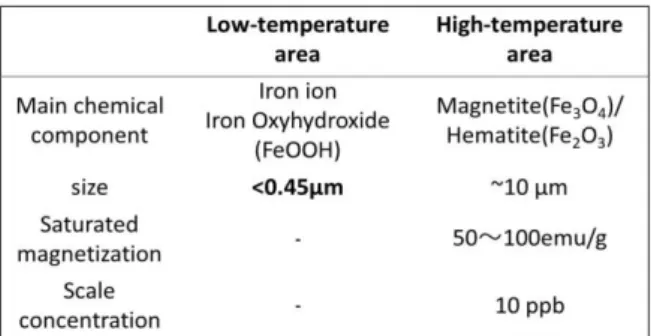
TABLE I
CHARACTERISTICS OF SCALE FROM DIFFERENT TEMPERATURE.
2. EVALUATION OF IRON SCALE
To investigate the iron scale, we collected feed water from various places of the supply system in the thermal power plant and the water quality was test such as pH, ammonia concentration, suspended substance and iron concentration. In addition, particle size distribution, magnetization, SEM and XRD of suspended matter were examined. Ammonia is essential for AVT treatment, though it volatilizes after the turbine. To confirm this the concentration of ammonia was measured. Table I shows the characteristics of the suspended matter with the collected site. As can be seen, in the low temperature range (room temperature to about 100 ° C), there are 0.45 μm or less of suspended matter, FeOOH or dissolved iron ions. In the high temperature region (150 ° C or higher), there are magnetite or hematite of which size are approximately 10 μm and hence the saturated magnetization is also large and the concentration is about 10 ppb. From these results, we decided the high temperature area (150 ℃ or higher) as the scale removing site.
It was judged that the high pressure feed water heater drain was the appropriate site for scale removing [5]. The feed water flow volume ranges from 400 to 500 m 3 / h, the water temperature is 160 to 200 ° C, and the pressure is 20 atm. The iron oxide (mainly magnetite) to be removed at this point is 25 to 57 kg / year. The pipe diameter is 1 m and the flow rate is 0.2 to 0.5 m / s. Fig. 1 shows the schematic diagram of the feed-water system and the assumed installation site of the separator.
3. SCALE REMOVING SYSTEM
Under the conditions, we examined what scale removal system is appropriate. Comparison was made with membrane filter, precoat filter, electromagnetic separation and superconducting magnetic separation. It was considered that the membrane filter shows the highest separation efficiency. The separation efficiency is plotted against the flow rate in Fig,2. Separation efficiencies of membrane were calculated from catalog values of several companies. Thought the membrane filter exhibits a high separation efficiency at low flow rate, the efficiency decreases rapidly with flow rate. On the other hand, superconducting high gradient separation, HGMS shows
Turbine
Deaerator Boiler
Low pressure Feed-water heater High pressure
Feed-water heater
Fig. 1. Feed-water system and location of separator.
High gradient Magnetic separation
Fig. 2. Flow speed dependency of Separation efficiency of membrane filter and high gradient superconducting magnet separation.
high separation efficiency even at high fluid speed (0.6-0.7m/s at 1T) [6]. The precoat filter was found to be difficult to use at high temperature. The electromagnetic separation was not adopted because it does not generate an appropriate magnetic field in the large diameter water supply. Based on this consideration, it was concluded that high gradient superconducting magnetic separation could show high performance withstanding high temperature, high pressure and even high flow velocity.
4. POLICIES AND PROCEDURES
Before installation of HGMS into the thermal power plant we decided to introduce HGMS in a chemical cleaning system of which specifications is similar to that in thermal power plant. The chemical cleaning process is carried out periodically (about every two years) to remove the scale accumulated in the water supply system of the thermal power plant. This system is not always installed, but at the time of cleaning, a line diverging from the main water supply system is provided to remove the scale. In this chemical cleaning system, the identical iron oxide scale as that in the thermal power plant is purified. By installing the HGMS in the chemical cleaning system, it is possible to evaluate the separation performance of the HGMS of the actual iron scale. Conditions in the high pressure feed water heater drain and chemical cleaning system were compared in Table II. It can be understood that both are almost the
Removal of iron oxide scale from feed-water in thermal power plant using superconducting magnetic separation
TABLE II
CONDITIONS OF CHEMICAL CLEANING LINE AND HIGH PRESSURE FEED WATER HEATED DRAIN.
Fig. 3. Chemical cleaning line.
same though the fluid temperature and pressure are different. In addition, the chemical cleaning system shows more severe as the flow rate. For this reason, we decided to introduce HGMS into chemical cleaning systems first. It was already proven that HGMS can show the performance even at 200 ° C and 20 atm. Fig. 3 shows a photograph of a chemical cleaning system to be installed. In the near future, we will set up HGMS here.
5. RESEARCH AND DEVELOPMENT
5.1. Superconducting Magnet
The problem to be solved is the mass processing. As shown in Table 2, the system is required to process at least 100 kg of scale. Although in the conventional HGMS, reverse cleaning is carried out periodically, in the power plant feedwater line it is dangerous to do the reverse cleaning because the feed water is 200 ° C and 20 atm. In other words, it is necessary to develop the system that can capture 100 kg of scale at a time without reverse cleaning.
This system can be installed in both the thermal power plant feedwater line and chemical cleaning line.
We first developed a 1/7 scale mockup system. That is, the HGMS with capture performance of 20 kg at a time.
Then we examined whether this data can be extrapolated.
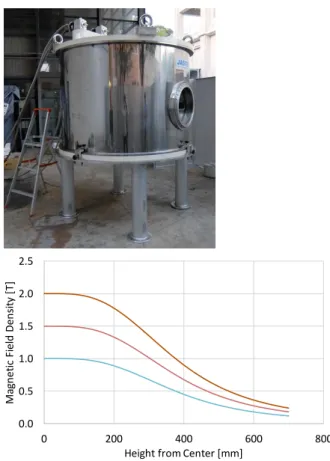
Fig. 4 shows the superconducting magnet used in this work.
A maximum magnetic field of 4T can be generated at the center of the bore. The room temperature bore is 400 mm [7]. In Fig. 4 the magnetic field density distribution along the center axis of the magnet was also demonstrated. It produces 3T of central field at 67.3A of operating current.
Fig. 4. Superconducting magnet used in this work and magnetic field density distribution.
The experiments were performed changing the central magnetic fields from 0 to2T as shown in Fig. 4.
5.2. Magnetic Separation
We performed the magnetic separation experiments on the simulated scales made of magnetite by placing 150 magnetic filters in the magnet. The 15 filters were made one stack and 10 stacks were assembled to be a magnetic filter system. Changing the external magnetic field, the amount of captured scale was measured. Fig. 5 shows the appearance of the magnetic filter before and after the experiment. The magnetic separation experiment was carried out at 0.1 T. When the external magnetic field was higher than 1 T, the magnetic filter became blocked by the scale near the inlet and was not able to separate large amount of scale. On the other hand, when the external magnetic field was set at 0.2 to 0.5 T, it was possible to accumulate more than 2 kg in a filter stack without blocking and hence more than 20 kg of magnetite in the whole filter system.
(a) (b)
Fig. 5. Magnetic filter stack before (a) and after (b) experiment.
0.0 0.5 1.0 1.5 2.0 2.5
0 200 400 600 800
MagneticField Density [T]
Height from Center [mm]
S. Nishijima
Since the mockup is a system of 1/7 of actual size, it would capture more than140kg scale when the diameter becomes 800 mm, the actual size of the filter. This means that it is possible to satisfy the objective to capture more than 100 kg without reverse cleaning.
5.3 AVT and OT
The magnetic separation of iron oxide in the water supply system of the thermal power plant has been described here. In the water supply system, the iron oxide scale is subjected to all volatile substance treatment (AVT) or oxygen treatment (OT) to prevent the occurrence of iron oxide scale. However, they are not always sufficient, and thermal power plants are periodically shut down to remove iron oxide scale by the chemical cleaning. What has been described here is the thermal power plant treated with AVT.
In AVT the feed water is adjusted pH at 9 to 9.7 with a small amount of ammonia and is added hydrazine as an oxygen scavenger (<7 ppb). As a result, a magnetite becomes in a stable region, and the magnetite film can be formed on the inner surface of the pipe to prevent corrosion.
However, in the turbine the corrosion products such as iron oxyhydroxide (FeOOH) are formed because the pH is decreased due to the evaporation of ammonia. The corrosion products are brought into the main loop through the drain or condenser. They change to magnetite (Fe3O4) at the high temperature (> 150 ° C) and adheres to the boiler tube to form a scale, which lowers the heat exchange performance of the boiler results in a decrease in power generation efficiency.
AVT is now major of water treatment, and about 70% of thermal power plants employ this method in 2016.
On the other hand, the latter OT is positioned as advanced feed water treatment. A slight amount of oxygen is injected as an oxidizing agent (20 to 200 ppb) under the weak alkaline conditions controlled by ammonia from 8 to 9.3 of pH. In this method the hematite, which is poorly soluble iron oxide, is deposited on the surface of the pipe to suppress the elution of corrosion products. The solubility of hematite is much smaller than that of magnetite. However, the removal of hematite scale is also required, for example, there have been some reports of thermal damage due to hematite scale adhesion to boiler tubes. This method is considered to be the major in the future.
6. CONCLUSION
Research and development of the superconducting HGMS system was described. The system will be applied to the thermal power plant to remove the iron scale from feed water system. The following conclusions were drawn.
(1) The removal of iron oxide from the water supply system in thermal power plants could reduce annual CO2 emissions by 1.6 million tons in Japan. (2) It is necessary to install the scale removal device at the high temperature area where temperature is 200 ℃ and pressure is 20 atm. (3) High gradient superconducting magnetic separation is the
most suitable as a scale removal device to introduce into the feedwater system because it satisfies the conditions. (4) 1/7 mockup has been successfully developed. It was confirmed that the amount of the accumulated scale is proportional to the filter area, that is proportion rule. (5) The experimental results of the mockup showed the possibility to remove the scale for about 2 years without reverse cleaning with the actual sized magnetic separator. Though the separation system described here is applied to the all volatile treatment system, that to oxygen treatment system should be developed in near future.
ACKNOWLEDGMENT
This research was partly supported by “Advanced Low Carbon Technology Research and Development Program (ALCA)” of Japan Science and Technology Agency (JST).
This paper is a review of the work made by our ALCA collaboration team. I thank the following team members, H.Okad and, N.Hirota from National Institute for Materials Science, H. Matsuura, S. Namba from Shikoku Research Institute Inc., T. Sekine from Ebara Industrial Cleaning Co.
Ltd., Y.Akiyama from Osaka University and F.Mishima, from Fukui University of Technology.
.
REFERENCES
[1] Greenhouse Gas Inventory Office of Japan, “National Greenhouse Gas Inventory Report of Japan,” 2018.
[2] E. Imamura, M. Iuchi and S. Bando, “Comprehensive Assessment of Life Cycle CO2 Emissions form Power Generation Technologies in Japan,” CRIEPI Research Report, vol. Y06, 2016.
[3] M. Siddhartha Bhatt, “Effect of water side deposits on the energy performance of coal fired power plants,” Energy Conversion and Management, vol. 47, pp. 1247-1263, 2006.
[4] CRIEIPI Environmental Science Research Laboratory,
“Optimization of chemical cleaning time of supercritical pressure boiler,” CRIEPI Research Report, vol. 206, pp. 73-74, 1980.
[5] H. Okada, K. Imamura, N. Hirota, et al., “Development of a Magnetic Separation System of Boiler Feedwater Scale in Thermal Power Plants,” IEEE Trans. Appl. Supercond., vol. 26, no. 3, pp.
3701505, 2016.
[6] N. Nizuno, F. Mishima, et al., “Removal of iron oxide with superdonducting magnet high gradient magnetic separation form feed-water in thermal Plant,” IEEE Trans. Appl. Supercond., vol.
25, no. 3, pp. 3700804, 2015.
[7] T. Kiyoshi, S. Matsumoto, et al., “Cryocooler-cooled split-paired magnet for anisotropic conductive sheet production,” IEEE Trans.
Appl. Supercond., vol. 16, no. 2, pp. 1134-1137, 2006.