
The Effects of Epimedii Herba on a Hypothyroidism Rat Model induced by PTU(6-Propyl, 2-thiouracil)
10
0
0
전체 글
(2) 14. Journal of Pharmacopuncture 제 14권 제 4호( 2011년 12월). I. 서론. cold intolerance. PTU Rat. II. 재료 및 방법 1. Epimedii Herba 1,500 80 heating mantle 2 500 applicator filter Rotary evaporator Model NE-1 Japan 1 1 10 95 2 1,000. 14,000rpm. 20 0.2. Levothyroxine TSH. 70 19.7. 2. PTU Epimedii Herba Berberidaceae Epimedium bervicornum Maxim, E.sagittatum S. et Z. Maxim E. koreanum Nakai. 2 rat. 200 20 Korea 40~70. Sprague-Dawley. male. cage. 1 6-Propyl, 2-thiouracil water supplement Ca P3755, 10g, sigma 400 H2O 40 rat 100 0.2 day 4.
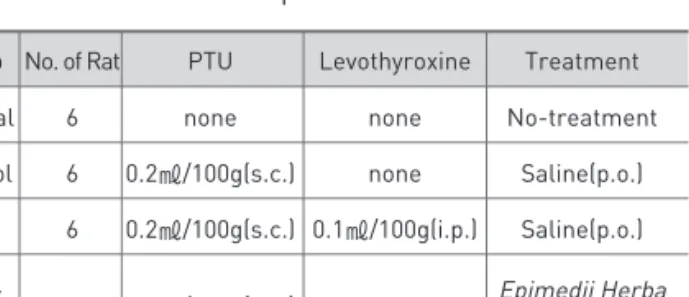
(3) 15. 3.. 4.. SD male rat 6 Control group Thyroxine LT4 Normal group Propyl, 2-thiouracil. Normal group 1. sampling. PTU 64 PTU. 2. 500 Zonde 1 Control group. CAS 2.5D, Korea rat bowl rat. rat. 1 2 PTU. 2 LT4 PTU 2 Levothyroxine CA T2376, 1g, sigma 0.5N NaOH isotonic saline 250 500 rat 100 0.1 day 2 Table 1, Fig. 1 Table 1. Structure of the Experimenta Group No. of Rat. PTU. Levothyroxine. Treatment. Normal. 6. none. none. No-treatment. Control. 6. 0.2 /100g(s.c.). none. Saline(p.o.). LT4b. 6. 0.2. /100g(s.c.) 0.1. /100g(i.p.). Saline(p.o.). Epimediic. 6. 0.2. /100g(s.c.). none. Epimedii Herba 500 / (p.o.). 5. 4 rat 10cc 3,000rpm 20 -40 AST Aspartate Transaminase ALT Alanine Transaminase ALP Alkaline Phosphatase BUN Blood Urea Nitrogen Creatinine, Glucose, Albumin, Protein, Total Cholesterol, HDL-Cholesterol, LDL-Cholesterol, Triglyceride. 6.. T3, T4. TSH. a. Each parenthesis represents the route of administration. s.c.,subcu-. taneous injection; i.p.,intraperitoneal; p.o.,oral administration. LT4 b, Levothyroxine 0.1 500 /. /100g treatment group. Epimediic, Epimedii Herba. treatment group.. Figures & Tables start. 1week. 2week. T3, T4 TSH Rodent T3 ELISA Enzyme-Linked Immunosorbent Assay test kit Endocrine technologies Inc., USA. Rodent T4 ELISA test kit Rodent TSH ELISA test kit 3,000rpm 20 -40. 3week. 4week. T3. PTU(6-propyl, 2-thiouracil) (s.c.). Epimedii Herba (p.o.) Levothyroxine (i.p.). sampling. Fig. 1. The experimental schedule for this study. T3-antibody microtiter wells 50 standard T3 solution 100 T3 HRP Horseradish Peroxidase conjugate, 100 TBM color solution, 50 2N HCl stop solution ELISA reader 450nm T3 T4 TSH T4-antibody TSH-antibody microtiter wells 100 standard T4 TSH solution.
(4) Journal of Pharmacopuncture 제 14권 제 4호( 2011년 12월). 16. 100 T4 TSH enzyme conjugate, 100 TBM color solution, 50 2N HCl stop solution ELISA reader 450nm T4 TSH. 5. LT4 7.. Table 2 Table 2. Body Weight of Each Experimental Group. rat 70. 80. 10 95. 100. 0week(g). 100. 95 80 rehydration matoxyline-Eosin HE. 2week(g). 3week(g). 4week(g). Normal. 238.3 3.98. 252.8 8.13. 306.0 10.88. 339.0 26.42. 347.5 41.05. Control. 240.3 6.35. 280.5 5.39. 295.2 2.14. 262.2 11.27. 291.8 37.04. LT4. 241.3 4.55. 277.2 3.97. 301.5 6.38. 266.5 9.01. 303.5 9.33. Epimedii. 244.0 2.90. 284.3 6.83. 302.2 19.30. 313.7 20.53. 312.5 24.55. microtome 4 gelatin coated slide. 1week(g). xylene 70 He2. Olympus BX-50,. Olympus Optical, Tokyo, Japan 400. rat ALP, AST, ALT. 8.. LT4 69.2 12.25IU L. GraphPad PRISM statistical package ver 4.03, Graphpad software inc., San Die go, USA one-way analysis of variance ANOVA Tuckey’s post-hoc test mean S.D. Twotailed p value p 0.05. AST. Table 3 Table 3. Biochemical Analysis of Alkaline Phosphatase, Aspartate Transaminase and Alanine Transaminase in Each Experimental Group ALP(IU/L). AST(IU/L). ALT(IU/L). Normal. 161.7. 32.68. 123.3. 31.68. 52.5. 11.40. Control. 128.2. 26.87. 117.5. 42.44. 46.0. 3.69. LT4. 120.0. 29.87. 69.2. 12.25*. 36.2. 10.68. Epimedii. 101.2. 22.19. 5.10. 35.6. 7.64. III. 결과 1.. LT4 117.5 42.44IU/L p 0.05 ALP, ALT. 73.9. *Significantly different from the control group at p 0.05. rat 1. 4. 3..
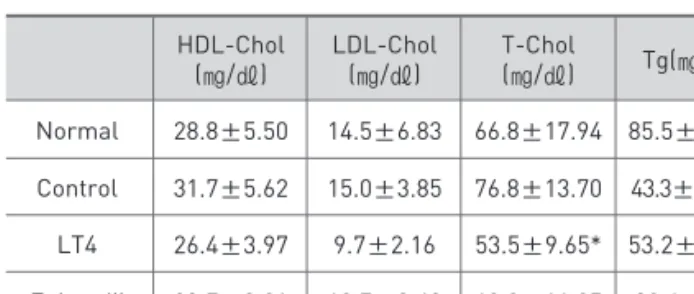
(5) 17. BUN. LT4 LT4. Creatinine. BUN Creatinine 0.5 0.04 p 0.05. 0.4 0.08. Total Cholesterol HDLCholesterol, LDL-Cholesterol, Triglyceride Triglyceride 43.3 12.66 85.5 35.21 p 0.05 HDL-Cholesterol, LDL-Cholesterol, Total Cholesterol. Table 4. LT4. Table 4. Biochemical Analysis of Blood Urea Nitrogen and Creatinine in Each Experimental Group BUN( /. ). Cr(. / ). Normal. 17.2 1.77. 0.5. 0.08. Control. 17.5 2.38. 0.5. 0.04. LT4. 17.0 2.88. 0.4 0.08*. 20.00. 0.5. Epimedii. 1.42. Total Cholesterol LT4 9.65 76.8 13.70 p 0.05 Table 6. 53.5. Table 6. Biochemical Analysis of HDL-Cholesterol, LDLCholesterol, Total Cholesterol and Triglyceride in each experimental group HDL-Chol ( / ). LDL-Chol ( / ). Normal. 28.8. 5.50. 14.5. 6.83. 66.8. 17.94. 85.5 35.21. Control. 31.7. 5.62. 15.0. 3.85. 76.8. 13.70. 43.3 12.66#. LT4. 26.4. 3.97. 9.7. 2.16. 53.5. 9.65*. 53.2 15.69. Epimedii. 23.7. 3.21. 18.7. 3.49. 62.9. 11.05. 30.6. 0.05. *Significantly different from the control group at p 0.05. 4. #. T-Chol ( / ). Tg( / ). 9.02. Significantly different from the normal group at p 0.05. *Significantly different from the control group at p 0.05. 103.0 32.75 122.2 13.38 6. LT4 rat Table 5 Table 5. Biochemical Analysis of Glucose in each experimental group. Glucose( / ) Normal. 122.2. 13.38. Control. 103.0. 32.75. LT4. 125.3. 30.12. Epimedii. 132.1. 17.02. LT4 Albumin, Total Protein Table 7 Table 7. Biochemical analysis of Albumin and Total Protein in each experimental group Albumin(g/ ). 5.. Total Protein(g/. Normal. 1.9. 0.29. 5.0. 1.15. Control. 1.8. 0.20. 5.2. 0.96. LT4. 1.4. 0.29. 3.9. 0.57. Epimedii. 1.6. 0.15. 4.7. 0.60. ).
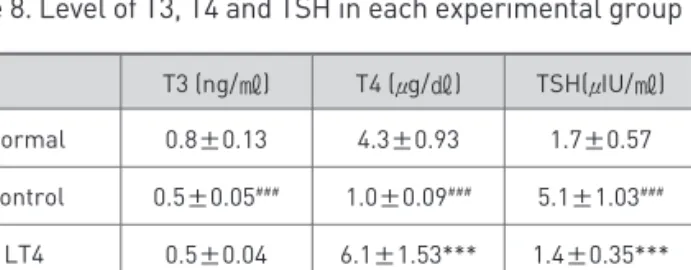
(6) Journal of Pharmacopuncture 제 14권 제 4호( 2011년 12월). 18. 7. PTU rat T3, T4. TSH. Thyroglobulin T3. 0.05. 0.8 0.13 p 0.001 4.3 0.93 p 0.001 1.7 0.57 IU p 0.001. IU. 0.5. colloid epithelial cell. T4. TSH. 1.0 0.09 LT4. TSH. 5.1 1.03 epithelial cell. T3. LT4. T4. LT4. 6.1 1.53. 1.0 0.09 p 0.001. Fig. 2. T4. 1.3 0.30 p 0.05 1.4 0.35 IU. TSH. LT4 5.1 1.03 IU p 0.001. Fig. 2. Histology of thyroid gland of Normal, Control, LT4, Epimedii-treated Hypothyroidism rats inducued by PTU. Control, PTU; T4, PTU + T4; Epimedii, PTU + Epimedii.. Table 8 Table 8. Level of T3, T4 and TSH in each experimental group T3 (ng/ Normal Control. ###. 0.8. ). 0.13. 0.5 0.05. ###. T4 ( g/ 4.3. ). TSH( IU/. 0.93. 1.0 0.09. 1.7 0.57. ###. LT4. 0.5. 0.04. 6.1 1.53***. Epimedii. 0.6. 0.07. 1.3 0.30*. ). 5.1 1.03### 1.4. 0.35***. 4.0 0.81. Significantly different from the normal group at p 0.001. ***Significantly different from the control group at p 0.001 *Significantly different from the control group at p 0.05. 8. PTU. Rat. Hematoxyline-Eosin HE follicle. IV. 고찰.
(7) 19. PTU Rat T3, T4 T3. TSH T4 TSH TSH T3, T4 T3, T4 T3, T4 Epimedii Herba ridaceae bervicornum Maxim Z. Maxim. BerbeEpimedium E.sagittatum S. et E. koreanum Nakai. TSH. T4 TSH. T4. T4. T3 T3. TSH. T4. T3. T3 PTU 20. flavonoid icariin noricariin lignan cresyl alcohol, flavonol glycoside korepimedoside A B. T4. T3 T4. PTU TSH LT4 negative feed back. TSH TSH.
(8) Journal of Pharmacopuncture 제 14권 제 4호( 2011년 12월). 20. Levothyroxine 6. 2 TSH 6. TSH TSH. Acknowledgement This study was sponsored by the Ministry of Health and Welfare. (Identification number: B090061). References 1.. V. 결론. racil. Epimedii Herba Rat. T3, T4, TSH 1.. 2. 3.. 4. T4. PTU 6-Propyl, 2-thiou-. Seoul. 1991:401-405. 2. Min HK, Choi YG, Koh CS, Huh KB, Lee TH, Lee HK. Endocrinology. Seoul: Korea Medical Book Publisher. 1999:270,277-278,299-305. 3. Cho BY. Clinical thyroidology. 2nd ed. Seoul: Korea Medical Book Publisher. 2005:409-441. 4. Seoul National University College of Medicine. Principles of endocrinology. Seoul National University Press. 1998:189-97. 5. 1993:1059-1065. 6. 1993:321. 7. 1991:10, 30. 8. Mandel SJ, Brent GA, Larsen PR. Levothyroxine therapy in patients with thyroid disease. Ann Intern Med. 1993;119:492-502. 9. Roti E, Minelli R, Gardini E, Braverman LE. The use and misuse of thyroid hormone. Endocr Rev. 1993;14(4):401-424. 10. Ladenson PW. Recognition and management of cardiovascular disease related to thyroid dysfunction. Am J Med. 1990;88:638-641. 11. Klein I, Ojamaa K. Thyroid hormone and the.
(9) 21. cardiovascular system. N Engl J Med. 2001;344:501-509. 12. 2004:602-603. 13. Cai D, Shen S, Chen. Clinical and experimental research of Epimedium brevicornum in relieving neuroendocrino-immunological effect inhibited by exogenous glucocorticoid. Zhongguo Zhong Xi Yi Jie He Za Zhi. 1998;18:4-7. 14. Ye LC, Chen JM. Advances in study on pharmacological effects of Epimedium. Zhongguo Zhong Yao Za Zhi. 1998;18:4-7. 15. Tadano T, Aizawa T, Asao T, Hozumi M, Kisara K. Pharmacological studies of nutritive and tonic crude drugs on fatigue in mice. Nippon Yakurigaku Zassi. 1992 Nov;100(5):423-31. 16. Xu Min, Zhang Xiaohui, Du Zhaixing, Ou Ming. Effect of the Yang tonifying herbs on myocardial -adrenoceptors of hypothyroid rabbits. Journal of Ethnopharmacology 1998;60:43-51. 17. Kim MS. A Hyungsang medical study about thyroid disease. 2008;9(1):351-92. 18. Park JH, Han YH. A Study on the relationship between Shin with Thyroid. The Journal of Korean Oriental Internal Medicine. 1997;18(2):305-331. 19. Ahn SY. Thyroid clinic. Seoul: Seongbosa. 2004:210-213, 241-248. 20. Kim SI, Byun SH, Kang KH, Lee BC, Ahn YM, Doo HK et al. The Effect of Anjeonlejoong-tang on Hypothyroidism: The Prospective Controlled Clinical Study. The Journal of Korean Oriental Internal Medicine. 2004:65-72. 21. Seoul 1989:573-577. 22. Kang KH, Lee SH, Kim YS, Kang CH, Doo HK, Ahn YM et al. The Clinical Guideline of Anjeonleejoong-tang on Hashimoto' thyroidi-. tis. The Journal of Korean Oriental Internal Medicine. 2006:1-8. 23. Kim YS, Kim CJ. Experimental Studies of Kamidaebotang on the Hypothyroidism. The Journal of Korean Oriental Internal Medicine. 1994;15(2):305-17. 24. Thiouracil 1996;5(1):233-250. 25. Lim BS, Kim CJ. The Effects of Woogwieum(Yougui-yin) on the Hypothyroidism of Rats. J Korean Oriental Med. 2000;21(4):26-36. 26. Choi IG, Chae EY, Chang SK, Cho CS, Kim CJ. Effects of Jinmutang(JMT) on Hypothyroidism in Rat. The Journal of Korean Oriental Internal Medicine. 2006;27(4):879-87. 27. Cho CS, Kim DB, Kim CJ. The Effects of Danggwisaeyeoktang on the Hypothyroidism of Rat. Kor. J. Herbology. 2007;22(1):95-102 28. Kim DH, Choi JS, Kim CJ, Cho CS. The Effects of Daeyoungjeon(DYJ) on the Hypothyroidism in Rats. Kor. J. Herbology. 2007;22(4):35-43 29. 2001:1-35. 30. Lee SH, Lee BC, Ahn YM, Doo HK, Ahn SY. The Effects of Aconiti Radix on Thyroid Function in Hypothyroidism Rat Model Induced by 6-propyl-2-thiouracil(PTU). The journal of Korean Oriental Internal Medicine. 2007;28(2):275-83. 31. 1990;6(2):202-10. 32. Yang HT, Yoon JW, Kim KS, Song CH, Ahn CB. Study of effect of cervus nippon temminck aqua-acupuncture on the hypothyroidism induced by thiourea in rats. Journal of Korean Acupuncture and Moxibustion Society. 1992;9(1):215-227..
(10) 22. Journal of Pharmacopuncture 제 14권 제 4호( 2011년 12월). 33. Kang KH, Kim SI, Kim YS, Lee SH, Doo HK. A case report of Hashimoto's thyroiditis treated with Anjeonleejoong-tang. Korean J. Orient. Int. Med. 2005:103-10. 34. Kim YS, Kim KS. Clinical study of 1 case of patient with Hypothyroidism. Korean Journal of Oriental Medical Prescription. 2001;9(1):397-403. 35. Park SY, Kim HJ, Kim JH, Choi JH. The one case of Hypothyroidism patient. The Journal of Oriental Medical Surgery, Ophthalmology & Otolaryngology. 2001;14(2):286-294. 36. Journal of Henan Medical University 1996;31(2):45-47. 37. Choudhury S, Chainy GB. Mishro MM. Experimentally induced hypo- and hyper-thyroidism influence on the antioxidant defence system in adult rat testis. andrologia. 2003;35:131-40..
(11)
수치
관련 문서
Results: PTU treatment, marked decrease of body weight, increases of thyroid weight, decreases of liver, testis, epididymis and prostate weights, decreases of
During this moment the body weight, thyroid gland weights, liver weight, serum thyroid hormone, lipid content and liver antioxidant defense system were
菟絲子 투여군은 대조군 에 비해 Creatinine과 BUN 항목에서 통계학적으로 유의한 차이가 없으므로 菟絲子가 갑상선기능저하 증 rat의 신기능에 대해 별 영향을
그러나 실험군은 대조군에 비해 T 4 수치가 상승하 였으나 유의성은 없었으며,LT 4 투여군은 대조군 에 비해 유의한 증가를 보였다.TSH 항목의 경우 대조군은
Normal: normal Wistar rat group, Control: MIA-induced osteo- arthritis rat group, Indomethacin: MIA-induced osteoarthritis rat group treated with Indomethacin,
Normal: Normal wister rat group, Control: MIA-induced osteo- arthritis rat group, Indomethacin: MIA-induced osteoarthritis rat group treated with Indomethacin
Normal: Normal SD-Rat group, Control: MIA-induced osteoarth- ritis group, Indomethacin: MIA-induced osteoarthritis group tre- ated with indomethacin, GKHA:
[r]
