Causes of Shoulder Pain in Women with Breast Cancer-Related Lymphedema: A Pilot Study
Ho Joong Jeong, Young-Joo Sim, Ki Hun Hwang, and Ghi Chan Kim
Department of Physical Medicine and Rehabilitation, Kosin University College of Medicine, Busan, Korea.
Received: August 30, 2010 Revised: September 26, 2010 Accepted: October 14, 2010
Corresponding author: Dr. Young-Joo Sim, Department of Physical Medicine and Rehabilitation, Kosin University College of Medicine, 34 Amnam-dong, Seo-gu, Busan 602-702, Korea.
Tel: 82-51-990-6261, Fax: 82-51-241-2019 E-mail: [email protected]
∙ The authors have no financial conflicts of interest.
© Copyright:
Yonsei University College of Medicine 2011 This is an Open Access article distributed under the terms of the Creative Commons Attribution Non- Commercial License (http://creativecommons.org/
licenses/by-nc/3.0) which permits unrestricted non- commercial use, distribution, and reproduction in any medium, provided the original work is properly cited.
Purpose: To inform on shoulder pathology and to identify the disabilities and level of quality of life (QOL) associated with shoulder pain in patients with breast can- cer-related lymphedema (BCRL). Materials and Methods: Using patient history, physical examination, and ultrasound (US), we classified patients with BCRL into the following three groups: no pain with normal ultrasound (US), pain with nor- mal US, and pain with abnormal US. We evaluated shoulder pathology using US, pain intensity using a visual analogue scale (VAS), and functional disability using the Korean version of the Disabilities of Arm, Shoulder, and Hand (DASH) ques- tionnaire. For assessment of QOL, we used the Korean version of the brief form of the World Health Organization Quality of Life Assessment Instrument (WHO- QOL-BREF). Results: 28.9% of patients had no pain and normal US, 31.6% had pain with normal US, and 39.5% had pain with abnormal US. The US findings for those with pain and abnormal US revealed the following: 53.3% had a supraspina- tus tear, 13.3% had biceps tenosynovitis, 13.3% had acromioclavicular arthritis, 13.3% had subdeltoid bursitis, and 53.3% had adhesive capsulitis. Patients with shoulder pain and abnormal US findings had significantly higher mean DASH and pain scores. Pain scores were positively correlated with DASH scores and nega- tively correlated with QOL. Conclusion: We found that BCRL with shoulder pain and evidence of shoulder pathology on US was associated with reduced QOL and increased disability. Proper diagnosis and treatment of shoulder pain are necessary to improve QOL and decrease disability in patients with BCRL.
Key Words: Lymphedema, shoulder pain, ultrasound
INTRODUCTION
Breast cancer-related lymphedema (BCRL) is a very common and serious condi- tion that affects patients receiving breast cancer treatment. It affects approximately one-third of all breast cancer survivors.1 Patients receiving breast cancer treatment may develop lymphatic damage related to surgical removal of the nodes and breast tissue that can result in problems with lymph drainage caused by damaged lymph vessels, radiation-induced scarring, fibrosis of lymph structures and the surround- ing tissues, as well as postoperative infection.2 BCRL occurs when the transport
Measurements
We classified the patients into three groups: group I (no pain with normal US) did not have shoulder pain; group II (pain with normal US) had shoulder pain and normal structural findings of the tendons, ligaments and joint on US examina- tion; group III (pain with abnormal US findings) had shoul- der pain and abnormal structural findings by US examina- tion. In group I, patients underwent US at a follow-up visit and confirmed that they had not had any pain during the fol- low-up period. In group I, one patient had supraspinatus ten- dinopathy without shoulder pain and was not included.
Therefore, the final number of enrolled patients was 38.
The date of diagnosis, age, stage of tumor, type of surgery, number of lymph nodes dissected, and presence of metasta- sis were obtained from the medical history. Shoulder symp- toms related to BCRL were evaluated, including shoulder pain and limitation of range of motion. We measured the cir- cumference of the upper limbs. Pain intensity was measured using a 100 mm Visual Analogue Scale (VAS). Patients were asked to indicate the intensity of their shoulder pain. Range of motion was measured using a goniometer, and the differ- ence in circumference between the upper limbs was mea- sured using measuring tape. The same investigator per- formed all pain, range of motion, and arm circumference assessments. Functional disability was measured using the Korean version of the Disabilities of Arm, Shoulder and Hand (DASH) questionnaire. In addition, the DASH-glob- al, DASH-work, and DASH-sports questionnaires were used. The DASH-work and DASH-sports assessments were not completed by many patients; therefore, only the DASH- global was analyzed in this study. On this questionnaire, low scores indicate less disability.
For the assessment of QOL, the Korean version of the World Health Organization Quality of Life Assessment In- strument’s brief form (WHOQOL-BREF) was used. The WHOQOL-BREF contains a total of 26 questions and is self-administered. It is composed of four domain scores in- cluding physical health, psychological health, social rela- tionships, and environment. The four domain scores denote the individual’s perception of QOL in each particular do- main. Domain scores are scaled in a positive direction with QOL. The mean score of items within each domain was used to calculate the domain score.
The interview and measurement of circumference were conducted by a physician who was blinded to the patient characteristics, and we tried to avoid any other circumstances in which the values were influenced by the interviewer.
capacity of the lymphatic system is obstructed and may cause deformity, functional disability, pain, and recurrent infections within the edematous limb. When chronic BCRL develops, many patients have symptoms that involve the upper extremities, such as poor range of arm motion, pain, stiffness, weakness, and numbness, as well as general poor upper body function.3 They may also experience anxiety, depression, social isolation, and sexual problems.4,5
Previous studies have shown that breast cancer survivors with and without lymphedema experience disability, a poor quality of life (QOL), and psychological distress.4,6 Howev- er, these results did not show a specific correlation between QOL or disability and shoulder pain. Also the results did not suggest an etiology for the disability, poor QOL, and psy- chological distress. Therefore, the goal of this study was to provide information on shoulder pathology related to shoul- der pain in patients with BCRL and to investigate levels of QOL and disabilities that are associated with shoulder pain in the setting of BCRL.
MATERIALS AND METHODS
Subject Recruitment
This study used a prospective cross-sectional design. A physician consecutively selected patients from the outpa- tient clinic of the department of rehabilitation medicine.
The inclusion criteria were: 1) patients with lymphedema, confirmed using lymphoscintigraphy of the upper limb and 2) patients with a history of breast cancer surgery. The ex- clusion criteria were: 1) patients with shoulder pain prior to their BCRL diagnosis; 2) patients with a history of trauma of the neck and/or upper extremities; 3) patients with bilat- eral breast cancer surgery; 4) patients with bilateral shoul- der pain; 5) patients that declined an ultrasound (US) of the shoulder; 6) patients that did not complete the question- naire; 7) patients with neurological findings, such as de- creased motor power, sensory changes, and decreased deep tendon reflexes; and 8) patients with neck pain. We also ob- tained demographic and health related information. The Ethics Committee of Kosin University Gospel Hospital ap- proved this study.
We enrolled a total of 39 women with and without shoul- der pain among patients with BCRL from the outpatient clinic of the department of rehabilitation medicine at Kosin University Gospel Hospital, Korea, from June 2009 through September 2009.
the Mann-Whitney U analysis (p<0.05). Correlation analysis was completed using Spearman’s correlation coefficient. Data is presented as mean with standard deviation and percentage.
p values of less than 0.05 were considered significant.
RESULTS
Demographic and health-related data
The age range of the patients was 36 to 76 (mean age 49.71±
2.45). The mean duration of lymphedema was 17.66±8.65 months. There were 11 patients (28.9%) in group I (no pain with normal US), 12 patients (31.6%) in group II (pain with normal US), and 15 patients (39.5%) in group III (pain with abnormal US). The mean duration of shoulder pain was 4.20±3.26 months in groups II and III. Thirty-one patients For assessment of shoulder pain, real-time US (Envisor,
Philips, Andover, MA, USA) was performed in all groups.
The US examination was conducted by a physician who had six years of experience with US examination. The US was performed with a 10-MHz commercially available lin- ear-array transducer using a standardized study protocol.7 The US findings were classified as the following: intact ro- tator cuff, rotator cuff disease (partial-thickness, full-thick- ness rotator cuff tears, and tendinosis), subacromial bursitis, and adhesive capsulitis or thickening of the rotator cuff in- terval.8
Data analysis
SPSS for Windows 12.0 was used for statistical analysis of associations among groups I (no pain with normal US), II (pain with normal US) and III (pain with abnormal US) by
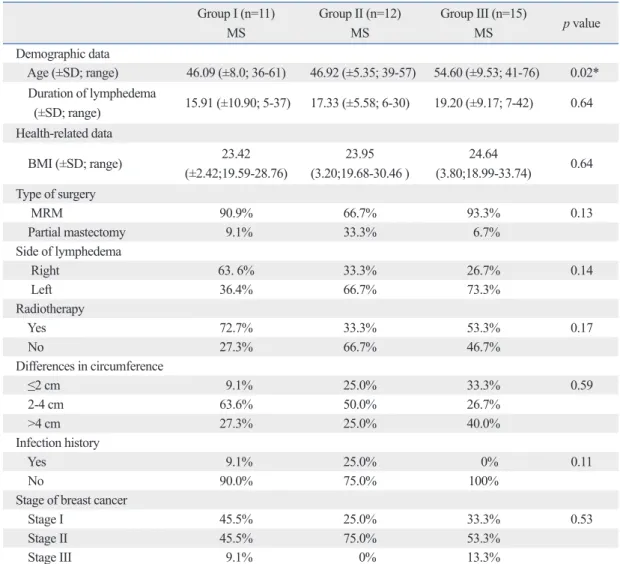
Table 1. Demographic and Health-Related Parameters for Groups I, II, and III Group I (n=11)
MS
Group II (n=12) MS
Group III (n=15)
MS p value
Demographic data
Age (±SD; range) 46.09 (±8.0; 36-61) 46.92 (±5.35; 39-57) 54.60 (±9.53; 41-76) 0.02*
Duration of lymphedema
(±SD; range) 15.91 (±10.90; 5-37) 17.33 (±5.58; 6-30) 19.20 (±9.17; 7-42) 0.64 Health-related data
BMI (±SD; range) 23.42
(±2.42;19.59-28.76)
23.95 (3.20;19.68-30.46 )
24.64
(3.80;18.99-33.74) 0.64 Type of surgery
MRM 90.9% 66.7% 93.3% 0.13
Partial mastectomy 9.1% 33.3% 6.7%
Side of lymphedema
Right 63. 6% 33.3% 26.7% 0.14
Left 36.4% 66.7% 73.3%
Radiotherapy
Yes 72.7% 33.3% 53.3% 0.17
No 27.3% 66.7% 46.7%
Differences in circumference
≤2 cm 9.1% 25.0% 33.3% 0.59
2-4 cm 63.6% 50.0% 26.7%
>4 cm 27.3% 25.0% 40.0%
Infection history
Yes 9.1% 25.0% 0% 0.11
No 90.0% 75.0% 100%
Stage of breast cancer
Stage I 45.5% 25.0% 33.3% 0.53
Stage II 45.5% 75.0% 53.3%
Stage III 9.1% 0% 13.3%
MS, mean score. Group I, no pain with normal ultrasound findings; Group II, pain with normal US findings; Group III, pain with abnormal US findings.
*p<0.05.
domain, environmental, and overall score, as compared to group III (Table 2).
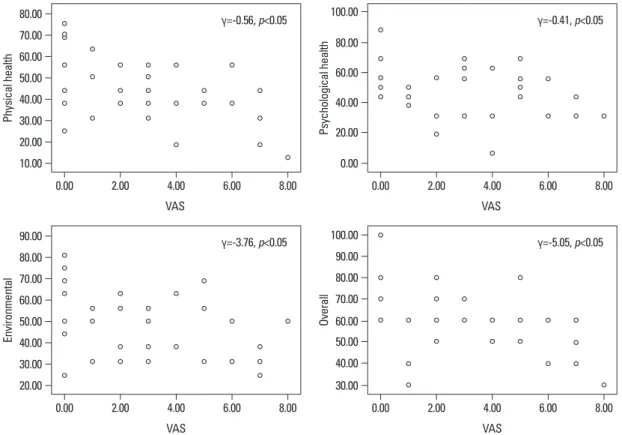
Comparison of pain, quality of life, and disability Pain scores were positively correlated with DASH scores (γ=0.558, p<0.05) and negatively correlated with WHO- QOL scores, including the physical health domain (γ=-0.56, p<0.05), psychological health domain (γ=-0.41, p<0.05), environmental domain (γ=-3.76, p<0.05), and overall score (γ=-5.05, p<0.05), with the exception of the social relation- ships domain (γ=-1.71, p=0.30) (Figs. 1 and 2).
DISCUSSION
In this study, we observed more disability and decreased QOL among patients with BCRL and shoulder pain than in patients with BCRL without shoulder pain. Furthermore, this study revealed that shoulder pain and the nature of the pathologic abnormality were the most important factors as- sociated with upper limb dysfunction (ULD) and decreased quality of life in patients with BCRL. A previous study of (81.6%) had a history of modified radical mastectomy, and
seven patients (18.4%) had a history of partial mastectomy.
Thirty-five patients (92.1%) had a history of axillary lymph- adenectomy. The demographic data for the groups are sum- marized in Table 1. The only significant difference between the groups at baseline was in mean age.
Pain and US findings
The mean pain scores using the VAS were 3.00±1.95 and 4.60±1.80 in groups II (pain with normal US) and III (pain with abnormal US), respectively. The mean pain score of group II was significantly lower than that of group III. The following findings were observed on the US of patients in group III: supraspinatus tear (8 patients, 53.3%) (partial thickness tear 75%/full thickness tear 25%), tenosynovitis (2 patients, 13.3%), acromioclavicular arthritis (2 patients, 13.3%), subdeltoid bursitis (2 patients, 13.3%) and adhe- sive capsulitis (8 patients, 53.3%).
Disability
The mean DASH score for group I (no pain with normal US) was significantly lower than those of both group III (pain with abnormal US) and group II (pain with normal US). Group II also had a significantly lower mean DASH score than group III (Table 2).
Quality of life
Group I (no pain with normal US) had a significantly high- er mean WHOQOL score, including the physical health do- main, psychological health domain, and overall score, as compared to group II (pain with normal US findings). Group II had a significantly higher mean WHOQOL score, includ- ing the physical health domain and overall score, cas om- pared to group III (pain with abnormal US findings). Group I had a significantly higher mean WHOQOL score, in- cluding the physical health domain, psychological health
Table 2. Comparison of DASH and QOL Scores among Groups I, II and III Group I (n=11)
MS (SE)
Group II (n=12) MS (SE)
Group III (n=15) MS (SE)
p value (I vs. II)
p value (I vs. III)
p value (II vs. III)
DASH 14.90 (9.32) 24.58 (16.23) 41.71 (20.88) 0.02* 0.00* 0.03*
Physical 56.45 (16.81) 43.33 (14.40) 39.00 (9.71) 0.04* 0.01* 0.02*
Psychological 61.45 (12.60) 44.83 (18.22) 44.73 (15.40) 0.03* 0.02* 0.84 Social relationships 55.64 (20.10) 48.83 (18.73) 47.74 (17.06) 0.11 0.13 0.84 Environmental 58.09 (17.00) 45.92 (12.95) 44.60 (12.21) 0.09 0.04* 0.80
Overall 73.64 (14.33) 56.67 (14.97) 53.00 (11.83) 0.02* 0.02* 0.04*
DASH, Disabilities of Arm, Shoulder and Hand; QOL, quality of life; vs. versus; MS, mean score; SE, standard deviation.
Group I, no pain with normal ultrasound findings; Group II, pain with normal US findings; Group III, pain with abnormal US findings .
*p<0.05.
Fig. 1. Correlation between Disabilities of Arm, Shoulder, and Hand (DASH) and pain scores in breast cancer-related lymphedema.
0.00 20.00 40.00 60.00 80.00 100.00
DASH
0.00 2.00 4.00 6.00 8.00
γ=0.558, p<0.05
VAS
the shoulder. As BCRL develops, the arm weighs more.
Some patients compare the feeling to carrying a heavy load with that arm. This increase in force on the rotator cuff can result in pain, bursitis, and tendonitis. In some cases, it leads to chronic injury with ischemia and tearing of the supraspi- natus muscle.11,12
Rotator cuff disease is one of the most common indica- tions for US of the shoulder region. Diagnostic US is the pri- mary imaging technique for soft-tissue injuries of the shoul- der; its advantages are dynamic examination with side-to- side comparisons of the focus of interest. Many studies have reported excellent sensitivity and specificity of ultrasound for detecting rotator cuff tears.13 Recently, one study reported that US can provide early, accurate diagnosis of adhesive capsulitis by assessing the rotator interval for hypoechoic vascular soft tissue.8 In order to achieve an accurate diagno- sis, we evaluated patients for adhesive capsulitis using US.
In this study, patients in group III (pain with abnormal US) had more severe pain than those in group II (pain with nor- mal US). Group III patients had the following US findings:
supraspinatus tear (8 patients, 53.3%) (partial thickness tear 75%/full thickness tear 25%), bicep tenosynovitis (2 patients, 13.3%), acromioclavicular arthritis (2 patients, 13.3%), sub- deltoid bursitis (2 patients, 13.3%), and adhesive capsulitis (8 patients, 53.3%). Group II patients did not have patho- ULD in breast cancer survivors showed that the prevalence
of rotator cuff disease increased with time. However, the study did not report the prevalence of rotator cuff disease in patients with BCRL.9 Herrera and Stubblefield10 with a ret- rospective case series, found that rotator cuff tendonitis is a complication of lymphedema caused by internal derange- ment of tendon fibers, which may be subject to impinge- ment, functional overload, and intrinsic tendinopathy.
Therefore, we tried to identify the shoulder pathology that causes shoulder pain and dysfunction in patients with BCRL.
To this end, we used US to assess pathologic findings in pa- tients with and without shoulder pain in BCRL. We then in- vestigated differences in ULD and QOL according to the pathologic shoulder findings. Although we see patients with shoulder pain in the context of BCRL in the clinical setting, we often do not determine the cause of the shoulder pain and have typically used physical therapy of the shoulder and complex decongestive physiotherapy without specific proper treatment. Some patients improve after complex de- congestive physiotherapy (CDT), but other patients do not, and may develop intractable pain. This study showed that shoulder pain was often not simple and could involve defi- nite structural abnormalities, which can lead to ULD and affect QOL.
The rotator cuff stabilizes the shoulder joint and abducts
10.00
20.00
0.00
30.00 20.00
30.00
20.00
40.00 30.00
40.00 40.00
50.00
40.00
50.00 50.00
60.00 60.00
70.00
60.00
60.00 70.00 70.00
80.00
80.00
90.00 80.00
80.00 100.00
100.00
Physical healthEnvironmental Psychological healthOverall
0.00
0.00
0.00
0.00 2.00
2.00
2.00
2.00 4.00
4.00
4.00
4.00 6.00
6.00
6.00
6.00 8.00
8.00
8.00
8.00 γ=-5.05, p<0.05
90.00 γ=-3.76, p<0.05
γ=-0.56, p<0.05 γ=-0.41, p<0.05
Fig. 2. Correlation of between quality of life (QOL) and pain in breast cancer-related lymphedema.
VAS
VAS VAS
VAS
heaviness in older people would have more of an effect on shoulder pathology in the elderly than in young people. Of course, we could not definitely rule out that only elderly pa- tients had more shoulder pathology regardless of arm swell- ing and heaviness, because this study was conducted in a small group. This study is the first to evaluate QOL and dis- ability in patients with BCRL-associated shoulder pain eval- uated by US, and confirmation of these results is needed with a larger sample and longer follow-up.
The results of this study showed that group III (pain with abnormal US) had more disability and poorer quality of life compared to group I (no pain with normal US) and group II (pain with normal US findings). Pathologic shoulder find- ings on US in patients with BCRL were associated with more severe pain, more disability, and poorer QOL. There- fore, proper diagnosis and treatment of shoulder pain should be performed early in patients with BCRL and pathologic findings on US of the shoulder in order to improve the quali- ty of life for patients with BCRL.
REFERENCES
1. Logan V. Incidence and prevalence of lymphoedema: a literature review. J Clin Nurs 1995;4:213-9.
2. Ridner SH. Breast cancer lymphedema: pathophysiology and risk reduction guidelines. Oncol Nurs Forum 2002;29:1285-93.
3. Hayes SC, Janda M, Cornish B, Battistutta D, Newman B. Lymph- edema after breast cancer: incidence, risk factors, and effect on upper body function. J Clin Oncol 2008;26:3536-42.
4. Pyszel A, Malyszczak K, Pyszel K, Andrzejak R, Szuba A. Dis- ability, psychological distress and quality of life in breast cancer survivors with arm lymphedema. Lymphology 2006;39:185-92.
5. McWayne J, Heiney SP. Psychologic and social sequelae of sec- ondary lymphedema: a review. Cancer 2005;104:457-66.
6. Chachaj A, Małyszczak K, Pyszel K, Lukas J, Tarkowski R, Pudełko M, et al. Physical and psychological impairments of women with upper limb lymphedema following breast cancer treatment. Psy- chooncology 2010;19:299-305.
7. Soble MG, Kaye AD, Guay RC. Rotator cuff tear: clinical experi- ence with sonographic detection. Radiology 1989;173:319-21.
8. Lee JC, Sykes C, Saifuddin A, Connell D. Adhesive capsulitis: so- nographic changes in the rotator cuff interval with arthroscopic correlation. Skeletal Radiol 2005;34:522-7.
9. Lauridsen MC, Christiansen P, Hessov I. The effect of physiother- apy on shoulder function in patients surgically treated for breast cancer: a randomized study. Acta Oncol 2005;44:449-57.
10. Herrera JE, Stubblefield MD. Rotator cuff tendonitis in lymphede- ma: a retrospective case series. Arch Phys Med Rehabil 2004;85:
1939-42.
11. Ridner SH. Quality of life and a symptom cluster associated with breast cancer treatment-related lymphedema. Support Care Cancer 2005;13:904-11.
12. Avrahami R, Gabbay E, Bsharah B, Haddad M, Koren A, Dahn J,
logic findings on the US despite experiencing shoulder pain.
This result showed that some patients with shoulder pain in patients with BCRL did not have pathologic findings by US.
The reasons for developing pain without pathologic findings could be several conditions including pectoralis tightness, myofascial pain syndrome, post-mastectomy pain syn- drome, axillary web syndrome.14 Therefore, patients with shoulder pain and pathologic findings including rotator cuff tear, bursitis, acromioclavicular arthritis, and adhesive cap- sulitis had more severe pain than patients with shoulder pain and no pathologic findings. We concluded that pathologic findings in the shoulder on US are an important factor in de- velopment of severe pain in patients with BCRL.
In the Iowa Women’s Health Study, both women with di- agnosed lymphedema and women with arm symptoms without diagnosed lymphedema had a substantially lower health-related QOL than breast cancer survivors without lymphedema or arm symptoms. Lymphedema had an im- pact on health-related QOL several years after diagnosis.15 In our study, QOL and disability were affected in patients with BCRL. Patients with shoulder pain accompanying BCRL, especially those with pathologic findings on US, appeared to have increased ULD and decreased QOL. In our evaluation of disability, patients with severe ULD had significantly more shoulder pain, and the most severe ULD was observed in patients with both shoulder pain and patho- logic findings on US. However, QOL evaluation revealed that patients with shoulder pain and pathologic findings on US had significantly lower scores overall and in the physical domain of the QOL questionnaire, but that they did not dif- fer significantly from the other patient groups in the psy- chological, environmental, and social relationship domains.
These results suggest that pathologic shoulder findings on US more easily affect a patient’s physical life than their psy- chological, social, or environmental life. Therefore, patients with shoulder pain and pathologic shoulder findings in the setting of BCRL require proper treatment, including US- guided injection, medication, and appropriate physiotherapy.
The limitations of this study include the small number of patients and their recruitment from only one hospital. Be- cause of this, the participants may not adequately represent the general population of patients with shoulder pain in the setting of BCRL. In addition, age between groups was dif- ferent and the patients in group III were older than those in the groups. Generally, older people tend to have less strength in the shoulders and a lower blood supply to the supraspi- natus tendon than younger people. Thus, arm swelling and
dinal change of treatment-related upper limb dysfunction and its impact on late dysfunction in breast cancer survivors: a prospec- tive cohort study. J Surg Oncol 2010;101:84-91.
15. Ahmed RL, Prizment A, Lazovich D, Schmitz KH, Folsom AR.
Lymphedema and quality of life in breast cancer survivors: the Iowa Women’s Health Study. J Clin Oncol 2008;26:5689-96.
et al. Severe lymphedema of the arm as a potential cause of shoul- der trauma. Lymphology 2004;37:202-5.
13. Lew HL, Chen CP, Wang TG, Chew KT. Introduction to musculo- skeletal diagnostic ultrasound: examination of the upper limb. Am J Phys Med Rehabil 2007;86:310-21.
14. Yang EJ, Park WB, Seo KS, Kim SW, Heo CY, Lim JY. Longitu-