Diagnostic Performance of Thyroglobulin Value in Indeterminate Range in Fine Needle Aspiration Washout Fluid
from Lymph Nodes of Thyroid Cancer
Yu-Mee Sohn,
1Min Jung Kim,
2Eun-Kyung Kim,
2and Jin Young Kwak
21Department of Radiology, Kyung Hee University Hospital, College of Medicine, Kyung Hee University, Seoul;
2Department of Radiology, Research Institute of Radiological Science, Yonsei University College of Medicine, Seoul, Korea.
Received: February 8, 2011 Revised: April 13, 2011 Accepted: April 21, 2011
Corresponding author: Dr. Min Jung Kim, Department of Radiology,
Yonsei University College of Medicine, 50 Yonsei-ro, Seodaemun-gu Seoul 120-752, Korea.
Tel: 82-2-2228-7400, Fax: 82-2-393-3035 E-mail: [email protected]
∙ The authors have no financial conflicts of interest.
© Copyright:
Yonsei University College of Medicine 2012 This is an Open Access article distributed under the terms of the Creative Commons Attribution Non- Commercial License (http://creativecommons.org/
licenses/by-nc/3.0) which permits unrestricted non- commercial use, distribution, and reproduction in any medium, provided the original work is properly cited.
Purpose: The purpose was to compare the frequency of metastatic and nonmeta- static lymph nodes diagnosed by fine needle aspiration biopsy cytology (FNAC) and thyroglobulin concentration from fine needle aspiration biopsy washout fluid (FNAB-Tg) in an indeterminate range (0.2-100 ng/mL), and to evaluate the most appropriate threshold value of FNAB-Tg in an indeterminate range. Materials and Methods: We performed ultrasound-guided FNAB and FNAB-Tg in suspi- cious metastatic cervical lymph nodes of papillary thyroid carcinoma and per- formed surgery. Ninety-five lymph nodes with indeterminate values of FNAB-Tg ranging from 0.2-100 ng/mL in ninety-two patients were included in this study.
The diagnostic performances in multiple Tg levels (0.7, 1.0, 5.0, 10.0, 20.0, 50.0) were evaluated to compare with FNAB cytology using sensitivity, specificity, and accuracy with area under the curve (AUC) analysis. Results: Forty-two were met- astatic lymph nodes and fifty three were nonmetastatic lymph nodes. FNAB-Tg ranged from 0.22 to 90.9 ng/mL in metastatic lymph nodes (mean; 34.3±33.3 ng/
mL) and 0.20 to 56.7 ng/mL in nonmetastatic lymph nodes (mean; 4.9±11.1 ng/
mL) (p<0.001). The most excellent diagnostic performance was displayed in 5 ng/
mL of FNAB-Tg with AUC of 0.76, sensitivity, specificity, accuracy, 69.0, 83.0, and 76.8, respectively. However, there was no significant difference from 10 ng/
mL FNAB. Conclusion: We ascertained that 5 ng/mL yielded the most excellent diagnostic performance among FNAB-Tg levels in the present setting with a large series with the indeterminate range (0.2-100 ng/mL) of FNAB-Tg values. These results need additional confirmation under different laboratory conditions.
Key Words: Fine needle aspiration biopsy, thyroglobulin, lymph nodes
INTRODUCTION
Ultrasound (US) and US-guided fine needle aspiration biopsy (US-FNAB) are well-known trustworthy diagnostic tools for cervical metastasis of differentiated papillary thyroid cancer (DPTC) by preoperative cytological analysis and recur- rence after thyroid surgery.1-4 Moreover, in addition to fine needle aspiration biop-
ng/mL in nonmetastatic lymph nodes.3,7 The lowest limit of the Tg measurement was designated as 0.2 ng/mL for ana- lytical sensitivity and as 0.7 ng/mL for functional sensitivi- ty, calculated with the imprecision profile for a coefficient of variation equal to 20%.
Of all 691 patients with 702 lymph nodes, 557 lymph nodes in 554 patients were excluded because they had higher (>100 ng/mL) or lower (<0.2 ng/mL) Tg values. Fifty lymph nodes in 45 patients from 145 lymph nodes in 137 patients were also excluded due to the absence of histologic confir- mation. Finally, 95 lymph nodes in 92 patients made up this analysis. All 92 patients had no prior surgery with cytologi- cally confirmed papillary carcinoma.
Imaging evaluation and ultrasound-guided fine needle aspiration and Tg test
US evaluation of cervical lymph nodes was undertaken us- ing a 7- to 15-MHz linear array transducer (HDI 5000;
Philips Medical Systems, Bothell, WA, USA) and a 5- to 12-MHz linear array transducer (iU22; Philips Medical Systems). Compound imaging was performed in all cases.
We performed US-FNAB of lateral lymph nodes with US features suspicious for metastases at our institution.
Suspicious US features of lymph nodes included the loss of fatty hilum, cystic change, calcification, hyperechogenicity (higher echogenicity than the surrounding muscles), and round shape (long/transverse diameter ratio <1.5).2,19-23 How- ever, we did not perform US-FNAB of central lymph nodes with suspicious US features in patients who were scheduled for thyroidectomy because routine central lymph node dis- sections were performed at the time of thyroidectomy.
US-FNAB was performed by one of three radiologists, K.E.K., K.J.Y., and K.M.J., who have 10, 6, and 4 years of experience in thyroid imaging, respectively, and who were aware of the patients’ clinical history. US-FNAB was per- formed with a 23-gauge needle attached to a 2-mL dispos- able plastic syringe. Each lesion was aspirated at least twice.
The materials obtained from FNAB were smeared on glass slides.24 All smears were placed in 95% alcohol for Papani- colau staining and the remaining aspirates in the syringe and needle were rinsed with normal saline and 1 mL of rinsed washout was submitted for Tg measurements (FNAB-Tg).
Positive cytology was defined as a metastatic lymph node of thyroid carcinoma, and negative cytology included be- nign cytology such as reactive lymph nodes or other benign lymphadenitis and paucicellular cytology due to insuffi- cient material.2,3
sy cytology (FNAC) examination, thyroglobulin (Tg) mea- surements from FNAB washout fluid have been reported as an important supplemental tool for diagnosis of metastatic thyroid cancer with excellent diagnostic performance.2,3,5-18 However, various threshold Tg values have been report- ed.2,3,5-14,16,17 That is because Tg values are represented as a wide range in metastatic and nonmetastatic lymph nodes and the different techniques of FNAB-Tg measurements were used with different analytical and functional sensitivi- ty.3,6,8-11,13,14,17 We suggested 10 ng/mL as a positive (meta- static lymph node) reference or 1 ng/mL as a negative refer- ence (nonmetastatic lymph node) for the threshold value.3 In cases of Tg values lower than 10 ng/mL, recommenda- tion by clinical occasion and imaging was proposed.3 How- ever, in a previous study,3 there were too few cases with in- determinate Tg values covered between nonmetastatic and metastatic lymph nodes to verify the statistical significance of diagnostic potential. To the best of our knowledge, re- search into the diagnostic performance of Tg measurement in a large series with an indeterminate range (0.2-100 ng/
mL) has rarely been reported.
Therefore, in this study, we intended to compare the fre- quency of metastatic and nonmetastatic lymph nodes diag- nosed by FNAC and FNAB-Tg in an indeterminate range (0.2-100 ng/mL) and to identify the most appropriate thresh- old value of FNAB-Tg.
MATERIALS AND METHODS
The institutional review board approved this retrospective observational study and required neither patient approval nor patient informed consent for the review of their images and records.
Patients
From January to December 2008, 691 consecutive patients underwent FNAB and FNAB-Tg measurement for suspi- cious metastatic cervical lymph nodes of papillary thyroid carcinoma at our institution. Informed consent was ob- tained from all patients before FNAB.
Indeterminate range of FNAB-Tg measurements In the published literature, there were no known false posi- tives with Tg levels higher than 100 ng/mL.2,3,6-14,17 As such, the positive predictive value was 100% with Tg levels higher than 100 ng/mL, so we included the Tg levels lower than 100
were compared. Each Tg threshold value was then compared with the threshold value with the highest AUC in diagnostic performances. Statistical differences between AUC values were evaluated by the method from the DeLong, et. al.25 re- port. Statistical analyses were conducted with SAS version 9.1 (SAS Institute Inc., Cary, NC, USA).
RESULTS
FNAC/FNAB-Tg vs. final diagnosis
On FNAC, seventy-eight lymph nodes had negative cytolo- gy and seventeen lymph nodes had positive cytology. Upon final diagnosis, 42 (44.2%) lymph nodes were metastatic and 53 (55.8%) lymph nodes were nonmetastatic. In nega- tive cytologic results, the frequency of metastatic lymph nodes was 32.1% (n=25) and that of nonmetastatic lymph nodes was 67.9% (n=53); in positive cytologic results, they were 100% (n=17) and 0 % (n=0), respectively (p<0.0001).
Of the 78 cases with negative cytology, 25 cases (32%) were confirmed as metastases by surgery. Fourteen (56%) among these 25 had negative cytology, and the remaining eleven cases (44%) had paucicellular cytology deemed as negative cytology. The diagnostic performance of FNAC was as fol- lows: sensitivity, specificity, PPV, NPV, accuracy, and AUC were 40.5, 100, 100, 67.9, 73.7, and 0.70 (95% CI, 0.6273- 0.7775), respectively.
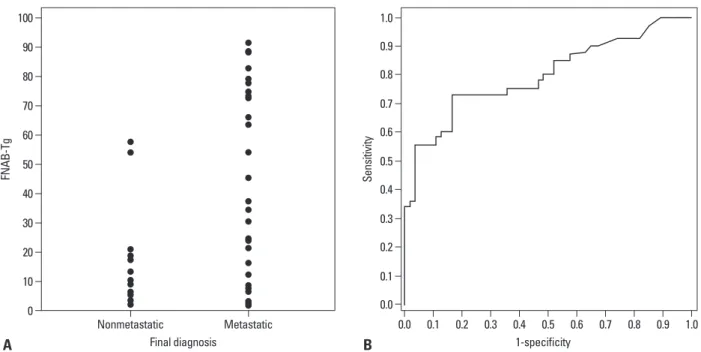
Tg levels of metastatic and nonmetastatic lymph nodes upon final diagnosis are shown in Fig. 1. The AUC is 0.799 (95% CI, 0.7063-0.8949). The value of FNA-Tg ranged from 0.22 to 90.9 ng/mL in metastatic lymph nodes (mean, 34.3±33.3 ng/mL) and 0.20 to 56.7 ng/mL in nonmetastatic lymph nodes (mean, 4.9±11.1 ng/mL). There was a signifi- cant difference between metastatic and nonmetastatic lymph nodes (p<0.0001).
Comparison of diagnostic performances
Table 1 shows the diagnostic performances in six diagnos- tic threshold values of FNAB-Tg. 10.0 ng/mL of FNAB-Tg had a good diagnostic performance with sensitivity, speci- ficity, and accuracy as 59.5, 86.8, and 74.7, respectively, with 0.73 of AUC (95% CI, 0.6435-0.8197). The most ex- cellent diagnostic performance was displayed in 5.0 ng/mL of FNAB-Tg with 0.76 of AUC (95% CI, 0.6731-0.8476), sensitivity, specificity, and accuracy as 69.0, 83.0, and 76.8, respectively; however, it was not significantly different from 10.0 ng/mL and 20.0 ng/mL in terms of sensitivity, specific- Tg was assayed with a monoclonal antibody immunora-
diometric assay (IRMA; CIS Bios international, Gif-surv- Yvette, France). FNA washout samples were not assayed for Tg autoantibodies because previous studies have reported that FNAB-Tg measurements were not affected by serum autoantibodies.10,11,17 The smallest detectable Tg concentra- tion different from zero with a probability of 95% was desig- nated as 0.2 ng/mL. The diagnostic performances of multiple Tg levels (0.7, 1.0, 5.0, 10.0, 20.0, 50.0) were evaluated.
Surgical protocol and histopathological analyses
When cytology results revealed positive cytology in lymph nodes, an unilateral modified neck dissection was per- formed as the initial thyroid surgery. However, a selective frozen section was performed as the initial thyroid surgery in patients with lymph nodes with suspicious US features but negative cytology. A selective dissection was done in patients who had already undergone a total thyroidectomy.
We evaluated the final results of the aspirated lymph nodes in a level-by-level analysis, and compared them to the pa- thology reports. On pathologic results, positive lymph nodes were defined as metastatic and negative lymph nodes were defined as nonmetastatic.
Statistical analyses
The reference standards were set by the pathology results of the lymph node dissection. The Chi-square test was used to compare the frequency of positive and negative lymph nodes diagnosed by FNAC and by FNAB-Tg in an indeter- minate range (0.2-100 ng/mL) when the threshold value was designated as 10 ng/mL as suggested by prior studies.3,9,10,17 The statistical difference in Tg measurements of metastatic and nonmetastatic lymph nodes in the final diagnosis was assessed by Wilcoxon rank-sum test because these mea- surements had no normal distribution. The diagnostic per- formance, including sensitivity, specificity, accuracy, posi- tive predictive value (PPV), and negative predictive value (NPV), was evaluated. Receiver operating characteristic (ROC) curve analysis was performed to assess the appro- priate threshold value of FNAB-Tg levels for multiple diag- nostic threshold values of Tg. The area under the ROC curve (AUC) and the 95% confidence interval (CI) were also cal- culated. If the given Tg value was larger than the respective threshold Tg value, it was deemed a positive Tg value.
Using the generalized estimation equation method, the diagnostic performances (sensitivity, specificity, accuracy, PPV, and NPV) of each threshold value mentioned above
confirmed as metastases upon final diagnosis (32%). In these 25 cases, FNAB-Tg ranged from 0.22 to 88.34 ng/mL. Al- though seven cases were categorized as a negative Tg value by all six threshold values, 13 cases (52%) were categorized as a positive Tg value by 10 ng/mL, 15 cases (60%) by 5 ng/mL, 18 cases (72%) by 0.7 or 1 ng/mL, and eight cases (32%) were categorized as a positive Tg value by all six threshold values.
DISCUSSION
Taking Tg measurements from FNAB washout fluid was proposed by Pacini, et al.16 for the early detection of cervi- cal lymph node metastases in DPTC, and they reported that ity, accuracy, PPV, NPV, and AUC (p>0.05). Between com-
parison with Tg threshold 10 ng/mL, the specificity and PPV of 0.7 ng/mL and 1.0 ng/mL were significantly lower and the sensitivity of 0.7 ng/mL and 1.0 ng/mL was signifi- cantly higher (p<0.05). The accuracy of 0.7 ng/mL was sig- nificantly lower (p<0.05). The sensitivity and NPV of 50.0 ng/mL were significantly lower (p<0.05). In the AUC, there was no significant difference between 10 ng/mL and other Tg values. Compared to the Tg threshold of 5.0 ng/mL, which had the highest AUC, the specificity, accuracy, PPV, and AUC of 0.7 ng/mL and 1.0 ng/mL were significantly lower (p<0.05). The sensitivity and NPV of 50.0 ng/mL were sig- nificantly lower (p<0.05).
Among the 78 cases with negative cytology, 25 cases were
Fig. 1. Thyroglobulin concentration from fine needle aspiration biopsy washout fluid (FNAB-Tg) and final diagnosis. (A) The distribution of FNAB-Tg values is displayed according to the final diagnosis of 95 lymph nodes. The mean value of FNAB-Tg is 35.09 ng/mL in metastatic lymph nodes and 4.87 ng/mL in non- metastatic lymph nodes. (B) Receiver operator characteristics for FNAB-Tg in this study. The area under the curve is 0.799 (95% confidence interval 0.7063- 0.8949).
Table 1. Diagnostic Performances of FNAC and Various FNAB-Tg Threshold Values in 95 Proven Lymph Nodes with Indeter- minate Levels of FNAB-Tg
Diagnostic
performance With FNAB-Tg alone
Sensitivity Specificity PPV NPV Accuracy AUC (95% CI)
FNAC 40.5 (17/42) 100 (53/53) 100 (17/17) 67.9 (53/78) 73.7 (70/95) 0.70 (0.6273-0.7775) FNAB-Tg (0.7) 80.9 (34/42) 49.1 (26/53) 55.7 (34/61) 76.5 (26/34) 63.2 (60/95) 0.65 (0.5593-0.7407) FNAB-Tg (1) 80.9 (34/42) 52.8 (28/53) 57.6 (34/59) 77.8 (28/36) 65.3 (62/95) 0.67 (0.5783-0.7595) FNAB-Tg (5) 69.0 (29/42) 83.0 (44/53) 76.3 (29/38) 77.2 (44/57) 76.8 (73/95) 0.76 (0.6731-0.8476) FNAB-Tg (10) 59.5 (25/42) 86.8 (46/53) 78.1 (25/32) 73.0 (46/63) 74.7 (71/95) 0.73 (0.6435-0.8197) FNAB-Tg (20) 52.4 (22/42) 96.2 (51/53) 91.7 (22/24) 71.8 (51/71) 76.8 (73/95) 0.74 (0.6623-0.8237) FNAB-Tg (50) 35.7 (15/42) 96.2 (51/53) 88.2 (15/17) 65.4 (51/78) 69.5 (66/95) 0.66 (0.5819-0.7375) FNAC, fine needle aspiration cytology; FNAB-Tg, thyroglobulin concentration from fine needle aspiration biopsy washout fluid; AUC, area under the curve;
PPV, positive predictive value; NPV, negative predictive value; 95% CI, 95% confidence interval.
The numbers in parentheses indicate the numbers of cases.
0 0.0
10 0.1
20 0.2
30 0.3
40 0.4
50 0.5
60 0.6
70 0.7
80 0.8
90 0.9
100 1.0
FNAB-Tg Sensitivity
Nonmetastatic Metastatic 0.0 0.1 0.2 0.3 0.4 0.5 0.6 0.7 0.8 0.9 1.0
Final diagnosis 1-specificity
A B
cluded an overlapped range between nonmetastatic and metastatic lymph nodes. However, a Tg value with less than 0.2 ng/mL and more than 100 ng/mL can be straight- forwardly classified as nonmetastatic and metastatic lymph nodes, respectively. Therefore, if the aforementioned ranges (<0.2 ng/mL and >100 ng/mL) were included, the AUC would be much higher than in the previous studies.3,6
There were limitations to this study: first, there was no evaluation of diagnostic accuracy when the prespecified threshold values were combined with FNAC or directly compared with FNAC. We did not include the combination with FNAC because it can affect the diagnostic accuracy of FNAB-Tg. According to published reports,2,3,5-8,10-14,16 when FNAC was combined with FNAB-Tg, its sensitivity was increased to 96-100%. However, we would like to focus on assessing the complementary role and appropriate cutoff value for FNAB-Tg itself. Second, we did not compare the metastatic lymph nodes with higher FNAB-Tg and those with intermediate or lower FNAB-Tg. Further study of the details of the histology or prognosis of the metastatic lymph nodes at this level of FNAB-Tg value will be necessary to overcome this limitation. Third, even though we used 1 mL rinsed washout with normal saline, there may be a difference in the delicate diluted concentration of the washout. A more accurate quantitative analytic method should be developed to compensate for this limitation. Fourth, even though a re- cent study17 using measurements of FNAB albumin report- ed interference by the serum Tg can be negligible to FNAB- Tg results. However, this report17 showed much higher levels of FNAB-Tg measurements than did the present study. The negligibility of interference by the serum Tg in the low or in- termediate FNAB-Tg measurements in this study must be solved by further investigation. Lastly, our study was retro- spective, and we recruited cases with histologic confirma- tion, so we could not evaluate changes in surgical strategy based on FNAB-Tg results and also did not correlate or compare FNAB-Tg with corresponding serum Tg levels.
Further study will be necessary to clarify these limitations.
In conclusion, we ascertained that 5 ng/mL had the most excellent diagnostic performance among FNAB-Tg levels in the present setting with a large series with an indetermi- nate range (0.2-100 ng/mL) of FNAB-Tg values. However, these results also need additional confirmation under differ- ent laboratory conditions, because there were no significant differences between the results for 5 and 10 ng/mL. Neck node dissection should be considered when FNAB-Tg is higher than this threshold value, regardless of FNAC results, its use in combination with FNAC had better diagnostic
performance than FNAC alone.5-14,16,17 Many studies have reported an increased sensitivity of FNAB-Tg.5-14,16,17 FNAB- Tg could contribute especially to the diagnosis of poor cel- lular material obtained from cystic metastasis.12 However, various threshold values have been suggested,2,3,6-14,16,17 part- ly because the indeterminate Tg ranged cases (0.2-100 ng/
mL) showed a prevalence too low to provide statistically significant results. Tg also can be detected in FNAB wash- out fluid from even nonmetastatic lymph nodes in the pres- ence of a thyroid gland and Tg can have a wide range in nonmetastatic and metastatic lymph nodes. Moreover, vari- ous techniques of FNAB-Tg assay were used with different analytical and functional sensitivities.3,8-11,14,17
Although one study3 included the largest numbers of pa- tients among the published literature, there were only 22 cases (13.1% of 168 cases) with indeterminate Tg values, which may be covered between nonmetastatic and metastatic lymph nodes to verify the statistical significance of diag- nostic potential. In the published studies, it is difficult to es- timate the exact number of cases with an indeterminate range of Tg values in each study. However, the current study included more than four times the number of cases with an indeterminate Tg range than the prior study3 with the larg- est population among all those published on this subject.3,8
In most prior studies of the wide range of FNAB-Tg, the mean+2 standard deviation,3,10,12,14,16 the mean+standard de- viation,11 10 ng/mL,3,9,10,17 and more than serum Tg2,3,7,8 have been reported as threshold values that differentiate nonmet- astatic from metastatic lymph nodes. Only one study re- ported 1 ng/mL as a threshold value,6 and another designat- ed it as 0.9 ng/mL.13 However, these studies covered a wide range of FNAB-Tg including over 100 ng/mL.3,6-8,10-14,17
The cutoff values suggested were determined by the ex- treme end of the wide spectrum of FNAB-Tg values rather than the indeterminate values.
In Kim, et al’s.3 report, the Tg threshold value was sug- gested as 10 ng/mL to differentiate nonmetastatic and meta- static lymph nodes. With a large series of indeterminate ranges, 5 ng/mL showed the highest AUC (0.76; 95% CI, 0.6731-0.8476) and there was no significant difference from 10 ng/mL; however, three levels including 0.7, 1.0, and 50.0 ng/mL were not recommended due to low AUC and sensitivity. In the present study, the overall AUC of FNAB-Tg was 0.799. This result was not so high compared to the AUC (0.955-0.999) of the previous studies.3,6 This is because the Tg measurements of the present study only in-
ence of circulating anti-Tg antibodies. J Clin Endocrinol Metab 2006;91:1364-9.
12. Cignarelli M, Ambrosi A, Marino A, Lamacchia O, Campo M, Picca G, et al. Diagnostic utility of thyroglobulin detection in fine- needle aspiration of cervical cystic metastatic lymph nodes from papillary thyroid cancer with negative cytology. Thyroid 2003;13:
1163-7.
13. Cunha N, Rodrigues F, Curado F, Ilhéu O, Cruz C, Naidenov P, et al. Thyroglobulin detection in fine-needle aspirates of cervical lymph nodes: a technique for the diagnosis of metastatic differen- tiated thyroid cancer. Eur J Endocrinol 2007;157:101-7.
14. Frasoldati A, Toschi E, Zini M, Flora M, Caroggio A, Dotti C, et al. Role of thyroglobulin measurement in fine-needle aspiration biopsies of cervical lymph nodes in patients with differentiated thyroid cancer. Thyroid 1999;9:105-11.
15. Lima N, Cavaliere H, Tomimori E, Knobel M, Medeiros-Neto G.
Prognostic value of serial serum thyroglobulin determinations af- ter total thyroidectomy for differentiated thyroid cancer. J Endo- crinol Invest 2002;25:110-5.
16. Pacini F, Fugazzola L, Lippi F, Ceccarelli C, Centoni R, Miccoli P, et al. Detection of thyroglobulin in fine needle aspirates of nonthy- roidal neck masses: a clue to the diagnosis of metastatic differenti- ated thyroid cancer. J Clin Endocrinol Metab 1992;74:1401-4.
17. Borel AL, Boizel R, Faure P, Barbe G, Boutonnat J, Sturm N, et al. Significance of low levels of thyroglobulin in fine needle aspi- rates from cervical lymph nodes of patients with a history of dif- ferentiated thyroid cancer. Eur J Endocrinol 2008;158:691-8.
18. Bruno R, Giannasio P, Chiarella R, Capula C, Russo D, Filetti S, et al. Identification of a neck lump as a lymph node metastasis from an occult contralateral papillary microcarcinoma of the thy- roid: key role of thyroglobulin assay in the fine-needle aspirate.
Thyroid 2009;19:531-3.
19. Miseikyte-Kaubriene E, Trakymas M, Ulys A. Cystic lymph node metastasis in papillary thyroid carcinoma. Medicina (Kaunas) 2008;44:455-9.
20. Fish SA, Langer JE, Mandel SJ. Sonographic imaging of thyroid nodules and cervical lymph nodes. Endocrinol Metab Clin North Am 2008;37:401-17.
21. Kuna SK, Bracic I, Tesic V, Kuna K, Herceg GH, Dodig D. Ultra- sonographic differentiation of benign from malignant neck lymph- adenopathy in thyroid cancer. J Ultrasound Med 2006;25:1531-7.
22. Park JS, Son KR, Na DG, Kim E, Kim S. Performance of preop- erative sonographic staging of papillary thyroid carcinoma based on the sixth edition of the AJCC/UICC TNM classification sys- tem. AJR Am J Roentgenol 2009;192:66-72.
23. Rosário PW, de Faria S, Bicalho L, Alves MF, Borges MA, Purisch S, et al. Ultrasonographic differentiation between meta- static and benign lymph nodes in patients with papillary thyroid carcinoma. J Ultrasound Med 2005;24:1385-9.
24. Lee MJ, Hong SW, Chung WY, Kwak JY, Kim MJ, Kim EK. Cy- tological results of ultrasound-guided fine-needle aspiration cytol- ogy for thyroid nodules: emphasis on correlation with sonographic findings. Yonsei Med J 2011;52:838-44.
25. DeLong ER, DeLong DM, Clarke-Pearson DL. Comparing the areas under two or more correlated receiver operating characteris- tic curves: a nonparametric approach. Biometrics 1988;44:837-45.
to improve sensitivity and maintain specificity of FNAC. Ad- ditionally, US features predicting lymph node metastasis also deserve consideration in the appropriate interpretation of lymph node metastasis.
REFERENCES
1. Boland GW, Lee MJ, Mueller PR, Mayo-Smith W, Dawson SL, Simeone JF. Efficacy of sonographically guided biopsy of thyroid masses and cervical lymph nodes. AJR Am J Roentgenol 1993;
161:1053-6.
2. Jeon SJ, Kim E, Park JS, Son KR, Baek JH, Kim YS, et al. Diag- nostic benefit of thyroglobulin measurement in fine-needle aspira- tion for diagnosing metastatic cervical lymph nodes from papillary thyroid cancer: correlations with US features. Korean J Radiol 2009;10:106-11.
3. Kim MJ, Kim EK, Kim BM, Kwak JY, Lee EJ, Park CS, et al.
Thyroglobulin measurement in fine-needle aspirate washouts: the criteria for neck node dissection for patients with thyroid cancer.
Clin Endocrinol (Oxf) 2009;70:145-51.
4. Takashima S, Sone S, Nomura N, Tomiyama N, Kobayashi T, Na- kamura H. Nonpalpable lymph nodes of the neck: assessment with US and US-guided fine-needle aspiration biopsy. J Clin Ul- trasound 1997;25:283-92.
5. Lee MJ, Ross DS, Mueller PR, Daniels GH, Dawson SL, Sime- one JF. Fine-needle biopsy of cervical lymph nodes in patients with thyroid cancer: a prospective comparison of cytopathologic and tissue marker analysis. Radiology 1993;187:851-4.
6. Snozek CL, Chambers EP, Reading CC, Sebo TJ, Sistrunk JW, Singh RJ, et al. Serum thyroglobulin, high-resolution ultrasound, and lymph node thyroglobulin in diagnosis of differentiated thy- roid carcinoma nodal metastases. J Clin Endocrinol Metab 2007;
92:4278-81.
7. Uruno T, Miyauchi A, Shimizu K, Tomoda C, Takamura Y, Ito Y, et al. Usefulness of thyroglobulin measurement in fine-needle as- piration biopsy specimens for diagnosing cervical lymph node metastasis in patients with papillary thyroid cancer. World J Surg 2005;29:483-5.
8. Sigstad E, Heilo A, Paus E, Holgersen K, Grøholt KK, Jørgensen LH, et al. The usefulness of detecting thyroglobulin in fine-needle aspirates from patients with neck lesions using a sensitive thyro- globulin assay. Diagn Cytopathol 2007;35:761-7.
9. Baloch ZW, Barroeta JE, Walsh J, Gupta PK, Livolsi VA, Langer JE, et al. Utility of Thyroglobulin measurement in fine-needle as- piration biopsy specimens of lymph nodes in the diagnosis of re- current thyroid carcinoma. Cytojournal 2008;5:1.
10. Baskin HJ. Detection of recurrent papillary thyroid carcinoma by thyroglobulin assessment in the needle washout after fine-needle aspiration of suspicious lymph nodes. Thyroid 2004;14:959-63.
11. Boi F, Baghino G, Atzeni F, Lai ML, Faa G, Mariotti S. The diag- nostic value for differentiated thyroid carcinoma metastases of thyroglobulin (Tg) measurement in washout fluid from fine-needle aspiration biopsy of neck lymph nodes is maintained in the pres-