Knowledge and Acceptability about Adult Pertussis Immunization in Korean Women of Childbearing Age
Hyun Sun Ko,
1Yun Seong Jo,
1Yeun Hee Kim,
1Yong-Gyu Park,
2Jeong Ha Wie,
1Juyoung Cheon,
1Hee Bong Moon,
3Young Lee,
1and Jong Chul Shin
1Departments of 1Obstetrics and Gynecology and 2Biostatistics, College of Medicine, The Catholic University of Korea, Seoul;
3Department of Obstetrics and Gynecology, Mizpark Women’s Hospital, Hwaseong, Korea.
Received: April 16, 2014 Revised: August 14, 2014 Accepted: September 2, 2014
Corresponding author: Dr. Jong Chul Shin, Department of Obstetrics and Gynecology, College of Medicine, The Catholic University of Korea, Seoul St. Mary’s Hospital, 222 Banpo-daero, Seocho-gu, Seoul 137-701, Korea.
Tel: 82-2-2258-3021, Fax: 82-2-595-1549 E-mail: [email protected]
∙ The authors have no financial conflicts of interest.
© Copyright:
Yonsei University College of Medicine 2015 This is an Open Access article distributed under the terms of the Creative Commons Attribution Non- Commercial License (http://creativecommons.org/
licenses/by-nc/3.0) which permits unrestricted non- commercial use, distribution, and reproduction in any medium, provided the original work is properly cited.
Purpose: The adult tetanus, reduced diphtheria, and acellular pertussis (Tdap) vac- cine has been introduced in order to provide individual protection and reduce the risk of transmitting pertussis to infants. We assessed the knowledge and acceptabili- ty of the Tdap vaccine around pregnancy. Materials and Methods: This study was a cross-sectional survey of women of childbearing age (20‒45 years) who visited obstetrics and gynecologic units of primary, secondary, or tertiary hospitals. They were asked to fill in a questionnaire assessing their knowledge, attitudes, and ac- ceptability of Tdap. Results: The questionnaire was completed by 308 women; 293 (95.1%) had not received information from doctors about Tdap, and 250 (81.2%) did not know about the need for vaccination. A significantly important factor related to subjects’ intention to be vaccinated, identified by stepwise multiple logistic re- gression, was the knowledge (OR 13.5, CI 3.92‒46.33) that adult Tdap is effective in preventing pertussis for infants aged 0‒6 months. Additionally, 276 (89.6%) con- sidered the recommendation of obstetric doctors as the most influencing factor about Tdap vaccination. Conclusion: In Korea, most women of childbearing age seem to be neither recommended nor adequately informed about the vaccination, although our population was not a nationwide representative sample. Information given by healthcare workers may be critical for improving awareness and prevent- ing pertussis.
Key Words: Pertussis, immunization, knowledge, acceptability
INTRODUCTION
Pertussis, or whooping cough, is a highly contagious respiratory tract disease caused by Bordetella pertussis. Pertussis can be an important cause of morbidity and mor- tality in young infants under the age of 6 months, although it affects people of all ages.1 Despite widespread immunization against pertussis among infants and chil- dren since the 1950s, pertussis has remained endemic. There has been gradual in- crease after a nadir in 1976, and substantial increases since 2000.2 The waning of vaccine-acquired immunity and decreased opportunities for boosting of immunity are considered as main reasons for the reemergence of pertussis.2-4
of 18 multiple choice questions included respondents’ de- mographic characteristics, perceived risk of infant pertussis, concern about the safety of Tdap, access to information about Tdap, possible barriers about Tdap, and, finally, the most important factor influencing a woman’s decision to ac- cept or decline the vaccine.
Statistical analyses
The primary outcome variable was each woman’s response to the question about their intention to accept or decline Tdap given the assumption that maternal Tdap effectively prevents infant pertussis. We analyzed the frequency of each response in relation to all variables including demographic characteristics, knowledge, attitude, and risk perception in this study. A chi-square test or Fisher’s exact test was used to identify significant associations between women’s intentions to vaccinate or not and their survey responses. All variables with p<0.10 in univariate analyses were entered into the multivariable logistic model to identify factors associated with acceptance or declination of Tdap immunization. Vari- ables that had originally been entered into the model were then removed if considered non-significant, and this was done in a stepwise fashion. All statistical analyses were con- ducted using SAS version 12.1. A p-value of 0.05 or less was considered significant.
RESULTS
Demographic characteristics
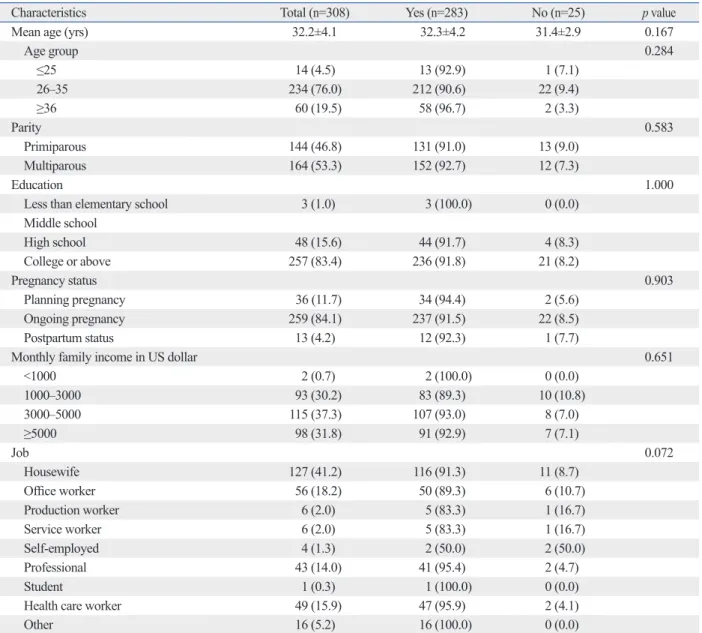
During the study period, 437 women of childbearing age re- siding within the geographic area were approached, and of these, 342 were planning pregnancy, pregnant, or within 6 months postpartum and therefore eligible to participate. Ul- timately, 317 of the eligible women agreed to participate, and 308 had complete survey responses, resulting in a complete survey response rate of 97.2%. Demographic characteristics are presented in Table 1.
Baseline characteristics of total population was same with the previous publication.11 Groups were separated according to intention regarding Tdap vaccination. There was no sig- nificant difference among groups according to maternal age, parity, education level, pregnancy status, monthly family in- come level, or occupation.
Knowledge and attitudes related to Tdap vaccination Women’s knowledge about pertussis and attitudes in relation Perinatal vaccination of close contacts of infants is known
as cocooning. Since 2006, the Advisory Committee on Im- munization Practices (ACIP) of the US Centers for Disease Control and Prevention (CDC) has recommended tetanus toxoid, reduced diphtheria toxoid, and acellular pertussis (Tdap) vaccination for household contacts of very young in- fants, with particular emphasis on mothers getting vaccinat- ed in the postpartum period.5
Korean government began to recommend routine diph- theria, tetanus, and whole cell pertussis (DTwP) vaccination in 1954 and introduced the diphtheria, tetanus, and acellular pertussis (DTaP) vaccine into the National Immunization Program in 1989. It has since been successful in controlling pertussis, with low numbers of reported cases until the 2000s.6,7 However, there has been increasing in the reported number of pertussis-case patients during the last decade.8 In 2009, the Tdap vaccine was licensed in Korea for use in ad- olescents (aged more than 11 years) and adults.9
Adults and adolescents in close contact with infants are a potential transmission source of pertussis.10 Therefore, aware- ness and understanding in women of childbearing age is criti- cal for effective Tdap vaccine implementation. This study aimed to assess the knowledge of pertussis infection among women of childbearing age and their attitudes towards vac- cination with the Tdap vaccine.
MATERIALS AND METHODS
Study design and participant selection
This study was a cross-sectional survey of women of child- bearing age (20‒45 years) living in Seoul and the surround- ing area (25000000 inhabitants). The survey was a self-ad- ministered close-ended questionnaire and it was conducted with the other survey, in a same way.11 Participants were asked to fill in the questionnaire in the clinic in order to as- sess their knowledge, attitudes, and acceptability of Tdap vaccination. Among women of childbearing age who visited the hospitals, those who were planning a pregnancy, preg- nant, or within 6 months postpartum were included in this study. Both the study and waiver of written consent were ap- proved by the respective Institutional Review Boards.
Questionnaire design
The questionnaire used in this study was adapted from a previous questionnaire that had been established and vali- dated by a Taiwanese group.12 The three-page questionnaire
Factors associated with the intention of Tdap vaccination: logistic regression analysis
In comparing women who intended to accept or decline Tdap vaccination, only one variable became significant in the final logistic regression model. Women who intended to accept Tdap vaccination were more likely to think that adult pertussis vaccination is highly effective in preventing pertus- sis for infants aged 0‒6 months, with an odds ratios of 13.5 (95% confidence interval, 3.92‒46.33, p=0.002) (Table 3).
Most important self-reported factor influencing the intention to accept or decline Tdap
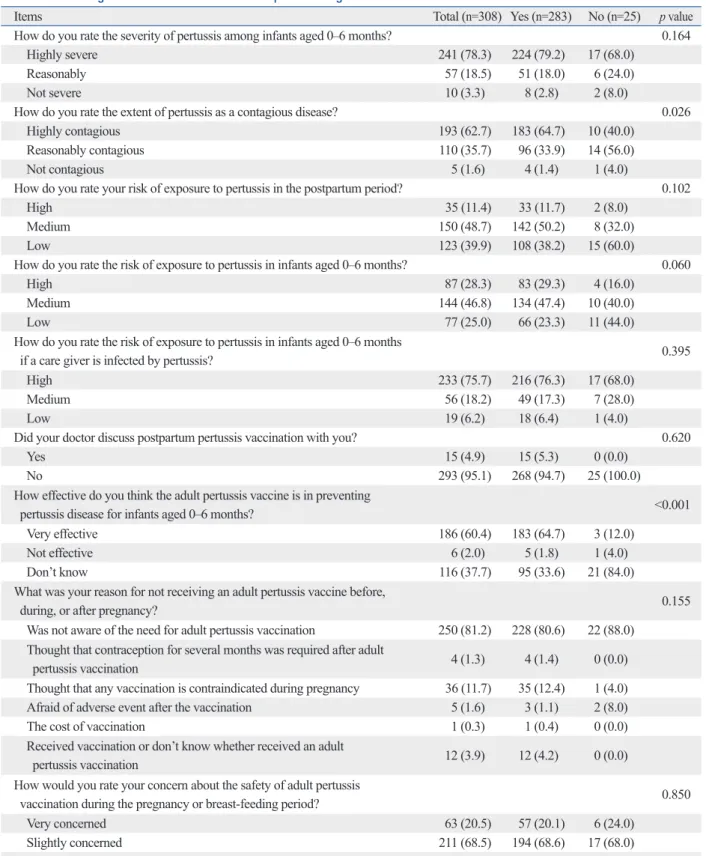
From a list of 12 factors, respondents selected the single most important factor that influenced their intention to accept or to Tdap vaccination before, during, and after pregnancy are
presented in Table 2. Significant differences were found be- tween women who intended to accept Tdap and those who did not intend to accept Tdap in 1) the rated level of conta- giousness of pertussis (p=0.026) and 2) the perceived effec- tiveness of Tdap in preventing infant pertussis (p<0.001).
Most women (95.1%) replied that they had not received in- formation from doctors about Tdap vaccination. Only 3.9%
of women replied that they had either received Tdap vacci- nation or did not know whether they had received it. The most common reason why they had not received Tdap vac- cination before, during, or after pregnancy was that they had not known of the need for Tdap vaccination (81.2%).
Table 1. Characteristics According to Intention of Tdap Vaccination
Characteristics Total (n=308) Yes (n=283) No (n=25) p value
Mean age (yrs) 32.2±4.1 32.3±4.2 31.4±2.9 0.167
Age group 0.284
≤25 14 (4.5) 13 (92.9) 1 (7.1)
26‒35 234 (76.0) 212 (90.6) 22 (9.4)
≥36 60 (19.5) 58 (96.7) 2 (3.3)
Parity 0.583
Primiparous 144 (46.8) 131 (91.0) 13 (9.0)
Multiparous 164 (53.3) 152 (92.7) 12 (7.3)
Education 1.000
Less than elementary school 3 (1.0) 3 (100.0) 0 (0.0)
Middle school
High school 48 (15.6) 44 (91.7) 4 (8.3)
College or above 257 (83.4) 236 (91.8) 21 (8.2)
Pregnancy status 0.903
Planning pregnancy 36 (11.7) 34 (94.4) 2 (5.6)
Ongoing pregnancy 259 (84.1) 237 (91.5) 22 (8.5)
Postpartum status 13 (4.2) 12 (92.3) 1 (7.7)
Monthly family income in US dollar 0.651
<1000 2 (0.7) 2 (100.0) 0 (0.0)
1000‒3000 93 (30.2) 83 (89.3) 10 (10.8)
3000‒5000 115 (37.3) 107 (93.0) 8 (7.0)
≥5000 98 (31.8) 91 (92.9) 7 (7.1)
Job 0.072
Housewife 127 (41.2) 116 (91.3) 11 (8.7)
Office worker 56 (18.2) 50 (89.3) 6 (10.7)
Production worker 6 (2.0) 5 (83.3) 1 (16.7)
Service worker 6 (2.0) 5 (83.3) 1 (16.7)
Self-employed 4 (1.3) 2 (50.0) 2 (50.0)
Professional 43 (14.0) 41 (95.4) 2 (4.7)
Student 1 (0.3) 1 (100.0) 0 (0.0)
Health care worker 49 (15.9) 47 (95.9) 2 (4.1)
Other 16 (5.2) 16 (100.0) 0 (0.0)
Values were presented as n (%). p-values were obtained by chi-square or Fisher’s exact test.
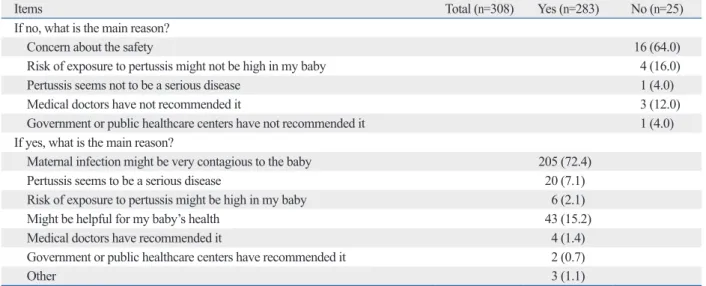
fection for her baby (72.4%), belief that the vaccine might be helpful for her baby’s health (15.2%), and believing pertussis is a severe disease among newborn infants (7.1%) (Table 4).
decline Tdap. The three most frequently selected reasons for respondents’ intention of accepting Tdap were belief that the respondent would be the most likely source of pertussis in-
Table 2. Knowledge and Attitudes Related to Tdap According to Intention of Pertussis Vaccination
Items Total (n=308) Yes (n=283) No (n=25) p value
How do you rate the severity of pertussis among infants aged 0‒6 months? 0.164
Highly severe 241 (78.3) 224 (79.2) 17 (68.0)
Reasonably 57 (18.5) 51 (18.0) 6 (24.0)
Not severe 10 (3.3) 8 (2.8) 2 (8.0)
How do you rate the extent of pertussis as a contagious disease? 0.026
Highly contagious 193 (62.7) 183 (64.7) 10 (40.0)
Reasonably contagious 110 (35.7) 96 (33.9) 14 (56.0)
Not contagious 5 (1.6) 4 (1.4) 1 (4.0)
How do you rate your risk of exposure to pertussis in the postpartum period? 0.102
High 35 (11.4) 33 (11.7) 2 (8.0)
Medium 150 (48.7) 142 (50.2) 8 (32.0)
Low 123 (39.9) 108 (38.2) 15 (60.0)
How do you rate the risk of exposure to pertussis in infants aged 0‒6 months? 0.060
High 87 (28.3) 83 (29.3) 4 (16.0)
Medium 144 (46.8) 134 (47.4) 10 (40.0)
Low 77 (25.0) 66 (23.3) 11 (44.0)
How do you rate the risk of exposure to pertussis in infants aged 0‒6 months
if a care giver is infected by pertussis? 0.395
High 233 (75.7) 216 (76.3) 17 (68.0)
Medium 56 (18.2) 49 (17.3) 7 (28.0)
Low 19 (6.2) 18 (6.4) 1 (4.0)
Did your doctor discuss postpartum pertussis vaccination with you? 0.620
Yes 15 (4.9) 15 (5.3) 0 (0.0)
No 293 (95.1) 268 (94.7) 25 (100.0)
How effective do you think the adult pertussis vaccine is in preventing
pertussis disease for infants aged 0‒6 months? <0.001
Very effective 186 (60.4) 183 (64.7) 3 (12.0)
Not effective 6 (2.0) 5 (1.8) 1 (4.0)
Don’t know 116 (37.7) 95 (33.6) 21 (84.0)
What was your reason for not receiving an adult pertussis vaccine before,
during, or after pregnancy? 0.155
Was not aware of the need for adult pertussis vaccination 250 (81.2) 228 (80.6) 22 (88.0) Thought that contraception for several months was required after adult
pertussis vaccination 4 (1.3) 4 (1.4) 0 (0.0)
Thought that any vaccination is contraindicated during pregnancy 36 (11.7) 35 (12.4) 1 (4.0)
Afraid of adverse event after the vaccination 5 (1.6) 3 (1.1) 2 (8.0)
The cost of vaccination 1 (0.3) 1 (0.4) 0 (0.0)
Received vaccination or don’t know whether received an adult
pertussis vaccination 12 (3.9) 12 (4.2) 0 (0.0)
How would you rate your concern about the safety of adult pertussis
vaccination during the pregnancy or breast-feeding period? 0.850
Very concerned 63 (20.5) 57 (20.1) 6 (24.0)
Slightly concerned 211 (68.5) 194 (68.6) 17 (68.0)
Not concerned 34 (11.0) 32 (11.3) 2 (8.0)
Values were presented as n (%). p values were obtained by chi-square or Fisher’s exact test.
pertussis vaccination before pregnancy, during pregnancy (in case of outbreak), or during the postpartum period (Table 5).
Regarding possible information or recommendation sources, 276 women (89.6%) replied that the most influencing factor in vaccination would likely be recommendation by medical staff in the obstetrics and gynecology department.
On the other hand, the three most frequently selected rea- sons for respondents’ intention of declining Tdap were 1) concern about the side effects of Tdap (64.0%), 2) believing the respondent’s baby would not be at high risk for develop- ing pertussis (16.0%), and 3) not receiving a recommenda- tion by medical doctors (12.0%). Most women (90.6%) did not know that the Korean government recommends an adult
Table 3. Factors Associated with Intention of Tdap Vaccination
Factors OR 95% CI p value
How effective do you think the adult pertussis vaccine is in preventing pertussis disease for infants aged 0‒6 months?
Very effective 13.5 3.92‒46.33 0.002
Not effective 1.1 0.12‒9.96 0.292
Don’t know 1 -
p-values were obtained by stepwise multiple logistic regression using factors with p<0.10 in univariate analyses.
Table 4. The Single Most Important Factor That Influences One’s Intention to Accept or Decline Tdap
Items Total (n=308) Yes (n=283) No (n=25)
If no, what is the main reason?
Concern about the safety 16 (64.0)
Risk of exposure to pertussis might not be high in my baby 4 (16.0)
Pertussis seems not to be a serious disease 1 (4.0)
Medical doctors have not recommended it 3 (12.0)
Government or public healthcare centers have not recommended it 1 (4.0)
If yes, what is the main reason?
Maternal infection might be very contagious to the baby 205 (72.4)
Pertussis seems to be a serious disease 20 (7.1)
Risk of exposure to pertussis might be high in my baby 6 (2.1)
Might be helpful for my baby’s health 43 (15.2)
Medical doctors have recommended it 4 (1.4)
Government or public healthcare centers have recommended it 2 (0.7)
Other 3 (1.1)
Values were presented as n (%).
Table 5. Information or Recommendation Sources That Can Affect Tdap Vaccination
Items Total (n=308) Yes (n=283) No (n=25) p value
Did you know that the Korean government recommends an adult pertussis vaccination before pregnancy,
during pregnancy (in case of outbreak), or during the postpartum period? 0.622
Yes 11 (3.6) 10 (3.5) 1 (4.0)
No 279 (90.6) 257 (90.8) 22 (88.0)
Partially 18 (5.8) 16 (5.7) 2 (8.0)
What might be the most influencing factor related to receiving adult pertussis vaccination before pregnancy,
during pregnancy (in case of outbreak), or postpartum period? 0.150
Recommendation by medical staff in internal medicine or family medicine 7 (2.3) 7 (2.5) 0 (0.0)
Recommendation by medical staff in OB/GYN 276 (89.6) 254 (89.8) 22 (88.0)
Recommendation by medical staff in pediatrics 14 (4.6) 14 (5.0) 0 (0.0)
Recommendation by family 1 (0.3) 1 (0.4) 0 (0.0)
Recommendation by friends
Information from other sources (TV/radio/newspaper/internet) 10 (3.3) 7 (2.5) 3 (12.0) Values were presented as n (%). p-values were obtained by chi-square or Fisher’s exact test.
diatric population.19 It has also been reported that household members, mainly parents, were responsible for pertussis transmission in the serologically-confirmed pertussis cases in Korean infants younger than 6 months of age.20 Ideally, a nationwide epidemiologic study of pertussis based on serol- ogy should be undertaken to develop diagnosis criteria for atypical pertussis and to set up vaccination strategies that can prevent waning immunity and reduce the number of very young unvaccinated individuals. Currently however, control of pertussis through booster vaccination with Tdap in fami- lies taking care of young infants is of immediate necessity in Korea. Therefore, the Committee on Infectious Disease in the Korean Pediatric Society and Korean CDC recommend- ed that mothers of newborn infants should be given a dose of Tdap as soon as is feasible if they previously have not re- ceived Tdap.9,21 Other candidates for Tdap include health care workers and family members who contact infants young- er than 12 months old, as well as childbearing-aged women, baby-care center workers, etc. Although pregnancy is not a contraindication to Tdap immunization, it is only recom- mended in Korea during pregnancy if clinically indicated, such as during an outbreak.21
Our study results demonstrated that women of childbear- ing age had insufficient knowledge about pertussis and relat- ed immunization recommendations and were consequently under-immunized. National pertussis surveillance data in Korea demonstrated that the most common age groups af- fected during 2010‒2011 were those aged <3 months and
≥15 years.22 Because infants without timely vaccination are at increased risk of pertussis infection, steps to provide time- ly vaccination to infants and to provide Tdap vaccination to adolescents and adults is now being tried in Korea. More- over, enhanced surveillance to discover adult pertussis-case patients with atypical symptoms should be proceeded in or- der to prevent transmission to vulnerable infants. Financial support and adequate information for Tdap vaccination from the government may lead to a decrease of cases in the sus- ceptible population among adolescents and adults.
Despite national recommendations in several countries, uptake in pregnant women, mothers after delivery, and house- hold contacts of infants remains limited. It seems that multi- ple strategies to increasing vaccine uptake rate should be con- sidered to increase protection in infants, such as, not only dissemination of information and education, but also consid- eration of easy accessibility and best timing for decision making, as well as increase of trust.12,23 The postpartum peri- od seems an opportune and unique time to provide pertussis
DISCUSSION
Unsurprisingly, only 3.9% of women replied that they had ei- ther received Tdap vaccination or did not know whether they received it. The most common reason why they had not re- ceived Tdap vaccination before, during, or after pregnancy was that they had not known the need for Tdap vaccination.
Most women replied that they had not received information from doctors about Tdap. Women who had no intention of receiving Tdap were more likely to rate maternal or infant risk of exposure to pertussis as low and to report that they did not know the efficacy of Tdap vaccination. These responses were similar to those of Taiwanese women who declined postpartum Tdap.12 Even in Canada, baseline knowledge of infant disease severity and adult vaccine recommendations was still poor, although the government there has recom- mended a single Tdap booster for all adults from 2008, espe- cially encouraging parents so as to create a cocooning effect for infants.13 In Australia, a study reported that 75% of moth- ers and 69% of fathers were aware that the pertussis vaccine was available and funded for new parents in a state that has funded Tdap for parents since 2009.14 Government support seems essential not only to increase vaccine uptake but also to increase awareness.
The trend of increasing pertussis cases is now becoming obvious in Korea, although it is less common than in West- ern countries. The reported number of pertussis cases in- creased up to 66 cases in 2009.8 Considering that the diag- nosis of reported cases was confirmed by polymerase chain reaction and culture without serology, the actual number of cases was likely much more than the reported number. Since 2011, the US ACIP has expanded its recommendation to in- clude Tdap vaccination during the late-second or third tri- mester of pregnancy, as well as in the postpartum period, ir- respective of the patient’s prior history of receiving Tdap, as the incidence of pertussis cases was not decreasing and up- take of Tdap was very low.15 The UK authorities did the same recommendation in October 2012, when they faced a rapid rise in pertussis cases and associated infant deaths that year.16
In Korea, it has been reported that approximately 20% of health care workers are susceptible to pertussis and that the immunity to pertussis gradually decreases after 15 years of age.17,18 In Korean pediatric hematology and oncology pa- tients, serologic immunity to Diphtheria-Tetanus-Pertussis was found to be much lower than immunity in a healthy pe-
PM, et al. Prevention of pertussis, tetanus, and diphtheria among pregnant and postpartum women and their infants recommenda- tions of the Advisory Committee on Immunization Practices (ACIP).
MMWR Recomm Rep 2008;57(RR-4):1-51.
6. Lee JK, Choi WS. Immunization Policy in Korea. Infect Che- mother 2008;40:14-23.
7. Chun BH. Public Policy and laws on infectious disease control in Korea: past, present and prospective. Infect Chemother 2011;43:
474-84.
8. Division of Tuberculosis and Bacterial Respiratory Infections:
Korea National Health Institute. Increasing incidence of pertussis in Korea. Seoul: Korea National Health Institute; 2009. p.709.
9. Choi KM, Kim KH, Kim YJ, Kim JH, Park SE, Lee HJ, et al.
Recommendation for the use of newly introduced Tdap vaccine in Korea. Korean J Pediatr 2011;54:141-5.
10. Wendelboe AM, Njamkepo E, Bourillon A, Floret DD, Gaudelus J, Gerber M, et al. Transmission of Bordetella pertussis to young infants. Pediatr Infect Dis J 2007;26:293-9.
11. Ko HS, Jo YS, Kim YH, Park YG, Moon HB, Lee Y, et al.
Knowledge, attitudes, and acceptability about influenza vaccina- tion in Korean women of childbearing age. Obstet Gynecol Sci 2015;58:81-9.
12. Cheng PJ, Huang SY, Shaw SW, Kao CC, Chueh HY, Chang SD, et al. Factors influencing women’s decisions regarding pertussis vaccine: a decision-making study in the Postpartum Pertussis Im- munization Program of a teaching hospital in Taiwan. Vaccine 2010;28:5641-7.
13. Frère J, De Wals P, Ovetchkine P, Coïc L, Audibert F, Tapiero B.
Evaluation of several approaches to immunize parents of neonates against B. pertussis. Vaccine 2013;31:6087-91.
14. Donnan EJ, Fielding JE, Rowe SL, Franklin LJ, Vally H. A cross sectional survey of attitudes, awareness and uptake of the parental pertussis booster vaccine as part of a cocooning strategy, Victoria, Australia. BMC Public Health 2013;13:676.
15. Centers for Disease Control and Prevention (CDC). Updated rec- ommendations for use of tetanus toxoid, reduced diphtheria tox- oid, and acellular pertussis vaccine (Tdap) in pregnant women-- Advisory Committee on Immunization Practices (ACIP), 2012.
MMWR Morb Mortal Wkly Rep 2013;62:131-5.
16. Joint Committee on Vaccination and Immunisation (JCVI) (2012) JCVI meeting on pertussis immunisation: August 2012. [accessed on 2013 December 28]. Available at: http://transparency.dh.gov.
uk/2012/09/28/jcvi-pertussis/.
17. Kim S, Oh H, Ham O, Chung MH, Seo W. Susceptibility and fac- tors of pertussis vaccination adherence in Korean health care workers. Am J Health Behav 2010;34:45-53.
18. Kang JH. The assessment of DTaP vaccine; age related seroepide- miology of diphtheria, tetanus and pertussis in Korea. The annual report of KFDA. Cheongju, Korea: Korea Food & Drug Administra- tion; 2008. p.783-4.
19. Kwon HJ, Lee JW, Chung NG, Cho B, Kim HK, Kang JH. As- sessment of serologic immunity to diphtheria-tetanus-pertussis af- ter treatment of Korean pediatric hematology and oncology pa- tients. J Korean Med Sci 2012;27:78-83.
20. Kwon HJ, Yum SK, Choi UY, Lee SY, Kim JH, Kang JH. Infant pertussis and household transmission in Korea. J Korean Med Sci 2012;27:1547-51.
21. Korean Centers for Disease Control and Prevention (CDC). Guide- lines of Vaccination for Adult. November 2012. [accessed on 2013 December 28]. Available at: http://www.cdc.go.kr.
vaccination to previously unimmunized mothers. In a recent study, when a Tdap vaccine was offered in the community after the promotion of vaccination in the maternity ward, the uptake rate did not significantly improve.14,24 When promo- tion and administration of the vaccine in the maternity ward was provided, the uptake rate increased up to 50% of parents, approximately.13,14 Therefore, offering Tdap in the maternity ward may be an effective approach for promoting cocoon- ing and increasing vaccine uptake. A recent randomized trial reported that there was no increased risk of adverse events among women who received Tdap vaccine during pregnan- cy or their infants, and maternal immunization with Tdap re- sulted in high concentrations of pertussis antibodies in in- fants during the first 2 months of life without substantially altering infant responses to DTaP.25 Vaccination strategy dur- ing pregnancy could be also considered as a means of in- creasing vaccine uptake.
As our study demonstrated that recommendation from medical staff in obstetrics and gynecology departments is the most influencing factor in vaccination, recommendations for Tdap provided with appropriate information by Korean maternal-fetal medicine professionals may be critical for im- proving awareness. Additionally, vaccination in the maternity ward after vaginal or cesarean delivery may also prove ben- eficial for preventing pertussis, although our population is not a nationwide representative sample of women of child- bearing age. Further investigation of the effectiveness of the cocooning strategy in decreasing infant morbidity and mor- tality is required in Korea, as is a nationwide epidemiologic study of pertussis.
REFERENCES
1. Wood N, Quinn HE, McIntyre P, Elliott E. Pertussis in infants:
preventing deaths and hospitalisations in the very young. J Paedi- atr Child Health 2008;44:161-5.
2. Lin YC, Yao SM, Yan JJ, Chen YY, Chiang CS, Wu HS, et al. Epi- demiological shift in the prevalence of pertussis in Taiwan: impli- cations for pertussis vaccination. J Med Microbiol 2007;56(Pt 4):533-7.
3. Sin MA, Zenke R, Rönckendorf R, Littmann M, Jorgensen P, Hel- lenbrand W. Pertussis outbreak in primary and secondary schools in Ludwigslust, Germany demonstrating the role of waning im- munity. Pediatr Infect Dis J 2009;28:242-4.
4. Duranoglu L, Sönmez C, Vurucu S, Kurtoglu D, Kesik V, Coplu N, et al. Evaluation of pertussis immunity status in schoolchildren immunized with whole-cell vaccine. Epidemiol Infect 2010;138:
299-303.
5. Murphy TV, Slade BA, Broder KR, Kretsinger K, Tiwari T, Joyce
vaccination among postpartum women. Am J Obstet Gynecol 2014;
210:237.
25. Munoz FM, Bond NH, Maccato M, Pinell P, Hammill HA, Swa- my GK, et al. Safety and immunogenicity of tetanus diphtheria and acellular pertussis (Tdap) immunization during pregnancy in mothers and infants: a randomized clinical trial. JAMA 2014;311:
1760-9.
22. Choe YJ, Park YJ, Jung C, Bae GR, Lee DH. National pertussis surveillance in South Korea 1955-2011: epidemiological and clini- cal trends. Int J Infect Dis 2012;16:e850-4.
23. Iroh Tam PY, Visintainer P, Fisher D. Response to an education program for parents about adult pertussis vaccination. Infect Con- trol Hosp Epidemiol 2009;30:589-92.
24. Yeh S, Mink C, Kim M, Naylor S, Zangwill KM, Allred NJ. Ef- fectiveness of hospital-based postpartum procedures on pertussis