• 검색 결과가 없습니다.

Improved CycleGAN for underwater ship engine audio translation

N/A
N/A
Protected

Academic year: 2021

Share "Improved CycleGAN for underwater ship engine audio translation"

Copied!
11
0
0

로드 중.... (전체 텍스트 보기)

전체 글

(1)

I. Introduction

Underwater data collection is a vital tool to solve many acoustic challenging tasks such as classification of different vessels

[1]

their velocities and location,

[2]

vessel tracking,

[3]

identifying targets and obstacles.

[4,5]

Generally, under- water data is collected with various measurement plat- forms integrated either on-board oceanographic vessels using sensor buoy system

[6]

or with the sonar arrays containing hydrophones.

[7]

Vast amount of recordings are

Improved CycleGAN for underwater ship engine audio translation

수중 선박엔진 음향 변환을 위한 향상된 CycleGAN 알고리즘

Hina Ashraf, 1,2 Yoon-Sang Jeong, 2 and Chong Hyun Lee 2†

(아쉬라프 히나,

1,2

정윤상,

2

이종현

2†

)

1

Foundation for Advancement of Science and Technology (NUCES-FAST),

2

Jeju National University (Received June 9, 2020; accepted June 30, 2020)

ABSTRACT: Machine learning algorithms have made immense contributions in various fields including sonar and radar applications. Recently developed Cycle-Consistency Generative Adversarial Network (CycleGAN), a variant of GAN has been successfully used for unpaired image-to-image translation. We present a modified CycleGAN for translation of underwater ship engine sounds with high perceptual quality. The proposed network is composed of an improved generator model trained to translate underwater audio from one vessel type to other, an improved discriminator to identify the data as real or fake and a modified cycle-consistency loss function. The quantitative and qualitative analysis of the proposed CycleGAN are performed on publicly available underwater dataset ShipsEar by evaluating and comparing Mel-cepstral distortion, pitch contour matching, nearest neighbor comparison and mean opinion score with existing algorithms. The analysis results of the proposed network demonstrate the effectiveness of the proposed network.

Keywords: Generative Adversarial Networks (GANs), Style transfer, Cycle-Consistency GAN (CycleGAN), Mel-Cepstrum (MCEP), Mean Opinion Score (MOS)

PACS numbers: 43.60.Ek, 43.30.Nb

초 록: 기계학습 알고리즘은 소나 및 레이더를 포함한 다양한 분야에서 사용되고 있다. 최근 개발된 GAN(Gene- rative Adversarial Networks)의 변형인 Cycle-Consistency Generative Adversarial Network(CycleGAN)은 쌍을 이루지 않은 이미지-이미지 변환에 대해 검증된 네트워크이다. 본 논문에서는 높은 품질로 수중 선박 엔진음을 변환시 킬 수 있는 변형된 CycleGAN을 제안한다. 제안된 네트워크는 수중 음향을 기존영역에서 목표영역으로 변환시키는 생성자 모델과 데이터를 참과 거짓으로 구분하는 개선된 식별자 그리고 변환된 수환 일관성(Cycle Consistency) 손실 함수로 구성된다. 제안된 CycleGAN의 정량 및 정성분석은 공개적으로 사용 가능한 수중 데이터 ShipsEar을 사용하 여 기존 알고리즘들과 Mel-cepstral분포, 구조적 유사 지수, 최소 거리 비교, 평균 의견 점수를 평가 및 비교함으로써 수행되었고, 분석결과는 제안된 네트워크의 유효성을 입증하였다.

핵심용어: 생성적 적대 신경망(Generative Adversarial Network, GAN), 데이터 확장 기법, Cycle-Consistency GAN (CycleGAN), Mel-Cepstrum(MCEP), 평균 의견 점수(Mean Opinion Score, MOS)

†Corresponding author: Chong Hyun Lee ([email protected])

Department of Ocean System Engineering, Jeju National University, 102, Jejudaehak-ro, Jeju-si, Jeju-do 63243, Republic of Korea (Tel: 82-64-754-3481, Fax: 82-64-755-6130)

Copyrightⓒ2020 The Acoustical Society of Korea. This is an Open Access article distributed under the terms of the Creative Commons

Attribution Non-Commercial License which permits unrestricted non-commercial use, distribution, and reproduction in any medium, provided

the original work is properly cited.

(2)

made by military installations but that data is either incomplete or inaccessible to the acoustic researchers due to security reasons. This makes research groups record and collect data to create their own database of underwater sounds by installing their own equipment. Hence, the underwater data collection becomes a costly investment in human resources, time consumption and hardware equip- ment.

During the past few years, researchers are applying machine learning for the underwater acoustics.

[1,4,8]

How- ever, underwater domain has an obvious shortage of the available data, which severely affects the accuracy of the applied ML techniques. To address this problem, the researchers, have been applying many data augmentation techniques in audio domain such as time stretching and scaling, pitch shifting on audio,

[9,10]

applying random frequency filters and interpolation of samples from input domain

[11]

to transform the existing data while preserving the input labels. In all these techniques, only pitch shifting and frequency filtering were effective to some extent while in other techniques; the network becomes invariant to these transformations.

Deep learning and more specifically Generative Adver- sarial Networks (GANs)

[12]

belong to the generative net- work family successfully used for generating realistic audio samples from the dataset provided for training.

[13]

For the audio generation, Long Short-Term Memory (LSTM) networks have also been used,

[14]

which generate audios with quite remarkable results but are notoriously slow in terms of computation due to their sequential processing. GANs are essentially useful for the data augmentation and expansion of the training dataset.

[15,16]

In this work, we propose to incorporate CycleGAN

[17]

(a variant of GAN) for the expansion of dataset by per- forming audio-to-audio translation to generate underwater ship radiated noisy engine sounds. The basic idea is to generate a new synthetic version of a given audios with a simple modification.

CycleGAN has been used widely for many applications including data augmentation and expansion.

[18]

In audio

domain, it is deployed as voice conversion without parallel-data

[19]

and a front-end processor for the robust Automatic Speech Recognition (ASR) on perturbed utterances with emotion and voice quality.

[20]

CycleGAN- Voice Conversion (VC)

[21]

learns a sequence-based map- ping function by incorporating CycleGAN with a gated Convolutional Neural Network (CNN)

[22]

and identity mapping loss.

[23]

CycleGAN consists of two GANs where one GAN takes the data from source domain (A) and translates the audios (  ) to target domain (B), which are fed to the other GAN that translates back the input synthetic data (  ) to the source domain (  ), hence the name CycleGAN. The key point is while the transfor- mation it generates the synthetic data (  ), which belongs to the source domain (A) but not exactly (a) and hence a new synthetic data contributing to the expansion of data- base. To our knowledge, this work is the first effort to accommodate CycleGAN approach to work with the underwater audio synthesis.

To improve the data synthesis quality and the network performance, recently introduced components such as instance normalization,

[24]

dilated convolution

[25]

and interpolated convolution

[26]

produce promising effects on the results of image generation process

[27]

and audio generations as well.

[22,25]

There has been need for im- provement in an overall end-to-end training network for the synthesized audios using these techniques. To satisfy this need, we proposed modified CycleGAN with im- proved generator, discriminator architecture and improved objective function. The contributions of this paper can be summarized as follows:

∙ Adoption of CycleGAN for performing the task of underwater ship engine sound transfer to another engine style.

∙ Usage of discriminator architecture based on PatchGAN in which dilated convolution increases the receptive field without increasing computation and memory costs while preserving the resolution.

∙ Improved generator architecture by using interpolated

(3)

convolutions instead of up-sampling that mitigates the well-known checkerboard artifacts during up-sampling.

∙ An analysis of the performance of current sound syn- thesis technique on underwater ship engine data.

The content of the paper is organized as follows. In Section II, we present background of underwater ship radiated audio model. In Section III, we describe the proposed CycleGAN model by explaining improvement over original CycleGAN. In Section IV, we present the experimental results with analysis and comparison. At the end, we present a conclusion in Section V.

II. Ship-radiated Noise Model

Water sailing ship audios generally have three com- ponents: mechanical noise caused by the sailing ship, propeller noise by propeller cavitation, rotating sound and hydrodynamic noise by the irregular water flow.

[28]

The major constituents of ship-radiated noise are mechanical noise and propeller noise that can be seen as the addition of strong line spectrum and weak continuous spectrum as given in Eq. (1). Its energy is mainly distributed in low

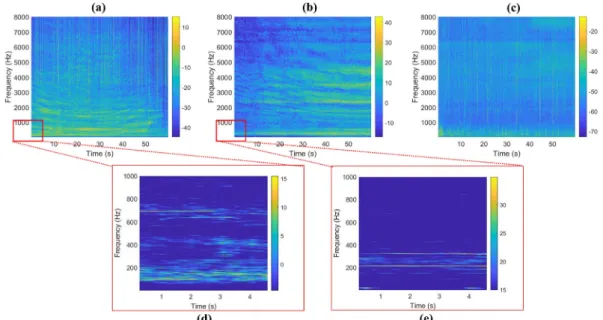
sound frequencies below 1000 Hz as shown in Fig. 1(a) and Fig. 1(b). Sources of underwater noise emissions in the environment have a bandwidth of 1 Hz to 100 KHz (a broad spectrum), which cover all existing frequencies as shown in Fig. 1(c).

xt 

t  at

t , (1)

where 

t , a(t) and 

t are time domain waveform of line spectrum component, periodic modulation and continuous spectrum component, respectively. Each term is a time-frequency atom (represented as a summation of sinusoidal and noisy components), which makes use of Inverse Fast Fourier Transform (IFFT) based efficient synthesis algorithms for the generation of the signal.

[29]

The Mel cepstrum (MCEP) is as good as conventional cepstrum and considered as an efficient parameter due to its relatively low order, making it a popular feature for underwater audio synthesis.

In most cases, basic discrimination of different under- water vessel sounds lie below 1000 Hz and we would be interested in this frequency spectrum. If we look closely at the spectrograms of motorboat and passengerboat as

Fig. 1. (Color available online) Spectrograms. (a) Underwater passengerboat engine audio, (b) underwater motorboat

engine audio, (c) ambient noise, (d) zoomed spectrogram of passengerboat for a 5 s duration and 0 Hz - 1000 Hz,

(e) zoomed spectrogram of motorboat for a 5 s duration and 0 Hz - 1000 Hz.

(4)

shown in Fig. 1(d) and Fig. 1(e), we can observe the dominant frequency components of each boat discrimi- nating them from each other. The basic task of CycleGAN is to translate one ship engine dominant frequencies to other ship engine frequencies. We hypothesize that the proposed improved version of CycleGAN can better perform this translation.

III. Network Architecture

The proposed network adopts network structure of the

CycleGAN

[21]

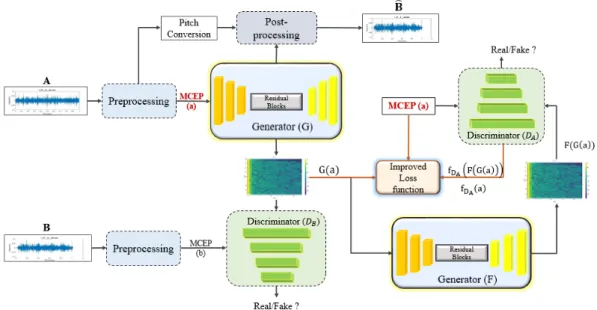
and achieves improvements by incorporating modified discriminator, a generator with improved up- sampling decoder and a modified objective function. The overall structure of the proposed modified CycleGAN network is shown in Fig. 2.

3.1 Generator Architecture

Generator network consist of three major blocks:

encoder (down sampling), residual blocks (transformation), decoder (up-sampling). In this architecture, the input is first down-sampled by the encoder network, then it is

Fig. 2. (Color available online) The proposed network architecture.

Fig. 3. (Color available online) Generator and discriminator architecture with network blocks.

(5)

passed to Residual Blocks (RB) where the stacked multiple convolutional layers, enable building a very deep network to learn feature maps. The output of residual blocks is then passed to decoder block where up-sampling is performed to reconstruct target MCEP as shown in Fig. 3. If CycleGAN is applied straight forwardly to audio-to-audio translations, it needs to first upsample the low-resolution input to the high-resolution by performing interpolation, which also enlarge the noisy patterns.

Hence, the direct application of existing CycleGAN causes amplified noise and training also becomes unstable. In previous technique, up-sampling has been done using simple nearest neighbor convolution, which has low performance and introduces noise and checkerboard affect. Instead of using simple up-sampling convolutions, we are using bi-cubic interpolation in generator decoder block, which removes the above-mentioned shortcomings.

Gated linear unit in 2-Dimensions (G-2D) block consist of Gated Linear Units (GLUs) where 2D means the input is 2D matrix, which achieved competitive results in signal modeling as LSTM while reducing the computational cost to manifolds. Gated Instance normalized (GI-2D) makes use of instance normalization, which is used for the style- transfer after G-2D block. The last conv2D layer is used to convert two-dimensional matrix into one-dimensional to feed into one-dimensional RB network.

3.2 Discriminator Architecture

Regular GAN discriminator has a global discriminator architecture that observes the whole input at once signifying as real or fake whereas PatchGAN

[27]

maps from complete input to every partial patches of the input.

This way receptive field can be traced back to see which patch or input samples is it sensitive to. In patch-based approach, the generator converges quickly due to operating on each local patch independently. However, attentiveness of the network to view the global spatial information is limited, which in turn limits the ability of the generator to perform coherent audio translation. As a remedy to the problem, the idea is to perform segmentation

using dilated convolutions. Dilated convolution requires a lot lesser parameters than required by conventional convolutional networks while maintaining the accuracy. It spreads out the convolution weights to over a wider area to expand the receptive field size significantly, which helps in prediction from larger surroundings and well narrate the dependency between the distant regions. This allows increased information flow between generator and dis- criminator as the generator knows now which patch or region to focus on.

3.3 Loss Function

With CycleGAN, there is a translator G : A → B and additional inverse translator, F : B → A both with bijective mappings. Both the mappings, G and F are trained simultaneously and a cycle consistency loss is added to encourage F(G(A)) ≈ a and G(F(b)) ≈ b. D

B

and D

A

are the associated adversarial discriminators.

Adversarial loss: We apply adversarial losses to both mapping functions. For the mapping function G: A → B and its discriminator D

B

, we express the objective as,

L

adv

GD

B

AB    

b∼pdatab

D

B

b  

   

a∼pdataa

D

B

Ga

 . (2)

Similarly, the mapping function for F: B → A and its dis- criminator D

A

can be expressed as,

L

adv

FD

A

BA    

a∼pdataa

D

A

a  

   

b∼pdatab

D

A

Fb

 . (3)

Proposed consistency loss: Since the adversarial loss only

restricts to follow the target distribution and does not

guarantee audio consistency between the target and source

features, consistency loss is introduced. Because cycle

consistency encourages generators to avoid unnecessary

changes and thus to generate images that share structural

(6)

similarity with inputs, it can also be viewed as a form of regularization. By enforcing cycle consistency, CycleGAN framework prevents generators from excessive hallu- cinations and mode collapse, both of which will cause unnecessary loss of information and thus increase in cycle consistency loss. The cycle consistency loss of the original CycleGAN is,

L

cyc

GFAB  

b∼pdatab

∥GFb  b∥



a∼pdataa

∥FGa a∥

 . (4)

The cycle consistency sometimes causes undesired results since it assumes no information loss during translation even when moderate loss is necessary as in underwater sound domain. To handle this problem, we adopt a weight, α in cycle consistency loss. The weight α starts with small number and gradually increases to a high value close but not equal to 1 to maintain some fraction of pixel level consistency and not to have unwanted results.

This helps stabilizing training in early stages but in later stages becomes an obstacle towards realistic results.

[30]

The final cycle consistency loss is,

L

cyc

GFAB 

b∼pdatab

 ∥ f

DB

GFb  f

DB

b ∥

  ∥GFb b∥





a∼pdataa

 ∥ f

DA

FGa  f

DA

a ∥

  ∥FGa a∥

 , (5)

where 

 

is the feature extractor of the last layer of D(.) and α ∊[0,1]

Similarity mapping loss: For encouraging input pre- servation, we use similarity mapping loss,

L

sim

GFAB  

b∼pdatab

∥Ga  b∥



a∼pdataa

∥Fb  a∥

 . (6)

The final loss of the proposed network can be expressed sum of all three discussed losses as follows:

L

final

 L

adv

FD

A

BA L

adv

GD

B

AB



cyc

L

cyc

GFAB 

sim

L

sim

GFAB , (7)

where λ

cyc

and λ

sim

are trade-off parameters between similarity and cyclic losses.

IV. Results

4.1 Dataset

We used ShipsEar,

[31]

a publicly available underwater dataset for the verification and analysis of results. From this dataset, we have taken two vessel types (motorboat and passengerboat) and ambient noise recordings. The audio recordings have a sampling rate of 52734 Hz. We resampled the audio files at 16 kHz since frequencies of interest for the underwater data lies between 0 to 8000 Hz ranges. The audio recordings are sliced into 5-second chunks of equal length. The dataset from each category contains 133 training examples. For extraction of features, the sampled audio chunks are fed to preprocessing block, where MCEP envelope, logarithmic fundamental frequency ( log 

) and aperiodicities (APs) are extracted every 5ms within 20ms window using WORLD analyzer.

The CycleGAN approach is used to model 24-dimensional MCEPs with 128 time frames. The order of MCEPs can be different for different datasets. In Fig. 4, we have plotted the loss curves for different number of MCEPs, which shows the network performance is almost similar if

Fig. 4. (Color available online) Loss curve for the

different number of MCEP coefficients.

(7)

MCEPs are chosen to be 24 or 34. We have taken the number of coefficients to be 24, since it is computationally efficient while maintaining the network performance.

For simulation parameters, we have used least square loss function to calculate the adversarial loss since it results in stable training and higher quality audios. Adam optimizer with a batch size of 2 is used as an adaptive learning rate optimization algorithm. At start, the learning rates of the generator and the discriminator are set to 0.0002 and 0.0001, respectively. For each epoch, it decayed by 2 × 10

5

. The trade-off parameters λ

cyc

is set to 10 and λ

sim

is set to 1 for the initial 100 epochs and then to zero after 100 epochs.

4.2 Spectral Feature Representation Analysis To evaluate the performance of the proposed algorithm, we conduct the experiment of engine sound style change from motorboat to passengerboat. The spectrogram out- puts of source, target and style changed outputs are shown in Fig. 5. We can observe that the frequency components of the target audios are present in translated audios by the proposed algorithm. In first row of Fig. 5, the few dominant frequency components are around 200 Hz and 900 Hz for target passengerboat while for motorboat it lies around 300 Hz and 150 Hz. In translated spectrogram, one

can observe the frequency component present around 200 Hz and 900 Hz while in baseline translated spectrogram, it is mostly closer to source Motorboat. The translated spectrograms by baseline CycleGAN also have increased noise as compared to the proposed technique due to the upsampling layer. Looking at these examples, we can say that the proposed CycleGAN has successfully changed source sound to target sound while the original CycleGAN fails in sound style change.

4.3 Analysis

4.3.1 Quantitative Analysis

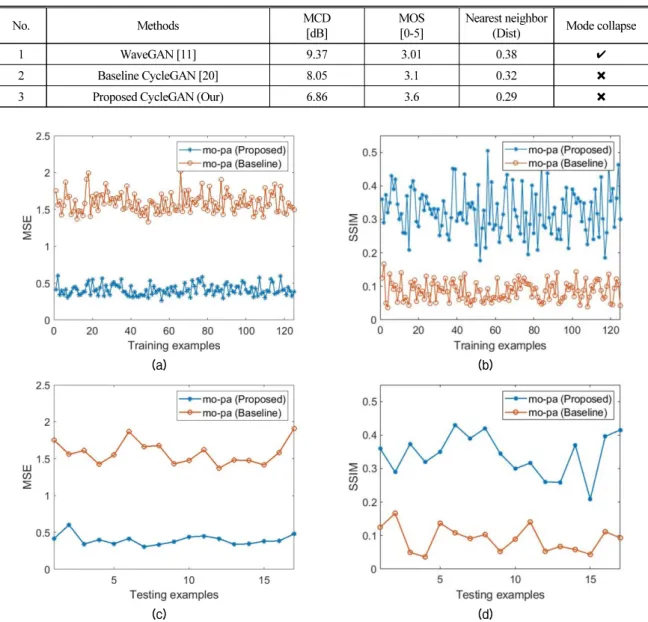
To quantify total structural differences, we took the Mel-cepstral distortion (MCD)

[32]

parameter, which cal- culates the distance between the target and converted MCEP structures. This quantity is measured using Eq. (8), a smaller value indicates that the target and converted MCEPs matches with each other. The results of the MCD is listed in Table 1.

MCDdb   ln  

i  D

mc

itarget

 mc

iconverted

 , (8) where mc

itarget

, mc

iconverted

and D are the i

th

MCEP

Passengerboat

(Target) Motorboat

(Source) Translated

(Proposed) Translated

(Baseline)

Fig. 5. (Color available online) Spectrograms of the target passengerboat, source motorboat, translated motorboat

to passengerboat by baseline and proposed CycleGAN.

(8)

coefficient of the target and converted audios and D is the order of MCEP features, respectively. Another measure to assess the output MCEPs with the target MCEP is chosen as Structural SIMilarity (SSIM).

[33]

The value of this parameter ranges between 1 and –1, where 1 shows the two images as identical. The SSIM can be calculated as follows:

SSIMmn   

m



n

C



m



n

C



m

n

C



mn

C

 , (9)

where μ

m

, μ

n

, σ

m

, σ

n

, and σ

mn

are the local means, standard deviations, and cross-covariance for images m, n. The training error plots for the measure SSIM and Mean Square Error (MSE) are shown in the Fig. 6, in which we can observed that the proposed network relatively low training error than original CycleGAN for the translation of motorboat engine audios to passengerboat audios (mo- pa).

As a second metric to compare the generated under- water audios with the original audios, we have chosen

Table 1. Qualitative and quantitative comparison with other techniques for motorboat audios.

No. Methods MCD

[dB] MOS

[0-5] Nearest neighbor

(Dist) Mode collapse

1 WaveGAN [11] 9.37 3.01 0.38 ✔

2 Baseline CycleGAN [20] 8.05 3.1 0.32 ✖

3 Proposed CycleGAN (Our) 6.86 3.6 0.29 ✖

(a) (b)

(c) (d)

Fig. 6. (Color available online) Comparison plots for translation from motorboat to passengerboat for the baseline

and modified CycleGAN. (a) MSE comparison plot for training dataset, (b) SSIM comparison plot for training

datasets, (c) MSE comparison plot for testing datasets, (d) SSIM comparison plot for testing datasets.

(9)

pitch contours that focus on the relative change in pitch over time. The fundamental frequency is estimated for each frame by segmenting the audio input according to a given window length and overlap. We are using Pitch Estimation Filter (PEF) to estimate fundamental frequency contours of translated and original audios by using window length set to 70 ms and with an overlap of 40 ms.

The pitch contours of other algorithms are shown in the Fig. 7 after style transfer from ambient noise to motorboat and passengerboat to motorboat. Notice that the proposed algorithm follows the pitch contours of the original audio better than the baseline CycleGAN and WaveGAN.

To calculate distances in the frequency-domain, we use test dataset consisted of 17 underwater motorboat samples given to the presented trained model and translated to passengerboat sounds. The ‘Dist’ represents the average Euclidean distance between 133 training samples and 17 generated samples from the test dataset. A low value justifies the similarity, if the generated examples are from the training dataset, its value will be 0. The audio

generated with the proposed CycleGAN does not suffer from mode collapse problem in which generator model produces limited varieties of samples. Unlike WaveGAN, the cycle consistency loss of CycleGAN ensures that the generative model does not incur mode collapse. The performance superiority of the improved CycleGAN with other techniques in terms of above explained metrics is summarized in Table 1.

4.3.2 Qualitative Analysis

We have chosen MOS

[34]

as the measure of quality of the generated audios with respect to original audios. Our ultimate goal is to produce ship engine audio examples that are recognizable to humans. To this end, we measure the ability of human annotators to label the generated audio either from the motorboat or passengerboat category. We translate 17 examples from testing data and ask annotators to label which category they perceive in each example, and compute their score with respect to the actual labels.

Annotators assign subjective values of 1-5 (1 being poor

Fig. 7. (Color available online) Pitch contour comparison of generated audio examples. (a) Ambient noise to motor- boat, (b) passengerboat to motorboat.

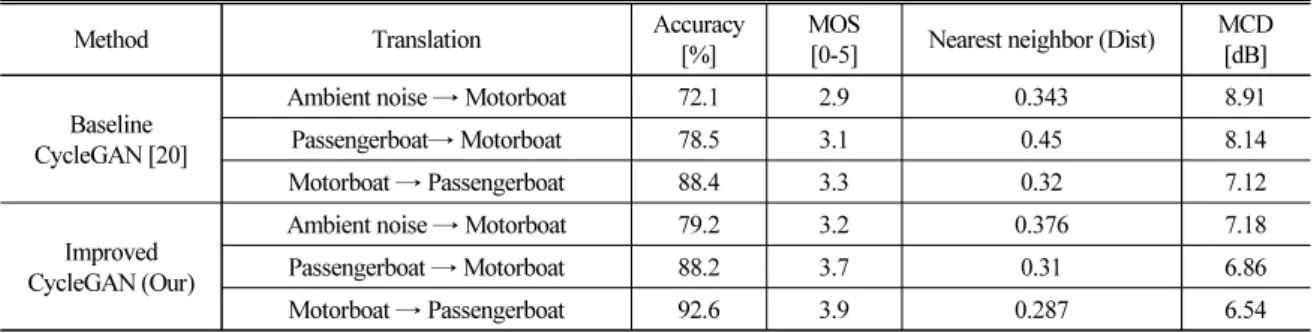
Table 2. Comparison of the improved CycleGAN with baseline CycleGAN technique.

Method Translation Accuracy

[%] MOS

[0-5] Nearest neighbor (Dist) MCD [dB]

Baseline CycleGAN [20]

Ambient noise → Motorboat 72.1 2.9 0.343 8.91

Passengerboat→ Motorboat 78.5 3.1 0.45 8.14

Motorboat → Passengerboat 88.4 3.3 0.32 7.12

Improved CycleGAN (Our)

Ambient noise → Motorboat 79.2 3.2 0.376 7.18

Passengerboat → Motorboat 88.2 3.7 0.31 6.86

Motorboat → Passengerboat 92.6 3.9 0.287 6.54

(10)

and 5 being excellent) for the criteria of sound quality and a classification category (motorboat and passengerboat).

The value MOS can be calculated by using the following Eq. (10).

MOS  

  

, (10)

where N are total human subjects and R is the assigned individual ratings.

To measure the similarity in terms of listening audios, we calculated average accuracy of the correctly recognized audios from two categories. We report accuracy (n = 17) and MOS in the following Table 2. We can observe that the proposed network is superior to original CycleGAN for all style transfers.

V. Conclusions

We proposed a modified version of CycleGAN for transfer of underwater ship engine sound to another style sound. The proposed algorithm is composed of modified generator, modified discriminator and improved cycle- consistency loss function. The audio results generated are quantified using various performance metrics, which include Mel-cepstral distortion, structural similarity, pitch contours, nearest neighbor and mean opinion score. The experimental results of using underwater audio dataset, demonstrate that the proposed algorithm outperforms original CycleGAN and other audio style transfer net- works in both quantitative and qualitative measures of the generated sounds.

Acknowledgements

This research was supported by the 2019 scientific promotion program funded by Jeju National University.

References

1. J. Choi, Y. Choo, and K. Lee, “Acoustic classification of surface and underwater vessels in the ocean using supervised machine learning,” Sensors, 19, 3492 (2019).

2. A. Tesei, S. Fioravanti, V. Grandi, P. Guerrini, and A. Maguer, “Localization of small surface vessels through acoustic data fusion of two tetrahedral arrays of hydrophones,” Proc. Meetings on Acoustics, 17, 070050 (2012).

3. R. Diamant and Y. Jin, “A machine learning approach for dead-reckoning navigation at sea using a single accelerometer,” IEEE J. Oceanic Engineering, 39, 672-684 (2013).

4. Y. Tan, J. K. Tan, H. S. Kim, and S. Ishikawa,

“Detection of underwater objects based on machine learning,” Proc. The SICE Annual Conference 2013, IEEE 2104-2109 (2013).

5. H. Yang, K. Lee, Y. Choo, and K. Kim, “Underwater acoustic research trends with machine learning: Passive SONAR applications,” JOET. 34, 227-236 (2020).

6. C. Albaladejo, F. Soto, R. Torres, P. Sánchez, and J.

A. López, “A low-cost sensor buoy system for moni- toring shallow marine environments,” Sensors, 12, 9613-9634 (2012).

7. D. G. Hathaway and R. M. Bridges, “Underwater sonar array,” U.S. Patent 4901287, 1990.

8. H. Yang, K. Lee, Y. Choo, and K. Kim, “Underwater Acoustic Research Trends with Machine Learning:

General Background,” JOET. 34, 147-154 (2020).

9. J. Schluter and T. Grill, “Exploring data augmentation for improved singing voice detection with neural net- works,” Proc. ISMIR. 121-126 (2015).

10. B. McFee, E. J. Humphrey, and J. P. Bello, “A soft- ware framework for musical data augmentation,”

Proc. ISMIR. 248-254 (2015).

11. N. V. Chawla, K. W. Bowyer, L. O. Hall, and W. P.

Kegelmeyer, “SMOTE: synthetic minority over-sampling technique,” JAIR. 16, 321-357 (2002).

12. I. Goodfellow, J. Pouget-Abadie, M. Mirza, B. Xu, D.

WardeFarley, S. Ozair, A. Courville, and Y. Bengio,

“Generative adversarial nets,” Proc. NPIS. 2672-2680 (2014).

13. C. Donahue, J. McAuley, and M. Puckette, “Adversarial audio synthesis,” arXiv preprint arXiv:1802.04208 (2018).

14. S. Mangal, R. Modak, and P. Joshi, “LSTM Based Music Generation System,” arXiv preprint arXiv:1908.

01080 (2019).

15. F. H. K. dos S. Tanaka and C. Aranha, “Data augmen-

tation using GANs,” arXiv preprint arXiv:1904.09135

(2019).

(11)

16. Y. Qian, H. Hu, and T. Tan, “Data augmentation using generative adversarial networks for robust speech recognition,” Speech Communication, 114, 1-9 (2019).

17. J.-Y., Zhu, T. Park, P. Isola, and A. A. Efros, “Unpaired image-to-image translation using cycle-consistent adversarial networks,” Proc. the IEEE int. conf. on computer vision, 2223-2232 (2017).

18. V. Sandfort, K. Yan, P. J. Pickhardt, and R. M. Summers,

“Data augmentation using generative adversarial net- works (CycleGAN) to improve generalizability in CT segmentation tasks,” Scientific reports, 9, 1-9 (2019).

19. T. Kaneko and H. Kameoka, “Parallel data-free voice conversion using cycle-consistent adversarial networks,”

arXiv:1711.11293 (2017).

20. S. H. Dumpala, I. Sheikh, R. Chakraborty, and S. K.

Kopparapu, “A Cycle-GAN approach to model natural perturbations in speech for ASR applications,” arXiv preprint arXiv:1912.11151 (2019).

21. T. Kaneko and H. Kameoka, “Cyclegan-vc: Non- parallel voice conversion using cycle-consistent ad- versarial networks,” Proc. 26th EUSIPCO. IEEE 2100- 2104 (2018).

22. Y. N. Dauphin, A. Fan, M. Auli, and D. Grangier,

“Language modeling with gated convolutional net- works,” Proc. ICML. 933-941 (2017).

23. Y. Taigman, A. Polyak, L. Wolf, “Unsupervised cross- domain image generation,” Proc. ICLR. arXiv preprint arXiv:1607.08022 (2017).

24. D. Ulyanov, A. Vedaldi, and V. S. Lempitsky. Instance normalization: The missing ingredient for fast styli- zation. CoRR. abs/1607.08022 (2016).

25. F. Yu and V. Koltun, “Multi-scale context aggregation by dilated convolutions,” CoRR. abs/1511.07122 (2015).

26. A. Odena, V. Dumoulin, and C. Olah, “Deconvolution and checkerboard artifacts,” Distill, 1, e3 (2016).

27. U. Demir and G. Unal, “Patch-based image inpainting with generative adversarial networks,” arXiv preprint arXiv:1803.07422 (2018).

28. J. Luo and Y. Yang, “Simulation model of ship- radiated broadband noise.” Proc. IEEE ICSPCC. 1-5 (2011).

29. C. Verron and G. Drettakis, “Procedural audio modeling for particle-based environmental effects,” 133rd AES Convention (2012).

30. CycleGAN with Better Cycles, https://ssnl.github.io/

better_cycles/report.pdf, (Last viewed July 21, 2020).

31. D. Santos-Domínguez, S. Torres-Guijarro, A. Cardenal- López, and A. Pena-Gimenez, “ShipsEar: An under- water vessel noise database,” Applied Acoustics, 113, 64-69 (2016).

32. J. Nirmal, P. Kachare, S. Patnaik, and M. Zaveri,

“Cepstrum liftering based voice conversion using

RBF and GMM,” Proc. ICCSP. IEEE 570-575 (2013).

33. W. Zhou, A. C. Bovik, H. R. Sheikh, and E. P.

Simoncelli, “Image qualifty assessment: from error visibility to structural similarity,” IEEE Trans. on Image Processing, 13, 600-612 (2004).

34. M. Chu and H. Peng, “Objective measure for esti- mating mean opinion score of synthesized speech,”

U.S. Patent 7024362, 2006.

Profile

▸Hina Ashraf (아쉬라프 히나)

HINA ASHRAF is currently a Ph.D. student at the Jeju National University in Ocean System Engineering department. She re- ceived her BS degree in Telecommuni- cation Engineering and MS degree in Electrical Engineering from National Uni- versity of Computer & Emerging Sciences (NUCES-FAST) in 2010 and 2014 respec- tively. Her research interest includes Sonar Signal Processing and audio signal generation using Machine Learning.

▸Yoon‑Sang Jeong (정윤상)

YOON-SANG JEONG is currently a Master student at the Jeju National University in Ocean system Engineering Department.

He received his BS degree from Jeju University in 2012. His research interest includes Smart RF sensor design, Signal processing and Energy Harvesting.

▸Chong Hyun Lee (이종현)

CHONG HYUN LEE received his Ph.D. degree

in Electronic Engineering from Korean

Institute of Science and Technology (KAIST)

in 2002. He received his MS degree from

Michigan Technological University in 1987

and BS degree in Electronic Engineering

from Hanyang University in 1985. His

research interest includes Smart RF sensor

design, acoustic and Sonar Signal pro-

cessing and generation with Machine

learning. Currently, he is working as a

Professor in Department of Ocean Systems

Engineering, Jeju National University.

수치

Fig. 1. (Color available online) Spectrograms. (a) Underwater passengerboat engine audio, (b) underwater motorboat  engine audio, (c) ambient noise, (d) zoomed spectrogram of passengerboat for a 5 s duration and 0 Hz - 1000 Hz,  (e) zoomed spectrogram of m
Fig. 2. (Color available online) The proposed network architecture.
Fig.  4.  (Color  available  online)  Loss  curve  for  the  different number of MCEP coefficients.
Fig. 5. (Color available online) Spectrograms of the target passengerboat, source motorboat, translated motorboat  to passengerboat by baseline and proposed CycleGAN.
+3

참조

관련 문서

- The system simulation operate to achieve improved design or to explore prospective modifications. - Choosing the combinations of dependent

The experimentally measured viscosity data of HPAM and Levenberg-Marquardt algorithm is used to train ANN viscosity model which is composed of the four layers, one input layer

An underwater searching system is a device which uses sonar to detect underwater objects: it radiates sonar wave, receives the echo signal and processes

Photograph of the rotary device renovated for the continuous hairtail hand line.. Photograph of the side roller at the underwater

As an alternative method to the projection moire, phase measuring profilometry (PMP) without such a secondary grating can be used to obtain similar but improved results

In this investigation, a new closure approxi- mation is proposed for obtaining improved results of numerical calculations of the fiber orientation distribution during

□ The least-upper-bound property (sometimes called completeness or supremum property) is a fundamental property of the real number system. The least-upper-bound

□ The least-upper-bound property (sometimes called completeness or supremum property) is a fundamental property of the real number system. The least-upper-bound