https://doi.org/10.20909/kopast.2018.24.2.85
계절별 수송 온도가 MA 포장한 어린잎 비트의 저장성에 미치는 영향
최인이1,2 · 한수정1 · 김주영1 · 고영욱3 · 김용득3 · 황명근3 · 유왕건4 · 강호민1,2*
1강원대학교 원예·시스템공학부 원예과학전공
2강원대학교 농업생명과학연구원
3철원플라즈마산업기술연구원
4(주)지엘비젼
Effect of Seasonal Distribution Temperature on Storability of Modified Atmosphere Packaged Baby Leaf Beet
In-Lee Choi1,2, Su Jung Han1, Ju Young Kim1, Young-Wook Ko3, Yongduk Kim3, Myung-Keun Hwang3, Wanggun Yu4, and Ho-Min Kang1,2*
1Division of Horticulture and Systems Engineering, Program of Horticulture, Kangwon National University, Chuncheon 24341, Korea
2Agricultural and Life Science Research Institute, Kangwon National University, Chuncheon 24341, Korea
3Cheorwon Plasma Research Institute, Cheorwon 24047, Korea
4GLVision Company Limited, Cheorwon 24062, Korea
Abstract The effects of distribution temperature due to season all changes on quality and storability of baby leaf beet (Beta vulgaris L.) was examined in modified atmosphere (MA) packages. The beet leaf had been harvested at the 10 cm leaf length stage and packaged with an oxygen transmission rate (OTR) film of 1,300 cc·m-2·day-1·atm-1 and then held at 4 different distribution temperatures which were -2oC, 4oC, 20oC, or 30oC for 5 hrs and then stored for 18 days at 8oC.
The loss of fresh weight of packged baby leaf beet was lowest at the 4oC treatment, and below 0.6% in all distribution temperature treatments. The atmosphere composition in packages did not show any significant differences among treat- ments. The oxygen conc. was the highest at 18.0% after the 4oC treatment, carbon dioxide conc. showed the maximum value of 4% at the 30oC and -2oC treatments, and ethylene conc. was highest at the 10oC treatment after 10 days in stor- age. The hardness was the highest at the 4oC treatment on the final storage day. The 4oC treatment showed the highest visual quality and the lowest off-odor and aerobic plate count. Therefore, it is necessary to establish a low-temperature distribution system which is controlled under 4oC, because the baby leaf beet’s storability and microbial growth are effected even during a short time of 5 hrs during the distribution process.
Keywords Aerobic plate count, Beta vulgaris, Carbon dioxide, Off-flavor, Visual quality
서 론
어린잎 채소는 1990년 들어 유럽과 미국 등지에서 baby vegetable 이라는 엽채류를 이용하기 시작하였는데, 새싹채소
보다 영양가는 다소 떨어지나 성채보다는 기능성 물질이 많 고 부드러워 샐러드로 사용되어 왔다17). 최근 간편하면서도 건강한 먹거리를 찾는 소비자들이 증가하면서 샐러드의 맛 과 영양 뿐만 아니라 색감까지 증진시킬 수 있는 어린잎 채 소의 생산 및 소비가 증가하고 있다4,10,23). 적색 계열의 엽채 류가 청색 계열보다 항산화능 및 기능성분이 높게 함유되어 있는 것으로 알려져 있어 현재 시중 판매되는 샐러드 구성 에 적색 계열 엽채류가 대부분 포함되어 유통되고 있는데, 비트, 근대, 그리고 아마란스 등이 이에 해당된다12,22,25).
*Corresponding Author : Ho-Min Kang
Division of Horticulture and Systems Engineering, Program of Hor- ticulture, Kangwon National University, Chuncheon 24341, Korea Tel : +82-33-250-6425, Fax : +82-33-243-6620
E-mail : [email protected]
베타레인(betalain) 성분과 비타민 A와 칼륨이 많이 함유되 어 있으며, 당분 함량이 많아 기능성 채소로 식용 또는 장식 용으로 많이 사용된다1,11,19). 우리나라는 비트 재배 역사가 짧고 주로 여름철 제주지역에서 생산하며, 소규모이지만 뿌 리를 샐러드 또는 식용색소 등으로 이용하고 있으며 최근 잎 과 줄기를 쌈채소로 이용하기도 한다11). 비트에 관한 연구는 주로 뿌리 재배에 관한 연구가 대부분을 차지하고 있으며5), 국내에서도 몇몇의 재배에 대한 연구가 보고되었으나 저장 에 관한 연구는 많이 부족한 실정이다. Park 등19)이 국내 비트 양액재배에 대한 첫 연구를 진행하였고, Kim 등11)은 비트뿌리의 저온저장과 PE 필름포장에 따른 저장성 비교를 하였다. 또한 온도처리에 따른 비트의 생육과 생리활성 물질 함량에 미치는 영향과 양액조성에 따른 품질비교도 보고되
었다10,14). 그러나 비트 잎이나 어린잎에 저장성 비교 연구는
전무한 실정이다. 이에 본 연구는 국내 유통체계를 바탕으로 한 모의 실험을 통해 수송 온도 조건이 어린잎 비트의 저장 성에 미치는 영향을 알아보고자 수행하였다.
재료 및 방법
본 실험에 사용된 비트(디트로리이트다크레드, 아시아종료) 어린잎은 강원도 춘천 강원대학교내 Quantum Dot LED등 (광도: 150±5µmol·m-2·s)이 설치된 폐쇄형 생장상에서 재배 하였다. 침지한 종자를 원예용 상토로 충진된 플러그 트레이 에 파종하여 어린잎 상태인 초장 10 cm까지 재배 후 수확 하였다.
수확한 어린잎 비트는 산소투과도를 조절 가능한 OTR (oxygen transmission rate) 필름 중, Jung16)이 어린잎 비트 저장시 적합하다고 보고한 1,300 cc·m-1·day-1·atm-1 필름을 사용하였다. 포장용기의 크기는 137×95×30 mm로 하여 순 간 가열식 용기접착기(SC200-IP, Kumkang, Korea)를 사용 하였다. 유통 및 저장 온도 조건은 4oC의 예냉(12시간) 후 계절별로 달라지는 상차·수송·하차 기간(5±1시간)의 4가지 온 도, 그리고 8oC의 저장·판매 기간(18일)으로 처리하였다. 계 절별로 달라지는 상차·수송·하차 기간7)의 온도는 저온유통 조건인 4oC와 여름철 조건으로 30oC, 봄·가을 조건인 20oC, 그리고 겨울철 조건으로 -2oC로 처리하였다.
어린잎 비트의 유통 중 수송 온도의 변화에 따른 MA (modified atmosphere) 저장에 미치는 영향을 상호 비교 분 석하기 위하여 저장 중 생체중을 측정하여 감소율을 백분율 로 나타내었다. 그리고 이산화탄소, 산소 및 에틸렌 농도 변 화를 측정하였는데, 이산화탄소 및 산소 농도는 적외선 센서 (infrared sensor(Checkmate, PBI, Denmark))로8), 에틸렌 농
측정하였다. 경도는 rheometer(Compac-100 II, Sun scienti- fic, Japan), 엽록소 함량은 SPAD(502plus, Konica minolta, USA)를 사용하여 측정하였다. 외관상 품질과 이취는 5명의 숙련된 패널에 의한 관능평가로 조사하였다. 외관상 품질의 등급은 저장 전 가장 좋은 상태를 5점, 상품성이 유지된 상 태를 3점, 그리고 완전폐기 상태를 1점으로 하였으며, 이취 의 평가 등급은 이취를 느끼지 못하는 수준을 0점, 이취가 매우 강한 수준을 5점으로 하였다21). 총균수는 stomacher (Power, mixer, B&F KOREA, Korea)로 균질화하여 3M Aerobic Count Plates petrifilm(3M Petrifilm Aerobic Count Plate, 3M Microbiology, USA)에 접종 후 35oC에서 48시간 배양하였다13). 배양 후 총균수를 세어 집락수(colony form unit: CFU)로 표기하였다. 모든 실험은 5반복으로 진 행하였으며, 통계처리는 Microsoft Excel 2013 program과 IBM SPSS Statistics 24 program을 사용하여 던컨의 다중 범위검정으로 분석하였다.
결과 및 고찰
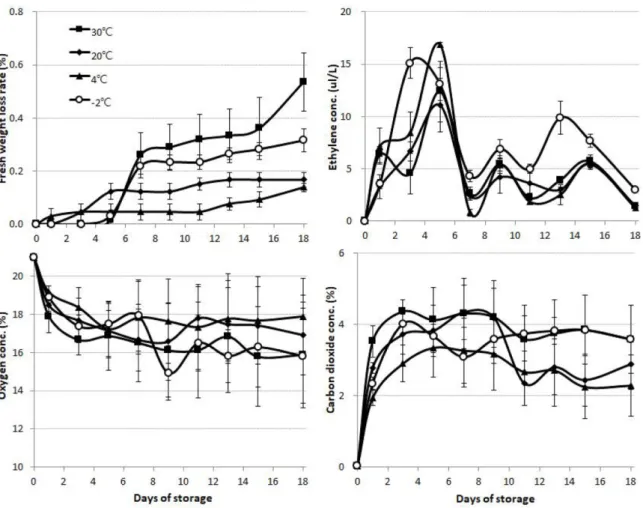
어린잎 비트의 저장 18일간 모든 처리구의 생체중 감소율 은 0.15%에서 0.55%의 수준으로 수분 손실에 의한 외관상 상품성 저하는 나타나지 않았는데9), 어린잎 비트의 MA저장 에 우수하다고 보고된 1,300 cc OTR 필름16)으로 무공포장 하였기 때문이라고 생각된다. 저장중 어린잎 비트의 생체중 은 수송 온도처리에 따라 차이를 나타냈는데, 5시간 동안의 짧은 시간이지만 호흡속도가 크게 증가했을 30oC에서 가장 크게 감소하였고, 다음으로 동해의 위험성이 있었던 -2oC 처 리구에서 다음으로 높은 감소율을 보였다. Kay와 Paull9)은 비트의 호흡속도는 온도가 증가함에 따라 빨라지며, 지상부 의 최고 동결온도(highest freezing point)는 -0.9oC로 보고하 여 이보다 낮은 -2oC 처리로 인해 동결점 이하로 떨어져 호 흡속도가 증가한 것으로 판단된다15).
저장중 포장내 산소 농도는 모든 처리구가 저장 직후 감 소하여 저장 종료일인 18일째 16-18%의 수준을 보였다.
30oC와 -2oC 처리구 중 다소 낮은 농도를 나타내었지만 통 계적 유의성은 없었다. 이산화탄소 농도는 모든 처리구가 저 장 후 증가하여 3% 내외 수준으로 유지하며, 저장 종료일에 2-4%의 농도를 나타내었는데, 30oC와 -2oC 처리에서 높았다.
무순의 경우 모의 유통조건에서 MA저장하였을 때, 온도처 리 차이를 높게 한 5oC-30oC-10oC와 5oC-20oC-10oC 처리 구에서 포장내 이산화탄소가 가장 높았다고 하였다. 포장내 에틸렌 농도는 저장 초기에 크게 증가한 후 저장 5일 이후 안정화되어 저장 종료일인 18일에는 모든 처리가 5 µL/L 내
외를 보였는데, 수송 온도 중 -2oC 처리구가 가장 높아 동해 를 입은 것으로 판단된다(Fig. 1).
저장 종료일에 경도, 엽록소 함량, 외관상 품질, 그리고 이 취를 조사하였는데(Table 1), 엽록소 함량은 4oC 처리구에서 가장 높았으나, 수송 온도처리에 따른 차이에 통계적 유의성 이 없었다. 일반적으로 엽채류의 황화는 에틸렌에 의해 진행 되는데6), 비트의 뿌리와 잎은 에틸렌 발생량이 매우 적고 에 틸렌 가스에 대한 감수성도 낮아9) 포장내 에틸렌 농도에 영 향을 받지 않은 것으로 보인다.
경도는 4oC 처리구에서 가장 높았으며, 다음으로 30oC와 20oC에서 높았으며 -2oC 처리구가 가장 낮았다. 대파의 경 우 수분 증산에 의한 생체중이 감소하며 조직감이 떨어지고 질겨지는 현상을 보이며 경도가 높아졌다고 보고하였는데2), 가장 높은 생체중 감소율을 보인 30oC가 높은 경도를 보인 것과 유사한 결과였다. 경도와 엽록소 함량이 가장 높았고 생체중 감소가 가장 적었던 4oC 처리구에서 외관상 품질이 가장 우수하였으며, 이취는 가장 낮았다. Kang 등7)도 cold chain 조건에서 저장중 낮은 수분 감소와 내적 품질 유지로
Fig. 1. Change of fresh weight loss rate, oxygen, carbon dioxide, and ethylene concentration of baby leaf beet controlled loading and transporting temperature. Vertical bars represent ±SD of the means (n=5).
Table 1. The hardness, chlorophyll (SPAD), visual quality, and off-odor of baby leaf beet controlled loading and transporting tem- perature at 18 days storage
Treatments Hardness (kg) Chlorophyll (SPAD) Visual quality Off-odor
30
oC 0.35b
z27.2a 2.3b 3.3a
20
oC 0.34b 27.6a 2.4b 2.3c
4
oC 0.59a 29.4a 2.7a 1.9d
-2
oC 0.15c 27.8a 2.4b 2.9b
z
Mean seperation within columns of treatments by DMRT ay 5% level.
외관상 품질이 높게 유지되었다고 하였다. MAP 내부의 이 취는 저산소 및 고이산화탄소에 의한 무기호흡이 원인이 되 기도 하지만6), 부패균에 의해 발생하기도 한다3). 어린잎 비트 의 저장 종료일의 총균수도 4oC 처리구에서 0.32 logCFU/g 로 가장 낮았고, 20oC와 30oC 처리구는 2.0 logCFU/g를 넘 었는데, 가장 온도가 낮았던 -4oC 처리구도 1.8 logCFU/g로 높았다(Fig. 2). 저장 중 균수 증가는 저온일수록 억제되지만, 본 실험에서 -2oC 처리구는 동해를 입어 조직이 손상되어 8oC의 저장 중 균수가 증가된 것으로 보인다. 신선편이 멜 론을 5oC 저온저장 전에 22oC에서 최소 1시간에서 최대 5 시간까지 방치하였을 때 박테리아와 곰팡이, 그리고 총균수 가 방치시간에 따라 꾸준히 증가하였다고 보고하였는데24), 본 실험에 비해 짧은 저장기간에 많은 균수를 보인 것은 저 장온도의 영향이었을 것이라 판단된다.
이상의 결과를 볼 때, 비록 상·하차 및 수송 중의 짧은 5시 간이지만 성채가 아닌 어린잎의 경우 연약하여 수확 후 품 질 유지에 영향을 미치는 것으로 판단되어 유통체계의 세심 한 관리가 필요하므로, 동해를 입을 수 있는 영하의 온도와 20oC의 고온을 피해야 할 것이다.
요 약
계절에 따라 달라지는 수송 온도에 따른 어린잎 비트의 저장성을 알아보기 위해 어린잎 크기에서 수확한 비트잎을 1,300 cc·m-2·day-1·atm-1의 OTR(oxygen transmission rate) 필름으로 포장하여 4가지 수송 온도 조건에서 18일간 저장 하였다. 어린잎 비트를 계절별로 달라지는 수송 온도(-2oC, 4oC, 20oC, 30oC)에서 5시간동안 보관한 후 8oC에서 저장하 면서 생체중 감소, 포장내 산소, 이산화탄소, 에틸렌 가스, 외
관 품질, 이취, 그리고 총균수를 조사하였다. 생체중 감소는 모든 처리구가 MAP 포장상태였기 때문에 0.6% 이하였으며, 처리중에는 4oC 처리에서 가장 낮았다. 포장내 가스 조성은 수송 온도별 차이에 통계적 유의성은 없었으나, 산소는 4oC 처리구에서 18%로 가장 높았고 이산화탄소는 30oC와 -2oC 에서 4% 수준으로 높았으며, 에틸렌는 저장 10일 이후 -2oC 에서 가장 높았다. 또한 저장 종료일의 경도와 외관은 4oC 처리구에서 가장 양호하였으며, 특히 이취와 총균수는 매우 낮았다. 따라서 어린잎 비트는 짧은 기간이지만 수송 온도가 균 발생과 저장성에 영향을 미치기 때문에 4oC 내외의 저온 유통체계 확립이 필요하다고 판단된다.
감사의 글
본 연구는 농림축산식품부의 재원으로 농림식품기술기획 평가원의 첨단생산기술개발사업(116111-03)의 지원으로 수행 되었음.
참고문헌