Vol. 26, No. 3 155~163 (2020)
https://doi.org/10.20909/kopast.2020.26.3.155
A Study on the Influence of the Packaging System-related Institutional Approach on Logistics Efficiency (Focusing on Retail Ready Packaging System)
Sung-Tae Jung
1*
1
Caroline University, USA
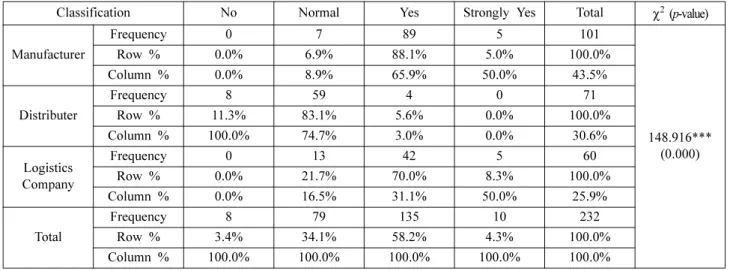
Abstract This paper conducted a study on the operation plan of the packaging system to enhance the logistics effi- ciency between the manufacturer and the distributor, whose prior research in the relevant field was insignificant. By iden- tifying problems and improvements in the operation of the packaging system between domestic manufacturers and distributors through the Retail Ready Packaging. The institutional aspects were investigated to confirm that the mediation role of government and social organizations was required to resolve issues (χ
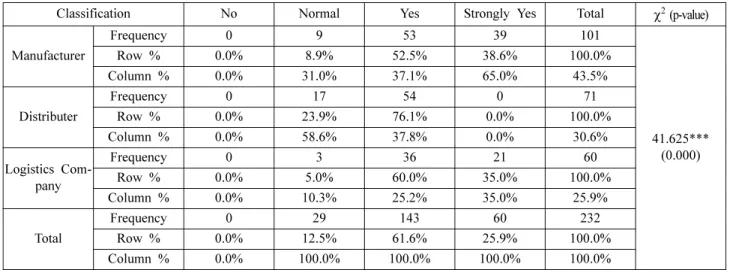
2= 148.916, p < 0.001), and that guidelines that gathered diverse opinions for the rational operation of the packaging system were essential, while institutional aspects are needed to be supplemented to be willing to improve logistics efficiency (χ
2= 95.781, p < 0.001). In this study, even though the difference in perception between manufacturers and distributors is clear and the issue related to the operation of the packaging system is ongoing, if there is no effort to grasp the issue, the opinions between manufacturers and dis- tributors will be left at odds and could become a social problem. Unnecessary interference from government and social organizations should be excluded, but the level of mediation to support win-win management in order to promote logistics standardization and reduce CO
2and national logistics costs can be explained as a catalyst for improving logistics effi- ciency through reasonable operation of the packaging system.
Keywords Packaging Design, Institutional Approach, Logistics efficiency
Introduction
Retailers these days have a huge influence on the determination of their own packaging formats, materials and sizes. The pressure from retailers to secure display space removed the
“Shadow Box” which was used to store deodorant containers and focused on compact containers to spread liquid detergent.
Meanwhile, in order to make their shelves cleaner and better aligned, North American retailers have recently introduced the RRP method, being actively propelled in Europe, that employees are able to store goods on shelves faster and easier.
As a result, empty brown corrugated cardboard boxes, which had previously been thrown away at retail stores, are being replaced with billboards of various colors. Since packaging design is recognized as a powerful medium of products that satisfy various environments and needs in modern life, the relationship between products and packaging is expanding its function and role as a sales tool for consumers' satisfaction and convenience beyond just sealing and protection. Twede
1)stated that the most basic tasks for a package of goods are seal of the product, protection the product and specification the contents
2-4). However, problems can arise if it is not easy to find the products you want by visiting nearby stores, and even if retailers receive all of their orders from general manufacturers, importers and PB suppliers, they still have the last door to overcome before putting them on the shelves. ECR Europe
5)offers a variety of examples of trays and cases that can be displayed on the shelves, some of which are shown in <Figure 1>
6). Things that happen in stores are vary from the basic problem of making it easy to find products in the store's warehouses to putting them on the shelves intact without damaging them, to the difficulty of opening the product's case, checking the product, quickly replenishing the product, which make the shelf corridors too crowded. From the customer's point of view, poor availability is defined as a situation in which the product is not available when it is found. This situation occurs when the product is out of stock, but it can also often occur if the product is not found in the store due to poor product management
7). The RRP aims to greatly improve these problems and completely redesign the “exterior packaging”
so that the product can be moved smoothly from warehouse to display stand and eventually to consumers' shopping carts
5). Thus, the introduction of RRP began with a concern to simplify inventory replenishment work and to encourage consumers to
*Corresponding Author : Sung-Tae Jung
Caroline University, 3660 Wilshire Blvd Suite 320, Los Angeles, CA 90010, USA
Tel : +82-10-6616-8955, Fax : +82-2-528-1827 E-mail : [email protected]