INTRODUCTION
Hyperhidrosis is a condition characterized by excessive sweating and can be focal (primary) or generalized (secondary) (1). Secondary hyperhidrosis is caused by an underlying condi- tion such as infection, endocrine or metabolic disorders, neo- plastic diseases, neurologic conditions, spinal cord injuries, cardiovascular or respiratory disorders, anxiety, or stress (2, 3).
Primary hyperhidrosis has been associated with hyperac- tivity of the sympathetic nervous system and can affect the palms, soles, axillae, face, and scalp as well as other sites (2, 4). This condition occurs in otherwise healthy people and can have a deeply detrimental effect on quality of life, result- ing in impairment of daily activities, social interactions and occupational activities (5, 6).
A pilot study of young Israelis reported an incidence of 1% (7), and hyperhidrosis prevalence in the United States is 2.8%, equivalent to 7.8 million people (2). Hyperhidrosis is uncommon but not rare. Despite many treatment modalities, research into the characteristics of hyperhidrosis patients is limited. Here, we retrospectively investigated the epidemi- ologic characteristics of primary hyperhidrosis patients vis- iting a hyperhidrosis center in Korea.
MATERIALS AND METHODS
We reviewed the medical records of patients visiting our hyperhidrosis center between March 2006, and February 2008, for diagnosis and treatment of hyperhidrosis. Information collected from the medical records included: sex, age at visit, age of onset, referral source, occupation, family history, past treatment, hyperhidrosis sites, aggravating factors and hyper- hidrosis disease severity scale (HDSS) ranking. We analyzed the relationship between family history of hyperhidrosis and age of onset. Qualitative variables are expressed as percentages and compared using Pearson’s chi-square test. Quantitative variables are expressed as mean±standard deviation and com- pared using Student’s t-test. We analyzed the results with SPSS version 15.0 (SPSS, Chicago, IL, USA) and all P values less than 0.05 were considered statistically significant.
RESULTS
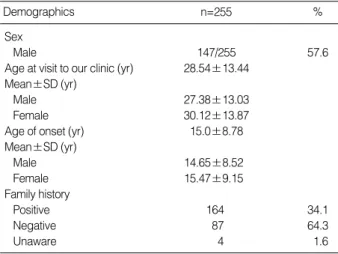
A total of 255 medical records were reviewed; 57.6% of the patients were male, the mean age was 28.54±13.44 yr old at the date of visit, with a mean age of onset of 15.0±8.78 yr
772
Eun Jung Park, Kyung Ream Han, Ho Choi, Do Wan Kim, and Chan Kim
Hyperhidrosis Center, Ajou University Hospital, Suwon, Korea
Address for Correspondence Chan Kim, M.D.
Department of Anesthesiology and Pain Medicine, Ajou University Hospital, 164 Worldcup-ro, Yeongtong-gu, Suwon 443-721, Korea Tel : +82.31-219-5689, Fax : +82.31-219-6656 E-mail : [email protected]
J Korean Med Sci 2010; 25: 772-5 ISSN 1011-8934
DOI: 10.3346/jkms.2010.25.5.772
An Epidemiological Study of Hyperhidrosis Patients Visiting the Ajou University Hospital Hyperhidrosis Center in Korea
Hyperhidrosis is a disorder of perspiration in excess of the body’s physiologic need and significantly impacts one’s occupational, physical, emotional, and social life. The purpose of our study was to investigate the characteristics of primary hyperhidrosis in 255 patients at Ajou University Hospital Hyperhidrosis Center from March 2006, to February 2008. Information collected from the medical records was: sex, sites of hyperhidrosis, age at visit, age of onset, aggravating factors, hyperhidrosis dis- ease severity scale (HDSS) rank, family history, occupation, and past treatment. A total of 255 patient records were reviewed; 57.6% were male. Patients with a fami- ly history (34.1%) showed a lower age of onset (13.21±5.80 yr vs. 16.04±9.83 yr in those without family history); 16.5% had previous treatment, most commonly ori- ental medicine. Palmar and plantar sites were the most commonly affected, and 87.9% of patients felt their sweating was intolerable and always interfered with their daily activities. Our study provides some original information on the Korean primary hyperhidrosis population. Patients who have a family history show signs of disease in early age than those without family history.
Key Words : Epidemiology; Primary Hyperhidrosis
Received : 30 March 2009 Accepted : 24 September 2009
ⓒ 2010 The Korean Academy of Medical Sciences.
This is an Open Access article distributed under the terms of the Creative Commons Attribution Non-Commercial License (http://creativecommons.org/licenses/by-nc/3.0) which permits unrestricted non-commercial use, distribution, and reproduction in any medium, provided the original work is properly cited.
Epidemiological Study of Hyperhidrosis 773
old, and 34.1% of all patients had a positive family history of hyperhidrosis (Table 1). The mean age of onset in those with a positive family history was 13.21±5.80 yr, significantly lower than the age (16.04±9.83 yr) in those without family history of hyperhidrosis (P<0.006).
The route to visit our center and occupation of the patients are described by frequency (Tables 2, 3). The most common
route of visit was “arranged by individual clinic” and the most common occupational category was “student”. Previous treat- ment was attempted by 42 of the 255 patients (16.5%). The most common treatment modality before the visit was ori- ental medicine such as herbal medication and acupuncture (Table 4). The most common aggravating factors were stress or anxiety, and social relationships (Table 5).
Palmar and plantar sites were the most commonly affected sites (Fig. 1). We determined how hyperhidrosis affected their life using the hyperhidrosis disease severity scale. Most (87.9%) patients felt their sweating was intolerable and always inter- feres with their daily activities (Fig. 2).
Demographics n=255 %
Sex
Male 147/255 57.6
Age at visit to our clinic (yr) 28.54±13.44 Mean±SD (yr)
Male 27.38±13.03 Female 30.12±13.87 Age of onset (yr) 15.0±8.78 Mean±SD (yr)
Male 14.65±8.52 Female 15.47±9.15 Family history
Positive 164 34.1
Negative 87 64.3
Unaware 4 1.6
Table 1. Patient demographic data
Route of visit % (n=255)
By Clinic 37.7
By Internet 27.0
By TV, newspapers and radios 16.3 By Recommendation from colleague 10.3 Other 8.7 Table 2. Referral source
Occupation % (n=255)
Student (elementary, high school, college, or graduate) 51.8
Officer worker 14.5
Home (housewives, at-home mothers, homemakers) 14.1 Professional (teachers, engineers, physicians, 9
public service personnel)
Unemployed 5.5 Self-employed 5.1 Table 3. Patient occupation
Past treatment received n=42 % Oriental medicine 17 40.5
Surgery 13 30.9
Nerve block 5 11.9
Botulinum toxin type A 3 7.1 Topical aluminum chloride 2 4.8 Oral anticholinergics 2 4.8
Iontophoresis 0 0
Table 4. Previous treatment
Factors %
Anxiety or stress 95.2
Social relationships 77.0
Heat 52.4
Summer season 50.8
Winter season 13.7
Exercise 10.1
Take a meal 8.2
Movement 7.3 Writing under stressful conditions (e.g. an exam) 6.7
Humidity 1.6
Coffee or Caffeine 1.6
Cold 0.8 Table 5. Aggravating factors
% of paients
35
30
25
20
15
10
5
0
Palmar/Plantar Palmar/Plantar/Axillae
Face onlyAxillae onlyPalmar onlyPlantar onlyGroin only Other site such as trunk
Others
Fig. 1. Sites of hyperhidrosis. Others are any combinations of ex- cessive sweating sites except palmar/platar and palmar/plantar/
axillae.
774 E.J. Park, K.R. Han, H. Choi, et al.
DISCUSSION
This research provides original information on primary hyperhidrosis and is the first descriptive study of Korean hyperhidrosis patients. The average age of onset is 15.0 yr old in our study, earlier than in a 2004 United States prevalence study (25.2 yr) (2). However, a more recent US study in 2007 showed a similar average age of onset to our study (14.05 yr) (8); the mean age at first visit for diagnosing and treatment of hyperhidrosis was 28.05 yr in our study and also in the recent US study (8), compared to 39.8 yr in the 2004 study (2). These studies showed that primary hyperhidrosis appeared in adolescence, but people seek medical treatment in early adulthood. Stolman suggested a genetic predisposition may exist, since 30-50% of patients have a family history of hyper- hidrosis (9). A pedigree analysis by Kaufmann et al. (10) sug- gested that hyperhidrosis segregated independently as an autosomal dominant trait and was not inherited as a cross- linked trait. Ro et al. (11) reported a 65% incidence of posi- tive family history in 49 patients with hyperhidrosis that had undergone thoracoscopic sympathectomy. The 2007 US study showed 47.3% of hyperhidrosis patients had a positive fam- ily history and patients who reported an onset age below 20 yr of age were more likely to have a positive family history of hyperhidrosis than those with a later age of onset (8). In line with these results, our study revealed a family history in 34.1% of primary hyperhidrosis cases; and positive fami- ly history patients had a younger onset age than those with a negative family history (13.21±5.80 yr old vs. 16.04± 9.83 yr old).
Hyperhidrosis is present in 2.8% of the general population in the United States (2). This condition can have a deeply detri- mental effect on a patient’s quality of life, resulting in dra- matic impairments of daily activities, social interactions and occupational activities (5, 6). But, patients rarely seek a physi- cian because many are unaware there are many treatments for
primary hyperhidrosis (1). In this study we asked patients how they were referred to our hyperhidrosis clinic or how they got information for hyperhidrosis treatment. The most common referral mode was recommendation by individual clinics, although many patients also found information from the inter- net or mass media.
Lear et al. (8) reported patients had some form of treatment before the consult visit, such as topical aluminum chloride or botulinum toxin type A subcutaneous injections. However, in this study the most common treatment modality before the visit was oriental medicine such as herbal medication and acupuncture.
Hyperhidrosis can be generalized, involving the whole body, but primary focal hyperhidrosis involves limited body areas, most often palms, soles, face, axillae or a combination of them.
In our study, the most commonly affected sites that had exces- sive sweating were palmar and plantar sites simultaneously (32.2%). Other common sites were a combination of palmar, plantar and axillae (22.4%). There are many treatment modal- ities for hyperhidrosis such as topical aluminum chloride, ion- tophoresis, botulinum toxin type A injection, endoscopic tho- racic sympathectomy (ETS), axillary sweat gland removal, oral anticholinergic, and chemical lumbar sympathectomy (CLS) (12-15). Most of such treatment modalities are usual- ly effective for focal area. But our results showed many pati- ents suffer from excessive sweating in multiple sites. In our clinic, We are performing different procedure depending on problem area. Patients who has only palmar hyperhidrosis, we perform VATS. Patients who has only plantar hyperhidro- sis, we perform CLS. Patients who has only axillary hyper- hidrosis, we perform axillary sweat gland removal. We use oral anticholinergic (glycopyrrolate) for the patients who has multiple sites hyperhidrosis or refuse to have invasive proce- dure, contraindication to have invasive treatment, recurrence after above mentioned procedure such as ETS, CLS, and axil- lary sweat gland removal.
Excessive sweating of primary hyperhidrosis patients is usu- ally triggered by anxiety, embarrassment, fear, anger, excite- ment, or mental stress (16). Eccrine sweat glands are inner- vated by cholinergic fibers from the sympathetic nervous sys- tem. Their sweat secretion function is affected by emotional and gustatory stimuli. Nearly all (95%) primary hyperhidro- sis patients said their sweating was intensified when they were in stressful situations or felt anxiety, and 77.0% felt their sym- ptoms were aggravated in social situations. Another common trigger factor was heat.
The severity and impact of hyperhidrosis was assessed using the HDSS, which provides a qualitative measure allowing tailored treatment; this validated and reliable instrument has been used in other studies of hyperhidrosis (17, 18). The HDSS is used to determine the severity of sweating experi- enced by the respondents. A 4-point, single-item question, the HDSS asks patients to indicate which of the following best describes the impact of sweating on their daily activi-
% of paients
100 90 80 70 60 50 40 30 20 10 0
Never noticeable Tolerable Barely tolerable Intolerable Fig. 2. Impact of sweating on daily activities accounting by hyper- hidrosis severity scale.
Epidemiological Study of Hyperhidrosis 775
ties: 1) never noticeable, never interferes; 2) tolerable, some- time interferes; 3) barely tolerable, frequently interferes; or 4) intolerable and always interferes. Most (87.9%) of hyper- hidrosis patients have sweating that is a ‘4’.
In conclusion, we described the epidemiologic character- istics of primary hyperhidrosis patients in Korea for the first time. These characteristics can help physicians who treat the patients. The patients who have a family history show signs of disease in early age than those without family history. Most of hyperhidrosis patients have intolerable sweating and exces- sive sweating which interfered their daily activities. Since the study scope was limited to one hyperhidrosis center; a nation- al survey should be performed to further expand the data available to assist whole Korean patients.
REFERENCES
1. Haider A, Solish N. Focal hyperhidrosis: diagnosis and management.
CMAJ 2005; 172: 69-75.
2. Strutton DR, Kowalski JW, Glaser DA, Stang PE. US prevalence of hyperhidrosis and impact on individuals with axillary hyperhidrosis:
results from a national survey. J Am Acad Dermatol 2004; 51: 241-8.
3. Eisenach JH, Atkinson JL, Fealey RD. Hyperhidrosis: evolving thera- pies for a well-established phenomenon. Mayo Clin Proc 2005; 80:
657-66.
4. Hornberger J, Grimes K, Naumann M, Glaser DA, Lowe NJ, Naver H, Ahn S, Stolman LP. Recognition, diagnosis, and treatment of prima- ry focal hyperhidrosis. J Am Acad Dermatol 2004; 51: 274-86.
5. Amir M, Arish A, Weinstein Y, Pfeffer M, Levy Y. Impairment in quality of life among patients seeking surgery for hyperhidrosis (exces- sive sweating): preliminary results. Isr J Psychiatry Relat Sci 2000;
37: 25-31.
6. Lerer B, Jacobowitz J, Wahba A. Personality features in essential
hyperhidrosis. Int J Psychiatry Med 1980-1981; 10: 59-67.
7. Connolly M, de Berker D. Management of primary hyperhidrosis: a summary of the different treatment modalities. Am J Clin Dermatol 2003; 4: 681-97.
8. Lear W, Kessler E, Solish N, Glaser DA. An epidemiological study of hyperhidrosis. Dermatol Surg 2007; 33: S69-75.
9. Stolman LP. Treatment of hyperhidrosis. Dermatol Clin 1998; 16:
863-9.
10. Kaufmann H, Saadia D, Polin C, Hague S, Singleton A. Primary hyperhidrosis-evidence for autosomal dominant inheritance. Clin Auton Res 2003; 13: 96-8.
11. Ro KM, Cantor RM, Lange KL, Ahn SS. Palmar hyperhidrosis: evi- dence of genetic transmission. J Vasc Surg 2002; 35: 382-6.
12. Baumgartner FJ, Bertin S, Konecny J. Superiority of thoracoscopic sympathectomy over medical management for the palmoplantar sub- set of severe hyperhidrosis. Ann Vasc Surg 2009; 23: 1-7.
13. Lee MR, Ryman WJ. Liposuction for axillary hyperhidrosis. Australas J Dermatol 2005; 46: 76-9.
14. Bajaj V, Langtry JA. Use of oral glycopyrronium bromide in hyper- hidrosis. Br J Dermatol 2007; 157: 118-21.
15. Kim WO, Yoon KB, Kil HK, Yoon DM. Chemical lumbar sympa- thetic block in the treatment of plantar hyperhidrosis: a study of 69 patients. Dermatol Surg 2008; 34: 1340-5.
16. Ellis H. Hyperhidrosis and its surgical management. Postgrad Med 1975; 58: 191-6.
17. Solish N, Bertucci V, Dansereau A, Hong HC, Lynde C, Lupin M, Smith KC, Storwick G. A comprehensive approach to the recogni- tion, diagnosis, and severity-based treatment of focal hyperhidrosis:
recommendations of the Canadian Hyperhidrosis Advisory Commit- tee. Dermatol Surg 2007; 33: 908-23.
18. Cetindag IB, Boley TM, Webb KN, Hazelrigg SR. Long-term results and quality-of-life measures in the management of hyperhidrosis. Tho- rac Surg Clin 2008; 18: 217-22.