400
©The Korean Society of Food Science and Technology
발효 균주에 따른 청국장의 발효특성
백낙민·박나영·박금순·이신호∗
대구가톨릭대학교 식품외식산업학부
Effect of Starter Cultures on the Fermentative
Characteristics of Cheonggukjang
Lag Min Baek, La Young Park, Kuem Soon Park, and Shin Ho Lee∗
Faculty of Food Technology and Service, Catholic University of Daegu
Abstract The effects of different starter cultures on the fermentative characteristics of cheonggukjang were examined by
using three Bacillus strains. The strains included Bacillus subtilis KCTC 1021 as a control, Bacillus sp. Kn-10 (Kn-10) isolated from a commercial cheonggukjang, and Bacillus sp. B-59 (B-59) isolated from rice straw. There were no significant differences in pH or viable cells among the different cheonggukjang samples during fermentation for 72 hr at 40oC. However, the sample
prepared with B-59 had higher slime content and protease activity than the controls and Kn-10 samples. DPPH free radical scavenging activity was higher in the B-59 sample and lower in the control and Kn-10 samples when compared to steamed soybeans after fermentation for 72 hr at 40oC. The total amino acid contents the cheonggukjangs were 34869.98 mg% (B-59),
34481.89 mg% (control), and 31791.09 mg% (Kn-10). Glutamic acid and lysine contents were higher in the B-59 sample than in the control. Finally, the cheonggukjang fermented using the B-59 strain had improved sensory qualities such as color, taste, texture, and overall acceptability compared to the control and Kn-10 samples.
Keywords: cheonggukjang, Bacillus sp., quality characteristics, rice straw
서
론
청국장은 대두 발효 식품류 중 가장 짧은 기간(2-3일)에 완성 할 수 있는(1) 풍미가 독특하고 여러 가지 필수아미노산, 식물성 지방 및 유기산들을 많이 함유하고 있어, 영양면에서도 우수한 발효식품이다. 특히 청국장은 소화흡수율이 높고, 소금이 들어가 지 않는 무염발효식품으로 고혈압, 위암, 뇌졸중 등의 발생과 관 련이 높은 정제소금의 과잉섭취를 간접적으로 예방할 수 있는 바 람직한 식품이라 할 수 있다(2). 현재 청국장은 혈중 콜레스테롤 저하(3), 고혈압 예방(4), 항암(5), 항산화(6), 혈전용해(7), 및 골다 공증 예방(8) 등의 다양한 생리활성이 밝혀짐에 따라 웰빙 식품 으로 관심이 집중되고 있다. 청국장의 품질은 발효에 관여하는 미생물의 종류에 따라 다르며, 청국장 제조는 볏짚을 이용한 자 연발효법과 일부 청국장 제조용 미생물을 이용하는 방법이 통용 되고 있으나 균일한 품질을 갖는 청국장을 제조하기란 매우 어 려운 실정이다. 청국장 발효는 Bacillus subtilis, Bacillus licheni-formis 및 Bacillus megaterium과 같은 Bacillus속의 균주를 단독(9-15) 또는 두 균주를 혼합(16,17)하여 사용한 예가 보고되고 있다. 청국장은 다양한 생리활성이 있는 우수한 발효식품임에도 불 구하고 발효 과정 중에 발생되는 암모니아에 기인한 특유한 냄 세로 말미암아 청소년층과 외국인이 기피하고 있는 실정이다. 이 러한 문제점을 해결하고 세계적인 전통 발효 식품으로서의 자리 매김을 하기 위해서는 특정 균주를 이용한 발효 과정 중 청국장 고유의 냄새를 줄이는 방법과 아울러 정장의 효과가 있는 생리 활성이 우수한 균주를 이용한 균일한 품질의 청국장 제조기법의 확립이 시급한 실정이다. 본 연구는 전통 청국장의 특유한 냄새를 완화하여 청소년층과 외국인의 기호성과 청국장의 생리활성을 개선 또는 증진시키고, 볏짚에서 분리한 장정착성과 항균활성이 있는 균주의 청국장 제 조용 starter로 사용 가능성을 검토하기 위하여 청국장 발효과정 중 일어나는 각종 변화와 품질 특성을 시중 청국장에서 분리한 균주와 비교 검토하였다.재료
및
방법
재료 및 사용 균주 원료대두는 2007년 경산 하양시장에서 구입한 국산 콩을 사용 하였으며, 청국장 제조에 사용한 균은 전통적인 발효균주인 Bacillus subtilis KCTC 1021과 시판 청국장에서 분리한 Bacillus sp. Kn-10, 볏짚에서 분리한 Bacillus sp. B-59를 사용하였다. 분리균주의 분리는 하양 시장에서 구입한 시판 청국장과 농가에서 수집한 볏 짚을 원료로 하여 멸균 증류수에 각각 현탁시킨 후 Nutrient broth (Difco, Detroit, MI, USA)에 도말하고, 37oC에서 24시간 배양 후 나타난 독립된 colony를 순수 분리하여 그람염색을 통한 형태학 적 검사와, spore 생성유무 그리고 Amoa-Awua 등의 방법(18)에 준하여 proteolytic activity, amylolytic activity, soybean activity와 를 측정하여 활성이 우수한 균주를 분리하였다. 각 균주는 Nutrient *Corresponding author: Shin-Ho Lee, Faculty of Food Technology
and Service, Catholic University of Daegu, Gyungsan, Gyeongbuk 712-702, Korea
Tel: 82-53-850-3217 Fax: 82-53-850-3217 E-mail: [email protected]
Received May 14, 2008; revised July 14, 2008; accepted July 16, 2008
broth에 접종하여 37o C에서 24시간 배양 후 사용하였다. 청국장 제조 선별한 대두를 수세하여 4o C의 물에 24시간 동안 침지한 후, 약 1시간 동안 수분을 제거하고, 121o C에서 45분간 증자 후 50o C 로 냉각시켰다. 0.1 M phosphate buffer(pH 7.0)에 적정 농도(108 CFU/mL)로 현탁시킨 균주를 증자된 콩에 각각 2%(v/w) 접종하 여 골고루 혼합한 다음 40o C, 상대습도 90%에서 72시간 발효시 키면서 24시간 간격으로 품질변화를 조사하였다. 총균수 및 pH측정 총균수는 시료 10 g에 멸균 증류수 90 mL를 첨가하여 ACE homogenizer(Nissei, Nihonseiki Kaisha Ltd., Tokyo, Japan)로 15,000 rpm에서 1분간 마쇄하였다. 마쇄한 시료 1 mL을 무균적 으로 취하여 0.1% peptone수로 적정 희석하고 Nutrient agar (Difco, Detroit, MI, USA)에 접종하여 37o
C에서 24시간 배양 후 나타나는 colony 수를 계측하였다. pH 측정은 마쇄한 시료를 여 과지(Whatman No. 5)로 여과하여 그 여액을 pH meter(Orion model 410-A, Boston, MA, USA)로 측정하였다.
점질물 생성량측정 청국장의 점질물량은 Lee 등(19)에 의한 방법에 준하여 청국장 시료에 동량의 증류수를 첨가하여 30분간 진탕한 후 여과 및 원 심분리(3000 rpm, 15분)하여 얻은 상등액 5 mL을 105o C에서 증발 건조시켜 그 무게를 측정하였으며, 시료에 대한 건물량(%)으로 나타내었다. 전자공여능(DPPH) 측정 Blois의 방법(20)을 변형하여 95% 메탄올을 이용한 청국장 추 출물 0.4 mL에 0.4 mM DPPH(α, α-diphenyl-β-picrylhydrazyl) 메 탄올 용액 0.8 mL을 혼합하고, 10분간 방치 후 분광광도계(phar-macia biotech ultrospec 1000, Cambridege, UK)를 사용 525 nm 에서 흡광도를 측정하여 아래 계산식에 준하여 환산하였다.
색도 측정
동결 건조한 청국장을 homogenizer(Nissei, Nihonseiki Kaisha Ltd., Tokyo, Japan)를 이용하여 마쇄하여 그 분말의 색차를 측정 하였다. 색차는 색차계(JC 801, color techno system Co., Tokyo, Japan)를 사용하여 L(lightness), a(redness), b(yellowness) 값을 3회 반복 측정하였다. 이때 표준판은 L 값 93.73, a 값 -0.12, b 값 0.11인 calibration plate를 사용하였다. 환원당 정량 환원당은 DNS법(21)으로 정량하였다. 시료 5 g에 증류수 100 mL를 가하여 3시간 진탕 추출시킨 후 여과지(whatman No.2)로 여과한 여액 1 mL에 DNS(dinitrosalicylic acid)시약 3 mL을 첨가 하고 5분간 끊인 다음, 냉각한 후 분광광도계(pharmacia biotech ultrospec 1000, Cambridege, UK)를 사용하여 550 nm에서 흡광도 를 측정하였다.
Protease 활성도측정
Protease 활성은 Abiose 등(22)과 Omafuvbe 등(23)의 방법을 일
부 변형하여 측정하였다. 청국장을 0.1 M sodium hydrogen phos-phate buffer(pH 6.5)를 이용하여 추출 후 4000 rpm에서 15분간 원 심분리한 상등액을 조효소액으로 -20oC 보관하여 사용하였다. 조 효소액 5 mL에 2% sodium casein용액 10 mL을 첨가하여 35o C 30분간 방치 후, 10% trichloroacetic acid용액 10 mL을 첨가하여 4000 rpm에서 15분간 원심분리하여 얻은 상층액의 단백질 양을 Lowry법(24)으로 측정하였다. 이때 tyrosine을 이용하여 작성한 표 준곡선으로부터 함량을 구하였다. 이때 1 unit는 기질 1 mL당 생 성된 tyrosine의 µg수이다. 아미노산 분석 Hong 등(25)에 의한 방법을 변형하여 동결 건조시킨 시료 1 g 을 취하여, 6 N HCl 5 mL 가한 다음 질소로 치환하여 밀봉한 후 110o C dry oven에서 24시간 가수분해한 분해액을 적정 희석하여
0.2µm syringe filter(Millipore Co., Billerica, MA, USA)로 여과 한 후 아미노산자동분석기(biochrom 30 amino acid analyzer, Cambridege, UK)로 분석하였다. 관능검사 평소 청국장을 기피하지 않은 대구가톨릭대학교 식품외식산업 학부 대학생 및 대학원생 25명을 대상으로 관능검사를 실시하였 다. 측정항목으로는 색상, 조직감, 맛, 향기, 종합적기호도를 5점 채점법으로 평가하였다. 아주 좋다가 5점, 보통이다가 3점, 아주 나쁘다가 1점으로 평가하였다. 통계처리 관능검사를 제외한 모든 실험은 3회 반복으로 행하였으며, 평 균치간의 유의성은 SPSS system(statistical package for social sci-ences, SPSS Inc., Chicago, IL, USA) software package(version 12.0)을 이용, p<0.05 수준으로 Duncan's multiple range test에 의 하여 검정하였다.
결과
및
고찰
pH 및 총균수40o
C에서 72시간 동안 발효시킨 청국장의 pH와 총균수의 변화 는 Fig. 1에서 보는 바와 같다. 발효 24시간까지는 Bacillus subtilis (대조구)가 가장 낮았으나 발효가 진행됨에 따라 대조구와 청국장 에서 분리한 Bacillus sp. Kn-10 처리구간 뚜렷한 차이는 없었으나 볏짚에서 분리한 Bacillus sp. B-59 균주는 다소 낮은 경향을 나타 내었다. 이때 각 처리구의 pH는 B. subtillis가 8.21 Bacillus sp. Kn-10은 8.12, Bacillus sp. B-59는 7.88이었다. 발효 후 청국장의 pH는 Youn 등(16)의 연구 결과와 같이 발효 전에 비해 증가하였 으며, Kim 등(26)이 보고한 우리나라 전통 청국장의 평균 pH 값 인 7.21과 유사하였다. 총균수의 변화는 발효초기 대조구와 Bacillus sp. Kn-10은 105 CFU/mL, Bacillus sp. B-59는 104 CFU/mL이었으
나 발효 24시간 이후 각 처리구의 총균수는 109
CFU/mL 이상을 나타내어 발효기간 중 3종의 청국장의 총 균수는 뚜렷한 차이를 나타내지 않았으며, 발효 균주에 따른 총 균수의 차이도 관찰되지 않았다. Youn 등(16)은 Bacillus natto와 B. licheniformis를 이용하여 청국장을 제조하였을 때 청국장발효 40시간 이후 총균수 109 CFU/ mL이었다는 보고하여 본 실험의 결과와 유사하였다. 점질물 생성량 발효 균주에 따른 청국장의 발효 과정 중 점질물 함량의 변화 전자공여능 1 시료첨가구의 흡광도 무 첨가구의 흡광도 ---– ⎝ ⎠ ⎛ ⎞ 100× =
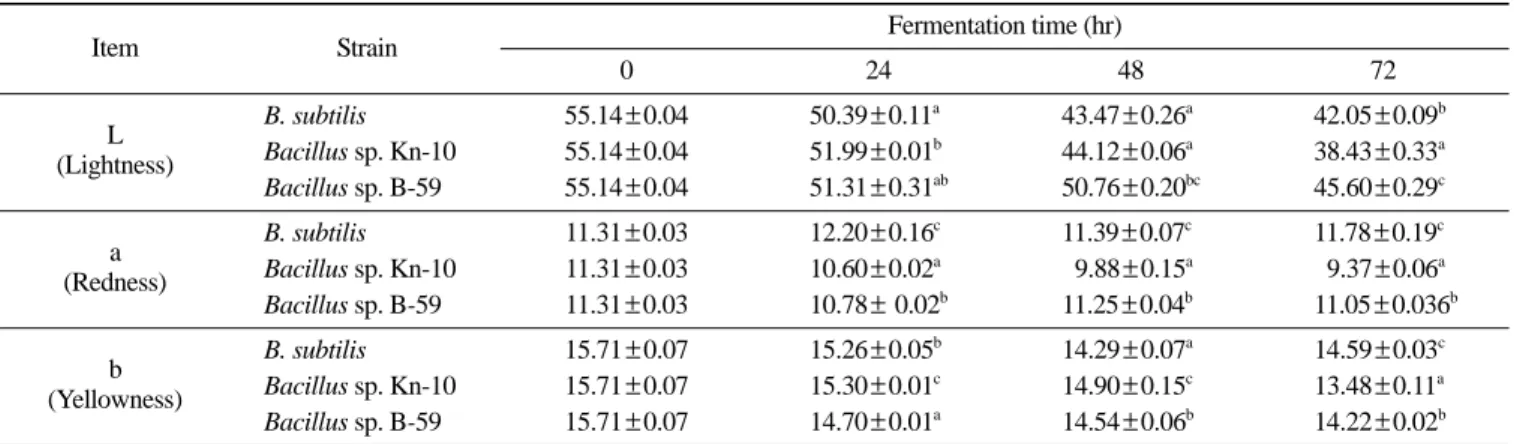
는 Table 1에 나타내었다. 청국장의 점질물은 콩 탄수화물 분해 물인 levan form fructan과 단백질 분해물 중합체인 polyglutamate 의 혼합물로 알려져 있으며(27), 일반 청국장에는 2.15-6.03%가 함유되어 있다(19). 점질물의 생성량은 발효가 진행됨에 따라 증 가하는 경향을 나타내었으며, 발효 24시간 후 B. subtillis는 2.90% Bacillus sp. Kn-10은 4.01%, Bacillus sp. B-59는 5.96%이었으며, 발효 48시간 후에 각 처리구별 점질물 함량은 각각 4.32%, 4.54% 그리고 6.28%를 나타내어 Bacillus sp. B-59 균주를 사용한 청국 장의 점질물 함량이 다른 처리구에 비해 유의적으로 높은 경향 을 나타내었다. Bacillus subtilis 6 균주를 이용하여 청국장을 제 조하였을 때, 40oC, 20시간동안 발효시킨 청국장의 점질물 양이 2.84-5.66%라고 보고한 Woo 등(28)의 결과에 비해 본 실험에 사 용한 균주로 제조한 청국장의 점질물 생성량이 높은 경향을 나 타내었다. 색도 발효 균주를 달리하여 제조한 청국장 분말의 색차는 Table 2 에 나타내었다. L 값(명도)의 경우 발효 전 55.14에서 발효 24시 간째 대조구, Kn-10, B-59 접종구가 각각 50.39, 51.99, 51.31을 나타내어 전반적으로 감소하였다. 명도는 발효시간이 경과할수록 감소하여 전반적으로 어둡게 변하였으며, Bacillus sp. B-59를 사 용한 청국장이 다른 2종에 비해 다소 밝은 색을 나타내었다. Choi 등(10)도 발효가 진행됨에 따라 청국장의 색이 어둡게 변하였다 고 보고하였다. a 값의 경우 Bacillus sp. Kn-10이 11.31에서 발효 72시간 후 9.37로 가장 급격하게 감소하였고, B. subtilis는 발효 기간 동안 뚜렷한 변화가 관찰되지 않았으며, Bacillus sp. B-59 는 11.31에서 발효 72시간 경과 후 11.05로 발효 초기에 비해 다 소 감소하였다. 발효기간 동안 b 값의 변화는 발효시간이 경과할 수록 감소하였으며, Bacillus sp. Kn-10이 가장 큰 변화를 나타내 었으며, 발효 72시간째도 13.48을 나타내어 3종의 청국장 중 가 장 낮았다. Bacillus sp. B-59 접종구는 대조구에 비해 황색도는 낮았으나, 명도가 높아 전반적으로 대조구보다 밝고 옅은 황색을 나타내어 청국장의 색도 개선에 효과가 있을 것으로 판단되었다. 환원당 발효시간에 따른 균주별 청국장의 환원당 변화는 Fig. 2에 나
Fig. 1. Changes in pH and total viable cell during
cheon-ggukjang fermentation with different strains of Bacillus for 72 hr
at 40oC. -■, Bacillus subtilis;
-◆-, Bacillus sp. Kn-10; -▲-, Bacillus sp. B-59
Table 2. Changes of color during cheonggukjang fermentation with different strains of Bacillus for 72 hr at 40o C
Item Strain Fermentation time (hr)
0 24 48 72 L (Lightness) B. subtilis 55.14±0.04 50.39±0.11a 43.47±0.26a 42.05±0.09b Bacillus sp. Kn-10 55.14±0.04 51.99±0.01b 44.12±0.06a 38.43±0.33a Bacillus sp. B-59 55.14±0.04 51.31±0.31ab 50.76±0.20bc 45.60±0.29c a (Redness) B. subtilis 11.31±0.03 12.20±0.16c 11.39±0.07c 11.78±0.19c Bacillus sp. Kn-10 11.31±0.03 10.60±0.02a 19.88±0.15a 19.37±0.06a Bacillus sp. B-59 11.31±0.03 10.78± 0.02b 11.25±0.04b 11.05±0.036b b (Yellowness) B. subtilis 15.71±0.07 15.26±0.05b 14.29±0.07a 14.59±0.03c Bacillus sp. Kn-10 15.71±0.07 15.30±0.01c 14.90±0.15c 13.48±0.11a Bacillus sp. B-59 15.71±0.07 14.70±0.01a 14.54±0.06b 14.22±0.02b a-d
Mean within each column with no common superscripts are significantly different (p<0.05).
Table 1. Comparison of slime content (%) in cheonggukjang fermented with different strains of Bacillus
Strain Fermentation time (hr)
24 48 72 B. subtilis 2.90±0.07a 4.32±0.02a 5.22±0.05b Bacillus sp. Kn-10 4.01±0.08b 4.54±0.12a 4.77±0.06a Bacillus sp. B-59 5.96±0.12c 6.28±0.06b 6.36±0.01c
a-cMean within each column with no common superscripts are
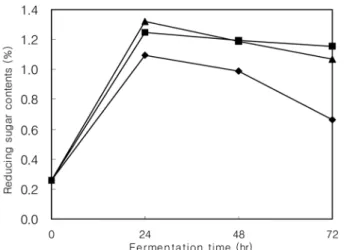
타내었다. 발효 24시간째 환원당 함량은 대조구, Bacillus sp. Kn-10, Bacillus sp. B-59 접종구 각각 1.25, 1.09, 1.32%를 나타내어 발효전의 환원당량인 0.25%에 비해 4-5배 증가하였으며, 발효 24 시간 이후부터 감소하는 경향을 나타내었다. Bacillus sp. Kn-10 접종구는 다른 2종에 비해 낮은 환원당 함량을 나타내었으며, 발 효 48시간 이후부터는 급격한 감소현상을 나타내어 Shon 등(29) 의 청국장 발효 24시간째에 가장 높은 환원당량을 나타내었다가 그 이후부터 감소하였다는 보고와 유사한 경향을 나타내었다. 발 효 24시간을 기점으로 환원당량이 변화하는 것은 콩의 다당류들 이 24시간까지는 저분자의 환원당으로 많이 생성되었다가 24시 간이후부터는 발효 미생물의 증식에 필요한 영양원과 화학적 갈 변화 반응 등에 이용되었기 때문인 것으로 사료된다. 전자공여능(DPPH) 및 protease 활성도 측정 4종의 균주로 발효시킨 청국장의 DPPH 라디칼 소거능을 측정 한 결과를 Table 3에 나타내었다. 청국장의 DPPH 라디칼 소거능 을 청국장의 원료인 증자시킨 콩과 비교한 결과 대조구와 Bacillus sp. Kn-10은 각각 18.95%, 16.58%를 나타내어 증자시킨 콩의 20.00%에 비해 낮게 나타나 발효 과정 중 DPPH 라디칼 소거능 이 감소하는 경향을 나타내었다. 반면에 Bacillus sp. B-59는 23.37% 를 나타내어 발효 기간 동안 DPPH radical 소거능이 증가하여, 발효에 의해 B-59로 제조한 청국장의 항산화 효과가 증가하는 것 으로 판단되었으며 대두, 메주, 된장의 methanol 추출물의 radical 소거능 효과가 발효가 진행됨에 따라 증가한다고 보고한 Choe 등(30)의 결과와 유사한 경향을 나타내었다. 대두 단백질을 가수분해하여 구수한 맛 성분인 아미노산, polypeptide 등을 생성하는 protease는 청국장 제조시 맛을 결정짓 는 중요한 인자이다. 균주를 달리한 청국장 발효 중 protease 활 성 변화는 Table 4에 나타내었다. 발효 기간 중 균주의 종류에 따라 protease의 활성은 뚜렷한 차이를 나타내었으며 발효가 진 행됨에 따라 증가하였다. 청국장 발효기간 동안 Bacillus sp. B-59의 protease 활성이 가장 높았으며, 대조구, Bacillus sp. Kn-10 순으로 활성을 나타내었다. 발효 48시간째 각 처리구별 protease 활성의 범위는 90.97-117.19 unit를 나타내었다. Lee 등(31)은 재래 청국장에서 분리한 균주를 이용하여 제조한 청국장의 protease 활 성은 균주에 따라 다르며, 그 범위는 32-110 tyrosine ug/g/hr이라 고 보고한 바 있다. 아미노산 측정 청국장 발효 중 콩 단백질은 Bacillus 속 미생물이 분비하는 효 소의 작용으로 polypeptide를 amino acid으로 분해되어 소화 흡수 가 용이한 형태로 바뀌고, 구수한 맛에 영향을 미치는 glutamic acid, aspartic acid, 단맛에 영향을 미치는 alanine, glycine 및 lysine의 함량(32), 그리고 발효 중 생성되는 점질물에 의해 청국 장은 고유 맛과 방향을 지니게 된다(33). 균주를 달리하여 제조한 청국장의 구성 아미노산의 비교는 Table 5에 나타내었다. 청국장 의 총 아미노산 함량은 Bacillus sp. B-59 접종구(34869.99 mg%), 대조구(34481.9 mg%), Bacillus sp. Kn-10 접종구(31791.12 mg%) 순으로 나타났다. 특히 Bacillus sp. B-59 접종구의 경우 청국장 의 구수한 맛에 영향을 미치는 L-glutamic acid(5552.13 mg%), 단 맛에 영향을 미치는 alanine(1565.31 mg%), L-lysine(2468.22 mg%) 의 함량이 대조구(B. subtilis 접종구)에 비해 뚜렷하게 높았으며, 필수아미노산인 phenylalanine, histidine이 유의적으로 높은 함량 을 나타내었다. 반면에 L-aspartic acid와 L-threonine, L-serine, glycine의 함량은 대조구가 높은 경향을 나타내었다. 관능검사 균주를 달리하여 48시간 동안 발효시킨 청국장의 관능검사 결 과는 Table 6에서 보는 바와 같다. Bacillus sp. B-59 접종구가 색 상, 풍미, 맛에 대한 기호도가 대조구에 비해 유의적으로 높게 평 가되었다. 종합적 기호도에 있어서도 대조구와 Bacillus sp. Kn-10이 3.07과 2.87인 반면 Bacillus sp. B-59는 3.82로 다른 처리구 에 비해 유의적으로 양호하였으며, 3종의 공시 청국장 중 가장 기호도가 높은 경향을 나타내었다. Glutamic acid는 청국장의 구 수한 맛에, lysine은 단맛에 영향을 미치며(32), 발효 과정 중 생 성된 점질물은 쓴맛을 감소시키는 작용이 있어 청국장의 관능적 특성은 점질물 함량과도 밀접한 관계가 있어(33) Bacillus sp. B-59 균주를 사용하여 제조한 청국장이 기호성이 양호한 것은
Fig. 2. Changes in reducing sugar during cheonggukjang fermentation with different strains of Bacillus for 72 hr at 40o
C.
-■-, Bacillus subtilis; -◆-, Bacillus sp. Kn-10; -▲-, Bacillus sp. B-59
Table 3. Comparison of antioxidative activity of
cheongguk-jangs fermented with different strains of Bacillus tested by
DPPH mehtods
Sample Antioxidative activity (%)
Steamed soybean 20.00±1.05b
B. subtilis 18.95±0.32b
Bacillus sp. Kn-10 16.58±0.47a
Bacillus sp. B-59 23.37±0.21c
a-dMean within each column with no common superscripts are significantly
different (p<0.05).
Concentrations of each sample were adjusted to 1,000 ppm.
Table 4. Change of protease activity in cheonggukjang fer-mented with different strain of Bacillus during fermentation for 48 hr at 40o
C (Unit: tyrosine µg/hr)
Strain Fermentation time (hr)
0 24 48 B. subtilis 0.14±0.13 49.19±0.83a 109.93±0.07b Bacillus sp. Kn-10 0.14±0.13 80.46±0.06b 190.97±0.11a Bacillus sp. B-59 0.14±0.13 95.33±1.73c 117.19±0.64c
a-dMean within each column with no common superscripts are
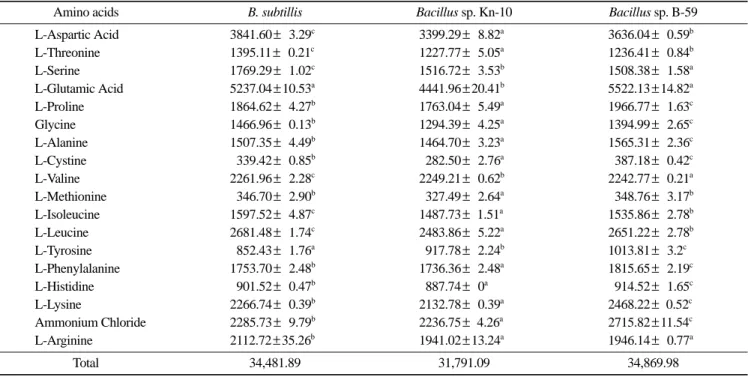
glutamic acid와 lysine의 함량이 다른 처리구에 비해 높고(Table 5) 점질물의 생성량이 높은 것에(Table 1)에 기인한 것으로 판단되 었다. 이상의 결과로 미루어 보아 Bacillus sp. B-59를 청국장 제조용 균주로 사용이 가능한 것으로 판단되며, 대규모 제조에 대비해 적정 접종량과 발효조건에 관한 연구가 선행되어야 할 것으로 판 단된다.
요
약
일반적으로 청국장 제조 시 첨가하는 Bacillus subtilis와 기존 청국장에서 분리한 Bacillus sp. Kn-10, 볏짚에서 분리한 Bacillus sp. B-59를 사용하여 청국장을 조제하고 그 청국장의 품질 특성 을 비교하였다. 균주에 따른 청국장 발효과정 중 pH와 총 균수 는 뚜렷한 차이를 나타내지 않았다. 배양 48시간째 청국장의 점 질물량은 Bacillus sp. B-59의 경우 6.28%로 가장 높았으며, Bacil-lus sp. Kn-10, B. subtillis 순으로 나타났다. 모든 처리구에서 L 값 은 발효가 진행됨에 따라 어두워지는 경향을 보였으며, a 값과 b 값은 감소하는 경향을 나타내었다. 환원당은 발효 24시간까지 증 가하였다가 감소하는 경향을 나타내었다. 청국장의 protease 활성 도는 Bacillus sp. B-59(117.19 unit), B. subtillis(109.93 unit)는 Bacillus sp. Kn-10(90.97 unit) 보다 우수하였다. B. subtillis 또는 Bacillus sp. Kn-10 접종구의 DPPH radical 소거능은 증자콩에 비 해 감소하였으나 Bacillus sp. B-59 접종구는 발효 기간 동안 증가하였다. 발효 균주에 따른 청국장의 총 아미노산 함량은 Bacillus sp. B-59(34,869.98 mg%), B. subtillis(34,481.89 mg%), Bacillus sp. Kn-10(31,791.09 mg%) 순으로 나타났으며, Bacillus sp. B-59는 glutamic acid와 lysine 함량이 다른 처리구에 비해 높았다. 관능검 사 결과, Bacillus sp. B-59로 제조한 청국장의 색, 맛, 조직감, 종 합적기호도에서 가장 양호하였다.
감사의
글
본 연구는 교육과학기술부와 한국산업기술재단의 지역혁신인 력양성사업으로 수행된 연구결과임.문
헌
1. Kwak CS, Kim MY, Kim SA, Lee MS. Cytotoxicity on human cancer cells antitumorigenesis of cheonggukjang, a fermented soybean prod-uct, in DMBA-treated rats. Korean J. Soc. Food Sci. Nutr. 39: 347-356 (2006)
2. Lee JO, Ha SD, Kim AJ, Yuh CS, Bang IS, Park SH. Industrial appli-cation and physiological functions of cheonggukjang. Food Sci. Ind. 38: 69-78 (2005)
3. Yoo JY. Present status of industries and research activities of Korean fermented soybean products. Korean J. Appl. Microbiol. Biotechnol. 23: 13-30 (1997)
4. Okamato A, Hanagata H, Matsumoto E, Kawamura T, Koizume Y, Yanagida F, Angiotensin I converting enzyme inhibitory activities of various fermented foods. Biosci. Biotech. Bioch. 59: 1147-1149 (1995) Table 5. Comparison of amino acid composition in cheonggukjangs fermented with different strains of Bacillus (Unit: mg%, dry basis)
Amino acids B. subtillis Bacillus sp. Kn-10 Bacillus sp. B-59
L-Aspartic Acid 3841.60±23.29c 3399.29±28.82a 3636.04±20.59b L-Threonine 1395.11±20.21c 1227.77±25.05a 1236.41±20.84b L-Serine 1769.29±21.02c 1516.72±23.53b 1508.38±21.58a L-Glutamic Acid 5237.04±10.53a 4441.96±20.41b 5522.13±14.82a L-Proline 1864.62±24.27b 1763.04±25.49a 1966.77±21.63c Glycine 1466.96±20.13b 1294.39±24.25a 1394.99±22.65c L-Alanine 1507.35±24.49b 1464.70±23.23a 1565.31±22.36c L-Cystine 2339.42±20.85b 2282.50±22.76a 2387.18±20.42c L-Valine 2261.96±22.28c 2249.21±20.62b 2242.77±20.21a L-Methionine 2346.70±22.90b 2327.49±22.64a 2348.76±23.17b L-Isoleucine 1597.52±24.87c 1487.73±21.51a 1535.86±22.78b L-Leucine 2681.48±21.74c 2483.86±25.22a 2651.22±22.78b L-Tyrosine 2852.43±21.76a 2917.78±22.24b 1013.81±23.2c L-Phenylalanine 1753.70±22.48b 1736.36±22.48a 1815.65±22.19c L-Histidine 2901.52±20.47b 2887.74±20a 2914.52±21.65c L-Lysine 2266.74±20.39b 2132.78±20.39a 2468.22±20.52c Ammonium Chloride 2285.73±29.79b 2236.75±24.26a 2715.82±11.54c L-Arginine 2112.72±35.26b 1941.02±13.24a 1946.14±20.77a Total 34,481.89 31,791.09 34,869.98 a-d
Mean within each column with no common superscripts are significantly different (p<0.05).
Table 6. Comparison of sensory quality in cheonggukjangs fermented with different strains of Bacillus
Strain Color Flavor Texture Taste Overall acceptance
B. subtilis 3.03b 3.03a 3.20a 3.53b 3.07b Bacillus sp. Kn-10 2.20a 3.83b 3.20a 2.52a 2.87a Bacillus sp. B-59 3.45c 3.67b 3.33a 3.78c 3.82c a-cMean within each column with no common superscripts are significantly different (p<0.05).
5. Takahashi C, Kikuchi N, Katou N, Miki T, Yanagida F, Umeda M. Possible antitumor-promoting activity of components in Japanese soy-bean fermented foods, natto. Effect on gap junctional intracelluar com-munication. Carciongenesis 16: 471-476 (1995)
6. Iwai K, Nakaya N, Kawasaki Y, Matsue H. Antioxidative functions of natto, a kind of fermented soybeans: Effect on LDL oxidation and lipid metabolism in cholesterol fed rats. J. Agr. Food Chem. 50: 3597-3601 (2002)
7. Yoo CK, Seo WS, Lee CS, Kang SM. Purification and characteriza-tion of fibrinolytic enzyme excreted by Bacillus subtilis K-54 isolated from chunggukjang. Korean J. Appl. Microbiol. Biotechnol. 26: 506-514 (1998)
8. Hosoi T. Recent progress in treatment of osteoprosis. Nippon Romen Igakkai Zasshi. 33: 240-244 (1996)
9. Lee BY, Kim DM, Kim KH. Studies on the change in rheological properties of chunggukjang. Korean J. Food Sci. Technol. 23: 478-484 (1991)
10. Choi UK, Ji WD, Chung YG. Characteristic of chunggukjang Pro-duced by Bacillus subtilis DC-2. Korean J. Soc. Food Sci. Nutr. 27: 846-851 (1998)
11. Suh JS, Lee SG. Effect on Bacillus strains on the chunggukjang pro-cessing. (I) Change of the components and enxyme activies during cheonggukjang-koji preparation. Korean J. Soc. Food Sci. Nutr. 14: 301-314 (1982)
12. Suh JS, Ryu MK, Hur YH. Effect on Bacillus strains on the chung-gukjang prosessing(III). J. Korean J. Soc. Food Sci. Nutr. 15: 385-391 (1983)
13. Choi UK, Son DH, Ji WD, Im MH, Choi JD, Chung YG. Changes of taste components and palatability during chunggukjang fermentation by Bacillus DC-2. Korean J. Soc. Food Sci. Nutr. 27: 840-845 (1998) 14. Seok YR, Kim YH, Kim S, Woo HS, Kim TW, Lee SH, Choi C.
Change of protein and amino acid composition during cheonggukjang fermentation using Bacillus licheniformis CN-115. Agr. Chem. Bio-technol. 37: 65-71 (1994)
15. Kim KH, Lim DW, Bae S, Chun SB. Fermentation characteristics of whole soybean meju model system inoculated with 4 Bacillus strains. Korean J. Food Sci. Technol. 29: 1006-1015 (1997)
16. Youn KC, Kim DH, Kim JO, Park BJ, Yook HS, Cho JM, Byun MW. Quality characteristics of the cheonggukjang fermented by the mixed culture of Bacillus natto and B. licheniformis. Korean J. Food Sci. Technol. 31: 201-210 (2002)
17. Kim DH, Lim DW, Bae S, Chun SB. Fermentation characteristics of whose soybean meju model system inoculated with 4 Bacillus strains. Korean J. Food Sci. Technol. 29: 1006-1015 (1997)
18. Amoa-Awua WK, Terlable NN, Sakyi-Dawson E. Screening of 42 Bacillus isolates for ability to ferment soybeans into dawadawa. Int. J. Food Microbiol. 106: 343-347 (2006)
19. Lee YL, Kim SH, Choung NH, Yim MH. A study on the production of viscous substance during the cheonggukjang fermentation. Korean J. Agr. Chem. Soc. 35: 202-209 (1992)
20. Blois MS. Antioxidant determination by the use of a stable free radi-cal. Nature 25: 1199-1120 (1958)
21. Miller GL. Use of dinitrosalicylic acid reagent for determination of reducing sugar. Anal. Chem. 31: 426-428 (1959)
22. Abios SH, Atalabi TA, Ajayi LO. Fermentation of African locust bean: Microbiological and biochemical studies. Niger. J. Biol. Sci. 1: 103-117 (1988)
23. Omafuvbe BO, Shonukan O, Abiose SH. Microbiological and bio-chemical changes in the traditional fermentation of soybeans from ‘soy-dadawa’ Nigerian food condiment. Food Microbiol. 17: 469-474 (2000)
24. Lowry OH, Rosenbrough NJ, Randall RJ. Protein measurement with folin phenol reagent. J. Biol. Chem. 193: 265-275 (1951)
25. Hong KH, Kim HK. Analysis of nutritional components in Pleurotus ferulea. Korean J. Food Sci. Technol. 36: 563-567 (2004)
26. Kim JS, Yoo SM, Choe JS, Park HJ, Hong SP, Chang CM. Physico-chemical properties of traditional chunggukjang produced in different regions. Agr. Chem. Biotechnole 41: 377-383 (1998)
27. In JP, Lee SK. Effect of yucca (Yucca shidigera) extract on quality characteristics of cheonggukjang using Bacillus subtilis p01. Korean J. Soc. Appl. Biol. Chem. 47: 176-181 (2004)
28. Woo SM, Kwon JH, Jeong YJ. Selection and fermentation characteris-tics of chunggukjang strains. Korean J. Food Preserv. 13: 77-82 (2006) 29. Shon MY, Kwon SH, Sung CK, Sung CK, Park SK, Choi SD.
Changes in chemical components of chunggukjang prepared with small black bean. Korean J. Life Sci. 11: 284-290 (2001)
30. Choe GS, Lim SY, Choi JS. Antioxidant and nitrite scavenging effect of soybean, meju and doenjang. Korean J. Life Sci. 8: 473-478 (1998) 31. Lee MY, Park SY, Jung KO, Park KY, Kim SD. Quality and
func-tional characteristics of cheonggukjang prepared with various Bacillus sp. isolated from traditional chunggukjang. Korean J. Food Sci. 70: 191-196 (2005)
32. Lee EJ. Isolation and selection of main strain for chunggukjang fer-mentation and characteristics of chunggukjang fermented with selected strains. PhD. thesis, Yeungnam University, Gyeongsan, Korea (2003) 33. Kim JK, Jung YG, Yang SH. Effective components on the taste of
ordinary Korean soy sauce. Korean J. Appl. Microbiol. Biotechnol. 13: 285-287 (1985)