INTRODUCTION
Varicella zoster virus (VZV) that causes varicella belongs to double-stranded DNA virus, Alphaherpesviridae (1).
Whereas varicella chiefly occurs in children, herpes zoster (HZ) primarily occurs in adults. The overall lifetime inci- dence of HZ among individuals who had varicella is known to be about 20% (2), thus 0.25% to 1.1% of population may be affected by HZ (3). VZV spreads into sensory nerve end- ings, and then centripetally transfers to cranial and dorsal root ganglia where it remains in a latent state. When VZV- specific cellular immunity of the host declines, VZV can be reactivated to develop HZ. The skin lesions begin as grouped vesicles on the reddish swollen base, and progress to pustules, and finally to crusts in 1 to 2 weeks. In general, characteris- tically intense, unilateral, and dermatomal pain is common in patients with HZ. Pain usually resolves or lessens as the lesions heal. However, 10% to 30% of patients with HZ suf- fer from persistent severe pain termed as postherpetic neu- ralgia (PHN) for a certain period varying from 1 to 3 months after the onset of rash (2, 4-9). The purpose of the present study was to evaluate the prognostic factors of PHN, and re- view the mechanisms of pain, and try the therapeutic options that might be expected to lower the chance of PHN.
MATERIALS AND METHODS Patients
From September 1996 to May 2001, 188 patients with HZ (80 males and 108 females, age range 6 to 79 yr) were enrolled in the study. All participants were Koreans. They signed an informed consent document before commencing the investigation. HZ was diagnosed on the basis of clinical setting. A few cases difficult to be differentiated from herpes simplex virus infection were excluded from participation.
Those who might be in a immunosuppressed state were also excluded. The patients were divided into 6 groups by age (7, 9).
Methods
Pain from HZ was assessed at week 0, 1, 2, 4, 6, 8, 12 after the onset of skin rash. The degree of intensity of pain was scored by each patient; mild, when not having substantial effects on the lifestyle; moderate, when in part affecting the normal daily life with medication not necessarily demanded;
severe, when affecting the normal daily life enough to demand medication (8). It was tentatively called PHN in this article when severe pain existed for 4 weeks or longer.
Rates of PHN were compared in terms of specific derma- Hwan Herr
Department of Dermatology, Kangnung Asan Hospital, University of Ulsan College of Medicine, Kangnung, Korea
Address for correspondence Hwan Herr, M.D.
Department of Dermatology, Kangnung Asan Hospital, University of Ulsan College of Medicine, Kangnung 210-711, Korea
Tel : +82.33-610-3207, Fax : +82.33-641-8120 E-mail : [email protected]
655
Prognostic Factors of Postherpetic Neuralgia
The investigation was aimed to determine prognostic factors related to postherpet- ic neuralgia (PHN), and treatment options for preventing PHN. The data showed 34 (17.0%) out of 188 patients with herpes zoster had severe pain after 4 weeks, and 22 (11.7%) after 8 weeks, compared with 109 (58.0%) at presentation. The age (≥50 yr), surface area involved (≥9%), and duration of severe pain (≥4 weeks) might be the main factors that lead to PHN. On the other hand, gender, dermatomal distribution, accompanied systemic conditions, and interval between initial pain and initiation of treatment might not be implicated in PHN. The sub- jects were orally received antiviral (valacyclovir), tricyclic antidepressant (amitripty- line), and analgesic (ibuprofen) as the standard treatment in the group 1. In addi- tion to the standard medication, lidocaine solution was sub- and/or perilesionally injected in the group 2, while lidocaine plus prilocaine cream was topically applied to the skin lesions in the group 3. The rates of PHN in the 3 treatment groups were not significantly different, suggesting adjuvant anesthetics may not be help- ful to reduce the severity of pain.
Key Words : Herpes Zoster; Pain; Neuralgia; Prognosis
Received : 10 April 2002 Accepted : 9 July 2002
tomal distribution (cranial, cervical, thoracic, and lumbosa- cral), accompanied systemic conditions (hypertension, diabetes mellitus, gastropathy, cardiopathy, hepatopathy, malignancy, and pulmonary diseases) (7, 8), surface area involved (≤4.4%, 4.5-8.9%, and ≥9% of body surface; by measuring the long and short axes of the infected erythematous area), and inter- val between initial pain and initiation of treatment (≤3, 4- 7, 8-14, and ≥15 days) (3).
The relationship between the treatment options for HZ and the occurrence of PHN was examined. The subjects having severe pain consisted of age-matched 3 groups (n=30, each group). The subjects in the group 1 were given valacyclovir (1,000 mg, tid, po), amitriptyline (10 mg tid po), and ibupro- fen (400 mg tid po) as the standard treatment. Valacyclovir was administered for the first week, otherwise amitriptyline and ibuprofen were administered until pain subsided or for a maximum of 12 weeks. In addition to the standard treat- ment, the solution containing 2% lidocaine was sub- and/or perilesionally injected twice weekly for 2 weeks in the group 2, while the cream containing 2.5% lidocaine plus 2.5% pri- locaine was topically applied to the lesion sites with non- occlusive dressing twice daily for 2 weeks in the group 3.
The data were analysed by SPSS for Windows (SPSS, Inc:
1999, Chicago, Il, U.S.A.) and values were calculated using chi square test. Values were compared between cohorts, with a p value of less than 0.05 considered significant.
RESULTS
Of 188 patients with HZ, 109 (58.0%) had severe pain at presentation; 78 (41.5%) at week 1; 51 (27.1%) at week 2; 32 (17.0%) at week 4; 25 (13.3%) at week 6; 22 (11.7%) at week 8; 17 (9.0%) at week 12 (Table 1).
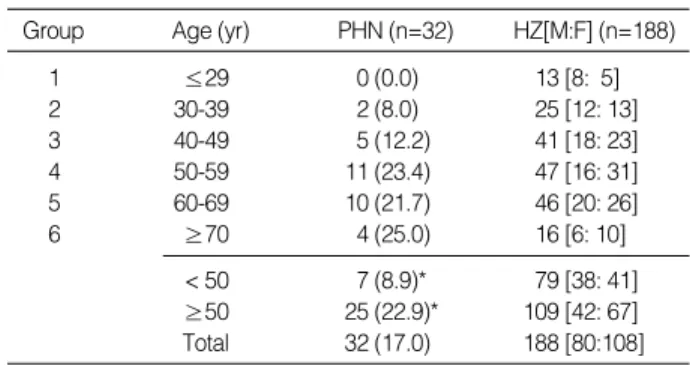
By the tentative definition of 4 weeks’ duration, the preva- lence of PHN in each age group ranged from 0% to 25.0%, with a roughly increasing tendency by age. In total, 32 (17.0
%) out of 188 patients had PHN. The rate of PHN above the age of 50 yr (25/109, 22.9%) was significantly higher than that under the age of 50 yr (7/79, 8.9%) (Table 2). The rates of PHN in the male and female were 15.0% (12/80) and 18.5% (20/108), respectively.
The rates of HZ in the specific dermatomes were signifi- cantly different. Of 188 patients with HZ, 94 (50.0%) were infected in thoracic area, 36 (19.1%) cranial, 35 (18.6%) lum- bosacral, and 30 (16.0%) cervical. However, the rates of PHN in the specific dermatomes were not significantly different;
cranial (7/36, 19.4%), cervical (4/30, 13.3%), thoracic (15/94, 16.0%), and lumbosacral (6/35, 17.1%) (Table 3). Two der- matomes were simultaneously involved in the 7 patients with HZ.
Of 188 patients with HZ, 24 (12.8%) had hypertension, 20 (10.6%) diabetes mellitus, 8 (4.3%) gastropathy, 7 (3.7%) cardiopathy, 7 (3.7%) hepatopathy, 4 (2.1%) malignancy, and 3 (1.6%) pulmonary diseases. Of 32 patients with PHN, 7 (21.9%) had hypertension and 6 (18.8%) diabetes mellitus.
No statistical significance was found in the rate of accompa- nied conditions between PHN and HZ groups (Table 4).
No systemic conditions were found in 15 patients with PHN and 130 patients with HZ. The 3 patients with PHN, and the
Hypertension 7 (21.9) 24 (12.8)
Diabetes mellitus 6 (18.8) 20 (10.6)
Gastropathy 2 (6.3) 8 (4.3)
Cardiopathy 2 (6.3) 7 (3.7)
Hepatopathy 1 (3.0) 7 (3.7)
Malignancy 1 (3.0) 4 (2.1)
Pulmonary diseases 1 (3.0) 3 (1.6)
None 15 (46.9) 130 (69.1)
Dermatomes PHN (n=32) HZ (n=188)
Table 4. Accompanied systemic conditions*
*p>0.05 between PHN and HZ groups; Number (%).
1 ≤29 0 (0.0) 13 [8: 5]
2 30-39 2 (8.0) 25 [12: 13]
3 40-49 5 (12.2) 41 [18: 23]
4 50-59 11 (23.4) 47 [16: 31]
5 60-69 10 (21.7) 46 [20: 26]
6 ≥70 4 (25.0) 16 [6: 10]
< 50 7 (8.9)* 79 [38: 41]
≥50 25 (22.9)* 109 [42: 67]
Total 32 (17.0) 188 [80:108]
Group Age (yr) PHN (n=32) HZ[M:F] (n=188)
Table 2. Prevalence of PHN by age
PHN, postherpetic neuralgia; HZ, herpes zoster; Number (%); [M:F]=
[male:female]; *p<0.05 between above and under the age of 50 yr.
0 20 59 109 (58.0)
1 10 40 78 (41.5)
2 6 31 51 (27.1)
4 1 18 32 (17.0)
6 0 7 25 (13.3)
8 0 2 22 (11.7)
12 0 0 17 (9.0)
Duration (week)
Table 1. Duration of pain in 188 patients with HZ
Intensity of pain
Mild Moderate Severe
HZ, herpes zoster; Patients were all on the medication; Data are given as number (%) of patients.
Cranial 7 (19.4) 36 (19.1)
Cervical 4 (13.3) 30 (16.0)
Thoracic 15 (16.0) 94 (50.0)�
Lumbosacral 6 (17.1) 35 (18.6)
Dermatomes PHN* (n=32) HZ (n=188)
Table 3. Dermatomal distribution
*p>0.05 between the dermatomes in PHN group; �p<0.05 between thoracic and others in HZ group.
15 patients with HZ had two systemic conditions simulta- neously.
The rate of PHN was significantly higher in patients with
≥9% of surface area involved than in patients with ≤4.4%
or 4.5-8.9% of surface area involved, demonstrating 27.4%
(20/73) vs 11.5% (6/52) or 7.9% (3/38), respectively (Table 5).
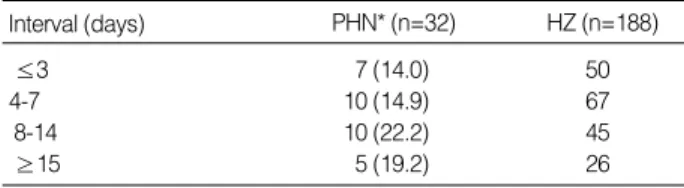
The patients whose treatment was initiated within 3 days after the initial pain had PHN at a rate of 14.0% (7/50); be- tween 4 and 7 days, 14.9% (10/67); between 8 and 14 days, 22.2% (10/45); over 15 days, 19.2% (5/26) (Table 6). No statistical significance was found in the intervals between initial pain and initiation of treatment.
Of 30 patients in each treatment group, 7 (23.3%) had PHN in the group 1; 5 (16.7%) in the group 2; 6 (20.0%) in the group 3. No statistical significance was found in the rate of PHN between the 3 groups (Table 7).
DISCUSSION
PHN has been defined in many ways. In practice, it is de- fined when pain prolongs after crusts have fallen off or pro- longs 4 to 12 weeks after the appearance of skin rash (4, 6).
The rate of severe pain notably decreased from 58.0% to 17.0
% during the first 4 weeks of treatment, whereas slightly decreased from 13.3% to 9.0% during the last 8 weeks of treatment (Table 1). The observation suggests that the rea- sonable period for diagnosing as PHN should be 4 weeks or longer. The rate of PHN widely ranges from 4.5% to 59% (6, 8-14), and the duration of PHN varied from 1 to 12 months in the articles (6, 8-11, 13-18). Choo et al. (6) reported the prevalence of PHN for more than 30 days was 8%, and 4.5%
after 60 days. Kwon et al. (8) reported 22.8% had PHN after 8 weeks. Leplow et al. (11) reported 59% had PHN for 3 months, and 28% for more than a year. Meister et al. (13) described the incidence of PHN as 28% after 4-5 weeks.
There seems to be no regional, ethnic, or gender difference in the occurrence of HZ and PHN (7, 8, 14, 15, 19).
The age has been known to be the most important risk factor for the development of the vexing complication, PHN.
The age above which PHN is more likely to occur was reaf- firmed to be 50 yr (Table 2). That critical age has been con- sidered as 40 to 60 yr (8, 9, 13, 15, 19).
Certain dermatomes, for example, the cranial or sacral area,
have been noted to be more vulnerable to the development of PHN (12, 13, 16). In the meantime, some reports docu- mented that there was no preference to specific dermatomes with regard to PHN (7, 9), which is compatible with the results of this study. HZ tended to occur more often in the thoracic area at a rate of 50.0% (Table 3), as described 48%
or 51% in other studies (7, 9).
Immunocompromising conditions such as the elderly, organ transplants with immunosuppressives, malignancy with che- motherapy, HIV infection, or long-term corticosteroid use contribute to the increased incidence of HZ and possibly PHN (6, 12). Researchers have investigated whether the systemic disorders other than immunosuppressed conditions might be associated with HZ. Some authors reported hypertension (20%) and diabetes mellitus (26%) were the two most com- mon combined conditions with HZ, but did not mention their association with PHN (7, 8). The difference was not significant in the rate of hypertension (21.9% vs 12.8%) or diabetes mellitus (18.8% vs 10.6%) between PHN and HZ groups (Table 4).
Attention has been paid to the extent of rash, severity of initial pain, interval between initial pain and initiation of treatment, and duration of intense pain in relation to the risk factors for PHN (3, 8, 12, 13, 15, 16, 19-21). The number of vesicles has been used as an index of cutaneous dissemina- tion and visceral involvement (3) or as an indicator of PHN (12). It appears to be sometimes hard to count the vesicles since the lesions can be fast changeable into coalescence and ulceration. So, the method of evaluating the extent of burn, known as the rule of 9, was applied to this research. Whit- ley et al. (19) stated time to initiating treatment after rash onset did not influence pain outcome. On the contrary, Watson (20) insisted on the possibility of prevention of PHN by early treatment within the first 72 hr. The data demon- strated that longer than 4 weeks of severe pain or wider than
≤3 7 (14.0) 50
4-7 10 (14.9) 67
8-14 10 (22.2) 45
≥15 5 (19.2) 26
Interval (days) PHN* (n=32) HZ (n=188)
Table 6. Interval between initial pain and initiation of treatment
*p>0.05 between the intervals in PHN group; Number (%).
1 7 (23.3) 30
2 5 (16.7) 30
3 6 (20.0) 30
Group* PHN�(n=15) HZ (n=90)
Table 7. Rate of PHN between the treatment options
*1, Valacyclovir, amitriptyline, and ibuprofen, tid po; 2, 1 with lidocaine (2% sol) infiltration; 3, 1 with lidocaine (2.5%) plus prilocaine (2.5%) cream; �p>0.05 between the 3 treatment groups.
≤4.4% 3 (7.9) 38
4.5-8.9% 6 (11.5) 52
≥9% 20 (27.4)� 73
Body surface PHN (n=29) HZ (n=163)
Table 5. Surface area involved*
*Surface area in 3 patients with PHN and 25 patients with HZ was not measurable or measured; Number (%); �p<0.05 between ≥9% and <9%
of body surface in PHN group.
9% of surface area involved might be associated with the higher probability of PHN, however earlier initiation of treat- ment might not guarantee a prevention of PHN. Besides, the prodromal symptoms such as loss of the tactile sense (12, 16, 19), and psychopathological impairment (11) have been the clinical predictors of PHN, albeit not connected with the length of PHN. A positive association of development of PHN with the HLA class I antigens was recognized, suggest- ing that HLA class I gene may control the immune response against VZV in the pathogenesis of PHN (22).
The pathogenetic mechanisms of PHN have not been clear- ly understood. To date, pathologic interaction between im- paired function of afferent A beta-fiber, impaired response of axon reflex, damaged C fiber, and spinal cord hyperreflex- ity may play a role in HZ pain as well as PHN (4, 23, 24).
These interactions act via excitatory amino acids and neuro- peptides, including norepinephrine, released from sympathet- ic terminals and newly expressed receptors on the afferent neuronal membrane (24). The recent article gave a clue that the relative contributions of peripheral and central mecha- nisms to the pathology of pain may differ among subjects and vary over the course of PHN (21). Also, the density of epidermal innervation may provide an objective correlate for the presence or absence of pain (17). In these contexts, ami- triptyline acts as a norepinephrine reuptake blocker, and lido- caine provides pain-relief by blocking neuronal sodium chan- nels and dampening peripheral nociceptor sensitization and CNS hyperexcitability (25).
At present, there is no ideal drug that completely eliminates herpetic pain, whether acute or chronic. Systemic adminis- tration of antiviral, tricyclic antidepressant and analgesic agents has been accepted as the conventional therapy (25).
It is controversial that conventional therapy alone or in com- bination with systemic corticosteroids and/or nerve block may be of some benefit for preventing PHN. Chiarello (26) challenged tumescent infiltration of corticosteroids, lidocaine, and epinephrine into dermatomes, with overall positive results for acute herpetic pain but inconstant results for PHN. The concentration of lidocaine he used was diluted to 0.05% with 1:1,000,000 epinephrine in a normal saline solution, and the amount of anesthetic solution injected was from 100 to 1,000 mL. Unlike that formula, 2% lidocaine solution with- out triamcinolone or epinephrine was chosen in this trial to find out the unique action of anesthetics on reduction of her- petic pain, and the amount of solution did not exceed 1 to 2 mL per injection. Kanazi et al. (25) reported patients with PHN were successfully treated with topical 5% lidocaine patches. Meanwhile, Attal et al. (27) reported a eutectic mix- ture of local anesthetics cream produced an anesthetic effect without reducing spontaneous ongoing pain and mechani- cal allodynia in the acute situation, but reduction of parox- ysmal pain and hyperalgesia in the long run. The same topi- cal agent was chosen in this trial. According to the findings of this investigation, adjuvant anesthetics, via injection or
topical application, added to the medication could not affect the duration of pain (Table 7). No remarkable adverse events save drowsiness or gastrointestinal discomfort in a few sub- jects occurred during the treatment. Further investigations employing new treatment trials with a larger number of pa- tients are required.
REFERENCES
1. Cohen JI, Straus SE. Varicella zoster virus and its replication. In:
Fields BN, eds. Fields Virology. Philadelphia: Lippincott-Raven, 1996: 2525-46.
2. Hope-Simpson RE. The nature of herpes zoster: a long-term study and a new hypothesis. Proc R Soc Lond Biol 1965; 58: 9-20.
3. McCrary ML, Severson J, Tyring SK. Varicella zoster virus. J Am Acad Dermatol 1999; 41: 1-14.
4. Kost RG, Straus SE. Postherpetic neuralgia-pathogenesis, treatment, and prevention. N Engl J Med 1996; 335: 32-42.
5. Gershon AA. Epidemiology and management of postherpetic neu- ralgia. Semin Dermatol 1996; 15 (suppl 2): S8-13.
6. Choo PW, Galil K, Donahue JG, Walker AM, Spiegelman D, Platt R. Risk factors for postherpetic neuralgia. Arch Intern Med 1997;
157: 1217-24.
7. Kim SY, Cho BH, Kim JH. A 5-year clinical study on herpes zoster:
1990-1994. Korean J Dermatol 1997; 35: 266-72.
8. Kwon SB, Kim DW, Chung SL, Lee SJ. A clinical observation on acute pain and postherpetic neuralgia in patients with herpes zoster.
Korean J Dermatol 2000; 38: 314-21.
9. Kim YJ. Clinical observation of postherpetic neuralgia in patients with herpes zoster. Korean J Dermatol 2001; 39: 1364-9.
10. Ragozzino MW, Melton LJ III, Kurland LT, Chu CP, Perry HO.
Population-based study of herpes zoster and its sequelae. Medicine (Baltimore) 1982; 61: 310-6.
11. Leplow B, Lamparter U, Risse A, Wassilev SW. Post-herpetic neu- ralgia: clinical predictors and psychopathologic findings. Nervenarzt 1990; 61: 46-51.
12. Meister W, Neiss A, Gross G, Doerr HW, Hobel W, Malin J-P, von Essen J, Reimann B, Witke C, Wutzler P. A prognostic score for postherpetic neuralgia in ambulatory patients. Infection 1998; 26:
359-63.
13. Meister W, Neiss A, Gross G, Doerr HW, Hobel W, Malin J-P, von Essen J, Reimann B, Witke C, Wutzler P. Demography, symptoma- tology, and course of disease in ambulatory zoster patients. A physi- cian-based survey in Germany. Intervirology 1998; 41: 272-7.
14. Helgason S, Petursson G, Gudmundsson S, Sigurdsson JA. Preva- lence of postherpetic neuralgia after a first episode of herpes zoster:
prospective study with long term follow up. BMJ 2000; 321: 794-6.
15. Dworkin RH, Boon RJ, Griffin DR, De Phung. Postherpetic neu- ralgia: impact of famciclovir, age, rash severity, and acute pain in herpes zoster patients. J Infect Dis 1998; 178(suppl 1): S76-80.
16. Zaal MJ, Volker-Dieben HJ, D’Amaro J. Risk and prognostic factors of postherpetic neuralgia and focal sensory denervation: a prospec- tive evaluation in acute herpes zoster ophthalmicus. Clin J Pain 2000;
16: 345-51.
17. Oaklander AL. The density of remaining nerve endings in human skin with and without postherpetic neuralgia after shingles. Pain 2001; 92: 139-45.
18. Riopelle JM, Naraghi M, Grush KP. Chronic neuralgia incidence following local anesthetic therapy for herpes zoster. Arch Dermatol 1984; 120: 747-50.
19. Whitley RJ, Shukla S, Crooks RJ. The identification of risk factors associated with persistent pain following herpes zoster. J Infect Dis 1998; 178(suppl 1): S71-5.
20. Watson CP. Postherpetic neuralgia: the importance of preventing this intractable end-stage disorder. J Infect Dis 1998; 178(suppl 1):
S91-4.
21. Pappagallo M, Oaklander AL, Quatrano-Piacentini AL, Clark MR, Raja SN. Heterogenous patterns of sensory dysfuction in postherpet- ic neuralgia suggest multiple pathophysiologic mechanisms. Anesthe- siology 2000; 92: 691-8.
22. Ozawa A, Sasao Y, Iwashita K, Miyahara M, Sugai J, Iizuka M,
Kawakubo Y, Ohkido M, Naruse T, Anzai T, Takashige N, Ando A, Inoko H. HLA-A33 and -B44 and susceptibility to postherpetic neuralgia (PHN). Tissue Antigens 1999; 53: 263-8.
23. Stucker M, Hugler P, von Kobyletzki G, Reuther T, Hoffmann K, Laubenthal H, Altmeyer P. Intracutaneous histamine injection can detect damage of cutaneous afferent fibers in postherpetic neuralgia.
Dermatology 1997; 195: 311-6.
24. Baron R. Peripheral neuropathic pain: from mechanisms to symp- toms. Clinical J Pain 2000; 16(2 suppl): S12-20.
25. Kanazi GE, Johnson RW, Dworkin RH. Treatment of postherpetic neuralgia: an update. Drugs 2000; 59: 1113-26.
26. Chiarello SE. Tumescent infiltration of corticosteroids, lidocaine, and epinephrine into dermatomes of acute herpetic pain or postherpetic neuralgia. Arch Dermatol 1998; 134: 279-81.
27. Attal N, Brasseur L, Chauvin M, Bouhassira D. Effects of single and repeated applications of a eutectic mixture of local anesthetics (EMLA) cream on spontaneous and evoked pain in post-herpetic neuralgia. Pain 1999; 81: 203-9.