ABSTRACT
Purpose: Post-thyroidectomy bleeding (PTB) is rare but may be a life-threatening complication. This study investigated the incidence of and risk factors for postoperative bleeding after thyroid surgery.
Methods: The medical records of all patients who underwent thyroidectomy at Samsung Medical Center between November 1994 and July 2018 were reviewed retrospectively to identify any risk factors for PTB. Clinicopathological factors related to post-thyroidectomy bleeding were included in our analysis, and the association of potential risk factors with outcomes was tested by logistic regression analysis.
Results: Of 19,657 patients, PTB occurred in 132 (0.67%). In addition, 130 cases of PTB had emerged within 24 hours, while only 2 patients required re-operation after discharge. One patient expired due to hypoxic brain damage. A univariate analysis revealed that male sex (odds ratio [OR]=2.28, P<0.0001), chronic kidney disease (OR=5.26, P=0.02), the use of anti- hemorrhagic agents (OR=0.57, P=0.0017), and surgeon-specific factors (OR=3.4, P<0.0001) were significantly associated with PTB. However, upon multivariate analysis, only male sex (OR=2.34, P<0.0001) and surgeon-specific factors (OR=3.10, P<0.0001) were significant risk factors for PTB.
Conclusion: Male sex and surgeon-related factors significantly increased the risk of PTB. Since our study showed a tendency for PTB to increase within 24 hours of surgery, surgeons should look through whole surgical process or surgical techniques to minimize bleeding during the operation and conduct a close observation of all patients immediately after surgery.
Keywords: Thyroidectomy; Post-thyroidectomy bleeding; Risk factors for post-thyroidectomy bleeding
INTRODUCTION
There are various complications that may occur after thyroidectomy; postoperative bleeding is one of the most dangerous. Post-thyroidectomy bleeding (PTB) is a rare but life-threatening complication due to the presence of airway obstruction, which requires immediate surgical
Original Article
Received: Oct 26, 2020 Revised: Nov 28, 2020 Accepted: Nov 30, 2020 Correspondence to Jung-Han Kim
Division of Endocrine Surgery, Department of Surgery, Samsung Medical Center, Sungkyunkwan University School of Medicine, 81 Irwon-ro, Gangnam-gu, Seoul 06351, Korea.
E-mail: [email protected] Copyright © 2020. Korean Association of Thyroid and Endocrine Surgeons; KATES This is an Open Access article distributed under the terms of the Creative Commons Attribution Non-Commercial License (https://
creativecommons.org/licenses/by-nc/4.0/).
ORCID iDs Dawid Lee
https://orcid.org/0000-0002-4586-3702 Kyorim Back
https://orcid.org/0000-0001-9160-3541 Jun-Ho Choe
https://orcid.org/0000-0001-6956-1840 Jee Soo Kim
https://orcid.org/0000-0003-0006-1834 Jung-Han Kim
https://orcid.org/0000-0002-2265-5556 Conflict of Interest
No potential conflict of interest relevant to this article was reported.
Author Contributions
Conceptualization: Dawid Lee, Jung-Han Kim;
Data curation: Dawid Lee; Formal analysis:
Jung-Han Kim, Kyorim Back, Dawid Lee;
Dawid Lee , Kyorim Back , Jun-Ho Choe , Jee Soo Kim , Jung-Han Kim
Division of Endocrine Surgery, Department of Surgery, Samsung Medical Center, Sungkyunkwan University School of Medicine, Seoul, Korea
Risk Factors for Post-Thyroidectomy
Bleeding: an Analysis of 19,657 Cases
from a Single Institution
Supervision: Jun-Ho Choe, Jee Soo Kim;
Validation: Jun-Ho Choe, Jee Soo Kim, Jung- Han Kim, Kyorim Back; Writing - original draft:
Dawid Lee; Writing - review & editing: Jung- Han Kim, Kyorim Back, Dawid Lee.
treatment (1,2). A high level of suspicion is required in acute neck hematoma because it may be lethal unless immediate surgical intervention and evacuation is carried out (3).
The incidence of PTB ranges from 0.3%–6.5% (4-10); Wojtczak et al. (11) reported a 1.19%
mortality rate for bleeding after thyroidectomy. To prevent PTB, numerous causes and risk factors have been suggested (12). The highest risk of PTB is in patients who are male, have a toxic goiter, and undergo a total thyroidectomy (11). A complex relationship likely exists between postoperative bleeding and intrinsic patient factors, such as sex or age, as well as extrinsic factors, including surgical methods and devices. This study aimed to investigate the frequency of risk factors related to increasing PTB by searching a large database from a single institute for a long duration, including the incidence of complications, the effectiveness of anti-hemorrhagic agents, or more frequent use of surgical energy devices.
MATERIALS AND METHODS
1. Patient selection & variables
We retrospectively reviewed the medical records of all patients who underwent thyroidectomy either with or without neck node dissection at Samsung Medical Center between November 1994 and July 2018. The analysis of risk factors looked for any increasing incidence of PTB along with clinicopathologic factors, such as age, sex, body mass index, any history of hypertension (HTN), chronic kidney disease (CKD), malignancy, or lymph node metastasis, and the pathology of the tumor. The use of energy-based devices, anti-adhesion agents, and hemostatic agents were also analyzed along with surgeon-specific factors, whether the thyroidectomy was bilateral, operation time, operative method (open, endoscopic, or robot- assisted), and neck dissection. Because almost all patients had stopped anti-coagulation drugs five to seven days before their operation, these types of drugs were excluded from the risk factors.
PTB is defined as when surgical intervention is required due to hematoma at the operation site after thyroidectomy during the patient's hospitalization or within 14 days of the
operation. Surgeon-specific factors indicated which surgeons carried out the thyroidectomy;
the three who had performed the most procedures were categorized as surgeons A, B, and C. Other operators who had completed only a small number of surgeries were placed into a single category of “Surgeon D.” Anti-hemorrhagic agents included greenplast® (aprotinin, fibrinogen, thrombin), tisseel® (aprotinin, fibrinogen, thrombin), and collastat® (absorbable bovine collagen sponge), while anti-adhesion agents were Q-block® (sodium hyaluronate), Guardix® (sodium hyaluronate, carboxymethylcell), Collabarrior® (atelocollagen), and Protescal® (sodium hyaluronate, carboxymethylcellulose, alginate). Energy based devices like Ligasure®, the Lotus hand-piece®, and the Harmonic scalpel® were used during the operation.
We investigated all of these as a single category according to the type of device instead of studying each one separately.
2. Statistical analysis
Statistical analyses were performed using SPSS version 22.0 software (IBM Corp, Armonk, NY, USA), and statistically significant differences were defined as those with P value less than 0.05.). The χ2 test was used for categorical variables and Student's t-test for continuous variables. The association of potential risk factors with outcomes was tested by logistic regression analysis.
RESULTS
1. Demographics of 19,641 patients according to bleeding status
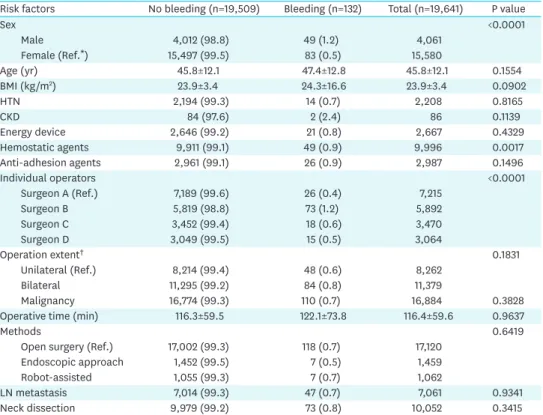
We surveyed 19,641 patients and excluded 16 cases due to incomplete data; 132 PTB cases were observed (0.67%). Only 2 patients required surgical intervention at 5 and 7 days after discharge, respectively, and 1 patient died due to brain hypoxia. We identified 130 patients who required re-operation due to bleeding during hospitalization within 24 hours after the primary operation. For bleeding control, patients who went on open thyroidectomy used previous incision in re-operation. 14 patients who received endoscopic/robotic surgery had re-operation in endoscopic approach. The risk factors of PTB are summarized in Table 1. In all, 15,580 female patients underwent thyroid surgery, and 83 of these experienced PTB. The mean age in no bleeding group and bleeding group were 45.8 and 47.4 years, respectively.
Patients who experienced PTB were older than those who did not, this difference was not statistically significant (47.4 vs. 45.8, P=0.1554). Among whole cohort, 4,061 patients were male (20.68%), and 49 of these (1.2%) had bleeding complications after thyroidectomy. The rate of female PTB was 0.53%, which was lower than the rate for males in this study. Body mass index was not different between groups (23.9 kg/m2 in no bleeding group vs. 24.3 kg/
m2 in bleeding group). In addition, there was no significant difference among operation methods, which included open-method (17,120 cases, 87.16%), endoscopic (1,459 cases, 7.43%), and robot-assisted approaches (1,062 cases, 5.41%). Using energy-based devices or anti-adhesion agents during surgery did not impact the frequency of bleeding complications after thyroidectomy (Table 1).
Table 1. Risk factor demographics
Risk factors No bleeding (n=19,509) Bleeding (n=132) Total (n=19,641) P value
Sex <0.0001
Male 4,012 (98.8) 49 (1.2) 4,061
Female (Ref.*) 15,497 (99.5) 83 (0.5) 15,580
Age (yr) 45.8±12.1 47.4±12.8 45.8±12.1 0.1554
BMI (kg/m2) 23.9±3.4 24.3±16.6 23.9±3.4 0.0902
HTN 2,194 (99.3) 14 (0.7) 2,208 0.8165
CKD 84 (97.6) 2 (2.4) 86 0.1139
Energy device 2,646 (99.2) 21 (0.8) 2,667 0.4329
Hemostatic agents 9,911 (99.1) 49 (0.9) 9,996 0.0017
Anti-adhesion agents 2,961 (99.1) 26 (0.9) 2,987 0.1496
Individual operators <0.0001
Surgeon A (Ref.) 7,189 (99.6) 26 (0.4) 7,215
Surgeon B 5,819 (98.8) 73 (1.2) 5,892
Surgeon C 3,452 (99.4) 18 (0.6) 3,470
Surgeon D 3,049 (99.5) 15 (0.5) 3,064
Operation extent† 0.1831
Unilateral (Ref.) 8,214 (99.4) 48 (0.6) 8,262
Bilateral 11,295 (99.2) 84 (0.8) 11,379
Malignancy 16,774 (99.3) 110 (0.7) 16,884 0.3828
Operative time (min) 116.3±59.5 122.1±73.8 116.4±59.6 0.9637
Methods 0.6419
Open surgery (Ref.) 17,002 (99.3) 118 (0.7) 17,120
Endoscopic approach 1,452 (99.5) 7 (0.5) 1,459
Robot-assisted 1,055 (99.3) 7 (0.7) 1,062
LN metastasis 7,014 (99.3) 47 (0.7) 7,061 0.9341
Neck dissection 9,979 (99.2) 73 (0.8) 10,052 0.3415
Values are presented as mean±standard deviation or number (%).
BMI = body mass index; HTN = hypertension; CKD = chronic kidney disease; LN = lymph node.
*Ref. indicates a reference for standard risk factors. †The operation extent specifies whether the thyroidectomy was a unilateral or bilateral surgery.
2. Bleeding focus
Overt bleeding from a vessel was noted in 53 patients (40%), but only some oozing was seen from the muscle or soft tissue in 69 patients. No bleeding focus was identified in the remaining 10 patients (Table 2).
3. Risk factors of post-thyroidectomy bleeding
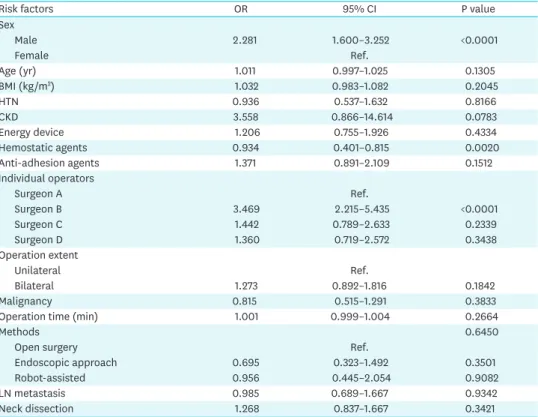
In univariate analysis, it appears that the male sex has a greater risk of PTB (adds ratio [OR]=2.28, P<0.0001). One surgeon appeared to have a significantly higher rate of bleeding after thyroidectomy (Surgeon B: OR=3.46, P<0.0001). Hemostatic agents were used in almost all thyroidectomies and were effective at decreasing the risk of PTB (OR=0.93, P=0.002). Age (OR: 1.01, P=0.1305), CKD (OR: 3.55, P=0.0783), the use of anti-adhesion agents (OR=1.371, P=0.1512), and the incidence of bilateral thyroidectomy (OR=1.27, P=0.1842) were not statistically significant (Table 3).
In multivariate analysis, male sex (OR=2.283, P<0.0001) and surgeon factor (Surgeon B: OR=2.942, P<0.0001) were the risk factors of PTB. However, there was no significant Table 2. Bleeding focus
Focus site No. of patients
Vessel 53 (40.1)
Muscle 41 (31.0)
Soft tissue 28 (21.2)
No. identified 10 (7.5)
Values are presented as number of patients (%).
Table 3. Univariable logistic regression with risk factors related to post-thyroidectomy bleeding
Risk factors OR 95% CI P value
Sex
Male 2.281 1.600–3.252 <0.0001
Female Ref.
Age (yr) 1.011 0.997–1.025 0.1305
BMI (kg/m2) 1.032 0.983–1.082 0.2045
HTN 0.936 0.537–1.632 0.8166
CKD 3.558 0.866–14.614 0.0783
Energy device 1.206 0.755–1.926 0.4334
Hemostatic agents 0.934 0.401–0.815 0.0020
Anti-adhesion agents 1.371 0.891–2.109 0.1512
Individual operators
Surgeon A Ref.
Surgeon B 3.469 2.215–5.435 <0.0001
Surgeon C 1.442 0.789–2.633 0.2339
Surgeon D 1.360 0.719–2.572 0.3438
Operation extent
Unilateral Ref.
Bilateral 1.273 0.892–1.816 0.1842
Malignancy 0.815 0.515–1.291 0.3833
Operation time (min) 1.001 0.999–1.004 0.2664
Methods 0.6450
Open surgery Ref.
Endoscopic approach 0.695 0.323–1.492 0.3501
Robot-assisted 0.956 0.445–2.054 0.9082
LN metastasis 0.985 0.689–1.667 0.9342
Neck dissection 1.268 0.837–1.667 0.3421
OR = odds ratio; CI = confidence interval; BMI = body mass index; HTN = hypertension; CKD = chronic kidney disease; LN = lymph node.
difference upon multivariate analysis between the groups that used hemostatic agents and the patients that did not (OR=0.734, P=0.1729) (Table 4).
DISCUSSION
Due to advanced diagnostic technology, thyroidectomy has become one of the most common surgeries performed on patients, including previously healthy people. As the prevalence of thyroid cancer increases (13), the prediction and prevention of complications after
thyroidectomy are becoming more important to ensure better surgery-related outcomes. Among the possible complications, PTB is rare but may be a life-threatening condition and requires emergent intervention due to airway obstruction by neck hematomas (4). Despite the advent of surgical energy devices to control bleeding, PTB still occurs. Therefore, it is important to study the risk factors for PTB to predict and prevent such complications as more patients undergo thyroid surgery (14,15). Many studies have addressed the risk factors for postoperative bleeding following thyroidectomy (3,5-8,14,16-18). However, this study is one of the largest including a large number of patients from a single institute with the aim of reducing the risk of PTB.
Our study revealed that the rate of PTB was higher in male patients. A similar result was found in other studies (3,11,14,16). There is no clear evidence to explain why male sex is associated with more frequent PTB. Males typically have more muscular tissue than females, and this difference might lead to a more frequent bleeding tendency after thyroidectomy in these patients (19). Some studies suggested that muscles might provoke reopening of coagulated vessels or dislodging of surgical sutures, which can lead to bleeding (20). Furthermore, males are more likely to have HTN and negative lifestyle habits (like smoking and drinking) than females, which increases their risk of PTB (14,16). Anatomical differences between each sex might also contribute to the different incidence rates of PTB. Male patients tend to have a larger thyroid that is also located more deeply than those of females, which may lead to limited visualization of the operative field and therefore increase the risk of PTB in male patients.
Individual surgeons have different skills for performing thyroid surgery. It is complicated to define an operator's characteristics accurately due to variable surgical techniques, experience, and tendencies that range from standard ligation of a vessel to the use of surgical energy devices in each situation during an operation. In the current study, one specific surgeon had a higher risk of PTB (Surgeon B: OR=3.46, P<0.0001). There was no any deviated tendency for selection of patient each by surgeon, and it was randomized arrangement for each surgeon to do thyroidectomy. However, there's kind of different tendency or features of operation Table 4. Multivariable logistic regression with a P value <0.2 upon univariable analysis
Risk factors OR 95% CI P value VIF
Male 2.283 1.596–3.267 <0.0001 1.00775
Age (yr) 1.009 0.995–1.024 0.1899
CKD 2.710 0.679–11.322 0.1718 1.00117
Hemostatic agents 0.734 0.470–1.145 0.1729 1.45687
Anti-adhesion agents 1.589 0.962–2.626 0.0708 1.10567
Individual operator 1.43398
Surgeon B 2.942 1.737–4.985 <0.0001
Surgeon C 0.636 0.378–1.137 0.1310
Surgeon D 0.775 0.541–1.110 0.1640
Operation extent 1.319 0.919–1.895 0.1334 1.01171
OR = odds ratio; CI = confidence interval; VIF = variance inflation factor; CKD = chronic kidney disease.
during thyroidectomy. Surgeon B tended to be cautious during dissection of the tissue around the parathyroid to preserve its function, which was likely to preserve more vessels.
The preference of surgeon B to use a mono-polar device rather than tie-ligation or energy devices could be one of the causes of increased bleeding risk compared to that of surgeon A or C. Subtle differences of operative characteristics may also induce an increased risk of PTB that could produce different consequences among operators (16,21). There's no change in incidence of post-thyroidectomy bleeding with the passage of time for all surgeons. In other words, there was no difference in frequency of PTB between earlier and later cases, which suggests a need for considering about what make it occurred and how to prevent it.
For example, some surgeon prefers to use energy device and other does monopolar device
‘bovie’. Monopolar cauterization could make bleeding with incomplete coagulation during cut the vessel. If operator does not recheck the field after dissection with monopolar device, bleeding could occur due to reopening of vessel when higher blood pressure comes. So the operator's habits of coagulation or dissection in thyroidectomy should be checked whether increasing a risk of PTB, which belongs to category ‘individual operator’. And also surgeons must review their surgery process and improve surgical skills continuously to ensure better surgery-related outcomes following thyroidectomy.
Perera et al. (9) reported that bleeding generally presents within 6 hours postoperatively. In this study, almost all bleeding complications occurred within 24 hours of the thyroidectomy (17). In exceptional cases, postoperative bleeding may occur a few days after surgery, especially in patients with an elevated bleeding tendency due to prescription drugs or diseases. In our study, only 2 patients experienced PTB after discharge, while all other patients underwent re-operation within 24 hours of their initial procedure. One patient died due to brain hypoxic damage after thyroidectomy, of which occurred because of relatively long time of desaturation. In conclusion, it is important watch for bleeding complications, especially during the first postoperative day.
Until recently, many hemostatic agents have been devised to control postoperative bleeding, including oozing from minor vessels or bleeding of an unknown origin (22). Several studies have suggested the use of hemostatic agents in thyroid surgery, but it is not clear whether they decrease the risk of PTB (22-24). Although hemostatic agents should play a role in decreasing the risk of bleeding complications, surgeons should not be dependent on them to control bleeding during the operation. In our study, 53 cases of PTB resulted from vessel bleeding, and applying anti-hemorrhagic agents would not prevent major vessel bleeding effectively. Only minor bleeding from the muscle or tissue may be controlled by anti- hemorrhagic agents. Without precise control with surgical sutures or an energy device, reliance on anti-hemorrhagic agents alone will not decrease the risk of PTB.
Promberger et al. (16) reported a low risk of PTB in benign thyroid disease with rich vascularity, such as in Graves' disease. According to the study, the surgeon may be more aggressive during dissection and resection of the lesion when malignancy is present.
Furthermore, the presence of cancer makes bleeding control during thyroidectomy more complex and difficult, increasing the risk of PTB. However, our findings indicated no significant difference between malignancy and benign thyroid conditions on PTB. The same techniques can be applied during unilateral or bilateral thyroidectomy, so the extent of surgery likely had no effect on the rate of PTB in our study.
In terms of surgical approach, a few studies have compared the risk of PTB between remote
access surgery (endoscopic approach or robotic-assisted surgery) and traditional open thyroid surgery (25-29). The authors concluded that there was no difference in complication rates including PTB between methods (26-29). Our study was concordant with these previous studies. Surgical method had no influence on the occurrence of PTB. Instead, the particular surgical technique of each unique operator is thought to contribute more to the incidence of bleeding after thyroid surgery.
Considering the cost of robotic surgery is higher than open/endoscopic approach, there could be some conflict or argument when postoperative bleeding occurs with patients who received robotic thyroidectomy. Commonly, almost of patients choose robotic surgery because of incision and more detailed than others. All re-operations of patients who received robotic thyroidectomy had done in endoscopic method using the same incision with robotic surgery.
Furthermore, a large space of flap area in robotic surgery more than open method is thought to make a lower pressure on airway relatively not leading to critical condition as a hypoxic damage. Although postoperative bleeding occurred, there was no severe situation such a hypoxic brain damage in patients who received robotic thyroidectomy, which led to make it easy to reassure them. And the detailed explanation is important for them that possibility of complication exists even in robotic surgery. These facts made them easier to accept such a situation and did not made it worsen.
The limitation of this study is that it was not a randomized controlled study, which would control for confounders. In addition, more specific benign thyroid diseases, such as Graves' disease, could have been examined in more detail regarding their relationship with PTB. And another risk factor category could be suggested in addition to the current. More studies with randomized controlled trials and a large volume of participants are therefore needed. Despite these limitations, this study had some strengths. It was performed using a large number of samples. We were able to gain knowledge on the frequency and type of PTB. Some risk factors are new modalities that have not been examined in previous reports, such as anti- adhesion agents or individual surgeon-specific factors.
CONCLUSION
PTB is not a common complication, but it can be lethal due to airway obstruction by neck hematoma, which leads to hypoxic brain damage. Based on the current analysis, male gender and surgeon-specific factors significantly increased the risk of PTB. Therefore, surgeons who undertake thyroidectomies in male patients should be mindful of the increased risk of bleeding postoperatively. After thyroidectomy, it is important to monitor neck swelling and avoid creating high pressure at the operation site by educating patients about the risks.
Regarding surgeon-specific factors, continued research into different approaches or surgical techniques for thyroidectomy may be necessary to reduce PTB. One can never be too cautious about bleeding after thyroidectomy.
REFERENCES
1. Rosenbaum MA, Haridas M, McHenry CR. Life-threatening neck hematoma complicating thyroid and parathyroid surgery. Am J Surg 2008;195:339-43.
PUBMED | CROSSREF
2. Sanabria A, Carvalho AL, Silver CE, Rinaldo A, Shaha AR, Kowalski LP, et al. Routine drainage after thyroid surgery--a meta-analysis. J Surg Oncol 2007;96:273-80.
PUBMED | CROSSREF
3. Suzuki S, Yasunaga H, Matsui H, Fushimi K, Saito Y, Yamasoba T. Factors associated with neck hematoma after thyroidectomy: a retrospective analysis using a Japanese inpatient database. Medicine (Baltimore) 2016;95:e2812.
PUBMED | CROSSREF
4. Lee HS, Lee BJ, Kim SW, Cha YW, Choi YS, Park YH, et al. Patterns of post-thyroidectomy hemorrhage.
Clin Exp Otorhinolaryngol 2009;2:72-7.
PUBMED | CROSSREF
5. Godballe C, Madsen AR, Pedersen HB, Sørensen CH, Pedersen U, Frisch T, et al. Post-thyroidectomy hemorrhage: a national study of patients treated at the Danish departments of ENT Head and Neck Surgery. Eur Arch Otorhinolaryngol 2009;266:1945-52.
PUBMED | CROSSREF
6. Bergenfelz A, Jansson S, Kristoffersson A, Mårtensson H, Reihnér E, Wallin G, et al. Complications to thyroid surgery: results as reported in a database from a multicenter audit comprising 3,660 patients.
Langenbecks Arch Surg 2008;393:667-73.
PUBMED | CROSSREF
7. Rosato L, Avenia N, Bernante P, De Palma M, Gulino G, Nasi PG, et al. Complications of thyroid surgery: analysis of a multicentric study on 14,934 patients operated on in Italy over 5 years. World J Surg 2004;28:271-6.
PUBMED | CROSSREF
8. Burkey SH, van Heerden JA, Thompson GB, Grant CS, Schleck CD, Farley DR. Reexploration for symptomatic hematomas after cervical exploration. Surgery 2001;130:914-20.
PUBMED | CROSSREF
9. Perera M, Anabell L, Page D, Harding T, Gnaneswaran N, Chan S. Risk factors for post-thyroidectomy haematoma. J Laryngol Otol 2016;130 Suppl 1:S20-5.
PUBMED | CROSSREF
10. Efremidou EI, Papageorgiou MS, Liratzopoulos N, Manolas KJ. The efficacy and safety of total thyroidectomy in the management of benign thyroid disease: a review of 932 cases. Can J Surg 2009;52:39-44.
PUBMED
11. Wojtczak B, Aporowicz M, Kaliszewski K, Bolanowski M. Consequences of bleeding after thyroid surgery - analysis of 7805 operations performed in a single center. Arch Med Sci 2018;14:329-35.
PUBMED | CROSSREF
12. Shaha AR, Jaffe BM. Practical management of post-thyroidectomy hematoma. J Surg Oncol 1994;57:235-8.
PUBMED | CROSSREF
13. Haugen BR, Alexander EK, Bible KC, Doherty GM, Mandel SJ, Nikiforov YE, et al. 2015 American Thyroid Association management guidelines for adult patients with thyroid nodules and differentiated thyroid cancer: the American Thyroid Association Guidelines Task Force on Thyroid Nodules and Differentiated Thyroid Cancer. Thyroid 2016;26:1-133.
PUBMED | CROSSREF
14. Liu J, Sun W, Dong W, Wang Z, Zhang P, Zhang T, et al. Risk factors for post-thyroidectomy haemorrhage:
a meta-analysis. Eur J Endocrinol 2017;176:591-602.
PUBMED | CROSSREF
15. Lang BH, Yih PC, Lo CY. A review of risk factors and timing for postoperative hematoma after thyroidectomy: is outpatient thyroidectomy really safe? World J Surg 2012;36:2497-502.
PUBMED | CROSSREF
16. Promberger R, Ott J, Kober F, Koppitsch C, Seemann R, Freissmuth M, et al. Risk factors for postoperative bleeding after thyroid surgery. Br J Surg 2012;99:373-9.
PUBMED | CROSSREF
17. Zhang X, Du W, Fang Q. Risk factors for postoperative haemorrhage after total thyroidectomy: clinical results based on 2,678 patients. Sci Rep 2017;7:7075.
PUBMED | CROSSREF
18. Caulley L, Johnson-Obaseki S, Luo L, Javidnia H. Risk factors for postoperative complications in total thyroidectomy: a retrospective, risk-adjusted analysis from the National Surgical Quality Improvement Program. Medicine (Baltimore) 2017;96:e5752.
PUBMED | CROSSREF
19. Chen E, Cai Y, Li Q, Cheng P, Ni C, Jin L, et al. Risk factors target in patients with post-thyroidectomy bleeding. Int J Clin Exp Med 2014;7:1837-44.
PUBMED
20. Harding J, Sebag F, Sierra M, Palazzo FF, Henry JF. Thyroid surgery: postoperative hematoma--prevention and treatment. Langenbecks Arch Surg 2006;391:169-73.
PUBMED | CROSSREF
21. Brauckhoff M. Risk factors for postoperative bleeding after thyroid surgery (Br J Surg 2012; 99: 373-379).
Br J Surg 2012;99:380.
PUBMED | CROSSREF
22. Khadra H, Bakeer M, Hauch A, Hu T, Kandil E. Hemostatic agent use in thyroid surgery: a meta-analysis.
Gland Surg 2018;7:S34-41.
PUBMED | CROSSREF
23. Materazzi G, Ambrosini CE, Fregoli L, De Napoli L, Frustaci G, Matteucci V, et al. Prevention and management of bleeding in thyroid surgery. Gland Surg 2017;6:510-5.
PUBMED | CROSSREF
24. Seyednejad H, Imani M, Jamieson T, Seifalian AM. Topical haemostatic agents. Br J Surg 2008;95:1197-225.
PUBMED | CROSSREF
25. Park KN, Jung CH, Mok JO, Kwak JJ, Lee SW. Prospective comparative study of endoscopic via unilateral axillobreast approach versus open conventional total thyroidectomy in patients with papillary thyroid carcinoma. Surg Endosc 2016;30:3797-801.
PUBMED | CROSSREF
26. Pan JH, Zhou H, Zhao XX, Ding H, Wei L, Qin L, et al. Robotic thyroidectomy versus conventional open thyroidectomy for thyroid cancer: a systematic review and meta-analysis. Surg Endosc 2017;31:3985-4001.
PUBMED | CROSSREF
27. Shan L, Liu J. Meta-analysis comparison of bilateral axillo-breast approach robotic thyroidectomy and conventional thyroidectomy. Surg Innov 2019;26:112-23.
PUBMED | CROSSREF
28. He QQ, Zhu J, Zhuang DY, Fan ZY, Zheng LM, Zhou P, et al. Comparative study between robotic total thyroidectomy with central lymph node dissection via bilateral axillo-breast approach and conventional open procedure for papillary thyroid microcarcinoma. Chin Med J (Engl) 2016;129:2160-6.
PUBMED | CROSSREF
29. Kang SW, Lee SH, Park JH, Jeong JS, Park S, Lee CR, et al. A comparative study of the surgical outcomes of robotic and conventional open modified radical neck dissection for papillary thyroid carcinoma with lateral neck node metastasis. Surg Endosc 2012;26:3251-7.
PUBMED | CROSSREF