서 론
천식은 가장 흔한 만성호흡기질환의 하나로서, 심각한 공중 보 건 문제의 하나로 인식되고 있다. 천식의 유병률은 전 세계적으로 최근 수십 년 동안 증가 추세를 보이며,1,2 한국에서도 의사에 의해 진단받은 천식의 발생률 역시 증가하고 있다.3,4
천식의 유병률이 증가하는 원인에 대해서는 확실히 밝혀진 바가
없으나, 산업화로 인한 공기 오염의 증가,5 실내 생활 환경의 변화,6 위생 상태 향상,7 그리고 유아기의 감염성 질환의 감소8 등이 천식 발생의 위험을 높인다고 추정되고 있다. 이전의 일부 연구들에서 연간 가계 소득, 교육 수준, 거주 지역 등의 사회경제적 요인이 천식 발생의 위험을 증가시킨다고 보고하였으나,9,10 사회경제적 요인이 천식의 발생을 증가시키는지에 대해서는 아직 명확하지 않다.11-13 지금까지 보고된 사회경제적 요인과 천식 발생의 관계에 대한 연구
Allergy Asthma Respir Dis 6(2):90-96, March 2018 https://doi.org/10.4168/aard.2018.6.2.90 ORIGINAL ARTICLE
Correspondence to: Ju Suk Lee https://orcid.org/0000-0002-5600-3441
Department of Pediatrics, Samsung Changwon Hospital, Sungkyunkwan University School of Medicine, 158 Paryong-ro, Masanhoewon-gu, Changwon 51353, Korea
Tel: +82-55-233-5932, Fax: +82-55-233-5329, E-mail: [email protected] Received: July 17, 2017 Revised: November 7, 2017 Accepted: November 8, 2017
© 2018 The Korean Academy of Pediatric Allergy and Respiratory Disease The Korean Academy of Asthma, Allergy and Clinical Immunology This is an Open Access article distributed under the terms of the Creative Commons Attribution Non-Commercial License
제5기 국민건강영양조사로 추정한 소아 천식과 사회경제적 관계에 관한 연구
이해정, 김철홍, 이주석
성균관대학교 삼성창원병원 소아청소년과
Association between social economic status and asthma in Korean children: An analysis of the Fifth Korea National Health and Nutrition Examination Survey (2010–2012)
Hae Jung Lee, Chul Hong Kim, Ju Suk Lee
Department of Pediatrics, Samsung Changwon Hospital, Sungkyunkwan University School of Medicine, Changwon, Korea
Purpose: Asthma is one of the most common chronic conditions, and its prevalence has been increasing in recent decades. Social economic status is a well-known risk factor for asthma. This study was performed to investigate the relationship between social eco- nomic status and asthma in Korean children.
Methods: Data were acquired from 4,397 children, aged under 18 years who participated in the Fifth Korea National Health and Nu- trition Examination Surveys, which was conducted from 2010 to 2012. The presence of asthma was based on self-reported, physi- cian-diagnosed asthma in the Health Interview Surveys.
Results: The prevalence of pediatric asthma was 5.3%, while the prevalence of atopic dermatitis in children was 14.0%. In univariate analysis, asthmatic children tended to be male, to be older, to have asthmatic mothers, to suffer from atopic dermatitis and to live in urban areas (P< 0.05). The parents’ marital status, employment status, education level, and the number of household members were not associated with pediatric asthma. In logistic regression analysis, older age, male sex, maternal asthma, pediatric atopic dermati- tis, and urban residence were associated with a higher prevalence of childhood asthma (P< 0.01).
Conclusion: Socioeconomic status was not an important risk factor for asthma in Korean children in our study. It is conceivable that socioeconomic factor could affect the asthma prevalence in a different manner in each country. Further studies are warranted to ex- plore mechanisms responsible for the association between socioeconomic status and asthma in children. (Allergy Asthma Respir Dis 2018;6:90-96)
Keywords: Asthma, Income, Education
2017-03-16 https://crossmark-cdn.crossref.org/widget/v2.0/logos/CROSSMARK_Color_square.svg
는 대부분 서구 국가의 연구이며 아직 한국 소아에서 사회경제적 요인과 천식 발생과의 관계에 대한 대규모 연구는 미비한 실정이다.
이에 저자들은 한국 소아에서 사회경제적 요인과 천식과의 관련성 을 알아보고자 하였다.
대상 및 방법
1. 대상
이 연구는 5차 국민건강영양조사(Korea National Health and Nutrition Examination Surveys)의 자료를 이용하여 실시하였다.
국민건강영양조사의 세부적인 조사 내용과 방법은 질병관리본부 연구윤리 심의위원회(Institutional Review Board)의 승인을 받아 수행되었다. 국민건강영양 조사는 한국질병관리본부의 건강영양 조사과에서 실시한 한국인의 건강과 영양 상태를 조사하기 위해 고안된 횡단면 조사로 자료는 가정 면담, 건강 검진, 혈액 검사, 영양 상태 평가 등으로 구성되어 있다. 5차 국민건강영양조사는 2010년 부터 2012년까지 3년 동안의 조사이며 총 25,534명이 참여하였고 이 중 18세 이하는 5,250명이었다. 소아 천식의 유무와 부모의 존재 유무를 확인할 수 없었던 참가자를 제외한 4,397명(남자 2,343명, 여자 2,054명)이 최종 분석에 포함되었다.
2. 천식의 정의, 일반적인 특성, 신체 계측
이 연구는 5차 국민건강영양조사를 이용하여 실시한 인구 기반 후향적 설문조사 연구이며 국민건강영양조사 자료는 국민건강영 양조사 홈페이지(https://knhanes.cdc.go.kr/knhanes)에서 제공받 았다. 결혼 상태는 결혼 생활을 유지하고 있는 경우와 독신인 경우 로 나누었고, 사별 또는 이혼한 경우는 독신에 포함하였다. 부모 직 업의 유무는 현재 직업에 종사하고 있는 경우와 무직으로 나누었 다. 흡연의 경우는 생애 흡연을 한 번도 하지 않았던 군, 이전에 흡연 을 하였지만 현재 금연을 한 군, 현재도 흡연을 하고 있는 군으로 나 누었으며 금연군은 금연 시행 후 흡연을 한 번도 하지 않은 군으로 정의하였고 간헐적 흡연이 있었던 군은 흡연군으로 분류하였다. 거 주지역은 도시와 농촌으로 나누었으며 시, 동은 도시로 읍, 면은 농 촌으로 분류하였다. 한 달 가구 수입은 5차 국민영양조사에서 분류 한 4분위수(1, 낮음; 2, 중간 낮음; 3, 중간 높음; 4, 높음)를 이용하였 고 교육 수준은 고등학교 졸업 미만, 고등학교 졸업, 고둥학교 졸업 이상으로 나누었다. 천식과 아토피피부염의 유무는 평생 의사에 의 해 진단받은 적이 있는 경우로 한정하였으며 진단을 위해 사용한 설문지 양식은 다음과 같다. “지금까지 살아오면서 ○○○ (질환명) 을 의사로부터 진단을 받은 적이 있습니까?”
3. 통계 방법
국민건강영양조사는 대한민국 거주 국민을 모집단으로 층화 및
집단 표본 선택 방법을 통해 수집되었으므로 통계 분석은 가중치 를 고려하는 복합 표본 자료 분석 방법을 통해 시행하였다. 참가자 의 특성은 백분율과 95% 신뢰구간으로 제시하였고, 두 군에서 빈 도 비교는 chi-square를 이용하였다. 통계적으로 유의성을 보인 변 수들을 대상으로 위험 인자와 소아 천식의 유병률 사이의 관계를 확인하기 위해 logistic regression analysis를 실시하였다. 자료 분석 은 PASW Statistics ver. 21.0 (SPSS Inc., Chicago, IL, USA) 프로그 램을 사용하였고 통계 분석은 IBM SPSS Statistics ver. 21.0 (IBM Co., Armonk, NY, USA)을 이용하였고, P값이 0.05 미만인 경우를 통계적으로 의미 있다고 판단하였다.
결 과
1. 연구 대상자들의 특징
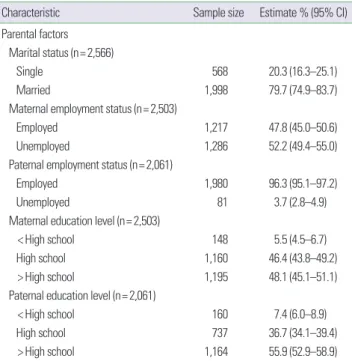
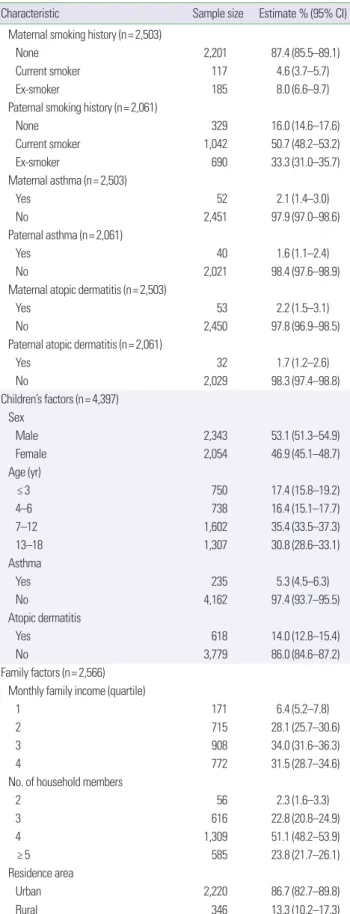
2010년부터 2012년까지의 제5기 국민건강영양조사를 통해 4,397명의 소아, 2,503명의 어머니와 2,061명의 아버지가 조사에 포 함되었다. 소아의 평균 연령은 9.2±5.0세였으며 남아의 비율은 53.1%였다. 대부분의 아버지는 직장을 갖고 있었으며(96.3%), 부모 의 교육 수준은 대부분 고등학교 졸업 이상이었다(어머니, 94.5%;
아버지, 92.6%). 아버지는 현재 흡연자인(50.7%) 경우가 많았으며 어머니는 비흡연자인(87.4%) 경우가 대부분이었다. 연구 대상에 포 함된 대부분의 소아들은 도시지역에(86.7%) 거주하였으며, 소아 천식 유병률은 5.3%, 소아 아토피 피부염의 유병률은 14.0%였다 (Table 1).
Table 1. Baseline characteristics of parents and children
Characteristic Sample size Estimate % (95% CI)
Parental factors Marital status (n= 2,566)
Single 568 20.3 (16.3–25.1)
Married 1,998 79.7 (74.9–83.7)
Maternal employment status (n= 2,503)
Employed 1,217 47.8 (45.0–50.6)
Unemployed 1,286 52.2 (49.4–55.0)
Paternal employment status (n= 2,061)
Employed 1,980 96.3 (95.1–97.2)
Unemployed 81 3.7 (2.8–4.9)
Maternal education level (n= 2,503)
< High school 148 5.5 (4.5–6.7)
High school 1,160 46.4 (43.8–49.2)
> High school 1,195 48.1 (45.1–51.1)
Paternal education level (n= 2,061)
< High school 160 7.4 (6.0–8.9)
High school 737 36.7 (34.1–39.4)
> High school 1,164 55.9 (52.9–58.9)
(Continued to the next page)
2. 천식과 사회 경제적 인자와의 관련성
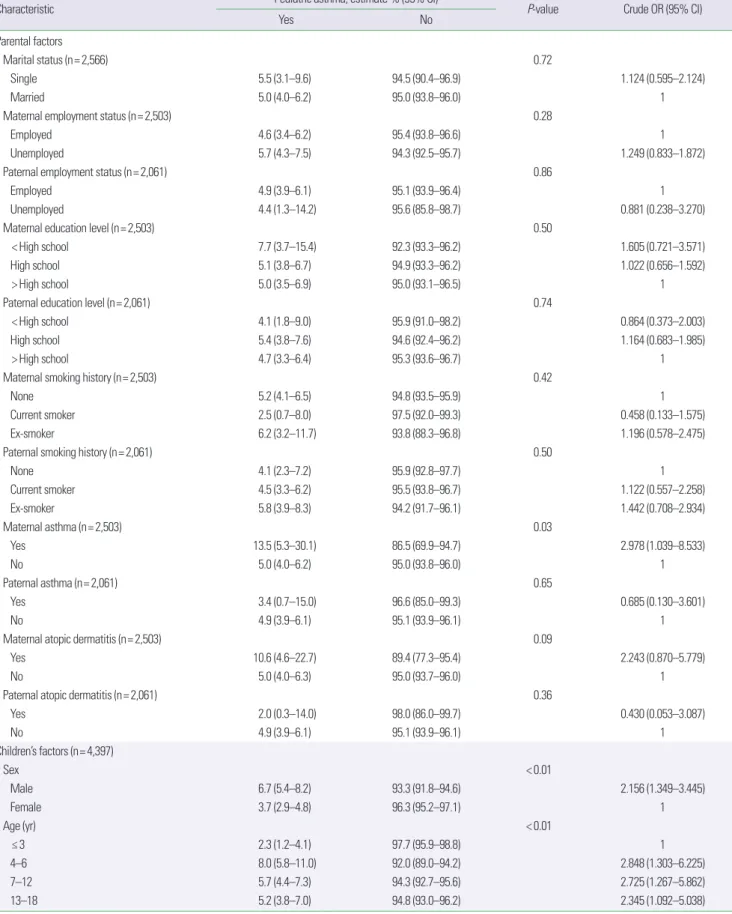
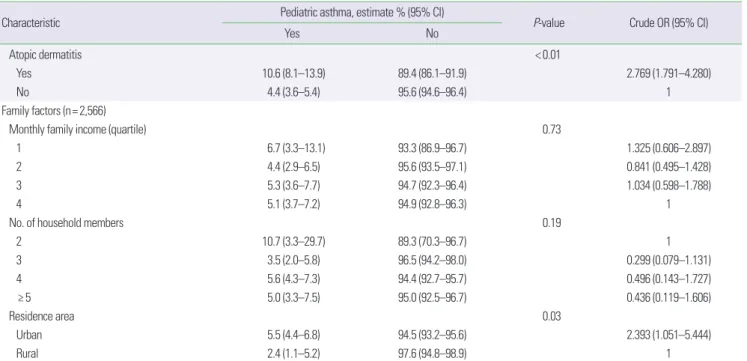
결과에서는 소아 천식 유무와 부모의 결혼 여부, 부모 고용 상태, 흡연력, 아버지 알레르기질환, 가족 구성원 수 사이에는 통계적으 로 유의한 상관관계는 없었다. 어머니의 교육 수준이 낮을수록, 소 득 수준이 가장 낮은 1분위수인 경우에 소아 천식의 유병률이 높 은 경향을 보였지만 소아 천식의 유무와 부모 교육 수준, 월별 가구 수입 사이에는 통계적으로 유의한 상관관계는 없었다.
천식이 없는 아이들과 비교했을 때 천식이 있는 아이들은 남아 (P<0.01), 연령이 증가할수록(P<0.01), 아토피피부염이 있는 경우 가 유의하게 많았다(P <0.01). 또한, 어머니가 천식이 있는 경우 (P = 0.03), 도시에 거주하는 경우(P = 0.03)에 그렇지 않은 경우보 다 소아 천식이 있는 경우가 많았다(Table 2).
다변량 분석에서 어머니 천식(adjusted odds ratio [aOR], 2.813;
95% confidence interval [CI], 1.057–7.487), 소아 아토피피부염 (aOR, 2.598; 95% CI, 1.695–3.983), 남아(aOR, 2.161; 95% CI, 1.317–
3.548), 그리고 도시 거주(aOR, 2.613; 95% CI, 1.201–5.683)인 경우 에 통계적으로 유의하게 소아 천식과 관련이 있었다. 나이와 관련 하여 천식이 있는 소아는 천식이 없는 소아보다 나이가 많은 경향 이 있었다(P<0.01). 천식의 유병률은 연령에 따라서 변화가 있었으 며, 천식 유병률은 3세 미만의 그룹에서 가장 낮았고, 7–12세 그룹 에서 가장 높게 나타났다. 이후 12세가 지나면 다시 천식의 유병률 은 감소 추세를 보였다(Fig. 1).
고 찰
이 연구는 다른 나라의 연구 결과들과9,10,14-16 달리 한국 소아에 서 부모의 교육 수준, 월별 가구 수입, 부모의 혼인 상태, 가족 구성 원 수와 같은 사회 경제적 요소와 천식과의 연관성을 확인할 수 없 었다. 이 연구에서 소아 천식과 관련된 위험 요인으로는 어머니 천 식, 남아, 나이가 많은 경우, 소아 아토피피부염, 도시에 거주하는 경 우가 있었다.
이번 연구에서 어머니 천식을 제외하고는 소아 천식과 부모의 요 인(결혼 상태, 부모 취업 상태, 교육 수준, 흡연력, 부모의 아토피피 부염 또는 아버지 천식)과 아무런 관련이 없었다. 이전의 많은 연구 에서 부모 알레르기질환이 소아 천식과 관련이 있음을 시사했지
만,10,16 이번 연구의 결과와는 일치하지 않았다. 소아 천식과 아버지
천식이 관련 있음을 나타내는 이전의 연구는 이번 연구와 대상 선 정에 차이가 있었다. 한 연구는 단일 도시의 사람들을 대상으로 실 시하였으며,10 다른 연구는 출생 코호트 연구를 이용하여 대상군 을 선정하였다.16 미국보건영양조사를 이용한 연구에서도 이번 연 구 결과와 유사하게 아버지의 알레르기질환력은 소아 천식과 관련 성이 없었다.17 한국 국민건강영양조사와 미국보건영양조사 자료는 각각의 국가를 대표하는 자료로써 각 표본은 전 국민이라는 모집
Characteristic Sample size Estimate % (95% CI)
Maternal smoking history (n= 2,503)
None 2,201 87.4 (85.5–89.1)
Current smoker 117 4.6 (3.7–5.7)
Ex-smoker 185 8.0 (6.6–9.7)
Paternal smoking history (n= 2,061)
None 329 16.0 (14.6–17.6)
Current smoker 1,042 50.7 (48.2–53.2)
Ex-smoker 690 33.3 (31.0–35.7)
Maternal asthma (n= 2,503)
Yes 52 2.1 (1.4–3.0)
No 2,451 97.9 (97.0–98.6)
Paternal asthma (n= 2,061)
Yes 40 1.6 (1.1–2.4)
No 2,021 98.4 (97.6–98.9)
Maternal atopic dermatitis (n= 2,503)
Yes 53 2.2 (1.5–3.1)
No 2,450 97.8 (96.9–98.5)
Paternal atopic dermatitis (n= 2,061)
Yes 32 1.7 (1.2–2.6)
No 2,029 98.3 (97.4–98.8)
Children’s factors (n= 4,397) Sex
Male 2,343 53.1 (51.3–54.9)
Female 2,054 46.9 (45.1–48.7)
Age (yr)
≤ 3 750 17.4 (15.8–19.2)
4–6 738 16.4 (15.1–17.7)
7–12 1,602 35.4 (33.5–37.3)
13–18 1,307 30.8 (28.6–33.1)
Asthma
Yes 235 5.3 (4.5–6.3)
No 4,162 97.4 (93.7–95.5)
Atopic dermatitis
Yes 618 14.0 (12.8–15.4)
No 3,779 86.0 (84.6–87.2)
Family factors (n= 2,566) Monthly family income (quartile)
1 171 6.4 (5.2–7.8)
2 715 28.1 (25.7–30.6)
3 908 34.0 (31.6–36.3)
4 772 31.5 (28.7–34.6)
No. of household members
2 56 2.3 (1.6–3.3)
3 616 22.8 (20.8–24.9)
4 1,309 51.1 (48.2–53.9)
≥ 5 585 23.8 (21.7–26.1)
Residence area
Urban 2,220 86.7 (82.7–89.8)
Rural 346 13.3 (10.2–17.3)
CI, confidence interval.
Table 1. Continued
Table 2. Demographic characteristics according to the presence of pediatric asthma
Characteristic Pediatric asthma, estimate % (95% CI)
P-value Crude OR (95% CI)
Yes No
Parental factors
Marital status (n= 2,566) 0.72
Single 5.5 (3.1–9.6) 94.5 (90.4–96.9) 1.124 (0.595–2.124)
Married 5.0 (4.0–6.2) 95.0 (93.8–96.0) 1
Maternal employment status (n= 2,503) 0.28
Employed 4.6 (3.4–6.2) 95.4 (93.8–96.6) 1
Unemployed 5.7 (4.3–7.5) 94.3 (92.5–95.7) 1.249 (0.833–1.872)
Paternal employment status (n= 2,061) 0.86
Employed 4.9 (3.9–6.1) 95.1 (93.9–96.4) 1
Unemployed 4.4 (1.3–14.2) 95.6 (85.8–98.7) 0.881 (0.238–3.270)
Maternal education level (n= 2,503) 0.50
< High school 7.7 (3.7–15.4) 92.3 (93.3–96.2) 1.605 (0.721–3.571)
High school 5.1 (3.8–6.7) 94.9 (93.3–96.2) 1.022 (0.656–1.592)
> High school 5.0 (3.5–6.9) 95.0 (93.1–96.5) 1
Paternal education level (n= 2,061) 0.74
< High school 4.1 (1.8–9.0) 95.9 (91.0–98.2) 0.864 (0.373–2.003)
High school 5.4 (3.8–7.6) 94.6 (92.4–96.2) 1.164 (0.683–1.985)
> High school 4.7 (3.3–6.4) 95.3 (93.6–96.7) 1
Maternal smoking history (n= 2,503) 0.42
None 5.2 (4.1–6.5) 94.8 (93.5–95.9) 1
Current smoker 2.5 (0.7–8.0) 97.5 (92.0–99.3) 0.458 (0.133–1.575)
Ex-smoker 6.2 (3.2–11.7) 93.8 (88.3–96.8) 1.196 (0.578–2.475)
Paternal smoking history (n= 2,061) 0.50
None 4.1 (2.3–7.2) 95.9 (92.8–97.7) 1
Current smoker 4.5 (3.3–6.2) 95.5 (93.8–96.7) 1.122 (0.557–2.258)
Ex-smoker 5.8 (3.9–8.3) 94.2 (91.7–96.1) 1.442 (0.708–2.934)
Maternal asthma (n= 2,503) 0.03
Yes 13.5 (5.3–30.1) 86.5 (69.9–94.7) 2.978 (1.039–8.533)
No 5.0 (4.0–6.2) 95.0 (93.8–96.0) 1
Paternal asthma (n= 2,061) 0.65
Yes 3.4 (0.7–15.0) 96.6 (85.0–99.3) 0.685 (0.130–3.601)
No 4.9 (3.9–6.1) 95.1 (93.9–96.1) 1
Maternal atopic dermatitis (n= 2,503) 0.09
Yes 10.6 (4.6–22.7) 89.4 (77.3–95.4) 2.243 (0.870–5.779)
No 5.0 (4.0–6.3) 95.0 (93.7–96.0) 1
Paternal atopic dermatitis (n= 2,061) 0.36
Yes 2.0 (0.3–14.0) 98.0 (86.0–99.7) 0.430 (0.053–3.087)
No 4.9 (3.9–6.1) 95.1 (93.9–96.1) 1
Children’s factors (n= 4,397)
Sex < 0.01
Male 6.7 (5.4–8.2) 93.3 (91.8–94.6) 2.156 (1.349–3.445)
Female 3.7 (2.9–4.8) 96.3 (95.2–97.1) 1
Age (yr) < 0.01
≤ 3 2.3 (1.2–4.1) 97.7 (95.9–98.8) 1
4–6 8.0 (5.8–11.0) 92.0 (89.0–94.2) 2.848 (1.303–6.225)
7–12 5.7 (4.4–7.3) 94.3 (92.7–95.6) 2.725 (1.267–5.862)
13–18 5.2 (3.8–7.0) 94.8 (93.0–96.2) 2.345 (1.092–5.038)
(Continued to the next page)
단에 대한 대표성을 나타내도록 선정되며 통계 시 각 항목 수치에 가중치를 부여한다. 미국보건영양조사 자료를 이용한 연구에서 소 아 천식은 어머니의 천식력과 연관성을 보였으나(risk ratio [RR], 3.71; 95% CI, 1.19–11.60), 아버지 천식력은 소아 천식과 유의한 관 련성이 없었다(RR, 2.17; 95% CI, 0.69–6.79).17 이번 연구와 다른 결
과를 보이는 이전의 연구에서 차이는 표본 추출 방법으로 인한 것 으로 생각한다.
남아, 나이가 많은 경우, 소아 아토피피부염은 소아 천식과 유의 한 양의 상관관계가 있는 것으로 알려져 있으며,16,18,19 이번 연구 결 과도 일치하였다. 일반적으로 소아 천식은 사춘기 이전에는 남아에
Characteristic Pediatric asthma, estimate % (95% CI)
P-value Crude OR (95% CI)
Yes No
Atopic dermatitis < 0.01
Yes 10.6 (8.1–13.9) 89.4 (86.1–91.9) 2.769 (1.791–4.280)
No 4.4 (3.6–5.4) 95.6 (94.6–96.4) 1
Family factors (n= 2,566)
Monthly family income (quartile) 0.73
1 6.7 (3.3–13.1) 93.3 (86.9–96.7) 1.325 (0.606–2.897)
2 4.4 (2.9–6.5) 95.6 (93.5–97.1) 0.841 (0.495–1.428)
3 5.3 (3.6–7.7) 94.7 (92.3–96.4) 1.034 (0.598–1.788)
4 5.1 (3.7–7.2) 94.9 (92.8–96.3) 1
No. of household members 0.19
2 10.7 (3.3–29.7) 89.3 (70.3–96.7) 1
3 3.5 (2.0–5.8) 96.5 (94.2–98.0) 0.299 (0.079–1.131)
4 5.6 (4.3–7.3) 94.4 (92.7–95.7) 0.496 (0.143–1.727)
≥ 5 5.0 (3.3–7.5) 95.0 (92.5–96.7) 0.436 (0.119–1.606)
Residence area 0.03
Urban 5.5 (4.4–6.8) 94.5 (93.2–95.6) 2.393 (1.051–5.444)
Rural 2.4 (1.1–5.2) 97.6 (94.8–98.9) 1
OR, odds ratio; CI, confidence interval.
Table 2. Continued
Fig. 1. Adjusted odds ratios and 95% confidence intervals (CI) for the prevalence of pediatric asthma. Odd ratios for the prevalence of pediatric asthma were adjusted for maternal asthma, children’s sex, children’s age, pediatric atopic dermatitis, and residence area in the Korean National Health and Nutrition Examination Survey (KNHANES) 2010–2012.
서 발생빈도가 높으며 사춘기가 지나면 남녀 비율이 비슷해지는 것 으로 알려져 있다.19 이번 연구에서는 12세 미만 소아의 빈도가 높 아 남아의 비율이 높은 것으로 생각한다.
천식은 도시 거주자에서 발생 빈도가 높은 것으로 알려져 있으 며, 도시 거주자에서 높은 천식 발생빈도는 환경과 관련이 있다고
보고되고 있다.11,13,20 도시 거주자는 생활 양식의 서구화에 따른 단
열 주택 보급으로 인해 보다 많은 집먼지진드기에 노출되고 농촌에 비해 상대적으로 많이 공기 오염에 노출된다.5,21 반면 농촌 거주자 들은 영아기부터 외양간이나 유제품 등에 노출이 더 빈번하며, 이 러한 요소가 천식 발생을 예방하는 것으로 알려져 있다.22-24
이번 연구에서 부모의 교육 수준과 월 가구 소득은 소아 천식과 관련이 없는 것으로 나타났다. 이전의 연구에서 소아 천식은 부모 의 교육 수준, 가구 수입과 관련이 있다고 보고하였고10,16 일반적으 로 저소득과 관련된 공기 오염,25,26 실내 알레르겐,27,28 미숙아 등은
29,30 천식 유병률 증가와 연관이 있는 것으로 알려져 있다. 그러나
가족의 사회경제학적 수준이 소아 천식과 관련이 없다는 보고도 있으며15 이러한 연관성은 인종에 따라 다르게 나타난다는 보고도 있다.31 이번 연구의 결과가 기존의 다른 연구들과 다르게 나타나는 것은 선택 삐뚤림이나 국가 간 문화 및 사회적 행동 양식이 다르기 때문인 것으로 추측된다.
이번 연구에서 부모의 흡연력이 있는 경우에 소아 천식의 유병률 이 높게 나타나는 경향이 있었으나 통계적으로 유의하지는 않았다.
그러나 이전의 연구들에서는 간접 흡연이 소아 천식과 연관되어 있 다고 보고하였다.32-37 이번 연구의 결과가 이전의 연구와 다르게 나 타난 요인으로 어머니 흡연력에서 잘못된 분류 편향(misclassifica- tion bias)이 관여했을 가능성이 있다. 다른 국가의 연구에서는 흡 연 유무에 있어서 과소 보고율이 적고 성별 차이가 미미한 것으로 나타났으나,38,39 한국에서 실시되었던 연구에서는 여성의 과소 흡 연 유무 보고율을 보여주었다.40 한국에서 시행된 연구에서 자가보 고 흡연율에 대한 소변 내 코티닌 성분 측정을 통한 흡연율의 비율 이 여성은 2.36배였고, 남성은 1.12배였다.40 즉, 코티닌은 니코틴의 체내 대사 물질로써 설문에 참여한 여성들이 스스로 보고한 흡연 율보다 소변 내 코티닌 검사로 확인된 흡연율이 약 2.36배 높게 확 인되었다. 이것은 간접 흡연에 의한 것일 수도 있으나, 한국 사회가 여성의 흡연은 부정적으로 보는 시각으로 인해 흡연 사실에 대해 솔직하게 말하지 않았을 가능성이 있다. 미국의 연구에서는 자가 보고된 비흡연자의 1.4%가 혈청 코티닌 수치 양성을 나타냈고, 흡 연력의 과소 보고에 대한 성별 차이는 없었다.38 핀란드의 연구에서 도 비흡연자로 자가보고했던 남자의 2.5%, 여자의 2.7%에서만이 혈청 코티닌이 검출되었다.39
이번 연구의 단점은 첫째, 후향적 단면 연구로 소아 천식과 사회 경제학적 요인 사이의 인과관계를 밝히기 어렵고 둘째, 설문조사 연구이므로 대상자 선정에서 선택 삐뚤림, 연구 참여자의 기억에
기인한 회상 삐뚤림이 발생할 수 있다. 이번 연구에서 대상 환아 대 부분이 도시 거주자였고 천식 중증도를 포함한 표현형이 조사되지 못하였는데 이러한 요인 역시 선택 삐뚤림으로 작용할 수 있을 것 으로 생각한다. 한국 국민건강영양조사에서 자녀가 12세 미만인 경우에는 부모가 설문지를 작성하였고 12세 이상에서는 부모 또는 자녀가 설문지를 작성하였기 때문에 회상 삐뚤림의 가능성이 있다.
셋째, 부모 흡연력만을 대상으로 실시하여 소아 본인의 흡연, 부모 이외 거주자의 흡연이 소아 천식에 미치는 영향을 조사하지 못하였 다. 넷째, 대상 환아 대부분이 도시 거주자로 지역적 차이 및 천식, 아토피피부염의 진단이 의사의 주관에 의한 삐뚤림의 가능성이 이 번 연구의 단점으로 생각된다. 그럼에도 불구하고 이 연구의 장점 은 대규모 전 국민 대상 연구이며 검사에 있어서 동일한 방법으로 표준화가 시행되었다. 또한 국내 대규모 자료를 이용하여 소아 천식 과 가족 사회경제적 요인의 연관성에 대한 국내 첫 보고로서의 의 의가 있다.
이번 연구에서는, 한국에서는 사회경제적 요인과 소아 천식 사이 의 유의한 상관관계는 없었으며, 이번 연구에서 확인된 결과를 보 다 견고하게 할 수 있기 위해서는 향후 추가 연구가 필요하다.
REFERENCES
1. Backman H, Raisanen P, Hedman L, Stridsman C, Andersson M, Lind- berg A, et al. Increased prevalence of allergic asthma from 1996 to 2006 and further to 2016-results from three population surveys. Clin Exp Al- lergy 2017;47:1426-35.
2. Lundback B, Backman H, Lotvall J, Ronmark E. Is asthma prevalence still increasing? Expert Rev Respir Med 2016;10:39-51.
3. Lee SI. Prevalence of childhood asthma in Korea: international study of asthma and allergies in childhood. Allergy Asthma Immunol Res 2010;
2:61-4.
4. Kim SY, Jung JY, Park MS, Kang YA, Kim EY, Kim SK, et al. Increased prevalence of self-reported asthma among Korean adults: an analysis of KNHANES I and IV data. Lung 2013;191:281-8.
5. Guarnieri M, Balmes JR. Outdoor air pollution and asthma. Lancet 2014;
383:1581-92.
6. Ahluwalia SK, Matsui EC. The indoor environment and its effects on childhood asthma. Curr Opin Allergy Clin Immunol 2011;11:137-43.
7. Eder W, von Mutius E. Hygiene hypothesis and endotoxin: what is the evidence? Curr Opin Allergy Clin Immunol 2004;4:113-7.
8. Kuo CH, Kuo HF, Huang CH, Yang SN, Lee MS, Hung CH. Early life ex- posure to antibiotics and the risk of childhood allergic diseases: an up- date from the perspective of the hygiene hypothesis. J Microbiol Immu- nol Infect 2013;46:320-9.
9. Litonjua AA, Carey VJ, Weiss ST, Gold DR. Race, socioeconomic factors, and area of residence are associated with asthma prevalence. Pediatr Pul- monol 1999;28:394-401.
10. Georgy V, Fahim HI, El-Gaafary M, Walters S. Prevalence and socioeco- nomic associations of asthma and allergic rhinitis in northern [corrected]
Africa. Eur Respir J 2006;28:756-62.
11. Odhiambo JA, Ng'ang'a LW, Mungai MW, Gicheha CM, Nyamwaya JK, Karimi F, et al. Urban-rural differences in questionnaire-derived markers
of asthma in Kenyan school children. Eur Respir J 1998;12:1105-12.
12. Woods RK, Burton DL, Wharton C, McKenzie GH, Walters EH, Comino EJ, et al. Asthma is more prevalent in rural New South Wales than met- ropolitan Victoria, Australia. Respirology 2000;5:257-63.
13. Yemaneberhan H, Bekele Z, Venn A, Lewis S, Parry E, Britton J. Preva- lence of wheeze and asthma and relation to atopy in urban and rural Ethiopia. Lancet 1997;350:85-90.
14. Zhang X, Morrison-Carpenter T, Holt JB, Callahan DB. Trends in adult current asthma prevalence and contributing risk factors in the United States by state: 2000-2009. BMC Public Health 2013;13:1156.
15. Harju M, Keski-Nisula L, Georgiadis L, Raatikainen K, Raisanen S, Hei- nonen S. Maternal socioeconomic status and the risk of asthma among offspring. BMC Public Health 2015;15:27.
16. Wen HJ, Chiang TL, Lin SJ, Guo YL. Predicting risk for childhood asth- ma by pre-pregnancy, perinatal, and postnatal factors. Pediatr Allergy Immunol 2015;26:272-9.
17. Xu R, DeMauro SB, Feng R. The impact of parental history on children's risk of asthma: a study based on the National Health and Nutrition Ex- amination Survey-III. J Asthma Allergy 2015;8:51-61.
18. Rodriguez MA, Winkleby MA, Ahn D, Sundquist J, Kraemer HC. Identi- fication of population subgroups of children and adolescents with high asthma prevalence: findings from the Third National Health and Nutri- tion Examination Survey. Arch Pediatr Adolesc Med 2002;156:269-75.
19. Almqvist C, Worm M, Leynaert B; working group of GA2LEN WP 2.5 Gender. Impact of gender on asthma in childhood and adolescence: a GA2LEN review. Allergy 2008;63:47-57.
20. Jie Y, Isa ZM, Jie X, Ju ZL, Ismail NH. Urban vs. rural factors that affect adult asthma. Rev Environ Contam Toxicol 2013;226:33-63.
21. Krieger J, Jacobs DE, Ashley PJ, Baeder A, Chew GL, Dearborn D, et al.
Housing interventions and control of asthma-related indoor biologic agents: a review of the evidence. J Public Health Manag Pract 2010;16(5 Suppl):S11-20.
22. Downs SH, Marks GB, Mitakakis TZ, Leuppi JD, Car NG, Peat JK. Hav- ing lived on a farm and protection against allergic diseases in Australia.
Clin Exp Allergy 2001;31:570-5.
23. Naleway AL. Asthma and atopy in rural children: is farming protective?
Clin Med Res 2004;2:5-12.
24. Riedler J, Eder W, Oberfeld G, Schreuer M. Austrian children living on a farm have less hay fever, asthma and allergic sensitization. Clin Exp Al- lergy 2000;30:194-200.
25. Aligne CA, Auinger P, Byrd RS, Weitzman M. Risk factors for pediatric asthma. Contributions of poverty, race, and urban residence. Am J Respir Crit Care Med 2000;162(3 Pt 1):873-7.
26. Neidell MJ. Air pollution, health, and socio-economic status: the effect of outdoor air quality on childhood asthma. J Health Econ 2004;23:1209- 27. Wilson J, Dixon SL, Breysse P, Jacobs D, Adamkiewicz G, Chew GL, et al. 36.
Housing and allergens: a pooled analysis of nine US studies. Environ Res
2010;110:189-98.
28. Camacho-Rivera M, Kawachi I, Bennett GG, Subramanian SV. Associa- tions of neighborhood concentrated poverty, neighborhood racial/ethnic composition, and indoor allergen exposures: a cross-sectional analysis of los angeles households, 2006-2008. J Urban Health 2014;91:661-76.
29. Crump C, Winkleby MA, Sundquist J, Sundquist K. Risk of asthma in young adults who were born preterm: a Swedish national cohort study.
Pediatrics 2011;127:e913-20.
30. Rosas-Salazar C, Ramratnam SK, Brehm JM, Han YY, Boutaoui N, Forno E, et al. Prematurity, atopy, and childhood asthma in Puerto Ricans. J Al- lergy Clin Immunol 2014;133:357-62.
31. Thakur N, Oh SS, Nguyen EA, Martin M, Roth LA, Galanter J, et al. So- cioeconomic status and childhood asthma in urban minority youths. The GALA II and SAGE II studies. Am J Respir Crit Care Med 2013;188:
1202-9.
32. Hawkins SS, Berkman L. Increased tobacco exposure in older children and its effect on asthma and ear infections. J Adolesc Health 2011;48:647- 33. Hedman L, Bjerg A, Sundberg S, Forsberg B, Ronmark E. Both environ-50.
mental tobacco smoke and personal smoking is related to asthma and wheeze in teenagers. Thorax 2011;66:20-5.
34. Wang MF, Kuo SH, Huang CH, Chen YJ, Lin SH, Lee CJ, et al. Exposure to environmental tobacco smoke, human E-cadherin C-160A polymor- phism, and childhood asthma. Ann Allergy Asthma Immunol 2013;111:
262-7.
35. Farber HJ, Batsell RR, Silveira EA, Calhoun RT, Giardino AP. The Impact of tobacco smoke exposure on childhood asthma in a medicaid managed care plan. Chest 2016;149:721-8.
36. Jayes L, Haslam PL, Gratziou CG, Powell P, Britton J, Vardavas C, et al.
SmokeHaz: systematic reviews and meta-analyses of the effects of smok- ing on respiratory health. Chest 2016;150:164-79.
37. Vardavas CI, Hohmann C, Patelarou E, Martinez D, Henderson AJ, Granell R, et al. The independent role of prenatal and postnatal exposure to active and passive smoking on the development of early wheeze in children. Eur Respir J 2016;48:115-24.
38. Caraballo RS, Giovino GA, Pechacek TF, Mowery PD. Factors associated with discrepancies between self-reports on cigarette smoking and mea- sured serum cotinine levels among persons aged 17 years or older: Third National Health and Nutrition Examination Survey, 1988-1994. Am J Epidemiol 2001;153:807-14.
39. Vartiainen E, Seppala T, Lillsunde P, Puska P. Validation of self reported smoking by serum cotinine measurement in a community-based study. J Epidemiol Community Health 2002;56:167-70.
40. Jung-Choi KH, Khang YH, Cho HJ. Hidden female smokers in Asia: a comparison of self-reported with cotinine-verified smoking prevalence rates in representative national data from an Asian population. Tob Con- trol 2012;21:536-42.