© 2016 The Korean Academy of Medical Sciences.
This is an Open Access article distributed under the terms of the Creative Commons Attribution Non-Commercial License (http://creativecommons.org/licenses/by-nc/4.0) which permits unrestricted non-commercial use, distribution, and reproduction in any medium, provided the original work is properly cited.
pISSN 1011-8934 eISSN 1598-6357
Estimates of Radiation Doses and Cancer Risk from Food Intake in Korea
The aim of this study was to estimate internal radiation doses and lifetime cancer risk from food ingestion. Radiation doses from food intake were calculated using the Korea National Health and Nutrition Examination Survey and the measured radioactivity of 134Cs, 137Cs, and 131I from the Ministry of Food and Drug Safety in Korea. Total number of measured data was 8,496 (3,643 for agricultural products, 644 for livestock products, 43 for milk products, 3,193 for marine products, and 973 for processed food). Cancer risk was calculated by multiplying the estimated committed effective dose and the detriment adjusted nominal risk coefficients recommended by the International Commission on Radiation Protection. The lifetime committed effective doses from the daily diet are ranged 2.957-3.710 mSv. Excess lifetime cancer risks are 14.4-18.1, 0.4-0.5, and 1.8-2.3 per 100,000 for all solid cancers combined, thyroid cancer, and leukemia, respectively.
Keywords: Diet; Neoplasm; Nuclear Power Plants; Radioactivity; Radionuclide; Risk Assessment
Eun-Kyeong Moon,1 Wi-Ho Ha,2 Songwon Seo,2 Young Woo Jin,2 Kyu Hwan Jeong,3 Hae-Jung Yoon,4 Hyoung-Soo Kim,4 Myung-Sil Hwang,4 Hoon Choi,5 and Won Jin Lee1
1Department of Preventive Medicine, Korea University College of Medicine, Seoul; 2Department of Planning and Research for Radiological Emergency, Korea Institute of Radiological and Medical Sciences, Seoul; 3Department of Radiation Safety, Korea Institute of Nuclear Safety, Daejeon;
4Department of Food Safety Evaluation, National Institute of Food & Drug Safety Evaluation, Ministry of Food and Drug Safety, Cheongju; 5Division of Food and Environmental Sciences, Wonkwang University, Iksan, Korea
Received: 4 April 2015 Accepted: 18 September 2015 Address for Correspondence:
Won Jin Lee, MD
Department of Preventive Medicine, Korea University College of Medicine, 73 Inchon-ro, Seongbuk-gu, Seoul 02841, Korea Tel: +82.2-2286-1413, Fax: +82.2-927-7220 E-mail: [email protected]
Funding: This study was supported by the Ministry of Food and Drug Safety (14161MFDS078) Republic of Korea.
http://dx.doi.org/10.3346/jkms.2016.31.1.9 • J Korean Med Sci 2016; 31: 9-12
INTRODUCTION
After the Fukushima Daiichi nuclear power plant accident, a widespread public concern for radiation exposure through the contamination of domestic or imported food has continued worldwide. The internal exposure from contaminated food is an important consideration for human health effects because ra- dioactive materials can contact directly with human tissues and they may accumulate over a long period of time. Some studies for estimating radiation doses and cancer risk from the Fuku- shima nuclear accident have been conducted in several coun- tries such as Japan (1-3), the US (4), UK (5), and Ireland (6).
Although it has been reported that the accident did not sig- nificantly affect environmental radioactivity levels in Korea (7), potential contamination of radionuclides in domestic food and imported marine products from Japan have aroused public at- tention and fear of radiation. However, to the best of our knowl- edge, no studies on radiation doses and cancer risk from food intake have been reported.
The aim of the study, therefore, was to estimate internal radia-
tion dose and lifetime cancer risk from food ingestion in the Korean population.
MATERIALS AND METHODS Study design
We conducted a health risk assessment of internal radiation ex- posure with the following steps. First, we selected three radio- nuclides (cesium 134 [134Cs], cesium 137 [137Cs], and iodine 131 [131I]) to study because these radionuclides are important for practical purposes with regards to internal radiation doses dur- ing the first few weeks after the accident (i.e., radioiodine) and after about one month (i.e., radiocesiums) (8). Second, we con- ducted radiation dose assessment from food intake using the Korea National Health and Nutrition Examination Survey (KNHANES), measured radioactivity concentration data from the Ministry of Food and Drug Safety (MFDS) in Korea, and the age-dependent committed effective dose coefficients from the International Commission on Radiation Protection (ICRP).
Third, we used the detriment adjusted nominal cancer risk co- ORIGINAL ARTICLE
Occupation & Environmental Medicine
Moon E-K, et al. • Radiation Doses and Cancer Risk from Food Intake
10 http://jkms.org http://dx.doi.org/10.3346/jkms.2016.31.1.9
efficients that were recommended by the ICRP for the dose-re- sponse relationship. Finally, cancer risks for all solid cancers, thyroid cancer, and leukemia were calculated by multiplying the lifetime committed effective doses and the detriment ad- justed nominal risk coefficients. The framework of this study is given in Fig. 1.
Intake of radionuclides
The amount of food intake was obtained from daily consumption data provided by the KNHANES in 2008-2010. The KNHANES has been carried out annually to assess the surveillance system in Korea that assesses the health and nutritional status of the Korean population (9). For infants, the information of measured formula milk powder was obtained from MFDS (10). The indi- vidual food items were grouped into five categories by the Food Code used in KNHANES (i.e., agricultural products, livestock products, milk products, marine products, and processed food).
The food consumption rate was estimated according to age group:
under 1 yr, 1 yr (covering 1-2 yr of age), 5 yr (3-7 yr of age), 10 yr (8-12 yr of age), 15 yr (13-17 yr of age), and adults (≥ 18 yr of age). These are the same groupings for the committed effective dose coefficients (11,12).
To assess the internal radiation dose to radionuclides in food, we used the radioactivity concentration data of food contami- nated by 134Cs, 137Cs, and 131I measured by the MFDS between 2012 and 2013. Total number of measured data was 8,496 (i.e., 3,643 for agricultural products, 644 for livestock products, 43 for milk products, 3,193 for marine products, and 973 for processed food). The measured concentration levels of radionuclide in in- dividual food items were averaged and assumed to be the con- centration level of radionuclide of each food category. The data values below the minimum detectable activity (MDA) were as- sumed to be 0.5 Bq/kg. The amount of intake of all food groups was calculated by adding the amounts of each food group con-
sumed in the annual diet for a person (kg/yr). To conservatively estimate the annual intakes of radionuclide, we used the 95th percentile level of food consumption amounts and average ra- dioactivity concentration for each food category.
Dose estimation
The annual committed effective dose (CED) (mSv/yr) from in- gestion of the three radionuclides was calculated using the fol- lowing formula:
CED =
∑
{M(A) × Cj× e j,ing (A)}M(A) is the food consumption per year for age and food group (kg/yr). Cj is the radioactivity concentration of radionuclide j in food group (Bq/kg) and ej,ing (A) is the age-dependent commit- ted effective dose coefficient from ingestion of radionuclide j (mSv/Bq) represented in ICRP 67 (11) and ICRP 72 (12). The intakes of radionuclide were converted into internal radiation doses using age-dependent ingestion dose coefficients of 134Cs,
137Cs, and 131I according to organ sites in ICRP 67 (11) and ICRP 72 (12).
Cancer risk estimation
All solid cancers, thyroid cancer, and leukemia were selected because of their radiosensitivity. For lifetime nominal risk as- sessment, lifetime doses were estimated by applying the annual committed effective dose from the age of first exposure until 89 yr of age for conservative estimation even though the actual life expectancy was 81 yr for Korean population in 2013 (13). Excess lifetime fatal cancer risk was estimated by multiplying the life- time committed effective dose and the detriment adjusted no- mi nal risk coefficient of 4.871%/Sv for all solid cancers, 0.127%/
Sv for thyroid cancer, and 0.615%/Sv for leukemia in ICRP 103 (14).
j
Fig. 1. Study framework. KNHANES, Korea National Health and Nutrition Examination Survey; MFDS, Ministry of Food and Drug Safety; ICRP, International Commission on Radi- ation Protection.
Risk characterization
· Cancer risk (Solid cancer, Thyroid cancer, Leukemia) Exposure assessment
· KNHANES: Food consumption data · MFDS: Food radioactivity concentration data · ICRP 67 & ICRP 72: Age-dependent committed effective dose coefficient
Dose-response relationship · ICRP 103: Nominal risk coefficients Hazard identification
· Cesium 134, Cesium 137, Iodine 131
Moon E-K, et al. • Radiation Doses and Cancer Risk from Food Intake
http://jkms.org 11
http://dx.doi.org/10.3346/jkms.2016.31.1.9
RESULTS
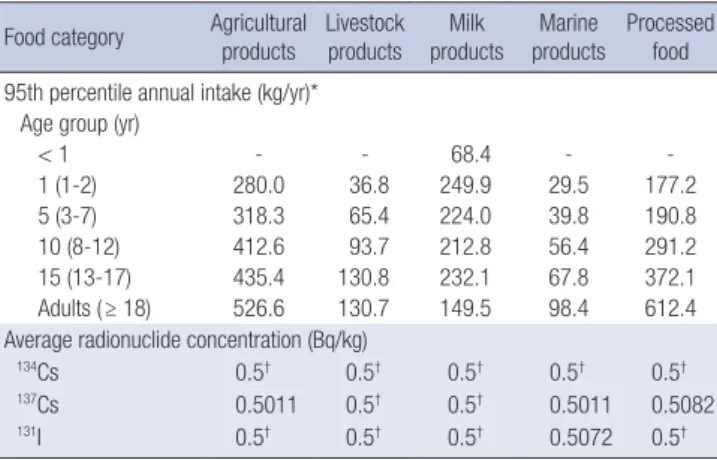
The annual amounts of food consumption (kg/yr) by age groups and average of radioactivity concentration for the five food cat- egories are shown in Table 1. Annual consumption rates of all food increased with increasing age, with the exception of milk products. Agricultural products had the highest annual con- sumption and marine products had the lowest among all food categories. The concentration of 134Cs was below the MDA in all food products, whereas the concentrations of 137Cs were 0.5011 Bq/kg in agricultural products, 0.5011 Bq/kg in marine products, and 0.5082 Bq/kg in processed food. The concentration of 131I was below the MDA in all food products except marine products.
Table 2 shows the annual committed effective and equivalent doses, lifetime dose, and excess lifetime cancer risk by age group.
The highest annual committed effective dose and thyroid equiv- alent dose were observed in the 1-yr age group, whereas the high- est red marrow equivalent dose was observed in adults. The life- time doses from the daily diet were 2.957-3.710 mSv for the com- mitted effective dose, 25.213-36.133 mSv for the thyroid equiva- lent dose, and 1.704-1.912 mSv for the red marrow equivalent
dose. The lifetime nominal risks for all solid cancers combined, leukemia, and thyroid cancer were decreased with increasing age with ranges of 14.4-18.1, 1.8-2.3, and 0.4-0.5 per 100,000, re- spectively.
DISCUSSION
This is the first study to estimate the internal radiation exposure through food ingestion and lifetime cancer risk in Korea. Our re- sults showed that the lifetime radiation doses and correspond- ing cancer risk were low among the Korean population. Com- pared with the population attributable fraction of well-known cancer risk factors in Korea (15), the potential contribution of cancer risk from internal radiation exposure through food con- sumption would be very small. However, the limitations of the ICRP nominal risk coefficient, which was applied to radiation- induced lifetime risk as an average by sex and age of the whole population, require careful interpretation for populations sus- ceptible to radiation.
The internal exposure level of radiation through food intake is expected to be lower than our estimates, which were calcu- lated using conservative assumptions. First, the detection rate for 134Cs, 137Cs, and 131I concentration in food was only 0.2% and the value of 0.5 Bq/kg was assigned for the below MDA. Sec- ond, this study used the 95th percentile of food consumption and the average concentration of radionuclides as part of our conservative approach. Third, the radioactivity concentration of the radionuclides for any single food item was assumed to be the concentration level of radionuclide for each food category.
On the other hand, the risks might be an underestimate. First the analysis of radionuclides was restricted to radiocesium and radioiodine and the other radioactive elements of strontium (Sr), plutonium (Pu), zirconium (Zr), and ruthenium (Ru) were not included in this analysis although the effective doses of stron- tium-90 were about 1/500 to 1/50 of that from radioactive cesi- um from the monitoring of fishery products in Japan (16). Sec- ond, the food intake pattern may change over decades and more extreme situations of food consumption could be possible.
Table 2. Annual committed effective and equivalent doses, lifetime dose, and excess lifetime cancer risk from dietary intake by age
Age group (yr)
Annual committed effective
and equivalent dose (mSv/yr) Lifetime dose (mSv)* Excess lifetime cancer risk
(case per 100,000) † Committed
effective dose Thyroid Red marrow Committed
effective dose Thyroid Red marrow Solid cancer Thyroid cancer Leukemia
< 1 0.008 0.128 0.001 3.710 36.133 1.912 18.1 0.5 2.3
1 0.081 1.4 0.009 3.702 36.005 1.911 18.0 0.5 2.3
5 0.051 0.89 0.008 3.467 31.932 1.877 16.9 0.4 2.1
10 0.041 0.546 0.012 3.242 28.512 1.825 15.8 0.4 2.0
15 0.041 0.441 0.019 3.039 26.096 1.743 14.8 0.4 1.9
Adults 0.041 0.35 0.024 2.957 25.213 1.704 14.4 0.4 1.8
*Lifetime doses were estimated by applying the annual committed effective dose from the age of first exposure until 89 yr of age; †Excess lifetime cancer risk was estimated by multiplying the lifetime committed effective dose and the detriment adjusted nominal risk coefficient of 4.871%/Sv for all solid cancers, 0.127%/Sv for thyroid cancer, and 0.615%/Sv for leukemia in ICRP 103.
Table 1. Annual food intake and measured radionuclide concentrations by food cate- gory
Food category Agricultural products Livestock
products Milk
products Marine
products Processed food 95th percentile annual intake (kg/yr)*
Age group (yr)
< 1 - - 68.4 - -
1 (1-2) 280.0 36.8 249.9 29.5 177.2
5 (3-7) 318.3 65.4 224.0 39.8 190.8
10 (8-12) 412.6 93.7 212.8 56.4 291.2
15 (13-17) 435.4 130.8 232.1 67.8 372.1
Adults ( ≥ 18) 526.6 130.7 149.5 98.4 612.4
Average radionuclide concentration (Bq/kg)
134Cs 0.5† 0.5† 0.5† 0.5† 0.5†
137Cs 0.5011 0.5† 0.5† 0.5011 0.5082
131I 0.5† 0.5† 0.5† 0.5072 0.5†
*Food intake was calculated using the Korea National Health and Nutrition Examina- tion Survey in 2008-2010; †Minimum detectable activity (MDA) was assumed to be 0.5 Bq/kg.
Moon E-K, et al. • Radiation Doses and Cancer Risk from Food Intake
12 http://jkms.org http://dx.doi.org/10.3346/jkms.2016.31.1.9
Previous studies of the Fukushima accident reported very low levels of radiation exposure or health risks among the pop- ulation in Japan (1-3), the US (4), UK (5), Ireland (6), and world- wide (17). Although a direct comparison with these studies is difficult because of the different methods of evaluation such as including other radioactive materials and using cancer inci- dence data, the different assumptions for the estimation of in- gestion dose and applying Monte-Carlo simulation, and radia- tion exposure pathways including water drinking as well, our findings were consistent with others in that the Fukushima ac- cident did not notably contribute to increased internal radia- tion dose or health risk to other countries.
Our findings suggest no discernible increase in radiation dos- es or excess fatal cancer risk from food ingestion at this stage in Korea, and provide scientific evidence of the risk communica- tion with general public associated with low-dose radiation ex- posure. However, the results were based on current monitoring situation and have considerable uncertainties in estimating the dose and risk, therefore, continuous food monitoring and strict regulation on food safety at the government level should be em- phasized to prevent any additional health hazards from food contamination.
DISCLOSURE
The authors have no conflicts of interest to disclose.
AUTHOR CONTRIBUTION
Conception and coordination of the study: Lee WJ, Jin YW, Yoon HJ. Acquisition of data: Kim HS, Hwang MS, Choi H. Ana- lyzed the data: Moon EK, Ha WH, Seo SW, Choi H. Data review:
Lee WJ, Jin YW, Yoon HJ, Jeong KH, Hwang MS, Kim HS, Ha WH, Seo SW, Choi H, Moon EK. Manuscript preparation: Moon EK, Lee WJ. Manuscript approval: all authors.
ORCID
Eun-Kyeong Moon http://orcid.org/0000-0002-2583-5886 Wi-Ho Ha http://orcid.org/0000-0002-2942-2501
Songwon Seo http://orcid.org/0000-0001-6200-5120 Young Woo Jin http://orcid.org/0000-0002-0029-9028 Kyu Hwan Jeong http://orcid.org/0000-0002-2087-5475 Hae-Jung Yoon http://orcid.org/0000-0003-4973-1659 Hyoung-Soo Kim http://orcid.org/0000-0001-5995-4579 Myung-Sil Hwang http://orcid.org/0000-0001-6470-6297 Hoon Choi http://orcid.org/0000-0002-9115-9636 Won Jin Lee http://orcid.org/0000-0002-0254-7267
REFERENCES
1. Murakami M, Oki T. Estimation of thyroid doses and health risks result- ing from the intake of radioactive iodine in foods and drinking water by the citizens of Tokyo after the Fukushima nuclear accident. Chemosphere 2012; 87: 1355-60.
2. Kamada N, Saito O, Endo S, Kimura A, Shizuma K. Radiation doses among residents living 37 km northwest of the Fukushima Dai-ichi Nu- clear Power Plant. J Environ Radioact 2012; 110: 84-9.
3. Harada KH, Niisoe T, Imanaka M, Takahashi T, Amako K, Fujii Y, Kana- meishi M, Ohse K, Nakai Y, Nishikawa T, et al. Radiation dose rates now and in the future for residents neighboring restricted areas of the Fuku- shima Daiichi Nuclear Power Plant. Proc Natl Acad Sci USA 2014; 111:
E914-23.
4. Fisher NS, Beaugelin-Seiller K, Hinton TG, Baumann Z, Madigan DJ, Garnier-Laplace J. Evaluation of radiation doses and associated risk from the Fukushima nuclear accident to marine biota and human con- sumers of seafood. Proc Natl Acad Sci USA 2013; 110: 10670-5.
5. Brown J. Assessment of radiation doses in the UK from the Fukushima Daiichi Nuclear accident. J Radiol Prot 2014; 34: N41-6.
6. McGinnity P, Currivan L, Duffy J, Hanley O, Kelleher K, McKittrick L, O’
Colmain M, Organo C, Smith K, Somerville S, et al. Assessment of the Impact on Ireland of the 2011 Fukushima Nuclear Accident. Dublin, Ra- diological Protection Institute of Ireland (Ireland), 2012.
7. Kim CK, Byun JI, Chae JS, Choi HY, Choi SW, Kim DJ, Kim YJ, Lee DM, Park WJ, Yim SA, et al. Radiological impact in Korea following the Fuku- shima nuclear accident. J Environ Radioact 2012; 111: 70-82.
8. IAEA. Assessment of doses to the public from ingested radionuclides. IAEA Safety Reports Series No.14, STI/PUB/1067. Vienna, 1999.
9. Kweon S, Kim Y, Jang MJ, Kim Y, Kim K, Choi S, Chun C, Khang YH, Oh K. Data resource profile: the Korea National Health and Nutrition Ex- amination Survey (KNHANES). Int J Epidemiol 2014; 43: 69-77.
10. Ministry of Food and Drug Safety. Risk assessment of heavy metals in infant
& young children foods. Daejeon: Ministry of Food and Drug Safety, 2012.
11. ICRP. Age-dependent doses to members of the public from intake of ra- dionuclides - Part 2 Ingestion dose coefficients. ICRP Publication 67. Ann ICRP 1993; 23(3-4).
12. ICRP. Age-dependent doses to the members of the public from intake of radionuclides - Part 5 Compilation of ingestion and inhalation coeffi- cients. ICRP Publication 72. Ann ICRP 1995; 26(1).
13. Statistics Korea. Population projections for Korea, Life expectancy at birth (Korea), 2015. Available at http://kosis.kr/ [accessed on 17 March 2015].
14. ICRP. The 2007 Recommendations of the International Commission on Radiological Protection. ICRP publication 103. Ann ICRP 2007; 37(2-4).
15. National Cancer Center Korea. Attrubutable causes of cancer in Korea in the year 2009. Available at http://www.ncc.re.kr / [accessed on 17 March 2015].
16. JFA. Leakage of comtaminated water at TEPCO’s Fukushima Daiichi nuclear power station and the safety of fishery products. Japan Fisheries Agency, 2014. Available at http://www.jfa.maff.go.jp/e/index.html [ac- cessed on 17 March 2015].
17. Evangeliou N, Balkanski Y, Cozic A, Møller AP. Global and local cancer risks after the Fukushima Nuclear Power Plant accident as seen from Chernobyl: a modeling study for radiocaesium ((134)Cs &(137)Cs). En- viron Int 2014; 64: 17-27.