Korean J Gastroenterol Vol. 75 No. 4, 216-219 https://doi.org/10.4166/kjg.2020.75.4.216 pISSN 1598-9992 eISSN 2233-6869
CASE REPORT
Korean J Gastroenterol, Vol. 75 No. 4, April 2020 www.kjg.or.kr
설페이트 기반 저용량 액상 장정결제 복용 후 발생한 허혈성 장염 1예
정정화, 이정민, 손영우, 한원철1, 윤기철
원광대학교 산본병원 소화기내과, 병리과1
Ischemic Colitis Associated with Low-volume Oral Sulfate Solution for Bowel Preparation
Jung Wha Chung, Jung Min Lee, Young Woo Sohn, Weon Cheol Han1 and Kichul Yoon
Departments of Internal Medicine and Pathology1, Wonkwang University Sanbon Hospital, Gunpo, Korea
Ischemic colitis resulting from bowel preparation for colonoscopy is extremely rare, with only a small number of cases with poly- ethylene glycol having been reported. Here, we present a patient with ischemic colitis after administration of a low-volume oral sulfate solution (OSS). A 49-year-old female without any significant medical history experienced abdominal pain, vomiting, and hematochezia after ingestion of OSS. She complained of severe abdominal pain during colonoscopy, and diffuse edema, hyper- emia, friability, and shallow erosions were present on the transverse, descending, and sigmoid colons. A mucosal biopsy revealed mixed lymphoid inflammatory cell infiltration with de-epithelialization, whereas an abdominal CT scan showed submucosal ede- ma on the transverse colon. A diagnosis of ischemic colitis was made. The patient recovered with fluid and antibiotic therapy with- out significant sequelae. Although OSS is a clinically validated and generally safe bowel preparation agent, ischemic colitis is a rare complication that should be considered. (Korean J Gastroenterol 2020;75:216-219)
Key Words: Colitis, ischemic; Bowel preparation; Colonoscopy
Received December 25, 2019. Revised February 10, 2020. Accepted February 17, 2020.
CC This is an open access article distributed under the terms of the Creative Commons Attribution Non-Commercial License (http://creativecommons.org/licenses/
by-nc/4.0) which permits unrestricted non-commercial use, distribution, and reproduction in any medium, provided the original work is properly cited.
Copyright © 2020. Korean Society of Gastroenterology.
교신저자: 윤기철, 15865, 군포시 산본로 321 원광대학교 산본병원 소화기내과
Correspondence to: Kichul Yoon, Department of Internal Medicine, Wonkwang University Sanbon Hospital, 321 Sanbon-ro, Gunpo 15865, Korea. Tel:
+82-31-390-2204, Fax: +82-31-390-2592, E-mail: [email protected], ORCID: https://orcid.org/0000-0003-1392-2808 Financial support: None. Conflict of interest: None.
INTRODUCTION
Ischemic colitis is caused by impaired blood perfusion to the intestine.1 It frequently affects the elderly with various clinical courses, from self-limited ischemia to life-threatening infarction and necrosis.2 Nonspecific symptoms such as ab- dominal pain, diarrhea, and hematochezia are frequently present, whereas mesenteric artery embolism or thrombosis, trauma, congestive heart failure, excessive physical activity, shock, and mechanical obstruction are well-known risk factors for this condition.3 Ischemic colitis resulting from bowel prepa-
ration for colonoscopy is extremely rare, with only a few cases due to administering polyethylene glycol (PEG) and bisacodyl having been reported worldwide.4 Herein, we report a rare case of ischemic colitis caused by low-volume oral sulfate sol- ution (OSS) for bowel preparation.
CASE REPORT
A 49-year-old female without significant medical history at- tended the outpatient clinic of the gastroenterology department with severe abdominal pain, which started after ingestion of
Chung JW, et al. Ischemic Colitis Associated with OSS 217
Vol. 75 No. 4, April 2020
A B
Fig. 2. Abdominal computed tomography revealed submucosal edema of transverse colon (A) transverse section and (B) coronal section.
A B
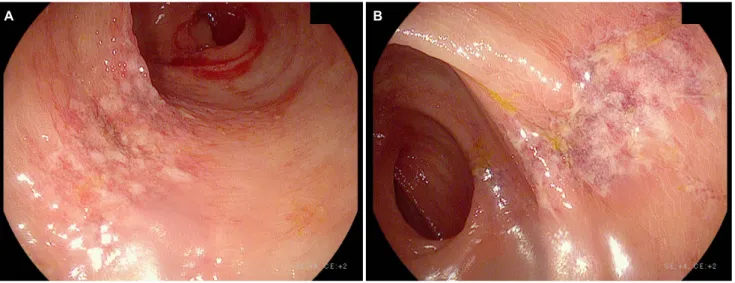
Fig. 1. Colonoscopy revealed diffuse edematous hyperemic inflammation, shallow erosions, and friability in mucosa of (A) sigmoid and (B) transverse colons.
OSS for bowel preparation and became aggravated during colonoscopy. She had the colonoscopy as scheduled as part of an elective general health checkup. Upon physical examina- tion, the abdomen was soft to palpation with moderate tender- ness of the lower part. Before this episode, she had received colonoscopies several times without complications. She did not have any symptoms before starting the bowel preparation.
The patient experienced abdominal pain, vomiting, and hema- tochezia shortly after ingesting a low-volume OSS (magnesium sulfate anhydrous 1.6 g, sodium sulfate anhydrous 17.5 g, potassium sulfate 3.13 g, in 177 mL of Suclear Solution®;
Pharmbio, Seoul, Korea) with water as instructed. During the colonoscopy, she experienced further severe abdominal pain
from the beginning of the procedure onward. Diffuse edema- tous hyperemic inflammation of the mucosa as well as shallow erosions and friability in the transverse, descending, and sig- moid colons were evident during the colonoscopy (Fig. 1). At the time of admission, her vital signs were blood pressure, 130/70 mmHg; heart rate, 82 beats/min; respiratory rate, 20 breaths/min; and body temperature, 37.0℃. The initial labo- ratory findings were white blood cell count, 11,000/µL (72.9%
neutrophils); hemoglobin, 15.2 g/dL; hematocrit 45.1%; plate- lets 324,000/µL; CRP, 0.523 mg/dL; BUN, 15.9 mg/dL; and creatinine, 0.94 mg/dL. An abdominal CT scan with enhance- ment was carried out after admission to investigate the cause of the abdominal pain, and CT images showed submucosal
218 정정화 등. 설페이트 기반 장정결제와 연관된 허혈성 장염
The Korean Journal of Gastroenterology
A B
Fig. 3. (A, B) Histologic examination of sigmoid and transverse colonic mucosa showed mixed lymphoplastic cell infiltration (arrows) and de-epithelialization, consistent with ischemic colitis (A: H&E, ×40; B: H&E, ×200).
edema of the transverse colon (Fig. 2). Multiple biopsies of the transverse and sigmoid colon revealed mixed lymphoid inflammatory cell infiltration with de-epithelialization, thereby suggesting ischemic colitis (Fig. 3). Treatment with dextrose saline hydration and intravenous antibiotics (ceftriaxone and metronidazole) was performed. Her symptoms gradually im- proved with therapy, and she was discharged without serious complications. In the follow-up outpatient visit, it was found that she had recovered completely without sequelae.
DISCUSSION
Ischemic colitis has various etiological and clinical presentations. Cases rarely present without risk factors such as old age, diabetes, dyslipidemia, heart failure, and/or pe- ripheral arterial disease, whereas medications reported to be associated with ischemic colitis include vasoconstrictors, psy- chotropics, oral contraceptives, interferon‐α, 5‐hydroxytrypt- amine‐1 agonists, digoxin, and acetylsalicylic acid.5 However, a few cases of ischemic colitis resulting from the admin- istration of electrolyte lavage solution consisting of saline, magnesium citrate, or sodium phosphate have been reported worldwide.6-8
According to a consensus document on bowel preparation before colonoscopy, PEG solutions have proven to be effective
and relatively well tolerated and thus are regarded as a stand- ard method.9 PEG solution is comprised of large polymer mol- ecules in an osmotically balanced solution of sodium and po- tassium chloride and, when administered in large amounts, causes diarrhea due to its osmotic activity.7,10 However, as a large volume of solution is needed to administer PEG, there has been demand for a lower-volume alternative laxative regi- men to ensure patient compliance. Recently, a new low-vol- ume sulfate solution consisting of sodium sulfate, magnesium sulfate, and potassium sulfate in liquid form has been in- troduced, and several clinical studies have reported its safety and efficacy.11,12 Sulfate is a poorly absorbed anion that is an osmotic agent used in laxatives developed as an alter- native to phosphate solutions, which cause serious renal complications.11,13 Similar to the safety profile of PEG solution, OSS has been shown to have little effect on the stool electro- lyte balance.13 Furthermore, OSS does not form urinary cal- cium precipitates or affect the cardiac QTc interval.14
In the current case, the patient started having abdominal pain, vomiting, and hematochezia almost immediately after taking OSS. The diagnosis of ischemic colitis was made via colonoscopy, histologic examination, and a CT scan. Although an observational study on OSS has reported the cumulative incidence of ischemic colitis as 0.02%,14 this is the first case report in Korea. The hypertonic property of the solution could
Chung JW, et al. Ischemic Colitis Associated with OSS 219
Vol. 75 No. 4, April 2020
have resulted in dehydration of the bowels. However, as the incidence of ischemic colitis between PEG and OSS is not significantly different according to the results of a large-scale study, the exact mechanism of ischemic colitis due to OSS has not yet been established. A possible explanation could be bowel hypoperfusion and subsequent ischemia from the rapid shift of intravascular fluid to the colon lumen by the hyperosmolar laxative.7 In addition, magnesium sulfate in- cluded in OSS is known to stimulate colon motility via chol- ecystokinin and prostaglandin, which could have also con- tributed to hypoperfusion and ischemia.15
As OSS is a relatively novel agent employed for bowel prep- aration, rare complications such as ischemic colitis, as in this case study, should be monitored and considered in clinical practice. Patients should be educated to imbibe adequate hy- dration before starting bowel preparation, and symptoms such as abdominal pain or hematochezia during preparation must be reported immediately to the physician.
REFERENCES
1. Sreenarasimhaiah J. Diagnosis and management of ischemic colitis. Curr Gastroenterol Rep 2005;7:421-426.
2. Green BT, Tendler DA. Ischemic colitis: a clinical review. South Med J 2005;98:217-222.
3. Theodoropoulou A, Koutroubakis IE. Ischemic colitis: clinical practice in diagnosis and treatment. World J Gastroenterol 2008;14:7302-7308.
4. Baudet JS, Castro V, Redondo I. Recurrent ischemic colitis in- duced by colonoscopy bowel lavage. Am J Gastroenterol 2010;
105:700-701.
5. Higgins PD, Davis KJ, Laine L. Systematic review: the epidemiol- ogy of ischaemic colitis. Aliment Pharmacol Ther 2004;19:
729-738.
6. Lee SO, Kim SH, Jung SH, et al. Colonoscopy-induced ischemic
colitis in patients without risk factors. World J Gastroenterol 2014;20:3698-3702.
7. Oh JK, Meiselman M, Lataif LE Jr. Ischemic colitis caused by oral hyperosmotic saline laxatives. Gastrointest Endosc 1997;45:
319-322.
8. Park JE, Moon W, Nam JH, et al. A case of ischemic colitis present- ing as bloody diarrhea after normal saline enema. Korean J Gastroenterol 2007;50:126-130.
9. Wexner SD, Beck DE, Baron TH, et al. A consensus document on bowel preparation before colonoscopy: prepared by a task force from the American Society of Colon and Rectal Surgeons (ASCRS), the American Society for Gastrointestinal Endoscopy (ASGE), and the Society of American Gastrointestinal and Endoscopic Surgeons (SAGES). Gastrointest Endosc 2006;
63:894-909.
10. Di Palma JA, Smith JR, Cleveland Mv. Overnight efficacy of polyethylene glycol laxative. Am J Gastroenterol 2002;97:
1776-1779.
11. Rex DK, Di Palma JA, Rodriguez R, McGowan J, Cleveland M. A randomized clinical study comparing reduced-volume oral sul- fate solution with standard 4-liter sulfate-free electrolyte lavage solution as preparation for colonoscopy. Gastrointest Endosc 2010;72:328-336.
12. Kim B, Lee SD, Han KS, et al. Comparative evaluation of the effi- cacy of polyethylene glycol with ascorbic acid and an oral sulfate solution in a split method for bowel preparation: a randomized, multicenter phase III clinical trial. Dis Colon Rectum 2017;60:
426-432.
13. Patel V, Nicar M, Emmett M, et al. Intestinal and renal effects of low-volume phosphate and sulfate cathartic solutions designed for cleansing the colon: pathophysiological studies in five normal subjects. Am J Gastroenterol 2009;104:953-965.
14. Anastassopoulos K, Farraye FA, Knight T, Colman S, Cleveland MV, Pelham RW. A comparative study of treatment-emergent ad- verse events following use of common bowel preparations among a colonoscopy screening population: results from a post-marketing observational study. Dig Dis Sci 2016;61:
2993-3006.
15. Hass DJ, Kozuch P, Brandt LJ. Pharmacologically mediated colon ischemia. Am J Gastroenterol 2007;102:1765-1780.