열가압 리튬 디실리케이트 전장도재와 지르코니아 하부구조의
전단결합강도 평가
부산가톨릭대학교 보건과학대학 치기공학과
김재홍
Adhesion between heat-pressed lithium disilicate
veneer and zirconia framework: Shear bond strength evaluation
Jae-Hong Kim
Department of Dental Laboratory Science, College of Health Science, Catholic University of Pusan
요 약 본 연구의 목적은 shear bond strength을 이용하여 pressed lithium disilicate 전장도재와 zirconia core의
접착을 비교 분석하는 것이다. Zirconia blank(Zirtooth, HASS, Gangneung, Korea)에 각 pressed ceramic(IPS
e.max Zirpress, Vita PM9, GC Initial IQ, HASS Rosetta UP)이 적용된 시편을 제작하였다(N=40). 전단결합강도를
비교 평가하기 위해 The Schmitz–Schulmeyer test method을 이용하였고 산출된 파괴하중의 값을 분석했다. 산출된
네 가지 전단결합강도 값들 간의 평균 비교는 일원분산분석(one-way ANOVA)을 통해 이루어졌고, Tukey의 사후검정
을 실시하여 서로 간의 평균 차이가 통계적으로 유의함을 검증하였다. 또 파절면의 3D 분석을 통하여 파괴 표면을 관찰
하여, 그 파괴 양상도 분류하였다. 실험군별 전단결합강도는 IPS e.max Zirpress 16.69±3.11㎫, VITA PM9
14.21±3.63㎫, GC Initial IQ 11.17±2.92㎫, HASS Rosetta SM 27.90±5.71㎫이었으며, Lithium disilicate
ceramic veneer(HASS Rosetta SM)의 결합 강도는 다른 제품들보다 통계적으로 유의하게 높았다(p<0.05). 또, 파괴면
의 유형 분류 결과, 모든 시편에서 cohesive 파괴는 관찰되지 않았고 주로 adhesive와 cohesive가 같이 조합된 파괴
유형이 관찰되었다. 본 연구 결과에 의해서 pressed lithium disilicate 전장도재가 기존의 pressed to zirconia
system보다 나은 접착력을 보여주었다.
Abstract This study examined the shear bond strength between the zirconia core and pressed lithium
disilicate veneering ceramics. The Schmitz-Schulmeyer test method was used to investigate the
core-veneer shear bond strength of industrially manufactured zirconia core ceramic (Zirtooth, HASS,
Gangneung, Korea) and pressed veneer ceramic (IPS e.max Zirpress, Vita PM9, GC Initial IQ, HASS
Rosetta SM) (N=40). Data were statistically analyzed using one-way ANOVA and Tukey's test (a=0.05). The
fractured surfaces of the specimens were examined to determine the failure pattern using a digital
microscope. The mean ± SD shear bond strength in MPa were 16.69±3.11, 14.21±3.63, 11.17±2.92, and
27.90±5.71 for IPS e.max Zirpress, VITA PM9, GC Initial IQ, and HASS Rosetta SM, respectively. The
average shear bond strength was largest for HASS Rosetta SM, followed by IPS e.max Zirpress, Vita PM9,
and GC Initial IQ(p<0.05). The digital microscopy examination of the fracture surface showed adhesive
and cohesive failure in pressed lithium disilicate veneering ceramics. The use of lithium disilicate veneer
ceramic produced a significantly higher shear bond strength.
Keywords : Adhesion, Lithium disilicate, Pressing technique, Shear bond strength, Zirconia
*Corresponding Author : Jae-Hong Kim(Catholic University of Pusan) email: [email protected]
Received November 4, 2019 Revised December 18, 2019 Accepted March 6, 2020 Published March 31, 2020
1. 서론
고정성 국부의치(FPD)에서 금속과 도재의 조합에 의
한 수복물에 대한 연구는 오랜 기간 임상 데이터를 가지
고 있다[1, 2]. 매우 신뢰 있는 치료 수단으로 입증되어
왔지만[3], 금속 하부구조물의 구강 내 생체적합성과 전
장도재 조합에서의 잦은 실패라는 고질적인 단점을 가지
고 있다. 또한 환자들의 심미적 요구가 증대함에 따라 기
존의 금속 도재 수복물은 내부 구조를 이루는 금속으로
인해 자연치아의 재현에 있어 심미적 한계가 발생한다[4].
그러나 이러한 문제를 해결하기 위해 약간의 빛 투과
가 가능할 뿐만 아니라 기존의 ceramic 보다 우수한 굴
곡 강도와 파괴인성을 가지는 zirconia를 이용한
zirconia-ceramic system이 소개되었다[5]. 그리고 최
근에는 이러한 system의 발전으로 기존의 pressing
technique을 이용하여 zirconia 하부구조물 위에
glass-ceramic을 적층 시키는 구조의 세라믹이 널리 퍼
져있다[6]. 이것은 zirconia 소재를 기반으로 왁스 소환
법을 통해 해부학적인 wax-up 하여 매몰, 소환한 후 세
라믹 인고트(ingot)를 가압하는 방법으로써 소결 전에
zirconia 하부구조물로 지지 되어있는 납형을 구강 내에
서 미리 조정할 수 있기 때문에 올려지는 ceramic의 기
계적인 특성에 영향을 미치지 않게 할 수 있을 뿐만 아니
라[7], 기존의 hand-layer technique 과정 중에 발생되
는 다수의 소성에 의해 수축이 최소화 된다. 이는 지대치
와 도재 부위의 변연이 좋은 적합도의 결과로 이어지게
되고[8, 9], 수복물의 빠르고 쉬운 생산을 가능하게 한다
[10]. 뿐만 아니라 만일 디자인 시 완성되는 수복물을 의
도적으로 cut-back 하여 가압한 후, 남겨진 공간에 포세
린 분말을 적용하면 더 심미적인 수복물의 제작도 가능
하게 된다.
하지만 이런 zirconia 기반의 가압된 전장도재의 사
용에서도 포세린의 파절은 여전히 해결해야할 큰 과제이
다. Christensen 등[11]은 붓을 통하여 전장도재를 축성
하는 zirconia system 뿐만 아니라 가압을 통해 전장도
재를 축성하는 zirconia system의 파손율도 porcelain
fused to metal(PFM) 수복물의 파손율 보다는 훨씬 높
다는 점을 보고하였다. 그리고 가압을 통해 전장도재를
축성하는 zirconia system의 파손에서 나타난 가장 보
편적인 파괴 유형을 살펴보면, 포세린의 내부의 파절로서
붓을 통하여 전장도재를 축성하는 zirconia system에서
발생된 파괴 유형과 유사하다는 것이 발견하였다[11]. 또
한, Choi 등의 가압을 통해 전장도재를 축성하는
zirconia system들의 결정상과 접착, 굴곡강도에 관한
비교 연구에서는 포세린 자체 내에서의 파절이 계면에서
의 파손보다 많은 것을 관찰하여 임상의 결과를 뒷받침
해주었다[12, 13].
그리고 이런 비니어 포세린 자체의 파절이 가능한 이
유로는 열팽창계수(CTE)의 mismatch에 의한 과도한
인장응력[14], 포세린이 들어가는 미세 구조지역의 기공
발생에 의한 기계적인 결함[15], 하부구조물의 부족한 지
지 또는 표면 결함[16, 17], 과도하게 주어지는 힘 또는
피로[18], 불충분한 결합강도[19], 그리고 전장도재의 낮
은 파괴 저항성[20] 등이 있다. 이러한 결과들로 미루어
보아, 파절 저항성과 물성을 개선시킨 전장 재료를 사용
해야만 포세린 파절의 파손율을 낮추는 것에 기여할 수
있다는 점을 알 수 있다. 이에 관하여 기존 재료들에 비
하여 상당히 우수한 기계적 특성을 가진 lithium
disilicate 전장도재가 추천되고 있다[21, 22]. 그리고 최
근에는 상대적으로 장비의 가격이 비싸지 않은 pressing
technique을 활용한 zirconia 기반의 lithium
disilicate 전장도재의 제작이 이루어지기 시작했다[23].
Pressing technique에서 lithium disilicate 전장도
재를 사용하는데 한 가지 고려해야 할 부분이 있다. 그것
은 바로 zirconia 하부구조물과의 접착이다[24, 25]. 선
행된 연구에서 기존 다른 재료들과 zirconia와의 접착은
연구되어 왔으나[26], lithium disilicate 전장도재와
zirconia 하부구조물의 접착에 관한 연구는 이루어진 바
가 없다. 따라서, 이 연구의 목적은 가압된 lithium
disilicate 전장도재와 다른 가압 ceramic 전장도재가
보여주는 접착을 비교 분석하는 것이다.
2. 연구 방법
2.1 실험 재료
비교 할 4가지 종류의 실험군은 IPS e.max Zirpress,
VITA PM9, GC Initial IQ와 HASS Rosetta SM이다.
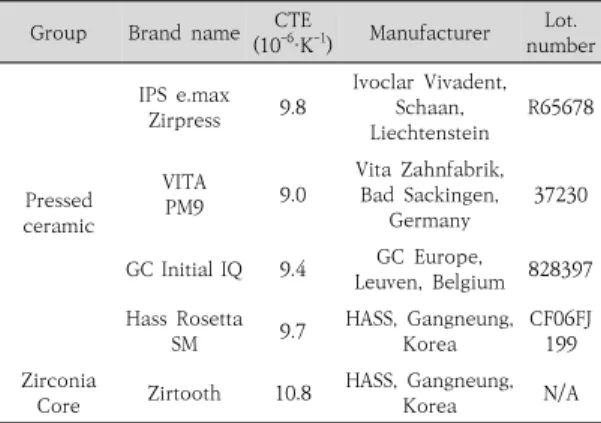
이들과 zirconia core의 제조회사, batch 번호, CTE,
조성은 각 Table 1, 2에 나열하였다. 각 4가지 제조회사
별로 10개의 시편을 제작하여 총 40개의 시편들 중 전단
결합강도 테스트에서는 각 8개씩 총 32개의 시편들로 비
교 실험을 진행하였다[Table 1, 2]. 남는 그룹별 2개씩의
시편들은 따로 zirconia와 ceramic의 계면을 관찰하는
데 사용되었다.
Group Brand name CTE
(10-6·K-1) Manufacturer Lot.
number
Pressed ceramic
IPS e.max
Zirpress 9.8 Ivoclar Vivadent, Schaan,
Liechtenstein R65678 VITAPM9 9.0 Vita Zahnfabrik,
Bad Sackingen, Germany 37230 GC Initial IQ 9.4 GC Europe,
Leuven, Belgium 828397 Hass Rosetta
SM 9.7 HASS, Gangneung, Korea CF06FJ
199 Zirconia
Core Zirtooth 10.8 HASS, Gangneung,
Korea N/A
Table 1. Materials used in this study
Compostio n
Brand name IPS e.max
Zirpress VITA PM9 GC Initial
IQ HASS
Rosetta SM
SiO2 57-62 62-67 63-68 71~85
Al2O3 12-16 16-19 14-17 1~5
K2O 2-4 6-8 9-13 -
Na2O 6-8 5-8 5-7 -
TiO2 - - <1 -
CeO2 - - <1 -
ZrO2 - - <1 -
CaO - - 0-1 -
B2O3 - 1-3 1-2 1~6
BaO - - 0-1 -
SnO2 - - - -
ZnO - - - -
F 0.5-1 - - -
LiO2 - - <1 10~15
P2O5 1-2 - - 2~5
SrO - - - -
MgO - - <1 -
FeO - - - -
Other
Oxides 0-6 - - 3~9
Pigments 0.2-0.9 Yes 0.1-3 0.1~2
Table 2. Composition of veneering porcelains(All in wt %)
2.2 지르코니아 하부구조물 제작
실험 방법은 Schmitz Schulmeyer Method[Fig. 1]
를 사용한다. 이에 따른 시편을 제작하기 위하여 지르코
니아 블록(Zirtooth, HASS, Gangneung, Korea)을
sintering furnace(Zirkonofen 600/V2, Zirkonzahn
GmbH, Gais, Italy)에 넣어 full density로 만든 후, 정
밀 saw(IsoMet 2000, Buehler, Dusseldorf,
Germany)를 사용하여 잘라내어 길이 5.0mm, 폭
5.0mm, 그리고 높이 13.0mm의 동일한 모양의 지르코
니아 하부구조물 시편을 제작하였다.
Fig. 1. Schematic Illustration of Schmitz Schulmeyer Specimen.
2.3 전장도재 시편 제작
준비된 zirconia 시편을 길이 4.0mm, 폭 5.0mm, 높
이 3.0mm 치수로 wax-up(S-U-Gnatho-Ax Blue,
Schuler Den-tal, Ulm, Germany) 한다. 그 후 3mm
길이의 10 gauge 왁스로 주입선을 달아 200gram
investment ring(Silicone Ring, Ivoclar Vivadent,
Schaan, Liechtenstein) 안에 고정시킨다. 다음으로 인
산염 결합 매몰재(CALBRA-PRESS, PROTECHNO,
Vilamalla Girona, Spain) 을 이용하여 매몰한다. 매몰
재가 경화하면 Programat P500 furnace에 넣어 각각
의 제조회사의 추천에 따른 소성 스케줄[Table 3]에 맞
추어 pressing technique를 적용한다.
Brand name Heat up temperat
ure
Start temperat
ure
Heat Rate (°C per Minute)
Vacuum Hold Time (Minute)
Pressing Temperat ure (°C) IPS e.max
Zirpress 900 700 60 15 910
VITAPM9 850 700 50 20 1,000
GC Initial
IQ 850 700 60 20 940
Hass
Rosetta SM 900 700 60 20 920
Table 3. Pressing Schedule for the Pressed Ceramics Used in the Study
2.4 전단결합강도 실험
Schmitz Shulmeyer Methods를 적용하기 위해 준
비된 시편을 메탈 홀더를 이용하여 universal testing
machine(OUT-05D, Oriental Corp, Gyenonggi-do,
Korea) 에 고정시킨다. Load는 시편의 장축에 평행한
끝(wedge) 을 통해 veneer와 core의 계면에 cross-head
speed 0.5mm/min로 veneer ceramic의 delamination이
일어날 때까지 적용한다. 얻어진 failure에 대한 최대
load 값(N) 을 bonding된 영역(mm
2)으로 나누어 전단
결합강도(mpa)를 계산했다.
2.5 SEM을 이용한 표면 분석
Scanning Electron Microscopy(SEM: JSM-6701F,
JEOL, Tokyo, Japan)을 사용하여 platinum 코팅된 시
편의 접착된 계면을 관찰하여 각 ceramic들과 zirconia
의 area를 qualitative analysis하고 성분분포를 확인하
였다.
2.6 통계 분석
모든 통계적 분석은 Statistical Package for Social
Sciences(SPSS 21.0, IBM SPSS, Chicago, USA)를 사
용하였다. 측정된 값들에 대한 동질성 검정을
Shapiro-wilk test로 정규성 검정한 결과 p=0.078을
보이며, 그룹 내 p-value는 0.05 이상으로 정규성을 띠
는 것으로 검증되었다. 이에 4가지 종류의 pressable
glass ceramic의 전단결합강도 값들 사이에 차이가 없
을 것이라는 귀무가설을 통계적으로 검증하기 위하여 일
원분산분석(one-way ANOVA)를 사용하였다. 또, 만일
값들 간의 차이가 있을 경우, 이들의 차이가 유의 수준
5% 하에서 통계적으로 유의한지 사후분석하기 위해
Tukey’s post-hoc analysis를 사용하였다.
3. 연구 결과
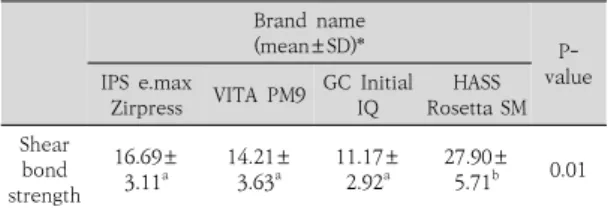
지르코니아 코어와 전장 도재 간의 평균 전단결합강도
는 IPS e.max Zirpress 16.69±3.11㎫, VITA PM9
14.21±3.63㎫, GC Initial IQ 11.17±2.92㎫, HASS
Rosetta SM 27.90±5.71㎫으로 나타났다. 이와 같은 결
과를 토대로 모수적 통계방법인 one-way ANOVA test
의 p-value는 0.01 미만으로 5% 유의수준 하에서 “열가
압 세라믹의 종류에 따라 전단 결합 강도에 차이가 없
다.”라는 귀무가설을 기각한다. 4가지 제품군들 간의 차
이 양상이 구체적으로 어떠한지 분석하기 위하여 Tukey
의 사후분석을 실행하였다. 이를 위한 Levene의 등분산
검정은 유의수준 0.064로 만족하였다. 분석 결과,
ZirPress와 PM9, 그리고 GC Initial IQ 간에는 통계적
으로 유의한 차이가 없었다. 반면, 본 연구에서 제시하는
Rosetta SM은 나머지 셋과 평균이 통계적으로 유의한
차이가 있었으며, 또한 평균도 크게 높았다[Table 4].
Brand name
(mean±SD)* P-
value IPS e.max
Zirpress VITA PM9 GC Initial IQ HASS Rosetta SM Shear
bond strength
16.69±
3.11a 14.21±
3.63a 11.17±
2.92a 27.90±
5.71b 0.01
*Same letters indicate statistically non-significant based on Tukey’s multiple comparison
Table 4. Shear bond strength comparison results
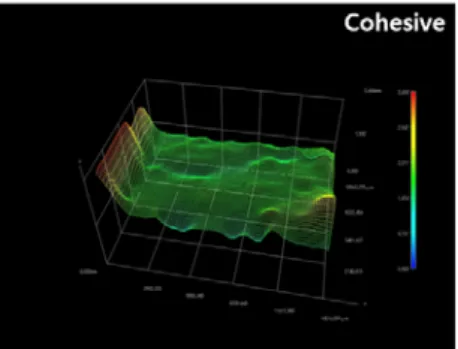
모든 종류의 시편들 사이에서 core 내에 cohesive
파괴는 관찰되지 않았다. 12개의 시편들 중 평균적으로
12.5% 정도 cohesive 파괴가 나타났고, 주로 관찰된 파
괴 유형은 adhesive 와 cohesive가 같이 조합된 파괴유
형이 87.5%로 나타났다[Table 5, Fig. 2].
Brand name Mean
Percent IPS e.max age
Zirpress VITA PM9 GC Initial IQ HASS Rosetta SM Cohesive 2
(16.67%) 1
(8.33%) 1
(8.33%) 2
(16.67%) 12.5%
Adhesive
&
Cohesive
(83.33%)10 11
(91.67%) 11
(91.67%) 10
(83.33%) 87.5%
Table 5. Cohesive and adhesive fracture analysis
Fig. 2. Observation and analysis using multi focus
4. 고찰
최근 몇 년간 지르코니아 하부구조 기반의 전장도재
system에서 전장도재의 cohesive failure 즉, porcelain
chipping은 수복물 failure의 주요한 문제였다[28]. 이
런 문제를 해결하기 위하여 장석계 ceramic보다 3배 정
도 강한 기계적 특성을 가지 lithium disilicate가 지르
코니아 하부구조 위에 전장 재료로서 제안되어지기 시작
했다. 이 lithium disilicate를 전장으로 만들어진 수복
물이 우수한 기계적 성능을 가지는 것은 사실이다. 그러
나 여기서 코어와 전장재료의 adhesion도 같이 고려되
어야 하는데[29], 그 이유는 코어와 전장재료 구조가 가
지는 수복물의 오랜 기간의 임상 성공에 adhesion이 굉
장히 큰 영향을 미치기 때문이다[30]. 따라서 pressed
technique을 사용하여 접착된 lithium disilicate veneer
를 기존의 pressed to zirconia veneer의 adhesion과
비교 분석함으로써 기존 pressed to zirconia system
의 대안으로 pressed lithium disilicate veneer to zirconia
core의 가능성을 제시 했다. lithium disilicate은
lithium metasilicate 결정과 lithium disilicate 결정
핵을 포함하여 부분적으로 결정화된 상태이다. 이 상태에
서는 가공이 용이하고 가공 중 수복물이 chipping 되는
것을 예방한다. 가공이 끝난 후 결정화 열처리 작업을 거
치면 굴곡강도가 360㎫로 상승하게 된다. 이는 통상적으
로 사용되는 장석 도재(약 100㎫), leucite-reinforced
glass ceramics(약 160㎫)보다 훨씬 높은 수준이다[21].
본 연구에서는 lithium disilicate veneer와 zirconia core
의 adhesion을 비교 분석하기 위하여 먼저 전단 결합
강도 값을 측정하였다. 측정은 The Schmitz–
Schulmeyer test를 사용하였다. 이 측정 방법은 메탈
ceramic 뿐만 아니라 all ceramic에서도 자주 응용되
는[31, 32]방법으로, 전단결합강도의 평가에 간단하고 신
뢰되는 검사방법으로 잘 알려져 있다. 또한 이를 통해 시
험할 경우 직접적으로 계면에 힘을 가해 상대적으로 균
일한 분포의 계면응력값을 측정 할 수 있다[33, 34]. 전
단 결합강도값은 lithium disilicate veneer인 Rosetta
SM 기존 pressed ceramic과 비교하여 상당히 높은 전
단결합강도 값을 가지는 것으로 나타났다. 이런 큰 차이
의 결합강도를 가지는 것에 대한 이유로 먼저 고려 되야
하는 것은 veneer 와 core system의 결합강도 연구에
서 빈번히 논의되는 것 중 하나인 CTE의 불일치의 효과
이다[35, 36]. 선행연구에서는 재료의 열팽창계수 차이로
인한 계면에 잔류응력 형성이 접착강도에 영향을 준다고
보고하였다[25]. 하지만 all ceramic system의 bond
strength에 대한 몇몇의 연구에서는 CTE의 불일치와 측
정된 결합강도에 영향이 없는 것으로 보고되어졌다[30].
그렇다면 코어와 전장재료의 어느 정도 가까운 수준의
열팽창률 차이에 의한 잔류응력의 형성보다 전장재료 자
체의 고유인성(intrinsic toughness)이나 강성이 결합강
도에 더 영향을 미칠 것 이라고 해석될 수 있다[37]. 본
연구에서도 열팽창률 차이와 상관없이 다른 세라믹 보다
강성이 강한 lithium disilicate crystalline을 가진
Rosetta UP이 가장 강한 결합강도를 나타낸 것을 보여
줌으로써 기존 연구의 결과를 뒷받침 해주었다. 그리고
전단 시험된 시편들의 파손유형은 주로 계면에서의
adhesive 와 veneering ceramic안의 cohesive의 조
합이었다. 이것 역시 선행연구인 brush-applied
veneered to zirconia system의 파손 유형과 유사한
결과를 보여주었다[29, 30].
본 연구의 제한점으로는 결합강도와 함께 잔류응력이
함께 조사되지 못한 점, 제작된 pressed ceramic 시편
들이 임상적인 수복물의 형태를 반영되지 못한 점이다.
Adhesion에 대한 좀 더 임상적인 결과와 구체적인 분석
이 되기 위해서는 구강 내 환경과 수복물의 형상을 띈 시
편들을 이용하여 유한요소 분석 또는 잔류응력에 대한
영향에 관한 조사들이 진행되어야 할 것 이다.
5. 결론
본 연구는 먼저 Schmitz–Schulmeyer test를 통해
pressed lithium disilicate veneer가 기존 pressed
ceramic veneer보다 zirconia에 대한 전단결합강도가
높다는 것을 비교 분석하였다. 이를 바탕으로 pressed
techinique이 응용된 lithium disilicate가 기존의
pressed to zirconia system의 대안으로 사용될 수 있
는 것을 제안한다.
References
[1] H. De Backer, G. Van Maele, N. De Moor, L. Van Den Berghe, “Long-term results of short-span versus long-span fixed dental prostheses: An up to 20-year retrospective study”, International Journal of Prosthodontics, Vol.21, No.1, pp.75-85, 2008.
DOI: https://doi.org/10.1016/S0022-3913(08)60157-2 [2] T.R. Walton, “An up to 15-Year Longitudinal Study of
515 Metal-Ceramic FPDs: Part 1. Outcome”
International Journal of Prosthodontics, Vol.15, No.5, pp.439-445, 2002.
[3] K. Tan, B. E. Pjetursson, N. P. Lang, E. S. Y. Chan , “A systematic review of the survival and complication rates of fixed partial dentures (FPDs) after an observation period of at least 5 years – III.
Conventional FPDs”, Clinical Oral Implants Research, Vol.15, No. 6, pp.654-666, 2004.
DOI: https://doi.org/10.1111/j.1600-0501.2004.01119.x [4] A. J. Raigrodski, “Contemporary materials and
technologies for all-ceramic fixed partial dentures: A review of the literature”, Journal of Prosthetic Dentistry, Vol.92, No.6, pp.557-562, 2004.
DOI: https://doi.org/10.1016/j.prosdent.2004.09.015 [5] P. Baldissara, A. Llukacej, L. Ciocca, F. L. Valandro, R.
Scotti, “Translucency of zirconia copings made with different CAD/CAM systems”, Journal of Prosthetic Dentistry, Vol.104, No.1, pp.6-12, 2010.
DOI: https://doi.org/10.1016/S0022-3913(10)60086-8 [6] C. H. Lim, Y. S. Jang, M. H. Lee, T. S. Bae, “Evaluation
of fracture strength for single crowns made of the different types of lithium disilicate glass–ceramics”, Odontology, 2019 Sep 28.
DOI: https://doi.org/10.1007/s10266-019-00460-4 [Epub ahead of print]
DOI: https://doi.org/10.1007/s10266-019-00460-4 [7] E. Tsalouchou, M. J. Cattell, J. C. Knowles, P.
Pittayachawan, A. McDonald, “Fatigue and fracture properties of yttria partially stabilized zirconia crown systems”, Dental Materials, Vol.24, No.3, pp.308-318, 2008.
DOI: https://doi.org/10.1016/j.dental.2007.05.011 [8] E. B. Goldin, N. W. Boyd, G. R. Goldstein, E. L.
Hittelman, V. P. Thompson, “Marginal fit of leucite-glass pressable ceramic restorations and ceramicpressed-to-metal restorations”, Journal of Prosthetic Dentistry, Vol.93, No.2, pp.143-147, 2005.
DOI: https://doi.org/10.1016/j.prosdent.2004.10.023 [9] J. E. Holden, G. R. Goldstein, E. L Hittelman, E. A.
Clark, “Comparison of the Marginal Fit of Pressable
Ceramic to Metal Ceramic Restorations”, Journal of Prosthodontics-Implant Esthetic and Reconstructive Dentistry, Vol.18, No.8, pp.645-645, 2009.
DOI: https://doi.org/10.1111/j.1532-849X.2009.00497 [10] H. Lüthy, J. K. Dong, A. Wohlwend, P. E. Schärer,
“Effects of veneering and glazing on the strength of heat-pressed ceramics”, SSO, Vol.103, No.10, pp.1257-1260, 1993.
[11] G. Christensen, “PFM vs. Zirconia Restorations – How Are They Comparing Clinically?”, Clinician's Report CR Foundation, Vol.1, No.11, 2008.
[12] B. Stawarczyk, M. Ozcan, M. Roos, A. Trottmann , I.
Sailer, C. H. F. Hammerle, “Load-bearing capacity and failure types of anterior zirconia crowns veneered with overpressing and layering techniques”, Dental Materials, Vol.27, No.10, pp.1045-1053, 2011.
DOI: https://doi.org/10.1016/j.dental.2011.07.006 [13] J. E. Choi, J. N. Waddell, B. Torr, M. V. Swain, “Pressed
ceramics onto zirconia. Part 1: Comparison of crystalline phases present, adhesion to a zirconia system and flexural strength”, Dental Materials, Vol.27, No.12, pp.1204-1212, 2011.
DOI: https://doi.org/10.1016/j.dental.2011.08.006 [14] J. Fischer, B. Stawarzcyk, A. Trottmann, C. H. F.
Hammerle, “Impact of thermal misfit on shear strength of veneering ceramic/zirconia composites”, Dental Materials, Vol.25, No.4, pp.419-423. 2009.
DOI: https://doi.org/10.1016/j.dental.2008.09.003 [15] B. Ohlmann, P. Rammelsberg, M. Schmitter, S.
Schwarz, O. Gabbert, “All-ceramic inlay-retained fixed partial dentures: Preliminary results from a clinical study”, Journal of Dentistry, Vol.36, No.9, pp.692-696, 2008.
DOI: https://doi.org/10.1016/j.jdent.2008.04.017 [16] E. A. Bonfante, B. Rafferty, R. A. Zavanelli, N. Silva, E.
D. Rekow, V. P. Thompson, “Thermal/mechanical simulation and laboratory fatigue testing of an alternative yttria tetragonal zirconia polycrystal core-veneer all-ceramic layered crown design”, European Journal of Oral Sciences, Vol.118, No.2, pp.202-209, 2010.
DOI: https://doi.org/10.1111/j.1600-0722.2010.00724.x [17] B. W. Marchack, Y. Futatsuki, C. B. Marchack, S. N.
White, “Customization of milled zirconia copings for all-ceramic crowns: A clinical report”, Journal of Prosthetic Dentistry, Vol.99, No.3, pp.169-173, 2008.
DOI: https://doi.org/10.1016/S0022-3913(08)00028-0 [18] P. G. Coelho, N. R. Silva, E. A. Bonfante, P. C. Guess,
E. D. Rekow, V. P. Thompson, “Fatigue testing of two porcelain-zirconia all-ceramic crown systems”, Dental Materials, Vol.25, No.9, pp.1122-1127, 2009.
DOI: https://doi.org/10.1016/j.dental.2009.03.009 [19] M. V. Swain, “Unstable cracking (chipping) of
veneering porcelain on all-ceramic dental crowns and fixed partial dentures”, Acta Biomaterialia, Vol.5, No.5, pp.1668-1677, 2009.
DOI: https://doi.org/10.1016/j.actbio.2008.12.016 [20] F. Beuer, J. Schweiger, M. Eichberger, H. F. Kappert,
W. Gernet, D. Edelhoff, “High-strength CAD/CAM-fabricated veneering material sintered to zirconia copings – A new fabrication mode for all-ceramic restorations”, Dental Materials, Vol.25, No.1, pp.121-128, 2009.
DOI: https://doi.org/10.1016/j.dental.2008.04.019 [21] M. Schmitter, M. Schweiger, D. Mueller, S. Rues S,
“Effect on in vitro fracture resistance of the technique used to attach lithium disilicate ceramic veneer to zirconia frameworks”, Dental Materials, Vol.30, No.2, pp.122-130, 2014.
DOI: https://doi.org/10.1016/j.dental.2013.10.008 [22] A. Baltzer, “All-ceramic single-tooth restorations:
Choosing the material to match the preparation – Preparing the tooth to match the material”, Materialgerechte Präparation, Vol.11, No.3, pp.241-256, 2008.
[23] I. Denry, J. A. Holloway, “Ceramics for dental applications:
A review”, Materials, Vol.3, No.1, pp.351-368, 2010.
DOI: https://doi.org/10.3390/ma3010351
[24] E. P. Rocha, R. B. Anchieta, A. C. Freitas-Junior, E. O.
de Almeida, P. M. Cattaneo, C. C. Ko, “Mechanical behavior of ceramic veneer in zirconia-based restorations: A 3- dimensional finite element analysis using microcomputed tomography data”, The Journal of Prosthetic Dentistry, Vol.105, No.1, pp.14-20, 2011.
DOI: https://doi.org/10.1016/S0022-3913(10)60184-9 [25] M. N. Aboushelib, N. de Jager, C. J. Kleverlaan, A. J.
Feilzer, “Microtensile bond strength of different components of core veneered all-ceramic restorations”, Dental Materials, Vol.21, No.10, pp.984-991, 2005.
DOI: https://doi.org/10.1016/j.dental.2005.03.013 [26] M. Ishibe, A. J. Raigrodski, B. D. Flinn, K. H. Chung, C.
Spiekerman, R. R. Winter, “Shear bond strengths of pressed and layered veneering ceramics to high-noble alloy and zirconia cores”, The Journal of Prosthetic Dentistry, Vol.106, No.1, pp.29-37, 2011.
DOI: https://doi.org/10.1016/S0022-3913(11)60090-5 [27] M. N. Aboushelib, C. J. Kleverlaan, A. J. Feilzer,
“Microtensile bond strength of different components of core veneered all-ceramic restorations: Part II:
Zirconia veneering ceramics”, Dental Materials, Vol.22, No.9, pp.857-863, 2006.
DOI: https://doi.org/10.1016/j.dental.2005.11.014 [28] I. Sailer, A. Fehér, F. Filser, L. J. Gauckler, H. Lüthy, C.
H. F. Hämmerle, “Five-year clinical results of zirconia frameworks for posterior fixed partial dentures”, International Journal of Prosthodontics, Vol.20, No.4, pp.383-388, 2007.
[29] J. Teng, H. Wang, Y. Liao, X. Liang, “Evaluation of a conditioning method to improve core-veneer bond strength of zirconia restorations”, The Journal of Prosthetic Dentistry, Vol.107, No.6, pp.380-387, 2012.
DOI: https://doi.org/10.1016/S0022-3913(12)60095-X [30] P. C. Guess, A. Kuliš, S. Witkowski, M. Wolkewitz, Y.
Zhang, J. R. Strub, “Shear bond strengths between different zirconia cores and veneering ceramics and their susceptibility to thermocycling”, Dental Materials, Vol.24, No.11, pp.1556-1567, 2008.
DOI: https://doi.org/10.1016/j.dental.2008.03.028 [31] M. Dündar, M. Özcan, B. Gökçe, E. Çömlekoğlu , F.
Leite, L. F. Valandro, “Comparison of two bond strength testing methodologies for bilayered all-ceramics”, Dental Materials, Vol.23, No.5, pp.630-636, 2007.
DOI: https://doi.org/10.1016/j.dental.2006.05.004 [32] R. G. Luthardt, O. Sandkuhl, B. Reitz, “Zirconia-TZP
and alumina—advanced technologies for the manufacturing of single crowns”, The European journal of prosthodontics and restorative dentistry, Vol.7, No.4, pp.113-119, 1999.
[33] I. A. Hammad, Y. F. Talic, “Designs of bond strength tests for metal-ceramic complexes: Review of the literature”, Journal of Prosthetic Dentistry, Vol.75, No.6, pp.602-6085, 1996.
DOI: https://doi.org/10.1016/S0022-3913(96)90244-9 [34] K. J. Anusavice, P. H. Dehoff, C. W. Fairhurst,
“Comparative evaluation of ceramic-metal bond tests using finite element stress analysis”, Journal of Dental Research, Vol.59, No.3, pp.608-613, 1980.
[35] M. De Kler, N. De Jager, M. Meegdes, J. M. Van Der Zel, “Influence of thermal expansion mismatch and fatigue loading on phase changes in porcelain veneered Y-TZP zirconia discs”, Journal of Oral Rehabilitation, Vol.34, No.11, pp.841-847, 2007.
DOI: https://doi.org/10.1111/j.1365-2842.2006.01675.x [36] C. W. Fairhurst, K. J. Anusavice, R. D. Ringle, S. W.
Twiggs, “Porcelain-metal thermal compatibility”, Journal of Dental Research, Vol.60, No.4, pp.815-819, 1981.
[37] M. E. Çömlekoǧlu, M. Dündar, M. Özcan, M. A. Güngör, B. Gökçe, C. Artunç, “Evaluation of bond strength of various margin ceramics to a zirconia ceramic”, Journal of Dentistry, Vol.36, No.10, pp.822-827, 2008.
DOI: https://doi.org/10.1016/j.jdent.2008.05.019
김 재 홍(Jae-Hong Kim) [정회원]
• 2012년 8월 : 고려대학교 일반대 학원 보건과학과 치의기공전공 (이 학석사)
• 2014년 8월 : 고려대학교 일반대 학원 보건과학과 치의기공전공 (이 학박사)
• 2019년 3월 ~ 현재 : 부산가톨릭 대학교 보건과학대학 치기공학과
<관심분야> 교수
디지털치의학, 치과신소재, 치과보철, 의공학