소결 전 지르코니아 표면처리와 라이너 사용에 따른 지르코니아와 전장용 세라믹의 전단결합강도**
이광영1, 홍민호2*
원광보건대학교 치기공과1, 부산가톨릭대학교 치기공학과22)
Effects of Pre-Sintering Surface Treatment and Liner Application on the Shear Bond Strength of Zirconia and Veneer Ceramic**
Gwang-Young Lee
1, Min-ho Hong
2*
1Dept. of Dental Laboratory Technology, Wonkwang Health Science University, Iksan, Korea
2Dept. of Dental Laboratory Science, School of Dental Technology, Catholic University of Pusan, Busan, Korea
(Received: Jun. 3, 2014; Revised: Jun. 20, 2014; Accepted: Jun. 20, 2014)
DOI : http://dx.doi.org/10.14815/kjdm.2014.41.2.95
ABSTRACT
This study was intended to investigate the effect of applying liner for chemical bonding and physical surface roughness created on Yttria-toughened zirconia (YTZ core) by using a polishing tool before sintering on the bond strength between the two materials. YTZ blocks(Fine Base, K&F, Korea, 15mm×15mm
×4mm) were cut using a low-speed cutter. Plate-shaped specimen (6mm×6mm×3mm) was fabricated by sintering after giving surface roughness according to three kinds of polishing tools. Depending on whether or not to use liner, 60 specimens were divided into two groups ZP(non-liner), ZLP(liner), and the two groups were subdivided into three groups respectively in accordance with polishing tools used, totaling six groups (n=10). The surface roughness (Ra) values and shapes before sintering were observed, and shear bond strength after veneer ceramic plasticity was measured with a universal testing machine.
For a test of the significance, a one-way ANOVA was performed, and Tukey's multiple comparison test was conducted. The observation of fracture surfaces using an optical microscope revealed that the surface roughness was SZ(1.10±0.76㎛)<CZ(1.92±0.41㎛)<PZ(3.08±0.58㎛). In the case of ZP Group, the shear bond strength was SZ(27.82±1.97㎫)<PZ(30.94±3.84㎫)<CZ(38.56±2.09㎫) in order, and CZ showed the highest shear bond strength of all experimental groups(p<0.05). As for ZLP Group, there was no statistically significant difference in the shear bond strength between groups with SLZ(26.7±2.8㎫), PLZ(27.1±1.6㎫), CLZ(28.1±3.2㎫)(p>0.05). The research results showed that the bond strength of YTZ core and veneering ceramic was further improved by physical surface treatment before sintering, rather than by chemical bonding through liner surface treatment.
Key words : Zirconia, Ceramic, Surface treatment, Shear bond strength, Liner addition
INTRODUCTION
In the clinical field, all-ceramic crown restoration is
* 교신저자 : 홍민호 609-757 부산광역시 금정구 오륜대로 57 부산가 톨릭대학교 치기공학과
Tel : 051-510-0599, E-mail : [email protected]
** 이 논문은 원광보건대학교 교내학술 연구과제(No.2014052)에 의해 연구하였음.
a widely used for replacement of porcelain-fused metal crown restoration because of the former’s excellent aesthetics and biocompatibility. Yttria-toughened zirconia (YTZ), which has outstanding physical and mechanical properties, is particularly favored as an all-ceramic crown core (Manicone et al., 2007).
In the past, YTZ core was difficult to use comm-
ercially in dental applications because its contraction and high intensity after sintering resulted in processing problems. The introduction of computer-aided design/
manufacturing increased the precision of YTZ core restoration, and preliminarily sintered YTZ core enabled the production of high-intensity aesthetic prosthesis by the ready processing of sintered bodies (Luthardt et al., 2001; Luthardt et al., 2002).
All-ceramic crown restoration is generally applied to veneer ceramic is laid onto the upper segment of the crown after a YTZ core is fabricated. The results are aesthetically excellent but the veneer ceramic exhibits poor absorption of elastic energy, thereby presenting a high possibility of fracture resulting from low tensile force and fine structural defects (Albakry et al., 2003;
Aboushelib et al., 2008).
Numerous reports regarding failure in the interface between YTZ core and veneer ceramic have been published; in particular, many are about cases in which only veneer ceramic was unaffected by YTZ core fracture (Sundh et al., 2004). Fracture resulting from the low strength of bonding between YTZ core and veneer ceramic is caused by stress distribution that stems from differences in thermal expansion coefficient, low wettability of YTZ core with veneer ceramic, contraction resulting from plasticity, heat- or stress load-induced YTZ core crystal transformation in the interface between YTZ core and veneer ceramic, and defects in manufacturing (De Jager et al., 2005). Research on improving the strength of bonding between YTZ core and veneer ceramic has been conducted, with a view to resolving mechanical or chemical defects.
Aboushelib et al(2005) reported that among surface treatment methods, sandblasting did not affect bond strength when veneer ceramic is used and that bond strength increased when a liner was applied. Wegner and Kern(2000) observed excellent bond strength under sandblasting with 110-µm aluminum oxide. Derand et al(2005) reported that the prominent structure of an irregular surface increased surface energy and wettability, thereby improving the strength of bonding between YTZ core and veneer ceramic.
Many experiments on the strength of bonding between YTZ core and veneer ceramic have been performed.
Considerable research has been devoted to this subject matter, but none focuses on the effects of pre-sintering surface treatment of YTZ core on bond strength. The present study analyzed the effects of physical surface roughness created on YTZ core by using a grinding tool prior to sintering. This process was implemented to reduce failure in YTZ core–veneer ceramic restoration.
The study also investigated the effects of liner treat- ment (for chemical bonding) on the strength of bond- ing between YTZ and veneer ceramic. The results can serve as reference for successful prosthesis production
MATERIALS AND METHODS
1. Preparation of YTZ specimens
Table 1 lists the specifications of the YTZ core, liner, and veneer ceramic used in this study. A total of 60 specimens were fabricated by the cutting of a YTZ block (Fine Base, K&F, Korea) into rectangular 15 mm
× 15 mm × 4 mm specimens that were parallel piped using a low-speed saw (Model-650, South Bay Tech- nology, USA). The specimens were classified into six groups, with 10 specimens each.
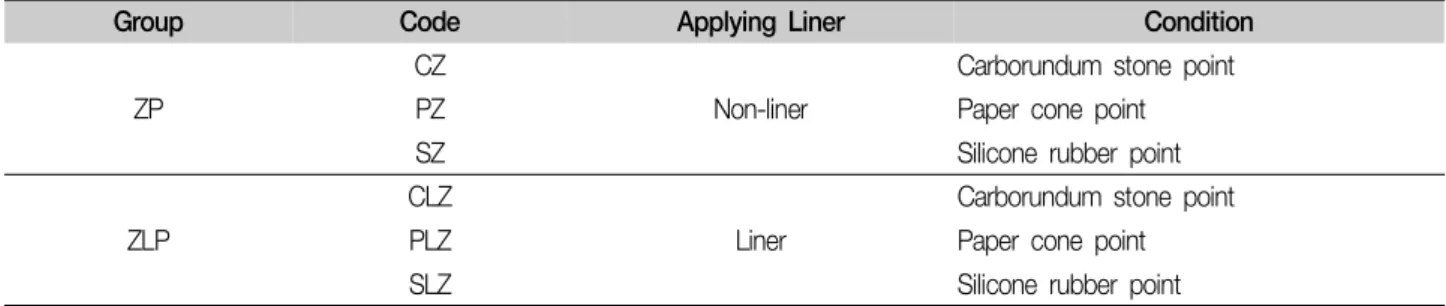
Table 2 displays the codes of the specimens and their surface pre-treatment conditions. The specimens were divided into two groups, the liner- and non-liner treated groups (ZP and ZLP groups, with 30 specimens each). These two groups were again subdivided into three groups for the experiments on different levels of surface roughness. Grinding on YTZ core prior to the sintering of the plate-type specimens was conducted with a carborundum stone point (GC#44, Sunil, Korea), a paper cone point (Monose Mfg., Japan), and a silicone rubber point (Eve Ecoceram NK, EVE Ernst Vetter GmbH, Germany). Grinding from the right side to the left side of the specimens was conducted 10 times, after which the specimens were placed in a calcination furnace (Zirkonofen 600, Zirkonzahn GmbH, Italy). The furnace temperature was increased from 650 to 1,500 °C at a heating rate of 8 °C/min. The specimens were sintered for 2 hours (Table 3). The final specimen specifications after sintering were 6 mm
×6 mm × 3 mm.
Table 1. Materials used in this study
Materials Brand name Manufacturer Code
Yttria-stabilized tetragonal zirconia Fine Base K&F, Korea YTZ
Liner Zirliner Ivoclar Vivadent, Liechtenstein ZLP
Veneering ceramics Zirmax Alphadent, Korea ZP
Table 2. Treatment condition and code
Group Code Applying Liner Condition
ZP
CZ
Non-liner
Carborundum stone point
PZ Paper cone point
SZ Silicone rubber point
ZLP
CLZ
Liner
Carborundum stone point
PLZ Paper cone point
SLZ Silicone rubber point
Table 3. Surface pre-treatments and sintering
Tool Method
Carborundum stone point
grinding process was conducted 10 times from right to left.
Paper cone point Silicone rubber point
Sintering 650℃ → 1500℃(8℃/min)in air (2 hour duration)
Table 4. Firing schedule
Pre-drying Heating rate
(℃/min)
Firing temperature (℃)
Holding time (min) Temperature(℃) Time(min)
Liner 403 4 40 960 1
Ceramic 403 4 40 800 1
2. Liner application, Ceramic veneering, and firing.
Table 4 illustrates the sintering schedule for ceramic veneer and liner application. Each specimen was ultra- sonically cleaned for 10 min after surface pre-treatment.
The liner (Zirliner, Ivoclar Vivadent, Liechtenstein) was not sprayed onto the ZP group, but 1.0 to 0.2 mm of liner was sprayed onto the ZLP group after cleaning.
Liner thickness was measured using a micrometer (MDC-SB, Mitsutoyo, Tokyo, Japan).
Cylindrical silicon mode was used to strengthen the liner and veneer ceramic, with each specimen having the same contact area and size. Veneer ceramic (Zirmax, Alphadent, Korea) of uniform moisture was mixed on a wetting palette in a mold with an internal diameter of 4 mm and a height of 3 mm. The plasticity of the liner and veneer ceramic was induced in the same
calcination furnace (Dagussa Dental Co., Germany) acco- rding to the plasticity temperature specified by the manufacturer.
3. Evaluation of surface morphology and surface roughness
In order to comparatively observe surface roughness
created by grinding prior to sintering, a surface mea-
surement system (SJ-400, Mitutoyo Co., Kanagawa, Japan)
was used to measurea 4.0-mm distance from the central
area adjusted by 0.5-mm/s movement in each specimen
five times. The average roughness (Ra) of each specimen
was recorded. Surface shape was observed using a
3-dimensional digital microscope (VHX-600, Keyence Co.,
Japan).
4. Shear bond test and failure mode analysis
After veneer ceramic sintering, the 60 specimens were embedded with acrylic resin to create cylindrical speci- mens with a diameter of 30 mm and a height of 20 mm. This process enabled the fixing of the specimens onto a jig for the measurement of shear bond strength.
Fixing was performed so that load was delivered in parallel with the bonded surface between YTZ core and veneer ceramic. The maximal load was subsequently measured using a universal testing machine (Model 8871, Instron, USA) with cross head speed at 0.5 mm/min (Figure 1).
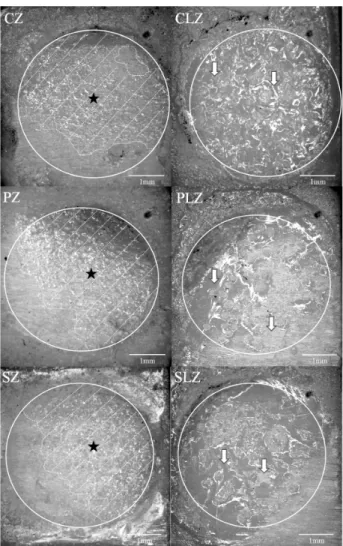
For the analysis of fracture surfaces, fracture patterns in the bonded interfaces were observed using an optical microscope (SZX7, Olympus, Japan).
Fig. 1. Schematic diagram of the shear bond strength test sep-up on
5. Statistical analysis
To determine significance, one-way ANOVA was conducted with SPSS 20.0 for Windows (SPSS Inc., Illinois, USA), after which Tukey’s multiple comparison test was performed
RESULTS
1. Observations of surface roughness prior to sintering
An experiment for observing the physical surface roughness characteristics of YTZ core prior to sintering was conducted using a surface measurement system (SJ-400,
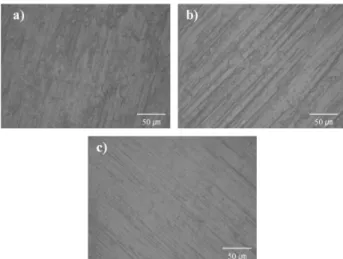
Mitutoyo Co., Kanagawa, Japan) and a 3-dimensional digital microscope. On the surfaces of CZ specimens polished with the carborundum stone point, small particles together with trace lines were observed. PZ specimens polished with the paper cone point exhi- bited very rough trace lines and small particles, but the CZ specimens did not present rough trace lines.
Only fine trace lines were observed in the SZ group polished with the silicon rubber point (Figure. 2).
The average surface roughness values of the PZ, CZ, and SZ specimens were 3.08 ± 0.58, 1.92 ± 0.41, and 1.10 ± 0.76 µm, respectively (Table 5). in the same column are significantly different (p<0.05, Tukey’s method).
Fig. 2. Image of YTZ after each surface grinding. a)CZ, b) PZ, and c) SZ
Table 5. Surface roughness analysis of specimens(µm)
After grinding Mean±SD
CZ PZ SZ
1.92±0.41†
3.08±0.58‡
1.10±0.76†
Each value represents the mean±SD. The values with different superscripts (†, ‡)
2. Shear bond strength and fracture pattern
Table 6 show the analysis results for the shear bond
strengths and fracture patterns of YTZ core and veneer
ceramic. The CZ group polished only with the car-
borundum stone point had the highest shear bond
strength at 38.56±2.09 MPa. The shear bond strengths
of the PZ group polished with the paper cone point
and the SZ group polished with the silicon rubber
Table 6. Shear bonding strength of specimens
Code Mean (SD) [MPa] Failure mode
CZ 38.56±2.09
†(C)100%mixed failure
PZ 30.94±3.84
‡(C)100%mixed failure
SZ 27.82±1.97
‡(C)100%mixed failure
CLZ 22.73±2.92
†‡(B)100%cohesive failure
PLZ 21.90±2.40
†‡(B)100%cohesive failure
SLZ 22.10±1.69
†‡(B)100%cohesive failure
Each value represents the mean±SD. The values with different superscripts (†,‡,†‡) in the same column are significantly different (p<0.05, Tukey’s method).
shear bonding strength(Mpa) = F(load)/A(area)