• 검색 결과가 없습니다.

Optimal Design of Compact Heat Exchanger (Louver Fin-tube Heat Exchanger for High Heat Transfer and Low Pressure Drop)

N/A
N/A
Protected

Academic year: 2021

Share "Optimal Design of Compact Heat Exchanger (Louver Fin-tube Heat Exchanger for High Heat Transfer and Low Pressure Drop)"

Copied!
8
0
0

로드 중.... (전체 텍스트 보기)

전체 글

(1)

Optimal Design of Compact Heat Exchanger

(Louver Fin-tube Heat Exchanger for High Heat Transfer and Low Pressure Drop)

Hie-Chan Kang†

(Received November 16, 2011; Revised November 22, 2011; Accepted November 22, 2011)

Abstract: The present work was conducted to get the best geometric information for the optimum design of the complex heat exchanger. The objective function for optimal design was expressed as a combination of pressure drop and heat transfer rate. The geometric parameters for the variables of louver pitch and height, tube width, etc., were limited to ranges set by manufacturing conditions. The optimum geometric parameters were calculated by using empirical correlations and theory. The sensitivity of the parameters and optimum values are shown and discussed. The weighting factor in the objective function is important in the selection of the louver fin-tube heat exchanger.

Key words :Heat Exchanger, Louver Fin, Pressure Drop, Heat Transfer, Optimal Design

† Corresponding Author(School of Mechanical and Automotive Engineering, Kunsan National University, E-mail:

[email protected], Tel:063-469-4722)

This paper is extended and updated from the short version that apeared in the Proceedings of the International symposium on Marine Engineering and Technology (ISMT 2011), held at BEXCO, Busan, Korea on October 25-28, 2011.

Nomenclature

a exponent for heat transfer rate

A surface area of heat exchanger, A f + A t , m 2 A c minimum flow area of heat exchanger, m 2 A f fin surface area of heat exchanger, m 2 A t tube surface area of heat exchanger, m 2 b exponent for pressure drop

f pressure drop coefficient F d depth of flow-direction fin, m F p fin pitch, m

F th fin thickness, m H fin height, m

h heat transfer coefficient, W/m 2 K j Colburn j factor

k f thermal conductivity of fin, W/m K L l louver length, m

L p louver pitch, m L pa average louver pitch, m

Pr Prandtl number

Re Lpa Reynolds number based on average louver pitch

u c frontal velocity on minimum section, m/s w Q weighting factor for heat transfer rate w  weighting factor for air-side pressure drop

Greek Symbols

P air-side pressure drop

 objective function

 surface efficiency

fin efficiency μ viscosity of air, Pa.s

 louver angle, rad ρ density of air, kg/m 3

1. Introduction

The louver fin-tube heat exchanger, commonly

(2)

called the brazed aluminum heat exchanger, is widely used in engineering applications for air-conditioners, processing equipment, ship and automobile components, etc. It is very compact, usually more than 700 m 2 /m 3 , yet lightweight, allows little pressure loss, is fairly recyclable and performs well. Therefore, the heat exchanger has many merits. However, its geometry is complex, and the geometric parameters should be carefully determined.

For example, in the heat exchanger of an automobile, the air-side thermal resistance comprises more than 70% of the entire thermal resistance, and fins are an essential element used to reduce it. The heat exchanger is becoming more compact, and its surface area per unit volume is of critical importance.

Many studies have been conducted on the reduction of pressure drop and enhancement of heat transfer performance through the use of louver fins in brazed heat exchangers. Kays and London [1]

presented experimental data on heat transfer and pressure drop for seven types of louver fins. Many researchers, such as Davenport [2], Achaichia and Cowell [3], Sunden and Svantesson [4], Sahnoun and Webb [5], Webb [6] and Kang and Kim [7]

and Kang and Jun [8], conducted experiments on louver fins and suggested experimental correlations.

In the present work, the effects of geometric parameters of the louver fin heat exchanger are studied. The object function and its weighting factors are tested and discussed to get optimal thermal hydraulic performance.

2. Louver Fin Heat Exchanger Geometry

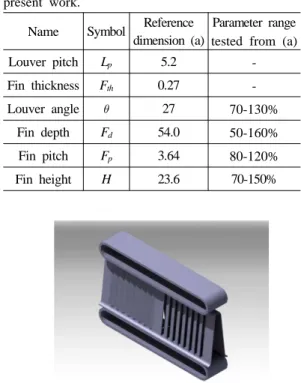
The louver fin-tube heat exchanger consists of flat tubes and louver fins. Figure 1 shows the geometry of the louver fin-tube heat exchanger commonly used in transportation applications. The

Table 1: Dimensions of louver fin-tube heat exchanger and range of parameters used in the present work.

Name Symbol Reference dimension (a)

Parameter range tested from (a)

Louver pitch L p 5.2 -

Fin thickness F th 0.27 -

Louver angle  27 70-130%

Fin depth F d 54.0 50-160%

Fin pitch F p 3.64 80-120%

Fin height H 23.6 70-150%

Figure 1: Brazed louver fin-tube heat exchanger used in transportation applications.

Figure 2: Schematic diagram of the louver fin-tube heat exchanger.

flat tube reduces the air-side flow resistance, and

provides a bigger area for heat transfer. The louver

fins also enhance the heat transfer by creating a

surface with many interruptions and accelerating the

air velocity. Figure 2 and the Table 1 show the

dimensions and range of parameters used in the

present work.

(3)

0.4 0.8 1.2 1.6 2.0

Ob je c tive fu nct ion , φ

0.4 0.6 0.8 1.0 1.2 1.4 1.6

Design parameter

w

Q

=1.0, w

ΔP,air

=0.0 Tube depth, Td Fin pitch, Fp Louver angle, θ Fin height, H

0.8 1.0 1.2 1.4 1.6

Obj e c ti v e fun c tio n , φ

0.4 0.6 0.8 1.0 1.2 1.4 1.6

Design parameter

w

Q

=0.8, w

ΔP,air

=0.2 Tube depth, Td Fin pitch, Fp Louver angle, θ Fin height, H

(a) w Q =1.0, w Δ P,air =0.0 (b) w Q =0.8, w Δ P,air =0.2

0.8 1.2 1.6 2.0 2.4

O bjec ti ve f unc tio n , φ

0.4 0.6 0.8 1.0 1.2 1.4 1.6

Design parameter

w

Q

=0.5, w

ΔP,air

=0.5 Tube depth, Td Fin pitch, Fp Louver angle, θ Fin height, H

0.0 1.0 2.0 3.0 4.0 5.0

Obje c ti v e fu ncti on, φ

0.4 0.6 0.8 1.0 1.2 1.4 1.6

Design parameter

w

Q

=0.0, w

ΔP,air

=1.0 Tube depth, Td Fin pitch, Fp Louver angle, θ Fin height, H

(c) w Q =0.5, w Δ P,air =0.5 (d) w Q =0.0, w Δ P,air =1.0 Figure 3: Sensitivity of the design parameters in the present work.

3. Optimization Method

3.1 Objective Function and Design Parameters

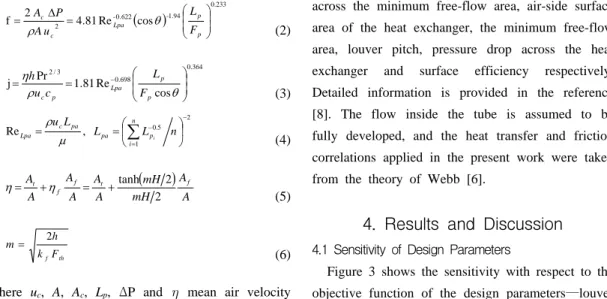
The objective function  in the present work is a combination of pressure drop and heat transfer rate as expressed below: [9]

  

  

 

(1)

where w Q , w △P,air , a and b are the weighting factors and exponents to normalize the heat transfer rate and pressure drop by their reference values respectively. The reference heat transfer rate and pressure drop are for the reference heat

exchanger, and their geometric data are listed in Table 1. High heat transfer and low pressure drop are favorable, so exponents a and b have different signs. The heat transfer rate is less sensitive than the pressure drop, so the absolute value of a is greater than that of b. The exponents a and b were set as 0.5 and -2, respectively in the present work.

3.2 Heat Exchanger Performance

The performance of the louver fin-tube heat

exchanger can be calculated by the following

procedure. The pressure drop and heat transfer rate

are for the air side:

(4)

(a) w Q =1.0, w Δ P,air =0.0 (b) w Q =0.8, w Δ P,air =0.2

(c) w Q =0.5, w Δ P,air =0.5 (d) w Q =0.0, w Δ P,air =1.0

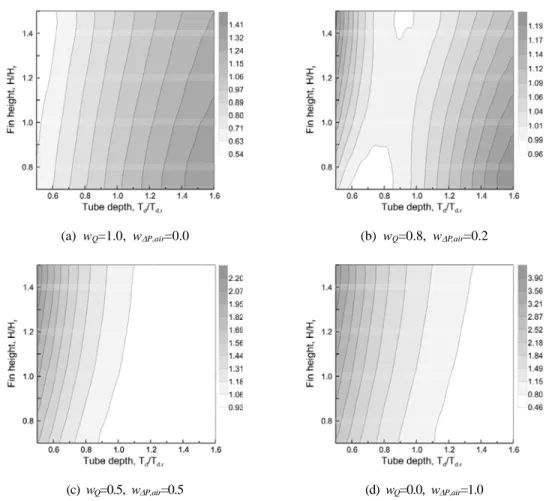
Figure 4: Contour maps of the objective function for tube depth and fin pitch when the louver angle and fin height are reference values in Table 1.

( )

0.233 1.94 622 - 0

2

4 . 81 Re cos

f 2 ⎟ ⎟

⎜ ⎜

= ⎛

= Δ

p . p

- Lpa c

c

F L u

A P

A θ

ρ (2)

0.364 698

. 0 3

/ 2

Re cos 81 . Pr 1

j ⎟ ⎟

⎜ ⎜

= ⎛

=

θ ρ

η

p p Lpa p

c

F

L c

u h

(3)

2

1 5 .

0

, Re

=

⎜ ⎞

= ⎛

= u L L

n

L n

i p pa pa c

Lpa

μ

i

ρ

(4)

( )

A A mH

mH A

A A A A

A f t f

f t

2 2 + tanh

= +

= η

η (5)

th f
F k m 2 h

= (6)

where u c , A, A c , L p , ΔP and  mean air velocity

across the minimum free-flow area, air-side surface area of the heat exchanger, the minimum free-flow area, louver pitch, pressure drop across the heat exchanger and surface efficiency respectively.

Detailed information is provided in the reference [8]. The flow inside the tube is assumed to be fully developed, and the heat transfer and friction correlations applied in the present work were taken from the theory of Webb [6].

4. Results and Discussion

4.1 Sensitivity of Design Parameters

Figure 3 shows the sensitivity with respect to the

objective function of the design parameters―louver

(5)

(a) w Q =1.0, w Δ P,air =0.0 (b) w Q =0.8, w Δ P,air =0.2

(c) w Q =0.5, w Δ P,air =0.5 (d) w Q =0.0, w Δ P,air =1.0

Figure 5: Contour maps of the objective function for tube depth and fin height when the louver angle and fin pitch are reference values in Table 1.

angle, fin height, depth, and pitch (see Table 1)―

within their considered ranges. The tube depth is the most sensitive, and the other parameters in decreasing rank order are fin pitch, louver angle and fin height. The tube depth showed most sensitive to the air-side performance in the test range and the performance is increased as the tube depth is increased if the heat transfer rate is dominant (w Q →1.0) as shown in Figure 3 (a). The tube depth minimum was near 80% of the reference tube depth: its trend was the exception among the parameters as shown in Figure 3 (b). If the pressure drop becomes important (w △P,air →1.0), the large tube depth is not a favorable parameter for

enhancing the overall performance. The performance is drastically decreased with a small tube depth.

The effect of the louver angle is very small if the heat transfer rate is dominant (w Q →1.0) as shown in Figure 3 (a). However, a large louver angle is unfavorable only if the portion of pressure drop is more than 20% as shown in Figure 3 (b)-(d). The effect of the louver angle and the performance were almost linear.

The fin pitch is a carefully considered parameter in the design of the louver fin heat exchanger.

When the heat transfer is dominant (w Q <0.5), the performance decreases as the fin pitch increases.

However, the trend reverses when the pressure drop

(6)

is important. The fin pitch is the major parameter on the hydraulic diameter of the air-side.

4.2 Optimum Values

Figure 4 shows contour maps of the objective function in the tube depth and fin pitch domains for the different weight factors of heat transfer and pressure drop, w Q , w △P,air . As an example, w Q =0.8,

w △P,air =0.2 of Figure 4(b) means that 80%

weighting of the heat transfer value and 20%

weighting of the pressure drop value are considered in the object function and used to select the heat exchanger. The tube pitch is the dominant design parameter when heat transfer is the only important factor, as shown in Figure 4(a). If we desire 20%

weighting of air-side pressure drop, the recommendation is for high tube depth and low fin pitch or low tube depth and high fin pitch―certainly not for geometry in the medium range―as shown Figure 4(b). When the air-side pressure drop is important, as in 4(d), low tube depth and high fin pitch are preferred. Therefore the weighting factor in the objective function is very important for deciding the geometry of the louver fin-tube heat exchanger.

Figure 5 shows contour maps of the objective function in the tube depth and fin height domains for the different weight factors of heat transfer and pressure drop. The general trends are similar to the tube depth and fin pitch cases of Figure 4. When the heat transfer is important, a large tube depth and small fin height are recommended. However, when the pressure drop is important, a small tube depth gives a better performance. The fin height is a minor parameter compared to the tube depth. For the case of Figure 5 (b), mixed weighting conditions of heat transfer and pressure drop: there exists an undesirable range of tube depth and fin height. Therefore, the degrees of importance of the heat transfer and pressure drop should be decided to design the optimal heat exchanger for a practical

application.

Figure 6 shows the contour plot of objective function of weighting factor of heat transfer and louver angle. The figure shows that the selection of louver angle is not important in which system the heat transfer is very valuable. In the case that pressure drop is important, the lowest louver angle gives benefit, and the benefits are accentuated for the low weighting factor of heat transfer.

Figure 6: Contour plot of objective function for the weighting factor of heat transfer and louver angle when the fin depth, pitch and height are reference values in Table 1.

Figure 7: Contour plot of objective function for the

weighting factor of heat transfer and fin pitch when

the louver angle, fin depth and height are reference

values in Table 1.

(7)

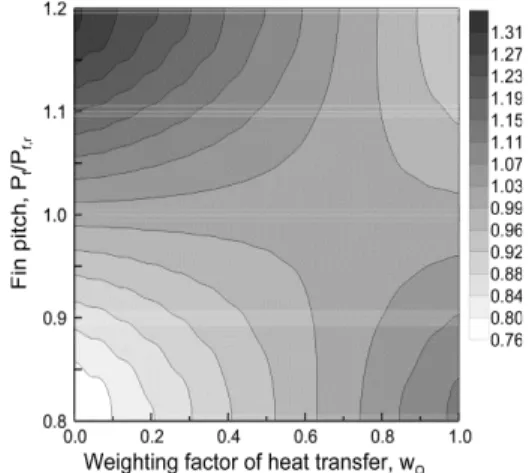
Figure 7 shows the contour plot of the objective function of the weighting factors of heat transfer and fin pitch. The figure shows that the selection of fin pitch is less important systems in which the heat transfer is very valuable. In such systems, low fin pitch, or high fin density and low hydraulic diameter are recommended. If pressure drop is important, the largest fin pitch is beneficial, and the benefits are accentuated for high weighting factors of pressure drop. It is very interesting that there exists a neutral region near w Q = 0.7.

5. Concluding Remarks

The present work was conducted to get useful information for the optimal design of the complex heat exchanger. The geometric parameters such as louver pitch and height, and tube width were limited by the manufacturing conditions, and the design variables that were chosen were louver angle and fin height, depth, and pitch. The results were compared and discussed, drawing the following conclusions:

1. Tube depth is the most sensitive factor, and the ranking of sensitivity related to the objective function is fin pitch, louver angle and fin height.

2. Large tube depth gives better performance when heat transfer is the only goal. When the pressure drop is important, low tube depth and high fin pitch are preferable. The weighting factor in the objective function is important in the selection and design of the louver fin-tube heat exchanger.

3. The louver angle is not important systems in which the heat transfer is very valuable, and the lowest louver angle is preferable in pressure drop-dominant systems.

Acknowledgments

This work is financially supported by the Kunsan National University’s long-term overseas research

program for faculty member in the year 2009, and author thanks to Prof. Gang Won Jang (Sejong University) for his recommendation.

References

[1] Kays, W. M., and London, A. L., “Compact Heat Exchangers”, 3rd ed., McGraw-Hill, New York, 1984.

[2] Davenport, C. J., “Correlation for heat transfer and flow friction characteristics of louvered fin”, AIChE Symp. Ser. 79, pp. 19-27, 1983.

[3] Achaichia, A. and Cowell, T. A., “Heat transfer and pressure drop characteristics of flat tube and louvered plate fin surfaces”, Experimental Thermal and Fluid Science, vol. 1, pp. 147-157, 1988.

[4] Sunden, B. and Svantesson, J., “Correlation of j and f factors for multi-louvered heat exchanger surfaces”, in Proceedings of the 3rd UK National Heat Transfer Conf., pp. 805-811, 1992.

[5] Sahnoun, A. and Webb, R. L., “Prediction of heat transfer and friction for louver fin geometry”, J. of Heat Transfer, vol. 114, pp.

893-899, 1992.

[6] Webb, R. L., “Principles of Enhanced Heat Transfer”, John Wiley & Sons, New York, U.S.A., 1994.

[7] Kang, H. C. and Kim, M. H., “Effect of Strip Location on the Air-Side Pressure Drop and Heat Transfer in Strip Fin-and-Tube Heat Exchanger”, Int. J. Refrig., vol. 22, pp. 302- 312, 1999.

[8] Kang, H. C. and Jun, G. W, “Heat Transfer and Flow Resistance Characteristics of Louver Fin Geometry for Automobile Applications”, J.

Heat Transfer, vol. 133, pp. 101802, 2011.

[9] Park, G. J., “Analytic methods for design

practice”, Springer-Verlag Ltd., London, 2007.

(8)

Author Profile

Hie-Chan Kang

He received his Ph.D in mechanical

engineering from Pohang University of

Science and Technology in 1992. Since

1992, he has been a professor of School

of Mechanical and Automotive Engineering

at Kunsan National University. From 2010

to 2011, he was a visiting scholar in the

University of Illinois at Urbana-Champaign. His research

interests are in heat exchanger design and wettability control.

수치

Table 1: Dimensions of louver fin-tube heat  exchanger and range of parameters used in the  present work.
Figure 3 shows the sensitivity with respect to the  objective function of the design parameters―louver
Figure 5: Contour maps of the objective function for tube depth and fin height when the louver angle and fin pitch  are reference values in Table 1.
Figure 5 shows contour maps of the objective  function in the tube depth and fin height domains  for the different weight factors of heat transfer and  pressure drop

참조

관련 문서

Key words: Flat-plate solar collector, Heat transfer enhancement device, Heat transfer characteristics, Pressure drop,

Since the presence of lubrication oil can change the characteristics properties of refrigerant, the oil affects the heat transfer performance of heat exchanger

B., 1998, Pool boiling heat transfer co- efficients of alternative refrigerants on low fin tube, Korea Journal of Air-Conditioning and Refrigeration

The experimental results were compared with the calculated values by correlations based on gasketed plate heat exchangers, and showed that the heat transfer performance

The test results showed that the heat transfer characteristics were similar to those of the tube in case of a normal heat transfer mode and degree of

Key Words: Heat Exchanger( 열교환기 ), Plate Fin( 플레이트 핀 ), Heat Transfer( 열전달 ), Pressure Drop(

A comparison of the flattened tube data with existing correlations revealed that the heat transfer coefficients were reasonably predicted by the Shah

Abstract: The objective of this study is to investigate the air-side heat transfer characteristics of a spirally-coiled circular fin- tube heat exchanger for