대한침구의학회지 제31권 제4호 (2014년 12월) : 81-97 The Acupuncture Vol. 31 No. 4 December 2014 : 81-97 pISSN 1229-1137 eISSN 2287-7797 http://dx.doi.org/10.13045/acupunct.2014056
http://dx.doi.org/10.13045/acupunct.2014056 81
암에 대한 약침치료의 국내 동물모델 연구 현황※
유희경, 구본혁, 석경환, 이주현, 류수형, 이수연, 김민정, 박연철, 백용현, 박동석, 서병관*
경희대학교 한의과대학 침구의학교실
[Abstract]
The Current Research Methodology of Pharmacopucture for the Treatment of Animal Cancer Models in Korea
※Hee Kyoung Ryu, Bon Hyuk Goo, Kyung Hwan Suk, Ju Hyeon Lee, Soo Hyeong Ryu, Su Yeon Lee, Min Jeong Kim, Yeon Cheol Park, Yong Hyeon Baek, Dong Suk Park and Byung Kwan Seo*
Department of Acupuncture & Moxibustion Medicine, College of Korean Medicine, Kyung Hee University
Objectives : The purpose of this study is analyzing the current research methodology of pharmacopucture for the treatment of animal cancer models.
Methods : Four electronic databases were searched for animal studies published from January 2000 to September 2014 onward using these search terms “cancer, anticancer, pharmaco- puncture, beevenom”. Selected articles were described about animal cancer models. The methods used to induce cancer and the outcome measures used to assess the effects of pharmacopuncture on animal cancer models were analyzed.
Results : 37 articles were included. For producing animal cancer models BALB/C mice(n=22) and C57BL/6 mice(n=17) were selected. And intravenous injection of B16-F10 melanoma cells into tail vein(n=14) or intraperitoneal injection of sarcoma-180 cells(n=14) were frequently used to induce cancer. Various pharmacopunctures were injected into acupoints CV12(n=19), ST36
(n=8), BL18(n=8) or peritoneal cavity(n=6), tumor site(n=2), tail vein(n=2). Outcome measures were categorized into anti-cancer, anti-metastasis, general condition, cytotoxicity, immune response, toxicity. Median Survival Time(MST) and increase of life span(ILS)(n=26) was frequently used for evaluating anti-cancer effects. And pulmonary colonization assay(n=13) was frequently used for evaluating anti-metastasis effects
Conclusions : Based on these data, further research would be needed to ascertain the effectiveness of pharmacopuncture for treating cancer and broaden the range of clinical applications.
Key words : Cancer;
Pharmacopuncture;
Bee venom;
Animal model
Received : 2014. 10. 31.
Revised : 2014. 11. 24.
Accepted : 2014. 11. 27.
On-line :2014. 12. 20.
※ This study was supported by a grant from the Traditional Korean Medicine R&D Project, Ministry of Health & Welfare, Republic of Korea(HI13C0379)
✱ Corresponding author : Department of Acupuncture & Moxibustion Medicine, Kyung Hee University Hospital at Gangdong, 892, Dongnam-ro, Gangdong-gu, Seoul, 134-727, Republic of Korea Tel : +82-2-440-6292 E-mail : [email protected]
This is an Open-Access article distributed under the terms of the Creative Commons Attribution Non-Commercial License (http://creativecommons.org/licenses/by-nc/3.0) which permits unrestricted non-commercial use, distribution, and reproduction in any medium, provided the original work is properly cited.
The Acupuncture is the Journal of Korean Acupuncture & Moxibustion Medicine Society. (http://www.TheAcupuncture.org) Copyright © 2014 KAMMS. Korean Acupuncture & Moxibustion Medicine Society. All rights reserved.
Review Article
The Acupuncture Vol. 31 No. 4 December 2014
82 http://dx.doi.org/10.13045/acupunct.2014056
Records identified through database searching 2000. 1. 1-
(n=291)
Records after duplicates removed (n=128)
Records screened (n=163)
Excluded invitro experimental studies
(n=58) Excluded case reports
(n=10)
Excluded literature review (n=2)
Excluded irrelevant articles (n=49)
Excluded invivo studies with oral administration
(n=7) Articles included in analysis
(n=37)
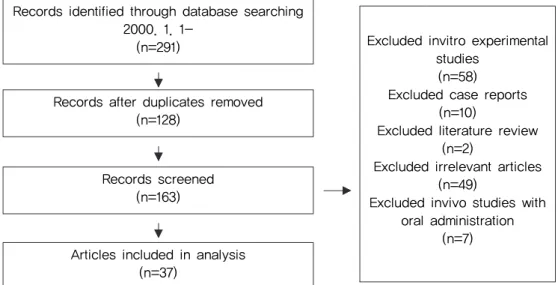
Fig. 1. Flow diagram of the study selection process
Ⅰ. 서 론
암은 국내 사망원인 1위 질환으로, 국내전체 암 발생자 수는 2011년 통계에서 약 22만 명으로 추산되며, 암으로 인한 사망은 점점 증가하고 있는 추세이다1). 2014년 WHO 는 전 세계적으로 암환자 수가 2008년 1,270만 명에서 2012년 1,410만 명으로 증가하였고, 이러한 추세가 지속된 다면 향후 20년 후 암환자의 수는 대략 2,500만 명에 육박 할 것으로 예상된다고 발표하였다2).
암의 진단법 및 치료법 발전으로 암 환자의 생존율은 증 가하였으나, 화학치료 또는 방사선치료는 피로, 수면장애, 불안증, 우울증, 오심, 구토 등 상당한 부작용을 생길 수 있다.
이와 같은 항암치료 부작용은 개선 또는 관리하기가 쉽 지 않으며, 환자의 삶의 질 저하를 유발할 수 있고, 이러한 한계를 극복하기 위하여 세계 각국에서 대체의학을 찾는 사람이 증가하고 있다는 보고가 있다3,4).
약침요법은 본초학적으로 유효한 약물을 증류 또는 알 코올 추출 등의 방법을 사용하여 주사액으로 만들어 경락 학적으로 유효한 경혈이나 아시혈 또는 피부 양성 반응점 에 주입함으로써 침 자극 효과와 약물의 상승효과를 나타 내어 생리기능을 강화시키고 병리적인 상태를 개선하는 방법이다5).
약침은 추간판탈출증6,7), 골관절염8), 안면마비에 동반된 이후통9) 등 다양한 질환의 치료에 쓰이고 있으며, 또한 한 국과 중국에서는 암과 관련된 증상을 완화시키기 위하여
널리 쓰이고 있다10). Cheon et al11)은 근거 수준이 강력하 지는 않지만 약침은 암과 관련된 통증, 항암 화학요법에 의 한 구역과 구토, 장폐색, 딸꾹질, 소화기 질환 등에 증상의 완화와 삶의 질(quality of life, QoL)의 증가에 도움이 될 수 있다 하였다.
암치료에서 약침의 효과 및 그 기전을 확인 할 수 있는 동물실험은 비교적 활발히 진행되고 있으나12), 그에 관한 정리 및 분석 과정은 없었다.
이에 저자는 2000년부터 2014년 9월까지 국내의 암 동 물모델에서 약침의 효능 및 그 기전을 연구한 논문을 선별 하여 암동물의 제작방식, 치료방법, 평가방법을 분석하여 고찰해보고자 하였다.
II. 대상 및 방법
1. 연구대상
본 연구는
≪
대한침구의학회지≫
,≪
대한한의학회지≫
, 한국학술정보, 한국전통지식포탈을 통해 2000년 1월부터 2014년 9월까지 국내의 암치료에서 약침의 효과를 확인하 기 위한 동물모델을 대상으로 한 in vivo 실험논문을 검색 하였다. 검색어로는 “암(cancer), 항암(anticancer), 약침 (pharmacopuncture), 봉독(bee venom)”을 배합하여 사 용하였다.동물모델 연구현황을 파악함에, 인간 대상의 케이스 임
암에 대한 약침치료의 국내 동물모델 연구 현황
http://dx.doi.org/10.13045/acupunct.2014056 83
상연구와 in vitro 세포 수준의 실험연구 및 문헌조사 연구 는 제외하였다. In vivo 실험연구 중 약물의 경구투여는 제외하였고, 경혈이 아니더라도 복강 내 약침 혹은 약물 주 입은 약침의 범주에 포함하였다.
2. 연구방법
검색된 논문은 제목과 초록을 확인하였고, 미리 정한 기 준에 따라 논문을 분석하였다. 논문 선정의 기준과 과정은 Fig. 1에 요약하였다.
Data extraction form은 암 동물모델 제작을 위하여 사 용된 동물(species, strain, sex), 암 모델 제작(tumor cell line, site of tumor injection), 사용된 약침의 종류와 시 술부위, 약침처치 후 평가방법(anti-cancer, anti-me- tastasis, general condition, cytotoxicity, cechanism, immune response, tocixity)으로 구성되었다.
III. 결 과
총 37편의 논문을 최종 선정하였고, 세부 연구로 총 44 건의 암 동물모델연구가 있었다.
1. 암 모델 제작
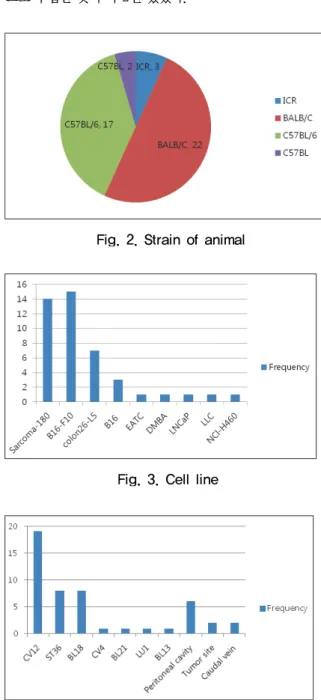
44건 모두 생쥐(mouse)를 사용하였으며, 사용된 종은 BALB/C가 22건, C57BL계가 19건 중 C57BL/6가 17건, ICR이 3건이었다(Fig. 2).
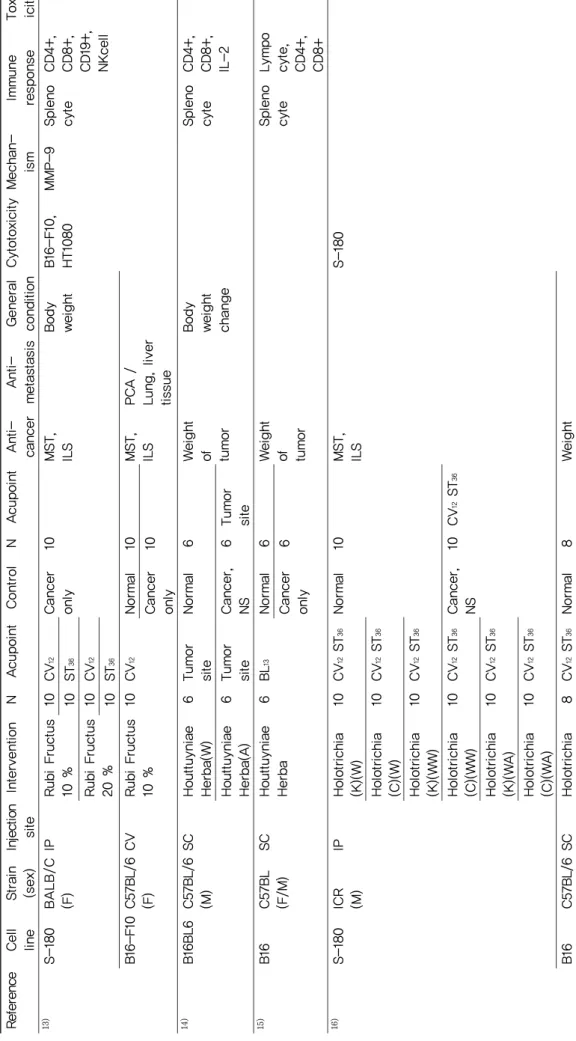
사용된 암종은 B16-F10 melanoma cell이 15건으로 가 장 많이 사용되었고, 그 중 14건이 꼬리정맥으로 암세포를 주입하였고, 그 외 1건은 암종을 피하로 주사하여 암을 유 발하였다.
다음으로 sarcoma-180 cell을 복강에 주입하여 sar- coma를 유발한 것이 14건으로 많았다. 이 외에도 colon 26-L5 carcinoma cell이 7건, B16 melanoma cell 3건 있 었고, LLC lung cancer cell, NCI-H460 human lung cancer cell, LNCaP human prostate cancer cell, Ehrlich ascites tumor cell(EATC) 및 7,12-dimethyl- benzanthracene(DMBA) 약품으로 암을 유발한 연구가 각 1건씩 있었다(Fig. 3).
2. 약침의 종류 및 처치
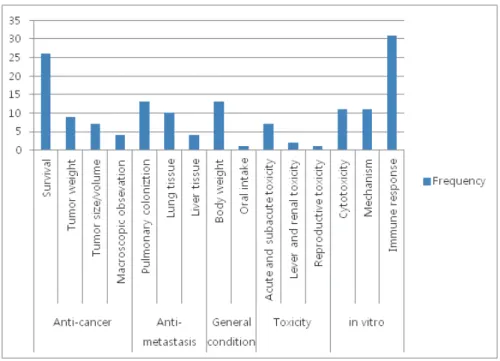
사용된 약침의 종류 및 시술 부위를 Table 1에 정리하였 다. 사용된 경혈의 빈도는 중완(CV12)이 19건, 족삼리 (ST36) 및 간수(BL18)가 각 8건으로 많이 사용되었다. 그 외 관원(CV4)
ㆍ
폐수(BL13)ㆍ
위수(BL21)ㆍ
중부(LU1)가 각 1회 씩 사용되었다(Fig. 4). 그 외 복강으로 주사한 것이 6건 있었고, 암 발생부위에 직접적으로 주입하거나, 꼬리정맥 으로 주입한 것이 각 2건 있었다.Fig. 2. Strain of animal
Fig. 3. Cell line
Fig. 4. Injection site
ReferenceCell lineStrain (sex)Injection siteInterventionNAcupointControlNAcupointAnti- cancerAnti- metastasisGeneral conditionCytotoxicityMechan- ismImmune responseTox- icity 13) S-180BALB/C (F)IPRubi Fructus 10 %10CV12Cancer only10MST, ILSBody weightB16-F10, HT1080MMP-9Spleno cyteCD4+, CD8+, CD19+, NKcell
10ST36 Rubi Fructus 20 %10CV12 10ST36 B16-F10C57BL/6 (F)CVRubi Fructus 10 %10CV12Normal10MST, ILSPCA / Lung, liver tissueCancer only10 14) B16BL6C57BL/6 (M)SCHouttuyniae Herba(W)6Tumor siteNormal6Weight of tumor
Body weight change
Spleno cyteCD4+, CD8+, IL-2Houttuyniae Herba(A) 6Tumor siteCancer, NS6Tumor site 15)B16C57BL (F/M)SCHouttuyniae Herba6BL13Normal6Weight of tumor
Spleno cyteLympo cyte, CD4+, CD8+
Cancer only6 16)S-180ICR (M)IPHolotrichia (K)(W)10CV12ST36Normal10MST, ILSS-180 Holotrichia (C)(W)10CV12ST36 Holotrichia (K)(WW)10CV12ST36 Holotrichia (C)(WW)10CV12ST36Cancer, NS10CV12 ST36 Holotrichia (K)(WA)10CV12ST36 Holotrichia (C)(WA)10CV12ST36 B16C57BL/6SCHolotrichia8CV12ST36Normal8Weight
Table 1. Summary of the studies
(M)(K)(W)of tumorHolotrichia (C)(W)8CV12ST36 Holotrichia (K)(WW)8CV12ST36 Holotrichia (C)(WW)8CV12ST36Cancer, NS8CV12ST36 Holotrichia (K)(WA)8CV12ST36 Holotrichia (C)(WA)8CV12ST36 5)EATCICR (M)IPGlycyrrhizae Radix 0.3 g/ml 6CV12Cancer only6Survival rateEATC, Hepalelc7, HeLa, A549
Spleno cyteT cell, B cell6BL18 Glycyrrhizae Radix 1.5 g/ml
6CV12Normal6 6BL18 17)S-180BALB/C (F)IPCistanches Herba 10 %10CV12Cancer only10MST, ILSBody weightB16-F10, HT1080MMP-9Spleno cyteCD4+, CD8+, CD19+, NK cell
10ST36 Cistanches Herba 20 %10CV12 10ST36 B16-F10C57BL/6 (F)CVCistanches Herba 10 %10CV12Normal10MST, ILSPCA / Lung, liver tissueCancer only10 18)S-180BALB/C (F)IPAmomum Amarum Lourerio 10 %
10CV12Cancer only10MST, ILSBody weightB16-F10, HT1080MMP-9Spleno cyteCD4+, CD8+, CD19+, NK cellAmomumam Arum lourerio 20 % 10CV12 B16-F10C57BL/6 (F)CVAmomum Am Arum10CV12Normal10MST, ILSPCA / Lung, liver
Lourerio 10 %tissue Amomumam Arum Lourerio 20 %
10CV12Cancer only10 19)S-180BALB/C (F)IPCuscutae Semen 10 %10CV12Cancer only10MST, ILSBody weightB16-F10, HT1080MMP-9Spleno cyteIFN-r, TNF-a, CD4+, CD8+, CD19+
Cuscutae Semen 20 %10CV12 B16-F10C57BL/6 (F)CVCuscutae Semen 10 %10CV12Normal10PCA / Lung, liver tissueCuscutae Semen 20 %10CV12Cancer only10 20)S-180BALB/C (M)IPCarthami Tinctorii- Fructus -CV12Cancer, NS-CV12MST, ILSSpleno cyteNK cell, IL-2
Acute, suba cute 21)S-180BALB/C (M)IPJuglandis Semen-CV12Cancer, NS-CV12MST, ILSSpleno cyteNK cell, IL-2 22)S-180BALB/C (M)IPTrigilii Semen-IPCancer, NS-IPMST, ILSSpleno cyteNK cell, IL-2
Acute, suba cute 23) S-180BALB/C (M)IPArmeniac Aeamarum Semen 0.1 cc
-CV12Cancer, NS-CV12MST, ILSSpleno cyteNK cell, IL-2
Acute, suba cute Armeniac Aeamarum Semen 0.2 cc
-CV12 24)DMBAC57BL (M)SkinBee venom 5 μl20Tumor siteCancer only20-Tumor sizeCpp32 Bee venom 25 μl20Tumor site
Bee venom 50 μl20Tumor site 25)S-180BALB/C (M)IPCultivated wild ginseng 0.1 cc 10CVCancer, NS10CVMSTSpleno cyteNK cell, IL-2
Acute, suba cute Cultivated wild ginseng 0.2 cc
10CV 26)B16-F10C57BL/6 (F)CVAsparagus cochinchine nsis
-CV12Cancer only--PCA / Lung tissue
MMP-9PBMCCD3e+ /CD4+, CD3e+ /CD8+, CD3e+ /NK+
Asparagus cochinchine nsis
-CV4Cancer, NS-Random point 27) S-180ICR(M)IPK-herbal10IPCancer, NS10IPMST, ILSPBMCCD25+ /CD4+, CD8+/ CD3e+, CD69+/ B220+, NK1.1+ /CD3e+
Acute, suba cuteB16-F10BALB/C (M)CVK-herbal10IPCancer, NS10IPLung tissue 28)B16-F10C57BL/6 (F)CVEvodiae Fructus 10 %12ST36Cancer only12MST, ILSPCASpleno cyteCD25+ /CD4+. CD8+/ CD3e+, CD69+/ B220+, NK1.1+ /CD3e+
Cancer, AT12ST36Evodiae Fructus 1 %12ST36 Cancer, NS12ST36 29)B16-F10C57BL/6 (F)CVAucklandiae Radix 10 %12ST36Cancer only12MST, ILSPCASpleno cyteCD25+ /CD4+. CD8+/
Aucklandiae Radix 1 %12ST36Cancer, AT12ST36CD3e+, CD69+/ B220+, NK1.1+ /CD3e+
Cancer, NS12ST36 30)B16-F10C57BL/6 (F)CVEcliptaprostr ate 10 %12ST36Cancer only12MST, ILSPCASpleno cyteCD25+ /CD4+. CD8+/ CD3e+, CD69+/ B220+, NK1.1+ /CD3e+
12ST36 Cancer, ATEcliptaprostr ate 1 %12ST3612ST36 Cancer, NS 31)S-180BALB/C (M)IPRed-ginseng6BL21Cancer, NS6CV12MST, ILSCox-1, Cox-2, Bcl-2, Bax
Spleno cyteIL-2, IL-4 Red-ginseng6CV12 32)S-180BALB/C (M)IPWhite-ginseng10BL21Cancer, NS10CV12MST, ILSCox-1, Cox-2, Bcl-2, Bax
Spleno cyteIL-2, IL-4White-ginseng10CV12 33) S-180BALB/C (M)IPFresh-ginseng10BL21Cancer, NS10CV12MST, ILSCox-1, Cox-2, Bcl-2, Bax
Spleno cyteIL-2, IL-4Fresh-ginseng10CV12 34) B16-F10C57BL/6 (-)CVSinomeniiac uti Lignum 10%
12CV12Cancer only12MST, ILSPCA / Lung tissue
Spleno cyteCD25+ /CD4+. CD8+/ CD3e+, CD69+ /B220 +,NK1. 1+/CD
Cancer, AT12CV12 Sinomeniiac uti Lignum 1 %
12CV6 Cancer, NS12CV12
3e+ 35)B16-F10C57BL/6 (-)CVSinomeniiac uti Lignum 10 %
10ST36Cancer only10MST, ILSPCA / Lung tissue
Spleno cyteCD25+ /CD4+. CD8+/ CD3e+, CD69+/ B220+, NK1.1+ /CD3e+
Cancer, AT10ST36 Sinomeniiac uti Lignum 1 %
10ST36 Cancer, NS10ST36 36)B16-F10C57BL/6 (F)CVCarthami Flos 10 %12CV12Cancer only12MST, ILSPCA / Lung tissue
Spleno cyteCD25+ /CD4+. CD8+/ CD3e+, CD69+/ B220+, NK+/C D3e+
Cancer, AT12CV12Carthami Flos 1 %12CV12 Cancer, NS12CV12 37)B16-F10C57BL/6 (F)CVEcliptaprostr ate 10 %12CV12Cancer only12MST, ILSPCA / Lung tissue
Spleno cyteCD25+ /CD4+. CD8+/ CD3e+, CD69+/ B220+, NK1.1+ /CD3e+
Cancer, AT12CV12Ecliptaprostr ate 1 %12CV12 Cancer, NS12CV12 38) B16-F10C57BL/6 (-)CVAT-LU1Normal-MST, ILSPCAA549Spleno cyteIL-2, IL-4, IL-12, INF-r
Cancer, NS-Oral intakeLonecerae Flos; HAT-LU1 Cancer, HAT-Femur part 39)Colon 26-L5BALB/C (F)HPVCultivated wild ginseng-BL18Cancer, PBS-BL18Blood serumIL-1a, IL-1b, IL-4,
IL-10, IL-12, INF-r, TNF-a 40)Colon 26-L5BALB/C (F)HPVCultivated wild ginseng6BL18Cancer, PBS6BL18Weight of liver, Liver*
Body weightSpleno cyteIFN-r, IL-4 Normal2 41)Colon 26-L5BALB/C (F)HPVOrostachys Japhonicus-BL18Cancer, PBS-BL18Weight of liver, Liver*
Body weightColon26- L5Spleno cyteIFN-r, IL-4/IF N-r, IL-12
Acute, suba cute 42) Colon 26-L5BALB/C (M)HPVPatriniae Radix-BL18Cancer, PBS-BL18Liver* Body weightColon26- L5Spleno cyteIFN-r, IL-4/IF N-r, IL-12
Acute, suba cute 43) B16-F10C57BL/6 (M)SCDoxorubicin+ NS-IPNormal-Tumor size and weight
Body weightRepr oduct iveCultivated wild ginseng + doxorubicin
-IPCancer, NS-IP Cultivated wild ginseng-IP 44)Colon 26-L5BALB/C (F)HPVCarthami Semen7BL18Cancer, PBS7BL18Weight of liver, Liver*
Body weightColon26- L5Spleno cyte, Macrop hage
IFN-r, IL-4/IF N-r, IL-12Colon 26-L5BALB/C (F)SCCarthami Semen6BL18Cancer, PBS6BL18Tumor size 45) Colon 26-L5BALB/C (F)SCHominis Slacenta Extract
-BL18Cancer, PBS-BL18Tumor size and volume Body weightSpleno cyteINF-r, IL-4 46)LLCC57BL/6 SCAgrimonia9IPCancer,11IPTumor BodyCaspase-Liver