INTRODUCTION
In last two decades, adjuvant chemotherapy has played a crucial role in the management of early breast cancer (EBC), significantly improving patient survival [1]. Despite strong antitumor activity, the role of anthracyclines in adjuvant chemotherapy of EBC has been under constant evaluation [2].
Although short-term toxicities, such as transient arrhythmias,
pericarditis, or acute left ventricular failure, can be managed, irreversible long-term cardiotoxicity, such as late onset ven- tricular dysfunction and arrhythmias, as well as secondary leukemia, can pose significant threats to patient health [3].
Recently, docetaxel has emerged as a prime chemotherapeutic agent in adjuvant chemotherapy worldwide [4]. It is preferred in adjuvant chemotherapy because of its pharmacokinetic profile, consistent positive results, and convenient, intermit- tent, brief infusion schedule [5]. It is not subject to cross-resis- tance with anthracyclines and is more active than commonly used anthracyclines [5]. Moreover, unlike paclitaxel, the phar- macokinetic action of docetaxel is independent of commonly used doxorubicin, suggesting that it can be used in combina- tion with doxorubicin without aggravating doxorubicin-asso- ciated cardiotoxicity [4]. Nonetheless, docetaxel can produce
Safety Results of Docetaxel-(Taxotere®)-Based Chemotherapy in Early Breast Cancer Patients of Asia-Pacific Region: Asia-Pacific Breast Initiative II
Sung-Bae Kim, Yau Tsz Kok1, Tran Van Thuan2, Tsu-Yi Chao3, Zhen Zhou Shen4
Department of Oncology, Asan Medical Center, University of Ulsan College of Medicine, Seoul, Korea; 1Clinical Oncology, Pamela Youde Nethersole Eastern Hospital, Hong Kong, China; 2Medical Oncology, National Cancer Hospital, Hanoi, Vietnam; 3Division of Hematology/Oncology, Tri-Service General Hospital, National Defense Medical Center, Taipei, Taiwan; 4Department of Breast Surgery, Shanghai Fudan University Cancer Hospital, Shanghai, China ORIGINAL ARTICLE
Purpose: The goal of this registry was to collect patient charac- teristics and safety data from patients from the Asia-Pacific re- gion with early breast cancer receiving adjuvant chemotherapy containing docetaxel (Taxotere®). Methods: This registry was open-label, international, longitudinal, multicenter, and observa- tional in design and included a prospective group of consecutive early breast cancer patients with an intermediate-to-high risk of recurrence being treated with various docetaxel-based (anthra- cycline and non-anthracycline) adjuvant chemotherapy regimens during 2009–2013 in real-world clinical settings. Results: The analysis included 1,712 patients, 79% of whom received docetaxel-based, anthracycline-containing regimens, while 21%
received non-anthracycline-containing regimens. Patients re- ceiving adjuvant docetaxel-based chemotherapy were followed for 1.5 years. Chemotherapy-related adverse events (AEs) were reported by 76.2% of patients (anthracycline-containing vs. non- anthracycline-containing regimens: 76.8% vs. 74.1%). Serious AEs were reported in 12% of patients (12.3% vs. 10%). National Cancer Institute Common Terminology Criteria for Adverse Events grade 3 or higher neutropenia was reported in 20% of
patients (21.6% vs. 13.9%), leukopenia in 7.4% of patients (5.4% vs. 14.8%), and vomiting in 1.6% of patients (1.8% vs.
0.6%). Treatment-related death was reported in 27 patients (1.6%), while only 3% of patients had a relapse. Low-density lipoprotein cholesterol/high-density lipoprotein cholesterol (HDL-C) and total cholesterol/HDL-C ratios increased after chemo- therapy. A clinically insignificant reduction of 1.9% in left ven- tricular ejection fraction, from 66.43 to 64.53, was observed 1.5 years after therapy was completed. Conclusion: The Asia-Pacific Breast initiative II registry identified a variety of important facts regarding patient population characteristics, disease epidemiol- ogy and treatment response for early breast cancer patients of the Asia-Pacific region receiving docetaxel-based chemother- apy. Docetaxel-based chemotherapy did not show any signifi- cant safety concerns for early breast cancer patients of the Asia- Pacific region, and thus may represent a safe adjuvant chemo- therapy regimen for these patients.
Key Words: Breast neoplasms, Docetaxel, Registries, Safety
Correspondence to: Sung-Bae Kim
Department of Oncology, Asan Medical Center, University of Ulsan College of Medicine, 88 Olympic-ro 43-gil, Songpa-gu, Seoul 05505, Korea Tel: +82-2-3010-3217, Fax: +82-2-3410-0041
E-mail: [email protected]
The study was funded by SANOFI AVENTIS.
Received: May 20, 2015 Accepted: November 12, 2015
Cancer
adverse events (AEs), including nausea, alopecia, neutropenia, febrile neutropenia, and leukopenia [6]. Neutropenia, febrile neutropenia, and gastrointestinal complications are the most frequent National Cancer Institute Common Terminology Criteria for Adverse Events (NCI CTCAE) grade 3 or higher AEs arising from docetaxel therapy. Two of the most common long-term adverse effects of docetaxel chemotherapy are sen- sory and motor peripheral neuropathy [7]. Grade 3 or higher neuropathy is observed in <10% of patients receiving docetaxel therapy [7]. Various supportive therapies, such as growth fac- tors, can be administered to ameliorate AEs [7]. As the inci- dence of breast cancer is increasing in young people of the Asia-Pacific region, it is necessary to study these long-term toxicities in real-world patients from the region.
Breast cancer exhibits significant differences in pathology, progression, and epidemiology between Western and Asian countries [8,9]. Disease onset at younger ages and in urban areas, detection at later stages, and higher frequency of estro- gen receptor (ER)-negative and progesterone receptor (PR)- negative breast tumors are some of the main differences in breast cancer between Western and Eastern countries [9].
Moreover, an unexpected surge in breast cancer incidence in the Asia-Pacific region has been observed recently. Taken to- gether, these observations point to an unmet need for an in- depth analysis of disease epidemiology, safety, and efficacy of current therapeutic regimens in real-world clinical settings of the Asia-Pacific region.
Therefore, the Asia-Pacific breast initiative II (APBI-II), an observational registry, has been established to evaluate safety parameters of docetaxel-based anthracycline and non-anthra- cycline-containing regimens for the treatment of EBC patients in the Asia-Pacific region. Prospective data regarding major safety parameters, including cardiac function, have been col- lected and analyzed to better understand treatment patterns and safety outcomes for these patients.
METHODS
Study design and patient population
The APBI-II registry is an open-label, longitudinal, multi- center, multicountry, prospective study to collect safety and efficacy data from operable EBC patients with intermediate- to-high risk of recurrence treated with docetaxel (Taxotere®; Sanofi-Aventis, Bridgewater, USA) based adjuvant chemo- therapy.
The study was conducted in nine countries in the Asia- Pacific region (China, Hong Kong, Indonesia, Korea, Pakistan, Russia, Taiwan, Thailand, and Vietnam) from 2009 to 2013.
Physicians (oncologists/surgeons) enrolled existing or newly
diagnosed patients with operable breast cancer with an inter- mediate-to-high risk of recurrence who were treated with docetaxel-based regimens in the adjuvant setting. Patients were enrolled consecutively. The treatment was determined solely by the patient’s physician. Thus, data acquired and re- ported in the registry reflect a real-world approach to the treatment of patients with early stage breast cancer. Similarly, there was no blinding, as the study aimed to track the real-life prescribing patterns and patient management in Asian-Pacific countries.
The APBI-II registry was planned under the guidance of a steering committee of academic members experienced in the treatment of breast cancer. Patient data were collected using a no-carbon-required copy of a data collection form. The study was performed according to the International Conference on Harmonization guidelines for Good Clinical Practice and Good Epidemiology Practice. The study protocol and the written data release consent forms were approved by Institu- tional Review Boards/Ethics Committees, and local regulatory authorities. The consent form for data release included a state- ment by which the patient allowed the sponsor’s duly autho- rized personnel, ethic committees, and the regulatory authori- ties to have direct access to original medical records, e.g., the patient’s medical file, appointment books, original laboratory records, and so forth. Data for each patient were collected only after obtaining that patient’s signed written data release forms.
Treatment
Consulting physicians prescribed docetaxel-based adjuvant chemotherapy to the patients at their discretion. The physi- cians were guided by the prescribing information outlined in the summary of product characteristics/product information.
Docetaxel monotherapy was administered by intravenous in- fusion with dexamethasone premedication and proper anti- emetic prophylaxis. The prevention/treatment of febrile neutro- penia and other chemotherapy-related AEs was managed according to the physician’s treatment strategy. Patients were followed up for 1.5 years to assess safety parameters.
Safety parameters
Efficacy variables and safety outcomes were measured dur- ing the course of treatment in this registry. In this study, all AEs/serious adverse events (SAEs) regardless of relationship to chemotherapy were recorded from the first day of chemo- therapy through 30 days after the final chemotherapy dose.
Investigators identified the worst AEs (by grade according to NCI CTCAE), and seriousness criteria for these AEs. Data re- garding action taken with chemotherapy, corrective treat-
ment/therapy for the AE, and whether the AE had resolved by the next chemotherapy were carefully monitored and record- ed. Thereafter, through the termination of the study, only re- lated SAEs were reported. Serum cholesterol (high-density li- poprotein cholesterol [HDL-C], low-density lipoprotein chol- esterol [LDL-C], and total cholesterol) were determined using the site’s local laboratory before chemotherapy and at the 1.5 years follow-up visit. Echocardiogram or Multi Gated Acqui- sition (MUGA) scan (within ±2 months of study entrance and within ±1 month of the 1.5 years follow-up visit) was performed for the patients who received anthracycline as an adjuvant therapy. Left ventricular ejection fraction (LVEF) was obtained using the site’s local method.
Only AEs having an overall incidence of ≥10% across all patients based on the preferred term from the Medical Dic- tionary for Regulatory Activities (MedDRA) were summa- rized both overall and for each country and also for each che- motherapy category. Multiple reports of the same event from a patient were counted only once within each preferred term for MedDRA.
AEs of special interest were defined as neutropenia, febrile neutropenia, neutropenic infection, asthenia, and peripheral sensory neuropathy. AEs of special interest were summarized by the MedDRA preferred term by country and chemother- apy categories for the following: worst toxicity grade for each cycle, number of cycles in which the AE occurred, cycle of first occurrence, and most frequent cycle during which the AE occurred.
Data collection
Data entry, verification, and validation were carried out us- ing standard computer software; data were stored in an Oracle database on a digital Virtual Memory System computer. A double-entry method was used to ensure that the data (except comments) were transferred accurately from the case report forms to the database. Moreover, every modification in the database could be traced using an audit trail. A data checking plan was established to define all automatic validation checks, as well as supplemental manual checks, to ensure data quality.
All discrepancies were researched until resolved.
Statistical analyses
All data recorded were analyzed in an exploratory and de- scriptive manner. Statistical analysis used SAS® version 9.13 (SAS Institute, Cary, USA) All statistical tests were conducted against a two-sided alternative hypothesis at the 0.05 level of significance, unless otherwise specified. Data were summa- rized using descriptive statistics (number of subjects [n], mean, standard deviation [SD], median, minimum, and max-
imum) for continuous variables and using frequency and per- centage for discrete variables.
RESULTS
Patient population
A total of 1,786 patients were enrolled in the study from the Asia-Pacific region. The intention-to-treat (ITT) and safety populations comprised 1,712 patients. Patients from nine countries participated in the registry: Korea (24.6%), Taiwan (22.4%), China (16.0%), Thailand (11.5%), Russia (7.5%), Hong Kong (7.0%), Pakistan (4.3%), Vietnam (3.9%), and In- donesia (2.8%). The mean (±SD) age of patients was 50.26 (±9.736) years. Patient demographic data are summarized in Table 1.
Clinical assessment and comorbidity
As described in Table 1, 171 patients (10%) had a history of proliferative breast disease/hyperplasia and 40 patients (2.3%) had a history of another type of cancer. In 104 patients (6.1%), proliferative breast disease was confirmed by biopsy. At the inclusion visit, 373 patients (21.8%) had comorbidities, which included diabetes mellitus (n=99, 5.8%), cardiovascular dis- ease (n=359, 21%), osteoporosis (n=27, 1.6%), and thrombo- embolic events (n=3, 0.2%). Of the 1,712 patients, 779 pa- tients (45.5%) were premenopausal, 796 patients (46.5%) were postmenopausal while 137 patients (8.0%) were perimeno- pausal women.
Tumor classification and characterization
Tumor classification and characterization data are depicted in Table 2. Ductal carcinoma was present by histology in 1,484 Table 1. Baseline demographic details of the study population (intent- to-treat) (n=1,712)
Characteristic No. (%)
Age (yr)* 50.26±9.73
<50 823 (48.1)
≥50 889 (51.9)
Height (cm)* 157.41±6.1
Weight (kg)* 59.99±9.7
Body mass index (kg/m2)* 24.22±3.77
Proliferative breast disease or hyperplasia history 171 (10.0) History of other types of cancer
(excluding nonmelanoma skin cancer) 40 (2.3) Menopausal status
Premenopausal 779 (45.5)
Perimenopausal 137 (8.0)
Postmenopausal 796 (46.5)
*Mean±SD.
(86.7%) patients and lobular carcinoma in 89 (5.2%), while all other types were reported in <3% of patients. More than half of patients were ER+ and PR+. Tumor biopsies were analyzed for molecular subtype by determining the human epidermal growth factor receptor 2 (HER2) status. The majority of pa- tients detected the breast mass themselves. However, the diag- nosis for each patient was made from biopsy material ob- tained using fine needle aspiration, excisional biopsy, or core biopsy in the clinic.
Recurrence risk assessment
Recurrence risk was determined by the investigator as well as by St. Gallen Consensus guidelines. Approximately half of the patients (50.1%) had a high recurrence risk, while the re- mainder (49.9%) had intermediate recurrence risk according to the investigators’ assessments. St. Gallen Consensus Guide- lines provided similar estimates of recurrence risk.
Radiotherapy and hormonal therapy
More than half of the patients (51.2%) had received radia- tion therapy by the 1.5 year follow-up visit, 59.2% of whom had nonconserving breast surgery and 40.8% of whom had breast-conserving surgery. Sites treated by radiotherapy in- cluded the right or left breast, chest wall, axillary, internal mammary, and supraclavicular regions. Hormonal therapy (anastrozole, exemestane, letrozole, oophorectomy, tamoxifen, and so forth) was administered during the 1.5 years of follow- up in 56.7% of patients.
Supportive medications
All patients received concomitant supportive medication.
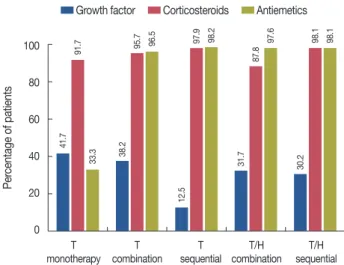
The main supportive medications were antiemetics, cortico- steroids, and growth factors. The details are described in Fig- ure 1. In HER2+ patients, concomitant trastuzumab, along with tamoxifen and aromatase inhibitors, was administered.
Breast cancer surgery
Mastectomy (total or partial) without axillary lymph node surgery was performed for 0.1% of patients. Mastectomy along with lymphadenectomy was performed for 99.2% of patients. Lymphadenectomy alone was performed for 0.7% of patients. Other surgeries were performed for 0.4% of patients.
Chemotherapy regimens and docetaxel exposure
Patients were divided into five groups based on docetaxel- containing chemotherapeutic regimens as described in Table 3. The regimens were docetaxel monotherapy, docetaxel se- quential regimens, docetaxel combination regimens, docetax- el-trastuzumab sequential regimens, and docetaxel and trastu- zumab in combination. Anthracycline-containing regimens Table 2. Tumor characteristic (n=1,712)
Tumor characteristic No. (%)
Ductal carcinoma 1,484 (86.7)
Differentiation
Poor 108 (7.3)
Moderate 723 (48.7)
Well 546 (36.8)
Unknown 107 (7.2)
Lobular carcinoma 89 (5.2)
Mixed carcinoma 34 (2.0)
Medullary carcinoma 9 (0.5)
Mucinous carcinoma 13 (0.8)
Tubular carcinoma 35 (2.0)
Other 48 (2.8)
Hormone receptors
ER+ and PR+ 894 (52.2)
ER- and PR- 553 (32.3)
ER+ and PR- 52 (3.0)
ER- and PR+ 200 (11.7)
Unknown 13 (0.8)
HER2
Negative 1,111 (64.9)
Positive 574 (33.5)
Unknown 27 (1.6)
AJCC stage
I 156 (9.1)
IIA 559 (32.7)
IIB 450 (26.3)
IIIA 347 (20.3)
IIIB 17 (1.0)
IIIC 175 (10.2)
IV 1 (0.1)
Not determined 7 (0.4)
ER=estrogen receptor; PR=progesterone receptor; HER2=human epider- mal growth factor receptor 2; AJCC=American Joint Committee on Cancer.
Figure 1. Patients receiving supportive medications (n=1,712).
T=docetaxel; H=trastuzumab.
100 80 60 40 20
0
T T T T/H T/H
monotherapy combination sequential combination sequential Growth factor Corticosteroids Antiemetics
Percentage of patients 41.7 38.2 12.5 31.7 30.2
91.7 95.7 97.9 87.8 98.1
33.3 96.5 98.2 97.6 98.1
were administered to 1,353 patients (79.0%), while 359 pa- tients (21.0%) received non-anthracycline-containing regi- mens. Among the patients who received anthracycline-con- taining regimens, most received docetaxel sequential (54.1%) or docetaxel combination regimens (36.6%), while for non- anthracycline-containing regimens, most patients received docetaxel combination regimens (83.0%) or docetaxel-trastu- zumab combination regimens (11.4%). The actual chemo- therapy as chosen by the investigators and the five most fre- quently selected specific regimens are summarized in Table 4.
Safety assessment
Overall, treatment emergent AEs (TEAE), including those related to surgery, were reported in 77.5% of patients (anthra- cycline-containing regimen vs. non-anthracycline-containing regimen: 77.9% vs. 75.8%). A total 13,247 AEs were reported.
Chemotherapy related AEs were reported in 76.2% of patients (anthracycline-containing regimen vs. non-anthracycline-
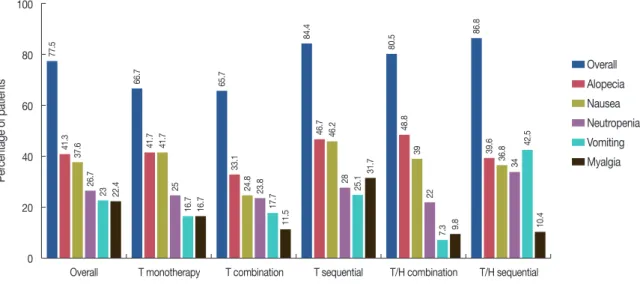
containing regimen: 76.8% vs. 74.1%). The most commonly reported AEs were alopecia, nausea, neutropenia, vomiting, myalgia, stomatitis, anorexia, diarrhea, and fatigue. In general, the frequency of various types of AEs (including deaths) was broadly comparable across all chemotherapy strategies, with lower rates of AEs for docetaxel monotherapy and combina- tion therapy (66.7% and 65.7%) compared with 84.4% for pa- tients receiving docetaxel sequential chemotherapy, 80.5% for patients receiving docetaxel-trastuzumab combination che- motherapy and 86.8% for patients receiving docetaxel-trastu- zumab sequential chemotherapy (Figure 2).
NCI CTCAE ≥grade 3 adverse events
NCI CTCAE ≥grade 3 AEs were recorded in 35.2% of pa- tients (anthracycline-containing regimen vs. non-anthracy- cline-containing regimen: 35.6% vs. 33.7%). Chemotherapy- related AEs were observed in 34.8% patients (35.2% vs.
33.4%), the details of which are summarized in Table 5.
Deaths
Twenty-seven patients (1.6%) had died by 1.5 years of fol- low-up (anthracycline-containing regimen vs. non-anthracy- cline-containing regimen: 1.6% vs. 1.4%). None of the docetaxel monotherapy patients had died, while 11 (1.8%) of docetaxel combination regimen patients, 14 (1.4%) of docetaxel sequential patients, 1 (2.4%) of docetaxel-trastu- zumab combination patients, and 1 (1.0%) of docetaxel- trastuzumab sequential patients had died.
Serious adverse events
Serious AEs were reported by 12.0% of patients (anthracy- Table 3. Chemotherapy regimen administered in the safety population
(n=1,712)
Chemotherapy
regimen Overall
No. (%) Anthracycline No. (%)
Non- anthracycline
No. (%)
Mean dose intensity of docetaxel (mg/m2/wk)
T monotherapy 12 (0.7) - 12 (0.7) 24.1
T combination 626 (36.6) 328 (19.2) 298 (17.4) 22.7 T sequential 927 (54.1) 922 (53.9) 5 (0.3) 25.1
T/H combination 41 (2.4) - 41 (2.4) 23.8
T/H sequential 106 (6.2) 103 (6.0) 3 (0.2) 25.5 Total 1,712 (100.0) 1,353 (79.0) 359 (21.0) - T=docetaxel; H=trastuzumab.
Table 4. Actual chemotherapy (safety population) and five most frequently prescribed regimens in the anthracycline and non-anthracycline groups Actual chemotherapy
No. (%) of patients T monotherapy
(n=12)
T combination (n=626)
T sequential (n=927)
T/H combination (n=41)
T/H sequential (n=106)
Overall 12 (0.7) 626 (36.6) 927 (54.1) 41 (2.4) 106 (6.2)
Anthracycline - 328 (19.2) 922 (53.9) 0 103 (6.0)
Five most frequent specific regimens TEC: 136 (7.9) AC-T: 500 (29.2) - FEC-TH: 54 (3.2)
TAC: 127 (7.4) FEC-T: 250 (14.6) AC-TH: 22 (1.3)
TE: 21 (1.2) EC-T: 84 (4.9) EC-TH: 14 (0.8)
TA: 44 (2.6) FAC-T: 33 (1.9) TH-FEC: 6 (0.4)
TC+THP: 9 (0.5) T-FEC: 11 (0.6) FAC-TH: 3 (0.2)
Non-anthracycline - 298 (17.4) 5 (0.3) 41 (2.4) 3 (0.2)
Five most frequent specific regimens TC: 269 (15.7) T+DDP-TCb: 2 (0.1) TCbH: 30 (1.8) Each other agent (TC-TCH, TCH-TCbH, and TCbH-TH) selected for single patients only TX: 11 (0.6) NC-T: 1 (0.1) TH: 7 (0.4)
T+DDP: 3 (0.2) T-TC: 1 (0.1) TCH: 4 (0.2) TCb: 5 (0.3) TC-TFC: 1 (0.1)
TFCM: 6 (0.4)
T=docetaxel/Taxotere®; H=Herceptin (trastuzumab); E=epirubucin; C=cyclophosphamide; A=adriamycin; THP=pirarubicin; F=5-fluorouracil; X=capecitabine;
DDP=cisplatin; Cb=carboplatin; M=methotrexate.
cline-containing regimen vs. non-anthracycline-containing regimen: 12.3% vs. 10.9%). Chemotherapy-related serious AEs were reported in 11.1% of patients (11.5% vs. 10.0%). The number of cycles in which SAEs occurred is shown in Table 6.
The most frequent SAEs were neutropenia, febrile neutrope- nia, asthenia, and peripheral sensory neuropathy. Neutrope- nia was reported most frequently in the docetaxel sequential regimens, with a mean of 2.6 cycles per patient (95% confi- dence interval, 2.37–2.83). Febrile neutropenia occurred most frequently with docetaxel-trastuzumab sequential regimens, with a mean of 1.4 cycles per patient (0.72–2.08). Few patients had neutropenic infections, with only one cycle reported per patient experiencing neutropenic infection. Asthenia oc- curred most frequently with docetaxel sequential regimens,
with a mean of 1.4 cycles per patient (1.28–1.58). Peripheral sensory neuropathy occurred most frequently with docetaxel- trastuzumab combination regimens, with a mean of 1.4 cycles per patient (0.49–2.26).
Lipid profile
At the end of chemotherapy, the mean LDL-C and total cholesterol increased while the mean HDL-C decreased from baseline in all menstrual status groups, which resulted in in- creased LDL-C/HDL-C and total cholesterol/HDL-C ratios.
LDL-C, HDL-C, and total cholesterol levels in different meno- pausal stages are summarized in Table 7.
Cardiac function
To assess cardiac function, the LVEF was measured in 916 of the patients who received anthracycline-containing regi- mens. The mean ( ±SD) of LVEF at baseline was 66.4%
(±7.389) and 64.5% (±7.165) at 1.5-year follow-up with a mean change of -1.9% (± 7.062), which was not clinically relevant. Risk factors for reduced LVEF, such as age, history of hypertension or diabetes, presence of cardiovascular events, total cholesterol, LDL-C, and HDL-C, also did not significant- Figure 2. Summary of adverse events by regimen.
T=docetaxel; H=trastuzumab.
100
80
60
40
20
0
Overall T monotherapy T combination T sequential T/H combination T/H sequential
Overall Alopecia Nausea Neutropenia Vomiting Myalgia
Percentage of patients 77.5 66.7 65.7 84.4 80.5 86.8
41.3 41.7 33.1 46.7 48.8 39.637.6 41.7 24.8 46.2 39 36.8
26.7 25 23.8 28 22 34
23 16.7 17.7 25.1 7.3 42.5
22.4 16.7 11.5 31.7 9.8 10.4
Table 5. Summary of adverse events and NCI CTCAE severity grade 3 or higher related to chemotherapy
Overall (n=1,712)
No. (%)
Anthracycline (n=1,353)
No. (%)
Non-anthracycline (n=359)
No. (%) Any related AEs 1,326 (77.5) 1,054 (77.9) 272 (75.8) Most common AEs
Alopecia 707 (41.3) 554 (40.9) 153 (42.6) Nausea 643 (37.6) 552 (40.8) 91 (25.3) Neutropenia 457 (26.7) 394 (29.1) 63 (17.5) Vomiting 394 (23) 352 (26) 42 (11.7) Peripheral sensory
neuropathy
219 (12.8) 186 (13.7) 33 (9.2)
NCI CTCAE severity grade 3 or higher
603 (35.2) 482 (35.6) 121 (33.7)
Neutropenia 342 (20) 292 (21.6) 50 (13.9)
Vomiting 27 (1.6) 25 (1.8) 2 (0.6)
NCI CTCAE=National Cancer Institute Common Terminology Criteria for Ad- verse Events; AEs=adverse events.
Table 6. Number of cycles with serious adverse events Serious adverse
event Overall
(95% CI) Anthracycline
(95% CI) Non-anthracycline (95% CI) Neutropenia 2.3 (2.16–2.47) 2.4 (2.22–2.55) 1.9 (1.56–2.25) Febrile neutropenia 1.3 (1.16–1.35) 1.13 (1.15–1.38) 1.2 (1.01–1.41) Asthenia 1.4 (1.26–1.51) 1.4 (1.27–1.54) 1.1 (0.79–1.49) Peripheral sensory
neuropathy 1.2 (1.17–1.31) 1.2 (1.16–1.30) 1.3 (1.00–1.54) CI=confidence interval.
ly influence LVEF change from baseline.
Treatment discontinuation
Overall, 35 patients had a total of 41 AEs leading to with- drawal from therapy, with 33 TEAEs in 27 patients (2.0%) re- ceiving anthracycline-containing regimens and eight TEAEs in eight patients (2.2%) receiving non-anthracycline-contain- ing regimens. The most frequently reported TEAEs leading to discontinuation were neutropenia in five patients (0.3%), leu- kopenia in four patients (0.2%), fatigue in three patients (0.2%), and myalgia in one patient (0.1%).
Follow-up
There were 202 patients (11.8%) who were not seen for the 1.5-year follow-up visit. One hundred seventy-five patients (10.2%) were lost to follow-up, and chemotherapy-related death was reported in 27 patients (1.6%). The remaining 1,510 patients (88.2%) were alive; 1,454 patients (96.3%) had no re- lapse, 45 patients (3.0%) had one relapse, and 11 patients (0.7%) had a secondary malignancy.
Relapse
The number of patients alive was similar between patient groups receiving anthracycline regimens (87.9%) and non-an- thracycline regimens (89.4%). Relapse was observed in 45 (3%) patients. In 12 patients, the first relapse was locoregional, while it was distant in 32 patients. Relapse occurred in 22 pa- tients receiving docetaxel combination regimens and 19 pa- tients receiving docetaxel sequential regimens. The relapse rate was similar between anthracycline- and non-anthracy- cline-receiving patient groups.
With respect to actual chemotherapy regimens, the relapse rate was <2% for each regimen. Most patients who reported
relapse were the American Joint Committee on Cancer stage IIIC. The most frequent breast cancer subtype to relapse was the HER2-enriched subtype, which was reported in 15 pa- tients, while the subtype was not determined for 10 patients.
DISCUSSION
The APBI-II was an observational study conducted to ex- amine the safety parameters of the most commonly used che- motherapeutic agent, docetaxel, in anthracycline- and non- anthracycline-containing regimens in EBC patients treated in real-world clinics of the Asia-Pacific region. Significant differ- ences in the epidemiology of breast cancer between Eastern and Western countries and AEs related to docetaxel led to the establishment of this registry.
Consecutive patients were enrolled representing a real- world clinical setting. Patients were at different stages of menopause and different ages at inclusion. In contrast to Western countries, where most patients are older than 65 years of age, two-thirds of the patients in this registry were younger than 55 years, confirming earlier reports that in Asia- Pacific region, a younger population is prone to breast cancer [8,9]. The increased number of younger patients in this area demands better screening methods and treatment availability to reduce morbidity. Interestingly, most patients in this regis- try had ER+ and PR+ disease, similar to Western countries.
Compared with Western patient populations, more patients were found to be positive for HER2 (33% vs. 20%) in the APBI registry [10]. Younger women more frequently have HER2+ breast cancer, as was seen in this patient population, which included more young patients [10]. Since HER2+ sta- tus is correlated with poor prognosis, an appropriate treat- ment at the right time is necessary to ensure good patient sur- Table 7. Lipid profiles in different menopausal stages
No. Baseline
(mean±SD)
End of chemotherapy (mean±SD)
Change
(mean±SD) p-value
LDL-C (mg/dL)
Premenopausal 177 109.66±34.95 115.54±41.57 5.88±30.21 <0.0001
Perimenopausal 432 110.77±32.71 128.31±35.38 17.55±31.56 <0.0001
Postmenopausal 586 131.51±138.39 139.70±124.45 8.19±40.99 <0.0001
HDL-C (mg/dL)
Premenopausal 179 59.80±22.94 55.71±23.219 -4.09±16.01 0.0005
Perimenopausal 434 54.65±18.23 52.26±16.22 -2.38±14.7 0.0019
Postmenopausal 595 54.23±17.46 49.41±16.12 -4.82±15.95 <0.0001
Total cholesterol (mg/dL)
Premenopausal 196 192.11±48.12 205.70±51.7 13.59±35.8 <0.0001
Perimenopausal 470 187.27±36.42 208.60±40.89 21.33±39.82 <0.0001
Postmenopausal 655 206.19±49.62 213.22±41.89 7.03±50.63 <0.0001
LDL-C=low-density lipoprotein cholesterol; HDL-C=high-density lipoprotein cholesterol.
vival. As in any real-world clinical setting, a variety of surger- ies and chemotherapy regimens were applied, based on each patient’s condition and disease status. Chemotherapeutic regi- mens most commonly used docetaxel. More than 10 different regimens were used to treat patients, along with various sup- portive medications, such as growth factors, antibiotics, and antiemetics. Altogether, the patients’ demographics and treat- ment strategies were highly diverse. Hence, this registry repre- sents real-world clinical settings in which to test the effect of chemotherapeutic agents in patients with EBC.
Several AEs were reported in the APBI-II registry, consis- tent with other published studies. However, the majority of AEs in all regimens were manageable. AEs, such as neutrope- nia and vomiting, were recorded more frequently in patients receiving anthracycline-containing regimens than in patients receiving non-anthracycline-containing regimens. Leukope- nia occurred significantly more often in patients receiving non-anthracycline-containing regimens. The most common AEs were alopecia, nausea, neutropenia, and leucopenia. The most frequent NCI CTCAE grade 3 or higher AEs were neu- tropenia and leucopenia. Neutropenia was recorded signifi- cantly more frequently in patients receiving anthracycline- containing regimens, while leukopenia was more frequent in patients receiving non-anthracycline-containing regimens.
Neutropenia was also reported more frequently in the docetaxel- sequential arm as compared with the docetaxel-combination arm. In a phase III (n=1,491) trial of lymph node-positive breast cancer patients, Martin et al. [5] reported grade 3 or higher neutropenia in 65% of patients, compared with 20% of patients in the APBI-II registry. Similarly, in another phase III clinical trial, Jones et al. [11] reported grade 3 or higher neu- tropenia in more than 61% of patients (n=1,016). In the BCIRG005 trial (n=1,649), neutropenia was reported in docetaxel-sequential and -combination arms, at 57.8% and 59.9%, respectively [12]. Hence, compared with that in other published reports, the incidence of grade 3 or higher neutro- penia was lower in the APBI-II registry.
In the APBI-II registry, relapse was observed in 3% of pa- tients. In the BCIRG005 trial, relapse was observed in 21%, and in a study by Jones et al. the relapse rate was 14% [11,12].
However, the BCIRG005 trial followed patients for 2.5 years and Jones et al. for 5.5 years, compared with the APBI-II reg- istry that had a follow-up of 1.5 years [11,12]. If patients were followed for a longer time in the APBI-II registry, an increase in relapse rates may have been observed. Patients death was observed in <1% of patients in the BCIRG005 trial and 11%
by Jones et al. [11,12]. In the ABPI-II registry, death was re- ported in 1.6% of patients. The longer follow-up period of 5.5 years may be the main reason for the higher incidence of
deaths in the phase III clinical trial by Jones et al. [11]. AEs, NCI CTCAE ≥grade 3 events, SAEs, death, relapse rates, treatment discontinuation rate, and number of patients alive at 1.5 years of follow-up was approximately equal in both cat- egories of docetaxel-based anthracycline-containing and non- anthracycline-containing regimens. In the APBI-II registry, no significant safety issue was observed in any patient or treat- ment group of the Asia-Pacific region that differed from those published in clinical trials of other populations [4].
Breast cancer patients are at increased risk for cardiac dis- ease after anthracycline chemotherapy [2]. Hence, cardiac function was evaluated at baseline and at 1.5 years of follow- up in anthracycline-receiving patients (n=916). LVEF has been used to assess cardiac function [13]. A reduction in LVEF of more than 15%, to an absolute LVEF of 30% to 45%, reflects impairment in cardiac function [13]. LVEF levels were within the normal range at both time points, with a mean re- duction of 1.9% from baseline at the 1.5 years follow-up visit.
These results indicate that docetaxel-based, anthracycline- containing chemotherapeutic regimens do not cause signifi- cant impairment in cardiac function 1.5 years after the com- pletion of chemotherapy in an Asia-Pacific patient population.
Moreover, the reduction in LVEF was not correlated with oth- er risk factors for cardiac disease, such as history of hyperten- sion, diabetes, cardiovascular disease and/or total cholesterol, LDL-C, and HDL-C levels. Taken together, these results sug- gest that administration of docetaxel-based, anthracycline- containing chemotherapy did not cause significant cardio- toxicity in breast cancer patients of the Asia-Pacific region.
Nonetheless, a longer follow-up is required to determine the cardiotoxicity related to docetaxel- and anthracycline-based chemotherapy in EBC patients of Asia-Pacific region.
Serum cholesterol levels increase due to chemotherapy [14].
Consistent with previous reports, the APBI-II registry also observed a small but significant increase in LDL-C and total cholesterol levels and a small but significant decrease in HDL- C levels at the end of chemotherapy in pre-, peri-, and post- menopausal women. However, perimenopausal patients had a larger change in lipid levels at the end of chemotherapy, in- dicative of their unstable hormonal status due to menopause.
At the end of chemotherapy, both LDL-C and total cholesterol showed increasing trend in all menstrual status groups. How- ever, mean values were within normal range. Measurement of lipid levels after 3 to 5 years is required to provide better in- sight regarding the effect of docetaxel-based chemotherapy on cholesterol levels in EBC patients of the Asia-Pacific region.
Long-term cardiac toxicity has been observed in EBC pa- tients treated with anthracyclines. However, in this registry, the lipid profile and LVEF of patients were followed only for
1.5 years after chemotherapy treatment. It is necessary to fol- low these patients for a longer duration to evaluate the effect of docetaxel on cardiac safety.
This registry underscores the importance of recognizing the great diversity in patients’ demographics as well as treatment strategies in real-world patients of the Asia-Pacific region. In this registry, various docetaxel-based anthracycline- and non- anthracycline-containing regimens were not found to cause significant issues in safety outcomes such as AEs, NCI CTCAE
≥ grade 3 events, SAEs, death, relapse rates, treatment discontinuation rates, number of patients alive, LVEF, and lipid profile at 1.5 years after treatment. However, a longer fol- low-up evaluation may be performed to assess long-term safety outcomes. This study’s results suggest that docetaxel- based chemotherapy is a safe choice for EBC patients of the Asia-Pacific region.
CONFLICT OF INTEREST
The authors declare that they have no conflict interests.
ACKNOWLEDGMENTS
The authors offer their sincere thanks to all the participating investigators, clinical trial staff, and others who supported the conduct of this study.
REFERENCES
1. Akram M, Siddiqui SA. Breast cancer management: past, present and evolving. Indian J Cancer 2012;49:277-82.
2. de Boer RH, Chan A, Tran B, Wilcken N. Use of non-anthracycline regimens in early stage breast cancer in Australia. Asia Pac J Clin Oncol 2011;7:4-10.
3. Jensen BV, Skovsgaard T, Nielsen SL. Functional monitoring of anthra- cycline cardiotoxicity: a prospective, blinded, long-term observational study of outcome in 120 patients. Ann Oncol 2002;13:699-709.
4. Crown J, O’Leary M, Ooi WS. Docetaxel and paclitaxel in the treatment of breast cancer: a review of clinical experience. Oncologist 2004;9 Sup- pl 2:24-32.
5. Martin M, Pienkowski T, Mackey J, Pawlicki M, Guastalla JP, Weaver C, et al. Adjuvant docetaxel for node-positive breast cancer. N Engl J Med 2005;352:2302-13.
6. Pant S, Chilukuri MP, Ramaswamy B. Docetaxel for the post-surgery treatment of patients with node-positive breast cancer. Ther Clin Risk Manag 2008;4:419-24.
7. Alken S, Kelly CM. Benefit risk assessment and update on the use of docetaxel in the management of breast cancer. Cancer Manag Res 2013;
5:357-65.
8. Youlden DR, Cramb SM, Yip CH, Baade PD. Incidence and mortality of female breast cancer in the Asia-Pacific region. Cancer Biol Med 2014;11:101-15.
9. Green M, Raina V. Epidemiology, screening and diagnosis of breast cancer in the Asia-Pacific region: current perspectives and important considerations. Asia Pac J Clin Oncol 2008;4(Suppl 3):S5-13.
10. Singh JC, Jhaveri K, Esteva FJ. HER2-positive advanced breast cancer:
optimizing patient outcomes and opportunities for drug development.
Br J Cancer 2014;111:1888-98.
11. Jones SE, Savin MA, Holmes FA, O’Shaughnessy JA, Blum JL, Vukelja S, et al. Phase III trial comparing doxorubicin plus cyclophosphamide with docetaxel plus cyclophosphamide as adjuvant therapy for operable breast cancer. J Clin Oncol 2006;24:5381-7.
12. Eiermann W, Pienkowski T, Crown J, Sadeghi S, Martin M, Chan A, et al. Phase III study of doxorubicin/cyclophosphamide with concomitant versus sequential docetaxel as adjuvant treatment in patients with hu- man epidermal growth factor receptor 2-normal, node-positive breast cancer: BCIRG-005 trial. J Clin Oncol 2011;29:3877-84.
13. Volkova M, Russell R 3rd. Anthracycline cardiotoxicity: prevalence, pathogenesis and treatment. Curr Cardiol Rev 2011;7:214-20.
14. Alexopoulos CG, Pournaras S, Vaslamatzis M, Avgerinos A, Raptis S.
Changes in serum lipids and lipoproteins in cancer patients during che- motherapy. Cancer Chemother Pharmacol 1992;30:412-6.