patients with peri-implant mucositis
Jungwon Lee1, Jong heun Lim2, Jungeun Lee1, Sungtae Kim1, Ki-Tae Koo1, Yang-Jo Seol1, Young Ku1, Yong-Moo Lee1, In-Chul Rhyu1,*
1Department of Periodontology, Seoul National University School of Dentistry, Seoul, Korea
2The Armed Forces Medical Command, Seongnam, Korea
Research Article
J Periodontal Implant Sci 2015;45:56-61 http://dx.doi.org/10.5051/jpis.2015.45.2.56
Purpose: The aim of this study was to evaluate the effectiveness of powered toothbrushes for plaque control in patients with peri-implant mucositis, in comparison with manual toothbrushes.
Methods: This randomized, prospective, controlled, clinical parallel study compared the ef- ficacy of manual and powered toothbrushes for plaque control in implant restorations. Pa- tients with bleeding on probing, no residual pocket depth (as indicated by a pocket probing depth ≥ 5 mm), and no radiological peri-implant bone loss were eligible for this study. Pa- tients were requested to complete a questionnaire describing their oral hygiene habits. The duration and frequency of tooth brushing were recorded by subjects in order to assess their compliance. Clinical parameters, including the modified plaque index (mPI), the modified sulcus bleeding index (mSBI), and clinical photographs (buccal and lingual views) were re- corded at baseline and at one-month and two-month follow-up visits.
Results: Statistically significant differences between patients who used manual tooth- brushes and those who used powered toothbrushes were found regarding the frequency of tooth brushing per day and the duration of brushing at one-month and two-month fol- low-up visits, while no statistically significant differences were found relating to other oral hygiene habits. A statistically significant difference in patient compliance for tooth brush- ing was found at one month, while no difference was found at two months. Statistically significant decreases in the mPI and the mSBI were observed in both groups from baseline to the one- and two-month follow-ups. The overall reduction of these parameters was not significantly different between the two groups, except for mPI reduction between baseline and one month of follow-up.
Conclusions: Sonic-powered toothbrushes may be a useful device for plaque control in pa- tients with peri-implant mucositis.
Keywords: Dental implant, Dental plaque, Oral hygiene.
Received: Feb. 17, 2015 Accepted: Mar. 27, 2015
*Correspondence:
In-Chul Rhyu
Department of Periodontology, Seoul National University School of Dentistry, 101 Daehak-ro, Jongno-gu, Seoul 110-768, Korea
E-mail: [email protected] Tel: +82-2-2072-3858 Fax: +82-2-744-0051
INTRODUCTION
Peri-implant mucositis is defined as inflammation in the mucosa around a dental im- plant. Gingivitis and peri-implant mucositis are similar in that both are reversible [1]. Early intervention with effective removal of the microbial biofilm is known to be helpful in pre- venting further progression to periodontitis and peri-implantitis, respectively [2]. Peri-im- plantitis is diagnosed when the inflamed mucosa is accompanied with bone loss around the dental implant [3]. If peri-implant mucositis is left untreated, it can result in the pro- gressive destruction of the marginal bone around the dental implant, which in turn leads
This is an Open Access article distributed under the terms of the Creative Commons Attribution Non-Commercial License (http://creativecommons.org/licenses/by-nc/3.0/).
to peri-implantitis [4,5].
The presence of plaque around dental implants appears to be as- sociated with peri-implant mucositis [6]. Peri-implant lesions are associated with inadequate plaque control at implant sites, whereas peri-implantitis is rare when proper plaque control is ensured [7,8].
In a long-term clinical study, peri-implant lesions were frequently found in patients who did not adhere to supportive therapy, includ- ing the removal of bacterial biofilm [6]. Most practitioners agree that the long-term success of implant restorations can be improved by maintaining good oral hygiene and preventing plaque accumu- lation around the implants [9,10].
Daily plaque control using a manual toothbrush is one effective way to prevent plaque accumulation around teeth [11]. Dental floss and interdental cleansing devices are also recommended for daily plaque control. In some clinical situations, in which an implant- supported prosthesis does not have the proper contour, angulation, or location, more time and effort are required for the daily removal of plaque [12]. Powered toothbrushes may assist in maintaining good oral hygiene, as they provide patients with an easy plaque control technique that does not require substantial training [13].
Powered toothbrushes have advantages compared to other oral hygiene appliances. Sicilia et al. [14] reported that the use of pow- ered toothbrushes, especially those with counter-rotational and os- cillating-rotating brushes, can be beneficial in reducing the levels of gingival bleeding or inflammation. Vandekerckhove et al. [13]
reported that powered toothbrushes are effective, safe and com- fortable for patients who have undergone rehabilitation with im- plant prostheses. Wolff et al. [15] demonstrated that sonic brushing is an effective means of dental implant maintenance. On the other hand, Swierkot et al. [16] found no significant differences between manual and sonic-powered toothbrushes regarding plaque removal around dental implants. These results were obtained from subjects without periodontal or peri-implant disease. To the best of our knowledge, no studies have evaluated the effectiveness of sonic- powered toothbrushes for plaque removal in subjects with peri-im- plant mucositis.
The aim of this study was to evaluate the effectiveness of pow- ered toothbrushes, in comparison with manual toothbrushes, for plaque control in patients with peri-implant mucositis.
MATERIALS AND METHODS
Experimental design
This randomized, prospective, controlled, clinical parallel study compared the efficacy of manual toothbrushes (Butler GUM 311, Sunstar, Etoy, Switzerland) and sonic-powered toothbrushes (Soni- care DiamondClean, Philips, Amsterdam, Netherland) for plaque control around dental implants. The sonic-powered toothbrush used in this study has a frequency of up to 31,000 brush strokes per min- ute and a two-minute timer to ensure the recommended brushing time. The study protocol was approved by the Institutional Review Board (IRB #CMP13003), Seoul National University Dental Hospital,
Seoul, Korea. All patients received a detailed description of the pro- posed study protocol and provided informed written consent to participate in the study. Subjects were recruited from December 2013 to August 2014. The first procedure was carried out in Decem- ber 2013, and all one-month follow-up visits were completed by October 2014. A block randomization sequence was used to ensure equal distribution of the subjects to the manual toothbrush group and the sonic-powered toothbrush group. The randomization was performed on the day of scaling, using a sealed envelope contain- ing the allocated toothbrush procedure.
The sample size was determined to be 20 subjects per group. Wolff et al. [15] demonstrated that a change of 0.1 (±0.1) in the modified sulcus bleeding index (mSBI) around the implant sites was found be- tween baseline and 24 weeks of follow-up. In our study, a difference of 0.3 in the magnitude of mSBI change after two months was con- sidered to be the threshold of clinical relevance when comparing the use of manual and sonic-powered toothbrushes. A total sample size of 36 subjects (18 per group) was found to achieve 81% power in detecting a difference of 0.3 between the mean mSBI values of the manual toothbrush group and the sonic-powered toothbrush group, with a standard deviation of 0.3. The Mann-Whitney U test was used, and P-values <0.05 were considered to indicate statistical sig- nificance. Assuming a drop-out rate of 10%, a total sample size of 40 (20 per group) was required.
Population screening
Patients with bleeding on probing, no residual pocket depth (as shown by a pocket probing depth ≥5 mm), and no radiological peri-implant bone loss were considered eligible for this study. In order to be eligible for enrollment, all the patients had to meet the following inclusion and exclusion criteria.
The inclusion criteria of this study were: 1) the presence of at least one implant restoration, 2) no use of antibiotic medications within the previous three months, 3) the presence of an implant prosthesis that was installed at least three months previously, and 4) no peri-implant bone loss as shown by radiography.
The exclusion criteria of this study were: 1) pregnancy, being less than three months postpartum, bleeding disorders, hemophilia, di- abetes, immunodeficiency, epilepsy, rheumatic heart disease, or a joint replacement prosthesis; 2) the use of cyclosporin, dilantin, calcium channel blockers, or the chronic use of non-steroidal anti- inflammatory drugs; 3) the requirement of dental treatment due to dental caries, abscesses, or similar conditions; 4) the presence of an orthodontic appliance; and 5) the presence of a condition that would prevent a patient from actively controlling oral hygiene, such as Parkinson’s disease or mental retardation.
Procedures
All subjects were instructed to brush their teeth and implants three times a day for two minutes. Subjects in the manual tooth- brush group were instructed to brush their teeth and implants using the Bass technique [17], and subjects in the sonic-powered tooth-
brush group were told to follow the manufacturer's instructions.
Clinical baseline measurements were taken at the screening ap- pointment, along with a standard periapical radiograph in order to exclude peri-implantitis. The data included the modified plaque in- dex (mPI), mSBI [18], and clinical photographs (buccal and lingual views). Clinical measurements were taken by blind and calibrated investigators. Scaling was performed to minimize the effect of nat- ural teeth adjacent to the implant at the first visit. The data were uploaded to a database in which patient privacy was protected ac- cording to current regulations. Clinical parameters were recorded at baseline as well as at one-month and two-month follow-up visits.
Patients were requested to complete a questionnaire that as- sessed oral hygiene habits and patient compliance. The duration and frequency of tooth brushing were recorded by the subjects for compliance assessment.
Statistical analysis
After a brief training, two examiners (JWL, JEL) performed repeat- ed measurements of the mPI and mSBI using clinical photographs one week apart. The intra-examiner reproducibility and inter-exam- iner reliability of the measurements of the mPI and mSBI were as- sessed using the intraclass correlation coefficient and Kappa statis- tics [19,20].
The Student’s t-test (for continuous measures) or the Mann-Whit- ney U test (for categorical measures) was used to evaluate whether any statistically significant differences were present between the two groups at each time point, and the Wilcoxon signed-rank test was used to evaluate whether statistically significant changes oc- curred from baseline within each group. P-values <0.05 were con- sidered statistically significant. Correlations between the age of sub- jects and the change of the mPI and mSBI were determined with the Spearman's correlation test. All statistical analyses were performed using IBM SPSS Statistics version 21.0 (IBM Corp., Armonk, NY, USA).
RESULTS
Subject data
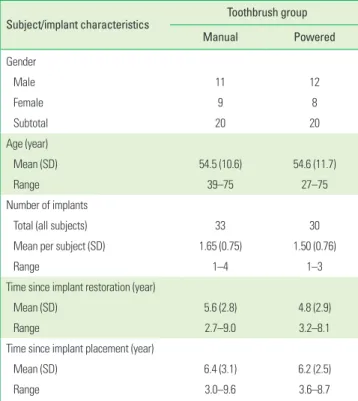
The initial study population consisted of 41 volunteers who were recruited from the patients of Seoul National University Dental Hos- pital. One subject withdrew consent to participate in the study, re- sulting in a total of 40 participants who participated in the study (Table 1). The subjects of the manual toothbrush group ranged in age from 39 to 75 years (mean±standard deviation [SD]=54.5±10.6 years) and included 11 men and nine women. The subjects of the powered toothbrush group ranged in age from 27 to 75 years (mean±SD=54.6±11.7 years) and included 12 men and eight wom- en. A total of 33 implants were present in the manual toothbrush group, and 30 implants were present in the powered toothbrush group. The time of implant restoration ranged from 2.7 to 9.0 years (mean±SD=5.6±2.8 years) in the manual toothbrush group and from 3.2 to 8.1 years (mean±SD=4.8±2.9 years) in the powered toothbrush group. The time of implant placement ranged from 3.0 to
9.6 years (mean±SD =6.4 ±3.1 years) in the manual toothbrush group and from 3.6 to 8.7 years (mean±SD=6.2±2.5 years) in the powered toothbrush group.
Subject oral hygiene habits and compliance
The data collected from the questionnaire relating to oral hygiene habits and compliance are shown in Table 2. The daily frequency of brushing in the manual toothbrush group was significantly higher than in the powered toothbrush group, whereas the duration of brushing in the manual toothbrush group was significantly shorter than in the powered toothbrush group at one and two months of follow-up. The frequency of use of an interdental brush and dental floss in the manual toothbrush group was comparable to that found in the powered toothbrush group. At one month and two months of follow-up, larger differences were found between the two groups.
The percentage of patient compliance was significantly different be- tween the two groups at one month of follow-up, but not at two months .
Intraexaminer and interexaminer reliability
The intraexaminer evaluation yielded high reproducibility, with intraclass correlation coefficients for JWL and JEL of 0.941 and 0.912, respectively. The interexaminer evaluation likewise yielded high reliability, with a kappa value for JWL and JEL of 0.91.
Table 1. Description of subjects and implants by toothbrush group.
Subject/implant characteristics Toothbrush group
Manual Powered
Gender
Male 11 12
Female 9 8
Subtotal 20 20
Age (year)
Mean (SD) 54.5 (10.6) 54.6 (11.7)
Range 39–75 27–75
Number of implants
Total (all subjects) 33 30
Mean per subject (SD) 1.65 (0.75) 1.50 (0.76)
Range 1–4 1–3
Time since implant restoration (year)
Mean (SD) 5.6 (2.8) 4.8 (2.9)
Range 2.7–9.0 3.2–8.1
Time since implant placement (year)
Mean (SD) 6.4 (3.1) 6.2 (2.5)
Range 3.0–9.6 3.6–8.7
SD: standard deviation.
Table 2. Oral hygiene habits and compliance at baseline, one month, and two months.
Oral hygiene habit Manual tooth brush Powered tooth brush
Baseline 1 month 2 months Baseline 1 month 2 months
Frequency of brushing per day 2.33 (0.56) 2.58 (0.50) 2.50 (0.51) 2.36 (0.49) 2.16 (0.37)a) 2.20 (0.41)a) Time of brushing (minute) 1.85 (0.73) 2.27 (0.57) 2.41 (0.52) 2.02 (0.80) 3.00 (0.58)a) 2.82 (0.48)a)
Use of interdental brush (%) 63 67 63 56 40 48
Use of dental floss (%) 29 40 54 24 24 24
Use of water irrigation device (%) 0 0 0 0 0 0
Use of toothpicks (%) 8 0 0 8 4 4
Use of mouthwash (%) 13 13 8 24 12 12
Patient compliance for tooth brushing (%) 95.2 (4.6) 96.1 (6.1) 98.7 (3.5)a) 99.5 (1.1)
a)Statistically significant compared to the manual toothbrush group at the same time.
Table 3. Reduction in clinical parameters between baseline and post-baseline follow-up points.
Clinical parameters Base to 1 month 1 month to 2 months Base to 2 months
Mean±SD P-valueb) Mean±SD P-valueb) Mean±SD P-valueb)
mPI
Manual 0.67±0.85 <0.001 0.09±0.68 0.439 0.76±0.90 <0.001
Powered 1.07±0.91 0.001 0.20±0.71 0.134 1.27±0.87 <0.001
P-valuea) 0.104 0.499 0.043
mSBI
Manual 0.48±0.91 0.006 0.09±0.77 0.491 0.58±0.79 0.001
Powered 0.63±0.61 <0.001 0.30±0.60 0.013 0.93±0.87 <0.001
P-valuea) 0.300 0.242 0.100
a)Mann-Whitney test, used for comparison between the groups.
b)Wilcoxon signed rank test, used for comparison within the groups.
mPI: modified plaque index, mSBI: modified sulcus bleeding index, SD: standard deviation.
Clinical parameters at the implant sites
The mPI and mSBI scores were observed in the manual and pow- ered toothbrush groups at baseline and at one and two months of follow-up. In the manual toothbrush group, the mean±SD mPI scores at the baseline, one month, and two months were 1.85±0.62, 1.18±0.98, and 1.09±0.95, respectively. In the powered toothbrush group, the corresponding mPI values were 1.70±0.65, 0.63±0.72, and 0.43±0.68, respectively. A significant difference in the mPI val- ues of the manual and powered toothbrush groups was found at two months of follow-up.
An overall pattern in which mPI and mSBI values decreased post- baseline was observed in both groups (Table 3). In both groups, sta- tistically significant reductions of mPI and mSBI values were found at one month and two months of follow-up compared to the base- line values. Moreover, in the powered toothbrush group, a statisti- cally significant reduction in the mSBI was found between one and two months of follow-up (Fig. 1). The overall reductions were not significantly different between the two groups, except the mPI re- duction between baseline and two months of follow-up (Table 3).
The Spearman coefficients between age and the change of mPI and mSBI (from baseline to two months of follow-up) were −0.209 (P- value=0.244) and −0.102 (P-value=0.508) in the manual tooth- brush group and −0.044 (P-value =0.818) and −0.034 (P-val- ue=0.860) in the powered toothbrush group, respectively.
DISCUSSION
The results from the present study have demonstrated that the use of both manual and powered toothbrushes led to significant reductions in mPI and mSBI scores. However, no significant differ- ences were found between the two groups for any post-baseline metric except mPI at two months of follow up. This finding could be due to a therapeutic effect and a genetic effect. Professional scaling was performed at the first visit to minimize plaque that had accumulated around the natural teeth and the dental implant, because the presence of bacterial plaque could have affected the clinical parameters evaluated in this study. Oral hygiene education was also performed at the first visit, because the subjects had not
undergone recent oral hygiene education at the same time point before the study. Professional scaling and oral hygiene education could conceal the differences between manual and powered toothbrushes in a relatively short-term study, in which the thera- peutic effect could be substantial [14,21]. Unlike short-term stud- ies, long-term studies have reported significant differences in gin- gival bleeding depending on the use of manual or powered tooth- brushes [21,22]. Therefore, if we had investigated the subjects in a long-term study, it is probable that differences in the mPI or mSBI values would have been observed. Another factor leading to these results is the possible effect individual genetic factors on host im- munity [23,24]. Depending on individual genetic factors, the in- flammatory response of soft tissue to bacterial plaque could be different. Therefore, genetic factors could affect the variation of parameters such as mSBI between the two groups. A larger sample size would probably be necessary to rule out such differences.
Various types of powered toothbrush motion exist, including side to side, counter-oscillation, rotation oscillation, circular, sonic, and ionic. The powered toothbrush provided to the subjects in this study was a sonic toothbrush that uses high-velocity lateral vibra- tions. In their review study, Yaacob et al. [25] reported that sonic toothbrushes reduced plaque and gingivitis more than manual toothbrushes. In another review study, sonic toothbrushes were found to be inferior to rotation/oscillation-powered toothbrushes for removing plaque, especially from tooth surfaces that are diffi- cult to clean, such as the lingual and proximal surfaces [26]. Based on previous studies and the present study, we can conclude that sonic-powered toothbrushes have a positive effect on plaque con- trol, even if it has not been shown that they are superior to other
types of powered toothbrushes.
Biofilm overgrowth in the peri-implant pocket contributes to the increase of inflammatory mediators, such as matrix metalloprotein- ases and interleukins. Assessing changes of both clinical and bio- logical parameters over time would enable a more thorough evalu- ation of the effectiveness of manual and powered toothbrushes in peri-implant mucositis patients. In particular, cytokine levels should be evaluated in future studies, in addition to mPI and mSBI values.
Powered toothbrushes can be especially useful for geriatric pa- tients with impaired manual skills. Verma and Bhat [27] compared the efficacy of manual and powered toothbrushes in patients aged 68–85 years. They reported that powered toothbrushes were more effective than manual toothbrushes in removing plaque and con- trolling gingivitis. However, in the present study, the age of the patient was not found to contribute significantly to the change of mPI or mSBI from baseline to two months of follow-up. Both the manual and powered toothbrush groups contained only three el- derly subjects (with an age > 65 years). More elderly subjects should be recruited in future studies in order to identify the rela- tionship between age and the change of mPI and mSBI values in response to treatment.
CONFLICT OF INTEREST
This study was supported by a grant from the Philips Corpora- tion.
ORCID
Jungwon Lee http://orcid.org/0000-0002-5508-442X Jong heun Lim http://orcid.org/0000-0002-8034-8976 Jungeun Lee http://orcid.org/0000-0001-8921-984X Sungtae Kim http://orcid.org/0000-0001-6361-4104 Ki-Tae Koo http://orcid.org/0000-0002-9809-2630 Yang-Jo Seol http://orcid.org/0000-0002-2076-5452 Young Ku http://orcid.org/0000-0001-5682-0604 Yong-Moo Lee http://orcid.org/0000-0002-5619-3847 In-Chul Rhyu http://orcid.org/0000-0003-4110-6381
REFERENCES
1. Salvi GE, Aglietta M, Eick S, Sculean A, Lang NP, Ramseier CA.
Reversibility of experimental peri-implant mucositis compared with experimental gingivitis in humans. Clin Oral Implants Res 2012;23:182-90.
2. Heitz-Mayfield LJ, Lang NP. Comparative biology of chronic and aggressive periodontitis vs. peri-implantitis. Periodontol 2000 2010;53:167-81.
3. Zitzmann NU, Berglundh T. Definition and prevalence of peri-im- plant diseases. J Clin Periodontol 2008;35:286-91.
4. Van Steenberghe D, Klinge B, Lindén U, Quirynen M, Herrmann I, Garpland C. Periodontal indices around natural and titanium Figure 1. Clinical assessments of the modified plaque index (mPI) and the
modified sulcus bleeding index (mSBI) at the implant sites by visit and group.
An overall pattern of reduction in the mPI and mSBI was observed post- baseline in both groups. In addition, in the powered toothbrush group, a sta- tistically significant reduction of the mSBI was found between one month and two months of follow-up.
a)P<0.05 compared to the baseline in the manual toothbrush group.
b)P<0.05 compared to the baseline in the powered toothbrush group.
c)P<0.05 compared to the baseline and one month of follow-up in the pow- ered toothbrush group.
2.5
2.0
1.5
1.0
0.5
0 Base 1 month 2 months Base 2 months
mPI
1 month mSBI
a) a)
a) a)
b) b)
b) c)
Manual Powered
abutments: a longitudinal multicenter study. J Periodontol 1993;
64:538-41.
5. Lang NP, Mombelli A, Tonetti MS, Brägger U, Hämmerle CH. Clini- cal trials on therapies for peri-implant infections. Ann Periodon- tol 1997;2:343-56.
6. Roos-Jansåker AM, Lindahl C, Renvert H, Renvert S. Nine- to four- teen-year follow-up of implant treatment. Part I: implant loss and associations to various factors. J Clin Periodontol 2006;33:283-9.
7. Serino G, Ström C. Peri-implantitis in partially edentulous pa- tients: association with inadequate plaque control. Clin Oral Im- plants Res 2009;20:169-74.
8. Ferreira SD, Silva GL, Cortelli JR, Costa JE, Costa FO. Prevalence and risk variables for peri-implant disease in Brazilian subjects. J Clin Periodontol 2006;33:929-35.
9. Schou S, Holmstrup P, Hjørting-Hansen E, Lang NP. Plaque-in- duced marginal tissue reactions of osseointegrated oral implants:
a review of the literature. Clin Oral Implants Res 1992;3:149-61.
10. Lindquist LW, Carlsson GE, Jemt T. A prospective 15-year follow- up study of mandibular fixed prostheses supported by osseointe- grated implants. Clinical results and marginal bone loss. Clin Oral Implants Res 1996;7:329-36.
11. Axelsson P, Lindhe J, Nyström B. On the prevention of caries and periodontal disease. Results of a 15-year longitudinal study in adults. J Clin Periodontol 1991;18:182-9.
12. Duncan JP, Taylor TD, Kosis DL. A simple toothbrush modification for easier implant-supported prosthesis hygiene. J Prosthodont 1998;7:49-50.
13. Vandekerckhove B, Quirynen M, Warren PR, Strate J, van Steen- berghe D. The safety and efficacy of a powered toothbrush on soft tissues in patients with implant-supported fixed prostheses.
Clin Oral Investig 2004;8:206-10.
14. Sicilia A, Arregui I, Gallego M, Cabezas B, Cuesta S. A systematic review of powered vs manual toothbrushes in periodontal cause- related therapy. J Clin Periodontol 2002;29 Suppl 3:39-54.
15. Wolff L, Kim A, Nunn M, Bakdash B, Hinrichs J. Effectiveness of a sonic toothbrush in maintenance of dental implants. A prospec- tive study. J Clin Periodontol 1998;25:821-8.
16. Swierkot K, Brusius M, Leismann D, Nonnenmacher C, Nüsing R, Lubbe D, et al. Manual versus sonic-powered toothbrushing for plaque reduction in patients with dental implants: an explana- tory randomised controlled trial. Eur J Oral Implantol 2013;6:
133-44.
17. Bass CC. An effective method of personal oral hygiene. J La State Med Soc 1954;106:57-73.
18. Mombelli A, van Oosten MA, Schurch E Jr, Land NP. The microbi- ota associated with successful or failing osseointegrated titani- um implants. Oral Microbiol Immunol 1987;2:145-51.
19. Assaf AV, Tagliaferro EP, Meneghim Mde C, Tengan C, Pereira AC, Ambrosano GM, et al. A new approach for interexaminer reli- ability data analysis on dental caries calibration. J Appl Oral Sci 2007;15:480-5.
20. Kim HY. Statistical notes for clinical researchers: Evaluation of measurement error 1: using intraclass correlation coefficients.
Restor Dent Endod 2013;38:98-102.
21. Ainamo J, Xie Q, Ainamo A, Kallio P. Assessment of the effect of an oscillating/rotating electric toothbrush on oral health. A 12-month longitudinal study. J Clin Periodontol 1997;24:28-33.
22. van der Weijden GA, Timmerman MF, Reijerse E, Danser MM, Mantel MS, Nijboer A, et al. The long-term effect of an oscillat- ing/rotating electric toothbrush on gingivitis. An 8-month clini- cal study. J Clin Periodontol 1994;21:139-45.
23. Yoshie H, Kobayashi T, Tai H, Galicia JC. The role of genetic poly- morphisms in periodontitis. Periodontol 2000 2007;43:102-32.
24. Michalowicz BS, Diehl SR, Gunsolley JC, Sparks BS, Brooks CN, Koertge TE, et al. Evidence of a substantial genetic basis for risk of adult periodontitis. J Periodontol 2000;71:1699-707.
25. Yaacob M, Worthington HV, Deacon SA, Deery C, Walmsley AD, Robinson PG, et al. Powered versus manual toothbrushing for oral health. Cochrane Database Syst Rev 2014;6:CD002281.
26. Grender J, Williams K, Walters P, Klukowska M, Reick H. Plaque removal efficacy of oscillating-rotating power toothbrushes: re- view of six comparative clinical trials. Am J Dent 2013;26:68-74.
27. Verma S, Bhat KM. Acceptability of powered toothbrushes for elderly individuals. J Public Health Dent 2004;64:115-7.