Received:
Revised:
Accepted:
May 22, 2014 June 5, 2014 June 11, 2014
Corresponding Author: Kyong Soo Park, Department of Internal Medicine, Seoul National University College of Medicine, 28 Yongon-dong, Jongno-gu, Seoul 110-744, Korea
Tel: +82-2-2072-2946, Fax: +82-2-3676-8309, E-mail: [email protected]
This is an Open Access article distributed under the terms of the creative Commons Attribution Non-Commercial License (http://creativecommons.org/licenses/by-nc/3.0) which permits unrestricted non-commercial use, distribution, and reproduction in any medium, provided the original work is properly cited.
http://dx.doi.org/10.12997/jla.2014.3.1.1
pISSN 2287-2892 • eISSN 2288-2561
JLA
Environmental Pollutant and Cardiovascular Disease
Min Kyong Moon1,2, Kyong Soo Park1
1Department of Internal Medicine, Seoul National University College of Medicine, Seoul,
2Department of Internal Medicine, Seoul Metropolitan Government Boramae Medical Center, Seoul, Korea
환경오염물질과 심혈관질환
문민경1,2, 박경수1
1서울대학교 의과대학 내과학교실, 2서울특별시 보라매병원 내과
Increases in cardiovascular disease (CVD) in modern society are attributable to aging and lifestyle changes such as westernized diet and decreased physical activity. On the other hand, mounting evidence suggests that environmental pollutants such as persistent organic pollutants (POPs), bisphenol A (BPA) and phthalates are also related to the increases in CVD. POPs are a family of lipophilic stable chemicals that accumulate in adipose tissue and create a persistent toxic effect. The association between POPs and CVD is reported through epidemiologic, animal and in vitro studies. The association between BPA and CVD has also been established from many epidemiologic studies; however, a causal relationship remains uncertain.
Exposure to POPs or BPA is also associated with the development of well-known CV risk factors such as type 2 diabetes mellitus, hypertension, hypercholesterolemia and obesity. Therefore, it is uncertain whether POPs and BPA are involved directly to the pathogenesis of atherosclerosis or indirectly associated with CVD. Additional longitudinal and experimental studies searching for the direct causal relationship and exact linking mechanisms should be conducted to investigate the effect of exposure to environmental pollutants such as POPs and BPA.
Key Words: Environmental pollutant, Cardiovascular disease, Persistent organic pollutants, Bisphenol A
서 론
20세기 이후 전 세계적인 산업화, 도시화 및 이와 관련된 생활 양식의 변화는 심혈관질환의 발생을 증가시켰고, 심혈관질환은 산업화된 나라의 주된 사망 원인이다. 2012년 통계청 자료에 의하면 우리나라 사망 원인 중 심장질환이 2위, 뇌혈관질환이 3위를 차지하였고, 이로 인한 사망은 각각 10만명당 52.5명, 51.5명으로 암으로 인한 사망 다음으로 주요한 사망 원인이다.1
이러한 심혈관질환의 발생에는 노화, 생활 양식(흡연, 신체
활동 감소, 서구화된 고열량 고지방 식이), 고지혈증, 비만, 당뇨병, 가족력 등이 주요한 위험 인자들로 그 연관성이 잘 알려져 있다.
그러나 이 외에도 특정 환경 혹은 특정 물질에의 노출 또한 심혈관 질환의 발생과 관련되어 있다는 많은 보고들이 있다.2-9
2차 세계대전 이후 수많은 화학 물질들이 생산되고 사용되면서 인류는 점점 더 많은 화학물질에 노출되고 있다. 실례로 European Chemicals Agency에는 약 150,000종의 화학 물질이 등록되어 있는데, 그 동안 약품으로 사용되는 물질에 대해서는 엄격한 규제 와 확인 절차가 이루어져왔지만, 그 외 대부분의 화학 물질들의
독성과 안전성에 대한 규제는 거의 이루어지지 않았다.10 그 결과 persistent organic pollutants (POPs)가 대부분의 사람의 혈액 에서 검출되고 있다. POPs는 공통된 독성 특징을 가지며 잘 분해되 지 않는 다양한 화학 물질의 총칭으로 대부분 소수성이라 지방 조직에 축적되고 1개월에서 수년의 반감기를 가진다.11 그 중 잘 알려진 물질이 polychlorinated biphenyl (PCB), 다이옥신, 브롬 화 난연재(brominated flame retardant), dichlorodiphenyl- trichloroethane (DDT)와 같은 유기염소계 농약 등이다. 그 외 POPs와는 다른 종류이나 세계에서 가장 많이 생산되는 화학 물질 인 비스페놀 A (bisphenol A, BPA)와 프탈레이트도 인류의 건강 에 영향을 미치는 인자로 많은 연구가 이루어져 왔다. POPs와 BPA, 프탈레이트의 공통점은 성호르몬 수용체에 작용제 혹은 길항제로 작용하는 내분비계 교란 물질이라는 것이다. 본 종설에 서는 POPs 또는 BPA가 죽상경화증 혹은 심혈관질환의 발생과 연관이 있는지 여러 역학 연구와 동물 실험 결과들을 통해 논의해 보고자 한다.
환경오염물질과 심혈관질환과의 연관성을 보여주는 역학 연구들
1. POPs
다양한 대상군에서 이루어진 여러 역학 연구들에서 POPs에의 노출과 죽상경화증 혹은 심혈관질환의 발생과의 연관성이 보고되 어 있다.
1976년 이탈리아 북부 Seveso 마을에서 공장 폭발로 주변 지역이 2,3,7,8-tetrachlorodibenzo-p-dioxin (TCDD)에 노출 된 사건이 있었다. 이후 25년간의 추적 관찰 보고가 이루어졌는데, TCDD 노출 이후 심혈관질환으로 인한 사망이 첫 10년간 유의하게 증가하였고, 특히 5-9년 추적 기간 동안 가장 높았다[RR 1.8, 95% CI 1.0-3.1]. 이와 함께 당뇨병으로 인한 사망률도 증가하였 다[RR=1.7 95% CI 1.1-2.7].2,3 1978-1979년 대만의 Yucheng 지역에서 PCB에 오염된 쌀겨기름을 먹고 수천명이 PCB에 노출된 사고가 있었는데 이후 24년 추적 관찰 연구에서 보면 여성에서만 당뇨병의 발생 위험이 2.1배 증가하였으며 (odds ratio [OR] 2.1 [95% CI 1.1–4.5]), 심한 PCB/다이옥신 노출의 증거인 염소여드름(chloracne)이 있는 여성에서는 당 뇨병의 발생이 5배, 고혈압의 발생이 3.5배 증가하였다. 그러 나, 자가 보고한 심혈관질환의 발생은 대조군과 유의한 차이가
없었다.12
스웨덴 PCB 공장 노동자 연구에서는 심혈관질환으로 인한 사망이 증가하였고,13 페녹시 제초제와 클로로페놀 및 TCDD에 노출된 노동자에서 허혈성 심질환의 발생이 1.8배 증가하였으며,4 미국, 캐나다, 영국, 핀란드, 스웨덴, 덴마크, 네덜란드, 이탈리아, 독일, 오스트리아, 호주, 뉴질랜드 등 12개 나라의 페녹시 제초제와 클로로페놀 생산 공장에서 일하는 노동자로 구성된 International Agency for Research on Cancer (IARC) 국제 코호트 연구에서 는 TCDD 또는 염화 다이옥신에 노출된 노동자에서 뇌혈관질환으 로 의한 사망은 증가하지 않았으나, 허혈성 심질환[RR=1.67, 95% Cl 1.23-2.26]과 당뇨병[RR 2.25, 95% Cl 0.53-9.50]의 발생이 증가하는 경향을 보였다.6 그러나, TCDD 공장 노동자에서 심혈관질환 발생 증가 여부를 본 다른 연구에서는 TCDD에의 노출은 심근경색증, 협심증, 부정맥, 고혈압, 말초 혈액 순환 장애 와 상관관계가 없음을 보고하기도 하였다.14 베트남 전쟁에 참전하 여 Agent Orange (TCDD)에 노출되었던 군인에서 대조군에 비해 심혈관질환과 고혈압, 당뇨병의 발생이 유의하게 증가함은 잘 알려져 있다.15 이러한 사고나 직업에 의한 노출은 일반적으로 지역 사회에서 일어나는 통상적인 노출에 비해 그 농도가 높으나 기간은 짧기 때문에 이러한 결과를 지역 사회의 경우로 일반화하기 는 어렵다. 지역 사회 기반 연구에서도 POPs에의 노출과 심혈관질 환과의 상관관계를 보여주는 여러 연구 결과들이 있다. 뉴욕에서 POPs에 오염된 것으로 알려진 지역에 거주하는 주민들은 오염되 지 않는 지역 주민들보다 관상동맥질환으로 인한 입원이 15%
높고, 급성심근경색으로 인한 입원이 20% 증가함이 보고되기도 하였다.16 1999년–2002년에 이루어진 National Health and Nutrition Examination Survey에 포함된 40세 이상 성인 889명 에서 21가지의 POPs [3가지 polychlorinated dibenzo-p- dioxins (PCDDs), 3가지 polychlorinated dibenzofurans (PCDFs), 5가지 dioxin-like polychlorinated biphenyls (PCBs), 6가지 nondioxin-like PCBs, 4가지 유기염소계 제초제]
농도와 자가 보고한 심혈관질환의 유병률을 비교한 연구에서 dioxin-like PCB, nondioxin-like PCB, 유기염소계 제초제의 농도가 여성에서 심혈관질환의 유병률과 양의 상관관계를 보였다 (Table 1).7
Prospective Investigation of the Vasculature in Uppsala Seniors (PIVUS) 연구에 포함된 70세 이상 898명의 노인에서 21가지의 POPs (16가지 PCBs, 3가지 유기염소계 농약, 1
Table 1. Number of cases/total number and adjusted OR (95% CI) for prevalence of cardiovascular diseases by quartiles of PCDDs, PCDFs, dioxin-like PCBs, nondioxin-like PCBs, and OC pesticides in females.7
Females <25th 25th to
<50th 50th to
<75th ≥75th p trend
PCDDs 8/115
Referent
9/116 1.1(0.3-3.3)
11/116 1.5(0.5-4.3)
19/115
2.0(0.7-6.4) 0.16
PDCFs 9/115
Referent 10/116
0.9(0.3-2.5) 13/116
1.1(0.4-3.0) 15/115
1.0(0.3-2.8) 0.92
Dioxin-like PCBs 4/115
Referent
8/116 0.9(0.2-3.5)
12/116 2.0(0.5-7.6)
23/115
5.0(1.2-20.4) <0.01 Nondioxin-like PCBs 5/115
Referent 9/115
1.2(0.4-4.0) 9/117
1.2(0.4-4.2) 24/115
3.8(1.1-12.8) 0.02
OC pesticides 3/115
Referent 9/116
1.9(0.5-7.7) 10/116
1.7(0.4-7.1) 25/115
4.0(1.0-17.1) 0.03 PCDD; polychlorinated dibenzo-pdioxin, PCDF; polychlorinated dibenzofurans, PCB; Polychlorinated biphenyls, OC; organochlorine
brominated diphenyl ether (BDE), 다이옥신)의 기저 혈청 농도와 5년간 뇌졸중 발생을 분석하여 보았을 때 PCB들과 p,p′- DDE, trans-nonachlor, octachlorodibenzo-p-dioxin이 뇌졸 중의 발생과 유의한 상관관계를 보여 POPs가 고령에서 뇌졸중의 발생에 관여할 가능성을 보여주고 있다.17
2. Bisphenol A
BPA는 아세톤과 페놀의 농축으로 만들어지며 플라스틱의 일종 인 polycarbonate, epoxy resin의 원료가 된다.18,19 BPA는 통조 림 식품이나 캔음료의 플라스틱 라이닝에서 방출되어 음식과 함께 경구로 흡수되는 것이 가장 흔하지만 공기나 피부를 통해서도 흡수될 수 있다. 도처에 산재하는 BPA에 인간이 얼마나 많이 노출되어 있는지 살펴보았을 때 1988-1994년에 검사한 미국 성인 95%에서, 2003-2004년에 아동과 성인 대상으로 검사했 을 때 93%의 소변에서 발견되었고 또한 사람 혈청 내 BPA는 약 0.2-1.6 ng/mL으로 존재한다고 보고된 바 있다.
2003-2004년 미국 국민영양조사 자료를 바탕으로 1,455명 의 성인에서 소변 BPA농도와 만성 질환의 상관관계를 본 연구에서 소변의 BPA 농도가 1 표준편차 증가함에 따라 당뇨병의 발생 위험이 1.39배, 심혈관질환의 발생 또한 1.39배 증가하였다.8 중국에서 3,390명을 대상으로 이루어진 또 다른 역학 연구에서도 소변 BPA 농도가 증가함에 따라 비만, 복부 비만, 인슐린 저항성의 발생이 유의하게 증가하였다.20 보다 흥미로운 연구 결과는 European Prospective Investigation of Cancer–Norfolk UK 코호트에서 소변 BPA 농도가 1 표준 편차 (4.56 ng/mL) 증가함에
따라 약 10.8년 후 새로운 관상동맥 질환의 발생이 1.13배 증가하 여 시간적 상관관계 또한 보여주었다는 것이다.9
환경오염물질과 심혈관질환과의 연관성을 보여주는 동물 실험들
앞서 서술한 역학 연구들에서 환경오염물질이 실제 직접적으로 심혈관질환의 발생에 기여할 가능성을 제시하지만 많은 연구들이 단면 연구이고 인과 관계를 명확히 보여주지 못한다는 한계를 가지고 있다. 또한, POPs 혹은 BPA에의 노출은 잘 알려진 심혈관 질환의 위험 인자들, 당뇨병, 고혈압, 고지혈증, 비만과도 연관 관계가 알려져 있기 때문에 환경오염물질이 이러한 위험 인자들에 영향을 미쳐 심혈관질환을 증가시키는 것인지, 직접 죽상경화증의 병태 생리에 관여하는 것인지에 대해서는 잘 알려져 있지 않다.
그러나, 환경오염물질이 심혈관질환의 병태 생리에 관여할 가능성 을 많은 동물 연구로부터 찾아 볼 수 있다.
1. POPs
ApoE 결핍 생쥐에 TCDD를 7주 혹은 26주간 투여하면 죽상경 화증이 조기에 심하게 발생한다.21 또 다른 연구에서도 ApoE 결핍 생쥐에 TCDD를 투여하면 죽상경화증의 진행이 유도되고, 이는 IL-8, F4/80, matrix metalloproteinase (MMP)-12와 같 은 염증 유전자의 발현의 증가와 동반되었다. TCDD를 투여하면서 고지방식이를 함께 하면 TCDD에 의한 염증 반응이 증가되고 죽상반의 형성이 촉진되었다. 흥미로운 것은 CXCR2 억제제나
A
A 800 VLDL LDF HDL
700 600 500 400 300 200 100 0
0.4 0.3 0.2 0.1
0.0
4 6 8 10 12 14 16 18 20 22 Fraction number
Vehicle PCB
50 μm 50 μm
50 μm 50 μm
Liver vehicle
Vehicle PCB-77
Liver vehicle 60×
Liver PCB-77 Liver PCB-77
Vehicle PCB-77
Vehicle PCB-77
B
C D
E
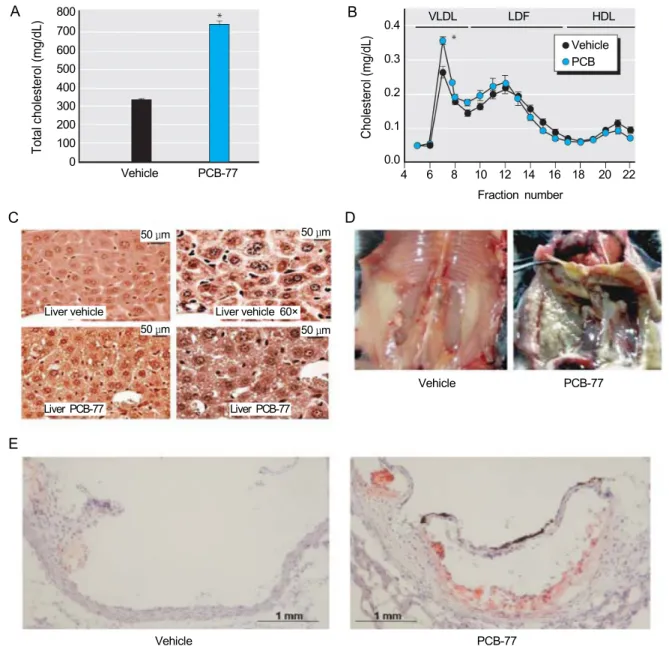
Fig. 1. Effects of PCB-77 on total serum cholesterol and VLDL cholesterol concentrations, lipid deposition within the liver and abdominal cavity, and atherosclerosis in ApoE–/– mice.24 (A) Total serum cholesterol concentrations (n=10 mice per group). Total serum cholesterol concentrations were markedly increased in ApoE–/– mice injected with PCB-77 compared with vehicle, (B) Lipoprotein cholesterol distributions (n=4 mice per group). Elevations in serum cholesterol concentrations in PCB-77–treated mice were predominantly in very low-density lipoprotein (VLDL) cholesterol, (C) Representative tissue sections from livers of mice injected with vehicle or PCB-77. Compared with vehicle-treated mice, tissue sections of liver from mice administered PCB-77 exhibited lipid-laden vacuoles, (D) Administration of PCB-77 resulted in marked deposition of lipid within the abdominal cavity, (E) Aortic root sections stained with oil red O from vehicle or PCB-77–injected mice.
Administration of PCB-77 to ApoE–/– mice increased atherosclerosis in aortic root sections. *Significantly different from vehicle (p<0.05).
aryl hydrocarbon receptor (AhR) 길항제를 주게 되면 TCDD에 의한 죽상경화변병의 진행이 억제되었다는 것이다.22
수컷 C57BL/6 생쥐에 300 ng TCDD/kg를 주당 3번씩 60일 동안 튜브를 통해 투여하면 고혈압과 함께 심장 무게의 증가,
좌심실비대가 유도되었다.23 이는 신장, 심장, 대동맥 조직에 superoxide 생성 증가와 동반되었고, 특히 대동맥에서 supero- xide의 생성 증가는 혈관 내피세포기능 이상을 초래하였다. 이러 한 내피세포의 기능이상은 superoxide dismutase (SOD)
mimetic 투여로 회복되는 결과를 보여 주어 TCDD가 superoxide 생성 증가를 통해 고혈압과 심근 비후를 유도함을 알 수 있었다.23
C57BL/6 생쥐에 PCB의 동질체 중 하나인 PCB-77을 복강 내로 6주간 투여하면 체중이 증가하는데, AhR 결핍 생쥐에서는 이러한 체중 증가가 관찰되지 않아 PCB-77의 비만 유도 효과는 AhR을 통한 작용임을 알 수 있다.24 한편, ApoE 결핍 생쥐에도 PCB-77을 투여하면 체중 증가, 지방 세포 비후, 이상지질혈증, 죽상경화증의 악화가 관찰되었다(Fig. 1).24
PCB-77을 복강 주사하면 대동맥 조직에서 VCAM-1의 발현이 증가하고 ApoE 결핍 생쥐에 Angiotensin II와 함께 PCB-77을 투여하면 Angiotensin II만 투여한 생쥐에 비해 수축기 혈압이 더 높고(156±6 vs 137±5 mmHg), 대동맥궁의 죽상경화 병변이 더 크게 형성되며(2.0±0.4 vs 0.9±0.1%), 복부대동맥류의 발생 빈도가 증가되었다(85% vs 47%).25 이 연구에서도 PCB-77을 투여받은 생쥐의 복부대동맥류 부근의 지방 조직에서 TNF-a, IL-1b, MCP1과 같은 염증성 사이토카인의 발현이 증가되어 있었다.
이상의 동물 연구에서 볼 때 TCDD나 PCB와 같은 POPs는 AhR를 통해 산화 스트레스와 염증 반응을 증가시키고, 이상지질 혈증, 체중 증가, 인슐린 저항성 혹은 내당능장애를 초래하는 작용을 통해 죽상경화증을 유도하리라 생각된다.
2. Atrazine
아트라진 제초제와 심혈관질환 혹은 죽상경화증에 대해서는 연구 결과가 거의 없는 상태이다. 임 등26은 미국의 비만 인구 분포와 아트라진 제초제의 사용 지역이 일치한다는 생각에서 출발 하여 아트라진이 미토콘드리아 기능을 손상시켜 인슐린 저항성과 비만을 초래할 것이라는 가설 아래 Sprague-Dawley rat에 5개월 동안 저농도의 아트라진을 투여하였다. 동시에 정상 식이와 고지 방식이를 진행하면서 인슐린 저항성과 관련된 지표들의 변화를 관찰하였다. 5개월간의 아트라진 투여는 기초 대사량 감소, 체중 증가, 복부 지방과 인슐린 저항성 증가를 유도하였다. 이에 더하여 고지방식이는 인슐린 저항성과 비만을 더욱 악화시켰다. 아트라진 을 투여받은 쥐의 골격근과 간조직 미토콘드리아는 형태가 부풀고 cristae가 파괴되어 있었다. 아트라진은 oxidative phosphory- lation complexes I과 III의 활성을 억제하여 산소 소모량을 감소시 켰고, 인슐린 매개 Akt의 인산화를 억제하였다. 이런 결과는 아트 라진 제초제에 장기간 노출되면 인슐린 저항성과 비만이 발생하며, 특히 고지방식이를 하는 경우 이런 상황이 더욱 조장될 수 있음을
보여주었다. 최근에 재태 기간 동안 아트라진에 노출된 Sprague- Dawley rat에서 7-10주 후 혈압이 대조군에 비해 증가하여 지속 적으로 더 높았다는 보고가 있었다.27
3. BPA
BPA와 심혈관질환의 위험에 대해서는 기전적 연구가 매우 부족하다. BPA가 죽상경화증의 위험 인자인 내당능장애, 인슐린 저항성, 비만과 관련된다는 동물 연구들은 많이 되어 있어 이를 통해 간접적으로 죽상경화증을 유발하거나 악화시킬 수 있을 것으 로 생각되나 직접적으로 죽상경화증을 유발한다는 연구 결과는 거의 없다. 이에 저자들은 BPA가 직접적으로 죽상경화를 촉진시 키는지 ApoE 결핍 생쥐를 통해 알아보았다.28 ApoE 결핍 생쥐에 12주간 고지방 고콜레스테롤 식이를 시행하면서 50 μg/kg body weight/day의 BPA를 투여하였다. Oil red O 염색을 통해 대동맥 의 죽상경화 병변을 관찰하여 보았을 때, BPA 투여군이 대조군에 비해 죽상경화 병변이 유의하게 증가하였다(6.1±1.2% vs. 2.7
±0.2%, p=0.04, Fig. 2). 이는 BPA 투여군에서 non-HDL 콜레 스테롤 수치의 유의한 증가와 동반되었다(1,035±70 mg/dL vs.
484±48 mg/dL, p=0.02). HUVEC 세포주에서 0.1–10 nM BPA 처리는 세포의 증식이나 이주에 영향이 없었다. 따라서, ApoE 결핍 생쥐에서 BPA에 의한 죽상경화증의 증가는 non-HDL 콜레스테롤의 증가에 의한 것으로 생각된다. 저자들의 실험 외에 도 실험 동물에서 BPA 투여 시 혈중 지질 농도가 증가한다는 몇몇 보고가 있다. Wei 등의 연구에서는 임신한 Wistar rat을 재태 기간과 수유기 동안 하루 50 µg/kg body weight의 BPA에 노출시키고 여기서 태어난 새끼들에서 여러 대사적 변화를 관찰하 였다.29 이 실험에서는 수컷 생쥐에서만 중성지방의 증가와 HDL 콜레스테롤의 감소가 관찰되었고, 고지방식이 시 이러한 변화가 더욱 뚜렷하여 암컷과 수컷 생쥐 모두에서 총콜레스테롤, 중성지 방, LDL 콜레스테롤의 증가 및 HDL 콜레스테롤의 감소가 나타났 다. 그러나, 이러한 변화가 사람에게도 그대로 적용될 수 있을지에 대해서는 보다 많은 연구가 필요한 상황이다. 예전에 발표된 대규 모 역학 연구의 결과들에서 보면 사람에서는 소변 BPA 농도의 증가에 따른 콜레스테롤의 변화는 뚜렷하지 않았다
BPA가 내당능장애를 유발하는지에 대해서는 논란이 있는 상황 이다. Ryan 등은 CD-1 생쥐의 재태 기간부터 생후 21일째 이유기 까지 하루 약 0.25 µg/kg body weight의 BPA를 투여했을 때, 4주령까지의 성장이 BPA에 노출되지 않은 생쥐에 비해 성장이
Fig. 2. Atherosclerotic lesions in the aorta and aortic sinus of ApoE−/− mice. (A) Representative photographs of aortas stained with Oil red O. Magnification ×40, (B) Representative photographs of aortic sinuses stained with Oil red O. Scale bars represent 1 mm, (C) Representative photographs of aortic sinuses stained with an anti-F4/80 antibody. Scale bars represent 1 mm.
빠를 뿐이지 이후 고지방식이를 시행하더라도 내당능장애나 비만 이 발생하지 않음을 보여 주어 BPA 자체가 비만을 유발하거나 당뇨병과 같은 대사 질환의 원인이 아님을 주장하였다.30 그러나, 연이어 발표된 Wei 등의 연구에서는 임신한 Wistar rat을 재태 기간과 수유기 동안 하루 50 µg/kg body weight의 BPA에 노출시켰을 때 여기서 태어난 새끼들은 이후 정상 식이에도 체중 증가, 혈중 인슐린 증가, 내당능장애를 보였고, 이러한 변화는 고지방식이를 시행한 경우 더욱 가속화되어 비만, 이상지질혈증, 고렙틴혈증, 고혈당, 고인슐린혈증, 내당능장애 등의 심한 대사 이상이 관찰되었다.29 흥미롭게도 보다 더 높은 용량인 일일 250 과 1,250 µg/kg body weight에 노출된 랫트에서는 고지방식이 를 하더라도 이러한 변화가 관찰되지 않았다. 이는 BPA의 효과가 전형적인 용량–반응 곡선을 따르지 않는다는 것을 보여 주는 한 예라 할 수 있다.
환경오염물질이 죽상경화증을 유발하는 기전
POPs중 다수와 BPA는 성호르몬 수용체에 결합하는 작용제 혹은 길항제로 성호르몬 수용체에 결합하여 작용을 나타낼 수 있다. BPA의 경우 대표적인 에스트로젠 유사 물질이지만 17β- estradiol에 비해 100-10,000배 낮은 약한 에스트로젠 효과를 가지고 있다. 하지만, BPA는 전형적인 핵내 estrogen receptor α (ERα) 뿐 아니라 세포질, 미토콘드리아, 세포막에 존재하는 핵외 ERα, ERβ에 결합하여 Src, Phosphatidylinositol-4, 5-bisphosphate 3-kinase (PI3-Kinase), EGFR, IGF-1R와 같은 receptor tyrosine kinase, cAMP, cGMP, Ca2+과 같은 이차신 호전달물질의 활성화 등 여러 가지 다른 신호전달체계를 통해 작용할 것으로 생각된다.31
그 외 BPA가 심혈관질환의 위험인자인 당뇨병과 인슐린 저항 성, 비만의 발생에 어떻게 기여할 수 있을지를 시사하는 많은
A B
C
Control BPA
Control BPA Control BPA
전임상연구들이 있다. 먼저, BPA는 췌장 베타 세포의 기능을 교란시킨다. 일회성 BPA에의 노출은 포도당 유도 칼슘 진동 (glucose-induced Ca2+ oscillation)을 증가시켜 인슐린 분비를 증가시킨다.32 그러나, 8-10주령의 생쥐를 이보다 좀 더 오래 4일 혹은 8일간 BPA에 노출시키면 인슐린 저항성과 식후 고인슐 린혈증이 유발된다.33 둘째, BPA는 지방세포에서 아디포넥틴의 생산과 분비를 억제할 수 있다. 아디포넥틴은 잘 알려진 인슐린 감수성을 증가시키는 adipocytokine으로 이의 감소는 인슐린 저항성을 증가시킬 수 있으며 죽상경화증의 발생에도 기여할 수 있다. 0.1과 1 nM의 BPA는 사람의 유방, 피하지방, 내장 지방 조직에서 공히 아디포넥틴의 분비를 억제하였고,34 지방세포에서 Akt 신호전달을 감소시켰다.35 셋째, BPA는 지방 세포에서 지방세 포의 분화를 촉진하고 지방 축적을 증가시키며 지방분화에 관여하 는 유전자의 발현을 증가시킨다. 이와 관련하여 생쥐와 랫트를 포함한 동물 실험에서 주산기 BPA 노출은 새끼와 이후 성체에서 체중 증가를 초래하였다.36-39 넷째, BPA는 인슐린 반응 조직에서 산화 스트레스의 증가와 미토콘드리아 기능 이상을 통해 인슐린 저항성을 유도한다.40-43 저자들은 5일간 생쥐를 하루 0.05와 1.2 mg/kg body weight의 BPA에 노출시켜 간조직의 미토콘드 리아의 구조적 변화와 산소 소모량의 감소, respiratory complex 단백질 발현이 감소함을 관찰하였다.40 이는 간조직에서 malon- dialdehyde (MDA)의 증가와 항산화 효소인 glutathione peroxidase 3 (GPx3)의 발현 감소와 동반되었다. HepG2 cell에 서 10 또는 100 nM BPA를 처리하면 동물 실험에서와 유사하게 산소 소모량, ATP 생산 및 미토콘드리아 막전위가 감소하였다.
앞서 동물 실험 결과에서도 언급한 것처럼 다이옥신과 다이옥신 유사 PCB 들은 AhR를 통해 작용을 나타냄이 잘 알려져 있다.
AhR은 다이옥신에 의해 활성화된 후 cytochrome P450 효소인 CYP1A1의 활성을 증가시키고, 그 결과 반응 산소족(reactive oxygen species (ROS))의 생성과 염증 반응이 증가한다.44,45 또한, 다이옥신에 의한 AhR 활성화에 의해 세포자멸사(apoptosis rate)와 세포 주기의 변화가 유발된다.46-49 이렇게 증가된 ROS에 의한 LDL 산화 증가 및 낮은 정도의 만성 염증 반응에 의해 죽상경 화증이 촉진되고, 혈관 평활근 세포의 자멸사로 인해 경화반이 쉽게 파열되고 혈전이 형성되는 기전이 될 수 있다.
POPs와 여러 만성 질환과의 관계를 연구할 때 문제점 중 하나는 실제 사람에서 수없이 많은 POPs가 존재하며, 이들의 총합이 각 개인에서 최종적인 POPs의 효과를 나타낼 것으로 생각되지만,
이제까지 해 온 연구들은 알려진 POPs를 한 가지 혹은 몇 가지를 측정하여 각종 질병 혹은 대사 지표와의 연관성을 분석해왔다.
모든 종류의 POPs를 다 측정한다는 것은 실제적으로는 불가능하 고, 그 중 중요하다고 생각되는 몇 가지의 POPs의 측정 또한 많은 비용과 많은 혈액량이 요구된다. 이런 제한점을 극복하고자 체내 다이옥신과 다이옥신 유사물질의 양을 잘 반영하는 AhR 리간드의 활성을 측정하는 방법을 사용하기도 한다.50,51 이 방법을 이용한 연구에서 97명의 한국인에서 혈중 AhR 리간드의 활성을 측정하였는데, 예상한 대로 내당능장애가 있는 사람에서 정상 혈당인에 비해 혈중 AhR 리간드의 활성이 높았고, AhR 리간드의 활성과 체질량지수, 혈압, 공복 혈당, 혈청 중성지방농도가 양의 상관관계에 있었다. 더욱 흥미로운 것은 혈중 AhR 리간드 활성이 높아짐에 따라 미토콘드리아의 ATP 생산 능력이 감소되는 결과를 보여 주어 POPs에 의한 미토콘드리아 기능 이상과 비만, 내당능장 애를 연결지었다는 것이다.52
그 외 프탈레이트는 peroxisome proliferator-activated receptor에 작용하여 지방 세포의 분화, 지질 대사 및 인슐린 저항성, 당뇨병 발생에 작용할 수 있다.53
결 론
산업화, 도시화로 인해 인류가 유래 없는 풍족한 고열량 음식을 향유하면서 한편으로는 평균 수명 증가, 운동량 감소 등 생활 양식의 변화로 인해 심혈관질환이 증가된 것으로 이해해 왔다.
그러나, 이와 함께 POPs, BPA, 아트라진, 프탈레이트 등 규제되지 않은 많은 화학 물질들 또한 비만, 고지혈증, 인슐린저항성, 고혈 압, 죽상경화증, 심혈관질환을 유발하는 데 관여해온 것으로 생각 된다. 그러나, 사람에서 이런 환경오염물질이 직접적으로 죽상경 화증을 유발하거나 진행시키는데 기여하는지를 보는 임상 연구는 불가능하기 때문에 앞으로도 더욱 명확한 답을 얻는 데는 한계가 있을 것으로 생각된다. 혈액이나 조직의 환경오염물질의 농도나 활성을 측정하고 이후 다양한 대사 질환의 발생을 관찰하는 종적 연구나 이들의 활성을 개선할 수 있는 치료를 통해 이런 질환의 발생이 예방되는지를 보는 연구가 현실적으로 가장 필요할 것으로 보인다. 물론, 이를 위해서 환경오염물질 농도나 활성 측정 방법의 정확도를 높이고 표준화하는 것이 매우 중요한 과제라 할 수 있겠 다.
한편 현재까지 수 만종 이상의 화학 물질이 별다른 안전성
정보 없이 사용되어 왔다는 것은 놀라운 사실이다. 2007년부터 REACH (Registration, Evaluation, Authorization and Res- triction of Chemicals) 제도가 시행되어 유럽 연합에서 연간 1톤 이상 생산되거나 수입되는 모든 화학 물질에 대해 관리를 하고 있고, 국내에서도 내년부터 신규화학물질이나 연간 1톤 이상 기존화학물질을 제조, 수입 시 물질에 대한 유해성, 위해성정보를 첨부하여 등록해야 하는 화학 물질 평가 및 등록에 관한 법률 및 화학물질관리법이 본격적으로 시행될 예정이다. 이러한 관리 노력들을 통해 환경오염물질에 노출됨으로써 초래될 수 있는 대사 질환과 심혈관질환 발생위험이 감소되기를 기대한다.
참고문헌
1. Statistics Korea. Cause of death statistics 2012. Daejeon:
Statistics Korea; 2013.
2. Bertazzi PA, Consonni D, Bachetti S, Rubagotti M, Baccarelli A, Zocchetti C, et al. Health effects of dioxin exposure: a 20-year mortality study. Am J Epidemiol 2001;153:1031-1044.
3. Bertazzi PA, Bernucci I, Brambilla G, Consonni D, Pesatori AC. The Seveso studies on early and long-term effects of dioxin exposure: a review. Environ Health Perspect 1998;106 Suppl 2:625-633.
4. Hooiveld M, Heederik DJ, Kogevinas M, Boffetta P, Needham LL, Patterson DG Jr, et al. Second follow-up of a Dutch cohort occupationally exposed to phenoxy herbicides, chlorophenols, and contaminants. Am J Epidemiol 1998;147:891-901.
5. Pesatori AC, Zocchetti C, Guercilena S, Consonni D, Turrini D, Bertazzi PA. Dioxin exposure and non- malignant health effects: a mortality study. Occup Environ Med 1998;55:126-131.
6. Vena J, Boffetta P, Becher H, Benn T, Bueno-de- Mesquita HB, Coggon D, et al. Exposure to dioxin and nonneoplastic mortality in the expanded IARC inter- national cohort study of phenoxy herbicide and chloro- phenol production workers and sprayers. Environ Health Perspect 1998;106 Suppl 2:645-653.
7. Ha MH, Lee DH, Jacobs DR. Association between serum concentrations of persistent organic pollutants and self-reported cardiovascular disease prevalence: results from the National Health and Nutrition Examination
Survey, 1999-2002. Environ Health Perspect 2007;115:
1204-1209.
8. Lang IA, Galloway TS, Scarlett A, Henley WE, Depledge M, Wallace RB, et al. Association of urinary bisphenol A concentration with medical disorders and laboratory abnormalities in adults. JAMA 2008;300:1303-1310.
9. Melzer D, Osborne NJ, Henley WE, Cipelli R, Young A, Money C, et al. Urinary bisphenol A concentration and risk of future coronary artery disease in apparently healthy men and women. Circulation 2012;125:1482- 1490.
10. Lind L, Lind PM. Can persistent organic pollutants and plastic-associated chemicals cause cardiovascular disease?
J Intern Med 2012;271:537-553.
11. Van den Berg M, Birnbaum LS, Denison M, De Vito M, Farland W, Feeley M, et al. The 2005 World Health Organization reevaluation of human and Mammalian toxic equivalency factors for dioxins and dioxin-like compounds. Toxicol Sci 2006;93:223-241.
12. Wang SL, Tsai PC, Yang CY, Guo YL. Increased risk of diabetes and polychlorinated biphenyls and dioxins: a 24-year follow-up study of the Yucheng cohort. Diabetes Care 2008;31:1574-1579.
13. Gustavsson P, Hogstedt C. A cohort study of Swedish capacitor manufacturing workers exposed to poly- chlorinated biphenyls (PCBs). Am J Ind Med 1997;32:
234-239.
14. Calvert GM, Wall DK, Sweeney MH, Fingerhut MA.
Evaluation of cardiovascular outcomes among U.S.
workers exposed to 2,3,7,8-tetrachlorodibenzo-p- dioxin. Environ Health Perspect 1998;106 Suppl 2:635- 643.
15. Kang HK, Dalager NA, Needham LL, Patterson DG Jr, Lees PS, Yates K, et al. Health status of Army Chemical Corps Vietnam veterans who sprayed defoliant in Vietnam. Am J Ind Med 2006;49:875-884.
16. Sergeev AV, Carpenter DO. Hospitalization rates for coronary heart disease in relation to residence near areas contaminated with persistent organic pollutants and other pollutants. Environ Health Perspect 2005;113:756- 761.
17. Lee DH, Lind L, Jacobs DR Jr, Salihovic S, van Bavel B, Lind PM. Associations of persistent organic pollutants with abdominal obesity in the elderly: the Prospective
Investigation of the Vasculature in Uppsala Seniors (PIVUS) study. Environ Int 2012;40:170-178.
18. Brotons JA, Olea-Serrano MF, Villalobos M, Pedraza V, Olea N. Xenoestrogens released from lacquer coatings in food cans. Environ Health Perspect 1995;103:608- 612.
19. Olea N, Pulgar R, Pérez P, Olea-Serrano F, Rivas A, Novillo-Fertrell A, et al. Estrogenicity of resin-based composites and sealants used in dentistry. Environ Health Perspect 1996;104:298-305.
20. Wang T, Li M, Chen B, Xu M, Xu Y, Huang Y, et al.
Urinary bisphenol A (BPA) concentration associates with obesity and insulin resistance. J Clin Endocrinol Metab 2012;97:E223-E227.
21. Dalton TP, Kerzee JK, Wang B, Miller M, Dieter MZ, Lorenz JN, et al. Dioxin exposure is an environmental risk factor for ischemic heart disease. Cardiovasc Toxicol 2001;1:285-298.
22. Wu D, Nishimura N, Kuo V, Fiehn O, Shahbaz S, Van Winkle L, et al. Activation of aryl hydrocarbon receptor induces vascular inflammation and promotes athero- sclerosis in apolipoprotein E-/- mice. Arterioscler Thromb Vasc Biol 2011;31:1260-1267.
23. Kopf PG, Huwe JK, Walker MK. Hypertension, cardiac hypertrophy, and impaired vascular relaxation induced by 2,3,7,8-tetrachlorodibenzo-p-dioxin are associated with increased superoxide. Cardiovasc Toxicol 2008;8:
181-193.
24. Arsenescu V, Arsenescu RI, King V, Swanson H, Cassis LA. Polychlorinated biphenyl-77 induces adipocyte diffe- rentiation and proinflammatory adipokines and pro- motes obesity and atherosclerosis. Environ Health Perspect 2008;116:761-768.
25. Arsenescu V, Arsenescu R, Parulkar M, Karounos M, Zhang X, Baker N, et al. Polychlorinated biphenyl 77 augments angiotensin II-induced atherosclerosis and abdominal aortic aneurysms in male apolipoprotein E deficient mice. Toxicol Appl Pharmacol 2011;257:148- 154.
26. Lim S, Ahn SY, Song IC, Chung MH, Jang HC, Park KS, et al. Chronic exposure to the herbicide, atrazine, causes mitochondrial dysfunction and insulin resistance. PLoS One 2009;4:e5186.
27. Rogers JM, Ellis-Hutchings RG, Grey BE, Zucker RM,
Norwood J Jr, Grace CE, et al. Elevated blood pressure in offspring of rats exposed to diverse chemicals during pregnancy. Toxicol Sci 2014;137:436-446.
28. Kim MJ, Moon MK, Kang GH, Lee KJ, Choi SH, Lim S, et al. Chronic exposure to bisphenol A can accelerate atherosclerosis in high-fat-fed apolipoprotein E knock- out mice. Cardiovasc Toxicol. Forthcoming 2013.
29. Wei J, Lin Y, Li Y, Ying C, Chen J, Song L, et al. Perinatal exposure to bisphenol A at reference dose predisposes offspring to metabolic syndrome in adult rats on a high-fat diet. Endocrinology 2011;152:3049-3061.
30. Ryan KK, Haller AM, Sorrell JE, Woods SC, Jandacek RJ, Seeley RJ. Perinatal exposure to bisphenol-a and the development of metabolic syndrome in CD-1 mice.
Endocrinology 2010;151:2603-2612.
31. Alonso-Magdalena P, Ropero AB, Soriano S, García- Arévalo M, Ripoll C, Fuentes E, et al. Bisphenol-A acts as a potent estrogen via non-classical estrogen triggered pathways. Mol Cell Endocrinol 2012;355:201-207.
32. Nadal A, Ropero AB, Laribi O, Maillet M, Fuentes E, Soria B. Nongenomic actions of estrogens and xenoestrogens by binding at a plasma membrane receptor unrelated to estrogen receptor alpha and estrogen receptor beta.
Proc Natl Acad Sci U S A 2000;97:11603-11608.
33. Alonso-Magdalena P, Morimoto S, Ripoll C, Fuentes E, Nadal A. The estrogenic effect of bisphenol A disrupts pancreatic beta-cell function in vivo and induces insulin resistance. Environ Health Perspect 2006;114:106-112.
34. Hugo ER, Brandebourg TD, Woo JG, Loftus J, Alexander JW, Ben-Jonathan N. Bisphenol A at environmentally relevant doses inhibits adiponectin release from human adipose tissue explants and adipocytes. Environ Health Perspect 2008;116:1642-1647.
35. Kidani T, Kamei S, Miyawaki J, Aizawa J, Sakayama K, Masuno H. Bisphenol A downregulates Akt signaling and inhibits adiponectin production and secretion in 3T3-L1 adipocytes. J Atheroscler Thromb 2010;17:834- 843.
36. Rubin BS, Murray MK, Damassa DA, King JC, Soto AM.
Perinatal exposure to low doses of bisphenol A affects body weight, patterns of estrous cyclicity, and plasma LH levels. Environ Health Perspect 2001;109:675-680.
37. Rubin BS, Soto AM. Bisphenol A: perinatal exposure and body weight. Mol Cell Endocrinol 2009;304:55-62.
38. Howdeshell KL, Hotchkiss AK, Thayer KA, Vandenbergh JG, vom Saal FS. Exposure to bisphenol A advances puberty. Nature 1999;401:763-764.
39. Somm E, Schwitzgebel VM, Toulotte A, Cederroth CR, Combescure C, Nef S, et al. Perinatal exposure to bis- phenol a alters early adipogenesis in the rat. Environ Health Perspect 2009;117:1549-1555.
40. Moon MK, Kim MJ, Jung IK, Koo YD, Ann HY, Lee KJ, et al. Bisphenol A impairs mitochondrial function in the liver at doses below the no observed adverse effect level.
J Korean Med Sci 2012;27:644-652.
41. Nakagawa Y, Tayama S. Metabolism and cytotoxicity of bisphenol A and other bisphenols in isolated rat hepatocytes. Arch Toxicol 2000;74:99-105.
42. Bindhumol V, Chitra KC, Mathur PP. Bisphenol A induces reactive oxygen species generation in the liver of male rats. Toxicology 2003;188:117-124.
43. Asahi J, Kamo H, Baba R, Doi Y, Yamashita A, Murakami D, et al. Bisphenol A induces endoplasmic reticulum stress-associated apoptosis in mouse non-parenchymal hepatocytes. Life Sci 2010;87:431-438.
44. Shertzer HG, Nebert DW, Puga A, Ary M, Sonntag D, Dixon K, et al. Dioxin causes a sustained oxidative stress response in the mouse. Biochem Biophys Res Commun 1998;253:44-48.
45. Puga A, Hoffer A, Zhou S, Bohm JM, Leikauf GD, Shertzer HG. Sustained increase in intracellular free calcium and activation of cyclooxygenase-2 expression in mouse hepatoma cells treated with dioxin. Biochem Pharmacol 1997;54:1287-1296.
46. Sadhu DN, Merchant M, Safe SH, Ramos KS. Modulation of protooncogene expression in rat aortic smooth muscle cells by benzo[a]pyrene. Arch Biochem Biophys
1993;300:124-131.
47. Nebert DW, Roe AL, Dieter MZ, Solis WA, Yang Y, Dalton TP. Role of the aromatic hydrocarbon receptor and [Ah] gene battery in the oxidative stress response, cell cycle control, and apoptosis. Biochem Pharmacol 2000;59:65-85.
48. Kim KY, Kim DS, Lee SK, Lee IK, Kang JH, Chang YS, et al. Association of low-dose exposure to persistent organic pollutants with global DNA hypomethylation in healthy Koreans. Environ Health Perspect 2010;118:
370-374.
49. Thackaberry EA, Jiang Z, Johnson CD, Ramos KS, Walker MK. Toxicogenomic profile of 2,3,7,8-tetrachlorodi- benzo-p-dioxin in the murine fetal heart: modulation of cell cycle and extracellular matrix genes. Toxicol Sci 2005;88:231-241.
50. Murk AJ, Legler J, Denison MS, Giesy JP, van de Guchte C, Brouwer A. Chemical-activated luciferase gene expression (CALUX): a novel in vitro bioassay for Ah receptor active compounds in sediments and pore water.
Fundam Appl Toxicol 1996;33:149-160.
51. Joung KE, Chung YH, Sheen YY. DRE-CALUX bioassay in comparison with HRGC/MS for measurement of toxic equivalence in environmental samples. Sci Total Environ 2007;372:657-667.
52. Park WH, Jun DW, Kim JT, Jeong JH, Park H, Chang YS, et al. Novel cell-based assay reveals associations of circulating serum AhR-ligands with metabolic syndrome and mitochondrial dysfunction. Biofactors 2013;39:494- 504.
53. Desvergne B, Feige JN, Casals-Casas C. PPAR-mediated activity of phthalates: a link to the obesity epidemic? Mol Cell Endocrinol 2009;304:43-48.