R E S E A R C H A R T I C L E Open Access
Vitamin D status and associated occupational factors in Korean wage workers: data from the 5th Korea national health and nutrition
examination survey (KNHANES 2010 –2012)
Harin Jeong1*, Sujin Hong1, Yunjeong Heo1, Hosun Chun1, Daeseong Kim1, Jongtae Park1and Mo-yeol Kang2
Abstract
Objectives: Vitamin D deficiency is increasing worldwide. However, few studies have attempted to examine the vitamin D status of wage workers and the correlation between vitamin D deficiency and working conditions.
Hence, we aimed to evaluate the prevalence of vitamin D deficiency and the association between occupational conditions and vitamin D deficiency among Korean wage workers.
Methods: Wage workers aged 20–65 years from the 5th Korea National Health and Nutrition Examination Survey (KNHANES 2010–2012; n = 5409) were included in our analysis. We measured the prevalence of vitamin D deficiency and identified the correlations with the working conditions of these subjects.
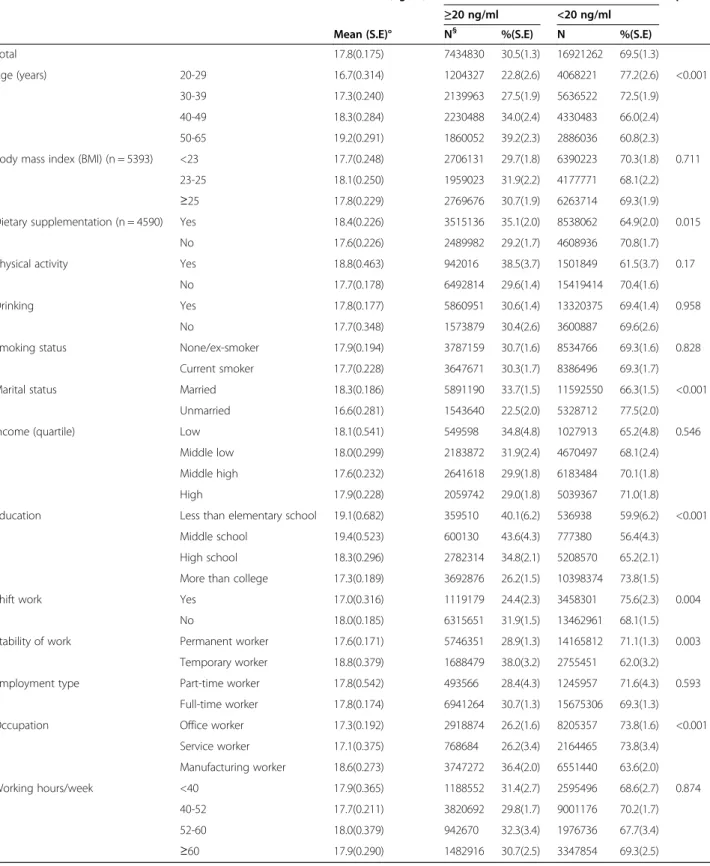
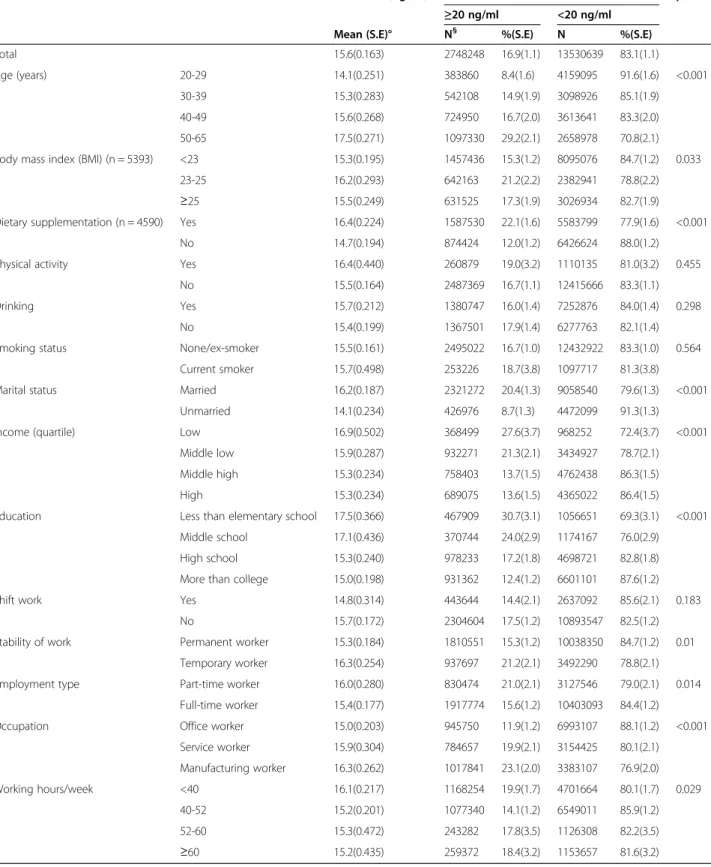
Results: The prevalence of vitamin D deficiency in male and female subjects was 69.5% and 83.1%, respectively.
Among the male subjects, a significant correlation between vitamin D deficiency and working conditions was observed among shift workers, office workers, and permanent workers. No significant correlation with any type of working conditions was observed among female subjects.
Conclusion: The prevalence of vitamin D deficiency among Korean wage workers was very high and was found to correlate significantly with working conditions, likely because of insufficient exposure to sunlight associated with certain types of work. Wage workers require more frequent outdoor activity and nutrition management to maintain sufficient vitamin D level.
Keywords: Vitamin D deficiency, Shift work, Office work, Indoor work, KNHANES
Introduction
Vitamin D (25-hydroxyvitamin D; 25 (OH) D) deficiency is common in the general Korean population, and the in- creasing trend in vitamin D deficiency is a worldwide phenomenon [1-3]. Vitamin D deficiency is thought to be caused by lifestyle factors such as indoor confinement for a considerable period of the day, consumption of an im- balanced diet and low-quality (nutrient-poor) food, and widespread use of sunblock. Furthermore, in many big cit- ies, air pollution and blockage of sunlight by high-rise buildings also contributes to vitamin D deficiency [4,5].
Workers with vitamin D deficiency often present with common symptoms such as non-specific weakening of the muscles and myalgia, and these symptoms may be confused for fibromyalgia or chronic fatigue syndrome.
In many cases, the musculoskeletal diseases of workers are attributed to the intensity of the work they perform or to their posture at work, whereas, unfortunately, vita- min D deficiency is seldom considered the potential cause of the symptoms [6-10].
Among the limited number of studies on the topic, most have focused on the prevalence of vitamin D deficiency by job, rather than on establishing a concrete correlation with working conditions [11]. Among the studies on the rela- tionship of vitamin D deficiency and working conditions, limited studies examined miners who work underground
* Correspondence:[email protected]
1Department of Occupational Medicine, Korea University Hosipital, 123, Jeokgeum-ro, Ansan, Gyeonggido, Republic of Korea
Full list of author information is available at the end of the article
© 2014 Jeong et al.; licensee BioMed Central Ltd. This is an Open Access article distributed under the terms of the Creative Commons Attribution License (http://creativecommons.org/licenses/by/4.0), which permits unrestricted use, distribution, and reproduction in any medium, provided the original work is properly credited. The Creative Commons Public Domain Dedication waiver (http://creativecommons.org/publicdomain/zero/1.0/) applies to the data made available in this article, unless otherwise stated.
for long hours [12]. The theoretical probability of the cor- relation between vitamin D deficiency and working condi- tions, such as shift work, has been noted. For example, the lack of vitamin D may play a role in the potential bio- logical mechanisms of shift work as a “carcinogen” [13].
However, despite the theoretical probability of such correlations between working conditions and vitamin D deficiency, few attempts to examine their actual epidemio- logical correlation have been carried out [14,15]. Clinical attention to vitamin D deficiency has been mainly focused on growth in children, fractures in the elderly, and de- creased bone density [16-18]. Perhaps because the causes and treatment of vitamin D deficiency are simple and ob- vious, researchers have not considered the need to manage the working conditions of healthy workers as well [19].
Vitamin D is widely recognized as important for bone health and maintenance. Moreover, vitamin D, which is known mainly for its role in calcium homeostasis and musculoskeletal conditions such as rickets and osteo- malacia, is now also thought to be involved in various disease and pathologic processes such as cancer, cardio- vascular disorders, and inflammation. Recently, vitamin D has been reconceptualized as a“hormone” rather than just a “nutrient” [20,21]. As increasing the vitamin D levels of workers may improve their musculoskeletal sta- tus and reduce the risk of chronic diseases, including some cancers, autoimmune diseases, infectious diseases, and type 2 diabetes mellitus, we investigated here the status of vitamin D deficiency and the association be- tween serum vitamin D levels and working conditions in Korean wage workers to identify correctable occupa- tional factors [22-24].
Materials and methods Subjects
The Korea National Health and Nutrition Examination Survey (KNHANES) is one of the most representative surveys of the entire national population of the Republic of Korea. It is administered by the Ministry of Health and Welfare as a means to evaluate the status of health and nutrition of Koreans nationwide. The fifth survey (2010–2012) continued the use of the rolling sampling survey method. This survey separated the ordinary resi- dential areas from areas containing apartments to apply two different sets of sampling frameworks (examining the residential registration data for the ordinary resi- dential areas and surveying market price trends in the apartment areas). Based on the complex samples, each of these areas was internally stratified. Twenty house- holds were surveyed per area, and each household participated in interviews, medical examinations, and nutritional examinations. Interview personnel with rele- vant training visited the sample households in the area to conduct surveys using structured questionnaires to
gather demographic, socio-economic, occupational, and health status information.
Out of the total of 25,534 subjects who participated in the fifth survey (2010–2012), 5,686 subjects who identi- fied themselves as“wage workers” and were aged 20–65 years were selected for this study. Of these subjects, those who answered the questions related to their work- ing conditions with “I do not know” or did not answer (n = 56), those who did not undergo a vitamin D exam- ination (n = 166), and those who did not answer the questions regarding their income, drinking habits, and smoking status (n = 55) were excluded, resulting in 5,409 subjects included in our analysis.
Classification of data
For this study, data regarding age, income, marital sta- tus, education, occupation, whether they worked in shifts, working hours, and total household income were gathered from each of the subjects. The subjects were grouped into 20–29, 30–39, 40–49, and 50–65-year age groups, and were further classified into married and un- married groups, and into“elementary or lower education”,
”middle school”, “high school” and “college or above”
groups. The income level data were calculated by classify- ing the subjects into quartiles by total household income.
For the question “Do you currently smoke?” the sub- jects who answered “Yes” were classified as “current smokers” whereas the remaining subjects were grouped as“ex-smokers and non-smokers”. With regard to drink- ing habits, the subjects were grouped according to whether they had consumed alcohol more than once a month in the past year. As for the nutrition- and exercise-related questions, the subjects were grouped ac- cording to whether they had consumed dietary supple- ments for ≥2 weeks in the past year and whether they performed medium-intensity exercise, accompanied by significant fatigue or shortness of breath, in more than two sessions that lasted for at least 20 minutes each over the past week on≥3 days in a week.
Vitamin D deficiency is defined by most experts as serum vitamin D levels <20 ng/mL (50 nmol/L), although there is no consensus on the optimal levels of serum vita- min D [25-28]. Accordingly, in this study, a cutoff value of 20 ng/mL was used to divide the samples into the“defi- ciency” group and the “normal” group.
As for the type of occupation, the occupation classifi- cation code was used to group the subjects who worked as managers, experts/specialists, or office workers as“of- fice workers”; those who worked in the service or sales sectors as“service workers”; and workers in the fields of agriculture or fishery, and related industries, assembly of machinery, machine operation, and simple labor as
“manufacturing workers”. Those who responded that they worked between 6 a.m. and 6 p.m. were classified
as “daytime workers”; and those who worked in the afternoon (2 p.m. to midnight), at night (from 9 p.m. to 8 a.m. the following day), in regular rotation of shifts be- tween the day shifts and the night shifts, in 24-h shifts, in segmented shifts (working more than two shifts a day), and in irregular shifts, were all classified as “shift workers”. The number of hours the subjects worked was counted based on their answers to the relevant open question in the questionnaire. Based on their responses, they were grouped into <40 hours per week group (which is the legal limitation of working hours in Korea), the 40 ~ 52 hours per week group (which included the legal overtime limitation), and the 52 ~ 60 hours per week group, ≥60 hours per week group. The workers who had a permanent job were classified “permanent workers”, and the others were classified as “temporary workers”. Finally, the workers who worked on a part- time basis were classified as “part-time workers,” and those who answered that they worked full-time were classified as“full-time workers.”
Statistical analysis
The design of the samples in the national survey was based on the complex sample design method. To achieve results without biases, the samples must be ana- lyzed using weights, stratified variables, and cluster vari- ables, which are the primary extraction units. Thus, in this study, the statistical data extracted from the fifth na- tional survey were analyzed similarly, using the inte- grated weights, stratified variables, and cluster variables.
The overall characteristics of the subjects were calcu- lated using frequencies and percentages by gender. The average vitamin D level and the correlation between the prevalence of vitamin D deficiency and the relevant vari- ables were calculated and verified using the t test and the chi-square test. By using logistic regression models, we calculated the odds ratios of vitamin D deficiency as- sociated with the variables on working conditions. The variables showed statistical correlations with vitamin D deficiency in the univariate analyses, and factors already known to affect the vitamin D level (alcohol, smoking, BMI, etc.) were used in the multivariate logistic regres- sion analysis. For the statistical analysis, SPSS version 18.0 (Chicago, IL, USA) was used for statistical analysis, and the statistical significance was set at p < 0.05.
Ethics statement
We used reconstructed dataset from the 5th Korean National Health and Nutrition Examination Survey (KNHANES 2010-2012). All participants in this survey signed an informed consent form and the survey was ap- proved by the institutional review board of Centers for Disease Control and Prevention in Korea (IRB No. 2010- 02CON-21-C, 2011-02CON-06-C, 2012-01EXP-01-2C).
Results
The general characteristics of the subjects without the weight applied are shown in Table 1. Of the 5409 subjects in total, 2868 (53.0%) were men, while 2541 (47.0%) were women. The subjects who reported that they worked in shifts accounted for 18.5% (532/2868) of the male subjects and 17.2% (437/2541) of the female subjects. Those who described themselves as permanent workers were 84.8% of the male and 72.1% of the female subjects. A higher pro- portion of the female subjects than the male subjects were part-time workers, and more women worked in the ser- vice industry. Those who worked under the legal limit for working hours (52 hours) comprised 68.8% of the male and 84.7% of the female subjects (Table 1).
The results of a chi-square analysis using weight are shown in Tables 2 and 3. The vitamin D deficiency preva- lence of men and women, respectively, were 69.5% and 83.1%. Among the male subjects, the prevalence of vita- min D deficiency showed a significant difference depend- ing on the use of food supplements, marital status, and education level. Furthermore, working conditions such as shift work, permanent work, and occupation contributed to significant differences as well (p < 0.05) (Table 2).
Among the female subjects, BMI, food supplements, marital status, family income, and education level con- tributed to significant differences in the prevalence of vitamin D deficiency. The permanent workers (84.7%) showed a higher prevalence of vitamin D deficiency compared to the temporary workers (78.8%), while the prevalence of vitamin D deficiency among the office workers was 88.1%, which was considerably higher than that of the manufacturing workers (79.0%) (Table 3).
The result of a logistic regression model analysis for the male subjects showed that the risk of vitamin D defi- ciency significantly increased with shift work, permanent work, and office work. After some variables were ad- justed, the odds ratio of the shift workers (vs. daytime workers) was 1.456 (CI 1.089-1.946), while the odds ratio of the permanent workers (vs. temporary workers) was 1.420 (CI 1.019 – 1.979). The univariate analysis by oc- cupation showed that the office workers and the service workers both showed significant correlations with vita- min D level. However, after adjustment, only the office workers showed a significant odds ratio of 1.478 (CI 1.098-1.990). Of the female subjects, the correlation be- tween their working conditions and vitamin D deficiency disappeared, which made it impossible to identify a clear occupational factor for vitamin D deficiency (Table 4).
Discussion
This study confirmed that the prevalence of vitamin D deficiency was very high among the wage workers of Korea. Furthermore, we showed here that occupational factors such as shift work and office work were related
to an increased risk of vitamin D deficiency in the male subjects. Only a few previous studies have suggested cor- relations between vitamin D deficiency and working
conditions. In 2011, a British cohort study revealed that women, but not men, working at night and longer hours might be vulnerable to deficits in vitamin D and to the Table 1 General characteristics of the subjects
Male Female Total
N* % N % N %
Total (N) 2868 2541 5409
Age (years) 20-29 385 13.4% 548 21.6% 933 17.2%
30-39 903 31.5% 630 24.8% 1533 28.3%
40-49 793 27.6% 630 24.8% 1423 26.3%
50-65 787 27.4% 733 28.8% 1520 28.1%
Body mass index (BMI) (n = 5393) <23 1040 36.4% 1472 58.1% 2512 46.6%
23-25 741 25.9% 489 19.3% 1230 22.8%
≥25 1077 37.7% 574 22.6% 1651 30.6%
Dietary supplementation (n = 4590) Yes 922 40.3% 1182 51.4% 2104 45.8%
No 1368 59.7% 1118 48.6% 2486 54.2%
Physical activity Yes 254 8.9% 223 8.8% 477 8.8%
No 2614 91.1% 2317 91.2% 4931 91.2%
Drinking Yes 2249 78.4% 1252 49.3% 3501 64.7%
No 619 21.6% 1289 50.7% 1908 35.3%
Smoking status None/ex-smoker 1553 54.1% 2372 93.3% 3925 72.6%
Current smoker 1315 45.9% 169 6.7% 1484 27.4%
Marital status Married 2324 81.0% 1910 75.2% 4234 78.3%
Unmarried 544 19.0% 631 24.8% 1175 21.7%
Income (quartile) Low 154 5.4% 216 8.5% 370 6.8%
Middle low 739 25.8% 645 25.4% 1384 25.6%
Middle high 1020 35.6% 837 32.9% 1857 34.3%
High 955 33.3% 843 33.2% 1798 33.2%
Education Less than elementary school 121 4.2% 285 11.2% 406 7.5%
Middle school 183 6.4% 258 10.2% 441 8.2%
High school 889 31.0% 831 32.7% 1720 31.8%
More than college 1675 58.4% 1167 45.9% 2842 52.5%
Shift work Yes 532 18.5% 437 17.2% 969 17.9%
No 2336 81.5% 2104 82.8% 4440 82.1%
Stability of work Permanent worker 2432 84.8% 1831 72.1% 4263 78.8%
Temporary worker 436 15.2% 710 27.9% 1146 21.2%
Employment type Part-time worker 167 5.8% 638 25.1% 805 14.9%
Full-time worker 2701 94.2% 1903 74.9% 4604 85.1%
Occupation Office worker 1427 49.8% 1232 48.5% 2659 49.2%
Service worker 291 10.1% 598 23.5% 889 16.4%
Manufacturing worker 1150 40.1% 711 28.0% 1861 34.4%
Working hours/week <40 413 14.4% 963 37.9% 1376 25.4%
40-52 1561 54.4% 1188 46.8% 2749 50.8%
52-60 332 11.6% 188 7.4% 520 9.6%
≥60 562 19.6% 202 7.9% 764 14.1%
*Unweighted count.
Table 2 Vitamin D status according to variables (Male)
Vitamin D (ng/ml) Vitamin D p-value
≥20 ng/ml <20 ng/ml
Mean (S.E)° N§ %(S.E) N %(S.E)
Total 17.8(0.175) 7434830 30.5(1.3) 16921262 69.5(1.3)
Age (years) 20-29 16.7(0.314) 1204327 22.8(2.6) 4068221 77.2(2.6) <0.001
30-39 17.3(0.240) 2139963 27.5(1.9) 5636522 72.5(1.9)
40-49 18.3(0.284) 2230488 34.0(2.4) 4330483 66.0(2.4)
50-65 19.2(0.291) 1860052 39.2(2.3) 2886036 60.8(2.3)
Body mass index (BMI) (n = 5393) <23 17.7(0.248) 2706131 29.7(1.8) 6390223 70.3(1.8) 0.711
23-25 18.1(0.250) 1959023 31.9(2.2) 4177771 68.1(2.2)
≥25 17.8(0.229) 2769676 30.7(1.9) 6263714 69.3(1.9)
Dietary supplementation (n = 4590) Yes 18.4(0.226) 3515136 35.1(2.0) 8538062 64.9(2.0) 0.015
No 17.6(0.226) 2489982 29.2(1.7) 4608936 70.8(1.7)
Physical activity Yes 18.8(0.463) 942016 38.5(3.7) 1501849 61.5(3.7) 0.17
No 17.7(0.178) 6492814 29.6(1.4) 15419414 70.4(1.6)
Drinking Yes 17.8(0.177) 5860951 30.6(1.4) 13320375 69.4(1.4) 0.958
No 17.7(0.348) 1573879 30.4(2.6) 3600887 69.6(2.6)
Smoking status None/ex-smoker 17.9(0.194) 3787159 30.7(1.6) 8534766 69.3(1.6) 0.828
Current smoker 17.7(0.228) 3647671 30.3(1.7) 8386496 69.3(1.7)
Marital status Married 18.3(0.186) 5891190 33.7(1.5) 11592550 66.3(1.5) <0.001
Unmarried 16.6(0.281) 1543640 22.5(2.0) 5328712 77.5(2.0)
Income (quartile) Low 18.1(0.541) 549598 34.8(4.8) 1027913 65.2(4.8) 0.546
Middle low 18.0(0.299) 2183872 31.9(2.4) 4670497 68.1(2.4)
Middle high 17.6(0.232) 2641618 29.9(1.8) 6183484 70.1(1.8)
High 17.9(0.228) 2059742 29.0(1.8) 5039367 71.0(1.8)
Education Less than elementary school 19.1(0.682) 359510 40.1(6.2) 536938 59.9(6.2) <0.001
Middle school 19.4(0.523) 600130 43.6(4.3) 777380 56.4(4.3)
High school 18.3(0.296) 2782314 34.8(2.1) 5208570 65.2(2.1)
More than college 17.3(0.189) 3692876 26.2(1.5) 10398374 73.8(1.5)
Shift work Yes 17.0(0.316) 1119179 24.4(2.3) 3458301 75.6(2.3) 0.004
No 18.0(0.185) 6315651 31.9(1.5) 13462961 68.1(1.5)
Stability of work Permanent worker 17.6(0.171) 5746351 28.9(1.3) 14165812 71.1(1.3) 0.003
Temporary worker 18.8(0.379) 1688479 38.0(3.2) 2755451 62.0(3.2)
Employment type Part-time worker 17.8(0.542) 493566 28.4(4.3) 1245957 71.6(4.3) 0.593
Full-time worker 17.8(0.174) 6941264 30.7(1.3) 15675306 69.3(1.3)
Occupation Office worker 17.3(0.192) 2918874 26.2(1.6) 8205357 73.8(1.6) <0.001
Service worker 17.1(0.375) 768684 26.2(3.4) 2164465 73.8(3.4)
Manufacturing worker 18.6(0.273) 3747272 36.4(2.0) 6551440 63.6(2.0)
Working hours/week <40 17.9(0.365) 1188552 31.4(2.7) 2595496 68.6(2.7) 0.874
40-52 17.7(0.211) 3820692 29.8(1.7) 9001176 70.2(1.7)
52-60 18.0(0.379) 942670 32.3(3.4) 1976736 67.7(3.4)
≥60 17.9(0.290) 1482916 30.7(2.5) 3347854 69.3(2.5)
S.E; standard error, § estimated population size.
Table 3 Vitamin D status according to variables (Female)
Vitamin D (ng/ml) Vitamin D p-value
≥20 ng/ml <20 ng/ml
Mean (S.E)° N§ %(S.E) N %(S.E)
Total 15.6(0.163) 2748248 16.9(1.1) 13530639 83.1(1.1)
Age (years) 20-29 14.1(0.251) 383860 8.4(1.6) 4159095 91.6(1.6) <0.001
30-39 15.3(0.283) 542108 14.9(1.9) 3098926 85.1(1.9)
40-49 15.6(0.268) 724950 16.7(2.0) 3613641 83.3(2.0)
50-65 17.5(0.271) 1097330 29.2(2.1) 2658978 70.8(2.1)
Body mass index (BMI) (n = 5393) <23 15.3(0.195) 1457436 15.3(1.2) 8095076 84.7(1.2) 0.033
23-25 16.2(0.293) 642163 21.2(2.2) 2382941 78.8(2.2)
≥25 15.5(0.249) 631525 17.3(1.9) 3026934 82.7(1.9)
Dietary supplementation (n = 4590) Yes 16.4(0.224) 1587530 22.1(1.6) 5583799 77.9(1.6) <0.001
No 14.7(0.194) 874424 12.0(1.2) 6426624 88.0(1.2)
Physical activity Yes 16.4(0.440) 260879 19.0(3.2) 1110135 81.0(3.2) 0.455
No 15.5(0.164) 2487369 16.7(1.1) 12415666 83.3(1.1)
Drinking Yes 15.7(0.212) 1380747 16.0(1.4) 7252876 84.0(1.4) 0.298
No 15.4(0.199) 1367501 17.9(1.4) 6277763 82.1(1.4)
Smoking status None/ex-smoker 15.5(0.161) 2495022 16.7(1.0) 12432922 83.3(1.0) 0.564
Current smoker 15.7(0.498) 253226 18.7(3.8) 1097717 81.3(3.8)
Marital status Married 16.2(0.187) 2321272 20.4(1.3) 9058540 79.6(1.3) <0.001
Unmarried 14.1(0.234) 426976 8.7(1.3) 4472099 91.3(1.3)
Income (quartile) Low 16.9(0.502) 368499 27.6(3.7) 968252 72.4(3.7) <0.001
Middle low 15.9(0.287) 932271 21.3(2.1) 3434927 78.7(2.1)
Middle high 15.3(0.234) 758403 13.7(1.5) 4762438 86.3(1.5)
High 15.3(0.234) 689075 13.6(1.5) 4365022 86.4(1.5)
Education Less than elementary school 17.5(0.366) 467909 30.7(3.1) 1056651 69.3(3.1) <0.001
Middle school 17.1(0.436) 370744 24.0(2.9) 1174167 76.0(2.9)
High school 15.3(0.240) 978233 17.2(1.8) 4698721 82.8(1.8)
More than college 15.0(0.198) 931362 12.4(1.2) 6601101 87.6(1.2)
Shift work Yes 14.8(0.314) 443644 14.4(2.1) 2637092 85.6(2.1) 0.183
No 15.7(0.172) 2304604 17.5(1.2) 10893547 82.5(1.2)
Stability of work Permanent worker 15.3(0.184) 1810551 15.3(1.2) 10038350 84.7(1.2) 0.01
Temporary worker 16.3(0.254) 937697 21.2(2.1) 3492290 78.8(2.1)
Employment type Part-time worker 16.0(0.280) 830474 21.0(2.1) 3127546 79.0(2.1) 0.014
Full-time worker 15.4(0.177) 1917774 15.6(1.2) 10403093 84.4(1.2)
Occupation Office worker 15.0(0.203) 945750 11.9(1.2) 6993107 88.1(1.2) <0.001
Service worker 15.9(0.304) 784657 19.9(2.1) 3154425 80.1(2.1)
Manufacturing worker 16.3(0.262) 1017841 23.1(2.0) 3383107 76.9(2.0)
Working hours/week <40 16.1(0.217) 1168254 19.9(1.7) 4701664 80.1(1.7) 0.029
40-52 15.2(0.201) 1077340 14.1(1.2) 6549011 85.9(1.2)
52-60 15.3(0.472) 243282 17.8(3.5) 1126308 82.2(3.5)
≥60 15.2(0.435) 259372 18.4(3.2) 1153657 81.6(3.2)
S.E; standard error, § estimated population size.
associated health hazards. According to the authors, that was the first study exploring the relationship between different occupations and vitamin D deficiency [14].
It seems that the differences in the risk for vitamin D deficiency in subjects working in shifts and according to the type of work (e.g. office work) are directly related to exposure to sunlight. Vitamin D can either be absorbed from food or naturally synthesized in the body upon skin exposure to sunlight. It is stored in the human body as a precursor vitamin D molecule, which is converted to the active and free form when it is exposed to ultraviolet B (UV-B) radiation (wavelength, 280–320 nm). Active vita- min D helps the body to absorb calcium and controls the density of calcium in our body [29].
Approximately 90% of the vitamin D in our body is generated upon exposure to sunlight, and the remaining 10% can be absorbed from ingested food. Among UV bands, only UV-B can trigger the synthesis of vitamin D.
UV-B cannot penetrate glass; therefore, exposure to sunlight indoors through a window does not produce vitamin D. As a general rule, the more oblique the inci- dence angle at which sunlight passes, the more UV-B light is absorbed; therefore, only sunlight produced in the middle of the day (between about 10:00 and 15:00) is effective for synthesis of vitamin D, and if people are not exposed to adequate sunlight during this time, they may be at risk of developing vitamin D deficiency [30,31].
Interestingly, among the male subjects, the permanent workers showed a higher prevalence of vitamin D defi- ciency than the temporary workers. The male permanent workers worked an average of 49.2 hours/a week, while the temporary male workers worked an average of
40 hours/a week (p < 0.001; data not shown in table).
Since the temporary workers included daily workers or part-time workers, it would make sense that the routine activities and the standardized work patterns of perman- ent workers affect their outdoor activities and exposure to sunlight, rather than interpreting the permanent workers as the risk group for vitamin D deficiency.
Meanwhile, in our study, we failed to show a correl- ation between working hours and vitamin D deficiency.
We believe that this result might have arisen from the fact that the subjects reported the number of their work- ing hours as an answer to an open-ended question, which was subjective. Moreover, the exposure to sun- light, which is not necessarily work-related, might differ among individuals. Therefore, the number of working hours should also be investigated while taking into ac- count other factors.
In the females, it was not possible to confirm a clear correlation between vitamin D levels and working condi- tions. The majority of the female workers (84.7%) re- ported that they worked under the maximum number of legal working hours (52 hours/week), while the propor- tion of those working part-time jobs, which was 25.1%, was also significantly higher than that of the male sub- jects. This signified that, among the female subjects, other variables beyond occupational conditions, such as quantity of housework, affect sunlight exposure and thus, in turn, vitamin D levels [32,33].
Opinions are conflicting regarding the appropriate cut-off values for defining the optimal levels of vitamin D. Men and women differ in terms of body size, muscle mass, and body fat, so their vitamin D metabolism and Table 4 Logistic regression analyses of working conditions
Male Female
Crude OR(95% CI) Adjusted OR(95% CI)* Crude OR(95% CI) Adjusted OR(95% CI)*
Shift work Yes 1.449(1.119-1.876) 1.456(1.089-1.946) 1.258(0.893-1.773) 1.357(0.920-2.004)
No Reference Reference Reference Reference
Stability of work Permanent worker 1.511(1.158-1.971) 1.420(1.019-1.979) 1.489(1.105-2.006) 0.977(0.685-1.392)
Temporary worker Reference Reference Reference Reference
Employment type Part-time worker 1.118(0.740-1.688) 1.086(0.641-1.841) 0.694(0.521-0.924) 0.844(0.578-1.234)
Full-time worker Reference Reference Reference Reference
Occupation Office worker 1.608(1.302-1.985) 1.478(1.098-1.990) 2.225(1.657-2.986) 1.141(0.752-1.730) Service worker 1.611(1.105-2.347) 1.202(0.788-1.834) 1.209(0.882-1.659) 1.052(0.740-1.497)
Manufacturing worker Reference Reference Reference Reference
Working hours/week <40 0.967(0.703-1.331) 1.077(0.720-1.612) 0.905(0.579-1.415) 0.965(0.564-1.652) 40-52 1.044(0.812-1.341) 0.927(0.701-1.225) 1.367(0.874-2.137) 1.025(0.601-1.746) 52-60 0.929(0.638-1.352) 0.916(0.616-1.364) 1.041(0.571-1.897) 0.684(0.348-1.344)
≥60 Reference Reference Reference Reference
*OR; odds ratio, CI; confidence intervals.
Adjusted for age, BMI, socioeconomic status (income, marriage, education level).
Health behavior (smoking status, alcohol use, dietary supplement use, physical activity).
storage are also different [34-36]. The men in our study were more actively engaged in outdoor activities, while the women used cosmetics or sunscreen, which could have added another factor explaining the differences.
Broader discussion is needed on whether it is appropri- ate to apply the same cut-off value of 20 ng/mL vitamin D to both genders. As women have tended to show a much higher prevalence of vitamin D deficiency when the cut-off value was set at 20 ng/mL, it could be appro- priate to apply a lower value for females.
Recently, many studies have supported the necessity of vitamin D management. Vitamin D plays a crucial role in preventing rickets or osteoporosis by helping to store calcium in the bones. One of the most serious forms of complications of vitamin D deficiency is osteomalacia, which is caused by low blood calcium and phosphate levels. Moreover, subclinical vitamin D deficiency could result in a non-symptomatic drop in bone density [37].
Previous reports on the correlation of vitamin D with cardiovascular disorders, cancers, and non-musculoskeletal disease, apart from its already-known effects on musculo- skeletal systems, indicate the need for more proactive efforts to manage vitamin D deficiency [19,23,38-40]. Vita- min D has, moreover, been demonstrated to affect certain genes regulating blood pressure, increase the calcium levels in human cells, and stimulate immune cells to pre- vent inflammation or thrombosis in blood vessels [41,42].
Epidemiologic studies have reported that a person with vitamin D levels≤15 ng/mL is at twice the risk of myocar- dial infarction over those with vitamin D levels≥30 ng/mL [40]. Moreover, it has also been reported that people with vitamin D levels of≤15 ng/mL have a 2.7–8.1 times higher risk of hypertension in the following 4–8 years [43]. There have been other reports suggesting that vita- min D deficiency is related to various cancers such as stomach, colon, breast, and prostate cancer, and it is be- lieved that active vitamin D from various local tissues is capable of inducing cellular differentiation and the death of cancer cells [44,45].
While few studies have been conducted on the conse- quences of vitamin D deficiency in wage workers specif- ically, recent reports have confirmed the correlation between vitamin D deficiency in workers and their Framingham score, a cardiovascular risk score [46]. In a cross-sectional study of 10,646 health care workers, a correlation between vitamin D levels and presenteeism (the problem of workers’ being at their workplace but not fully functioning due to temporary illness or massive stress) was also confirmed, suggesting that vitamin D de- ficiency has the potential to undermine the productivity of workers [47].
It is generally sufficient to expose a portion of the body to sunlight for approximately 20 min a day to maintain sufficient levels of vitamin D [38,48]. However,
if a worker works in shifts or is in the office the whole day, the opportunity for sunlight exposure will inevitably be decreased. In addition, numerous factors affect vita- min D production, including the weather, time of day, latitude, air pollution, sunblock use, and clothing. There- fore, simply recommending outdoor activities is not a satisfactory solution. In the absence of other options, dietary supplements fortified with vitamin D could be used as an alternative solution.
Foods with a high vitamin D level include fish such as salmon, anchovies, and mackerel, as well as dairy prod- ucts such as milk. However, the maximum amount of vitamin D available in food is only approximately 100 IU/day [49]. The rest of the vitamin D requirement should be obtained from vitamin D supplements or milk products with fortified with additional vitamin D. Con- sumption of foods fortified with vitamin D may increase the daily intake by up to 800–1000 IU [37]. Therefore, dietary supplementation should be planned based on these facts in the workplace [37,50].
This study has a few limitations. First, since this was a cross-sectional study, it was unclear whether the work- ing conditions were responsible for the vitamin D defi- ciency. Second, the lack of information on exposure to sunlight (i.e., individual outdoor activity, sun exposure during work) and the amount of vitamin D consumed by the subjects limited the drawing of firm conclusions.
Third, the Korea National Health and Nutrition Examin- ation Survey was taken over 48 weeks a year at random times from January to December over 3 years, and the date of the examination was not disclosed for privacy.
However, the amount of sunlight exposure is influenced by the seasons [51], and we could not control the data for seasonal factors, which may be important confounders.
While few studies have addressed the relationship be- tween vitamin D deficiency and working conditions, this study was based on one of the most nationally represen- tative data sets produced in Korea, from which it was possible to demonstrate the effects of working in shifts and office work on vitamin D deficiency. This study pro- vided reasonable evidence of the need for vitamin D management in Korean wage workers. Since this study identified only the work-related factors that showed cor- relations with vitamin D deficiency, further studies are needed to supplement these findings, including studies focusing on complications of vitamin D deficiency (mus- culoskeletal/non-musculoskeletal) and actual effects on work productivity.
Conclusion
The increased prevalence of vitamin D deficiency is attracting more and more attention worldwide, and re- ports on its correlation with diseases other than muscu- loskeletal disorders, such as cardiovascular disorders and
diabetes, have made it a popular issue in public health.
While a number of reports have shown correlations between lack of sunlight exposure and vitamin D defi- ciency, few studies have examined the correlation be- tween vitamin D deficiency and working conditions. Our analysis showed an association of shift work and office work with vitamin D deficiency. It should be noted, however, that the prevalence of vitamin D deficiency in all the subjects was very high. It is essential to manage the vitamin D status of wage workers to maintain the productivity of a company’s entire workforce.
Competing interests
The authors declare that they have no competing interests.
Authors’ contributions
HRJ designed the study and the analytic strategy. DSK, JTP and MYK supervised the research concept and design, acquisition of data. SJH, YJH and HSC analyzed the data and helped conduct the literature review. All authors read and approved the final manuscript.
Acknowledgements
There is no conflict of interest or financial support to declare.
Author details
1Department of Occupational Medicine, Korea University Hosipital, 123, Jeokgeum-ro, Ansan, Gyeonggido, Republic of Korea.2Department of Occupational Medicine, Wonjin green hospital, 49-53, Sagajeong-ro, Jungnang-gu, Seoul, Republic of Korea.
Received: 7 March 2014 Accepted: 3 September 2014
References
1. Choi HS: Vitamin D Status in Korea. Endocrinol Metab (Seoul) 2013, 28:12–16.
2. Holick MF, Chen TC: Vitamin D deficiency: a worldwide problem with health consequences. Am J Clin Nutr 2008, 87:1080S–1086S.
3. van der Wielen RP, Lowik MR, van den Berg H, de Groot LC, Haller J, Moreiras O, van Staveren WA: Serum vitamin D concentrations among elderly people in Europe. Lancet 1995, 346:207–210.
4. Kulie T, Groff A, Redmer J, Hounshell J, Schrager S: Vitamin D: an evidence- based review. J Am Board Fam Med 2009, 22:698–706.
5. Hosseinpanah F, Pour SH, Heibatollahi M, Moghbel N, Asefzade S, Azizi F:
The effects of air pollution on vitamin D status in healthy women: a cross sectional study. BMC Public Health 2010, 10:519.
6. Le Goaziou MF, Bodier E, Souweine G, Moreau A, Perdrix C, Flori M, Dupraz C: Musculoskeletal chronic pains and Vitamin D deficiency. Study before after in general practice. Presse Med 2013, 42:e106–e113.
7. Wepner F, Scheuer R, Schuetz-Wieser B, Machacek P, Pieler-Bruha E, Cross HS, Hahne J, Friedrich M: Effects of vitamin D on patients with fibromyalgia syndrome: a randomized placebo-controlled trial. Pain 2014, 155:261–268.
8. Ashtari F, Ajalli M, Shaygannejad V, Akbari M, Hovsepian S: The relation between Vitamin D status with fatigue and depressive symptoms of multiple sclerosis. J Res Med Sci 2013, 18:193–197.
9. Antiel RM, Caudill JS, Burkhardt BE, Brands CK, Fischer PR: Iron insufficiency and hypovitaminosis D in adolescents with chronic fatigue and orthostatic intolerance. South Med J 2011, 104:609–611.
10. Hoeck AD, Pall ML: Will vitamin D supplementation ameliorate diseases characterized by chronic inflammation and fatigue? Med Hypotheses 2011, 76:208–213.
11. Wang JHJ-CK: The association between shift work and bone mineral density: analysis of 2008–2009 Korean National Health and Nutrition Examination Survey. Korean J Occup Environ Med 2012, 24:274–286.
12. Sarikaya S, Ozdolap S, Mungan AG, Gumustas S, Koc U, Guven B, Begendik F: Effect of underground working on vitamin D levels and bone mineral densities in coal miners: a controlled study. J Int Med Res 2006, 34:362–366.
13. Puligheddu M, Conti S, Campagna M, Meloni M, Pau M, Cocco P, Marrosu F:
[Cancer risk among shift workers: a review]. G Ital Med Lav Ergon 2012, 34:624–626.
14. Ward M, Berry DJ, Power C, Hypponen E: Working patterns and vitamin D status in mid-life: a cross-sectional study of the 1958 British birth cohort.
Occup Environ Med 2011, 68:902–907.
15. Itoh H, Weng Z, Saito H, Ogawa Y, Nakayama K, Hasegawa-Ohira M, Morimoto K, Maki S, Takahashi M: Association between night-shift work and serum 25-hydroxyvitamin D levels in Japanese male indoor workers:
a cross-sectional study. Ind Health 2011, 49:658–662.
16. LeBoff MS, Kohlmeier L, Hurwitz S, Franklin J, Wright J, Glowacki J: Occult vitamin D deficiency in postmenopausal US women with acute hip fracture. JAMA 1999, 281:1505–1511.
17. Lips P, Graafmans WC, Ooms ME, Bezemer PD, Bouter LM: Vitamin D supplementation and fracture incidence in elderly persons. A randomized, placebo-controlled clinical trial. Ann Intern Med 1996, 124:400–406.
18. Jackson RD, LaCroix AZ, Gass M, Wallace RB, Robbins J, Lewis CE, Bassford T, Beresford SA, Black HR, Blanchette P, Bonds DE, Brunner RL, Brzyski RG, Caan B, Cauley JA, Chlebowski RT, Cummings SR, Granek I, Hays J, Heiss G, Hendrix SL, Howard BV, Hsia J, Hubbell FA, Johnson KC, Judd H, Kotchen JM, Kuller LH, Langer RD, Lasser NL, et al: Calcium plus vitamin D supplementation and the risk of fractures. N Engl J Med 2006, 354:669–683.
19. Lee JH, O’Keefe JH, Bell D, Hensrud DD, Holick MF: Vitamin D deficiency an important, common, and easily treatable cardiovascular risk factor? J Am Coll Cardiol 2008, 52:1949–1956.
20. Wacker M, Holick MF: Sunlight and Vitamin D: A global perspective for health. Dermato-endocrinology 2013, 5:51–108.
21. Morris HA: Vitamin D: a hormone for all seasons–how much is enough?
Clin Biochem Rev / Aust Assoc Clin Biochem 2005, 26:21–32.
22. Hossein-nezhad A, Holick MF: Vitamin D for health: a global perspective.
Mayo Clin Proc 2013, 88:720–755.
23. Wang TJ, Pencina MJ, Booth SL, Jacques PF, Ingelsson E, Lanier K, Benjamin EJ, D’Agostino RB, Wolf M, Vasan RS: Vitamin D deficiency and risk of cardiovascular disease. Circulation 2008, 117:503–511.
24. Souberbielle JC, Body JJ, Lappe JM, Plebani M, Shoenfeld Y, Wang TJ, Bischoff-Ferrari HA, Cavalier E, Ebeling PR, Fardellone P, Gandini S, Gruson D, Guérin AP, Heickendorff L, Hollis BW, Ish-Shalom S, Jean G, von Landenberg P, Largura A, Olsson T, Pierrot-Deseilligny C, Pilz S, Tincani A, Valcour A, Zittermann A: Vitamin D and musculoskeletal health, cardiovascular disease, autoimmunity and cancer: Recommendations for clinical practice. Autoimmun Rev 2010, 9:709–715.
25. Hollis BW, Wagner CL: Normal serum vitamin D levels. N Engl J Med 2005, 352:515–516. author reply 515–516.
26. Holick MF: High prevalence of vitamin D inadequacy and implications for health. Mayo Clin Proc 2006, 81:353–373.
27. Malabanan A, Veronikis IE, Holick MF: Redefining vitamin D insufficiency.
Lancet 1998, 351:805–806.
28. Thomas MK, Lloyd-Jones DM, Thadhani RI, Shaw AC, Deraska DJ, Kitch BT, Vamvakas EC, Dick IM, Prince RL, Finkelstein JS: Hypovitaminosis D in medical inpatients. N Engl J Med 1998, 338:777–783.
29. DeLuca HF: Overview of general physiologic features and functions of vitamin D. Am J Clin Nutr 2004, 80:1689S–1696S.
30. Haddad JG, Matsuoka LY, Hollis BW, Hu YZ, Wortsman J: Human plasma transport of vitamin D after its endogenous synthesis. J Clin Invest 1993, 91:2552–2555.
31. Sayre RM, Dowdy JC: Darkness at noon: sunscreens and vitamin D3.
Photochem Photobiol 2007, 83:459–463.
32. Lopes JB, Danilevicius CF, Takayama L, Caparbo VF, Scazufca M, Bonfa E, Pereira RM: Vitamin D insufficiency: a risk factor to vertebral fractures in community-dwelling elderly women. Maturitas 2009, 64:218–222.
33. Nakamura K, Tsugawa N, Saito T, Ishikawa M, Tsuchiya Y, Hyodo K, Maruyama K, Oshiki R, Kobayashi R, Nashimoto M, Yoshihara A, Ozaki R, Okano T, Yamamoto M: Vitamin D status, bone mass, and bone metabolism in home-dwelling postmenopausal Japanese women:
Yokogoshi Study. Bone 2008, 42:271–277.
34. Johnson LK, Hofso D, Aasheim ET, Tanbo T, Holven KB, Andersen LF, Roislien J, Hjelmesaeth J: Impact of gender on vitamin D deficiency in morbidly obese patients: a cross-sectional study. Eur J Clin Nutr 2012, 66:83–90.
35. Lim JS, Kim KM, Rhee Y, Lim SK: Gender-dependent skeletal effects of vitamin D deficiency in a younger generation. J Clin Endocrinol Metab 2012, 97:1995–2004.
36. Lagunova Z, Porojnicu AC, Lindberg F, Hexeberg S, Moan J: The dependency of vitamin D status on body mass index, gender, age and season. Anticancer Res 2009, 29:3713–3720.
37. Holick MF: Vitamin D deficiency. N Engl J Med 2007, 357:266–281.
38. Holick MF: Vitamin D: importance in the prevention of cancers, type 1 diabetes, heart disease, and osteoporosis. Am J Clin Nutr 2004, 79:362–371.
39. Zittermann A: Vitamin D and disease prevention with special reference to cardiovascular disease. Prog Biophys Mol Biol 2006, 92:39–48.
40. Giovannucci E, Liu Y, Hollis BW, Rimm EB: 25-hydroxyvitamin D and risk of myocardial infarction in men: a prospective study. Arch Intern Med 2008, 168:1174–1180.
41. Lind L, Hanni A, Lithell H, Hvarfner A, Sorensen OH, Ljunghall S: Vitamin D is related to blood pressure and other cardiovascular risk factors in middle-aged men. Am J Hypertens 1995, 8:894–901.
42. Kunutsor SK, Burgess S, Munroe PB, Khan H: Vitamin D and high blood pressure: causal association or epiphenomenon? Eur J Epidemiol 2014, 29:1–14.
43. Forman JP, Giovannucci E, Holmes MD, Bischoff-Ferrari HA, Tworoger SS, Willett WC, Curhan GC: Plasma 25-hydroxyvitamin D levels and risk of incident hypertension. Hypertension 2007, 49:1063–1069.
44. Garland CF, Garland FC, Gorham ED, Lipkin M, Newmark H, Mohr SB, Holick MF: The role of vitamin D in cancer prevention. Am J Public Health 2006, 96:252–261.
45. Holick MF: Vitamin D: its role in cancer prevention and treatment. Prog Biophys Mol Biol 2006, 92:49–59.
46. Seung-Hyun Park J-HK: The relationship of serum vitamin D levels and the Framingham risk score among male workeres in the manufacturing sector. Korean J Occup Environ Med 2012, 24:115–123.
47. Plotnikoff GA, Finch MD, Dusek JA: Impact of vitamin D deficiency on the productivity of a health care workforce. J Occup Environ Med/Am College Occup Environ Med 2012, 54:117–121.
48. Hollis BW: Circulating 25-hydroxyvitamin D levels indicative of vitamin D sufficiency: implications for establishing a new effective dietary intake recommendation for vitamin D. J Nutr 2005, 135:317–322.
49. Bertone-Johnson ER, Powers SI, Spangler L, Brunner RL, Michael YL, Larson JC, Millen AE, Bueche MN, Salmoirago-Blotcher E, Liu S, Ockene JK, Ockene I, Manson JE: Vitamin D intake from foods and supplements and depressive symptoms in a diverse population of older women. Am J Clin Nutr 2011, 94:1104–1112.
50. Holick MF, Binkley NC, Bischoff-Ferrari HA, Gordon CM, Hanley DA, Heaney RP, Murad MH, Weaver CM, Endocrine S: Evaluation, treatment, and prevention of vitamin D deficiency: an Endocrine Society clinical practice guideline. J Clin Endocrinol Metab 2011, 96:1911–1930.
51. Rosecrans R, Dohnal JC: Seasonal vitamin D changes and the impact on health risk assessment. Clin Biochem 2014, 47(7-8):670–672.
doi:10.1186/s40557-014-0028-x
Cite this article as: Jeong et al.: Vitamin D status and associated occupational factors in Korean wage workers: data from the 5th Korea national health and nutrition examination survey (KNHANES 2010–2012).
Annals of Occupational and Environmental Medicine 2014 26:28.
Submit your next manuscript to BioMed Central and take full advantage of:
• Convenient online submission
• Thorough peer review
• No space constraints or color figure charges
• Immediate publication on acceptance
• Inclusion in PubMed, CAS, Scopus and Google Scholar
• Research which is freely available for redistribution
Submit your manuscript at www.biomedcentral.com/submit