ISSN 2234-3806 • eISSN 2234-3814
http://dx.doi.org/10.3343/alm.2015.35.1.111
The Impact of HLA and KIR Ligand Mismatching on Unrelated Allogeneic Hematopoietic Stem Cell
Transplantation in Korean Adult Patients
Hyewon Park, M.D.1,3,*, Eun Youn Rho, M.D.1,*, Ji Won In, M.D.1, Inho Kim, M.D.2, Sung-Soo Yoon, M.D.2, Seonyang Park, M.D.2, Sue Shin, M.D.1, Kyoung Un Park, M.D.1, and Eun Young Song, M.D.1
Departments of Laboratory Medicine1 and Internal Medicine2, Seoul National University College of Medicine, Seoul; Laboratory Medicine3, Seegene Medical Foundation, Seoul, Korea
Background: The impact of HLA and KIR ligand mismatching on the outcome of hemato- poietic stem cell transplantation (HSCT) remains unclear. Previous reports have identified considerable ethnic differences in the impact of HLA and KIR ligand mismatches, as well as KIR ligand status, on HSCT; however, to date, no data has been acquired in Korean adult patients.
Methods: We investigated the association of high-resolution HLA matching on five loci (HLA-A, -B, -C, -DRB1, and -DQB1), KIR ligand mismatching, and KIR ligand status on the outcome of allogeneic HSCT from unrelated donors in 154 Korean adult patients treated at Seoul National University Hospital.
Results: In a multivariate analysis, less than 9/10 allelic matches in five HLA loci was an independent risk factor for acute graft-versus-host disease (GVHD) (grade II to IV) (P =0.019, odds ratio [OR]=2.7). In addition, HLA-A allele mismatching was increasingly prevalent in patients with acute GVHD compared to patients without (61.9% vs. 34.5%, P =0.06). For KIR ligand status, the patient and donor combination of both C1/C1 ligands showed better event-free and overall survival than combinations with C2 ligand patients or donors (P =0.048, P =0.034, respectively) by log-rank test.
Conclusions: Korean adult transplant patients with less than 9 of 10 HLA allele matches in the HLA-A, -B, -C, -DRB1, and DQB1 loci have a higher likelihood of developing acute GVHD (grade II to IV). Impact of KIR ligand status on clinical outcome should be further studied in a larger patient population.
Key Words: HLA, KIR ligand, Mismatch, Hematopoietic stem cell transplantation
Received: July 9, 2014
Revision received: August 20, 2014 Accepted: November 14, 2014 Corresponding author: Eun Young Song Department of Laboratory Medicine, Seoul National University College of Medicine, 101 Daehak-ro, Jongno-gu, Seoul 110-744, Korea
Tel: +82-2-2072-0197 Fax: +82-2-3672-3337 E-mail: [email protected]
*These two authors contributed equally to this work.
© The Korean Society for Laboratory Medicine This is an Open Access article distributed under the terms of the Creative Commons Attribution Non-Commercial License (http://creativecom- mons.org/licenses/by-nc/3.0) which permits unrestricted non-commercial use, distribution, and reproduction in any medium, provided the original work is properly cited.
INTRODUCTION
HLA-identical related donors are only available for approximately 25% of patients that require allogeneic hematopoietic stem-cell transplantation (HSCT). As such, HLA-matched unrelated do- nors are widely used [1]. The precise impact of HLA mismatch- ing on unrelated HSCT remains unclear, particularly with regards to the relative importance of different HLA loci, as well as the
significance of antigenic versus allelic mismatches [2]. Killer cell immunoglobulin-like receptor (KIR) ligand mismatches have been associated with a significant increase in overall survival, as well as better engraftment and a reduced incidence of graft-ver- sus-host disease (GVHD) in patients with AML [3]; however, de- bates still exist on the impact of KIR ligand mismatch status in the outcome of unrelated HSCT [4, 5]. In addition, these effects vary greatly among different ethnic groups, especially in Japa-
nese patients [6, 7].
The HLA frequency distribution found in Koreans is most similar to that of the Japanese population [8, 9]. However, to the best of our knowledge, the effect of HLA or KIR ligand mismatch- ing and KIR ligand status on the outcome of HSCT from unre- lated donors in Korean adult patients has not yet been exam- ined. In this study, we retrospectively assessed the impact of high-resolution donor-recipient mismatching at the HLA-A, -B, -C, -DRB1, and -DQB1 loci, as well as KIR ligand mismatching and KIR ligand status, on the clinical outcome of 154 Korean adult patients treated with unrelated HSCT.
METHODS
Patients receiving unrelated HSCT between April 2006 and De- cember 2012 in Seoul National University Hospital were included in this study (n=154). Allele SEQR PCR/Sequencing kits for the HLA-A, -B, -C, -DRB1, and -DQB1 alleles were used for sequence- based typing (SBT) at the time of transplantation (all from Atria Genetics, South San Francisco, CA, USA). This study was ap- proved by the institutional review board of Seoul National Uni- versity Hospital (1309-068-521). Patients were categorized ac- cording to their HLA-inhibitory KIR ligand on the basis of their expression of (1) HLA-Bw4 or (2) HLA-Cw groups (C1 or C2) (Table 1) [10]. C1 alleles express Asn80 (such as -Cw1, -Cw3, -Cw7, -Cw8, -Cw12, -Cw12, -Cw14, -Cw16, etc.), whereas C2 alleles express Lys80 (such as -Cw2, -Cw4, -Cw5, -Cw6, -Cw15, -Cw17, -Cw18, etc.) [5]. KIR ligand mismatches were defined by the absence of one donor KIR ligand class I allele in the re- cipient [11]. For HLA-Cw groups, C1/C1 patients with C1/C2 do- nors, and C2/C2 patients with C1/C2 donors, were considered KIR ligand mismatches.
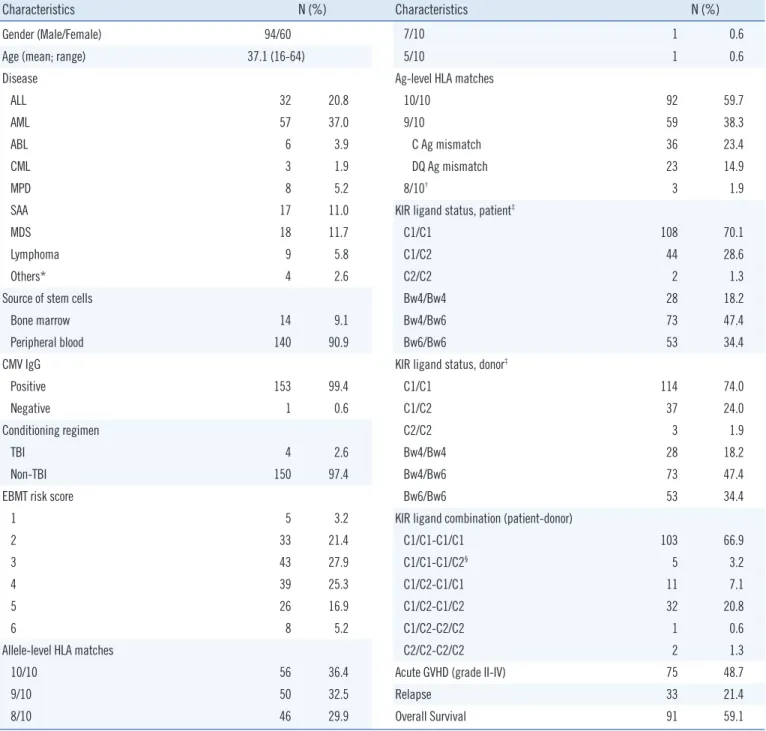
High-resolution HLA matching on the HLA-A, -B, -C, -DRB1, and -DQB1 loci, KIR ligand mismatch, and KIR ligand status were analyzed for their associations with the following clinical outcomes: patients’ overall survival, event-free survival, relapse of underlying disease, and the occurrence and severity of acute or chronic GVHD [12]. Overall survival was defined as the time from graft infusion to death from any cause at time of analysis (Jun 1, 2014). For event-free survival, death or relapse was con- sidered as events. Clinical characteristics of patients are shown in Table 1. Pre-HSCT patient risk status was classified by the European Group for Blood and Marrow Transplantation (EBMT) scoring system [13]. Antigen-level HLA mismatches were ob- served only at the HLA-C and -DQB1 loci in our study (Table 1).
Regression analysis was performed to assess the effect of dif-
ferent risk factors on clinical outcome. Categorical variables were analyzed by Chi-square and Fisher’s exact tests. The Cox proportional hazard model was applied for multivariate analyses.
Survival was analyzed by Kaplan-Meier with log-rank testing. All reported P values are 2-sided, and P value <0.05 was consid- ered statistically significant. All analyses were performed by us- ing SPSS Statistics 21.0 (IBM, Armonk, NY, USA).
RESULTS
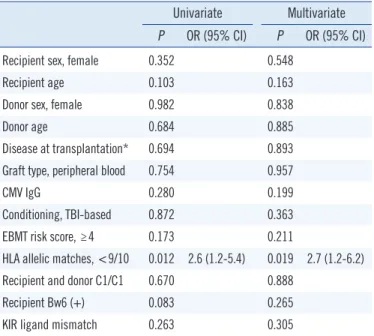
Of the five HLA loci, allelic mismatches of >9/10 alleles was considered a risk factor for severe acute GVHD (Grade II-IV) by univariate analysis (P =0.012, hazard ratio [HR]=2.6), and was also an independent risk factor for severe acute GVHD (Grade II-IV) by multivariate analysis (P =0.019, HR =2.7) (Table 2).
The frequency of mismatch at the HLA-A allele was increased in patients with acute GVHD compared to those without (61.9%
vs. 34.5%, P =0.06), among one mismatched allele in unre- lated HSCT (n=50) (Table 3). In contrast, the frequency of mis- match at other HLA loci (HLA-B, -C, -DRB1, and DQB1) failed to show any significant difference between the two groups.
In Cox proportional hazard model, acute GVHD (grade II-IV) was an independent risk factor for event-free survival (P =0.008, HR=2.0) and overall survival (P =0.011, HR=1.9) (Table 4). In our patient population, KIR ligand mismatch occurred in only five HLA-Cw group recipient-donor combinations (all of which were recipient C1/C1 and donor C1/C2; 5/154, 3.2%) (Table 1) and had no effect on clinical outcome (Table 4). For the analysis of KIR ligand status, recipient-donor combinations of both C1/
C1 ligands showed an increased tendency for event-free and overall survival than recipient-donor combinations with C2 li- gand (recipient C1/C2 or C2/C2 and donor C1/C2 or C2/C2) (P =0.078, P =0.094, respectively) but did not reach statistical significance (Table 4). In Kaplan-Meier survival analysis, C1/C1 recipient-donor combinations showed a significant increase in event-free and overall survival compared to C2 recipient-donor combinations (recipient C1/C2 or C2/C2 and donor C1/C2 or C2/C2) (P =0.048, P =0.034, respectively) (Fig. 1).
DISCUSSION
Previous studies have reported some ethnic variance in the re- lationship between HLA mismatching and HSCT patient out- come, especially in the Japanese population. Notably, a single HLA-A mismatch was considered to be a significant risk factor for survival (HR=2.27) in the Japanese Marrow Donor Program
(JMDP); however, single HLA-C mismatch was a risk factor in non-JMDP transplants (HR =1.68) [6]. In Japanese patients, HLA-A or -B mismatches significantly reduced survival, whereas
mismatches at HLA-C or -DRB1/DQB1 did not [14]. In our study, less than nine allelic matches among five HLA loci were signifi- cantly associated with acute GVHD (grade II-IV). In addition, the
Characteristics N (%)
Gender (Male/Female) 94/60
Age (mean; range) 37.1 (16-64)
Disease
ALL 32 20.8
AML 57 37.0
ABL 6 3.9
CML 3 1.9
MPD 8 5.2
SAA 17 11.0
MDS 18 11.7
Lymphoma 9 5.8
Others* 4 2.6
Source of stem cells
Bone marrow 14 9.1
Peripheral blood 140 90.9
CMV IgG
Positive 153 99.4
Negative 1 0.6
Conditioning regimen
TBI 4 2.6
Non-TBI 150 97.4
EBMT risk score
1 5 3.2
2 33 21.4
3 43 27.9
4 39 25.3
5 26 16.9
6 8 5.2
Allele-level HLA matches
10/10 56 36.4
9/10 50 32.5
8/10 46 29.9
Characteristics N (%)
7/10 1 0.6
5/10 1 0.6
Ag-level HLA matches
10/10 92 59.7
9/10 59 38.3
C Ag mismatch 36 23.4
DQ Ag mismatch 23 14.9
8/10† 3 1.9
KIR ligand status, patient‡
C1/C1 108 70.1
C1/C2 44 28.6
C2/C2 2 1.3
Bw4/Bw4 28 18.2
Bw4/Bw6 73 47.4
Bw6/Bw6 53 34.4
KIR ligand status, donor‡
C1/C1 114 74.0
C1/C2 37 24.0
C2/C2 3 1.9
Bw4/Bw4 28 18.2
Bw4/Bw6 73 47.4
Bw6/Bw6 53 34.4
KIR ligand combination (patient-donor)
C1/C1-C1/C1 103 66.9
C1/C1-C1/C2§ 5 3.2
C1/C2-C1/C1 11 7.1
C1/C2-C1/C2 32 20.8
C1/C2-C2/C2 1 0.6
C2/C2-C2/C2 2 1.3
Acute GVHD (grade II-IV) 75 48.7
Relapse 33 21.4
Overall Survival 91 59.1
Table 1. Patient Characteristics
*Others include NK cell lymphoma (n=2), hemophagocytic lymphohistiocytosis (n=1), and adult T cell leukemia lymphoma (n=1); †All three patients had one HLA-C antigen mismatch and one HLA-DQ antigen mismatch; ‡C1 alleles expressing Asn80 (such as -Cw1, -Cw3, -Cw7, -Cw8, -Cw12, -Cw12, -Cw14, -Cw16, etc.); C2 alleles expressing Lys80 (such as -Cw2, -Cw4, -Cw5, -Cw6, -Cw15, -Cw17, -Cw18,etc.); §KIR ligand mismatch was defined by the absence of one donor KIR ligand in the recipient. Patient C1/C1 and donor C1/C2 combination was the only KIR ligand mismatch in our study. The patient C2/C2 and donor C1/C2 combination was not observed in our study.
Abbreviations: ABL, acute biphenotypic leukemia; MPD, myeloproliferative disorder; SAA, severe aplastic anemia; EBMT, European Group for Blood and Marrow Transplantation; TBI, total body irradiation; CMV, cytomegalovirus; Ag, antigen; KIR, killer cell immunoglobulin-like receptor; GVHD, graft versus host disease.
association between HLA-A mismatching with acute GVHD (grade II-IV) is suspicious, since the other loci failed to show any association, somewhat similar to the previous Japanese reports [6, 14]. In a previous study of 1,047 Japanese patients with HLA-A2, a mismatch combination of HLA-A*02:01-*02:06, re- vealed inferior survival (HR =1.58) [7]. Non-permissive allelic mismatch combinations of A*02:06-A*02:01, A*02:06-A*02:07, A*26:02-A*26:01, and A*26:03-A*26:01 have been reported in Japanese patients [15]. Koreans are genetically most similar to Japanese [8, 9] and show more allelic diversity, particularly in HLA-A*02 and A*26 than Caucasians [8]. This causes higher allele-level mismatch frequencies of A*02 and A*26. In our study, 22 out of 23 HLA-A allelic mismatches were the result of mis- matching at HLA-A*02 (n=16) or A*26 (n=6). In Koreans, those mismatches could be associated with acute GVHD and poor clini- cal outcome in unrelated HSCT and should be confirmed in a larger patient population.
Furthermore, KIR ligand mismatching was not associated with clinical outcome following unrelated HSCT in this study. Results from previous studies on the impact of KIR ligand mismatching in unrelated HSCT were highly variable, and ranged from highly beneficial to detrimental [17-24]. This was partly due to the dif- ferences in the methods used to analyze donor-versus-recipient NK-cell alloreactivity [25]. Differences in patient populations,
underlying disease states, conditioning regimens, HLA match status, T-cell depletion, and post-transplant immunosuppressive regimens could also account for these discrepancies [5, 25]. In addition, there were also considerable ethnic differences in KIR gene and ligand frequencies [26]. In Koreans, the frequency of HLA-C2 ligand is much lower than that of Caucasians [8]. In our study, the portion of recipient-donor pairs with KIR ligand mis- match was very small (3.2%, 5/154), which may weaken the statistical power.
For the analysis of KIR ligand status, C1/C1 ligand patient-do- Table 2.Univariate and multivariate analysis of risk factors for acute
GVHD (grade II-IV)
Univariate Multivariate P OR (95% CI) P OR (95% CI)
Recipient sex, female 0.352 0.548
Recipient age 0.103 0.163
Donor sex, female 0.982 0.838
Donor age 0.684 0.885
Disease at transplantation* 0.694 0.893 Graft type, peripheral blood 0.754 0.957
CMV IgG 0.280 0.199
Conditioning, TBI-based 0.872 0.363
EBMT risk score, ≥4 0.173 0.211
HLA allelic matches, <9/10 0.012 2.6 (1.2-5.4) 0.019 2.7 (1.2-6.2)
Recipient and donor C1/C1 0.670 0.888
Recipient Bw6 (+) 0.083 0.265
KIR ligand mismatch 0.263 0.305
*Disease at transplantation was grouped and described in Table 1.
Abbreviations: GVHD, graft versus host disease; OR, odds ratio; CI, confi- dence interval; EBMT, European Group for Blood and Marrow Transplanta- tion; CMV, cytomegalovirus; KIR, killer cells immunoglobulin-like receptor.
Table 3. Associations of different HLA loci to acute GVHD (grade II -IV) among one-allele mismatched unrelated HSCT in Koreans (n=50)
aGVHD (-) (n=29) aGVHD (+) (n=21)
P OR (95% CI)
n (%) n (%)
HLA-A 10 (34.5) 13 (61.9) 0.06 3.1 (1.0-9.9)
B 1 (3.4) 1 (4.8) 1.00
C 10 (34.5) 6 (28.6) 0.89
DRB1 4 (13.8) 1 (4.8) 0.38
DQB1 4 (13.8) 0 (0.0) 0.13
Abbreviations: aGVHD, acute graft versus host disease; OR, odds ratio; CI, confidence interval.
Table 4. Multivariate analysis of risk factors for event-free and over- all survival using Cox regression
Event-free survival Overall survival P HR (95% CI) P HR (95% CI)
Recipient sex, female 0.732 0.514
Recipient age 0.002 1.0 (1.0-1.1) <0.001 1.0 (1.0-1.1)
Donor sex, female 0.768 0.616
Donor age 0.482 0.811
Disease at transplantation* 0.873 0.588 Graft type, peripheral blood 0.797 0.292
CMV IgG 0.093 0.084
Conditioning, TBI-based 0.836 0.674
EBMT risk score, ≥ 4 0.612 0.594
Acute GVHD (grade II-IV) 0.008 2.0 (1.2-3.4) 0.011 1.9 (1.2-3.3) HLA allelic matches, <9/10 0.480 0.714
Recipient and donor C1/C1 0.078 0.094
Recipient Bw6 (+) 0.225 0.085
KIR ligand mismatch 0.432 0.376
*Disease at transplantation was grouped and described in Table 1.
Abbreviations: CMV, cytomegalovirus; TBI, total body irradiation; EBMT, Eu- ropean Group for Blood and Marrow Transplantation; GVHD, graft versus host disease; KIR, killer cells immunoglobulin-like receptor; HR, hazard ra- tio; CI, confidence interval.
nor combinations showed an increase in event-free survival when compared to patient-donor combinations with C2 ligand (recipi- ent C1/C2 or C2/C2 and donor C1/C2 or C2/C2). Further studies are needed with a larger patient population to confirm the im- pact of KIR ligand status on clinical outcome. In Germany, the increase in overall survival for patients with C1/C1 ligand was reported for those with AML/CML, but did not extend to those with ALL/NHL [20]. On the contrary, a study from the Interna- tional Histocompatibility Working Group (IHWG) identified a lower rate of relapse in C1/C1 patients and to a similar extent in the AML, CML, and ALL subgroups [17]. In our study, the sub- group analyses failed to reach statistical significance (data not shown). The inconsistent results in ALL patients should be fur- ther clarified in future.
HLA-Bw4 ligand was not associated with clinical outcome in
our study. A study on 264 cases of unrelated HSCT identified increased relapse rate and decreased overall survival in patients with Bw6/Bw6 ligand with donors with KIR3DL1/3DS1[22]. The basis for the association between C1/C1 or Bw4/Bw4 ligand and better overall survival is unclear. Early reconstitution of KIR rep- ertoires has been reported following HSCT in NK cells with C1- specific KIR2DL2/3 or Bw4-specific KIR3DL1, as compared to NK cells with C2-specific KIR2DL1 [27-29], and may contribute to the better overall survival by facilitating the surveillance of HLA-C expression on leukemic or virus-infected cells. In addi- tion, the affinities of inhibitory KIRs for their respective HLA-C li- gands vary, with KIR2DL1 exhibiting the strongest affinity and in- hibitory signals [30]. As NK cell activation depends on a balance between inhibitory and activating signals, another explanation might be that donors with C2 ligand are less effective in activat-
1.0 0.8 0.6 0.4 0.2 0
1.0 0.8 0.6 0.4 0.2 0
Fig. 1. Kaplan-Meier analysis of event-free and overall survival according to KIR ligand mismatch and ligand status following unrelated he- matopoietic stem cell transplantation (HSCT) in Koreans. (A) Event-free survival in recipients with KIR ligand match (n=149) vs. KIR ligand mismatch (n=5), (B) Event-free survival in recipient-donor combination of both with C1/C1 (n=103) vs. recipients with C1/C2 or C2/C2 and donors with C1/C2 or C2/C2 (n=51), (C) Event-free survival in recipient with Bw4/Bw4 (n=28) vs. Bw4/Bw6 or Bw6/Bw6 (n=126), (D) overall survival in recipients with KIR ligand match (n=149) vs. KIR ligand mismatch (n=5), (E) overall survival in recipient-donor com- bination of both with C1/C1 (n=103) vs. recipients with C1/C2 or C2/C2 and donors with C1/C2 or C2/C2 (n=51), and (F) overall survival in recipient with Bw4/Bw4 (n=28) vs. Bw4/Bw6 or Bw6/Bw6 (n=126).
Abbreviation: Rec, recipient.
1.0 0.8 0.6 0.4 0.2 0
1.0 0.8 0.6 0.4 0.2 0
1.0 0.8 0.6 0.4 0.2 0
1.0 0.8 0.6 0.4 0.2 0 0 20 40 60 80 100
0 20 40 60 80 100
0 20 40 60 80 100
0 20 40 60 80 100
0 20 40 60 80 100
0 20 40 60 80 100 A
D
B
E
C
F Months after HSCT
Months after HSCT
Months after HSCT
Months after HSCT
Months after HSCT
Months after HSCT
Survival ProbabilitySurvival Probability Survival ProbabilitySurvival Probability Survival ProbabilitySurvival Probability
Log-rank test P =0.196
Log-rank test P =0.155
Log-rank test P =0.048
Log-rank test P =0.034
Log-rank test P =0.105
Log-rank test P =0.085 KIR ligand match
KIR ligand match
Rec C1/C1 and Donor C1/C1
Rec C1/C1 and Donor C1/C1
Bw4/Bw4
Bw4/Bw4 Recipient
Recipient KIR ligand mismatch
KIR ligand mismatch
Rec C1/C2 or C2/C2 and Donor C1/C2 or C2/C2
Rec C1/C2 or C2/C2 and Donor C1/C2 or C2/C2
Bw4/Bw6 or Bw6/Bw6
Bw4/Bw6 or Bw6/Bw6
ing leukemia-targeting NK cells than C1 ligand donors.
Despite the small number of cases in our study, all patients were treated at one center under uniform HSCT protocols. In con- clusion, matches with less than 9 of 10 alleles from HLA-A, -B, -C, -DRB1, and DQB1 loci were associated with acute GVHD (grade II-IV) in Korean adult patients that received unrelated HSCT. The impact of KIR ligand status on clinical outcome was inconclusive and should be studied in a larger patient population.
Authors’ Disclosures of Potential Conflicts of Interest
No potential conflicts of interest relevant to this article were re- ported.
REFERENCES
1. Perez LE. Outcomes from unrelated donor hematopoietic stem cell transplantation. Cancer Control 2011;18:216-21.
2. Shaw BE, Arguello R, Garcia-Sepulveda CA, Madrigal JA. The impact of HLA genotyping on survival following unrelated donor haematopoietic stem cell transplantation. Br J Haematol 2010;150:251-8.
3. Ruggeri L, Capanni M, Urbani E, Perruccio K, Shlomchik WD, Tosti A, et al., Effectiveness of donor natural killer cell alloreactivity in mismatched hematopoietic transplants. Science 2002;295:2097-100.
4. Malmberg KJ, Schaffer M, Ringdén O, Remberger M, Ljunggren HG.
KIR-ligand mismatch in allogeneic hematopoietic stem cell transplanta- tion. MolImmunol 2005;42:531-4.
5. Ruggeri L, Mancusi A, Burchielli E, Aversa F, Martelli MF, Velardi A.
Natural killer cell alloreactivity in allogeneic hematopoietic transplanta- tion. CurrOpinOncol 2007;19:142-7.
6. Petersdorf EW, Gooley T, Malkki M, Horowitz M; International Histocom- patibility Working Group in Hematopoietic Cell Transplantation. Clinical significance of donor-recipient HLA matching on survival after myeloab- lative hematopoietic cell transplantation from unrelated donors. Tissue Antigens 2007;69(S1):S25-30.
7. Morishima Y, Kawase T, Malkki M, Petersdorf EW; International Histo- compatibility Working Group in Hematopoietic Cell Transplantation Component. Effect of HLA-A2 allele disparity on clinical outcome in he- matopoietic cell transplantation from unrelated donors. Tissue Antigens 2007;69(S1):S31-5.
8. Lee KW, Oh DH, Lee C, Yang SY. Allelic and haplotypic diversity of HLA- A, -B, -C, -DRB1, and -DQB1 genes in the Korean population. Tissue An- tigens 2005;65:437-47.
9. Yang JH, Sohn YH, Ko SY, Choi SE, Kim MH, Oh HB. Anthropological analysis of Koreans using HLA class II diversity among East Asians. Tis- sue Antigens 2010;76:282-8.
10. Farag SS,Fehniger TA, Ruggeri L, Velardi A, Caligiuri MA. Natural killer cell receptors: new biology and insights into the graft-versus-leukemia effect. Blood 2002;100:1935-47.
11. Giebel S, Locatelli F, Lamparelli T, Velardi A, Davies S, Frumento G, et al.
Survival advantage with KIR ligand incompatibility in hematopoietic stem cell transplantation from unrelated donors. Blood 2003;102:814-9.
12. Glucksberg H, Storb R, Fefer A, Buckner CD, Neiman PE, Clift RA, et al. Clinical manifestations of graft-versus-host disease in human recipi-
ents of marrow from HL-A-matched sibling donors. Transplantation 1974;18:295-304.
13. Gratwohl A. The EBMT risk score. Bone Marrow Transplant 2012;47:
749-56.
14. Morishima Y, Sasazuki T, Inoko H, Juji T, Akaza T, Yamamoto K, et al.
The clinical significance of human leukocyte antigen (HLA) allele com- patibility in patients receiving a marrow transplant from serologically HLA-A, HLA-B, and HLA-DR matched unrelated donors. Blood 2002;
99:4200-6.
15. Kawase T, Morishima Y, Matsuo K, Kashiwase K, Inoko H, Saji H, et al.
High-risk HLA allele mismatch combinations responsible for severe acute graft-versus-host disease and implication for its molecular mech- anism. Blood 2007;110:2235-41.
16. Lee SJ, Klein J, Haagenson M, Baxter-Lowe LA, Confer DL, Eapen M, et al. High-resolution donor-recipient HLA matching contributes to the success of unrelated donor marrow transplantation. Blood 2007;110:
4576-83.
17. Hsu KC, Gooley T, Malkki M, Pinto-Agnello C, Dupont B, Bignon JD, et al. KIR ligands and prediction of relapse after unrelated donor hemato- poietic cell transplantation for hematologic malignancy. Biol Blood Mar- row Transplant 2006;12:828-36.
18. Giebel S, Locatelli F, Wojnar J, Velardi A, Mina T, Giorgiani G, et al. Ho- mozygosity for human leucocyte antigen-C ligands of KIR2DL1 is asso- ciated with increased risk of relapse after human leucocyte antigen-C- matched unrelated donor haematopoietic stem cell transplantation. Br J Haematol 2005;131:483-6.
19. Fischer JC, Ottinger H, Ferencik S, Sribar M, Punzel M, Beelen DW, et al. Relevance of C1 and C2 epitopes for hemopoietic stem cell trans- plantation: role for sequential acquisition of HLA-C-specific inhibitory killer Ig-like receptor. J Immunol 2007;178:3918-23.
20. Fischer JC, Kobbe G, Enczmann J, Haas R, Uhrberg M. The impact of HLA-C matching depends on the C1/C2 KIR ligand status in unrelated hematopoietic stem cell transplantation. Immunogenetics 2012;64:879- 85.
21. Ludajic K, Balavarca Y, Bickeböller H, Rosenmayr A, Fae I, Fischer GF, et al. KIR genes and KIR ligands affect occurrence of acute GVHD after unrelated, 12/12 HLA matched, hematopoietic stem cell transplanta- tion. Bone Marrow Transplant 2009;44:97-103.
22. Gagne K, Busson M, Bignon JD, Balère-Appert ML, Loiseau P, Dormoy A, et al. Donor KIR3DL1/3DS1 gene and recipient Bw4 KIR ligand as prognostic markers for outcome in unrelated hematopoietic stem cell transplantation. Biol Blood Marrow Transplant 2009;15:1366-75.
23. Miller JS, Cooley S, Parham P, Farag SS, Verneris MR, McQueen KL, et al. Missing KIR ligands are associated with less relapse and increased graft-versus-host disease (GVHD) following unrelated donor allogeneic HCT. Blood 2007;109:5058-61.
24. Farag SS, Bacigalupo A, Eapen M, Hurley C, Dupont B, Caligiuri MA, et al. The effect of KIR ligand incompatibility on the outcome of unrelated donor transplantation: a report from the center for international blood and marrow transplant research, the European blood and marrow transplant registry, and the Dutch registry. Biol Blood Marrow Transplant 2006;12:876-84.
25. Willemze R, Ruggeri A, Purtill D, Rodrigues CA, Gluckman E, Rocha V, et al. Is there an impact of killer cell immunoglobulin-like receptors and KIR-ligand incompatibilities on outcomes after unrelated cord blood stem cell transplantation? Best Pract Res ClinHaematol 2010;23:283- 90.
26. Hollenbach JA, Augusto DG, Alaez C, Bubnova L, Fae I, Fischer G, et al. 16(th) IHIW: population global distribution of killer immunoglobulin- like receptor (KIR) and ligands. Int J Immunogenet 2013;40:39-45.
27. Shilling HG, Young N, Guethlein LA, Cheng NW, Gardiner CM, Tyan D, et al. Genetic control of human NK cell repertoire. J Immunol 2002;
169:239-47.
28. Nguyen S, Dhedin N, Vernant JP, Kuentz M, Al Jijakli A, Rouas-Freiss N, et al. NK-cell reconstitution after haploidentical hematopoietic stem-cell transplantations: immaturity of NK cells and inhibitory effect of NKG2A
override GvL effect. Blood 2005;105:4135-42.
29. Stern M, de Angelis C, Urbani E, Mancusi A, Aversa F, Velardi A, et al.
Natural killer-cell KIR repertoire reconstitution after haploidentical SCT.
Bone Marrow Transplant 2010;45:1607-10.
30. Parham P. Immunology.NK cells lose their inhibition. Science 2004;
305:786-7.