INTRODUCTION
Most thyroid diseases are evaluated by radionuclide scintigra- phy, sonography or percutaneous needle biopsy. Sonography is perhaps the most definitive method for evaluation of nodules in a thyroid gland. However, the disadvantages of this technique include limited penetration in some anatomic locations, such as retrotracheal and substernal areas, and a limited field of view for assessing large masses. Further, current diagnostic methods may not enable the accurate detection of the malignant nature of a thyroid nodule, especially in a multinodular goiter.
Therefore, new techniques are being investigated to im-
prove the evaluation of thyroid nodules.
The magnetic resonance (MR) imaging has a minor role in the evaluation of most patients with thyroid nodules or goi- ters, because of inadequate spatial and contrast resolution and only a few cases documented. However, technological ad- vances have provided good spatial and contrast resolution in the neck including the thyroid gland, parathyroid gland and lymph node. Also it has made available the dynamic keyhole imaging of the thyroid nodule with spin echo sequences.
The aim of our study was to evaluate this new technique in the routine evaluation of possible thyroid cancer, and particu- larly for the determination of the characteristic MR dynamic
J Korean Soc Radiol 2011;65(5):433-439
Received April 25, 2011; Accepted August 24, 2011 Corresponding author: Hee Young Hwang, MD Department of Radiology, Gil Hospital, Gachon University of Medicine and Science, 1198 Guwol-dong, Namdong-gu, Incheon 405-760, Korea.
Tel. 82-32-460-3060 Fax. 82-32-460-3065 E-mail: [email protected]
The study was partly supported by the GE Healthcare Investigator Initiated Trials Committee (IITC).
Copyrights © 2011 The Korean Society of Radiology
Purpose: The purpose of this study is to determine the characteristic dynamic en- hancement pattern of magnetic resonance (MR) imaging for malignant thyroid tumor.
Materials and Methods: Eight patients who were pathology proven to have a malig- nant thyroid tumor, preoperatively. There are 5 papillary carcinomas, 1 medullary carci- noma, 1 follicular carcinoma, and 1 fine needle aspiration biopsy proven atypical cell.
Results: Based on preoperative MR imaging, we compared the dynamic MR enhance- ment pattern relating to the pathologic type. On contrast agent-enhanced dynamic T1-weighted image (T1WI), 5 papillary carcinoma and one medullary carcinoma showed delayed enhancement compared to normal parenchyma. In addition, one fol- licular carcinoma shows stronger enhancement than normal parenchyma, with one papillary carcinoma showing a persistent decrease in enhancement compared to nor- mal parenchyma.
Conclusion: Although this study is limited by a small patients population, the data suggests that delayed enhancement on enhanced dynamic T1WI is a possible char- acteristic MR finding of a malignant thyroid tumor. I think that the comparison of MR imaging between benign and malignant nodules is required for a correct char- acterization.
Index terms
Malignant Thyroid Tumor MRI
Dynamic Enhancement Pattern
Characteristic Dynamic Enhancement Pattern of Magnetic Resonance Imaging for Malignant Thyroid Tumor:
A Preliminary Report
악성 갑상선 종양의 특징적인 역동적 자기공명영상의 조영증강 소견:
Preliminary Report
Young Nam Park, MD, Hee Young Hwang, MD, Young Sup Shim, MD, Sung Su Byun, MD, Hye-Young Choi, MD, Hyung-Sik Kim, MD
Department of Radiology, Gil Hospital, Gachon University of Medicine and Science, Incheon, Korea
quired with a TR of 5.12 msec and an TE of 1.99 msec. The flip angle was 10 degrees and time to center was 26.4 sec.
Contrast enhanced dynamic T1WI were obtained immedi- ately after injection (as a precontrast scan) and at 1 min 30 sec/3 min/4 min 30 sec/6 min after injection of Gadovist.
Paramagnetic contrast agent (gadobutrol, Gadovist; Scher- ing, Berlin, Germany) was administered intravenously at a weight-adjusted dose of 0.15 mmol per kilogram of patient body weight.
RESULTS
Based on preoperative MR imaging, we compared the dy- namic MR enhancement pattern relating to the pathologic type. All biopsy-proven malignant thyroid tumors showed hy- poechogenicity on previous USG, except for one follicular car- cinoma (isoechogenicity). In addition, only one patient with papillary carcinoma remained on the color Doppler USG. In this case, the malignant nodules showed decreased vascularity compared to normal parenchyma.
1) On a T1WI, one papillary carcinoma showed high signal intensity (SI) and one medullary carcinoma showed low SI compared to normal parenchyma. And, other cases were not differentiated compared to normal parenchyma.
2) On a T2WI, 3 papillary carcinomas and one follicular car- cinoma showed high SI, and one papillary carcinoma showed low SI. The other case was not differentiated with normal pa- renchyma.
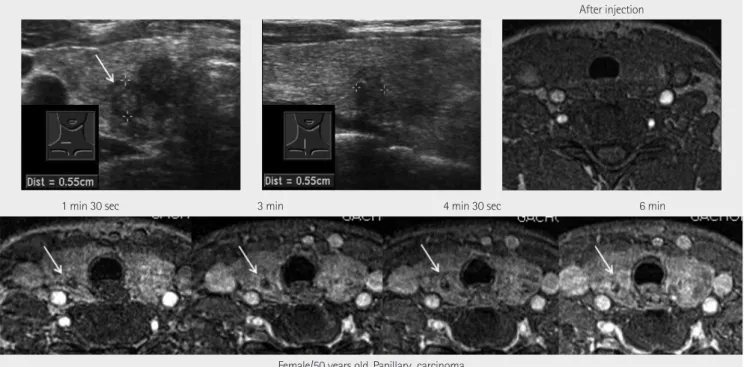
3) On contrast agent-enhanced dynamic T1WI, 4 papillary carcinomas and one medullary carcinoma, as well as 1 FNAB proven atypical cell (Fig. 1) showed delayed enhancement com- pared to normal parenchyma. And, one follicular carcinoma (Fig. 2) showed stronger enhancement than normal parenchy- ma, and one papillary carcinoma (Fig. 3) shows persistently de- creased enhancement compared to normal parenchyma.
About 75% of all cases showed delayed enhancement pat- tern on contrast-enhanced dynamic T1WI (Table 1).
Our study found that the maximum gland-lesion contrast difference occurred 3 to 4 minutes and 30 seconds after con- trast infusion.
In addition, two patients with benign nodules (nodular hyper- plasia) underwent the same MR imaging. One patient had a ho- enhancement pattern of a malignant thyroid tumor.
MATERIALS AND METHODS
This study series included eight patients (1 male and 7 fe- males; mean age: 56 years; age range: 22-81 years) who were pathologically proven to have a malignant thyroid tumor, pre- operatively; 5 papillary carcinoma, 1 medullary carcinoma, 1 follicular carcinoma, and 1 fine needle aspiration biopsy (FNAB) proven atypical cell (with multiple metastatic lymph nodes in the neck). Preoperative MRI images had been obtained in all patients.
We got the approval from the Institutional review board and informed consent from each patient part of this study. A pathologic report and ultrasonography (USG) findings were collected retrospectively.
All images were obtained with a 3.0-T MR imaging unit, Mag- netom Verio (Siemens Medical Systems, Erlangen, Germany).
The MRI protocol was constituted of pulse sequences in- cluding an axial fast spin-echo T2-weighted image (T2WI), axial T1-weighted image (T1WI), and contrast agent-enhanced dynamic T1WI.
1) The axial fast spin-echo T2WI was obtained in approxi- mately 3 minutes, 41 seconds. Imaging was performed in the 30 axial planes with 3-mm slice thickness, and no interslice gap. The field of view was 140 cm and the voxel size was 0.4 × 0.4 × 3.0 mm. The T2WI were acquired with a repetition time (TR) of 4,100 ms and an echo time (TE) of 137 ms. The flip angle was 90 degrees.
2) The axial T1WI was obtained in approximately 6 min- utes, 57 seconds. Imaging was performed in the 30 axial planes with a 3-mm slice thickness, and no interslice gap. The field of view was 140 cm and the voxel size was 0.5 × 0.5 × 3.0 mm. The T1WI were acquired with a TR of 2,740 msec and an TE of 48 msec. The flip angle was 70 degrees.
3) The dynamic spin-echo sequence was a routine axial T1 spin-echo sequence obtained during contrast infusion.
The image was obtained in approximately 9 minutes, 13 sec- onds. Imaging was performed in the 88 axial planes with a 0.7- mm slice thickness and no interslice gap. Slice oversampling was 36.4%. The field of view (read/phase) was 255 mm/50.0%, and the voxel size was 0.7 × 0.5 × 0.7 mm. The images were ac-
Fig. 1. On ultrasonography, an approximately 8 mm, well define hypoechoic nodule is seen in the mid level of the left lobe of the thyroid gland.
This is dynamic images of the thyroid gland in the axial section. The nodule (arrow) was not clearly delineated immediately after contrast injec- tion (as a precontrast scan). Early-phase dynamic images obtained 1 minute 30 seconds after injection best depicts the nodule (arrow) in left thy- roid gland. The nodules show decreased enhancment in the early phase of a dynamic enhacement study, compared to normal parenchyma. In addition, the nodule (arrow) shows gradually centrifetal delayed enhancement. A 6-minute image after contrast injection indicates that the nod- ule is masked into the backgronund thyroid tissue.
Note.-FNAB = fine needle aspiration biopsy
Fig. 2. On ultrasonography, an approximately 3 centimeter, well defined hyperchoic nodule (white arrow) is seen in right lobe of the thyroid gland at the mid level. On a dynamic image obtained 3 minutes after injection, the nodule (white arrow) shows strong early enhancement com- pared to the parenchyma of the left lobe. In addition, the nodule (white arrow) shows persistent well enhancement, compared to normal paren- chyma. In a 6-minute image after contrast injection, the nodule (white arrow) shows persistent enhancement, but background parenchyma is washed out.
After injection
After injection Male/80 years old, FNAB proven atypical cell
Female/69 years old, Follicular carcinoma 1 min 30 sec
1 min 30 sec
4 min 30 sec
4 min 30 sec 3 min
3 min
6 min
6 min
contrast enhanced dynamic T1WI is a possible characteristic MR findings of malignant thyroid tumor. The delayed en- hancement pattern of thyroid cancer on dynamic T1WI is similar to that of pituitary adenoma. We hypothesize that the enhancement pattern of these tumors is related with tumor angiogenesis and its vascularity. Pituitary tumors are known to be less vascular than normal pituitary tissue, suggesting that angiogenesis may be inhibited in these tumors. This is consistent with the findings of Jugenburg and colleagues, but is in marked contrast to studies in other tissues including the breast, prostate, and lung, in which tumors are more vascular than the respective normal (3). In contrast to the majority of solid tumors, pituitary adenomas show a decreased expres- sion of vascular endothelial growth factor and have signifi- mogeneous solid nodule on USG. On contrast agent-enhanced
dynamic T1WI, the nodule shows nearly the same enhancement as normal parenchyma. Other patients had heterogeneous solid and cystic nodules on USG. These nodules also had a hemor- rhagic portion on preT1WI. On contrast agent-enhanced dy- namic T1WI, the nodules show heterogeneous enhancement, and some part of the nodules showed nearly the same enhance- ment as normal parenchyma and other parts showed early or de- layed enhancement compared to parenchyma.
DISCUSSION
Although this study has the limitation of a small patient population, the data suggest that delayed enhancement on Table 1. Outcomes of Dynamic Enhancement Pattern, Thyroid Cancer
Dynamic Enhancement Pattern Patient Number Percentage (%)
Delayed enhancement 4 papillary carcinoma 75
1 medullary carcinoma 1 FNAB proven atypical cell
Early strong enhancement 1 follicular carcinoma 12.5
Persistently decreased enhancement 1 papillary carcinoma 12.5
8 100
Note.-Compared to normal thyroid parenchyma.
FNAB = fine needle aspiration biopsy
Fig. 3. On ultrasonography, an approximately 5 millimeter, well hypoechoic nodule (arrow) is seen in the right lobe of the thyroid gland at mid level. This nodule has internal punctate tiny echogenicity, suggesting a tiny calcification. On a dynamic enhancement study, the nodule (arrow) shows a persistent decrease in enhancement compared to background parenchyma.
After injection
Female/50 years old, Papillary carcinoma
1 min 30 sec 3 min 4 min 30 sec 6 min
ic enhanced T1WI. But, because of the other 7 cases had not remained on the Doppler USG, it was difficult to perform a correlation analysis between Doppler USG and dynamic en- hanced MR imaging in our study. We found that the maximum gland-lesion contrast difference peaked at 3 min- utes to 4 minutes, 30 seconds after contrast infusion, suggesting that this is the most sensitive time for detecting lesions of the thyroid gland. Our dynamic technique was easy to perform and did not add a time penalty to the pituitary study. The prac- tice of examining the gland twice, once during and after con- trast infusion, was effective. In conclusion, delayed enhance- ment on contrast-enhanced dynamic T1WI is a possible char- acteristic MR finding of malignant thyroid tumors. Also, dy- namic contrast-enhanced magnetic resonance imaging can be useful to detect or exclude thyroid carcinoma with high diag- nostic accuracy in patients with a multinodular goiter when results of other diagnostic methods are inconclusive. The pre- vious early results with MR of the thyroid indicate inadequate spatial and excellent contrast resolution for depicting disease in these glands (5, 6). The tool for the diagnosis of thyroid will be tempered by the traditional reliance on scintigraphy and so- nography for this purpose. However, with the development of the MR technique, MR imaging has been shown to be a prom- ising technique for imaging the thyroid. Moreover clear indi- cations for MR in the evaluation of these glands are emerging.
The limitations of our study was the relatively small patient population and the fact that we did not compare the benign and malignant thyroid lesions. Future studies should compare the MR imaging between benign and malignant nodules for the correct characterization of the tumor.
REFERENCES
1. de la Torre NG, Buley I, Wass JA, Turner HE. Angiogenesis and lymphangiogenesis in thyroid proliferative lesions: re- lationship to type and tumour behaviour. Endocr Relat Cancer 2006;13:931-944
2. Jugenburg M, Kovacs K, Stefaneanu L, Scheithauer BW.
Vasculature in nontumorous hypophyses, pituitary adeno- mas, and carcinomas: a quantitative morphologic study.
Endocr Pathol 1995;6:115-124
3. Turner HE, Nagy Z, Gatter KC, Esiri MM, Harris AL, Wass JA.
cantly lower microvessel densities compared to non-neoplas- tic pituitary glands (4). Similarly, the microvascular density was higher in normal tissue than in benign and malignant proliferative lesions of the thyroid gland (1). Microvessel den- sity is a surrogate marker of tumoral angiogenesis. Microves- sel density assessment is the most commonly used technique to quantify intratumoral angiogenesis in cancer. It was first de- veloped by Weidner et al. (7) and used for panendothelial im- munohistochemical staining of blood microvessels (8). In con- trast to thyroid tumor and pituitary adenoma, hypervascular tumors such as breast and prostate cancer, shows early en- hancement pattern on dynamic T1WI.
In addition, breast and prostate MR imaging is being wide- ly used with increasing frequency to aid in the detection and evaluation of breast and prostate malignancies. We explained that, contrary to common cancers, but similar to other endo- crine neoplasms such as pituitary and adrenal cortex tumours, angiogenesis is reduced in some thyroid proliferative lesions compared with normal tissue (1, 2). So, thyroid cancer shows a delayed enhancement pattern on contrast enhanced dynam- ic T1WI, probably due to its hypovascularity.
Two cases did not show a delayed enhancement pattern on dynamic T1WI. One case of follicular carcinoma showed strong early and persistent enhancement on contrast-enhanced dy- namic T1WI, compared to normal parenchyma. This nodule is about a 3 cm sized lesion, the largest identified in our study. So, relatively well developed vascularity within the large cancer caused a different dynamic enhancement pattern. This patient had hashimoto thyroiditis, which could also explain the un- known underlying parenchymal change in the thyroid gland enhancement pattern. The other case of papillary carcinoma showed a persistently decreased enhancement pattern on dy- namic T1WI, compared to normal parenchyma. The nodule was about a 5 mm sized lesion, relatively small compared to among the patients. Also this nodule has internal punctate tiny echogenicity, suggesting a microcalcification on USG.
Hence, a relatively poorly developed vascularity within the small cancer caused a different dynamic enhancement pattern.
Much to our regret, only one case of papillary carcinoma re- mained in the color Doppler USG. And, this malignant nodule shows hypovascularity compared to the parenchyma on USG and also showed a delayed enhancement pattern on the dynam-
ing of the thyroid. AJR Am J Roentgenol 1986;147:1255- 1261
7. Weidner N, Semple JP, Welch WR, Folkman J. Tumor an- giogenesis and metastasis--correlation in invasive breast carcinoma. N Engl J Med 1991;324:1-8
8. Des Guetz G, Uzzan B, Nicolas P, Cucherat M, Morere JF, Benamouzig R, et al. Microvessel density and VEGF expres- sion are prognostic factors in colorectal cancer. Meta- analysis of the literature. Br J Cancer 2006;94:1823-1832 Angiogenesis in pituitary adenomas and the normal pitu-
itary gland. J Clin Endocrinol Metab 2000;85:1159-1162 4. Niveiro M, Aranda FI, Peiró G, Alenda C, Picó A. Immuno-
histochemical analysis of tumor angiogenic factors in hu- man pituitary adenomas. Hum Pathol 2005;36:1090-1095 5. Stark DD, Moss AA, Gamsu G, Clark OH, Gooding GA,
Webb WR. Magnetic resonance imaging of the neck. Part II: pathologic findings. Radiology 1984;150:455-461 6. Higgins CB, McNamara MT, Fisher MR, Clark OH. MR imag-
악성 갑상선 종양의 특징적인 역동적 자기공명영상의 조영증강 소견: Preliminary Report
박영남 · 황희영 · 심영섭 · 변성수 · 최혜영 · 김형식
목적: 이 논문의 목적은 자기공명영상 검사에서 악성 갑상선 종양이 어떤 역동 조영증강 소견을 보이는지 확인해 보는 것 이다.
대상과 방법: 수술 전, 병리 조직 검사에서 악성 갑상선 종양으로 확인된 8명의 환자를 대상으로 하였으며, 각각 5명의 유두암종(papillary carcinoma), 1명의 수질암종(medullary carcinoma), 1명의 소포암종(follicular carcinoma), 1명의 세 침흡입검사에서 확인된 비정형세포(atypical cell)의 환자로 구성되었다. 모든 자기공명영상 검사는 3.0-T magnetic resonance (MR) imaging unit, Magnetom Verio (Siemens Medical Systems, Erlangen, Germany)로 얻어졌으며, MRI protocol은 axial fast spin-echo T2-weighted MR image, axial T1-weighted image and contrast agent-enhanced dynamic T1-weighted images의 pulse sequence를 포함하였다. 조영제는 paramagnetic contrast agent (gadobutrol, Gadovist; Schering, Berlin, Germany)를 이용하였다. 그 외 병리 조직 검사결과와 초음파 검사결과는 후향적으로 확인 하였다. 갑상선 자기공명영상 검사를 한 모든 환자에게 설명 후 동의를 받았으며 병원 윤리위원회에서 갑상선 자기공명 영상 검사에 대한 허가를 받았다.
결과: 수술 전 자기공명영상 검사를 시행하였고, 각각 종양의 조직형에 따른 역동 조영증강 소견을 비교해 보았다.
1) T1 강조영상에서 1명의 유두암종 환자는 고신호 강도 종괴로 보였고, 1명의 수질암종 환자는 저신호 강도 종괴로 보였으며, 그 외 6명의 경우는 갑상선 실질과 구분되어 보이지 않았다.
2) T2 강조영상에서 3명의 유두암종 환자와 1명의 소포암종 환자만 고신호 강도 종괴로 확인이 되었으며 1명의 유두 암종 환자는 저신호 강도 종괴로 확인되었다. 그 외 환자 3명의 종괴는 갑상선 실질과 구분되어 보이지 않았다.
3) 역동적 조영증강 T1 강조영상에서는, 5명의 유두암종 환자와 1명의 수질암종 환자가 정상 실질에 비하여 지연된 조 영증강 양상을 보였다. 1명의 소포암종 환자의 경우 종괴는 정상 실질과 비교하였을 때 강한 초기 조영증강 양상을 보였 으며, 1명의 유두암종 환자의 종괴는 지속적으로 정상 실질보다 감소된 조영증강 양상을 보였다.
결론: 위 연구는 8명이라는 적은 환자군을 가지고 악성 갑상선 종양이 역동 조영증강 양상을 연구했다는 점에서 한계점 이 있다. 하지만 위의 연구 결과로 미루어 볼 때 역동적 자기공명영상의 조영증강 검사에서 지연 조영증강 pattern은 악성 갑상선 종양의 하나의 특징적인 소견일 수 있다는 것을 제시해 준다. 앞으로 양성 갑상선 종괴의 자기공명영상 양상에 대 한 비교 연구가 좀 더 필요할 것으로 생각된다.
가천의과학대학교 길병원 영상의학과학교실