경락경혈학회지 Vol.28, No.4, pp.125 135, 2011
∼ Korean Journal of Acupuncture
Seung-Hee Noh , Kun-Hyung Kim , Young-Jin Yoon , Gi-Young Yang , Jae-Kyu Kim , Byung-Ryul Lee Yun-Kyoung Yim
Dept. of Acupuncture & Moxibustion, Pu-San National University Korean Medicine Hospital Div. of Clinical Medicine, School of Korean Medicine, Pu-San National University Dept. of Meridians & Acuopoints, College of Oriental Medicine, Dae-Jeon University
Abstract
Objectives : This study is aimed to evaluate the diagnostic value of Ryodoraku for traditional Korean medicine practice reported in the Korean literature.
Methods : A search of seven Korean databases was performed up to May 2011 using the search term ‘Ryodoraku(in Korean)’. All clinical studies on diagnostic Ryodoraku characteristics were included.
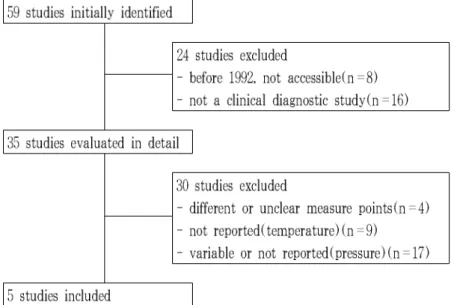
Results : The search yielded 59 studies, of which 5 were considered suitable for this analysis.
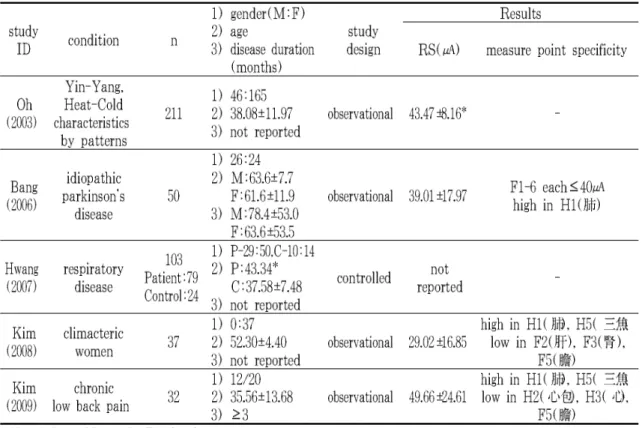
Four were observational studies. Only one was a controlled trial. Average Ryodoraku score(RS),
mean values for each measure point, physiologic limit, number of Pyesaek and Gyeokcha, and
pattern classification were used as references for the analysis. Correlations were observed
between average RS and idiopathic Parkinson's disease, some sub-groups of respiratory disease,
chronic low back pain, and menopause. Some mean values for measure points showed particularly
high or low tendencies in patients with idiopathic Parkinson's disease, chronic low back pain,
and menopause. Positive correlations were observed between the number of Pyesaek and H-Y
stage in idiopathic Parkinson's disease and F2( ) and the modified Kupperman's index with 肝
menopausal women. The four classes, organized based on Ryodoraku pattern, showed differences
- 126 -
Fig. 1. Flowchart of Study Selection Process.
- 128 -
-