INTRODUCTION
Recently, the interest in the prodromal stage of dementia that includes a transitional cognitive stage between the nor- mal aging and the early stage of dementia, i.e., ‘mild cognitive impairment (MCI)’ has been increasing. MCI refers to the stage between the normal aging and dementia in the cogni- tion continuum.1 Reportedly, 10–15% cases of MCI progress to diagnosed dementia each year, or about 50% of them prog- ress to dementia in 3 years;2 another study showed that in a
few years, 55–72% cases with MCI progressed to dementia, in particular, Alzheimer’s disease with the annual conversion rate of about 12%.3 As mentioned above, since MCI is highly likely to progress to dementia, appropriate measures at this stage are very important to suppress or delay the progression to dementia. Therefore, accurate diagnosis of MCI before it progresses to clinically apparent dementia can be a critical strategy for early detection of dementia and intervention.4
All patients with dementia exhibit semantic and lexical sys- tem deficits. Among several types of tests to examine the char- acteristics of semantic-lexical system in dementia, the catego- ry fluency task is convenient, useful, and widely used in the clinical setting. It examines the ability to generate words of the category within a limited time and is also known as verbal flu- ency test, generative naming test, and controlled oral word as-
Cued and Un-Cued Semantic Category Fluency in Older Adults with Mild Cognitive Impairment
Seong-Yeon Kwon,1 Ji-Wan Ha1,2
1Department of Speech and Language Pathology, Graduate School of Rehabilitation Science, Daegu University, Daegu, Korea
2Department of Speech Pathology, Daegu University, Gyeongsan, Korea
Background and Purpose Patients with switching deficits reportedly benefit more from categorical cueing for semantic category fluency than do patients with clustering deficits. We explored the contribution of language ability and executive control on the performance of se- mantic category fluency in older adults with mild cognitive impairment (MCI) by examining the effects of categorical cueing on the task.
Methods Order adults with MCI (n=10) and normal controls (n=25) were compared on two versions of a semantic fluency task: a stan- dard, un-cued version (SF) and a version in which subjects were cued (C-SF) with 4 subordinated categories. The scores and error types of SF and C-SF tasks were analyzed between two groups. Also, the correlation among the SF task, the C-SF task, and the confrontation naming task were examined.
Results The performance of the sematic fluency task improved when categorical cues were included in both groups. However, the normal group showed significantly more improvement than the MCI group. Self-repetition errors in the SF task and categorical errors in the C-SF task occurred most frequently. The normal group showed significantly more errors than the MCI group in the C-SF task. There was a positive correlation among the SF task, the C-SF task, and the confrontation naming task.
Conclusions The results of the present study suggested that the MCI group has more difficulty in the semantic memory store rather than in the use of retrieval strategies. A combination of standard and cued semantic fluency tasks may help to confirm the underlying deficit of se- mantic fluency impairment.
Key Words semantic category fluency, cued semantic category fluency, mild cognitive impairment.
Received: February 1, 2016 Revised: March 15, 2016 Accepted: March 15, 2016
Correspondence: Ji-Wan Ha, PhD, Department of Speech Pathology, Daegu University, 201 Daegudae-ro, Jillyang-eup, Gyeongsan 38453, Korea Tel: +82-53-850-4327, Fax: +82-53-850-4329, E-mail: [email protected]
cc This is an Open Access article distributed under the terms of the Cre- ative Commons Attribution Non-Commercial License (http://creative- commons.org/licenses/by-nc/3.0) which permits unrestricted non-com- mercial use, distribution, and reproduction in any medium, provided the ori- ginal work is properly cited.
DND
ORIGINAL ARTICLE
Seong-Yeon Kwon et al.
Cued Semantic Fluency in MCI
sociation test. The test is classified into the semantic category task, which requires generation of words of a specific semantic category; and the phonemic category task, which requires gen- eration of words beginning with specific phoneme or letter.5
Semantic category task is preferable to phonemic category to evaluate the semantic-lexical system deficit in patients with dementia, since it involves word retrieval on the basis of the semantic relationship, as compared to the phonemic category task that involves retrieval of morphologically similar words re- gardless of their semantic relationship. Performance of the se- mantic category task is reported as significantly lower than the phonemic category task in dementia of Alzheimer’s type.6
The semantic category fluency task enables the evaluation of semantic memories, quantity of words stored in the lexical re- pository, and the ability to retrieve them. The retrieval ability includes the cognitive strategy for retrieval of greater number of words within a given time. Therefore, if the small quantity of words is stored with specific meaning, and if the language output and the ability to use cognitive strategy to retrieve words efficiently within the given time has deficits, the task perfor- mance is negatively impacted. Therefore, several researchers use the concepts of clustering and switching.7 Clustering abil- ity refers to the capacity to recollect and retrieve the words within the same category among sub-categories of semantic category in sequential order; and switching ability refers to the capacity to change the category to another sub-category when the person cannot retrieve any more words through recollec- tion within one category. Thus, the former is associated with the quantity of words stored in repository in applicable seman- tic category and ability to retrieve them, while the latter is as- sociated with executive function of strategic exploration and cognitive flexibility. Also, it is described in connection with le- sions of the brain, for e.g., the temporal lobe dysfunction causes problems in clustering ability and the frontal lobe dys- function causes problems in switching ability.7,8
Several studies conducted the semantic category fluency task by suggesting the cues of sub-category in order to sepa- rately investigate the clustering ability and the switching abil- ity.9-11 In the cued sub-category task, the investigator provides information of sub-category in advance, when conducting the semantic category fluency task. For example, the method requests retrieval of as many animal names as possible within 60 seconds; the total 60 seconds are divided into 4 segment units of 15 seconds, and at the start of each segment, the sub- categories such as ‘pets growing at private home’, ‘livestock being bred at farms’, ‘animals living in jungle’ and ‘animals living in water’ are suggested. One such study reported that the cued task performance was substantially improved in Huntington’s disease and in Parkinson’s disease, while it was
not improved in Alzheimer’s disease;11 in addition, a study showed that provision of cue was significantly beneficial in the frontal lobe dysfunction, as compared to the temporal lobe dysfunction.9 Based on these results, the investigators sug- gested that the problem of cognitive processing i.e., switching should be suspected when the task performance improves after cuing; whereas it is reasonable to suspect problems of language representation and language processing i.e., cluster- ing, when the cued task performance shows little change.
Most researchers agree that the semantic category fluency performance declines with the progression of dementia.11,12 Randolph et al.11 reported that patients with Alzheimer’s dis- ease showed no significant differences in the performance de- pending on whether cued or un-cued due degeneration of the semantic memory repository. Thus, in the dementia of Al- zheimer’s type, the quantity of stored words is reduced with progressive degeneration of the semantic memory repository, thus, the performance of semantic category fluency inevitably declines regardless of being cued or not. However, while lower semantic category fluency was reported for cases with MCI, as compared to the normal elderly group;13 another study re- ported that semantic category fluency was not lower.14 More- over, few studies identify when the performance deficits are related to the clustering, or the switching in respect to cueing.
Therefore, in this study, we verified whether the group with MCI showed deficits in performance of semantic catego- ry fluency, as compared to the normal group by comparing the difference in performance depending on cueing/un-cueing.
Any differences in performance observed between the un- cued semantic category fluency task and the cued semantic category fluency task in the group with MCI, indicates the switching deficits but otherwise, it may indicate the clustering deficits as in dementia of Alzheimer’s type. In addition, com- parison of error types during the task performances between two groups verified whether the difficulties faced by the MCI group in performing the semantic fluency task were of dif- ferent quality, as compared to the normal group. Finally, the association between the un-cued semantic category fluency task performance, the cued semantic category fluency task performance, and the confrontation naming task performance which is frequently used in the clinical setting together with the category fluency task, were examined through the corre- lation analysis.
METHODS
Subjects
A total of 35 subjects ≥65 years old consisted of 25 non- demented elderly people and 10 patients with MCI had par-
DND
ticipated in this study. The subjects were users of the services provided by the Elderly Welfare Centers in Gyeongbuk region in Korea, and the patients with MCI among them were par- ticipants in the cognitive function improvement programs of the applicable Welfare Centers after diagnosis with MCI. Pre- test interviews were conducted for participants’ ages, years of education received and health conditions. The participants using Korean as native language, having no problems in vi- sion and hearing for daily living activities, and with no medi- cal history of neurologic and mental disease were primarily selected. Illiterate subjects were excluded. Subsequently, the secondary selection was with the following criteria. First, those with the result of Korean version of the Mini-Mental State Examination (K-MMSE)15 of ≥1.5 standard deviation (SD) (score ≥16%ile) were included, secondly those with medica- tion for hypertension or diabetes mellitus16 were excluded, and thirdly, those with depression of ≥moderate severity from the Geriatric Depression Scale17 were excluded.
Among the secondarily selected subjects, those with com- plaints of memory deterioration by the subject or the care- giver, and with the score of delayed recall ≤16% in the mem- ory domain of Neuropsychological Screening Seoul Neuro- psychological Screening Battery18 were classified as the MCI group and the rest of participants were classified as the nor- mal group. Diagnosis of MCI was confirmed according to di- agnosis criteria presented by Petersen1 and Winblad et al.19 Prior to the start of the study, all participants provided consent after they were sufficiently informed in advance about the purpose of the study, content of investigation, the required time, and voluntary nature of participation or discontinuation of par- ticipation.
Study tasks
As the experimental task of this study, ‘Animal Naming Test’
was selected based on a study of Kang et al.5 The un-cued se- mantic category fluency task is the same as generally used se- mantic category fluency task, which asks the subjects to gen- erate as many as possible animal names for 60 seconds. For the cued semantic category fluency task, 60 seconds were di- vided into 4 segment units of 15 seconds. By each segment, the subordinate categories were presented and the subjects were required to generate as many as possible animal names applicable to each category for 15 seconds. The subordinate categories were defined as ‘insects’, ‘birds’, ‘fishes’, and ‘general animals’ by referring to the precedent studies on the semantic category.20,21 As soon as starting each segment, the examiner presented the applicable title of the subordinate category by writing it on the screen of laptop computer in letters. The con- frontation naming test for correlation analysis was conducted
using the Korean Version of Boston Naming Test (K-BNT).22 Study procedures
In this study, the test was conducted serially in a quiet and separate room. ‘Fruits’ category was explained as an example and when complete subject understanding was confirmed, the test was begun. The test was done in a sequence of the un- cued semantic category fluency task, the confrontation nam- ing task (K-BNT), and the cued semantic category fluency task. When the cued semantic category fluency task was per- formed first, it was likely to affect the un-cued semantic cate- gory fluency task by providing the clue for the subordinate categories; therefore, the un-cued semantic category fluency task was implemented first. The examiner told the subject
“When I say ‘start’, please tell me the animal names as many as you know. Do you understand?” and then, instructed by saying “Start!”. When 60 seconds had passed, the examiner said “Stop”. K-BNT was conducted as described in the test manual. On completion of the K-BNT and after call to atten- tion, the cued semantic category fluency task was conducted.
The task was conducted in the same method as previously used, but the examiner explained to the subjects that the hint would be provided on the laptop computer and they were to provide the animal name corresponding to the hint. The time was measured with a stopwatch, and after 15 seconds, a cue was provided immediately for the next subordinate category.
The clueing was done in the order of ‘insects’, ‘birds’, ‘fishes’
and ‘general animals’, which was done in the same way for all the subjects. The examiner simultaneously recorded and doc- umented all responses of the subject on the recorder.
Data processing
The examiner recorded the number of words generated by the subjects and scored them in the tasks of the un-cued se- mantic category fluency and the cued semantic category flu- ency. When the subject repeated a same word, it was counted 1 time only, and the repetitive response was classified as wrong response. For error analysis, all the responses of the subjects were documented for the items of wrong responses. The er- ror types of the subjects were classified into three types i.e., repetition error, category error and unrelated error. The repe- tition error refers to re-generation of a word already generated.
The category error refers to generation of words belonging to another sub-categories; for example, when the subject gener- ated ‘cutlass fish, mackerel, ray-finned fishes and pig’ for
‘Fishes’ category, ‘pig’ was applied to the category error. The unrelated error refers to generation of word that is unrelated to the corresponding category semantically; for example, the words ‘sparrow, magpie, crow and apple’ for ‘Birds’ category,
Seong-Yeon Kwon et al.
Cued Semantic Fluency in MCI
‘apple’ was applied to the unrelated error. Scoring the results of K-BNT was done as described in the test manual.
Statistical analysis
For comparison of task executive ability according to the inter-group (2) cueing (2), the 1 inter-subjects – 1 intra-sub- ject mixed design repeated measures ANOVA was conducted.
The 1 inter-subjects – 2 intra-subject mixed design repeated measures ANOVA was conducted to compare the frequency by the error type (3) according to the inter-group (2) cueing (2). In addition, Pearson correlation analyses between each task were conducted without dividing the groups for correla- tion analyses between K-BNT, Un-Cued Semantic Category Fluency, and Cued Semantic Category Fluency task.
RESULTS
An Independent Samples t test was conducted prior to analysis of results in order to compare differences in the ages, years of education, K-MMSE scores, and scores of delayed re- call between the group with MCI and the normal control group. The results indicated no statistically significant differ- ences in all variables (p>0.05) except the scores of delayed re- call (p<0.001) (Table 1).
Comparison of cued and un-cued semantic category fluency between groups
From the task for un-cued semantic category fluency, the normal group scored 11.08 points (SD; 3.44) in average; where-
as, the group with MCI scored 8.80 points (SD; 3.70). From the task for cued semantic category fluency, the normal group scored 17.28 points (SD; 3.44) in average, whereas the group with MCI scored 11.90 points (SD; 3.70). The statistical anal- yses showed that the main effect between the groups (F (1,33)= 15.17, p<0.05) and the main effect depending on cueing (F (1,33)= 38.99, p<0.05) were significant (Table 2). Thus, regardless of cueing, the group with MCI showed significant deterioration in performance of the semantic category fluency, as compared to the normal group. Regardless of groups, the cued semantic category fluency task showed significantly improved perfor- mance, as compared to the un-cued semantic category fluen- cy. Also, as the interaction effects of the groups and the cueing were presented as significant (F (1,33)=4.33, p<0.05) (Table 2), an Independent Samples t test between two groups was con- ducted for each tasks to identify further details on the above outcomes. The results indicated no significant differences be- tween the two groups in the task for un-cued semantic cate- gory fluency (p>0.05), whereas in the task for cued semantic category fluency, the performance of the group with MCI was significantly deteriorated, as compared to the perfor- mance of the normal group (p<0.001).
Comparison of error type frequency of cued and un-cued semantic category fluency between two groups
In average, the normal group showed 0.40 times (SD; 0.20) of repetition error and each 0.4 times (SD; 0.20) of category error and unrelated error, respectively in the un-cued semantic
Table 1. Characteristics of participants
Group n Gender Mean (SD)
Male Female Age (yr) Education (yr) K-MMSE Delayed recall (SNSB)
Normal 25 1 24 74.84 (2.54) 4.92 (1.93) 25.84 (1.62) 5.04 (1.50)
MCI 10 0 10 74.30 (3.02) 3.90 (1.91) 24.90 (0.72) 1.7 (0.82)
p-value 0.59 0.167 0.138 0.000
K-MMSE: Korean version of the Mini-Mental State Examination, MCI: mild cognitive impairment, SD: standard deviation, SNSB: Seoul Neuropsy- chological Screening Battery.
Table 2. Results of repeated ANOVA for cued and un-cued semantic category fluency between two groups
Sources SS df MS F p
Between group
Group 209.56 1 209.56 15.17 0.000
Error 455.93 33 13.82
Within group
Cueing 308.89 1.00 308.89 38.99 0.000
Group×cueing 34.32 1.00 34.32 4.33 0.035
Error 261.45 33.00 7.92
df: degrees of freedom, MS: mean square, SS: sum of squares.
DND
category fluency task; while the group with MCI showed 0.60 times (SD; 1.26) of repetition error in average only. For the cued semantic category fluency task, the normal group showed 0.60 times (SD; 1.26) of repetition error in average only, while the group with MCI showed 0.30 times (SD; 94) of category error in average only.
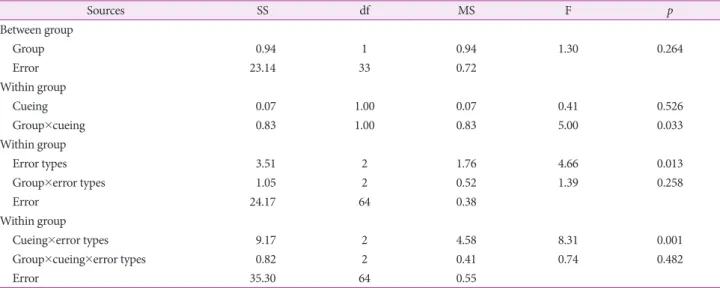
The statistical analyses showed that the main effect between the groups (F (1,33)=1.3, p>0.05) and the main effect depending on cued and un-cued (F (1,33)=41, p>0.05) were not significant.
However, the main effect depending on error types (F (2,64)=4.66, p<0.05), the interaction effect between the cueing and the er- ror types (F (2,64)=8.31, p<0.01) and the interaction effect be- tween the groups and the cueing (F (1,33)=5.00, p<0.05) were significant. In addition, the interaction effect of the groups and the error types (F (2,64)=1.39, p>0.05) as well as the interaction effect between three factors that were the groups, the cueing and the error types (F (2,64)=0.74, p>0.05) were not significant (Table 3).
Bonferroni post-hoc test to investigate the main effect de- pending on the detailed error types revealed that repeated er- rors and the category error were significantly higher than un- related errors (p<0.01). The paired t-test between two tasks
in each error type for detailed analysis of interaction effect between the cueing and the error types, indicated that the re- peated error was significantly higher in the un-cued semantic category fluency task than in the cued semantic category flu- ency task, while the category error was significantly higher in the cued semantic category fluency task than in the un-cued semantic category fluency task (p<0.05). Finally, the Indepen- dent Samples t-test for each task in order to investigate the interaction effect between the group and the cueing in details, showed no significant inter-group differences in the un-cued se- mantic category fluency task (p>0.05), but in the cued semantic category fluency task, the normal group showed significantly higher frequency of errors than the group with MCI (p<0.05).
Correlation between confrontation naming, un-cued semantic category fluency task and cued semantic category fluency task
The correlation coefficients of K-BNT and the un-cued se- mantic category fluency was 0.387, the correlation coefficients of K-BNT and the cued semantic category fluency was 0.505, and the correlation coefficients of the un-cued semantic catego- ry fluency and the cued semantic category fluency was 0.382.
The correlations between all tasks were statistically significant (p<0.05) (Table 4).
DISCUSSION
This study was conducted to compare the performance of the un-cued category fluency task and the cued category flu- ency task in order to determine the semantic fluency depend- ing on cueing for sub-category in the normal group and the Table 3. Results of repeated ANOVA for error types of cued and un-cued semantic category fluency between two groups
Sources SS df MS F p
Between group
Group 0.94 1 0.94 1.30 0.264
Error 23.14 33 0.72
Within group
Cueing 0.07 1.00 0.07 0.41 0.526
Group×cueing 0.83 1.00 0.83 5.00 0.033
Within group
Error types 3.51 2 1.76 4.66 0.013
Group×error types 1.05 2 0.52 1.39 0.258
Error 24.17 64 0.38
Within group
Cueing×error types 9.17 2 4.58 8.31 0.001
Group×cueing×error types 0.82 2 0.41 0.74 0.482
Error 35.30 64 0.55
df: degrees of freedom, MS: mean square, SS: sum of squares.
Table 4. Correlation between K-BNT, un-cued semantic fluency and cued semantic fluency
K-BNT SF C-SF
K-BNT
SF 0.387*
C-SF 0.505† 0.382*
*p-value<0.05, †p-value<0.01.
C-SF: cued semantic category fluency, K-BNT: Korean version of Bos- ton Naming Test, SF: semantic category fluency.
Seong-Yeon Kwon et al.
Cued Semantic Fluency in MCI
group with MCI. Regardless of cueing, the group with MCI showed significant deterioration in performance of the seman- tic category fluency, as compared to the normal group; and regardless of groups, the cued semantic category fluency task showed significantly improved performance, as compared to the un-cued semantic category fluency. However, since the in- teraction effects depending on the groups and the cueing were significant, a post-hoc test was conducted. The results indicat- ed that the performance of the group with MCI was signifi- cantly deteriorated in the task for the cued semantic category fluency only. Analysis of the error types indicated that the re- peated error and the category error were significantly higher in number, as compared to the unrelated error; and by the task, the repeated errors in the un-cued semantic category fluency and the category error in the cued semantic category fluency appeared significantly higher than the cued semantic catego- ry fluency and the un-cued semantic category fluency, respec- tively. Analysis of interaction effect depending on the group and the cueing indicated that the normal group had rather higher frequency of error in the cued semantic category fluen- cy. In addition, all of the confrontation naming, the un-cued semantic category fluency and the cued semantic category flu- ency tasks showed significant correlations.
Importantly, the un-cued semantic category fluency showed no group wise differences; but in the cued semantic category fluency, performance of the group with MCI was significantly deteriorated, as compared to the normal group. As mentioned in the introduction, the reports on the semantic fluency in pa- tients with MCI are conflicting. The two groups showed no significant differences in the un-cued semantic category flu- ency, corroborating the findings from a previous study14 that showed if the tasks were conducted by using general method, the semantic category fluency performance of the group with MCI would not be inferior to the normal group.
Both groups had shown improved performance in the cued semantic category fluency task for which the cues for the sub-categories were provided; however, in the normal group, the level was prominently high, presenting significant differ- ences between the two groups. Improved performance on cue- ing confirmed that the semantic category fluency task does not merely focus on the word retrieval ability but also requires the switching ability between the sub-categories, i.e., executive function. In addition, the result that it was more effective in the normal group implicates that the normal aging process is also associated with the substantial decline of executive func- tion. On the other hand, the group with MCI did not benefit from cueing as much as the normal group. Such result suggests that the decline of semantic category fluency in the group with MCI could be due to clustering deficits rather than the
switching deficits. Thus, the cued semantic category fluency task that requires lesser executive function i.e., the inter-cate- gorical switching, has difficulties and is indicative that the de- cline of cued semantic category fluency in the group with MCI is induced by small quantity of language information stored or by the presence of deficits in the word retrieval itself, or by both, rather than the executive functional problem.
The results of error analysis indicated a significantly higher frequency of errors in the normal group than the group with MCI in the cued semantic category fluency task. The normal group showed the highest category error in the cued semantic category fluency task (Table 2), which was applicable to re- trieved words belonging to another sub-categories. Accord- ing to the lexical access model of Dell et al.,23 retrieval of words involves the activation of not one target word alone but of several words connected to the lexical network simultane- ously. Therefore, the speaker has to select only one target word successfully while suppressing other words than the target word. At this time, the word that has semantic associa- tion with the target word shows stronger activation intensity and much more efforts are required to suppress such word.
Therefore, even a normal person makes a mistake in saying a wrong word that has a certain extent of semantic similarity but is different from the intended word in distracting circum- stances with cognitive burden. Based on such hypothesis, fre- quent appearance of category errors in the normal group could be explained by decline of function to suppress other interfering words that have semantic association, i.e., by relat- ing them to decline of executive function. Thus, the executive function deficits of the normal group are further confirmed in the analysis of errors.
Nevertheless, retrieval of words is easily interrupted by oth- er words either due to executive function deficits or another different problem. In such circumstances, the lexicalization deficits can be considered in the word retrieval error,24 which is not a cognitive problem but is a problem of language pro- cessing. The decline of semantic category fluency in the group with MCI is due to small quantity of words stored, the lexi- calization deficits, or both. However, the finding that catego- ry errors were less frequent in the group with MCI than the normal group suggests that the difficulties faced by the MCI group in the task performance are caused by neither execu- tive dysfunction nor lexicalization deficits. Consequently, the difficulty of the group with MCI resulted from the reduced amount of words in storage. Similar interpretation was made in precedent studies11,12 that explained the semantic category fluency deficits of the group with Alzheimer’s disease as a problem of semantic memory repository. Thus, the MCI can be confirmed as a stage of cognitive deficits in the progression
DND
of dementia.
The results of significantly higher incidences of repeated errors in the un-cued semantic category fluency and the cate- gory errors in the cued semantic category fluency, respective- ly, are likely to be explained in terms of the nature of the tasks.
The un-cued semantic category fluency task was performed for 60 seconds, while the cued semantic category fluency task was performed 4 times of 15 seconds each. Since the un- cued semantic category fluency task had longer time allowed per category, repeated error was higher as a result of repeated reproduction of the same word in a relatively long task time.
In addition, in the un-cued semantic category fluency task, even if a word was generated by wrongly selecting the one belonged to another sub-categories, it was highly likely not to be an error if it is belonged to the supra-category “Animal”.
Whereas, in the cued semantic category fluency task, the sub- categories are predetermined and if deviated from that cate- gory, it becomes the category error. Thus, the failure in sup- pression of interrupting words is revealed easily in the cued semantic category fluency task, with significantly higher fre- quency of category error than the un-cued semantic category fluency.
Finally, the result of the inter-task correlation analysis of higher correlation coefficients of the confrontation naming task and the cued semantic category fluency task than un- cued semantic category fluency, implicates greater language generation ability than any other cognitive processing abili- ties for the cued semantic category fluency task. The un-cued semantic category fluency task is to examine not only lin- guistic aspects but also cognitive strategy function inclusive- ly, thus, low correlation coefficients with both confrontation naming and the cued semantic category fluency task is as ex- pected. In summary, the un-cued semantic category fluency by general method is a task to evaluate both functions of clustering and switching; whereas, the cued semantic category fluency conducted in this study is a more efficient task to eval- uate the clustering function.
This study suggested that deficits of the group with MCI could be attributed to the problem of clustering rather than of switching function, by comparing the performance of seman- tic category fluency depending on cueing. In addition, the differences in performance from the normal group was signifi- cant in the cued semantic category fluency task but not signifi- cant in the un-cued semantic category fluency. Such result somewhat clarifies why previous studies could not agree upon consistent conclusion for the semantic category fluency of the group with MCI. The semantic category fluency task simulta- neously examines the language and the cognitive function and is thus, a very useful task; however, when it is difficult to deter-
mine whether the problem of patient is due to language defi- cits or cognitive deficits, it can be the limitation of the task.
Combined performance of the cued tasks may be a method to resolve such limitation. Therefore, if the un-cued semantic category fluency as well as the cued semantic category fluen- cy task are conducted in clinical practice, and the results are interpreted comprehensively, significant information would be acquired for accessing the underlying deficits of patient.
Despite such significance, this study has a few methodolog- ical limitations as well. The largest limitation is the limit of generalization due to small number of study subjects. In ad- dition, the low education level of the subject should be con- sidered for the interpretation of the results. Given such limita- tions, result of no significant group wise differences in the un- cued semantic category fluency should be cautiously inter- preted. In this study, the normal group seemed also to have difficulties in performing the un-cued task, because they scored 11.08 points (SD; 3.44) in un-cued semantic category fluency.
This score is substantially lower than the study results of Park et al.21 The age and the years of education identified in the normal group can be considered as one of the reasons for such differences presented by each study. The subjects of this study were older with lower education levels in average, as compared to those in the study of Park et al.21 In our study, since the normal group included old aged subjects with lower education level, it is possible that the differences from the group with MCI are not significant. Thus, further studies are required using normal subjects and subjects with MCI with higher, as well as more diversified level of education.
Conflicts of Interest
The authors have no financial conflicts of interest.
Acknowledgements
This work was supported by the Daegu University Research Grant, 2012 (No. 20120395).
REFERENCES
1. Petersen RC. Mild cognitive impairment as a diagnostic entity. J In- tern Med 2004;256:183-194.
2. Korean Dementia Association. Dementia a clinical approach. Seoul:
Academia, 2006.
3. Flicker C, Ferris SH, Reisberg B. Mild cognitive impairment in the elderly: predictors of dementia. Neurology 1991;41:1006-1009.
4. Petersen RC, Smith GE, Waring SC, Ivnik RJ, Tangalos EG, Kok- men E. Mild cognitive impairment: clinical characterization and out- come. Arch Neurol 1999;56:303-308.
5. Kang Y, Chin Jh, Na DL, Lee J, Park JS. A normative study of the Korean version of Controlled Oral Word Association Test (COWAT) in the elderly. Korean J Clin Psychol 2000;19:385-392.
6. Crossley M, D’Arcy C, Rawson NS. Letter and category fluency in community-dwelling Canadian seniors: a comparison of normal par- ticipants to those with dementia of the Alzheimer or vascular type. J
Seong-Yeon Kwon et al.
Cued Semantic Fluency in MCI
Clin Exp Neuropsychol 1997;19:52-62.
7. Troyer AK, Moscovitch M, Winocur G. Clustering and switching as two components of verbal fluency: evidence from younger and older healthy adults. Neuropsychology 1997;11:138-146.
8. Hirshorn EA, Thompson-Schill SL. Role of the left inferior frontal gyrus in covert word retrieval: neural correlates of switching during verbal fluency. Neuropsychologia 2006;44:2547-2557.
9. Drane DL, Lee GP, Cech H, Huthwaite JS, Ojemann GA, Ojemann JG, et al. Structured cueing on a semantic fluency task differentiates patients with temporal versus frontal lobe seizure onset. Epilepsy Be- hav 2006;9:339-344.
10. Iudicello JE, Kellogg EJ, Weber E, Smith C, Grant I, Drane DL, et al.
Semantic cueing improves category verbal fluency in persons living with HIV infection. J Neuropsychiatry Clin Neurosci 2012;24:183- 11. Randolph C, Braun AR, Goldberg TE, Chase TN. Semantic fluency 190.
in Alzheimer’s, Parkinson’s, and Huntington’s disease: dissociation of storage and retrieval failures. Neuropsychology 1993;7:82-88.
12. Bayles KA, Tomoeda CK, Kaszniak AW, Trosset MW. Alzheimer’s disease effects on semantic memory: loss of structure or impaired processing? J Cogn Neurosci 1991;3:166-182.
13. Standish TI, Molloy DW, Cunje A, Lewis DL. Do the ABCS 135 short cognitive screen and its subtests discriminate between normal cognition, mild cognitive impairment and dementia? Int J Geriatr Psychiatry 2007;22:189-194.
14. Testa JA, Ivnik RJ, Boeve B, Petersen RC, Pankratz VS, Knopman D, et al. Confrontation naming does not add incremental diagnostic utili- ty in MCI and Alzheimer’s disease. J Intern Neuropsychol Soc 2004;
10:504-512.
15. Kang Y, Na DL, Hahn S. A validity study on the Korean Mini-Mental State Examination (K-MMSE) in dementia patients. J Korean Neurol Assoc 1997;15:300-308.
16. Christensen KJ, Multhaup KS, Nordstrom S, Voss K. A cognitive battery for dementia: development and measurement characteristics.
Psychol Assess J Consult Clin Psychol 1991;3:168-174.
17. Jung IK, Kwak DI, Shin DK, Lee MS, Lee HS, Kim JY. A reliability and validity study of Geriatric Depression Scale. J Korean Neuropsy- chiatr Assoc 1997;36:103-112.
18. Kang YW, Na DL. Seoul neuropsychological screening battery.
Incheon: Human Brain Research & Consulting Co., 2003.
19. Winblad B, Palmer K, Kivipelto M, Jelic V, Fratiglioni L, Wahlund LO, et al. Mild cognitive impairment--beyond controversies, towards a consensus: report of the International Working Group on Mild Cog- nitive Impairment. J Intern Med 2004;256:240-246.
20. Lee KS, Park CI, Kim HH, Park ES. Development of generative naming ability in 3, 4, 5 and 6-year-old children. Commun Sci Disord 2004;9:1-21.
21. Park J, Kang Y, Chang EJ, Oh E, Yu KH, Lee BC. Clustering and switching on verbal fluency in vascular dementia and dementia of the Alzheimer’s type. Commun Sci Disord 2006;11:99-112.
22. Kim HH, Na DL. Korean version-Boston Naming Test. Seoul: Hak- sisa, 1997.
23. Dell GS, Schwartz MF, Martin N, Saffran EM, Gagnon DA. Lexical access in aphasic and nonaphasic speakers. Psychol Rev 1997;104:
801-838.
24. Ha JW, Sim HS. Application of WebFit for diagnosis of lexical disor- ders in Korean Aphasia. Commun Sci Disord 2011;16:231-247.