www.labmedonline.org 211 eISSN 2093-6338
mal growth factor receptor 2: negative) and underwent breast con- serving surgery with axillary lymph node dissection. After sur- gery, the patient was treated with six cycles of adjuvant chemo- therapy (docetaxel, doxorubicin, and cyclophosphamide) for 3 months with radiation therapy.
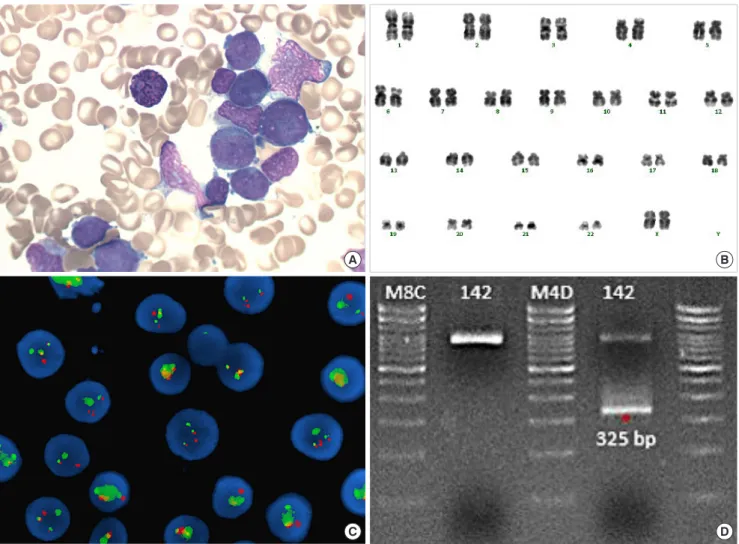
The result of initial complete blood count revealed a hemoglo- bin level of 9.7 g/dL, white blood cell (WBC) count of 48.2×10⁹/L (segmented neutrophils, 5%; band form neutrophils, 0%; lympho- cytes, 3%; monocytes, 2%; eosinophils, 1%; and blast, 86%), and platelet count of 48×109/L. The bone marrow aspirate was filled with morphologically abnormal myeloblasts/promyelocytes, which accounted for 93% of all nucleated cells. These cells had azuro- philic granulation and ovoid nuclei; a few of them had Auer rods (Fig. 1A). Bone marrow biopsy demonstrated a hypercellular mar- row approaching 95% cellularity. Flow cytometry analysis showed that the blasts were positive for CD13 (bright); CD33, CD117, CD2, CD56 (intermediate); CD54, CD41, and CD7 (dim); and negative for CD34, TdT, HLA-DR, CD15, CD14, CD19, CD19, cCD22, CD3, cCD3, and myeloperoxidase (MPO). The karyotype of this patient was 46,XX in all 20 metaphase cells analyzed (Fig. 1B). Fluores- cence in situ hybridization (FISH) analysis using a dual-color dual- fusion PML/RARA probe revealed two fusion signals in 496 out of 500 interphase cells; nuc ish (PML,RARA)×3 (RARA con PML× 2)[496/500] (Fig. 1C). Next-generation-sequencing screening for 49 genes related to AML identified internal tandem repeats of the FLT3 gene (FLT3-ITD); the variant allele frequency (VAF) was 39% at diagnosis, as confirmed by fragment analysis. Reverse- transcriptase polymerase chain reaction (RT-PCR) for PML-RARA rearrangement showed positive result for a fusion transcript (short Dear Editor,
Acute promyelocytic leukemia (APL) comprises 5−8% of acute myeloid leukemia (AML) [1]. The t(15;17)(q22;q12) with PML-RARA fusion transcript is reported in 90–95% of APL cases, while other structural rearrangements, including submicroscopic transloca- tion, have been noted in the remaining cases [2]. Therapy-related myeloid neoplasms (t-MNs) comprising therapy-related AML, my- elodysplastic syndrome (MDS), and myelodysplastic/myeloprolif- erative neoplasms (MDS/MPNs) account for 10−20% of all cases of AML, MDS, and MDS/MPNs. Approximately 8–21% APL cases are therapy-related APL (t-APL), and cryptic PML-RARA rearrange- ment in t-APL has been rarely reported [3, 4]. Here, we report a case of cryptic t-APL patient.
A 66-year-old female patient was admitted to hospital for oral bleeding. In 2016, she was diagnosed with triple-negative breast cancer, left (stage 3, pT2N3M0, P53: 90%, Ki-67: 60%, estrogen re- ceptor: negative, progesterone receptor: negative, human epider-
핵형분석에서 t(15;17) 결여된 치료관련 급성전골수구성백혈병 1예 보고
A Case of Therapy-related Acute Promyelocytic Leukemia Lacking t(15;17) on Karyotype
이 준·김영은
Jun Lee, M.D., Young-Eun Kim, M.D.
한양대학교병원 진단검사의학과
Department of Laboratory Medicine, Hanyang University Seoul Hospital, Hanyang University College of Medicine, Seoul, Korea
편지
Lab Med Online
Vol. 11, No. 3: 211-213, July 2021
https://doi.org/10.47429/lmo.2021.11.3.211 진단혈액학
Corresponding author: Young-Eun Kim, M.D., Ph.D.
https://orcid.org/0000-0002-4082-7630
Department of Laboratory Medicine, Hanyang University Seoul Hospital, Hanyang University College of Medicine, 222-1 Wangsimni-ro, Seongdong- gu, Seoul 04763, Korea
Tel: +82-2-2290-8974, Fax: +82-2-2290-9193, E-mail: [email protected] Received: August 20, 2020 Revision received: October 6, 2020 Accepted: October 15, 2020
This article is available from https://www.labmedonline.org 2021, Laboratory Medicine Online
This is an Open Access article distributed under the terms of the Creative Commons Attribution Non-Commercial License (https://creativecommons.org/licenses/by-nc/4.0/) which permits unrestricted non-commercial use, distribution, and reproduction in any medium, provided the original work is properly cited.
1 / 1 CROSSMARK_logo_3_Test
2017-03-16 https://crossmark-cdn.crossref.org/widget/v2.0/logos/CROSSMARK_Color_square.svg
이 준 외: A Case of Cryptic Therapy-related APL
https://doi.org/10.47429/lmo.2021.11.3.211 212 www.labmedonline.org
Fig. 1. (A) Granular promyelocytes from bone marrow aspiration smear (Wright-Giemsa stain, ×1,000). (B) Giemsa-banding karyotyping of the bone marrow cells at diagnosis reveals the karyotype 46,XX. (C) Fluorescence in situ hybridization (FISH) study using a PML/RARA dual-color, dual-fusion translocation probe at diagnosis. Fusion signals were observed. (D) RT-PCR for PML/RARA fusion transcripts. S-form (325 bp) PML/RARA chimeric transcripts were amplified.
Abbreviation: RT-PCR, reverse-transcriptase polymerase chain reaction.
B
D A
C
form, bcr3) (Fig. 1D). Therefore, the patient was diagnosed with t- APL. Treatment with all-trans-retinoic acid (ATRA) was initiated.
On the 6th day of admission, pulmonary hemorrhage and pneu- monia worsened, which led to pneumonic septic shock and multi- organ failure. The patient died at day 35 after hospitalization.
To reduce life-threatening complications such as disseminated intravascular coagulation and improve treatment results, accurate and rapid diagnosis of APL is imperative and arsenic trioxide and ATRA and arsenic trioxide (ATO)-based therapies must be initi- ated. Chromosome analysis can detect PML-RARA fusion in about 90% of APL cases but not in cryptic APL [5], necessitating FISH or PCR to detect the abnormality of the fusion transcript. Further, APL that is PML-RAR negative in FISH is rare but does exist [6]. It
seems important to perform RT-PCR test as well as chromosome analysis and FISH for clinical assessment of PML-RARA.
Mutations involving FLT3, including internal tandem duplica- tion (ITD) and tyrosine kinase domain (TKD) mutations, occur in 35−40% of APL. The FLT3-ITD mutation is the most common and associated with higher WBC counts, microgranular granulocytes, and bcr3 breakpoint in PML [7].
The difference in survival outcomes in de novo APL or t-APL patients is controversial. In a previous study, the outcome of t-APL was similar to that of de novo APL [4]. Nevertheless, for all sub- types of AML, clinical outcomes were worse for patients with ther- apy-related disease [8]. Elevated WBC counts predict worse prog- nosis, but the FLT3-ITD mutation of APL has no significant effect
이 준 외: A Case of Cryptic Therapy-related APL
https://doi.org/10.47429/lmo.2021.11.3.211 www.labmedonline.org 213
on prognosis. However, a higher FLT3-ITD mutation/wild-type ratio (≥0.5%) indicated adverse prognosis [9].
To our knowledge, this is the first report of cryptic t-APL in Ko- rea. Further study is warranted to estimate the prevalence of cryp- tic t-APL and to evaluate response to treatment and prognosis in t- APL patients.
Conflicts of Interest
None declared.
REFERENCES
1. Swerdlow SH, Campo E, et al. eds. WHO classification of tumours of haematopoietic and lymphoid tissues. Revised 4th edition. Lyon, France:
International Agency for Research on Cancer, 2017:134-55.
2. Burns TF, Loo EY, Bengtson EM, Bao L. Cytogenetically cryptic inser- tion of PML segment into RARA on chromosome 17q resulting PML- RARA fusion in acute promyelocytic leukemia. Ann Hematol 2019;98:
211-3.
3. Kayser S, Krzykalla J, Elliott MA, Norsworthy K, Gonzales P, Hills RK, et al. Characteristics and outcome of patients with therapy-related acute promyelocytic leukemia front-line treated with or without arsenic tri-
oxide. Leukemia 2017;31:2347–54.
4. Beaumont M, Sanz M, Carli PM, Maloisel F, Thomas X, Detourmignies L, et al. Therapy-related acute promyelocytic leukemia. J Clin Oncol 2003;21:2123-37.
5. Kim KE, Woo KS, Kim SH, Han JY. Detection of PML/RARA rearrange- ment by reverse transcriptase-PCR and sequencing in a case of micro- granular acute promyelocytic leukemia lacking t(15;17) on karyotype and FISH. Korean J Lab Med 2009;29:379-83.
6. Kim MJ, Cho SY, Kim MH, Lee JJ, Kang SY, Cho EH, et al. FISH-nega- tive cryptic PML–RARA rearrangement detected by long-distance poly- merase chain reaction and sequencing analyses: a case study and re- view of the literature. Cancer Genet Cytogenet 2010;203:278-83.
7. Breccia M, Loglisci G, Loglisci MG, Ricci R, Diverio D, Latagliata R, et al. FLT3-ITD confers poor prognosis in patients with acute promyelo- cytic leukemia treated with AIDA protocols: long-term follow-up anal- ysis. Haematologica 2013;98:e161-3.
8. Kayser S, Döhner K, Krauter J, Köhne CH, Horst HA, Held G, et al. The impact of therapy-related acute myeloid leukemia (AML) on outcome in 2853 adult patients with newly diagnosed AML. Blood 2011;117:2137- 45.
9. Schnittger S, Bacher U, Haferlach C, Kern W, Alpermann T, Haferlach T. Clinical impact of FLT3 mutation load in acute promyelocytic leuke- mia with t(15;17)/PML-RARA. Haematologica 2011;96:1799-807.