• 검색 결과가 없습니다.

Effect of Using Electrical Stimulation and Ultrasound with Aerobic Exercise on Local Lipolysis

N/A
N/A
Protected

Academic year: 2021

Share "Effect of Using Electrical Stimulation and Ultrasound with Aerobic Exercise on Local Lipolysis"

Copied!
7
0
0

로드 중.... (전체 텍스트 보기)

전체 글

(1)

Sug-Ju Choi, PT, PhD; Jin-Gu Jeong, PT, PhD

1

; Sam-Ki Seo, PT, PhD

2

Department of Physical Therapy, Taegu Science College;

1

Department of Physical Therapy, Chunnam Techno College;

2

Department of Physical Therapy, Seonam University

Purpose: This  study  was  designed  to  measure  the  effects  of  weight,  abdominal  girth,  body  fat,  abdominal  fat  and  cholesterol levels in combination with electrical stimulation, ultrasound and aerobic exercise on obesity and local lipolysis.

Methods: Subjects were 30 obese adults who volunteered to take part in the experiment and had no physical diseases. They  were  randomly  divided  into  three  groups:  (1)  an  aerobic  exercise  group  (n=10),  (2)  an  electrical  stimulation  group  with  aerobic exercise (n=10), and (3) an ultrasound stimulation group with aerobic exercise (n=10). Each experimental group  went through 8 weeks of training.

Results: All measured items including weight, girth of the abdomen, body fat, and cholesterol levels showed significant  differences among groups. All three groups showed decreases for all items. The electrical stimulation + aerobic exercise  group (group II) showed greater effects than the aerobic exercise group (group I) and the ultrasound stimulation group  with aerobic exercise (group III).

Conclusion:  Electrical  stimulation  +  aerobic  exercise  and  ultrasound  stimulation  +  aerobic  exercise  cause  decreases  in  weight, girth of the abdomen, body fat and cholesterol level compared to aerobic exercise alone.  These methods can be  considered to be effective adjuvants to aerobic exercise in obese adults.

Keywords: Electrical stimulation, Ultrasound stimulation, Aerobic exercise, Obesity Received: September 21, 2010

Revised: November 25, 2010 Accepted: December 6, 2010

Corresponding author: Sam-Ki Seo, [email protected]

Aerobic Exercise on Local Lipolysis

The Journal Korean Society of Physical Therapy
I. Introduction

As life environments have become increasingly convenient, including transportation options in modern society, physical activity has been rapidly reduced and eating increased and the rate of obesity has been sharply increased due to excessive intake of high-calorie foods. Indeed, it is widely known that lack of physical activity and excessive energy intake are accompanied by a higher risk of obesity, diabetes, coronary heart disease, hypertension and hyperlipemia, and musculoskeletal disease, and morbidity from obesity has been rapidly increasing for the last 100 years.

1

Obesity is a pathological factor causing many complications. It is significantly increased in advanced countries and directly related to national health.

2

Obesity is defined as a state of excessive accumulation of body fat that exceeds the

normal range. Obesity progresses to chronic metabolic disease by environmental factors such as a lack of physical activity, excessive calorie intake, stress, etc. Obesity is also an aggravating factor in other diseases. For example, obesity causes cardiovascular disease, joint disease, behavioral disorders, psychological depression, and a lower quality of life.

3

Weight control cannot be achieved in a short time and

requires continuous effort. Also as obese people's will, faith and

attitude are important in weight control, efforts to make

behavioral changes through more active and positive activities

are required.

4

There are many methods to control weight

including diet, behavior modification, drugs and surgery, but

exercise therapy –which has few side effects, no yo-yo effect, and

is not harmful to health–is generally recommended and

extensively used.

5,6

(2)

Existing studies indicate that medical treatment for obesity in long- and short-term evaluations should be combined with a physical activity program, measurements of weight control, and psychological support.

7

In general, a frequently used method for obesity control is aerobic exercise. Aerobic exercise refers to exercise that involves or improves oxygen consumption by the body. It promotes maximum oxygen into the body, improves the functioning of heart and lung, and leads to strong blood vessel tissues. It also assists in synthesizing ATP using fat and glycogen secreted by long-term activities. In addition, it has been reported that aerobic exercise activates fat metabolism and has positive influences on total cholesterol, neutral fat, and blood lipids (high density lipoprotein cholesterol and low density lipoprotein cholesterol).

5,8

Obese body shapes are divided into a centrally obese type, which is characterized by a bigger waist than hip circumference, and a peripherally obese type, which shows bigger hip than waist circumferences. It has been reported that central obesity and a protruded abdomen has worse effects on health.

9

In Korea, although obesity is not high, there are many cases of excess central body fat distribution. This may be a partial reason for the higher morbidity and mortality of adult diseases that are due to increased abdominal obesity.

10

Influences of obesity on health are huge. In particular, abdominal obesity has closer relations to diseases compared to obesity in other parts of the body, and successful methods for management and prevention of abdominal obesity are urgently needed.

Electrical stimulation to muscle has been mainly used for those for whom physical activity is limited. Its effects have been proven.

11-13

In electrical stimulation, muscles are stimulated at a low frequency to induce a change in the form of the muscular fibers and the method is effective in maximizing energy use.

14,15

But, clear evidence is lacking for the ability of electrical stimulation, when applied regularly and over the long term, to induce a loss of weight, a decrease of body fat, and a change of body composition. Lunde et al

16

reported that fat around muscles that were contracted by electrical stimulation were converted to energy, which consumed calories. The energy was released by a wrenching effect due to the contraction and relaxation of muscles, and to improved physical purification (discharging wastes and humors to the kidney through circulatory system).

Ultrasound is used at a frequency higher than 20,000 Hz – it

is a sound wave that cannot be heard by human ears. The effects of ultrasound include a thermotherapy effect and a micromassage effect. The micromassage effect, which is a result of the mechanics of the ultrasound, is accompanied by biological effects such as afriction effect, promotion of diffusion through cell membranes, an intercellular massage effect, reversible decreases in viscosity of colloidal substances, and effects on nerves and on circulatory mechanisms.

17,18

Therefore, when ultrasound is applied to the abdomen, fat is converted to a state in which it is easily dissolved by the warming and the vibration of ultrasound. The flow of blood and lymph is fostered, and excretion of fatty acids into the blood is promoted.

19

Some studies reported recently thatelectrical and ultrasound stimulation with diet or exercise were effective in controlling abdominal obesity, but research on which is more effective, electrical stimulation or ultrasound, is insufficient. Therefore, this study was designed to determine whether ultrasound or electrical stimulation is more effective when applied to local obesity, in particular abdominal obesity. We wanted to show whether either method has the capacity to dissolve fat, and whether one or the other is more effective. We hoped that the study results would suggest an efficient method for controlling abdominal obesity.

II. Methods

1. Subjects

This study was designed to examine the effects of electrical stimulation and ultrasound on local lipolysis. We recruited subjects from groupsof male and female students at C college.

We selected 30 subjects who had no special diseases, had no physical or mental disorders, and had a body fat ratio over 20%

for men and over 30% for woman. They all agreed to take part in the research. This study was a randomized controlled trial. All subjects were divided into three groups. The first group (group I) was anaerobic exercise group (n=10, age=20.4±2.07, weight=

64.08±8.67, height=163.4±8.47). The second group (group II) received electrical stimulation + aerobic exercise (n=10, age=

22.8±7.00, weight=63.84±9.57, height=165.2±8.44). The third group (group III) received ultrasound stimulation + aerobic exercise (n=10, age=20.4±13.84, weight=64.78±7.83, height=

164.4±7.83). All three groups attended meetings three times a

(3)

week for a total of 8 weeks. They did this netweem May 7 and Jun. 30, 2010.

2. Experimental process

Group I was applied to ultrasound for 20 min. and performed aerobic exercise for 50 min, group II had electrical stimulation for 20 min. and performed aerobic exercise for 50 min. and group III performed aerobic exercise only for 50 min. Each group had analysis of body composition, girth of the abdomen and blood analytes before and after the experiment.

3. Measurement

1) Analysis of body composition

Whole fat, body fat, weight and abdominal fat ratio were measured with a body composition analyzer (InBody 3.0, Biospace, Korea) before the experiment and 8 weeks after the experiment. Meals and beverage were prohibited from 5 hours before measurement. Subjects input their age, height and sex.

They were asked to stand barefoot on the place indicated on the body composition analyzer without wearing an accessory that can affect measurement. They were measured in a position in which the ears and eyes were at the same level.

2) Girth of abdomen

Waist (in cm) was measured at the lower part of the lowest rib and at the middle period of the top of the iliac crest while in an upright position. In that state, the subject breathes out using a Tapeline SECA-200 (SECA, Germany) after every experiment.

That is, waist circumference was measured 3 cm above the anterior superior iliac spine.

3) Blood analysis

Blood samples were taken between 8 and 9 AM after an overnight fast. A blood sample of 5 ml was taken from the antecubital vein using a disposable syringe. Blood was taken twice – before beginning the experiment and 8 weeks later. The blood sample was put into 5 ml Vacutainer SST tubes and centrifuged at 2500∼3000 rpm for 10∼15 min. Serum was separated and immediately tested by means of a blood analyzer (EKTACHEM DT60 II, Kodak, USA). Measured items were TG and TC.

4) Electrical stimulation

Electrical stimulation was conducted using a Dynatens 301 (BEST, Korea). Electrical stimulation was applied at a frequency of 50 Hz, which was reported to be suitable for improving the functional capacity of skeletal muscle, and at a fixed pulse duration of 250 ㎲. For a short circuit time of 4 sec, 4 electrical pads were attached to four parts of the body based on the navel.

The stimulation intensity was adjusted by the controller so as not to cause pain. Stimulation was done for 20 min.

5) Ultrasound stimulation

Ultrasound stimulation was conducted using a Sonotens 501 (BEST, Korea). Ultrasound stimulation used a 1 MHz pulse based on the navel. Ultrasound was applied to four parts of, up, down, left and right, by moving a distance of about 1 inch per second using a circular movement. Total ultrasound time was 20 min, each of the 4 parts being treated for 5 min. Ultrasound gel (moisture gel) was used as a base.

6) Aerobic exercise

Aerobic exercise was performed 2 hours after meals for a total exercise time of 50 min. This included warm-up and warm-down times (light gymnastics and stretching for 5 min each) with the main exercise being power walking on a treadmill at 6.5 km per hour speed for 40 min.

4. Statistical analyses

All data were analyzed using the SPSS 12.0 statistical program.

Comparisons of measured items before and after the experiment were done using analysis of covariance (ANCOVA), followed by a post hoc Bonferroni test. The significance level was set at 

=0.05.

III. Results

1. Changes in weight

There was a significant difference (p<0.01) in weight changes

between all groups. The aerobic exercise group showed a weight

change from 63.08±8.67 kg to 61.18±8.30 kg; the electrical

stimulation group showed a loss of weight from 64.78±7.83 kg

to 58.92±5.66 kg; the ultrasound group showed a loss of weight

from 62.84±9.57 kg to 60.3±9.1 kg (Figure 1).

(4)

Figure 1. Between group comparison of body fat ratio before and after the intervention.

M±SD: Mean±Standard deviation

Ⅰ: Aerobic exercise group

Ⅱ: Electrical stimulation with aerobic exercise group

Ⅲ: Ultrasound stimulation with aerobic exercise group

*p<0.05

Figure 2. Between group comparison of girth of the abdomen before and after the intervention.

M±SD: Mean±Standard deviation

Ⅰ: Aerobic exercise group

Ⅱ: Electrical stimulation with aerobic exercise group

Ⅲ: Ultrasound stimulation with aerobic exercise group

*p<0.05

Figure 3. Between group comparison of body fat ratio before and after the intervention.

M±SD: Mean±Standard deviation

Ⅰ: Aerobic exercise group

Ⅱ: Electrical stimulation with aerobic exercise group

Ⅲ: Ultrasound stimulation with aerobic exercise group

*p<0.05

Figure 4. Between group comparison of abdominal fat before and after the intervention.

M±SD: Mean±Standard deviation

Ⅰ: Aerobic exercise group

Ⅱ: Electrical stimulation with aerobic exercise group

Ⅲ: Ultrasound stimulation with aerobic exercise group

*p<0.05

2. Changes in abdominal girth

There was a significant difference (p<0.001) between all groups for abdominal girth. The aerobic exercise group showed a loss of weight from 79.7±1.33 cm to 78.92±1.52 cm; the electrical stimulation group showed a loss of weight from 76.98±5 cm to 74.9±4.92 cm; the ultrasound group showed a loss of weight from 77.5±4.71 cm to 74.54±4.62 cm (Figure 2).

3. Changes in body fat ratio

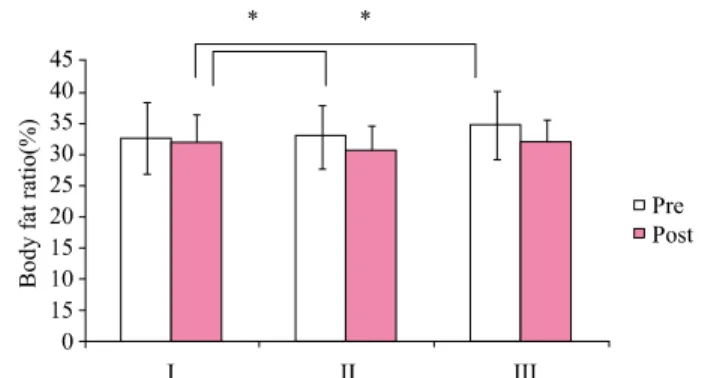
There was a significant difference (p<0.05) between all groups for changes in body fat ratio. The aerobic exercise group showed a decrease in the body fat ratio from 32.58±5.69% to 31.94±4.35%; the electrical stimulation group showed a

decrease in body fat ratio from 32.88±5.07% to 30.64±3.87%;

the ultrasound group showed a decrease in the body fat ratio from 34.64±5.34% to 31.94±3.64% (Figure 3).

4. Changes in abdominal fat

There were significant (p<0.01) differences in abdominal fat between the aerobic exercise group and the electrical stimulation group. The aerobic exercise group showed a decrease in abdominal fat from 0.83±0.04% to 0.82±0.04%; the electrical stimulation group showed a decrease in abdominal fat from 0.83±0.06% to 0.80±0.05%; the ultrasound group showed a decrease in abdominal fat from 0.84±0.08% to 0.80±0.07%

(Figure 4).

(5)

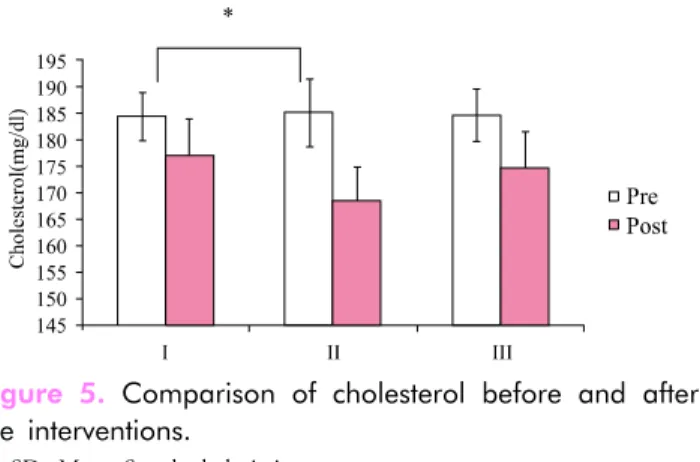
Figure 5. Comparison of cholesterol before and after the interventions.

M±SD: Mean±Standard deviation

Ⅰ: Aerobic exercise group

Ⅱ: Electrical stimulation with aerobic exercise group

Ⅲ: Ultrasound stimulation with aerobic exercise group

*p<0.05

5. Changes in cholesterol

There were significant differences in cholesterol between the aerobic exercise group and the electrical stimulation group. The aerobic exercise group showed a decrease in cholesterol from 184.40±46.53 mg/dL to 177.00±6.96 mg/dL the electrical stimulation group showed a decrease in cholesterol from 185.00±6.36 mg/dL to 168.80±6.26 mg/dL the ultrasound group showed a decrease in cholesterol from 184.60.40±5.02 mg/dL to 174.80±6.81 mg/dL (Figure 5).

IV. Discussion

In modern society, efforts to prevent and treat obesity have been continuously developed based on exercise, diet, drug, aroma and surgery, but more effective obesity control methods are increasingly required.

Of the many obesity control methods, exercise has been a contentious issue. Exercise is divided into aerobic and anaerobic exercises, depending on the type of metabolism stimulated, and many researchers have [developed calorie limitations with exercise ?] to verify the effects of aerobic exercise.

20,21

Exercise causes an explosive increase in the speed at which weight is lost due to increased energy use. Many studies which were designed to decide the duration and intensity of energy use for loss of weight indicated that short-term exercise was not effective for losing weight, but long-term exercise was effective.

22,23

Jakicic

24

and Lindelof et al

25

compared programs of (1) high exercise intensity and short exercise time to programs of (2) low exercise

intensity and long exercise time. Programs of low exercise intensity and long exercise time – matched for the same quantity of exercise – were more effective for weight control.

However, obesity treatments that are low cost and involve simple and effective procedures should be developed and side effects and complications should be prevented. Therefore, this study involved obese adults doing aerobic exercise for 8 weeks based on the preceding studies. It also analyzed the effects of combining electrical stimulation and ultrasound with aerobic exercise on body composition and hematology factors.

Oh et al

26

reported that a four-week aerobic exercise program elicited a significant decrease in weight, body fat mass, body fat ratio, abdominal fat, girth of abdomen and hip, significant muscular mass, and decreases in subcutaneous fat area and intestinal fat area that were not significant. Yun

27

suggested that a woman with essential hypertension without an exercise habit should perform aerobic exercise using a treadmill at an intensity of 50% HRmax for 16 weeks. As a result of the exercise, she reported a significant loss of weight, an average of 3.6 kg (5.96%) and a decrease in body fat ratio that averaged 4.4%

(14.56%).

Kim et al

28

reported that aerobic exercise was performed by obese youths for 12 weeks and there was a statistically significant difference in losses of neutral fat. There was also decreases in weight of 0.96 kg, in abdominal girth of 1.18 cm, in body fat ratio of 1.04%, in abdominal fat of 0.01%, in cholesterol of 1.6 mg/dL and in TG of 23.6 mg/dL. These results indicate that a regular 8-week aerobic exercise program fosters dissolution of neutral fat of fat tissues, converting it into free fatty acids, which are changed into energy by the mitochondrion, and which provides energy for use by muscle during exercise. Exercise increased energy consumption and prevented or decreased obesity.

22,29

Kim et al

30

suggested that regular electrical stimulation to the obese group for 4 months led to significant decreases in body fat ratio, in mass, and in body composition at one-week intervals;

there were no significant differences in weight or in whole fat weight. Jun

31

reported that electrical stimulation + aerobic exercise elicited significant decreases in weight, body fat ratio and mass; there were no significant differences in whole fat mass.

The results of our study showed that electrical stimulation +

aerobic exercise leads to decreases in weight (–5.86 kg), in

abdominal girth (–2.08 cm), in body fat ratio (–2.24%), in

(6)

abdominal fat (–0.03%) in cholesterol (–16.2 mg/dL) and in TG (–9.4 mg/dL). Based on the above results, it appears that regular electrical stimulation is effective in promoting lipolysis by stimulating fat tissue secondary to stimulating muscular contractions.

The Ultrasound + aerobic exercise group showed decreases in weight of 2.54 kg, girth of the abdomen of 2.96 cm, body fat ratio of 2.70%, of abdominal fat of 0.04%, and cholesterol of 9.8 mg/dL. Simillar to the study by Huh,

32

we showed significant decreases in waist and weight with ultrasound stimulation, presumably because it fosters secretion of fatty acids into the blood secondary to increases in material movement and permeability of fat cells. Therefore, it is appears that the combination of ultrasound and electrical stimulation with aerobic exercise enhances Ca

2+

homeostasis within fat cells, and activates protein kinase and lipolysis.

33,34

In conclusion, it was found that electrical stimulation and ultrasound in combination with aerobic exercise are effective in reducing local obesity. The most effective method was electrical stimulation + aerobic exercise. This intervention should be effective in decreasing weight, abdominal girth, body fat, abdominal fat and cholesterol levels, and in improving exercise capacity. This intervention was better than aerobic exercise alone. In addition, this intervention can be considered as a way to improve exercise capacity for health management and to coach obesity exercise.

V. Conclusion

This study was designed to examine the effects of electrical stimulation and ultrasound on local obesity in obese adults. We arrived at the following conclusions.

There are significant between-group differences in weight (p<0.01), abdominal girth (p<0.001), body fat ratio (p<0.05), abdominal fat (p<0.01), and cholesterol (p<0.05).

All interventions were effective in reducing local obesity. The most effective method was electrical stimulation + aerobic exercise. Ultrasound and electrical stimulation are effective for local lipolysis.

Author Contributions

Research design: Choi SJ Acquisition of data: Jeong JG

Analysis and interpretation of data: Jeong JG, Seo SK Drafting of the manuscript: Jeong JG, Seo SK

Administrative, technical, and material support: Choi SJ Research supervision: Seo SK

Acknowledgements

This research was supported by Taegu Science University Research Grants in 2010

References

1. Kang JI, Park SK, Lee JH. The effect of microwave diathermy against the body composition of obese women. J Kor Soc Phys Ther. 2008;20(4):29-34.

2. Albright A, Franz M, Hornsby G et al. American college of sports medicine position stand. Exercise and type 2 diabetes.

Med Sci Sports Exerc. 2000;32(7):1345-60.

3. Kolotkin RL, Binks M, Crosby RD et al. Obesity and sexual quality of life. Obesity (Silver Spring). 2006;14(3):472-9.

4. Mata J, Silva MN, Vieira PN et al. Motivational "spill-over"

during weight control: increased self-determination and exercise intrinsic motivation predict eating self-regulation.

Health Psychol. 2009;28(6):709-16.

5. Martins RA, Verissimo MT, Coelho e Silva MJ et al. Effects of aerobic and strength-based training on metabolic health indicators in older adults. Lipids Health Dis. 2010;9:76.

6. Klempel MC, Bhutani S, Fitzgibbon M et al. Dietary and physical activity adaptations to alternate day modified fasting:

Implications for optimal weight loss. Nutr J. 2010;9(1):35.

7. Douketis JD, Macie C, Thabane L et al. Systematic review of long-term weight loss studies in obese adults: Clinical significance and applicability to clinical practice. Int J Obes (Lond). 2005;29(10):1153-67.

8. Goldberg AP. Aerobic and resistive exercise modify risk factors for coronary heart disease. Med Sci Sports Exerc.

1989;21(6):669-74.

9. Kissebah AH, Vydelingum N, Murray R et al. Relation of body fat distribution to metabolic complications of obesity. J Clin Endocrinol Metab. 1982;54(2):254-60.

10. Lee YE. Factors related to obesity and chronic disease prevalence

according to obesity types: 1998-2005 KNHANES.Ewha

Womans University. Dissertation of Master's Degree. 2009.

(7)

11. Kushner RF. Bioelectrical impedance analysis: a review of principles and applications. J Am Coll Nutr. 1992;

11(2):199-209.

12. Heitmann BL. Body fat in the adult danish population aged 35-65 years: an epidemiological study. Int J Obes.

1991;15(8):535-45.

13. Kang YH, Yoon SW, Seo SK et al. The effect on change of spinal neuron excitability during gait training of hemiplegia patients by the functional electrical stimulation. J Kor Soc Phys Ther.

2007;19(1):11-22.

14. Park H, Bhalla R, Saigal R et al. Effects of electrical stimulation in C2C12 muscle constructs. J Tissue Eng Regen Med.

2008;2(5):279-87.

15. Balogh J, Li Z, Paulin D et al. Desmin filaments influence myofilament spacing and lateral compliance of slow skeletal muscle fibers. Biophys J. 2005;88(2):1156-65.

16. Lunde IG, Ekmark M, Rana ZA et al. Ppardelta expression is influenced by muscle activity and induces slow muscle properties in adult rat muscles after somatic gene transfer. J Physiol. 2007;582(Pt 3):1277-87.

17. Gam AN, Warming S, Larsen LH et al. Treatment of myofascial trigger-points with ultrasound combined with massage and exercise--a randomised controlled trial. Pain. 1998;77(1):73-9.

18. Halle JS, Scoville CR, Greathouse DG. Ultrasound's effect on the conduction latency of the superficial radial nerve in man.

Phys Ther. 1981;61(3):345-50.

19. Takayama S, Seki T, Watanabe M et al. Changes of blood flow volume in the superior mesenteric artery and brachial artery with abdominal thermal stimulation. eCAM. 2009:1-10.

20. Okura T, Nakata Y, Ohkawara K et al. Effects of aerobic exercise on metabolic syndrome improvement in response to weight reduction. Obesity (Silver Spring). 2007;15(10):2478-84.

21. Miller WC, Koceja DM, Hamilton EJ. A meta-analysis of the past 25 years of weight loss research using diet, exercise or diet plus exercise intervention. Int J Obes Relat Metab Disord.

1997;21(10):941-7.

22. Annesi JJ, Gorjala S. Relations of self-regulation and self-efficacy for exercise and eating and bmi change: A field investigation. Biopsychosoc Med. 2010;4(1):10.

23. Hill JO, Schlundt DG, Sbrocco T et al. Evaluation of an alternating-calorie diet with and without exercise in the treatment of obesity. Am J Clin Nutr. 1989;50(2):248-54.

24. Jakicic JM. Exercise in the treatment of obesity. Endocrinol Metab Clin North Am. 2003;32(4):967-80.

25. Lindelof A, Nielsen CV, Pedersen BD. Obesity treatment-more than food and exercise: A qualitative study exploring obese adolescents' and their parents' views on the former's obesity.

Int J Qual Stud Health Well-being. 2010;5:1-11.

26. Oh ST, Lee MH, Park RJ. The change of the effect on the subcutaneous fat area and visceral fat area by the functional electrical stimulation and aerobic exercise. J Kor Soc Phys Ther 2004;16(1):85-123.

27. Yoon MS. The effect of long term aerobic exercise on blood pressure, o

2

max and cardiac remodeling in hypertension patients. Journal of KoreaSport Research. 2004;15(1):

1091-100.

28. Kim YJ, Suk JW, Suk HK et al. The influence of aerobic exercise on leptin and lipid level in obese adolescents. The Korean Journal of Physical Educaton. 2003;42(1):583-91.

29. Pavlou KN. Exercise and obesity: lifestyle modification as a means in prevention and treatment. World Rev Nutr Diet.

2008;98:106-30.

30. Kim HL, An YJ, Son YH et al. The effects of slim line treatment for body fat reduction in obesity and non-obesity women(2). Journal of Sport and Leisure Studies. 2003;

20(1):1037-50.

31. Jun SC. The effects of low frequency electrostimulation on body composition, circumference and weight control of obese women. Dongdug Womans University. Dissertation of Master's Degree. 2005.

32. Heo EY. The effect for abdominal obesity management using the aroma oil, ultrasonic wave and low-frequency for adult women. Sungshin Womans University. Dissertation of Master's Degree. 2005.

33. Izawa T, Komabayashi T. Ca

2+

and lipolysis in adipocytes from exercise-trained rats. J Appl Physiol. 1994;77(6):2618-24.

34. Wahrenberg H, Bolinder J, Arner P. Adrenergic regulation of lipolysis in human fat cells during exercise. Eur J Clin Invest.

1991;21(5):534-41.

수치

Figure 1. Between group comparison of body fat ratio  before and after the intervention.
Figure 5. Comparison of cholesterol before and after  the interventions.

참조

관련 문서

Wrestler anaerobic exercise on body composition and function by analyzing the impact of physical man wrestler necessary for the efficient exercise

This study divided obese women into an exercise group and a control group, and through regular aerobic exercise for 10 weeks, find out whether there is a difference in

The purpose of this research is to confirm whether voluntary early morning physical exercise effects on the emotional and behavioral development of

The purpose and necessity of this study was to investigate the effect of the 8-week GX complex exercise program on the stress index, blood lipid and APG

12 weeks of combined exercise (body strength exercise and aerobic exercise) was applied to measure health fitness (muscle strength, muscular endurance,

Therefore, as a recovery method during exercise, it is more effective for recovery of exercise fatigue and prevention of body acidification due to high

In future studies focused on antioxidant effect and active oxygen reduction in resistance exercise using thera-band will be conducted in-depth research that

The purpose of this study was to investigate how the 8-week aerobic exercise program affects the physical strength and stress of obese women in the