한국임상약학회지 제27권 제3호
Korean J Clin Pharm, Vol. 27, No. 3, 2017
195 Case Report
Korean Journal of Clinical Pharmacy Official Journal of
Korean College of Clinical Pharmacy pISSN 1226-6051 eISSN 2508-786X https://doi.org/10.24304/kjcp.2017.27.3.195 Korean journal of clinical pharmacy (Online) URL: http://www.ekjcp.org
폐렴동반 류마티스성 관절염 환자에서 prednisolone, clarithromycin, tacrolimus를 이용한 치료 성공 사례
오에마사시*
일본 JCHO 홋카이도병원내과
(2017년 5월 29일접수· 2017년 6월 28일수정 · 2017년 8월 30일승인)
A Case of Rheumatoid Arthritis accompanied by Organizing Pneumonia Successfully Treated with Prednisolone, Clarithromycin and Tacrolimus
Masashi Ohe*
Department of Internal Medicine, JCHO Hokkaido Hospital, Sapporo 062-8618, Japan (Received May 29, 2017 · Revised June 28, 2017 · Accepted August 30, 2017)
Macrolide antibiotics (MACs) such as clarithromycin (CAM) and roxithromycin (RXM) provide not only anti-bacterial activity but also anti-inflammatory effects. Several recent studies have reported successful treatments of rheumatoid arthritis (RA) and organizing pneumonia (OP) using CAM as an anti- inflammatory drug.1-3) In Japan, tacrolimus (TAC) has been an armamentarium in the treatment for active RA with an inadequate response to methotrexate.4) Herein, we report a case of successful managements of uncontrolled RA and concomitant OP with prednisolone (PSL), CAM and TAC.
CASE REPORT
A 74-year-old man suffering from cryptogenic OP, a sort of interstitial pneumonia, visited our department with arthralgia accompanied with partial swellings of proximal interphalangeal and metacarpophalangeal joints with morning stiffness. Cryptogenic OP was diagnosed at another hospital 2 months before the episode of articular symptoms during a routine examination of his chest roentgenogram for hypertension. Because the patient did not complain of respiratory symptoms, he did not receive any treatment at the time. On this visit to our department, slight fine crackle was heard in the right lower lung field. Laboratory ABSTRACT
A 74-year-old man suffering from cryptogenic organizing pneumonia (OP) visited our department with arthralgia accompanied with partial swellings of proximal interphalangeal and metacarpophalangeal joints with morning stiffness. A diagnose of rheumatoid arthritis (RA) was made. It was thought that OP was associated with RA. We initiated a treatment with salazosulfapyridine and loxoprofen for RA. Although this treatment was effective, it was discontinued due to the development of drug eruption. As an alternative, the patient was treated with prednisolone (PSL) and clarithromycin (CAM). This treatment demonstrated being effective for OP and RA, to a certain extent; however, the RA activity was not completely suppressed. In order to suppress the RA activity further, tacrolimus (TAC) was successfully added with increasing the dosage of CAM that is assumed to raise blood TAC concentrations. The present case shows that treatment with PSL, CAM and TAC may be effective in some cases of RA.
KEY WORDS: Rheumatoid arthritis, prednisolone, clarithromycin, tacrolimus
*Correspondence to: Masashi Ohe, Department of Internal Medicine, JCHO Hokkaido Hospital 1-8-3-18 Nakanoshima, Toyohira-ku, Sap- poro 062-8618, Japan
Tel: +81-11-831-5151, Fax: +81-11-821-3851 E-mail: [email protected]
196 / Korean J Clin Pharm, Vol. 27, No. 3, 2017
findings were as follows: white blood cell count, 6,280/μL (normal range, 4,000 to 9,800/μL); C-reactive protein (CRP), 60.5 mg/L (normal value, <3 mg/L); and rheumatoid factor, 83 U/
mL (normal value, <15 U/mL). Bone roentgenogram revealed periarticular osteopenia in the bilateral knees and wrist joints.
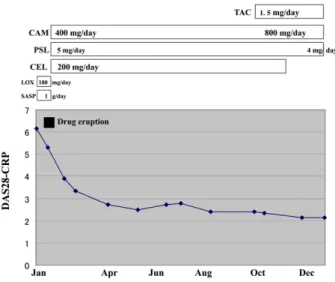
High resolution chest computed tomography revealed airspace consolidation and ground-glass opacity predominantly in the right lower lung field compatible with OP (Fig. 1). Because of the symmetric polyarthritis of the small joints in both hands and feet together with morning stiffness and the positive result of rheumatic factor, a diagnose of RA was made according to the American College of Rheumatology criteria.5) It was thought that OP was associated with RA. The clinical course is as follows (Fig. 2). We evaluated RA activity, taking advantage of disease activity score (DAS)28-CRP. The DAS28-CRP considers 28 tender and swollen joint counts, general health (GH; patient assessment of disease activity using a 100 mm visual analogue scale with 0=best, 100=worst), plus levels of CRP (mg/L). DAS28 values are calculated as follows: DAS28- CRP=0.56*√ (TJC28)+0.28* √ (SJC28)+0.014*GH+0.36*ln (CRP+1)+0.96, where TJC=tender joint count and SJC=swollen joint count. Regarding disease activity, DAS28-CRP over 4.1 indicates high disease activity, whereas DAS28-CRP below 2.7 indicates low disease activity and below 2.3 indicates remission.
DAS28-CRP between 4.1 and 2.7 indicates moderate disease activity.6, 7) Because his DAS28-CRP was 6.15, we initiated a treatment with salazosulfapyridine (1 g/day) and loxoprofen (180 mg/day). Although this treatment was effective, it was
discontinued due to the development of drug eruption. The patient decided not to receive either methotrexate or leflunomide because of several reports of interstitial pneumonia cases caused by these two agents. At the same time, he could not afford either tumor necrosis factor-α blocking agents or an interleukin (IL)-6-receptor due to their high costs. As an alternative, the patient received prednisolone (PSL) (5 mg/day), celecoxib (CEL) (200 mg/day) and CAM (400 mg/day), in the expectation of their anti-inflammatory effects on RA and OP.1-3) After six months of treatment with PSL, CEL and CAM, arthralgia and articular swellings, except for that of left wrist joint, substantially improved. His DAS28-CRP indicated low disease activity. OP also improved simultaneously. Since the left-handed patient did underappreciate improvement on the sign and symptom of the left wrist, TAC (1.5 mg/day) was added, and thereafter arthralgia and articular swelling of the left wrist improved only moderately. We regarded the optimal trough levels of TAC as 5.0 to 10.0 ng/mL; however, the trough levels of TAC (1.5 mg/day) were low (4.1 ng/mL).
Therefore, instead of increasing the dosage of expensive TAC, the dosage of CAM that is assumed to raise blood TAC concentrations was increased to 800 mg/day. Two weeks after enhancing the CAM (800 mg/day) treatment, the trough levels of TAC increased to 7.1 ng/mL, and 6 weeks after initiating a new dosage of the CAM (800 mg/day) treatment, arthralgia and articular swellings were almost completely resolved. His DAS28-CRP level indicated remission.
Fig. 1. High resolution computed tomography revealing air space consolidation and ground-glass opacity predominantly in the right lower lung field.
Fig. 2. Clinical course.
TAC, tacrolimus; CAM, clarithromycin; PSL, prednisolone; CEL, celecoxib; LOX, loxoprofen; SASP, salazosulfapyridine; DAS, dis- ease activity score; CRP, C-reactive protein
폐렴동반류마티스성관절염환자에서 prednisolone, clarithromycin, tacrolimus를이용한치료성공사례 / 197
DISCUSSION
MACs have shown to affect several pathways of the inflammatory process like the production of proinflammatory cytokines.1) In fact, CAM has shown to inhibit the productions of TNF-α and IL-6 8) associated with clinical features of RA. MACs also significantly influence on anti-inflammatory mechanisms through their antibacterial activity. For instance, MACs are active against periodontopathic bacteria, which are powerful stimulators of TNF-α and other proinflammatory cytokines in humans.1) Because Ogrendik hypothesized that oral anaerobic bacteria could play an important role in the pathogenesis of RA,9) the efficacy of CAM for RA may be derived from its antibacterial activity as well as its anti-inflammatory effects. Regarding CAM treatment for RA, Ogrendik reported that treatment with CAM 500 mg daily for 6 months improved the signs and symptoms in patients with early active RA.1) Regarding RXM treatment for RA, Ogrendik reported that treatment with RXM 300 mg daily for 3 months improved DAS 28.2) Similarly, Stover et al.
reported several cases of OP were treated successfully using MACs in consideration of their anti-inflammatory effects.3) In the present case, the treatment with PSL (5 mg/day) and CAM (400 mg/day) demonstrated being effective for OP and RA, to a certain extent; however, the RA activity was not completely suppressed. In order to suppress the RA activity further, TAC was carefully added with monitoring blood TAC concentrations. For the purpose of raising blood TAC concentrations, the dosage of CAM was effectively increased. With regard to the pharmacokinetic interaction between CAM and TAC, studies have shown that CAM causes an increase of blood TAC concentration by suppressing TAC metabolism.10) Researches have shown that TAC is primarily metabolized by cytochrome P450 (CYP)3A with oral administration and inter-individually varied widely on blood concentration. Levels are knowingly affected by the fat content and genetic polymorphisms of CYP3A5.11) As CAM is a potent CYP3A inhibitor, co-administra- tion of both CAM and TAC leads to significant pharmacokinetic interaction. As a result, CAM raises blood TAC concentrations by suppressing TAC metabolism via CYP3A inhibition.10) This allowed the RA activity to be completely controlled under optimal blood TAC concentrations. According to recent reports of successful treatments in lupus nephritis and adult-onset Still’s disease, CAM was added to increase blood concentra- tion of TAC.12, 13) Based on these findings, a treatment with
PSL, CAM and TAC with optimal blood concentrations, is thought to be effective for RA. When optimal blood concentrations of TAC are guaranteed, CAM may be useful.
In conclusion, we report a case of uncontrolled RA with concomitant OP successfully treated with PSL, CAM, and TAC.
Further research is necessary to substantiate our findings until this treatment is incorporated into mainstream.
CONFLICT OF INTEREST
No potential conflict of interest relevant to this article is reported.
REFERENCES
1. Ogrendik M. Effect of clarithromycin in patients with active rheuma- toid arthritis. Current Med Res Opin 2007;23:515-22.
2. Ogrendik M. Efficacy of roxithromycin in adult patients with rheuma- toid arthritis who had not received disease-modifying antirheumatic drugs: a 3-months, randomized, double-blind, placebo-control trial.
Clin Ther 2009;31:1754-64.
3. Stover DE, Mangino D. Macrolides: a treatment alternative for bron- chiolitis obliterans organizing pneumonia? Chest 2005;128:3611-17.
4. Lee WS, Lee SI, LeeMS, et al. Efficacy and safety of low-dose tacroli- mus for active rheumatoid arthritis with an inadequate response to methotrexate. Korean J Intern Med 2016;31:779-87.
5. Arnett FC, Edworthy SM, Bloch DA, et al. The American Rheumatism Association 1987 revised criteria for the classification of rheumatoid arthritis. Arthritis Rheum 1988;31:315-24.
6. Wells G, Becker JC, Teng J, et al. Validation of the 28-joint Disease Activity Score (DAS28) and European League Rheumatism response criteria based on C-reactive protein against disease progression in patients with rheumatoid arthritis, and comparison with the DAS28 based on erythrocyte sedimentation rate. Ann Rheum Dis 2009;68:
954-60.
7. Inoue E, Yamanaka H, Hara M, et al. Comparison of Disease Activity Score (DAS)28-erythrocyte sedimentation rate and DAS28-C-reactive protein threshold values. Ann Rheum Dis 2007;66:407-9.
8. Tamaoki J, Kadota J, Takizawa H. Clinical implications of the immu- nomodulatory effects of macrolides. Am J Med 2004;117(Suppl 9A):
S5-11.
9. Ogrendik M. Antibiotics for the treatment of rheumatoid arthritis. Int J Gen Med 2014;7:43-7.
10. Kunicki PK, Sobieszczanska-Malek M. Pharmacokinetic interaction between tacrolimus and clarithromycin in a heart transplant patient.
Ther Drug Monit 2005; 27:107-8.
11. Suzuki Y, Homma M, Doki K, et al. Impact of CYP3A5 genetic gene polymorphism on pharmacokinetics of tacrolimus in healthy Japanese subjects. Br. J Pharmacol 2008;66(1):154-5.
12. Ohe M, Kataoka H, Mukai M. A case of lupus nephritis treated with clarithromycin, tacrolimus, and glucocorticoids. Kaohsiung J Med Sci 2016;32:484-5.
13. Ohe M, Bohgaki T. A case of adult-onset Still’s disease treated with moni- toring of serum tacrolimus levels. Bull Hosp Jt Dis 2015;73:213-6.