pISSN 2288-9272 eISSN 2383-8493 J Oral Med Pain 2017;42(4):116-124 https://doi.org/10.14476/jomp.2017.42.4.116
Antidiuretic Hormone Levels in Men with Burning Mouth Syndrome:
A Pilot Study
Yeon-Hee Lee 1 , Mi-Jin Hwang 1 , Suk Chon 2 , Q-Schick Auh 1
1 Department of Orofacial Pain and Oral Medicine, Kyung Hee University Dental Hospital, Seoul, Korea
2 Department of Endocrinology and Metabolism, Kyung Hee University Hospital, Kyung Hee University College of Medicine, Seoul, Korea
Received October 14, 2017 Revised November 15, 2017 Accepted November 17, 2017
Purpose: Burning mouth syndrome (BMS) is a disabling pain that mostly occurs in elderly women, but rarely in men. It is characterized by an unremitting oral burning sensation and pain without detectable oral mucosal changes. We investigated the clinical and hematologic features of middle-aged men with BMS, and compared the results to those of men with oral mucositis.
Methods: Five men with BMS (48.60±6.19 years) and five age-matched controls with oral mu- cositis (49.80±15.26 years) underwent clinical and psychological evaluations and blood tests.
Psychological status was evaluated using the Symptom Checklist-90-Revised. Cortisol, estra- diol, progesterone, testosterone, follicle-stimulating hormone (FSH), luteinizing hormone (LH), adrenocorticotropic hormone (ACTH), and antidiuretic hormone (ADH) levels and erythrocyte sedimentation rate (ESR) were determined from the blood samples.
Results: ADH level was significantly lower in men with BMS than in the controls. ADH levels correlated with testosterone (p<0.01), and ACTH levels strongly correlated with ESR (p<0.05).
Progesterone level positively correlated with FSH and LH levels. Pain intensity on a visual ana- logue scale correlated with estradiol level only in men with BMS. Among psychological factors, the obsessive-compulsive disorder, interpersonal-sensitivity, and anxiety scores were higher in men with BMS than in the controls (p<0.05). However, no correlations were observed between the psychological and hematologic factors in both groups. The BMS symptoms presented only on the tongue, with the lateral border being the most prevalent area.
Conclusions: Men with BMS may experience dysregulated endocrinologic or psychoneuroen- docrinologic interactions, which might affect oral BMS symptoms, aggravating the severity of the burning sensation.
Key Words: Antidiuretic hormone; Blood; Burning mouth syndrome; Estradiol; Gonadal hor- mone; Male
Correspondence to:
Yeon-Hee Lee
Department of Orofacial Pain and Oral Medicine, Kyung Hee University Dental Hospital, 26 Kyungheedae-ro, Dongdaemun-gu, Seoul 02447, Korea Tel: +82-2-958-9454
Fax: +82-2-962-8124 E-mail: [email protected]
JOMP Journal of Oral Medicine and Pain
Copyright Ⓒ 2017 Korean Academy of Orofacial Pain and Oral Medicine. All rights reserved.
CC
This is an open-access article distributed under the terms of the Creative Commons Attribution Non-Commercial License (http://creativecommons.org/licenses/by-nc/4.0/), which permits unrestricted non-commercial use, distribution, and reproduction in any medium, provided the original work is properly cited.
INTRODUCTION
Burning mouth syndrome (BMS) is defined by the International Headache Society (IHS) as an intraoral burn- ing sensation without any medical or dental cause. It was first categorized as a distinct disease in 2004. IHS classi- fies BMS in the category of cranial neuralgias and central
causes of facial pain. 1) BMS is defined by the International
Association for the Study of Pain as a burning pain in
the tongue or other oral mucous membranes, without any
pathologic mucosal changes and lasting at least 4 to 6
months. 2) The main symptom of BMS is a burning sensa-
tion in the oral mucosa and perioral regions, and it is usu-
ally described as scalding, tingling, or numbing. 2,3) BMS is
characterized by positive sensory symptoms, such as burn- ing sensation, dysgeusia, and dysesthesia, and negative sen- sory symptoms, including taste loss and paresthesia. These characteristics and definitions seem clear. However, patients with BMS experience continuous burning pain without any obvious clinical signs, for which there are no definitive di- agnostic or imaging tests; 1) clinicians have difficulty under- standing, diagnosing, and managing BMS.
BMS probably has a multifactorial origin, and some- times, it can be idiopathic, or unclear etiopathogenesis in- volving local, systemic, and psychological factors. Female gender, peri-menopause, aging, depression, anxiety, and chronic medical conditions including gastrointestinal and urogenital diseases are reported risk factors for BMS de- velopment. 4-6) BMS affects 1.5%-8% of the general popula- tion, mainly occurring in middle-aged to elderly women, and has a 90% higher incidence in women than in men. 7-9) In a previous cohort study, the prevalence of BMS was high- er in women (5.5%) than in men (1.6%), and BMS was not found to occur before 40 years of age; nevertheless, the prevalence increased with age in both sexes. 4) The big dif- ference in BMS prevalence between the sexes might be ex- plained by the hormonal changes occurring around these middle ages. Women undergo endocrinological and physi- cal changes during menopause, particularly a decrease in the levels of estradiol and increase in the levels of follicle- stimulating hormone (FSH) or luteinizing hormone (LH) that affect their health. 10) In middle-aged men, aging is associ- ated with a significant decrease in the levels of testoster- one, dehydroepiandrosterone sulfate, and estradiol, and an increase in the levels of LH and FSH. 11) According to Kim et al., 12) female gonadal and stress hormones are dysregulated in patients with BMS. Although the results have not been consistent, the levels of female gonadal hormones such as estradiol, progesterone, and FSH have been shown to be al- tered in patients with BMS. 9,12,13) With regard to estradiol, altered levels of estrogen can affect the oral mucosal health, because the oral mucosa contains estrogen receptors. 14) Unfortunately, little research has been conducted into the relationship between the changes in endocrinal regulation and oral health.
Psychological factors are also considered major con- tributing factors to BMS. According to Kenchadze et al., 15)
patients with BMS in the age group of 46 to 70 years had depression, insomnia, neurologic disorders, phobic syn- drome, and cancer-phobia. A previous psychological ques- tionnaire survey of 184 patients with BMS showed that they had psychological conditions such as anxiety, depression, and neurotic tendencies. However, the authors emphasized that it was difficult to consider that psychological factors alone cause BMS. 3) Low sleep quality also contributes to the aggravation of BMS symptoms. According to a case-control study, patients with BMS had lower sleep quality than did healthy controls, and a depressed mood and anxiety were correlated with the existence of sleep disturbances in these patients with BMS. 16) In addition, antidiuretic hormone (ADH) or vasopressin has a crucial role in maintaining sleep quality. 17) Dysregulated or decreased ADH secretion can ag- gravate BMS symptoms. Almost all researchers agree and suggest complex interactions between psychological fac- tors and other local and/or systemic factors. In addition, it is widely accepted that psychological factors play a crucial role in the genesis and maintenance of pain sensations. 15)
Various factors may simultaneously participate in the oc- currence and development of BMS. Furthermore, since BMS occurs mainly in peri- or post-menopausal women, 4) many studies have overwhelmingly focused on the causes, de- velopment, and treatment of BMS in middle-aged women.
Thus, studies focused on the etiopathology and symptoms of BMS in men have scarcely been reported in the neuro- logical and dental literature. In this study, we investigated the psychologic and hematologic features of men with BMS by comparing their features with those of age-matched controls with chronic oral mucositis.
MATERIALS AND METHODS
1. Patients
We recruited 10 men who attended the Department of
Orofacial Pain and Oral Medicine (Kyung Hee University
Dental Hospital, Seoul, Korea) between January 1, 2016 and
June 30, 2017. Five men diagnosed with BMS (48.60±6.19
years) without objective clinical abnormality, and five age-
matched controls with oral mucositis (49.80±15.26 years)
with a definite oral mucosal lesion were included. The in-
clusion criteria for the patients with BMS adhered to the
International Classification of Headache Disorders-3 classi- fication suggested by IHS as follows: 1) superficial intraoral pain for more than 3 months; 2) a persistent (more than 2 h/day) and burning quality of the pain; 3) age between 30 and 68 years; and 4) no visible clinical changes in the oral mucosa. Since BMS has rarely been reported in men, 14,18) men with BMS were selected for the present investigation, and the measured values were compared with those of age- matched controls. All patients underwent clinical and psy- chological evaluations and blood tests. Their psychologi- cal status was evaluated using the Symptom Checklist-90- Revised (SCL-90R). The levels of cortisol, estradiol, proges- terone, testosterone, FSH, LH, adrenocorticotropic hormone (ACTH), cortisol, ADH, and erythrocyte sedimentation rate (ESR) were determined from blood samples. Patients were also asked to complete inventories used for the analysis of duration, type, intensity, and area of BMS symptoms. The exclusion criteria for the patients were as follows: heavy smoker, having uncontrolled diabetes, having a history of a disease or/and a therapy that can cause secondary BMS symptoms.
2. Study Design
All patients in both the BMS and oral mucositis groups underwent a physical examination, laboratory screening tests, and psychiatric assessment using the SCL-90R. The obtained data were analyzed and compared statistically.
The research protocol was reviewed for compliance with the Helsinki Declaration and was approved by the Institutional Review Board of the University Hospital (KHD IRB no.
1709-4). Informed consents were obtained from all patients.
3. Clinical Evaluation
Clinical evaluation procedures for the patients includ- ed an oral examination, and psychological evaluation us- ing the SCL-90R, 19) and blood tests. An overall question- naire was used to evaluate subjective discomforts, duration and areas of symptoms, and the characteristics of discom- fort (burning, itching, numbness, taste disturbance, or dry mouth). To rule out other possible systemic factors that may cause oral burning pain and/or abnormal oral sensations, a questionnaire about recent systemic disease and medica- tion was administered. In addition, the presence of stressful
conditions and insomnia was evaluated using a dichoto- mous question.
The severity of oral pain was scored on a visual analogue scale (VAS) (0-100 cm, with 100 cm indicating the worst pain). The SCL-90R was used to examine the psychological status of the patients. The SCL-90R is a tool for evaluating psychological symptoms by analyzing the answers to 90 questions, and it provides results regarding nine symptom dimensions, namely, somatization (SOM), obsessive-com- pulsive disorder (O-C), interpersonal sensitivity (I-S), depres- sion (DEP), anxiety (ANX), hostility (HOS), phobic anxiety (PHOB), paranoid ideation (PAR), and psychosis (PSY).
4. Blood Tests
Blood sampling was performed between 9:00 a.m. and 11:00 a.m. to minimize variability due to the circadian rhythm. The tests included complete blood counts with leu- kocyte differential and various hematologic variables. The levels of gonadal hormones, including estradiol, proges- terone, testosterone, LH, and FSH; stress markers, includ- ing ACTH and cortisol; ADH; and ESR were measured. The reference normal range of each variable is as follows: es- tradiol, 15-60 pg/mL; progesterone, 0.6-2.11 pg/mL; tes- tosterone, 2.67-10.12 pg/mL; ACTH, 10-60 pg/mL; cortisol, morning 5-27 g/dL; FSH, 1.3-8.1 mIU/mL; LH, 1.0-5.3 mIU/
mL; ESR, 0-15 mm/h; and ADH, <6.7 pg/mL.
5. Statistical Methods
We investigated the absolute and percentage distribu- tions of all nominal and categorical variables. We also ob- tained their means and standard deviations, and performed descriptive data analysis. We used various statistical meth- ods for data analysis. Results obtained for the men with BMS and men with chronic oral mucositis were compared using the t-test and Mann-Whitney U test. Fisher’s exact test was used to determine the equality of the proportions.
Spearman’s correlation analysis was used to determine cor-
relations between variables. Statistical significance was es-
tablished at p-values <0.05. Data were analyzed using IBM
SPSS Statistics ver. 20.0 for Windows (IBM Co., Armonk,
NY, USA).
RESULTS
1. Clinical Characteristics (Table 1)
The severity of pain scored on the VAS was not signifi- cantly different between the groups. Duration of symptom was longer in patients with BMS (9.25±1.58 years) than in the controls (2.08±2.27 years) (p=0.068). The most prevalent symptom was burning sensation, which was observed in all patients (n=5, 100.0%), and two of the five patients with BMS had the burning sensation only. One patient (20.0%) had burning sensation, itching, taste dysfunction, and dys- esthesia. The prevalence of stress (80.0%) was higher in pa- tients with BMS than in the controls. All patients reported the tongue as the main and only symptom area, especially the lateral border (n=5, 100.0%). The tongue tip (60%) and dorsum (60%) were the other main symptom areas (Fig. 1).
All patients had symptoms in more than two of these three sites. Moreover, pain was not reported in the lip, cheek, al- veolar mucosa, and floor of the mouth. One of the five pa- tients had hypertension, and no other systemic or psycho- logic disorders were reported by the patients with BMS.
2. Symptom Checklist-90-Revised (Table 2)
The results of the analysis using the SCL-90R showed that
the mean T-scores of all nine symptom dimensions were in the range of 30-60, and the scores were higher in patients with BMS than in the controls. More specifically, the di- mensions for which the T-scores were significantly higher in patients with BMS were O-C, I-S, and ANX (p<0.05); the scores for SOM (p=0.069), DEP (p=0.085), and PAR (p=0.089)
Table 1. Comparisons of clinical characteristics of non-BMS group and BMS group
Characteristic Oral mucositis (n=5) BMS (n=5) p-value
Age (y) 49.80±15.26 48.60±6.19 0.875
Duration of symptoms (d) 759.00±828.09 3,376.00±578.93 0.068
VAS (0-100) 56.00±16.73 62.00±16.42 0.583
Accompanying status
Oral dryness 1 (20.0) 4 (80.0) 0.103
Stress 2 (40.0) 4 (80.0) 0.262
Sleep problem 0 (0.0) 1 (50.0) 0.500
Hypertension 4 (80.0) 1 (20.0) 0.103
Symptom of BMS patients
Burning 2 (40.0)
Burning+itching 2 (40.0)
Burning+itching+taste dysfunction+dysesthesia 1 (20.0)
Area of symptoms
Tongue tip+lateral border 2 (40.0)
Dorsum+lateral border 2 (40.0)
Tongue tip+lateral border+dorsum 1 (20.0)
BMS, burning mouth syndrome; VAS, visual analogue scale.
Values are presented as mean±standard deviation or number (%).
Results were obtained via Mann-Whiteney U test and Fisher’ s exact test.
p-value was considered as significant when p-value<0.05.
Dorsum 60%
Tongue tip 60%
Lateral border (bilateral)
100%
Fig. 1. Distribution of burning mouth syndrome (BMS) symptoms
on the tongue. All patients had BMS symptoms on the bilateral
sides of the tongue, and 60% of the patients had symptoms on the
dorsum and tip of the tongue.
were relatively but significantly higher in patients with BMS. The mean scores of HOS, PHOB, and PSY were also higher in patients with BMS, but the differences were not statistically significant.
3. Blood Test Results (Table 3)
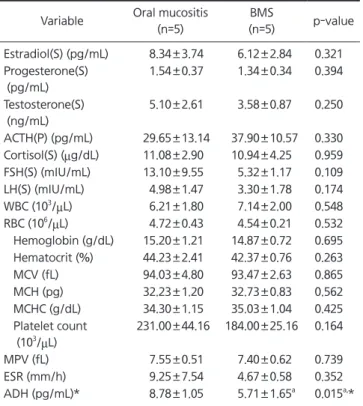
Among the hormones tested, only ADH showed a statisti- cally significant difference, with ADH levels being signifi- cantly lower in patients with BMS (5.71±1.65 pg/mL) than in the controls (8.78±1.05 pg/mL). None of the other he- matologic factors were significantly different. More specifi- cally, the mean level of estradiol, progesterone, testosterone, cortisol, FSH, LH, platelet count, and ESR was lower in pa- tients with BMS than in the controls. The mean ACTH level was higher in patients with BMS. However, these results were not statistically significant.
The mean values of estradiol and FSH were outside the normal ranges. The normal serum estradiol level is 15-60 pg/mL in men. In our study, serum estradiol level was lower than the normal reference range in both patients with BMS and in the controls. The mean FSH level (13.10 mIU/mL) was higher in the controls than in patients with BMS, and was higher than the reference FSH level (1.3-8.1 mIU/mL).
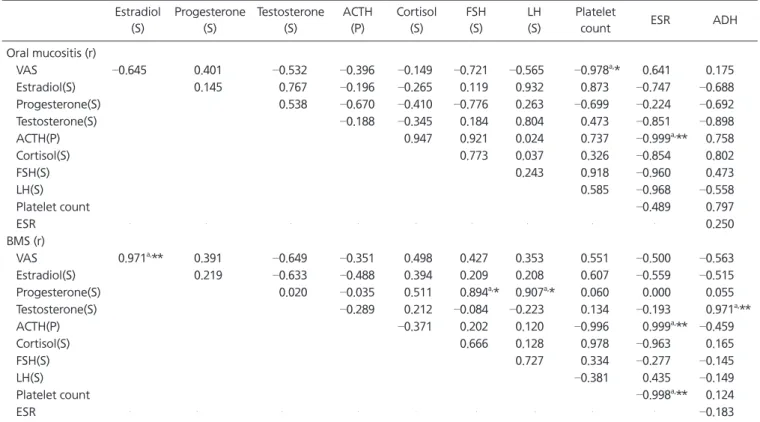
4. Correlations with VAS and Hematologic Variables (Table 4) In patients with BMS, the VAS scores were positively and strongly correlated with estradiol levels (r=0.971, p<0.01),
whereas the VAS scores were not correlated with any oth- er hematologic variables in the controls. Progesterone level was positively correlated with FSH and LH levels.
Interestingly, ESR was positively correlated with ACTH level (r=0.999, p<0.01), and was negatively correlated with the platelet count (r= – 0.998, p<0.01). Notably, ADH level was strongly and positively correlated with testosterone lev- el (r=0.971, p<0.01). These correlations between the VAS scores and hematologic variables, and among the hemato- logic variables, were not observed in the controls. In addi- tion, no correlations were observed among the nine psycho- logic dimensions and hematologic factors in both patients with BMS and the controls.
Table 2. Comparisons of mean values of psychological 9 dimensions Oral mucositis (n=5) BMS (n=5) p-value
SOM 41.80±2.49 50.60±9.02 0.069
O-C 39.40±2.97 49.60±7.47
a0.022
a,*
I-S 40.00±2.24 52.60±8.62
a0.013
a,*
DEP 39.40±2.97 43.00±2.83 0.085
ANX 41.60±1.67 52.20±8.50
a0.026
a,*
HOS 44.60±9.21 51.00±4.80 0.205
PHOB 48.00±9.00 53.60±9.21 0.359
PAR 43.80±8.73 51.40±0.89 0.089
PSY 45.20±7.79 46.80±4.87 0.707
BMS, burning mouth syndrome; SOM, somatization; O-C, obsessive- compulsive disorder; I-S, interpersonal sensitivity; DEP, depression;
ANX, anxiety; HOS, hostility; PHOB, phobic anxiety; PAR, paranoid ideation; PSY, psychosis.
Values are presented as mean±standard deviation.
Results were obtained via t-test.
a
p-value was at the significant level.
*p-value was considered as significant when p-value <0.05.
Table 3. Comparisons of mean values of hematologic variables between groups
Variable Oral mucositis (n=5)
BMS
(n=5) p-value Estradiol(S) (pg/mL) 8.34±3.74 6.12±2.84 0.321 Progesterone(S)
(pg/mL)
1.54±0.37 1.34±0.34 0.394
Testosterone(S) (ng/mL)
5.10±2.61 3.58±0.87 0.250
ACTH(P) (pg/mL) 29.65±13.14 37.90±10.57 0.330 Cortisol(S) (mg/dL) 11.08±2.90 10.94±4.25 0.959 FSH(S) (mIU/mL) 13.10±9.55 5.32±1.17 0.109 LH(S) (mIU/mL) 4.98±1.47 3.30±1.78 0.174 WBC (10
3/ mL) 6.21±1.80 7.14±2.00 0.548 RBC (10
6/ mL) 4.72±0.43 4.54±0.21 0.532 Hemoglobin (g/dL) 15.20±1.21 14.87±0.72 0.695 Hematocrit (%) 44.23±2.41 42.37±0.76 0.263
MCV (fL) 94.03±4.80 93.47±2.63 0.865
MCH (pg) 32.23±1.20 32.73±0.83 0.562
MCHC (g/dL) 34.30±1.15 35.03±1.04 0.425 Platelet count
(10
3/ mL)
231.00±44.16 184.00±25.16 0.164
MPV (fL) 7.55±0.51 7.40±0.62 0.739
ESR (mm/h) 9.25±7.54 4.67±0.58 0.352
ADH (pg/mL)* 8.78±1.05 5.71±1.65
a0.015
a,* BMS, burning mouth syndrome; S, serum; ACTH, adrenocorticotropic hormone; P, plasma; FSH, follicle-stimulating hormone; LH, luteinizing hor mone; WBC, white blood cell; RBC, red blood cell; MCV, mean cor- puscular volume; MCH, mean corpuscular hemoglobin; MCHC, mean corpuscular hemoglobin concentration; MPV, mean platelet volume;
ESR, erythrocyte sedimentation rate; ADH, anti-diuretic hormone.
Values are presented as mean±standard deviation.
a
p-value was at the significant level.
*p-value was considered as significant when p-value <0.05.
DISCUSSION
The results of the present study indicated that the clinical characteristics and hematologic features of men with BMS were different from those of men with chronic oral muco- sitis, as well as those of typical peri- and post-menopausal women with BMS. The majority of patients with chron- ic pain including BMS are women, and the reason is not purely biological, but mixed with sociocultural factors. 20) In the present study, ADH level was significantly lower in men with BMS than in men with oral mucositis, and ADH level was positively correlated with testosterone level.
Testosterone has an analgesic role of protecting against the development of painful conditions. 21) The specific effects of testosterone on neuropathic or chronic orofacial pain are complicated because much of testosterone is metabolized to estradiol in vivo; this feature needs to be investigated in future studies. Unfortunately, few studies have compared the symptoms between the sexes or have explored the
symptoms in men with BMS. To our knowledge, this is the first study to investigate the effects of changes in ADH lev- els on BMS symptoms in men, and to compare the psycho- logical factors with those of controls.
Decrease in ADH levels can be a causative factor of BMS in men. In a previous animal study, ADH release was re- lated to salivary secretion from the parotid gland in the oral cavity, as well as urine secretion. 22) Furthermore, ADH has an important role in maintaining sleep, and the total mea- sured secretion of ADH is significantly higher during the day than during the night. 17) In contrast, if the ADH level is low, nocturia can occur. Nocturia is generally associated with increased nocturnal urine production, and conserva- tive treatment with an ADH analogue can help reduce noc- turia symptoms. 23) In addition, among men, the association between nocturia and poor sleep quality becomes stron- ger with increasing age. 24) Poorer sleep quality is associ- ated with higher SCL-90R psychological distress scores. 25) Sleep disturbance and low sleep quality are well known to
Table 4. The correlations among the hematologic variables Estradiol
(S)
Progesterone (S)
Testosterone (S)
ACTH (P)
Cortisol (S)
FSH (S)
LH (S)
Platelet
count ESR ADH
Oral mucositis (r)
VAS –0.645 0.401 –0.532 –0.396 –0.149 –0.721 –0.565 –0.978
a,* 0.641 0.175
Estradiol(S) 0.145 0.767 –0.196 –0.265 0.119 0.932 0.873 –0.747 –0.688
Progesterone(S) 0.538 –0.670 –0.410 –0.776 0.263 –0.699 –0.224 –0.692
Testosterone(S) –0.188 –0.345 0.184 0.804 0.473 –0.851 –0.898
ACTH(P) 0.947 0.921 0.024 0.737 –0.999
a,** 0.758
Cortisol(S) 0.773 0.037 0.326 –0.854 0.802
FSH(S) 0.243 0.918 –0.960 0.473
LH(S) 0.585 –0.968 –0.558
Platelet count –0.489 0.797
ESR 0.250
BMS (r)
VAS 0.971
a,** 0.391 –0.649 –0.351 0.498 0.427 0.353 0.551 –0.500 –0.563
Estradiol(S) 0.219 –0.633 –0.488 0.394 0.209 0.208 0.607 –0.559 –0.515
Progesterone(S) 0.020 –0.035 0.511 0.894
a,* 0.907
a,* 0.060 0.000 0.055
Testosterone(S) –0.289 0.212 –0.084 –0.223 0.134 –0.193 0.971
a,**
ACTH(P) –0.371 0.202 0.120 –0.996 0.999
a,** –0.459
Cortisol(S) 0.666 0.128 0.978 –0.963 0.165
FSH(S) 0.727 0.334 –0.277 –0.145
LH(S) –0.381 0.435 –0.149
Platelet count –0.998
a,** 0.124
ESR –0.183
S, serum; ACTH, adrenocorticotropic hormone; P, plasma; FSH, follicle-stimulating hormone; LH, luteinizing hormone; ESR, erythrocyte sedimentation rate; ADH, anti-diuretic hormone; r, correlation coefficient; VAS, visual analogue scale; BMS, burning mouth syndrome.
Results were obtained by the Spearman’ s correlation test.
a