INTRODUCTION
Muscular dystrophies with an autosomal recessive mode of inheritance comprise of a genetically heterogeneous group of disorders. Among these, Miyoshi myopathy (MM) is an early-adult onset, autosomal recessive form of distal muscu- lar dystrophy, characterized by predominant involvement in the calf muscles and highly elevated serum creatine kinase (CK) levels (1). MM has been known to be caused by muta- tions in the dysferlin gene (DYSF) on chromosome 2p13 (2).
Mutations in the same gene were also identified in patients with limb-girdle muscular dystrophy type 2B (LGMD2B) (3), and distal anterior compartment myopathy (4). These diseases caused by mutations in DYSF are known by the term
‘dysferlinopathy’.
Although MM patients and their mutations in the DYSF gene have been found from all over the world, only a few cases have been reported in Korea (5-8). Considering that there have been many reports of MM among Japanese population (9), the incidence of MM might be underestimated in Korea since both countries are geographically and ethnically related with each other (10, 11). In the present study, we performed clinical and genetic analysis of three Korean patients with MM and found that all patients had compound heterozygous mutations in the DYSF gene.
MATERIALS AND METHODS Subjects
Three unrelated and non-consanguineous patients with clinical features of MM were evaluated (Table 1). All the pa- tients experienced early adulthood onset of slowly progres- sive muscle weakness, which preferentially involved muscles in the lower extremities. Patients 1 and 2 had a history of steroid medication under the presumptive diagnosis of poly- myositis according to the muscle biopsies and both showed transient responses. Patient 3 suffered from diabetes and show- ed the EMG findings of superimposed peripheral polyneuro- pathy.
Mutation analysis
The genomic DNA was extracted from the peripheral blood leukocytes using a Wizard Genomic DNA Purification kit according to the manufacturer’s instructions (Promega, Madi- son, WI, U.S.A.). All the coding exons as well as the flanking introns of the DYSF gene were amplified using the primer sets designed by the authors (primer sets available on request).
A polymerase chain reaction was performed with a thermal cycler (model 9700, Applied Biosystems, Foster City, CA,
Hyun-Jung Cho, Duck Hyun Sung*, Eun-Jin Kim*, Chul Ho Yoon�, Chang-Seok Ki, Jong-Won Kim
Departments of Laboratory Medicine, Physical Medicine and Rehabilitation*, Samsung Medical Center, Sungkyunkwan University School of Medicine, Seoul; Department of Rehabilitation Medicine�, College of Medicine and Institute for Neuroscience, Gyeongsang National University, Jinju, Korea
Address for correspondence Chang-Seok Ki, M.D.
Department of Laboratory Medicine, Samsung Medical Center, Sungkyunkwan University School of Medicine, 50 Ilwon-dong, Gangnam-gu, Seoul 135-710, Korea Tel : +82.2-3410-2709, Fax : +82.2-3410-2719 E-mail : [email protected]
*This work was supported by the Samsung Biomedical Research Institute grant, #SBRI C-A5-102-1.
724 J Korean Med Sci 2006; 21: 724-7
ISSN 1011-8934
Copyright � The Korean Academy of Medical Sciences
Clinical and Genetic Analysis of Korean Patients with Miyoshi
Myopathy: Identification of Three Novel Mutations in the DYSF Gene
Miyoshi myopathy (MM) is an autosomal recessive distal muscular dystrophy caused by mutations in the dysferlin gene (DYSF) on chromosome 2p13. Although MM patients and their mutations in the DYSF gene have been found from all over the world, there is only one report of genetically confirmed case of MM in Korea. Recently, we encountered three unrelated Korean patients with MM and two of them have previously been considered as having a type of inflammatory myopathy. The clinical and laboratory evaluation showed typical features of muscle involvement in MM in all patients but one patient initially had moderate proximal muscle involvement and another showed incomplete quadriparesis with rapid progression. Direct sequenc- ing analysis of the DYSF gene revealed that each patient had compound heterozy- gous mutations (Gln832X and Trp992Arg, Gln832X and Trp999Cys, and Lys1103X and Ile1401HisfsX8, respectively) among which three were novel. Although MM has been thought to be quite rare in Korea, it should be considered in a differential diag- nosis of patients exhibiting distal myopathy.
Key Words : Distal Myopathies; Muscular Diseases; DYSF protein, human; Muscular Dystrophies, Limb-Gir- dle; Mutation
Received : 21 November 2005 Accepted : 22 December 2005
DYSF Gene Mutations in Miyoshi Myopathy 725
U.S.A.) using the following conditions: 32 cycles of denatu- ration at 94℃for 30 sec, annealing at 60℃for 30 sec, and extension at 72℃for 30 sec. After the amplicon (5 L) treat- ment with 10 U shrimp alkaline phosphatase and 2 U exonu- clease I (USB Corp., Cleveland, OH, U.S.A.), direct sequenc- ing was performed with the BigDye Terminator Cycle Seq- uencing Ready Reaction kit (Applied Biosystems) using a ABI Prism 3,100 genetic analyzer (Applied Biosystems). All the novel mutations were confirmed by sequencing 100 con- trol chromosomes.
RESULTS Clinical findings
Patient 1 was a 45 yr-old male patient who had presented with progressive weakness in both lower extremities for the
previous 17 yr. He noticed difficulty in running and atrophy of the lower leg muscles at 27 yr of age. The muscle weak- ness and atrophy progressed. A neurological examination showed bilateral motor weakness and symmetric atrophy of the entire lower extremity muscles, which were more severe on the distal part than on the proximal part. Marked atrophy of the lower leg muscles with relatively spared pelvic girdle and upper thigh muscles resulted in a stalk-leg appearance.
He required a cane for level walking and also complained of decreased pinch strength. He had been diagnosed of having a polymyositis at the age of 28 yr as a result of a muscle biopsy of the medial gastrocnemius showing myopathic changes with inflammatory cell infiltration. Immunohistochemical stain was not performed on the biopsy specimen. His 43 yr- old younger sister was affected in the same way in her early thirties and found it difficult to walk up and downhills. Since then, the muscle weakness worsened so that walking was still possible but only for short distances using a cane. She also
Patient Sex/
age (yr)
Age at onset
(yr) Muscle biopsy finding EMG CK level
(IU/L)
Family
history Distribution
1 M/44 28 Inflammatory myopathy myopathic 5,400 + Thigh, Lower leg, Fore-arm
2 F/30 26 Inflammatory myopathy myopathic 5,152 - Upper arm, Thigh, Lower leg
3 M/37 18 Not available myopathic 2,100 + Upper arm, Fore-arm,
Thigh, Lower leg Table 1.Summary of the clinical and laboratory findings of the patients
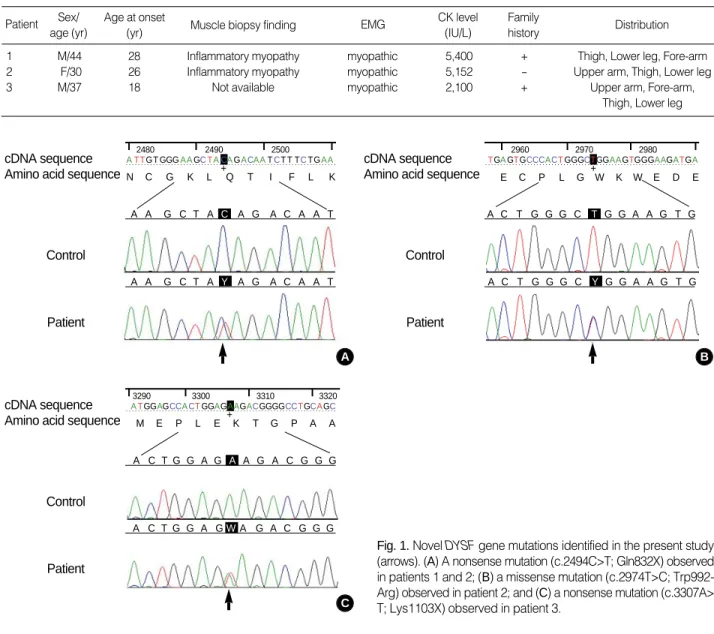
Fig. 1. Novel DYSF gene mutations identified in the present study (arrows). (A) A nonsense mutation (c.2494C>T; Gln832X) observed in patients 1 and 2; (B) a missense mutation (c.2974T>C; Trp992- Arg) observed in patient 2; and (C) a nonsense mutation (c.3307A>
T; Lys1103X) observed in patient 3.
A cDNA sequence
Amino acid sequence
Control
Patient
N C G K L +Q T I F L K
2480 2490 2500
A A G C T A Y A G A C A A T A A G C T A C A G A C A A T ATTGT GGGAAGCTACAGACAATCT T TCTGAA
B cDNA sequence
Amino acid sequence
Control
Patient
E C P L G +W K W E D E
2960 2970 2980
A C T G G G C Y G G A A G T G A C T G G G C T G G A A G T G TGAGTGCCCACTGGGCTGGAAGTGGGAAGATGA
C cDNA sequence
Amino acid sequence
Control
Patient
M E P L E +K T G P A A
3290 3300 3310 3320
A C T G G A G A A G A C G G G
A C T G G A GWA G A C G G G ATGGAGCCACTGGAGAAGACGGGGCCTGCAGC
726 H.-J. Cho, D.H. Sung, E.-J. Kim, et al.
had difficulty in holding her baby due to extended weakness of her upper extremity muscles. Standing on their tip-toe or heels were impossible in both patients. They could stand from sitting position only with the aid of their hands.
Patient 2 was a 30 yr-old female who presented with dif- ficulty in stair walking and pain in her low back and knee.
Difficulty in climbing stairs developed at 26 yr of age and this difficulty in walking gradually worsened so that she could not climb stairs without the support of her upper extremities.
A neurological examination showed atrophy of both calf mus- cles, decreased strength of the lower extremity muscles, and an absent tendon reflex. The Gowers’ sign was positive. She could not stand on her tip-toe, but standing on her heels was possible. The EMG revealed the myopathic changes in gas- trocnemius, rectus femoris, and biceps brachii muscles. A mus- cle biopsy without immunohistochemial stain from the biceps brachii suggested a diagnosis of inflammatory myopathy. Mag- netic resonance imaging of her lower leg disclosed symmet- ric fatty degeneration and decreased muscle volume of the posterior compartment muscles in both lower legs. The ante- rior and lateral compartment muscles had either a normal or a relatively normal signal intensity and morphology. The pa- tient denied a family history of neuromuscular disease.
Patient 3 was a 37-yr-old man with quadriparesis who first became aware of periodic weakness in his lower extremities at the age of 18 yr. He noticed difficulties in standing and climb- ing stairs at the age of 21 and could not walk by himself by the age of 33. An examination at the age of 37 showed incom- plete quadriparesis and he could walk with a four-point crutch.
His older sister developed lower extremity weakness and atro- phy at the age of 18 yr and could not walk by the age of 36.
Mutation analysis
Direct sequencing analysis identified five heterozygous mutations in the DYSF gene including three novel muta- tions (Fig. 1). Patient 1 and his sister had compound hetero- zygous mutations of a novel C to T transition (c.2494C>T) in exon 24 resulting in a nonsense mutation (Gln832X) along with a previously reported missense mutation (c.2997G>T;
Trp999Cys). The Gln832X mutation was also found in the patient 2 with a novel missense mutation (c.2974C>T; Trp- 992Arg). Patient 3 had two mutations including a novel A to T transversion (c.3307A>T) in exon 30, which resulted in a nonsense mutation (Lys1103X), and a previously reported insertion mutation (c.4200dupC) in exon 39 resulting in a frame shift mutation (Ile1401HisfsX8). Three novel muta- tions (Gln832X, Trp992Arg, and Lys1103X) were not detect- ed in 100 control chromosomes.
DISCUSSION
This study identified five different mutations in three Kore-
an MM patients, and all patients had compound heterozygous mutation in the DYSF gene. The c.2997G>T (Trp999Cys) mutation is reported to be one of the most frequent muta- tions found in Japanese MM patients, and has been associat- ed with a significantly later onset and a relatively mild form of MM (9). The age at onset in patient 2 with the c.2997G>T mutation was delayed compared with the other patients, but was earlier than the mean age at onset reported elsewhere (9).
The c.4200dupC mutation (Ile1401HisfsX8), which was found in two patients with MM or LGMD2B, appeared in the Dysferlin sequence variations in the Leiden Muscular Dys- trophy pages. The c.2494C>T (Gln832X) mutation was novel and was found in 2 unrelated patients, which might be due to a possible founder effect in the Korean population. How- ever, it will be necessary to perform haplotype analysis and collect more data on MM patients in Korea to address this issue.
Some patients with MM can be easily misdiagnosed as hav- ing an inflammatory myopathy because inflammation is fre- quently observed in patients with MM and the inflammatory changes found in patients with MM are indistinguishable from those observed in patients with inflammatory myopathy (12).
Indeed, two patients in this study had previously been sus- pected of having a form of inflammatory myopathy based on the muscle biopsy findings. McNally et al. (13) reported that the presence of inflammation is not an exclusion crite- rion in muscular dystrophy related to a dysferlin deficiency, while the muscle biopsies of MM or LGMD2B patients gen- erally demonstrates signs of a dystrophy with a dysferlin defi- ciency.
It is possible that some MM patients have been erroneously diagnosed with polymyositis based on the absence of dystro- phic features and the presence of inflammation in the mus- cle biopsies. Consequently, MM might has been considered to be quite rare in Korea. Therefore, MM should be consid- ered when making a differential diagnosis of patients exhibit- ing distal myopathy and muscular inflammation on muscle biopsies, and DYSF gene analysis should also be considered.
REFERENCES
1. Miyoshi K, Kawai H, Iwasa M, Kusaka K, Nishino H. Autosomal recessive distal muscular dystrophy as a new type of progressive muscular dystrophy. Seventeen cases in eight families including an autopsied case. Brain 1986; 109: 31-54.
2. Liu J, Aoki M, Illa I, Wu C, Fardeau M, Angelini C, Serrano C, Urti- zberea JA, Hentati F, Hamida MB, Bohlega S, Culper EJ, Amato AA, Bossie K, Oeltjen J, Bejaoui K, McKenna-Yasek D, Hosler BA, Schurr E, Arahata K, de Jong PJ, Brown RH Jr. Dysferlin, a novel skeletal muscle gene, is mutated in Miyoshi myopathy and limb girdle mus- cular dystrophy. Nat Genet 1998; 20: 31-6.
3. Bashir R, Britton S, Strachan T, Keers S, Vafiadaki E, Lako M, Richard I, Marchand S, Bourg N, Argov Z, Sadeh M, Mahjneh I, Marconi G,
DYSF Gene Mutations in Miyoshi Myopathy 727
Passos-Bueno MR, Moreira Ede S, Zatz M, Beckmann JS, Bushby K. A gene related to Caenorhabditis elegans spermatogenesis fac- tor fer-1 is mutated in limb-girdle muscular dystrophy type 2B. Nat Genet 1998; 20: 37-42.
4. Illa I, Serrano-Munuera C, Gallardo E, Lasa A, Rojas-Garcia R, Palmer J, Gallano P, Baiget M, Matsuda C, Brown RH. Distal anterior com- partment myopathy: a dysferlin mutation causing a new muscular dystrophy phenotype. Ann Neurol 2001; 49: 130-4.
5. Hong SC, Kim BJ, Lee EA, Suh YL. Distal myopathy of Miyoshi type: 1 case. J Korean Neurol Assoc 1999; 17: 916-9.
6. Jeon SH, Jang H, Lee CH, Kim HC, Kim JH. Miyoshi myopathy: a case report. J Korean Acad Rehabil Med 1999; 23: 425-9.
7. Lee YH, Park KJ, Lee KS, Lee L, Kim DS, Choi NC, Kwon OY, Lim BH. A case of Miyoshi type distal myopathy. J Korean Neurol Assoc 2001; 19: 555-7.
8. Oh SH, Kim TS, Choi YC. Identification of a dysferlin gene muta- tion in a Korean case with Miyoshi myopathy. Yonsei Med J 2004;
45: 927-30.
9. Takahashi T, Aoki M, Tateyama M, Kondo E, Mizuno T, Onodera
Y, Takano R, Kawai H, Kamakura K, Mochizuki H, Shizuka-Ikeda M, Nakagawa M, Yoshida Y, Akanuma J, Hoshino K, Saito H, Nishi- zawa M, Kato S, Saito K, Miyachi T, Yamashita H, Kawai M, Mat- sumura T, Kuzuhara S, Ibi T, Sahashi K, Nakai H, Kohnosu T, Non- aka I, Arahata K, Brown RH Jr, Saito H, Itoyama Y. Dysferlin muta- tions in Japanese Miyoshi myopathy: relationship to phenotype. Neu- rology 2003; 60: 1799-804.
10. Harihara S, Saitou N, Hirai M, Gojobori T, Park KS, Misawa S, Elle- pola SB, Ishida T, Omoto K. Mitochondrial DNA polymorphism among five Asian populations. Am J Hum Genet 1988; 43: 134-43.
11. Park MH, Kim HS, Kang SJ. HLA-A,-B,-DRB1 allele and haplotype frequencies in 510 Koreans. Tissue Antigens 1999; 53: 386-90.
12. Gallardo E, Rojas-Garcia R, de Luna N, Pou A, Brown RH Jr, Illa I.
Inflammation in dysferlin myopathy: immunohistochemical charac- terization of 13 patients. Neurology 2001; 57: 2136-8.
13. McNally EM, Ly CT, Rosenmann H, Mitrani Rosenbaum S, Jiang W, Anderson LV, Soffer D, Argov Z. Splicing mutation in dysferlin produces limb-girdle muscular dystrophy with inflammation. Am J Med Genet 2000; 91: 305-12.