서 론
간접흡연에 노출되면 암, 심장질환, 폐질환 발생이 증가할 뿐 아니 라,1,2) 치은염, 치주질환, 구강암 등 치아 및 구강건강에도 직접적인 영 향을 받는다.3) 또한 간접흡연 노출은 소아에서 중이염, 천식의 유발 과 악화, 기관지염 및 폐렴 등의 하기도 감염과 연관이 있으며,1) 임산 부에서는 저체중아 출산과 관련이 있다.3,4) 선행 연구에서 간접흡연
에 노출된 성인은 치주질환 이환율이 높다고 알려졌고,1,5) 국내 연구 에서도 간접흡연에 노출된 사람은 치주질환 유병률이 높았으며,3) 간 접흡연에 노출된 소아 청소년에서 유치 또는 영구치 우식 발생률이 높았다.6-8)
치주질환과 함께 성인의 대표적인 구강질환은 치아 우식증이다.9) 치아 우식증은 환경인자 및 유전요인의 상호작용으로 인해7,10) 치아 가 손상되는 질환으로, 전 세계적으로 유병률이 높고11) 선진국의 경
Original Article
한국 성인 비흡연자에서 간접흡연과 영구치 우식증과의 연관성:
국민건강영양조사 2008–2011 분석 결과
장은진, 유선미*, 황윤서, 정권진, 양희호, 박승국
인제대학교 해운대백병원 가정의학과
The Association between Environmental Tobacco Smoke and Permanent Dental Caries in
Nonsmoking Korean Adults: Korean National Health and Nutrition Examination Survey 2008–2011
Eun-Jin Jang, Sun-Mi Yoo*, Yun-Seo Hwang, Kwon-Jin Jeong, Hui-Ho Yang, Seung-Guk Park
Department of Family Medicine, Inje University Haeundae Paik Hospital, Busan, KoreaBackground: Active smoking is closely associated with the prevalence of periodontal diseases and with incidences of fewer remaining teeth. Although environmental tobacco smoke (ETS) can deteriorate oral health, very few studies have investigated the effects of ETS on dental decay. This study aimed to examine whether exposure to ETS was associated with occurrence of permanent teeth caries among nonsmoking Korean adults.
Methods: We used the cross-sectional data from the Korean National Health and Nutrition Examination Survey (2008–2011) of 2,984 nonsmoking adults aged 19–49 years, who had undergone dental examinations as well as urine cotinine level measurement. Self-reported information on smoking habits and exposure to ETS was obtained using a standardized questionnaire. We defined exposure to ETS as urine cotinine levels of 10–50 ng/mL. The odds ratio (OR) of exposure to ETS was calculated using multivariate logistic regression analysis.
Results: Most of the participants (91.3%) had had permanent caries in at least 1 tooth, and 84.5% had cotinine levels consistent with ETS. Elevated urinary cotinine level was significantly associated with permanent teeth decay (OR=1.501; 95% confidence interval [CI], 1.044–2.157) after adjusting for sex, daily frequency of tooth brushing, and perceived oral health status. This relationship persisted even after further adjusting for age, education, and household income level (OR=1.544; 95% CI, 1.068–2.231).
Conclusion: Exposure to ETS increases the risk of permanent teeth caries among nonsmoking adults. Reduction of ETS exposure is important for prevention of many medical problems, as well as for promotion of oral health.
Keywords: Tobacco Smoke Pollution; Dental Caries; Cotinine
http://dx.doi.org/10.21215/kjfp.2016.6.2.89 pISSN 2233-9019 · eISSN 2233-9116 Korean J Fam Pract. 2016;6(2):89-95
KJFP
Korean Journal of Family PracticeReceived January 18, 2016 Accepted March 19, 2016 Corresponding author Sun-Mi Yoo
Tel: +82-51-797-3220, Fax: +82-51-797-0298 E-mail: [email protected]
Copyright © 2016 The Korean Academy of Family Medicine
This is an open-access article distributed under the terms of the Creative Commons At- tribution Non-Commercial License (http://creativecommons.org/licenses/by-nc/4.0) which permits unrestricted noncommercial use, distribution, and reproduction in any medium, provided the original work is properly cited.
Eun-Jin Jang, et al. Environmental Tobacco Smoke and Permanent Teeth Caries
Korean Journal of Family Practice
KJFP
우, 학령기 아동의 60%–90%, 대다수의 성인에서 주요 건강 문제가 되고 있다.12) 치아 우식증은 치주질환과 함께 치통을 유발하고,9,11) 연 령 증가에 따라 다수의 치아 상실을 초래하여 삶의 질 저하 및 전반 적인 건강상태의 악화를 가져온다.11) 우리나라에서 치아 우식증은 치주질환과 함께 전 연령층에서 빈발하는 구강질환으로,9) 우리나라 성인 3명 중 1명이 치료하지 않은 영구치 우식을 보유하고 있다.13) 치아 우식증이 성인의 구강 건강 저하를 가져오는 중요한 질병이며, 간접흡 연이 치아 우식증을 유발하는 위험인자일 가능성이 있지만,6-8,14) 성인 의 치아 우식증과 간접흡연 노출에 대한 국내외 연구는 제한적이다.
따라서 본 연구는 국민건강영양조사 자료를 이용하여 우리나라 성인에서 간접흡연과 영구치 우식증의 연관성을 평가하고자 한다.
방 법
1. 연구대상
본 연구는 2008년부터 2011년까지 시행된 제4기 및 5기 국민건강 영양조사에 참여한 만 19–49세의 성인에서 평생 흡연 설문 응답자 13,652명 중 흡연자 5,769명과 모름으로 응답한 35명을 제외한 평생 비흡연자 7,848명 중에서 간접흡연 설문, 구강검진, 요 코티닌 농도에 대한 분석 자료가 모두 갖추어진 2,984명을 대상으로 하였다.
국민건강영양조사는 질병관리본부 연구윤리심의위원회의 승인 을 받아 수행되었다(2008-04EXP-01-C, 2009-01CON-03-2C, 2010- 02CON-21-C, 2011-02CON-06-C).
2. 연구 변수
구강검사는 잘 훈련된 공중보건 치과의가 이동검진센터에서 우식 경험 치아 수를 조사하였고, 우식 경험 영구치 수가 한 개 이상이면 영구치 우식증이 있는 것으로 정의하였다.
건강설문조사 중 연령, 성별, 교육 및 가구소득은 개별 면접 조사 방식으로, 흡연, 간접흡연 노출, 음주, 하루 칫솔질 횟수 등 건강 행태 관련 설문은 자기 기입식으로 조사하였다.15) 교육수준은 졸업인 경 우에는 해당 학력, 졸업 여부가 수료, 중퇴, 재학/휴학인 경우에는 이 전 학력으로 분류하였고, 가구소득수준은 가구 균등화 소득에 근 거하여 소득 사분위로 분류하였다. 하루 칫솔질 횟수는 조사 전일 하루 동안의 칫솔질 횟수를 합하여 1회 이하, 2회, 3회 이상으로 구분 하였으며, 본인인지 구강건강상태는 좋음, 보통, 나쁨으로 구분하여 분석하였다. 과자류 섭취는 식품섭취빈도 조사지를 이용하여 1주에 1회 이상 섭취, 1주에 1회 미만 섭취로 분류하였고, 음주 여부는 최근 1년 동안 한 달에 1회 이상 음주한 경우를 음주, 그렇지 않은 경우를 비음주로 구분하였다. 비만 여부는 체질량지수(body mass index,
BMI)를 이용하여 정상(BMI <25 kg/m2)과 비만(BMI ≥25 kg/m2)으로 구분하였다.
건강설문조사에서 평생 흡연 경험이 없는 비흡연자 중, 직장 또는 가정 실내에서 간접흡연 노출 시간이 0시간인 경우를 비노출, 그렇 지 않은 경우를 간접흡연 노출로 정의하였다.3)
Society for Research on Nicotine and Tobacco Subcommitee on Bio- chemical Verification에서는 비흡연과 흡연을 구분하는 요 코티닌 농 도를 50 ng/mL로 제시하였다.16,17) 요 코티닌 농도를 이용하여 간접흡 연자와 비흡연자를 명확하게 구별하기는 어렵지만,18) Haufroid와 Li- son19)은 비흡연자에서의 간접흡연 노출 여부를 구분하는 요 코티닌 농도를 5–10 ng/mL로 제안하였다. 따라서 본 연구에서는 10 ng/mL 미만을 간접흡연에 노출되지 않은 비흡연자, 10 ng/mL 이상 50 ng/
mL 미만을 간접흡연에 노출된 비흡연자로 정의하였고, 요 코티닌 농 도 50 ng/mL 이상은 흡연자로 간주하여 연구에서 배제하였다.
국민건강영양조사의 요 코티닌 농도 측정은 크로마토그래피(gas chromatography)와 질량 분석법(mass spectrometry)으로 cotinine과 diphenylamine 시약을 이용하였다.15,17)
3. 통계분석
모든 분석은 SAS ver. 9.2 (SAS Institute Inc., Cary, WC, USA)를 이용 하였으며 통계적 유의 수준은 P값이 0.05 미만으로 하였다. 국민건강 영양조사는 복합표본설계로 구성된 자료이기 때문에, 분산추정층, 층화변수, 표본가중치를 포함하여 분석하였다.
연구에 사용된 범주형 변수(성별, 연령, 교육수준, 가구소득 사분 위수, 비만 유병 여부, 1년간 음주 여부, 직장 또는 가정 간접흡연 노 출 여부, 조사 전일 칫솔질 횟수, 본인인지 구강건강 상태, 요 코티닌 농도, 과자류 섭취 빈도)와 영구치 우식증의 연관성을 알아보기 위 해 카이 제곱 검정을 실시하였다.
요 코티닌 농도와 영구치 우식증의 관계는 단변량 로지스틱 회귀 분석을 사용하여 평가하였다. 선행 연구에서 치아 우식증이나 치주 질환과 연관성이 있다고 보고된 성별, 연령, 교육수준, 가구소득, 하 루 칫솔질 횟수 및 본인인지 구강건강 상태를 보정변수로 사용하여 다중 로지스틱 회귀분석으로 요 코티닌 농도와 영구치 우식증의 연 관성을 평가하였다.
결 과
1. 연구 대상자의 일반적인 특성
연구 대상자의 일반적인 특성은 Table 1과 같다. 연구 대상자의 영 구치 우식증 경험률은 91.3%로 남성에서는 84.9%, 여성에서는 93.8%
장은진 외. 간접흡연과 영구치 우식증의 연관성 Korean Journal of Family Practice
KJFP
였으며, 연구 대상자 중에서 간접흡연 요 코티닌 농도가 10 ng/mL 이 상, 50 ng/mL 미만인 사람은 84.5%였다. 영구치 우식증 경험이 있는 사람에게서 하루 칫솔질 횟수가 많았고, 본인의 구강건강 상태가 나 쁘다고 인지하였다. 인구 사회적 요인(연령, 교육수준, 가구소득), 건 강행태(음주, 간접흡연), 식이 습관(과자류 섭취), 요 코티닌 농도는 영구치 우식 경험 여부와 유의한 차이가 없었다(Table 1).
2. 간접흡연 노출 여부와 영구치 우식증과의 연관성
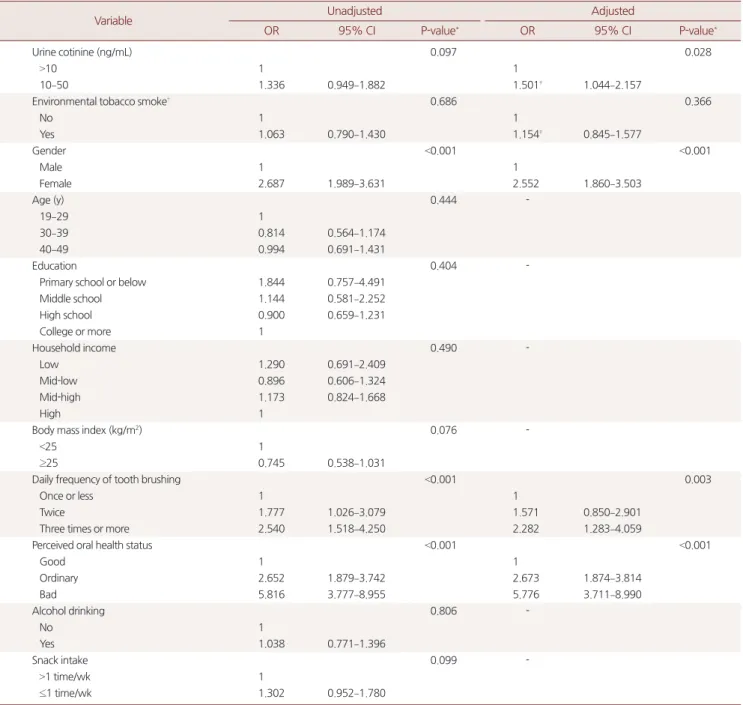
단변량 분석에서 직장 또는 가정의 실내에서 간접흡연에 노출된 사람은 영구치 우식증 위험이 높지 않았다(P=0.686). 요 코티닌으로 구분한 간접흡연 노출도 영구치 우식증에 대한 유의한 요인은 아니 었다(P=0.097). 그러나 단변량 분석에서 영구치 우식증과 통계적으 로 유의한 차이가 있는 것으로 나타난 성별, 하루 칫솔질 횟수, 본인 인지 구강건강상태를 보정하면 요 코티닌으로 구분한 간접흡연에 Table 1. Basal characteristics between the participants according to permanent dental caries
Characteristic
No dental caries With dental caries
P-value* Unweighted
frequency (n)
Estimated proportion (%)
Unweighted frequency (n)
Estimated proportion (%)
Gender <0.001
Male 99 15.1 521 84.9
Female 157 6.2 2,207 93.8
Age (y) 0.448
19–29 67 8.2 760 91.8
30–39 99 9.8 922 90.2
40–49 90 8.2 1,046 91.8
Education 0.467
Primary school or below 7 4.8 104 95.2
Middle school 14 7.4 182 92.6
High school 125 9.3 1,239 90.7
College or more 109 8.4 1,201 91.6
Household income 0.489
Low 19 7.2 221 92.8
Mid-low 57 10.1 578 89.9
Mid-high 85 7.9 931 92.1
High 94 9.1 959 90.9
Body mass index (kg/m2) - 0.075
<25 187 8.1 2,100 91.9
≥25 68 10.6 623 89.4
Daily frequency of tooth brushing 0.001
Once or less 26 16.2 158 83.8
Twice 101 9.8 959 90.2
Three times or more 129 7.1 1,611 92.9
Perceived oral health status <0.001
Good 79 20.9 299 79.1
Ordinary 124 9.1 1,261 90.9
Bad 53 4.3 1,163 95.7
Alcohol drinking 0.806
No 128 8.9 1,279 91.1
Yes 128 8.6 1,441 91.4
Environmental tobacco smoke† 0.686
No 134 8.9 1,441 91.1
Yes 122 8.4 1,287 91.6
Snack intake 0.098
>1 time/wk 127 9.3 1,241 90.7
≤1 time/wk 90 7.3 1,159 92.7
Urine cotinine (ng/mL) 0.096
>10 54 10.8 461 89.2
10–50 202 8.3 2,267 91.7
*Obtained by chi-square test. †Exposure to environmental tobacco smoke was defined as exposure to the indoor secondhand smoke at work or at home.
Eun-Jin Jang, et al. Environmental Tobacco Smoke and Permanent Teeth Caries
Korean Journal of Family Practice
KJFP
노출된 비흡연자는 노출되지 않은 사람에 비해 영구치 우식증 위험 이 유의하게 높았다(odds ratio [OR]=1.501; 95% confidence interval [CI], 1.044–2.157) (Table 2).
또한 본 연구에서 영구치 우식증과 통계적으로 유의한 차이가 있 었던 변수(성별, 하루 칫솔질 횟수, 본인인지 구강건강상태)와 선행 연구에서 치아 우식증과의 연관성이 보고된 연령, 교육수준, 가구소 득을 함께 보정변수로 사용하여 다변량 분석을 시행하였을 때도, 간
접흡연에 노출된 비흡연자의 영구치 우식증 위험이 유의하게 높았 다(OR=1.544; 95% CI, 1.068–2.231).
반면, 동일한 보정변수를 사용하여 직장 또는 가정 실내 간접흡연 노출 설문조사로 구분한 간접흡연 노출과 영구치 우식증과의 연관 성을 분석하였을 때, 영구치 우식증 위험은 간접흡연 노출자와 비노 출자 사이에 유의한 차이가 없었다(P=0.366).
Table 2. Factors affecting permanent dental caries among Korean adults
Variable Unadjusted Adjusted
OR 95% CI P-value* OR 95% CI P-value*
Urine cotinine (ng/mL) 0.097 0.028
>10 1 1
10–50 1.336 0.949–1.882 1.501‡ 1.044–2.157
Environmental tobacco smoke† 0.686 0.366
No 1 1
Yes 1.063 0.790–1.430 1.154‡ 0.845–1.577
Gender <0.001 <0.001
Male 1 1
Female 2.687 1.989–3.631 2.552 1.860–3.503
Age (y) 0.444 -
19–29 1
30–39 0.814 0.564–1.174
40–49 0.994 0.691–1.431
Education 0.404 -
Primary school or below 1.844 0.757–4.491
Middle school 1.144 0.581–2.252
High school 0.900 0.659–1.231
College or more 1
Household income 0.490 -
Low 1.290 0.691–2.409
Mid-low 0.896 0.606–1.324
Mid-high 1.173 0.824–1.668
High 1
Body mass index (kg/m2) 0.076 -
<25 1
≥25 0.745 0.538–1.031
Daily frequency of tooth brushing <0.001 0.003
Once or less 1 1
Twice 1.777 1.026–3.079 1.571 0.850–2.901
Three times or more 2.540 1.518–4.250 2.282 1.283–4.059
Perceived oral health status <0.001 <0.001
Good 1 1
Ordinary 2.652 1.879–3.742 2.673 1.874–3.814
Bad 5.816 3.777–8.955 5.776 3.711–8.990
Alcohol drinking 0.806 -
No 1
Yes 1.038 0.771–1.396
Snack intake 0.099 -
>1 time/wk 1
≤1 time/wk 1.302 0.952–1.780
OR, odds ratio; CI, confidence interval.
*Obtained by logistic regression analysis. †Exposure to environmental tobacco smoke was defined as exposure to the indoor secondhand smoke at work or at home.
‡Estimated by logistic regression analysis adjusted for gender, daily frequency of tooth brushing, perceived oral health status.
장은진 외. 간접흡연과 영구치 우식증의 연관성 Korean Journal of Family Practice
KJFP
고 찰
본 연구에서 국민건강영양조사 자료를 이용하여 우리나라 비흡 연 성인에서 간접흡연과 영구치 우식증의 연관성을 평가한 결과, 간 접흡연에 노출된 비흡연자는 간접흡연에 노출되지 않은 사람에 비 해 영구치 우식증 위험이 높았다. 성인 구강 건강에 대한 기존의 연 구는 주로 흡연 또는 간접흡연과 치주질환의 연관성1,3,5,20)에 대한 것 이었으나, 본 연구를 통해 간접흡연이 성인의 영구치 우식증에 대한 위험 요인임을 확인하였다. 이는 소아 청소년을 대상으로 한 선행 연 구 결과와도 일치하는 결과이다. 미국 네바다 주에 거주하는 12–19 세 청소년을 대상으로 치아 우식증 상위 30%와 치아 우식증이 없는 사람 및 National Health and Nutrition Examination Survey 결과를 비 교한 분석에서 간접흡연에 노출되었을 때 영구치 우식증 발생 위험 이 1.42배 높았다.7) 남아프리카공화국 고등학생을 대상으로 하여 가 정 실내 간접흡연 노출과 영구치 우식증과의 연관성을 평가한 연구 에서도 실내 간접흡연 노출군의 영구치 제2대구치 우식 위험은 비노 출군보다 2.02배 높았다.8) 생체 지표인 혈청 코티닌을 이용한 연구에 서도 4–11세 소아 중 혈청 코티닌이 가장 높은 (>1.0 ng/mL) 소아의 유 치 우식증 발생 위험이 혈청 코티닌이 가장 낮은 군 (<0.005 ng/mL)에 비해 2.3배 높게 나타났다.6)
본 연구 결과 남성보다 여성에서 영구치 우식증 위험이 유의하게 높았는데 이는 선행 연구 결과와 일치한다.8,21,22) 여성이 남성보다 우 식 유발 탄수화물 섭취 빈도가 높으며,21) 여성의 영구치가 남성보다 빨리 돋아나 우식 환경에 먼저 노출되고, 여성의 월경, 임신 등으로 인한 호르몬 변화가 타액 조성의 변화를 초래하여 우식에 잘 노출되 는 구강 환경이 되기 때문으로 생각된다.22) 또 영구치 우식증 경험이 있는 사람들 중에서 1일 칫솔질 횟수가 많았는데 이는 치아 우식이 있기 때문에 칫솔질을 자주 하게 된 것으로 추측된다. 본 연구에서 교육수준, 월 평균 가구소득 등의 사회경제적 요인이 유의한 위험요 인이 아니었던 점은 선행 연구 결과와 달랐다.6,11,23) 본 연구 대상자 중 영구치 우식증 경험이 있는 사람이 91.3%로 매우 높았는데, 이 때문 에 사회경제적 요인의 차이가 영구치 우식증 경험에 유의한 영향을 미치지 못한 것으로 추측된다. 본 연구에서 사용한 종속 변수는 현 재 상태를 평가하는 치아 우식 유병률이 아니라 치아 우식 경험 여부 였기 때문에23) 영구치 우식 경험률이 매우 높았다. 또한 본 연구는 흡 연자를 제외하고 비흡연자만 대상으로 했는데, 흡연자를 포함하면 교육수준에 따라 영구치 우식증 경험 여부가 유의한 차이를 보이는 것으로 보아(결과는 제시하지 않음) 현재 흡연이 교란변수로 작용할 가능성도 있다.
간접흡연에 대한 평가가 설문 응답으로 구성된 과거의 연구1-3,5,7,8,20)
와 달리, 본 연구는 생체 지표인 요 코티닌으로 흡연 노출 여부를 평 가하여, 객관적으로 간접흡연과 치아 우식증의 연관성을 평가할 수 있었다. 또한 요 코티닌 농도를 이용하여 간접흡연과 치아 우식증의 연관성에 영향을 줄 수 있는 직접 흡연자를 완전히 배제하였다. 니코 틴은 우식성 박테리아인 Streptococcus mutans의 성장을 촉진시켜 치 아 우식 형성에 영향을 주는 것으로 알려져 있으며, 구강 내 우식 유 발 병원균에 대한 직접적인 영향 외에 흡연에 의한 전신적인 염증에 의해서도 치아 우식증이 발생할 수 있다.6)
그러나 간접흡연 노출 여부를 묻는 설문 결과를 간접흡연 지표로 하여 영구치 우식증과의 연관성을 분석하였을 때에는 간접흡연 노 출 비흡연자와 노출되지 않은 비흡연자에서 영구치 우식증 위험도 에 유의한 차이가 없었다. 이는 기존 연구와 다른 결과로,7,8,24) 간접흡 연 설문이 자기 기입식으로 조사되어 대상자가 간접흡연 노출 여부 를 정확하게 보고하지 못하는 회상 바이어스가 발생했을 가능성이 있다.2) 간접흡연 상태에 대한 자기 기입식 노출 평가가 타당하다는 연구도 있지만,25,26) 자기 기입식 설문 조사로 평가한 간접흡연 노출 정도는 실제 측정한 간접흡연 노출보다 낮아27,28) 논란의 여지가 있다.
터키의 한 지역 초등학생을 대상으로, 가정 내 간접흡연 노출 여부에 대해 소아의 요 코티닌 농도와 부모의 간접흡연 설문 조사 결과를 비 교한 연구에서는 설문 조사가 신뢰성이 없었다.29)
본 연구에는 몇 가지 제한점이 있다. 단면 연구이기 때문에 간접흡 연과 영구치 우식증 발병의 인과 관계를 알 수 없으며, 기존의 영구치 우식증과 간접흡연으로 인해 새롭게 발생한 치아 우식을 구분할 수 없다. 둘째, 가정 및 직장 실내 간접흡연자를 포함하였으나 다른 장소 에서의 간접흡연 노출 여부는 포함되지 않았다. 이러한 제한점에도 불구하고 본 연구는 국가를 대표할 수 있는 국민건강영양조사 자료 를 이용하여 우리나라 비흡연 성인에서 간접흡연과 영구치 우식증 의 연관성을 확인할 수 있었다는 점에서 의미가 있다.
결론적으로 간접흡연 노출은 우리나라 비흡연 성인의 영구치 우 식증 위험을 증가시킨다. 향후 성인을 대상으로 한 간접흡연과 치아 우식증의 연관성에 대한 연구가 더 활발히 진행되어야 할 것이다. 또 한 혈청이나 타액, 모발 등 다른 생체에서 측정한 코티닌을 간접흡연 지표로 하여 간접흡연과 치아 우식증의 연관성을 평가하는 연구가 필요할 것이며, 간접흡연과 새롭게 발생한 치아 우식증과의 인과 관 계에 대한 연구가 필요할 것이다.
요 약
연구배경:
간접흡연은 구강건강에 부정적인 영향을 미칠 것으로 생 각되지만, 성인에서 간접흡연과 치아 우식증의 연관성에 대한 연구Eun-Jin Jang, et al. Environmental Tobacco Smoke and Permanent Teeth Caries
Korean Journal of Family Practice
KJFP
는 제한적이다. 본 연구는 국내 비흡연 성인에서 간접흡연과 영구치 우식증의 연관성을 평가하기 위해 수행되었다.
방법:
2008–2011년 국민건강영양조사에 참여한 만 19–49세 성인 비 흡연자 2,984명을 대상으로 하였다. 간접흡연 노출은 요 코티닌 농도 를 이용하여 10 ng/mL 이상, 50 ng/mL 미만으로 정의하였고 우식 경 험 영구치 수가 한 개 이상이면 영구치 우식증이 있는 것으로 정의하 였다. 성별, 하루 칫솔질 횟수, 본인 인지 구강건강상태 및 연령, 교육 수준, 가구소득을 보정변수로 하여 다중 로지스틱 회귀분석법으로 간접흡연 노출에 따른 치아 우식증의 교차비를 구하였다.결과:
연구 대상자의 영구치 우식 경험률은 91.3%였고, 84.5%가 요 코 티닌 농도 기준으로 간접흡연에 노출되었다. 성별, 하루 칫솔질 횟수, 본인인지 구강건강 상태를 보정하였을 때 간접흡연에 노출된 비흡연 자의 영구치 우식증 위험이 증가하였다(odds ratio [OR]=1.501; 95%confidence interval [CI], 1.044–2.157). 연령, 교육수준, 가구소득을 추 가로 보정하였을 때에도 간접흡연에 노출된 비흡연자의 영구치 우 식증 위험이 유의하게 높았다(OR=1.544; 95% CI, 1.068–2.231).
결론:
우리나라 비흡연 성인에서 간접흡연은 영구치 우식증의 유의 한 위험 요인이다.중심단어:
간접흡연; 영구치 우식; 요 코티닌REFERENCES
1. Arbes SJ Jr, Agústsdóttir H, Slade GD. Environmental tobacco smoke and periodontal disease in the United States. Am J Public Health 2001; 91: 253- 7.
2. Lee BE, Ha EH. Exposure to environmental tobacco smoke among South Korean adults: a cross sectional study of the 2005 Korea National Health and Nutrition Examination Survey. Environ Health 2011; 10: 29.
3. Kim JK, Baek HJ, Lee YE, Song KB, Chio YH. The association between envi- ronmental tobacco smoke and periodontal health: finding from Korean National Health and Nutrition Examination Survey 2008-2009. J Dent Hyg Sci 2014; 14: 123-31.
4. Leonardi-Bee J, Smyth A, Britton J, Coleman T. Environmental tobacco smoke and fetal health: systematic review and meta-analysis. Arch Dis Child Fetal Neonatal Ed 2008; 93: F351-61.
5. Ueno M, Ohara S, Sawada N, Inoue M, Tsugane S, Kawaguchi Y. The associ- ation of active and secondhand smoking with oral health in adults: Japan public health center-based study. Tob Induc Dis 2015; 13: 19.
6. Aligne CA, Moss ME, Auinger P, Weitzman M. Association of pediatric dental caries with passive smoking. JAMA 2003; 289: 1258-64.
7. Ditmyer M, Dounis G, Mobley C, Schwarz E. A case-control study of deter- minants for high and low dental caries prevalence in Nevada youth. BMC Oral Health 2010; 10: 24.
8. Ayo-Yusuf OA, Reddy PS, van Wyk PJ, van den Borne BW. Household smoking as a risk indicator for caries in adolescents’ permanent teeth. J Ado-
lesc Health 2007; 41: 309-11.
9. Ministry of Health and Welfare. Advanced analysis of Korean National Oral Health Survey [Internet]. Sejong: Ministry of Health and Welfare; 2011. [cit- ed 2015 Dec 22]. Available from: http://www.mohw.go.kr/front_new/jb/
sjb030301vw.jsp?PAR_MENU_ID=03&MENU_ID=0329&CONT_
SEQ=261565&page=1
10. Yildiz G, Ermis RB, Calapoglu NS, Celik EU, Turel GY. Gene-environment interactions in the etiology of dental caries. J Dent Res 2015; 95: 74-9.
11. Schwendicke F, Dörfer CE, Schlattmann P, Page LF, Thomson WM, Paris S.
Socioeconomic inequality and caries: a systematic review and meta-analysis.
J Dent Res 2015; 94: 10-8.
12. Petersen PE, Bourgeois D, Ogawa H, Estupinan-Day S, Ndiaye C. The global burden of oral diseases and risks to oral health. Bull World Health Organ 2005; 83: 661-9.
13. Korea Centers for Disease Control and Prevention. Health behavior and chronic disease statistics 2013 [Internet]. Cheongju: Korea Centers for Dis- ease Control and Prevention; 2014. [cited 2015 Dec 22]. Available from:
https://knhanes.cdc.go.kr/knhanes/index.do.
14. Lee JH. Children’s environmental tobacco smoke exposure and dental car- ies [dissertation]. Yongin: Dankook University; 2012. Korean.
15. Korea Centers for Disease Control and Prevention. The fifth Korea Nation- al Health and Nutrition Examination Survey guideline [Internet]. Cheon- gju: Korea Centers for Disease Control and Prevention; 2012. [cited 2015 Dec 22]. Available from: https://knhanes.cdc.go.kr/knhanes/index.do.
16. Wong SL, Malaison E, Hammond D, Leatherdale ST. Secondhand smoke exposure among canadians: cotinine and self-report measures from the Ca- nadian Health Measures Survey 2007-2009. Nicotine Tob Res 2013; 15:
693-700.
17. Kim KJ. Relationship between urinary cotinine concentration and peri- odontal disease: analysis of the 1st year (2010) data of the 5th National Health and Nutrition Survey. [dissertation]. Seoul: Yonsei University; 2015.
Korean.
18. Jung SM, Lee IS, Kim SB, Moon CS, Jung JY, Kang YA, et al. Urine cotinine for assessing tobacco smoke exposure in Korean: analysis of the Korea Na- tional Health and Nutrition Examination Survey (KNHANES). Tuberc Respir Dis 2012; 73: 210-8.
19. Haufroid V, Lison D. Urinary cotinine as a tobacco-smoke exposure index: a minireview. Int Arch Occup Environ Health 1998; 71: 162-8.
20. Jung JO, Chun JY, Lee KH. The relationship between smoking and peri- odontal disease in korean adults: based on the data form the Korea National Health and Nutrition Examination Survey 2010. J Korean Soc Dent Hyg 2013; 13: 481-9.
21. Kwon B, Bae I, Kim S, Kim J, Jeong T. Dental caries status of 14-16 year old adolescents in Yangsan area. J Korean Acad Pediatr Dent 2014; 41: 8-17.
22. Lukas JR, Largaespada LL. Explaining sex differences in dental caries preva- lence: saliva, hormones and life-history etiologies. Am J Hum Biol 2006; 18:
540-55.
23. Shin BM, Jung SH. Socio-economic inequalities in dental caries in Korea. J Korean Acad Oral Health 2012; 36: 144-52.
24. Shenkin JD, Broffitt B, Levy SM, Warren JJ. The association between envi- ronmental tobacco smoke and primary tooth caries. J Public Health Dent 2004; 64: 184-6.
25. Hovell MF, Zakarian JM, Wahlgren DR, Matt GE. Reducing children’s ex-
장은진 외. 간접흡연과 영구치 우식증의 연관성 Korean Journal of Family Practice
KJFP
posure to environmental tobacco smoke: the empirical evidence and direc- tions for future research. Tob Control 2000; 9 Suppl 2: II40-7.
26. Nondahl DM, Cruickshanks KJ, Schubert CR. A questionnaire for assessing environmental tobacco smoke exposure. Environ Res 2005; 97: 76-82.
27. Ozasa K, Higashi A, Yamasaki M, Hayashi K, Watanabe Y. Validity of self-re- ported passive smoking evaluated by comparison with smokers in the same household. J Epidemiol 1997; 7: 205-9.
28. Lindqvist R, Lendahls L, Tollbom O, Aberg H, Håkansson A. Smoking dur- ing pregnancy: comparison of self-reports and cotinine levels in 496 wom- en. Acta Obstet Gynecol Scand 2002; 81: 240-4.
29. Boyaci H, Etiler N, Duman C, Basyigit I, Pala A. Environmental tobacco smoke exposure in school children: parent report and urine cotinine mea- sures. Pediatr Int 2006; 48: 382-9.