Original Article: Soil/Pesticidal/Environmental Sciences
Characterization of Burcucumber Biochar and its Potential as an Adsorbent for Veterinary Antibiotics in Water
Jung Eun Lim · Hae Won Kim · Se Hee Jeong · Sang Soo Lee · Jae E Yang · Kye Hoon Kim · Yong Sik Ok*
가시박 유래 바이오차의 특성 및 항생물질 흡착제로서의 활용가능성 평가
임정은 · 김해원 · 정세희 · 이상수 · 양재의 · 김계훈 · 옥용식*
Received: 28 April 2013 / Accepted: 21 October 2013 / Published Online: 31 March 2014
© The Korean Society for Applied Biological Chemistry 2014
Abstract Biochar (BC) from biomass pyrolysis is a carbonaceous material that has been used to remove various contaminants in the environment. The eliminatory action for burcucumber (Sicyos angulatus L.) as an invasive plant is being consistently carried out because of its harmfulness and ecosystem disturbance. In this study, burcucumber biomass was converted into BCs at different pyrolysis temperatures of 300 and 700
oC under a limited oxygen condition. Produced BCs were characterized and investigated to ensure its efficiency on antibiotics’ removal in water. The adsorption experiment was performed using two different types of antibiotics, tetracycline (TC) and sulfamethazine (SMZ). For the BC pyrolyzed at a high temperature (700
oC), the values of pH, electrical conductivity, and the contents of ash and carbon increased whereas the yield, mobile matter, molar ratios of H/C and O/C, and functional groups decreased. Results showed that the efficiency of BCs on antibiotics’ removal increased as pyrolysis temperature increased from 300 to 700°C (38 to 99% for TC and 6 to 35% for SMZ). The reaction of π-π EDA (electron- donor-acceptor) might be involved in antibiotics’ adsorption to BCs. BC has potential to be a superior antibiotics’ adsorbent with environmental benefit by recycling of waste/invasive biomass.
Keywords bioenergy · black carbon · charcoal · proximate analysis · slow pyrolysis · ultimate analysis
서 론
바이오차(biochar)는 제한된 산소 조건에서 바이오매스를 700oC 이하의 온도로 열분해(pyrolysis)하였을 때 생성되는 고형물로, 탄소의 함량이 일반 유기물보다 상대적으로 높다(Lehmann과 Joseph, 2009). 특히, 바이오매스에 함유된 분해가 용이한 탄소 (labile C)는 열분해 과정을 통해 난분해성 탄소(stable C)로 변 환되므로, 바이오차를 토양에 투입하는 경우 탄소의 지중저장을 통해 온실가스 발생을 억제할 수 있다(Lehmann, 2007). 이 외 에도 바이오차의 토양 투입은 수분보유능 증가(Glaser 등, 2002), 토양구조 개선(Verheijen 등, 2010) 등 토양질(soil quality) 개선에 효과가 있는 것으로 알려져 있다. 최근에는 바 이오차의 수질 중 trichloroethylene (TCE) 흡착제거(Ahmad 등, 2012a), 토양 중 납(Pb)과 atrazine의 동시제거(Cao 등, 2011), 토양 및 수질 중 납, 카드뮴(Cd), 니켈(Ni) 등의 중금속 흡착제 거(Uchimiya 등, 2010a) 등 유·무기 오염물질 정화에 대한 연 구들이 활발하게 보고되고 있다(Ahmad 등, 2014).
신흥 유기오염물질로 인식되고 있는 항생물질(antibiotics)은 미생물에 의해 생성된 물질로 세균 및 타 미생물의 성장과 활 동을 억제하여 인간과 동물의 질병예방 및 치료에 사용되는 물 질이다(Thiele-Bruhn, 2003; Seo 등, 2007; Lim 등, 2009). 그 러나 물질 고유의 대사특성상 투여된 양의 일부만이 체내에서 사용되며 나머지는 체외로 배출된다(Pei 등, 2006; Kim 등, 2011). 배출된 항생물질은 다양한 경로를 통해 환경 중으로 유 입되며 내성박테리아 생성 등을 통해 인간과 생태계에 위협을 J. E. Lim · H. W. Kim · S. H. Jeong · S. S. Lee · J. E. Yang · Y. S. Ok
Korea Biochar Research Center & Department of Biological Environment, Kangwon National University, Chuncheon 200-701, Republic of Korea K. H. Kim
Department of Environmental Horticulture, The University of Seoul, Seoul 130-743, Republic of Korea
*Corresponding author (Y. S. Ok: [email protected])
초래한다(Kim 등, 2010; Kim 등, 2012b). 이 같은 위험성으로 인해 최근 들어 항생물질에 대한 모니터링 연구가 진행되어 왔 다. 국내에서도 환경 중 잔류 항생물질 모니터링 연구가 보고 된 바 있으며(Choi 등, 2008; Lim 등, 2009; Lee 등, 2010;
Ok 등, 2011), 이를 제거하기 위한 방법으로 수질 중 항생물질 에 대하여 활성탄(activated carbon)을 이용한 흡착 등이 주로 적용되고 있다(Son 등 2008a; 2008b). 그러나 활성탄은 700oC 이상의 열분해 조건에서 생산되어 에너지 소모가 크며 이 때 물리·화학적 활성화 과정을 수반하므로 생산단가가 높아 (Lehmann과 Joseph, 2009; Ahmad 등, 2012a) 이를 대체할 수 있는 경제적인 소재의 개발이 필요하다.
전술한 바와 같이 바이오차는 700oC 이하의 열분해 조건에 서 생산되며 활성화 과정이 요구되지 않으므로(Lehmann과 Joseph, 2009; Ahmad 등, 2012a), 항생물질 등 각종 유·무기‚
오염물질에 대한 경제적인 정화 소재로 사용할 수 있다. 바이 오차로 활용이 가능한 원료로는 농림부산물(Yuan 등, 2011;
Ahmad 등, 2012a; 2012b), 축산부산물(Cao와 Harris, 2010;
Uchimiya 등, 2010a; 2010b; Cantrell 등, 2012), 해양부산물 (Bird 등, 2011) 등이 있으며, 하수슬러지 등의 다양한 부산물들 이 생산에 활용될 수 있어(Awad 등, 2012; 2013) 원료의 구입 및 확보에 소모되는 비용도 매우 저렴할 것으로 판단된다.
가시박(Sicyos angulatus L.)은 환경부에서 지정한 대표적인 생태계교란식물로 북아메리카를 원산지로 하는 1년생 초본과의 덩굴식물이다. 가시박은 왕성한 생육특성으로 인해 분포면적이 넓어 생태계를 교란하고 농작물의 생산량을 감소시키는 등 다 양한 피해를 야기한다(Kang 등, 2011). 이로 인해 전국적으로 가시박 제거 작업이 활발히 진행되고 있으나 그 서식처가 강이 나 하천변에 주로 분포하고 있어 상수원 오염 등의 이유로 제 초제의 사용은 어려운 실정이다(Choi 등, 2012). 이 같은 이유 로 가시박 제거작업은 주로 예초 등 인력에 의존한 방법으로 진행되고 있어(Choi 등, 2012), 제거 후 발생하는 가시박 바이 오매스의 활용 방안이 필요한 것으로 판단된다.
그러므로 본 연구에서는 이에 대한 활용 방안 모색을 위해 하천변에서 수거된 가시박 바이오매스를 열분해하여 바이오차 를 생산하였다. 이 후 생산한 가시박 바이오차에 대한 물리·
화학적 특성을 평가하였으며 대표적 항생물질인 tetracycline과 sulfamethazine에 대한 흡착 효율을 평가함으로써 유해식물의 자 원화 가능성을 제시하고자 하였다.
재료 및 방법
가시박 채취 및 바이오차 생산. 가시박은 2012년 8월 서울시 영등포구 안양천 일대에서 채취하였고 실험실로 운반 후 지상 부에 대해 60oC에서 48시간 동안 건조하였다. 건조한 가시박은 1 mm 이하로 분쇄한 후 제한적 산소 조건에서 열분해를 실시 하였다. 열분해 최고온도(HTT, highest treatment temperature)는 각각 300oC와 700oC로 설정하였고 분당 7oC의 승온속도로 최 고온도에 도달하게 한 후 3시간을 유지하였다. 이 후 내부에서 12시간 방냉한 후 생산된 바이오차를 수집하였다. 본 연구에 사 용된 가시박 바이오매스 및 바이오차는 각각 BM (바이오매스), BC300 (300oC에서 생산된 바이오차), BC700 (700oC에서 생산 된 바이오차)으로 명명하였다.
일반성분 분석(proximate analysis). 수득률(yield)은 열분해 전
후의 시료무게를 바탕으로 산출하였으며(식 1), BM, BC300, BC700에 대해 105oC에서 24시간 건조, 450oC에서 30분간 가 열, 750oC에서 30분간 가열과정을 순차적으로 실시하여 식 2−
5의 계산을 통해 수분함량(moisture), 휘발분(mobile matter), 회 분(ash), 고정탄소(resident matter) 함량을 산출하였다(Ahmad 등, 2012a).
식 1) 수득률(%)=(열분해 후 시료의 무게/열분해 전 시료의 무게)*100
식 2) 수분함량(%)=[(105oC 건조 전 시료의 무게−105oC 건 조 후 시료의 무게)/105oC 건조 전 시료의 무게]*100
식 3) 휘발분(%)=[(450oC 가열 전 시료의 무게−450oC 가열 후 시료의 무게)/450oC 가열 전 시료의 무게]*100
식 4) 회 분(%)=(750oC 가열 후 시료의 무게/750oC 가열 전 시료의 무게)*100
식 5) 고정탄소(%)=100−(수분함량+휘발분+회분)
원소 분석(ultimate analysis). BM, BC300, BC700에 대해 원 소 분석기(Flash EA 1112, Thermo, USA)를 이용하여 탄소(C), 수소(H), 산소(O), 질소(N), 황(S)의 함량을 측정하였으며, 각 원 소 함량에 기초하여 방향성(aromaticity) 및 극성(polarity)의 정 도를 유추할 수 있는 H/C 및 O/C atomic ratio를 산출하였다 (Uchimiya 등, 2010b).
pH 및 EC 분석. BM, BC300, BC700의 pH는 시료와 증류수 를 1:10 비율로 혼합하여 30분간 교반한 후 pH meter (Inolab pH 7110 BNC, WTW, Germany)로 측정하였다. Electrical conductivity (EC)는 pH 측정 후 혼탁액을 Whatman No. 2 여과지에 여과한 후 EC meter (Orion 3 star, Thermo, USA) 로 측정하였다(Ahmad 등, 2012a).
작용기 분석(functional group analysis). BM, BC300, BC700 의 작용기 분석은 푸리에 변환 적외선 분광기(FT-IR, fourier transform infrared spectrometer) (FT-3000 MX, BIO-RAD, USA)를 이용하여 파장영역 4−4000 cm−1에 대해 resolution 4 cm−1, scan number 32로 측정하여 얻어진 스펙트럼을 Coates (2000) 의 방법에 준하여 해석하였다.
표면특성 및 입자크기 분석(surface and particle size analysis).
BM, BC300, BC700에 대한 표면 특성 관찰은 주사전자현미경 (SEM, scanning electron microscope) (S-4300, Hitachi, Japan) 을 이용하여 실시하였으며, 입자크기 및 분포는 입도 분석기 (PSA, particle size analyzer) (Matersizer2000, UK)를 이용하 여 측정하였다.
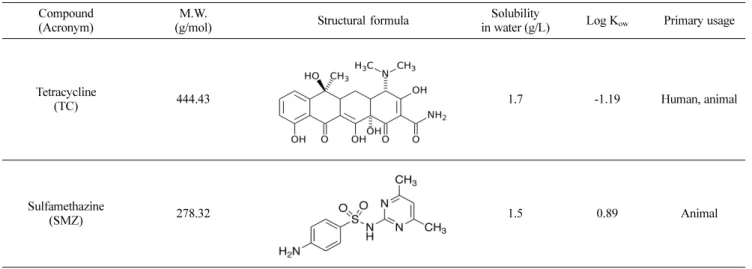
수용액 중 항생물질 흡착실험. 흡착실험의 대상 항생물질로는 국내 사용량이 높은 것으로 알려진 tetracycline계열과 sulfonamide 계열의 항생물질 중 tetracycline (TC)과 sulfamethazine (SMZ) 을 각각 선정하였으며 2종 항생물질의 화학적 특성은 Table 1과 같다(Tolls, 2001; KFDA, 2005; KEI, 2006; Seo 등, 2007).
BM, BC300, BC700에 의한 수용액 중 항생물질 흡착 실험 은 다음과 같이 수행되었다. TC와 SMZ 분말시약(Fluka Analytical Ltd., Switzerland)을 methanol에 녹여 TC와 SMZ의 표준용액(10 mg/L)을 제조하였다. 이 후 반응용기에 TC 및 SMZ 표준용액 50 mL를 가한 후 BM, BC300 및 BC700을 0.1 g씩 투입하고 25oC, 55 rpm으로 24시간 동안 교반하였다.
교반 후 용액은 0.45 µm syringe filter로 여과하고 이 후 항
생물질 분석을 위해 pore size가 2.7 µm, 내경이 3.0 mm, 길이 가 150 mm인 컬럼(Poroshell 120 SB-C18, Agilent, USA)과 diode array detector (DAD)가 장착된 고성능액체크로마토그래 프(HPLC, high performance liquid chromatograph) (1260 series, Agilent, USA)로 TC 및 SMZ를 분석하여 BM, BC300 및 BC700의 항생물질 흡착 제거효율을 평가하였다. 기타 HPLC 분석 조건은 Table 2에 명시하였으며, 이를 통해 얻어진 표준 물질의 크로마토그램(chromatogram)은 Fig. 1과 같다.
결과 및 고찰
일반성분 분석결과. 수득률은 BC300 50.07%, BC700 29.66%
로 나타나 생산 온도가 상승함에 따라 감소하는 경향을 보였다 (Table 3). 이와 유사하게 Novak 등(2009)은 계분을 포함한 4종 의 바이오매스로부터 생산한 바이오차의 특성을 분석한 결과 상 대적으로 낮은 열분해 온도조건에서 생산한 바이오차가 수득률 이 높으며, 이는 원료에 함유된 지방족 화합물의 열분해에 의 한 축합반응과 함께 CH4, H2, CO의 손실이 저온에서 상대적으 로 낮음에 기인하는 것으로 보고하였다. 또한 열분해 온도의 증 가에 따른 수득률의 감소는 수산기의 탈수작용과 목부섬유소 (ligno-cellulose) 구조의 열적 분해 등 바이오매스에 함유된 휘
발성 물질의 손실에 기인하는 것으로 알려져 있다(Novak 등, 2009; Cantrell 등, 2012).
수득률 감소의 주요인인 휘발분 함량은 BM 66.54%, BC300 52.30%, BC700 34.71%로 생산 온도가 상승함에 따라 감소하 였으며, 이는 앞서 언급한 생산 온도 상승에 의한 유기물의 분 해, 지방족 화합물 분해 후 축합반응에 의한 손실, 목부섬유소 의 분해 등에 의한 것으로 판단된다(Novak 등, 2009; Ahmad 등, 2012a).
회분 함량은 BM 16.82%, BC300 31.24%, BC700 54.29%
로 생산 온도가 상승함에 따라 증가하였다. Shinogi와 Kanri (2003)는 하수슬러지 등 4종의 바이오매스를 원료로하여 바이오 차를 생산하였으며, 800oC까지는 열분해 온도의 증가에 따라 회 분 함량이 증가함을 보고하였다. 이는 고온에 의해 원료성분 중 C, H, O, N, S 등이 휘발되는 반면, 분해·휘발되지 않는 무 기염류(inorganic salt)는 열분해 과정 중 농축됨에 기인한 것으 로 판단된다(Shinogi와 Kanri, 2003; Cao와 Harris, 2010;
Ahmad 등, 2012a).
원소 분석결과. C 함량은 BM 46.87%, BC300 68.37%, BC700 78.07%였으며 생산 온도가 상승함에 따라 증가하는 것 으로 나타났다(Table 3). 바이오차 생산 시 탄화(carbonization) 의 정도는 생산 온도가 상승할수록 증가하는 것으로 알려져 있 으며 본 결과도 이와 동일한 경향을 나타내었다(Novak 등, 2009; Ahmad 등, 2012a). 이와 반대로 O, H, N의 함량은 바 이오차의 생산 온도가 상승할수록 감소하는 것으로 나타났는데 이는 바이오매스의 열분해 과정에서 발생하는 전형적인 경향으 로 열분해 시 가시박 표면의 탈수작용에 의한 수산기(-OH)의 손실 및 C와 결합된 O, H 원자가 고온에서 분자구조의 변형을 통해 손실된 것으로 판단된다(Novak 등, 2009).
일반적으로 바이오차의 H/C 및 O/C atomic ratio는 서로 정 의 상관관계를 나타내며, 2가지 인자 모두 생산 온도와 부의 상 관관계를 나타내는 것으로 알려져 있다(Lehmann과 Joseph, 2009). 본 연구결과에서도 H/C 및 O/C atomic ratio는 서로 정 의 상관관계를 나타내었으며, 생산 온도가 상승하면 모두 감소 하는 부의 상관관계를 나타내어 선행연구 결과와 일치하였다 (Uchimiya 등, 2010b; Ahmad 등, 2012a). H/C atomic ratio 의 경우 BC의 방향성, O/C atomic ratio의 경우 극성과 연관된 인자로 본 연구결과에서는 H/C atomic ratio가 감소하여 바이오 Table 1 Chemical properties of selected antibiotics (Tolls, 2001; KEI, 2006)
Compound (Acronym)
M.W.
(g/mol) Structural formula Solubility
in water (g/L) Log Kow Primary usage
Tetracycline
(TC) 444.43 1.7 -1.19 Human, animal
Sulfamethazine
(SMZ) 278.32 1.5 0.89 Animal
Table 2 High performance liquid chromatograph (HPLC) condition for antibiotics analysis used in this study
Description Condition
Instrument HPLC 1260 series, Agilent, USA Injection volume 20 µL
Column Poroshell 120 SB-C18, Agilent, USA (3.0 mm×150 mm, 2.7 µm) Column flow rate 0.5 mL/min
Mobile phase A: 0.1% formic acid in acetonitrile B: 0.1% formic acid in water Gradient program 0 min, A/B=5/95
20 min, A/B=30/70 Column oven temperature 25oC
Detector DAD (254 nm)
차의 방향성이 증가되었으며, O/C atomic ratio가 감소하면서 바 이오차의 극성이 감소하였을 것으로 판단된다(Uchimiya 등, 2010b; Ahmad 등, 2012a). 이는 고온에서 바이오매스가 함유한 유기물의 탄화에 의해 방향성 구조(aromatic structure)의 형성이 증진되었으며, 바이오매스의 극성작용기(polar functional group) 가 고온에서 감소된 결과에 기인한 것으로 판단된다(Ahmad 등, 2012a).
pH 및 EC 분석결과. BM, BC300 및 BC700의 pH는 각각 7.79, 10.54, 12.56이었으며, EC는 각각 5.82, 12.38, 33.83 dS/
m로 나타나 생산 온도가 상승할수록 바이오차의 pH와 EC가 증가하는 것으로 나타났다(Table 3). 이와 같은 결과는 바이오
차 생산 시 열분해를 통해 가시박 바이오매스가 함유한 유기물 질로부터 알칼리성 염(salt)이 분리되면서 바이오차 자체가 알칼 리화된 것으로 판단된다(Shinogi와 Kanri, 2003; Ahmad 등, 2012a). EC의 경우도 열분해를 통해 가시박이 함유한 휘발성물 질이 손실됨으로써 회분 내 다양한 염들이 농축되는 효과에 의 해 EC가 증가되었을 것으로 판단된다(Cantrell 등, 2012).
작용기 분석결과. FT-IR을 통한 작용기 분석결과 열분해 온도 가 증가함에 따라 스펙트럼 상에서 작용기 특성 peak들이 완만 해지는 것을 관찰할 수 있었다(Fig. 2). 이는 열분해에 의한 작 용기들의 감소에 의한 것으로 판단된다. Coates (2000)이 제시 한 방법으로 스펙트럼의 작용기 peak를 해석한 결과 모든 시료 Fig. 1 Chromatograms for standard solution (5 mg/L) of (A) tetracycline (TC) and (B) sulfamethazine (SMZ).
Table 3 Physicochemical properties of burcucumber biomass (BM), burcucumber derived biochar at 300oC (BC300) and burcucumber derived biochar at 700oC (BC700)
Sample Yield Moisture Mobile matter
Resident
matter Ash pH EC C H O N S Atomic ratio
--- wt (%) --- 1:10 (dS/m) --- wt (%) --- H/C O/C
BM - 10.16 66.54 6.49 16.82 7.79 5.82 46.87 6.56 41.77 4.80 NDa 1.70 0.70
BC300 50.07 2.86 52.30 13.61 31.24 10.54 12.38 68.37 6.00 20.39 5.24 ND 1.04 0.22
BC700 29.66 2.87 34.71 8.13 54.29 12.56 33.83 78.07 2.48 14.66 4.78 ND 0.38 0.14
aNot detected.
에서 3331 cm−1 부근의 수분과 관련된 hydroxyl (-OH) peak가 존재하였다. 특히 2916 cm−1과 2864 cm−1부근의 지방족 methylen (-CH2) peak는 BM, BC300에서는 존재하였으나 BC700에서는 관찰되지 않았다. 한편, BM, BC300 및 BC700의 스펙트럼 상에 서 1650 cm−1부근의 amine NH peak, 1390 cm−1부근의 -COOH peak, 1242 cm−1와 871 cm−1 부근의 aromatic CH peak 및 1057 cm−1부근의 ester기(C-O-C) peak가 존재하였다. 대부분의 스펙트럼 내 -OH, CH 등의 작용기 특성 peak들은 열분해 온 도가 증가함에 따라 점차 감소되어 BC700에서는 매우 완만한 스펙트럼이 나타났다. 이는 원소 분석결과에서 열분해 온도가 증가할수록 감소되는 H, O, N 및 H/C, O/C atomic ratio의 감소경향과 일치하며 이를 통해 바이오차의 방향성 구조의 형 성이 증진되고, 극성작용기는 감소한 것으로 판단된다(Table 3)(Ahmad 등, 2012a).
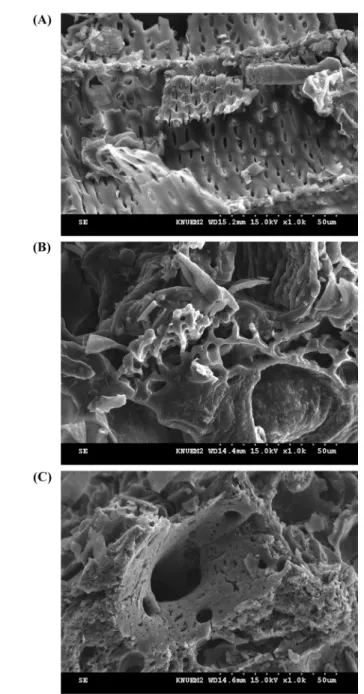
표면특성 및 입자크기 분석 결과. SEM을 이용한 바이오차의 표면 분석결과는 Fig. 3과 같다. BM과 비교할 때 열분해를 통 해 생산된 BC300과 BC700은 표면 내 상대적으로 많은 공극 이 관찰되었다. 공극의 증가는 열분해 과정 중 휘발성 물질들 이 제거됨에 기인한 것으로 판단되었다(Ahmad 등, 2012a).
Fig. 4는 BM, BC300 및 BC700의 입자크기의 분포를 나타 낸 것으로서 입자크기 79 µm 이하의 분포는 BM, BC300 및 BC700이 각각 8.34, 10.38, 10.42%로, 550 µm 이하의 분포는 각각 61.72, 77.45, 68.06%로써 대체적으로 바이오매스에서 바 이오차로 변환됨에 따라 미세 입자의 비율이 증가하는 것으로 나타났다. 이는 생산 온도가 상승함에 따라 바이오매스의 인장
강도(tensile strength)가 감소하면서 입자들이 쉽게 부서져 입자 크기가 감소한 것으로 판단된다(Kim 등, 2012a). 또한 BC300 이 BC700에 비하여 크기가 작은 입자의 비율이 높은 것으로 나타났는데 이는 BC700의 작은 입자들이 다시 뭉쳐지면서 나 타난 현상으로 판단된다(Lehmann과 Joseph, 2009).
수용액 중 항생물질 제거효율. BM, BC300 및 BC700에 의한 TC와 SMZ의 흡착효율은 Fig. 5와 같다. BM, BC300 및 BC700의 적용은 수용액 내 TC와 SMZ 항생물질을 효과적으로 감소시키는 것으로 나타났다. BM, BC300 및 BC700의 초기농 도 대비 TC 제거효율은 각각 38, 95, 99%였으며, SMZ에 대 한 제거효율은 각각 6, 7, 35%로 나타났다. 가시박은 바이오매 Fig. 2 Fourier transform infrared spectroscopy (FT-IR) spectra of
burcucumber biomass (BM), burcucumber derived biochar at 300oC (BC300) and burcucumber derived biochar at 700oC (BC700).
Fig. 3 Scanning electron microscopy (SEM) images of (A) burcucumber biomass (BM), (B) burcucumber derived biochar at 300oC (BC300) and (C) burcucumber derived biochar at 700oC (BC700).
스에서 바이오차로의 변환을 통해 TC와 SMZ에 대한 흡착제거 효율이 증가되는 것으로 나타났으며, 생산 시 열분해 온도가 높 은 BC700에서 가장 높은 제거효율을 보였다. 항생물질 별로는 TC에 대한 흡착제거효율이 SMZ보다 높은 것으로 나타났다. TC 와 SMZ의 Log Kow는 각각 -1.19와 0.89로서 SMZ이 상대적 으로 높은 소수성(hydrophobic)을 보유하고 있어(Table 1), 열분 해 과정 시 O/C가 감소하면서 소수성이 증대된 바이오차에 의 한 흡착이 TC보다 클 것으로 예상되었으나 본 연구결과는 반 대의 경향을 나타내었다.
일부 항생물질의 경우 평면(planar) 방향성 구조를 함유하며 이 경우 intercalation 현상에 의해 점토광물의 층간에 항생물질 이 삽입될 수 있어 Log Kow 외에도 항생물질 자체의 화학적 입체 구조 등에 영향을 받게 된다(Kûmmerer, 2008). Teixidó 등(2011)은 SMZ에 대한 바이오차의 흡착연구에서 π-π EDA (electron-donor-acceptor) 상호작용에 의한 흡착 메커니즘을 보 고하였으며, Ji 등(2010)은 TC의 평면 방향성 구조에서 기인된 반데르발스힘(van der Waals force) 및 π-π EDA 상호작용에 의한 TC와 탄소나노튜브(carbon nanotube) 간의 강한 흡착을 보고하였다. 이와 유사하게 Jonker와 Koelmans (2002)는 PAHs (polycyclic aromatic hydrocarbons) 흡착연구에서 PAHs의 평면 방향성 구조가 charcoal, 흑연, 활성탄에 존재하는 미세한 크기 의 공극으로 PAHs의 이동을 용이하게 하며, 이 때 방향성 구 조가 주 구성성분인 공극 표면에서 π-π 결합에 의해 PAHs가 흡착됨을 보고한 바 있다. 이 같은 선행연구들을 고려할 때 본 연구결과에서 생산된 바이오차와 항생물질 구조에 함유된 방향 성이 TC와 SMZ간 흡착제거에 영향을 주었을 것으로 판단된 다. 특히, TC와 SMZ는 분자 내에 각각 4개 및 2개의 방향성 구조를 포함하고 있어 4개의 방향성 구조로 이루어진 TC가 SMZ에 비해 바이오차와의 흡착반응이 더 우수하여 TC에 대한 제거효율이 매우 높게 나타난 것으로 사료된다. 이와 함께 열 분해 온도상승에 따른 항생물질 흡착제거효율 증대의 경우, 고 온에서 생산 시 바이오차 내 방향성 구조의 비율이 증가되는 것에 기인한 결과로 판단된다.
초 록
바이오차는 바이오매스의 열분해를 통해 생산되는 물질로써 최 근 토양 내 탄소격리, 토양질 개선, 환경 중 오염물질의 정화 등에 우수한 효과가 있는 것으로 보고되고 있다. 본 연구에서 는 외래 유해 식물인 가시박을 300oC 및 700oC에서 열분해하 여 바이오차를 생산하였으며, 생산된 바이오차에 대한 물리·화 학적 특성평가 및 수용액 중 항생물질의 흡착제거연구를 실시 하였다. 연구결과 열분해 온도가 증가함에 따라 생산된 가시박 바이오차의 pH, EC, 회분, 고정탄소함량은 증가하였으며, 수득 률, 휘발분함량, 작용기는 감소하였다. 특히, H/C atomic ratio 의 경우 바이오차의 방향성, O/C atomic ratio의 경우 극성과 관련된 인자로서 고온 열분해 시 바이오차의 방향성 구조의 형 성이 촉진되었고, 반대로 극성작용기들이 제거되면서 극성은 감 소하는 것으로 나타났다. 또한 고온에 의한 가시박 바이오매스 의 인장 강도 감소로 인해 생산된 바이오차의 입자크기는 감소 하였다. 수용액 중 항생물질 제거효율은 바이오차 생산 온도가 Fig. 5 Removal efficiency of burcucumber biomass (BM), burcucumber derived biochar at 300oC (BC300) and burcucumber derived biochar at 700oC (BC700) for (A) tetracycline (TC) and (B) sulfamethazine (SMZ) (experimental conditions: 0.1 g of adsorbents, 50 mL of antibiotics solutions at 10 mg/L, 25oC of contact temperature and 24 h of reaction time).
Fig. 4 Particle size distribution of burcucumber biomass (BM), burcucumber derived biochar at 300oC (BC300) and burcucumber derived biochar at 700oC (BC700).
상승함에 따라 증가하였는데, BM, BC300 및 BC700의 항생물 질 초기농도 대비 TC의 제거효율은 각각 38, 95, 99%, SMZ 의 제거효율은 각각 6, 7, 35%인 것으로 나타나 TC에 대한 제 거효율이 상대적으로 높았다. 가시박 바이오차에 의한 수용액 중 항생물질의 제거는 바이오차와 항생물질이 함유한 방향성 구 조 간에 발생하는 π-π EDA 작용에 의한 흡착제거기작에 기인 한 것으로 판단되었다. 본 연구결과 바이오차는 여러 유기오염 물질의 제거에 광범위하게 적용할 수 있을 것으로 판단된다. 이 외에도 여러 가지 바이오매스, 다양한 열분해 온도조건 및 화 학적 활성화를 통해 생산되는 바이오차의 특성평가와 실제 적 용에 관한 연구가 필요하며, 오염물질의 제거와 동시에 토양 적 용을 통한 탄소격리, 토양질 개선 등에 관한 연구도 이루어져 야 할 것으로 판단된다.
Keywords bioenergy · black carbon · charcoal · proximate analysis · slow pyrolysis · ultimate analysis
감사의 글 본 연구는 환경부 “토양·지하수 오염방지 기술개발사업(G112- 00056-0004-0)”으로 지원받은 과제이며, 시료의 기기분석은 한국기초과학지 원연구원, 강원대학교 공동실험실습관 및 환경연구소의 지원으로 수행되었습니다.
References
Ahmad M, Lee SS, Dou X, Mohan D, Sung JK, Yang JE et al. (2012a) Effects of pyrolysis temperature on soybean stover- and peanut shell- derived biochar properties and TCE adsorption in water. Bioresource Technol 118, 536–44.
Ahmad M, Lee SS, Yang JE, Ro HM, Lee YH, and Ok YS (2012b) Effects of soil dilution and amendments (mussel shell, cow bone, and biochar) on Pb availability and phytotoxicity in military shooting range soil.
Ecotoxicol Environ Saf 79, 225−31.
Ahmad M, Rajapaksha AU, Lim JE, Zhang M, Bolan N, Mohan D et al.
(2014) Biochar as a sorbent for contaminant management in soil and water: A review. Chemosphere 99, 19−33.
Awad YM, Blagodatskaya E, Ok YS, and Kuzyakov Y (2012) Effects of polyacrylamide, biopolymer, and biochar on decomposition of soil organic matter and plant residues as determined by 14C and enzyme activities. Eur J Soil Biol 48, 1–10.
Awad YM, Blagodatskaya E, Ok YS, and Kuzyakov Y (2013) Effects of polyacrylamide, biopolymer and biochar on the decomposition of 14C- labelled maize residues and on their stabilization in soil aggregates. Eur J Soil Sci 64, 488–99.
Bird MI, Wurster CM, de Paula Silva PH, Bass AM, and de Nys R (2011) Algal biochar - production and properties. Bioresource Technol 102, 1886–91.
Cantrell KB, Hunt PG, Uchimiya M, Novak JM, and Ro KS (2012) Impact of pyrolysis temperature and manure source on physicochemical characteristics of biochar. Bioresource Technol 107, 419–28.
Cao X and Harris W (2010) Properties of dairy-manure-derived biochar pertinent to its potential use in remediation. Bioresource Technol 101, 5222–8.
Cao X, Ma L, Liang Y, Gao B, and Harris W (2011) Simultaneous immobilization of lead and atrazine in contaminated soils using dairy- manure biochar. Environ Sci Technol 45, 4884–9.
Choi JS, Ko YK, Cho NG, Hwang KH, and Koo SJ (2012) Herbicidal activity of d-Limoneneto burcucumber (Sicyos angulatus L.) with potential as natural herbicide. Korean J Weed Sci 32, 263–72.
Choi K, Kim Y, Park J, Park CK, Kim M, Kim HS et al. (2008) Seasonal variations of several pharmaceutical residues in surface water and sewage treatment plants of Han River, Korea. Sci Total Environ 405, 120–8.
Coates J (2000) Interpretation of infrared spectra, a practical approach. In
Encyclopedia of Analytical Chemistry, Meyers RA (ed.), pp. 10815–37.
John Wiley & Sons Ltd, UK.
Glaser B, Lehmann J, and Zech W (2002) Ameliorating physical and chemical properties of highly weathered soils in the tropics with charcoal - a review. Biol Fert Soils 35, 219–30.
Ji L, Chen W, Bi J, Zheng S, Xu Z, Zhu D et al. (2010) Adsorption of tetracycline on single-walled and multi-walled carbon nanotubes as affected by aqueous solution chemistry. Environ Toxicol Chem 29, 2713–
9.
Jonker MTO and Koelmans AA (2002) Sorption of polycyclic aromatic hydrocarbons and polychlorinated biphenyls to soot and soot-like materials in the aqueous environment: Mechanistic considerations.
Environ Sci Technol 36, 3725–34.
Kang CK, Oh YJ, Lee SB, LeeBM, Nam HS, Lee YK et al. (2011) Herbicidal activity of naturally developed d-Limonene against Sicyos angulatus L.
under the greenhouse and open field condition. Korean J Weed Sci 31, 368–74.
KEI (2006) An approach for developing aquatic environmental risk assessment framework for pharmaceuticals in Korea, Korea Environment Institute, Korea.
KFDA (2005) Establishment of control system of antibiotics for livestock, National Antimicrobial Resistance Management Program, Korea Food and Drug Administration, Korea.
Kim KH, Kim JY, Cho TS, and Choi JW (2012a) Influence of pyrolysis temperature on physicochemical properties of biochar obtained from the fast pyrolysis of pitch pine (Pinus rigida). Bioresource Technol 118, 158–62.
Kim KR, Owens G, Kwon SI, So KH, Lee DB, and Ok YS (2011) Occurrence and environmental fate of veterinary antibiotics in the terrestrial environment. Water Air Soil Pollut 214, 163–74.
Kim KR, Owens G, Ok YS, Park WK, Lee DB, and Kwon SI (2012b) Decline in extractable antibiotics in manure-based composts during composting. Waste Manage 32, 110–6.
Kim SC, Yang JE, Ok YS, and Carlson K (2010) Dissolved and colloidal fraction transport of antibiotics in soil under biotic and abiotic conditions. Water Qual Res J Can 45, 275–85.
Kûmmerer K (2008) Pharmaceuticals in the environment - a brief summary.
In Pharmaceuticals in the Environment - Sources, Fate, Effects and Risks, Kûmmerer K (ed.), pp. 3–17. Springer-Verlag Berlin.
Lee SS, Kim SC, Kim KR, Kwon OK, Yang JE, and Ok YS (2010) Seasonal monitoring of residual veterinary antibiotics in agricultural soil, surface water and sediment adjacent to a poultry manure composting facility.
KJEA 29, 273–81.
Lehmann J and Joseph S (2009) Biochar for environmental management, science and technology. Earthscan, London.
Lehmann J (2007) A handful of carbon. Nature 447, 143–4.
Lim JE, Kim SC, Lee HY, Kwon OK, Yang JE, and Ok YS (2009) Occurrence and distribution of selected veterinary antibiotics in soils, sediments and water adjacent to a cattle manure composting facility in Korea. J of KSEE 31, 845–54.
Novak JM, Lima I, Xing B, Gaskin JW, Steiner C, Das KC et al. (2009) Characterization of designer biochar produced at different temperatures and their effects on a loamy sand. Ann Environ Sci 3, 195–206.
Ok YS, Kim SC, Kim KR, Lee SS, Moon DH, Lim KJ et al. (2011) Monitoring of selected veterinary antibiotics in environmental compartments near a composting facility in Gangwon Province, Korea.
Environ Monit Assess 174, 693–701.
Pei R, Kim SC, Carlson KH, and Pruden A (2006) Effect of river landscape on the sediment concentrations of antibiotics and corresponding antibiotic resistance genes (ARG). Water Res 40, 2427–35.
Seo YH, Choi JK, Kim SK, Min HK, and Jung YS (2007) Prioritizing environmental risks of veterinary antibiotics based on the use and the potential to reach environment. Korean J Soil Sci Fert 40, 43–50.
Shinogi Y and Kanri Y (2003) Pyrolysis of plant, animal and human waste:
physical and chemical characterization of the pyrolytic products.
Bioresource Technol 90, 241–7.
Son HJ, Jung JM, Hwang YD, Roh JS, and Yu PJ (2008a) Effects of activated carbon types and service life on adsorption of tetracycline antibiotic
compounds in GAC process. J of KSEE 30, 925–32.
Son HJ, Jung JM, Roh JS, and Yu PJ (2008b) Adsorption characteristics of sulfonamide antibiotic compounds in GAC process. J of KSEE 30, 401–
8.
Teixidó M, Pignatello JJ, Beltrán JL, Granados M, and Peccia J (2011) Speciation of the ionizable antibiotic sulfamethazine on black carbon (Biochar). Environ Sci Technol 45, 10020–7.
Thiele-Bruhn S (2003) Pharmaceutical antibiotic compounds in soils - a review. J Plant Nutr Soil Sc 166, 145–67.
Tolls J (2001) Sorption of veterinary pharmaceuticals in soils: a review.
Environ Sci Technol 35, 3397–406.
Uchimiya M, Lima IM, Klasson KT, Chang SC, Wartelle LH, and Rodgers JE
(2010a) Immobilization of heavy metals ions (CuII, CdII, NiII, and PbII) by broiler litter-derived biochars in water and soil. J Agr Food Chem 58, 5538–44.
Uchimiya M, Wartelle LH, Lima IM, and Klasson KT (2010b) Sorption of deisopropylatrazine on broiler litter biochars. J Agr Food Chem 58, 12350–6.
Verheijen F, Jeffery S, Bastos AC, van der Velde M, and Diafas I (2010) Biochar application to soils. A critical scientific review on soil properties, processes and functions. European Commission, Italy.
Yuan JH, Xu RK, and Zhang H (2011) The forms of alkalis in the biochar produced from crop residues at different temperatures. Bioresource Technol 102, 3488–97.