http://dx.doi.org/10.3988/jcn.2014.10.4.320 J Clin Neurol 2014;10(4):320-327
Introduction
Personality is defined as a dynamic and organized set of be- havioral, mental, and emotional response patterns that make each person unique. It is becoming increasingly clear that per- sonality features are important not only for social interactions but also for general medical health and vulnerability to various
diseases processes.1 Numerous studies have demonstrated a relationship between dimensions of personality and various psychiatric diseases2,3 and some neurological diseases, includ- ing Parkinson’s disease (PD),4 migraine,5 chronic pain,6 and epilepsy.7 Personality is also known to be related to well-be- ing.8 Together these findings suggest that knowledge about personality and its interaction with diseases can facilitate the understanding of clinical features and help to identify the pathophysiological mechanisms underlying neuropsychiatric diseases, and may have an impact on disease management.6,9
Restless legs syndrome (RLS) is a sleep-related movement disorder with a worldwide reported prevalence of 0.013–15%
Evaluation of Temperament and Character Features as Risk Factors for Depressive Symptoms in Patients with Restless Legs Syndrome
Vildan Altunayoglu Cakmak,a Sibel Gazioglu,a Nuray Can Usta,a Evrim Ozkorumak,b Ahmet Ayar,c Murat Topbas,d Cavit Boza
aDepartments of Neurology, bPsychiatry, cPhysiology, and dPublic Health,Karadeniz Technical University Medical Faculty, Trabzon, Turkey
Received December 5, 2013 Revised May 10, 2014 Accepted May 13, 2014 Correspondence
Vildan Altunayoglu Cakmak, MD Department of Neurology, Karadeniz Technical University Medical School,
61080 Trabzon, Turkey Tel +90 462 377 1124 Fax +90 462 325 3205
E-mail [email protected]
Background and PurposezzRestless legs syndrome (RLS) is a common sleep-related move- ment disorder that is frequently associated with psychological disturbances. Personality traits are of considerable importance with respect to coping with chronic illness and disease vulnera- bility. This study assessed the temperament and character traits of RLS patients using an ap- proach that involves the psychobiological model of personality.
MethodszzThe personality features of 65 newly diagnosed and untreated RLS patients with no neurological or psychiatric diseases and 109 healthy controls were determined using the Tem- perament and Character Inventory and compared using covariance analyses. The International RLS Study Group Severity Scale was used to assess the severity of the RLS symptoms, and the Beck Depression Inventory was used to assess the presence and severity of depressive symptoms.
ResultszzRLS patients scored significantly higher than healthy controls on the temperament dimension of harm avoidance (HA, p=0.02) and significantly lower on self-directedness (SD, p=0.001). No significant difference was observed in terms of the temperament dimension of novelty seeking (p=0.435). HA scores were significantly correlated with the BDI score but not with the RLS severity or duration.
ConclusionszzHigh HA and low SD scores are the main characterizing personality features of RLS patients. These personality dimensions may be among the factors predisposing patients to development of the depressive symptoms that are frequently associated with RLS.
J Clin Neurol 2014;10(4):320-327 Key Wordszz restless legs syndrome, Temperament and Character Inventory, personality,
harm avoidance, serotonin, dopamine.
Open Access
cc This is an Open Access article distributed under the terms of the Cre- ative Commons Attribution Non-Commercial License (http://creative- commons.org/licenses/by-nc/3.0) which permits unrestricted non-com- mercial use, distribution, and reproduction in any medium, provided the ori- ginal work is properly cited.
in the general population.10 It is suspected that the pathogene- sis of RLS involves dopaminergic dysfunction and iron defi- ciency in the brain, although the exact underlying mechanism remains to be established. RLS is characterized by an urge to move in response to unusual and uncomfortable sensations ex- perienced in the limbs, and particularly in the legs. Symptoms worsen during rest and in the evenings or at night, and are re- lieved by movement. The most important consequences of this syndrome are insomnia and associated problems (e.g., frag- mented sleep and excessive daytime sleepiness), and an im- paired quality of life.11 Ongoing symptoms and their progres- sion can also lead to psychological disturbances.12,13
The personality features of RLS patients and their impact on RLS-related factors have received little attention. In a recent study, Kalaydjian et al.14 examined the potential role of per- sonality characteristics in the association between RLS syn- drome and psychiatric disorders, and proposed that the person- ality of RLS patients could play a critical role in the development of mood disorders in RLS.Although that pioneering study identified the proposed association, confirmation is needed us- ing other inventories to assess personality characteristics from different perspectives.
The Temperament and Character Inventory (TCI) is a per- sonality questionnaire that is used widely in the literature, and is based on Cloninger’s seven-dimension psychobiological model.15 Personality is evaluated using this model by dividing it into temperament and character dimensions according to ev- idence derived from family studies, studies of longitudinal de- velopment, psychometric studies of personality structure, and neuropharmacological and neuroanatomical studies of behav- ioral conditioning and learning.16,17 Cloninger suggested that temperament comprises the heritable part of personality, which is stable throughout life and is associated with neurotransmit- ters in the brain.16 The four derived temperament dimensions are novelty seeking (NS), harm avoidance (HA), reward de- pendence (RD), and persistence (P); it has been hypothesized that these four derived dimensions are linked to dopaminergic, serotonergic, noradrenergic, and glutaminergic activity, re- spectively.16 The external aspect of personality, which is com- posed of character dimensions with low heritability, is deter- mined predominantly by environmental factors, and matures gradually throughout life. The three character dimensions of the TCI–self-directedness (SD), cooperativeness (C), and self- transcendence (ST)–are the main factors determining one’s ability to cope with social-life experiences. They also individ- ually influence vulnerability to emotional and behavioral dis- orders.2,15
Due to its psychobiological background and separate char- acter dimensions that help to explain the self-adaptive behav- iors of individuals, the TCI is highly suitable for assessing
personality features. Therefore, in the present study the possi- ble relationship between personality features and RLS-related symptoms was evaluated using the TCI to assess the tempera- ment and character features of RLS patients, with a view to providing further information regarding the personality fea- tures of RLS patients.
Methods
Participants
This case–control study was conducted at the sleep disorders outpatient clinic of our Neurology Department in a university hospital setting between June 2012 and December 2012. The study protocol was approved by the local ethical committee.
The investigation was carried out in accordance with the latest version of the Helsinki Declaration. Newly diagnosed, un- treated RLS patients without any known neurological, psychi- atric, or any other sleep disorders were considered for inclusion.
Control subjects were selected from age-, gender-, and educa- tional-level-matched subjects among relatives and neighbors of hospital staff without a history of neurological, psychiatric, or sleep disorders. Informed consent was obtained from the participants after they were provided with a full explanation of the study and its procedures. Before enrollment, a psychiatric interview was performed by a psychiatrist (E.O.) to rule out any current Axis-I mental disorders according to the criteria of the Diagnostic and Statistical Manual of Mental Disorders, fourth edition. All patients and control subjects were examined by a neurologist (V.A.C.) with experience of sleep disorders.
The demographic features of the subjects were recorded, de- tailed medical histories were taken, and physical and neuro- logical examinations were conducted. Subjects with any chronic diseases including renal failure, hepatic diseases, rheumato- logic diseases, or malignancy were not considered any further.
Subjects unwilling to complete the TCI or who participated with incomplete data were also excluded.
The Beck Depression Inventory (BDI) was used to evaluate depressive symptoms in both the patients and controls.18,19 The BDI is a questionnaire that measures symptoms of depression in psychiatric patients and the general population. The follow- ing guidelines have been suggested for interpreting BDI scores:
0–13, minimal depression; 14–19, mild depression; 20–28, moderate depression; and 29–63, severe depression.
Evaluation of RLS
Diagnosis of RLS was based on the following four diagnostic criteria of RLS according to the revised International RLS Study Group guidelines:20 1) feeling an urge to move the legs usually accompanied or caused by uncomfortable or unpleas- ant sensations in the legs, 2) symptoms worsening during peri-
ods of rest or inactivity, 3) symptoms improving with move- ment, and 4) symptoms worsening in the evening or at night.
All face-to-face interviews were carried out by a neurologist with experience of sleep disorders, and only those patients meeting all four criteria were assigned to the RLS population.
In addition to neurological examination, laboratory investiga- tions including the following laboratory examinations were performed to rule out secondary RLS: complete blood count, ferritin, vitamin B12, folic acid, and creatinine. Disease severity was determined using the International Restless Legs Syn- drome Severity Scale (IRLS).21 The IRLS consists of ten items for measuring symptom severity (items 1–3 and 6), impact on sleep (items 4 and 5), symptoms intensity and frequency (items 7 and 8), and impact on daily functions and mood (items 9 and 10). Each item has five response options graded from 0 (no symptoms) to 4 (very severe symptoms).
Personality assessment
Personality was assessed by using a self-administered ques- tionnaire, the TCI, which was developed by Cloninger for clinical and research use.15 As mentioned above, the TCI has the advantage of evaluating four temperament dimensions (NS, HA, RD, and P) and three character dimensions (SD, C, and ST). Each dimension has between three and five subdimen- sions, except for P, which has no subdimensions. NS is regarded as having a heritable bias toward behavioral activation for in- novation, active avoidance of punishment or disappointment, and extravagance in approach to cues for potential rewards.
NS consists of NS1 (exploratory excitability vs. stoic rigidity), NS2 (impulsiveness vs. reflection), NS3 (extravagance vs. re- serve), and NS4 (disorderliness vs. regimentation). HA is re- garded as having a heritable bias toward the inhibition of be- haviors such as pessimistic worry, passive avoidant behaviors such as fear of uncertainty and shyness with strangers, and rapid fatigability. HA consists of HA1 (anticipatory worry vs.
uninhibited optimism), HA2 (fear of uncertainty vs. detach- ment), HA3 (shyness with strangers vs. gregariousness), and HA4 (fatigability vs. vigor). RD reflects a heritable tendency toward the maintenance of behavior in response to cues of so- cial reward. RD has three subdimensions: RD1 (sentimentality vs. insensitivity), RD3 (attachment vs. detachment), and RD4 (dependence vs. independence). P is a hereditary tendency to- ward perseverance despite frustration and fatigue. SD refers to willpower and self-determination, and reflects the ability to identify behaviors that are appropriate for achieving individu- ally chosen goals and values. SD consists of SD1 (responsibil- ity vs. blaming), SD2 (purposefulness vs. lack of goal direction), SD3 (resourcefulness vs. ineffective), SD4 (self-acceptance vs.
self-striving), and SD5 (congruent second nature vs. bad hab- its). C reflects the difference in identification of oneself with
other people or the difference in acceptance of others, and has five subdimensions: C1 (social acceptance vs. intolerance), C2 (empathy vs. disinterest), C3 (helpfulness vs. unhelpfulness), C4 (compassion vs. revengefulness), and C5 (principled and pure- hearted vs. self-serving). ST expresses the extent to which an individual identifies him-/herself as an integral part of the uni- verse, and consists of ST1 (self-forgetfulness vs. self-con- sciousness), ST2 (transpersonal vs. personal identification), and ST3 (spiritual acceptance vs. rational materialism).15
The TCI is composed of 240 items that require true or false answers. All participants were instructed to complete the ques- tionnaire, and were allowed adequate time to achieve this. The items were then scored using a standard key, and scores were calculated according to the guidelines. Each of the TCI dimen- sions (except for P) was assessed as the sum of scores for the three to five subdimensions measuring more specific traits (e.g., HA is represented by the sum of the total scores of HA1, HA2, HA3, and HA4). There are also 14 items that are not scored according to the guidelines. The Turkish-language ver- sion of the TCI has been shown to have good reliability and validity.22
Analysis
All data were analyzed using SPSS version 15.0 for Windows (SPSS Inc., Chicago, IL, USA). The demographic variables of the RLS patients and controls were compared using Student’s t test for continuous variables and the chi-square test for cate- gorical variables. Since TCI scores are influenced by age23 and the BDI scores differed significantly between the RLS and control groups, adjusted mean TCI scores were calculated, and TCI dimension scores were compared using analysis of cova- riance (ANCOVA) using age and BDI as covariates. Pearson correlation analyses were used to examine possible correla- tions between TCI scores and age, BDI scores, the duration of the disease, total IRLS scores, and items of the IRLS. The cut- off for statistical significance was set at p<0.05.
Results
Ninety RLS patients and 180 control subjects were considered for enrollment in the study. Seventeen RLS patients and 25 control subjects were excluded due to a diagnosis of current psychiatric disease (depression and panic disorder), 46 control subjects were excluded due to missing TCI data, and 8 RLS patients were excluded due to a diagnosis of secondary RLS.
Therefore, 65 RLS patients (40 females, 15 males) and 109 control subjects (75 females, 34 males) were finally enrolled.
The ages of the RLS patients and controls were 49.9±9.9 years (mean±standard deviation; range, 24–70 years) and 47.9±10.8 years (range, 21–76 years), respectively. The mean age, sex,
and education level did not differ significantly between the two groups (p=0.236, 0.380, and 0.435, respectively). The mean RLS severity based on the IRLS scale was 23, and RLS duration was 8.0±7.5 years. The mean BDI score was signifi- cantly higher for the RLS patients than for the controls (p=0.013). The demographic features of patients and controls are summarized in Table 1.
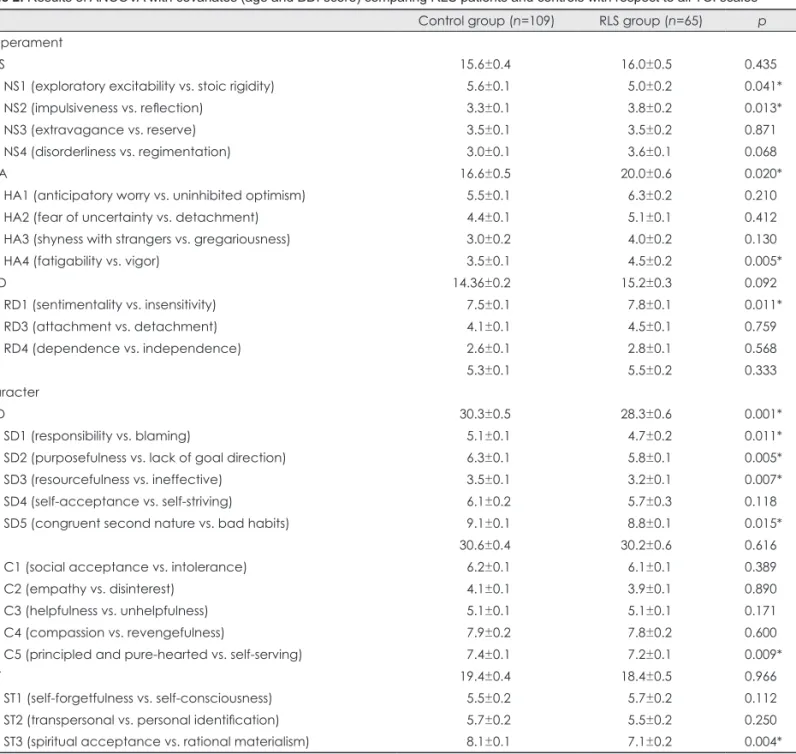
ANCOVA analysis of temperament dimensions revealed that RLS patients had significantly higher HA scores for the main dimensions (p=0.02). Subdimension analysis revealed that H4 and RD1 scores were also significantly higher in the RLS group than in the control group (p=0.005 and 0.011, re- spectively). The only significant differences in NS between the groups (p=0.435) were lower scores for the NS1 subdimension (p=0.041) and higher scores for the N2 subdimension (p=0.013) in the RLS group. Analysis of character dimensions revealed significantly lower scores for SD (p=0.001) as well as for four of the SD subdimensions (SD1, SD2, SD3, and SD5) in the RLS group (p=0.011, 0.005, 0.007, and 0.015, respectively).
The only other character dimensions that differed significantly between the groups were the C5 and ST3 subdimensions (p=0.009 and 0.004, respectively). The results of the TCI analy- ses are summarized in Table 2.
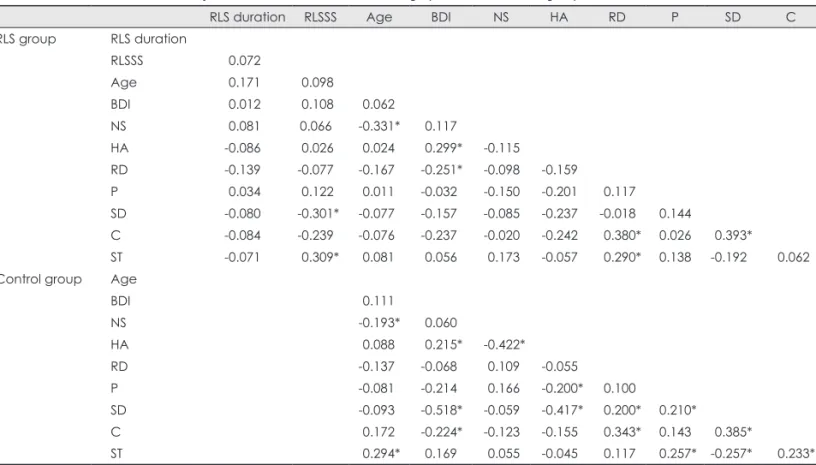
Correlation analyses revealed that the severity of RLS was negatively correlated with SD (p=0.015) and positively corre- lated with ST (p=0.012), but was not correlated with any of the temperament dimensions, including HA. Duration of RLS was also not significantly correlated with any of the main di- mensions. No significant correlation was detected between BDI score and the severity or duration of RLS. BDI in RLS patients was positively correlated with HA (p=0.015) and neg- atively correlated with RD (p=0.043, respectively), and in the control group it was positively correlated with HA (p=0.025) and negatively correlated with SD (p=0.000) and C (p=0.019).
The results of correlation analyses of the clinical demographic features and TCI dimensions are summarized in Table 3.
Detailed correlation analysis of IRLS scale items with scores of the BDI and the main dimensions of the TCI main di- mensions revealed that BDI score was not correlated with the
scores for any of the IRLS items. In terms of TCI dimensions, SD was negatively correlated with scores for items 2 (the need to move the extremities; p=0.022) and 4 (sleep disturbances;
p=0.002). ST was positively correlated with items 5 (fatigue and daytime sleepiness; p=0.002), 8 (duration of RLS symp- toms over 24 hours; p=0.006), 9 (effect on daily activities;
p=0.009), and 10 (effect on mood disturbances; p=0.020). The results of correlation analysis of scores for IRLS items with BDI and TCI dimensions are summarized in Table 4.
Discussion
This is the first study to document the temperament and char- acter features of RLS patients using the TCI. The results from this cross-sectional, case–control study indicate that patients with RLS have higher HA temperament and lower SD charac- ter scores than control subjects. To the best of our knowledge, the first and only study of personality features of RLS patients was conducted by Kalaydjian et al.,14 who assessed personality by using the Neuroticism-Extraversion-Openness (NEO) Per- sonality Inventory and reported that individuals with RLS had higher neuroticism scores than the controls. It is well docu- mented that neuroticism is strongly and positively correlated with HA and negatively correlated with SD, although these are clinically and etiologically different entities.24 Our findings of high HA and low SD scores in RLS patients are therefore con- sistent with the finding of high neuroticism scores in RLS pa- tients. We also found that RLS patients had high scores for the NS2 (impulsiveness) subdimension, which is included in neu- roticism in the NEO Personality Inventory.
As noted by Cloninger et al.15 individuals with a high HA temperament score exhibit avoidant behavior toward negative signals and punishments, and tend to be cautious, apprehen- sive, passive, and pessimistic, even in situations that do not normally worry most people. Individuals with a low SD char- acter are typically unable to control aversive situations and overcome obstacles in the absence of direction by a leader, easily lose their goals, and tend to blame others and the envi- ronment for their problems.15 In the literature, high HA tem-
Table 1. Clinical and demographic features of the participants
Control group (n=109) RLS group (n=65) p
Age (years) 47.9±10.8 49.9±9.9 0.236
Sex (females/males) 74/35 49/16 0.380
Education (years) 10.6±2.9 10.4±3.0 0.435
BDI score 9.2±7.8 12.4±9.0 0.013*
IRLS score - 22.9±7.8
RLS duration (years) - 8.0±7.5
The data are presented as mean±standard deviation values.
*Significant difference across groups, p<0.05.
BDI: Beck Depression Inventory, IRLS: International Restless Legs Syndrome Severity Scale, RLS: restless legs syndrome.
perament scores and low SD character scores have consistent- ly been reported in psychiatric patients, and especially those with depressive disorders.25 The results of many studies have led to HA being regarded as a marker of emotional vulnerabil- ity to depression and SD as a marker of executive function that protects a person from depression.3 Epidemiological and case–control studies have found a high prevalence and co-oc- currence of depressive disorders in RLS.13,26,27 Although the na- ture of this association remains unclear, various authors have suggested that clinical RLS symptoms such as pain, restless- ness, and insomnia induce the development of depression. Al-
ternatively, a shared underlying pathology such as dopamine deficiency may be another possible explanation.13 Gupta et al.28 very recently examined the prevalence of depression in RLS and reported a high current prevalence of depression without any significant impact on associated depression of RLS-related factors including duration and disease severity.
They suggested that RLS causes distress but is not able to in- duce clinical depression, or that it induces depression in bio- logically predisposed subjects in particular. Although the pres- ent study excluded subjects with current psychiatric disorders including depression, the BDI scores were significantly higher
Table 2. Results of ANCOVA with covariates (age and BDI score) comparing RLS patients and controls with respect to all TCI scales Control group (n=109) RLS group (n=65) p Temperament
NS 15.6±0.4 16.0±0.5 0.435
NS1 (exploratory excitability vs. stoic rigidity) 5.6±0.1 5.0±0.2 0.041*
NS2 (impulsiveness vs. reflection) 3.3±0.1 3.8±0.2 0.013*
NS3 (extravagance vs. reserve) 3.5±0.1 3.5±0.2 0.871
NS4 (disorderliness vs. regimentation) 3.0±0.1 3.6±0.1 0.068
HA 16.6±0.5 20.0±0.6 0.020*
HA1 (anticipatory worry vs. uninhibited optimism) 5.5±0.1 6.3±0.2 0.210
HA2 (fear of uncertainty vs. detachment) 4.4±0.1 5.1±0.1 0.412
HA3 (shyness with strangers vs. gregariousness) 3.0±0.2 4.0±0.2 0.130
HA4 (fatigability vs. vigor) 3.5±0.1 4.5±0.2 0.005*
RD 14.36±0.2 15.2±0.3 0.092
RD1 (sentimentality vs. insensitivity) 7.5±0.1 7.8±0.1 0.011*
RD3 (attachment vs. detachment) 4.1±0.1 4.5±0.1 0.759
RD4 (dependence vs. independence) 2.6±0.1 2.8±0.1 0.568
P 5.3±0.1 5.5±0.2 0.333
Character
SD 30.3±0.5 28.3±0.6 0.001*
SD1 (responsibility vs. blaming) 5.1±0.1 4.7±0.2 0.011*
SD2 (purposefulness vs. lack of goal direction) 6.3±0.1 5.8±0.1 0.005*
SD3 (resourcefulness vs. ineffective) 3.5±0.1 3.2±0.1 0.007*
SD4 (self-acceptance vs. self-striving) 6.1±0.2 5.7±0.3 0.118
SD5 (congruent second nature vs. bad habits) 9.1±0.1 8.8±0.1 0.015*
C 30.6±0.4 30.2±0.6 0.616
C1 (social acceptance vs. intolerance) 6.2±0.1 6.1±0.1 0.389
C2 (empathy vs. disinterest) 4.1±0.1 3.9±0.1 0.890
C3 (helpfulness vs. unhelpfulness) 5.1±0.1 5.1±0.1 0.171
C4 (compassion vs. revengefulness) 7.9±0.2 7.8±0.2 0.600
C5 (principled and pure-hearted vs. self-serving) 7.4±0.1 7.2±0.1 0.009*
ST 19.4±0.4 18.4±0.5 0.966
ST1 (self-forgetfulness vs. self-consciousness) 5.5±0.2 5.7±0.2 0.112
ST2 (transpersonal vs. personal identification) 5.7±0.2 5.5±0.2 0.250
ST3 (spiritual acceptance vs. rational materialism) 8.1±0.1 7.1±0.2 0.004*
The data are presented as mean±standard deviation values.
*Significant difference across groups, p<0.05.
ANCOVA: analysis of covariance, BDI: Beck Depression Inventory, C: cooperativeness, HA: harm avoidance, NS: novelty seeking, P:
persistence, RD: reward dependence, RLS: restless legs syndrome, SD: self-directedness, ST: self-transcendence, TCI: Temperament and Character Inventory.
in the RLS patients than in the controls. The correlation analy- sis revealed that the BDI score was not correlated with any of the RLS-related factors such as severity, duration, and symp- toms on the IRLS, but was positively correlated with HA. Our results concur with the conclusion drawn by Gupta et al.28 that RLS patients have depressive symptoms that are probably due to shared neurobiological mechanisms, rather than being pri- marily due to the severity and duration of RLS.
Explaining the association between HA and RLS with “neu- robiological data” obtained from the TCI appears to be diffi- cult since HA is thought to be related to dysfunction of seroto- nergic activity, while dopaminergic dysfunction is the main reported mechanism underlying RLS. However, there is still no common consensus in the literature regarding the relation- ship between serotonin and HA.29-32 Recent neuroimaging stud- ies have indicated that the relationship between serotonin and Table 3. Results of correlation analysis between the clinical and demographic features of the groups and the main dimensions of the TCI
RLS duration RLSSS Age BDI NS HA RD P SD C
RLS group RLS duration
RLSSS 0.072
Age 0.171 0.098
BDI 0.012 0.108 0.062
NS 0.081 0.066 -0.331* 0.117
HA -0.086 0.026 0.024 0.299* -0.115
RD -0.139 -0.077 -0.167 -0.251* -0.098 -0.159
P 0.034 0.122 0.011 -0.032 -0.150 -0.201 0.117
SD -0.080 -0.301* -0.077 -0.157 -0.085 -0.237 -0.018 0.144
C -0.084 -0.239 -0.076 -0.237 -0.020 -0.242 0.380* 0.026 0.393*
ST -0.071 0.309* 0.081 0.056 0.173 -0.057 0.290* 0.138 -0.192 0.062
Control group Age
BDI 0.111
NS -0.193* 0.060
HA 0.088 0.215* -0.422*
RD -0.137 -0.068 0.109 -0.055
P -0.081 -0.214 0.166 -0.200* 0.100
SD -0.093 -0.518* -0.059 -0.417* 0.200* 0.210*
C 0.172 -0.224* -0.123 -0.155 0.343* 0.143 0.385*
ST 0.294* 0.169 0.055 -0.045 0.117 0.257* -0.257* 0.233*
*Significant difference across groups, p<0.05.
BDI: Beck Depression Inventory, C: cooperativeness, HA: harm avoidance, NS: novelty seeking, P: persistence, RD: reward depen- dence, RLS: restless legs syndrome, RLSSS: RLS symptom severity, SD: self-directedness, ST: self-transcendence, TCI: Temperament and Character Inventory.
Table 4. Results of correlation analysis between scores for items on the IRLS, and scores for the BDI and the TCI dimensions in RLS pa- tients
BDI NS HA RD P SD C ST
IRLS item
Q1: discomfort in extremities 0.056 0.128 -0.010 -0.020 0.192 -0.243 -0.195 0.222
Q2: need to move the extremities 0.055 0.129 -0.111 -0.062 0.159 -0.285* -0.159 0.240
Q3: relieved by movement -0.020 -0.058 0.011 0.001 0.054 0.002 0.157 -0.051
Q4: sleep disturbances -0.013 -0.068 0.101 -0.011 0.200 -0.375* -0.174 -0.199
Q5: fatigue and daytime sleepiness -0.193 0.007 0.019 0.197 0.055 -0.012 0.039 0.380*
Q6: severity as a whole -0.031 0.178 -0.053 -0.042 0.233 -0.147 -0.088 0.211
Q7: frequency of symptoms -0.010 0.089 0.105 -0.066 0.076 -0.114 -0.191 0.214
Q8: duration over 24 hours -0.003 0.108 0.044 -0.053 0.052 -0.220 -0.239 0.336*
Q9: effect on daily activities 0.048 0.158 0.092 0.018 0.031 -0.235 -0.123 0.322*
Q10: effect on mood disturbances 0.056 0.124 0.239 -0.028 0.030 -0.071 -0.164 0.289*
*Significant difference across groups, p<0.05.
BDI: Beck Depression Inventory, C: cooperativeness, HA: harm avoidance, IRLS: International Restless Legs Syndrome Severity Scale, NS: novelty seeking, p: persistence, RD: reward dependence, RLS: Restless legs syndrome, SD: self-directedness, ST: self-transcen- dence, TCI: Temperament and Character Inventory.
HA is not direct, as originally thought by Cloninger,16 and that the HA dimension may be correlated with the balance of a complex neurotransmitter network including dopamine.33,34 There is also little information available about serotonergic ac- tivity in RLS. It has been suggested that serotonin acts through several serotonin receptor subtypes in the brain, to either facil- itate or inhibit dopaminergic activity.35 Furthermore, evidence from population and case–control studies and from case re- ports indicates that serotonin reuptake inhibitors may induce and aggravate RLS symptoms, or in contrast may relieve such symptoms.36 Jhoo et al.37 recently investigated the availability of serotonin transporters in the pons and the medulla of pa- tients with RLS and healthy controls, and found no difference between these two groups except for a negative correlation be- tween serotonin transporters availability and the severity of RLS symptoms. Therefore, considering the current level of evidence in the literature, possible direct or indirect involve- ment of serotonergic dysfunction in RLS cannot be ruled out.
Correlation analysis also revealed that character dimensions were correlated with the severity of RLS. Detailed analysis of the IRLS findings revealed that the correlation between SD and RLS was restricted to certain symptoms due to RLS such as “need to move extremities” and “sleep disturbances due to RLS.” We interpreted these results as a state effect of some RLS symptoms on SD. An alternative explanation is that be- ing less self-directed may predispose the RLS patients to a more severe disease state. A correlation between ST and many of the items on the IRLS scale and RLS severity was a partic- ularly interesting finding of the present study, since a high lev- el of ST was not a prominent characteristic in RLS patients. ST scores are well known to be high in debilitating chronic dis- eases.38 It is assumed that ST represents the way in which indi- viduals adapt to disease to achieve psychological well-being, although the disease itself is not actually relieved.39 This may also apply to RLS patients who cope better with severe RLS symptoms.
Using the TCI to assess the personality features of RLS pa- tients also allowed us to compare the personality features of two dopamine-related diseases: PD and RLS. Although the pathophysiology of RLS is unclear, the finding that RLS symptoms can be relieved by dopamine agonists and exacer- bated by dopamine antagonists suggests that dopaminergic dysfunction plays a central role in the pathophysiology of RLS.40 It is well documented that dopamine also occupies a central role in the pathogenesis of PD, which is characterized by dopaminergic neuron loss in various brain regions. Clon- inger’s personality model and its links to psychobiology have been extensively investigated in PD, with most studies finding lower NS scores and higher HA scores in PD patients than in healthy controls.4,41 We conclude from the findings of our
study that the personality features of RLS are quite different from Parkinsonian personality features since the NS scores of our RLS patients did not differ significantly from those of the controls. The lower NS1 score in RLS patients compared to scores in controls may be associated with reduced dopaminer- gic activity. On the contrary, the higher NS2 scores in RLS pa- tients compared to the controls were highly significant, and may indicate increased dopaminergic activity rather than do- paminergic deficiency. This controversy is also found in patho- genesis of RLS. As recently reviewed by Salas et al.42 unlike PD, RLS may be a hyperdopaminergic condition with an ap- parent postsynaptic desensitization. Differences in the person- ality features of RLS and PD patients can be considered as further evidence for a difference in pathophysiologies, despite the presence of shared dopaminergic insufficiency.
This study was subject to two main limitations. One that might directly interfere with the main outcome of the study is the exclusion of RLS patients with psychiatric disorders, in- cluding depression. It may have been possible to obtain more direct data about the association between these two entities if RLS patients experiencing current depression had not been excluded from the study, and it might then have been possible to better evaluate their intercorrelations. The second limitation is the cross-sectional design, which makes it difficult to draw conclusions concerning the causal relationships between per- sonality features, RLS, and depressive symptoms. However, the current design did allow us to investigate the personality features of RLS patients and to identify the impact of HA tem- perament on RLS.
In conclusion, this is the first study to demonstrate the tem- perament and character profiles of RLS patients using the TCI.
High HA and low SD scores were the prominent personality features of patients with RLS. The present results highlight the importance of awareness of the personality features of RLS patients, a dimension that has rarely been considered to date, but that is potentially important for understanding the patho- physiology and management of this clinical entity. These re- sults also have the potential to contribute new evidence to the knowledge regarding the possible developmental mechanisms underlying the depressive disorders commonly associated with RLS. The neurobiological bases of the TCI may help to clarify the possible pathophysiological links between RLS, specific personality features, and depressive disturbances.
Conflicts of Interest
The authors have no financial conflicts of interest.
REFERENCES
1. Smith TW, MacKenzie J. Personality and risk of physical illness.
Annu Rev Clin Psychol 2006;2:435-467.
2. Bagby RM, Ryder AG. Personality and the affective disorders: past
efforts, current models, and future directions. Curr Psychiatry Rep 2000;2:465-472.
3. Cloninger CR, Svrakic DM, Przybeck TR. Can personality assess- ment predict future depression? A twelve-month follow-up of 631 subjects. J Affect Disord 2006;92:35-44.
4. Poletti M, Bonuccelli U. Personality traits in patients with Parkin- son’s disease: assessment and clinical implications. J Neurol 2012;
259:1029-1038.
5. Boz C, Velioglu S, Ozmenoglu M, Sayar K, Alioglu Z, Yalman B, et al. Temperament and character profiles of patients with tension-type headache and migraine. Psychiatry Clin Neurosci 2004;58:536-543.
6. Conrad R, Schilling G, Bausch C, Nadstawek J, Wartenberg HC, Wegener I, et al. Temperament and character personality profiles and personality disorders in chronic pain patients. Pain 2007;133:197-209.
7. Yazici E, Yazici AB, Aydin N, Orhan A, Kirpinar I, Acemoglu H.
Temperament and character traits in patients with epilepsy: epileptic personality. J Nerv Ment Dis 2013;201:365-370.
8. Cloninger CR. The science of well-being: an integrated approach to mental health and its disorders. World Psychiatry 2006;5:71-76.
9. Kampman O, Poutanen O, Illi A, Setälä-Soikkeli E, Viikki M, Nuoli- virta T, et al. Temperament profiles, major depression, and response to treatment with SSRIs in psychiatric outpatients. Eur Psychiatry 2012;27:245-249.
10. Ohayon MM, O’Hara R, Vitiello MV. Epidemiology of restless legs syndrome: a synthesis of the literature. Sleep Med Rev 2012;16:283- 295.
11. Allen RP, Walters AS, Montplaisir J, Hening W, Myers A, Bell TJ, et al. Restless legs syndrome prevalence and impact: REST general population study. Arch Intern Med 2005;165:1286-1292.
12. Sevim S, Dogu O, Kaleagasi H, Aral M, Metin O, Camdeviren H.
Correlation of anxiety and depression symptoms in patients with restless legs syndrome: a population based survey. J Neurol Neuro- surg Psychiatry 2004;75:226-230.
13. Lee HB, Hening WA, Allen RP, Kalaydjian AE, Earley CJ, Eaton WW, et al. Restless legs syndrome is associated with DSM-IV major depressive disorder and panic disorder in the community. J Neuro- psychiatry Clin Neurosci 2008;20:101-105.
14. Kalaydjian A, Bienvenu OJ, Hening WA, Allen RP, Eaton WW, Lee HB. Restless Legs Syndrome and the five-factor model of personali- ty: results from a community sample. Sleep Med 2009;10:672-675.
15. Cloninger CR, Svrakic DM, Przybeck TR. A psychobiological model of temperament and character. Arch Gen Psychiatry 1993;50:975- 16. Cloninger CR. A systematic method for clinical description and clas-990.
sification of personality variants. A proposal. Arch Gen Psychiatry 1987;44:573-588.
17. Gillespie NA, Cloninger CR, Heath AC, Martina NG. The genetic and environmental relationship between Cloninger’s dimensions of temperament and character. Pers Individ Dif 2003;35:1931-1946.
18. Beck AT, Ward CH, Mendelson M, Mock J, Erbaugh J. An inventory for measuring depression. Arch Gen Psychiatry 1961;4:561-571.
19. Hisli N. Beck Depresyon Envanteri’nin üniversite öğrencileri ic¸in gec¸erliği, güvenirliği. Psikoloji Dergisi 1989;7:3-13.
20. Allen RP, Picchietti D, Hening WA, Trenkwalder C, Walters AS, Montplaisi J, et al. Restless legs syndrome: diagnostic criteria, spe- cial considerations, and epidemiology. A report from the restless legs syndrome diagnosis and epidemiology workshop at the National In- stitutes of Health. Sleep Med 2003;4:101-119.
21. Walters AS, LeBrocq C, Dhar A, Hening W, Rosen R, Allen RP, et al.
Validation of the International Restless Legs Syndrome Study Group rating scale for restless legs syndrome. Sleep Med 2003;4:121-132.
22. Kose S, Sayar K, Kalelioglu U, Aydin N, Celikel FC, Gulec H, et al.
Normative data and factorial structure of the Turkish version of the
Temperament and Character Inventory. Compr Psychiatry 2009;50:
361-368.
23. Trouillet R, Gana K. Age differences in temperament, character and depressive mood: a cross-sectional study. Clin Psychol Psychother 2008;15:266-275.
24. De Fruyt F, Van De Wiele L, Van Heeringen C. Cloninger’s psycho- biological model of temperament and character and the five-factor model of personality. Pers Individ Dif 2000;29:441-452.
25. Mochcovitch MD, Nardi AE, Cardoso A. Temperament and charac- ter dimensions and their relationship to major depression and panic disorder. Rev Bras Psiquiatr 2012;34:342-351.
26. Kim WH, Kim BS, Kim SK, Chang SM, Lee DW, Cho MJ, et al.
Restless legs syndrome in older people: a community-based study on its prevalence and association with major depressive disorder in older Korean adults. Int J Geriatr Psychiatry 2012;27:565-572.
27. Li Y, Mirzaei F, O’Reilly EJ, Winkelman J, Malhotra A, Okereke OI, et al. Prospective study of restless legs syndrome and risk of depres- sion in women. Am J Epidemiol 2012;176:279-288.
28. Gupta R, Lahan V, Goel D. A study examining depression in restless legs syndrome. Asian J Psychiatr 2013;6:308-312.
29. Sugiura M, Kawashima R, Nakagawa M, Okada K, Sato T, Goto R, et al. Correlation between human personality and neural activity in cerebral cortex. Neuroimage 2000;11(5 Pt 1):541-546.
30. Moresco FM, Dieci M, Vita A, Messa C, Gobbo C, Galli L, et al. In vivo serotonin 5HT(2A) receptor binding and personality traits in healthy subjects: a positron emission tomography study. Neuroimage 2002;17:1470-1478.
31. Karlsson H, Hirvonen J, Salminen JK, Hietala J. No association be- tween serotonin 5-HT 1A receptors and spirituality among patients with major depressive disorders or healthy volunteers. Mol Psychia- try 2011;16:282-285.
32. Tuominen L, Salo J, Hirvonen J, Någren K, Laine P, Melartin T, et al.
Temperament, character and serotonin activity in the human brain: a positron emission tomography study based on a general population cohort. Psychol Med 2013;43:881-894.
33. Yasuno F, Suhara T, Sudo Y, Yamamoto M, Inoue M, Okubo Y, et al.
Relation among dopamine D(2) receptor binding, obesity and per- sonality in normal human subjects. Neurosci Lett 2001;300:59-61.
34. Kim JH, Son YD, Kim HK, Lee SY, Cho SE, Kim YB, et al. Associ- ation of harm avoidance with dopamine D2/3 receptor availability in striatal subdivisions: a high resolution PET study. Biol Psychol 2011;
87:164-167.
35. Alex KD, Pehek EA. Pharmacologic mechanisms of serotonergic regulation of dopamine neurotransmission. Pharmacol Ther 2007;113:
296-320.
36. Bayard M, Bailey B, Acharya D, Ambreen F, Duggal S, Kaur T, et al.
Bupropion and restless legs syndrome: a randomized controlled trial.
J Am Board Fam Med 2011;24:422-428.
37. Jhoo JH, Yoon IY, Kim YK, Chung S, Kim JM, Lee SB, et al. Avail- ability of brain serotonin transporters in patients with restless legs syndrome. Neurology 2010;74:513-518.
38. Iwamoto R, Yamawaki N, Sato T. Increased self-transcendence in patients with intractable diseases. Psychiatry Clin Neurosci 2011;65:
638-647.
39. Cloninger CR, Zohar AH. Personality and the perception of health and happiness. J Affect Disord 2011;128:24-32.
40. Winkelman JW. Considering the causes of RLS. Eur J Neurol 2006;13 Suppl 3:8-14.
41. Tomer R, Aharon-Peretz J. Novelty seeking and harm avoidance in Parkinson’s disease: effects of asymmetric dopamine deficiency. J Neurol Neurosurg Psychiatry 2004;75:972-975.
42. Salas RE, Gamaldo CE, Allen RP. Update in restless legs syndrome.
Curr Opin Neurol 2010;23:401-406.