제 5 회 첨단 사이언스 교육 허브 개발(EDISON) 경진대회
- 87 -
Strain Dependence of Adsorption Energy of Single Layer MoS2: Possibility of Catalytic Usage
전부경*, 이창희
물리천문학부, 서울대학교, 서울특별시 관악구 관악로 151-742 E-mail: [email protected]
It is shown that the maximum value of exchange current is obtained where hydrogen adsorption energy is near 0. This enables to estimate catalytic efficiency of a material with hydrogen adsorption energy, which is relatively easier to calculate with density fuctional theory (DFT) method. Strain dependence of the adsorption energy was studied with DFT method and adsorption energy of 0.04 eV per hydrogen atom is obtained at 30% strain.
서론
Sabatier Principle에 따른 volcanic relation의 교환전류의 최대값은 근사적으로 수소 흡착에너지 가 0이 될 때 얻어짐이 밝혀진 바 있다. [1][2] 따 라서 상대적으로 계산하기 쉬운 수소 흡착에너지 를 사용하여 촉매 효율을 추정할 수 있다. 수소 흡착 에너지는 Density functional theory (DFT) method를 사용해 계산 할 수 있다. [3]
이 논문에서는 MoS2의 수소 흡착률이 strain과 황을 대신하는 산소 불순물에 따라 어떻게 변하는 지 연구하였다.
Strain이 없는 경우 MoS2의 수소 흡착에너지를 계산해 본 결과 3x3 Supercell에 대해 1.47 eV/(Hydrogen atom)임을 확인 할 수 있었다. 따 라서 Strain을 가하여 수소 흡착에너지를 0에 가까 운 값으로 만들어 촉매효율을 높이고자 하였다.
수소의 결합에너지를 높여야 하기 때문에 원소를 치환하는 경우, 황 대신 수소와의 결합 에너지가 더 높은 산소를 이용하는 것이 요구된다.
계산 방법
수소의 흡착 에너지는 다음과 같은 공식으로 나타내어 진다.
는 각각 수소가 흡착된 물 질의 total energy, 수소가 흡착되지 않은 물질의 total energy, 수소분자의 bonding energy이며, 는 zero point energy이다.
본 연구에서 와 의 값으로는 각각 와 를 사용 하였다. , , 는 모두 SIESTA method를 기반으로 한 DFT 소프트웨어 LCAODFTLab ver. 2.0을 사용 하여 계산하였다. [4]
MoS2 한 층의 격자 단위벡터는 서로 120 º의 각도를 이루고 있으며 크기는 실험적으로 3.16 Å 임이 확인되었다. [5] S는 Mo로부터 층 평면상에 서는 두 격자 단위벡터의 합의 3분지 1 지점에 위 치하고 있으며, inter-layer 방향으로 1.5 Å 떨어진 곳에 대칭적으로 두 개가 분포해 있다. 각 층은 van der Waals 힘으로 결합하고 있다. [6]
이 소프트웨어는 총 에너지를 최소로 하는 Unitcell 내의 원자 위치의 최적값을 구하는 Optimization 기능을 제공하고 있으나 이 기능은 MoS2에 수소가 흡착되는 거리를 찾기에는 적합하 지 않다. 이는 Optimization의 첫번째 Iteration에 사용될 구조에 수소와 황 사이의 거리를 3 Å으로 하는 경우, 3.5 Å으로 하는 경우, 4 Å으로 하는 경우에 각각 Optimization 후의 거리가 3.02 Å, 3.49 Å, 3.97 Å으로 사실상 변화 없이 유지되는 것으로부터 확인할 수 있다. 따라서 본 연구에서 는 수소와 황 사이의 거리에 따른 흡착 에너지 그 래프를 그려 그래프의 최소값을 물질의 흡착 에너 지로 결정하는 방식을 사용하였다. Single Point 기능을 사용하였으며, K-point sampling은 10 x 10 x 1 grid를 사용하였다.
Strain은 층의 평면 상에서 등방적으로 가하였 으며, 5%, 10%, 15%의 Strain에 대하여 계산을 수 행하였다.
결과 및 논의
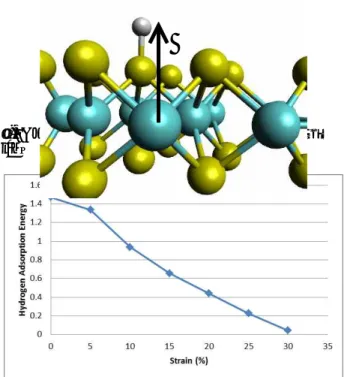
Fig. 1은 다양한 Strain 값에 대해 거리에 대한 흡착에너지 그래프를 그린 것이다. Strain 값이 커 짐에 따라 흡착 에너지가 작아지는 것을 확인 할 수 있다. x축은 Mo가 위치한 평면으로부터의 층 에 수직한 방향으로의 거리이며, 수소와 황과의 거리는 이 값에서 1.5 Å을 뺀 값과 같다. Fig. 3은 Strain 값에 따른 흡착 에너지의 그래프이다. y축 의 값은 Fig. 1의 그래프에서 3 Å 근방에 위치한 최소값에 해당한다. 여기서 약 30%의 Strain을 가 했을 때 수소 흡착에너지가 근사적으로 0이 되는 것을 확인 할 수 있다.
355
- 88 - Fig. 1. Hydrogen Adsorpsion energy of MoS2 plotted over distance from the Mo plane to the hydrogen for various strain values.
Fig. 2. Hydrogen Adsorbed on MoS2 at 3 Å from the Mo plane
Fig. 3. Strain dependence of hydrogen adsorption energy
결론
Strain 값에 따른 MoS2의 수소 흡착에너지를 계 산 하였다. Strain 값이 커짐에 따라 MoS2의 수소 흡착에너지는 작아진다. 충분한 촉매 효율을 얻기 위해서는 수소 흡착에너지가 -0.2~0.2 eV 구간에 포함되어야 하는데, Strain 값이 30% 일 때 0.04 eV/(Hydrogen atom)으로 이 조건을 만족시킴을 확인하였다.
ACKNOWLEDGEMENT(또는 감사의 글) 본 논문은 2015년도 정부(미래창조과학부)의 재 원으로 한국연구재단 첨단 사이언스·교육 허브 개
발 사업의 지원을 받아 수행된 연구임
(2012M3C1A6035302)
참고문헌
[1] R. Parsons, “The rate of electrolytic hydrogen evolution and the heat of adsorption of hydrogen”, Transactions of the Faraday Society 54 (1958)
[2] J. K. Norskov et al. “Trend in the Exchange Current for Hydrogen Evolution”, Journal of The Electrochemical Society 152, J23-J26 (2005)
[3] I. A. Pasti et al. “Hydrogen Adsorption on Palladium and Platinum Overlayers: DFT
Study”, Advances in Physical Society (2011) [4] J. M. Soler, “The Siesta method for ab initio
order-N materials simulation”, Journal of Physics: Condensed Matter (2002)
[5] T. K. Gupta, “Preparation and Characterization of Llayered Superconductors”, Physical Review B (1991) [6] P. A. Lee, “Physics and Chemistry of
Materials with layered structures: Optical and Electrical Properties”, Springer (1976)
[7] H. K. Lee et al. “Combinatorial Search for Optimal Hydrogen-Storage Nanomaterials Based on Polymers”, Physical Review Letters 97 (2006)
[8] N. Gracia-Araez, “Standard Adsorption Gibbs Energy for Hydrogen, OH, Chloride, and Sulfate on Pt(111): Comparison of Different Isotherms”, The Journal of Physical Chemistry C (2011)
r
356