제4회 첨단 사이언스 교육 허브 개발(EDISON) 나노물리 경진대회
First Principles Study of Mixed Inorganic-Organic Perovskites (HC(NH2)2PbI3- CH3NH3PbBr3) for Photovoltaic Applications
Min Jong Noh
Graduate School of EEWS, KAIST, 291 Daehak-ro, Yuseong-gu, Daejeon 305-701, Korea E-mail: [email protected]
To produce low cost and efficient photovoltaic cells, inorganic-organic lead halide perovskite materials appear promising for most suitable solar cells owing to their high power conversion efficiency. Most recent research showes that formamidinium lead iodide (FAPbI3) with methylammonium lead bromide (MAPbBr3) improves the power conversion efficiency of the solar cell to more than 18 per cent under a standard illumination because incorporated MAPbBr3 makes FAPbI3—relatively unstable but comparatively narrow band gap—more stable composition. In respect to first principle study, we investigated band gap of MAPbI3, FAPbI3, MAPbBr3, (FAPbI3)0.89-(MAPbBr3)0.11 and 0.615(eV), 0.466, 1.197, 0.518 respectively through EDISON DFT software. These results emphasize enhancing structure stability is important factor as well as finding narrow band gap.
INTRODUCTION
Dye-sensitized solar cells (DSSCs) are quite an interest in all over the world for its low cost, simple fabrication and high energy conversion efficiency properties. Besides engineering advantages, DSSCs also have distinct characteristics such as transparency, flexibility, colorful allowing practical applications. It is not an overstatement to say that DSSCs lead a solar cell market to next generation.
Recently, Perovskite materials integrated into DSSCs was reported by Miyasaka et al. in 2009.
Before, production generated only 3.8% power conversion efficiency (PCE) however, according to recent research it reaches 20% PCE allowing the possibility for perovskite solar cells to enter the market.
Specially, inorganic-organic lead halide perovskite materials composed of AMX3, where A is
an organic ammonium cation, M is Pb and X is a halide anion will show promising results.
By using (FAPbI3)0.85-(MAPbBr3)0.15 perovskite solar cell, world record in national renewable energy laboratory (NREL) has been changed.
This research confirmed that incorporation of MAPbBr3 into FAPbI3 stabilizes the perovskite phase of FAPbI3 and improves the power conversion efficiency compared to FAPbI3 or MAPbBr3 each.
Here, we investigate band gap of MAPbI3, FAPbI3, MAPbBr3, (FAPbI3)0.89-(MAPbBr3)0.11 respecitively, and identify that (FAPbI3)0.89-(MAPbBr3)0.11 material’s efficiency is related on band gap narrowing or structural stability.
CALCULATION METHODS
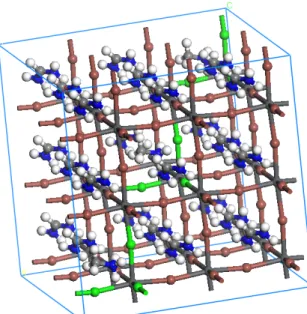
We study four perovskites as shown in Fig 1-4 using general gradient approximation (GGA – PBE) in LCAODFTLab of the EDISON Nano-physics that can calculate density functional theory (DFT).
87
- 92 - 제4회 EDISON 사업 SW활용 경진대회 및 성과전시회 | 나노물리
378
제4회 첨단 사이언스 교육 허브 개발(EDISON) 나노물리 경진대회
First Principles Study of Mixed Inorganic-Organic Perovskites (HC(NH2)2PbI3- CH3NH3PbBr3) for Photovoltaic Applications
Min Jong Noh
Graduate School of EEWS, KAIST, 291 Daehak-ro, Yuseong-gu, Daejeon 305-701, Korea E-mail: [email protected]
To produce low cost and efficient photovoltaic cells, inorganic-organic lead halide perovskite materials appear promising for most suitable solar cells owing to their high power conversion efficiency. Most recent research showes that formamidinium lead iodide (FAPbI3) with methylammonium lead bromide (MAPbBr3) improves the power conversion efficiency of the solar cell to more than 18 per cent under a standard illumination because incorporated MAPbBr3 makes FAPbI3—relatively unstable but comparatively narrow band gap—more stable composition. In respect to first principle study, we investigated band gap of MAPbI3, FAPbI3, MAPbBr3, (FAPbI3)0.89-(MAPbBr3)0.11 and 0.615(eV), 0.466, 1.197, 0.518 respectively through EDISON DFT software. These results emphasize enhancing structure stability is important factor as well as finding narrow band gap.
INTRODUCTION
Dye-sensitized solar cells (DSSCs) are quite an interest in all over the world for its low cost, simple fabrication and high energy conversion efficiency properties. Besides engineering advantages, DSSCs also have distinct characteristics such as transparency, flexibility, colorful allowing practical applications. It is not an overstatement to say that DSSCs lead a solar cell market to next generation.
Recently, Perovskite materials integrated into DSSCs was reported by Miyasaka et al. in 2009.
Before, production generated only 3.8% power conversion efficiency (PCE) however, according to recent research it reaches 20% PCE allowing the possibility for perovskite solar cells to enter the market.
Specially, inorganic-organic lead halide perovskite materials composed of AMX3, where A is
an organic ammonium cation, M is Pb and X is a halide anion will show promising results.
By using (FAPbI3)0.85-(MAPbBr3)0.15 perovskite solar cell, world record in national renewable energy laboratory (NREL) has been changed.
This research confirmed that incorporation of MAPbBr3 into FAPbI3 stabilizes the perovskite phase of FAPbI3 and improves the power conversion efficiency compared to FAPbI3 or MAPbBr3 each.
Here, we investigate band gap of MAPbI3, FAPbI3, MAPbBr3, (FAPbI3)0.89-(MAPbBr3)0.11 respecitively, and identify that (FAPbI3)0.89-(MAPbBr3)0.11 material’s efficiency is related on band gap narrowing or structural stability.
CALCULATION METHODS
We study four perovskites as shown in Fig 1-4 using general gradient approximation (GGA – PBE) in LCAODFTLab of the EDISON Nano-physics that can calculate density functional theory (DFT).
87
제4회 첨단 사이언스 교육 허브 개발(EDISON) 나노물리 경진대회
Fig. 40. methylammonium lead iodide
Fig. 41. Methylammonium lead bromide
Fig. 42. formamidinium lead iodide
Fig. 43. (FAPbI3)0.89 - (MAPbBr3)0.11
Cubic MAPbI3 MAPbBr3 FAPbI3
(FAPbI3)0.89 - (MAPbBr3)0.11
Å 6.3425 6.2355 6.4255 19.3485
Table 1. Cubic perovskites lattice constant
We have performed the total energy calculation to find the optimized unit-cell with changing lattice constant.
MAPbI3, MAPbBr3, FAPbI3 perovskite we tested a 5 × 5 × 5 Monkhorst−Pack grid but (FAPbI3)0.89 - (MAPbBr3)0.11 is tested by 1 × 1 × 1 Monkhorst
−Pack grid. These were performed with 25 / 200 Ry cutoffs.
RESULTS AND DISCUSSION
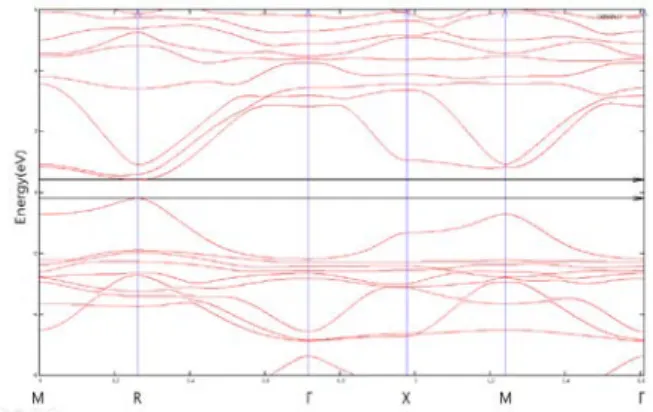
We have calculated band structure of 4 perovskites along the M → R → X → Г → M → Г. We obtained band gap at R point.
As previously mentioned, (FAPbI3)0.85- (MAPbBr3)0.15 material’s efficiency is higher than
88
- 93 -
제4회 EDISON 사업 SW활용 경진대회 및 성과전시회 | 나노물리
379
제4회 첨단 사이언스 교육 허브 개발(EDISON) 나노물리 경진대회
Fig. 44. methylammonium lead iodide band
Fig. 45. Methylammonium lead bromide band
Fig. 46. formamidinium lead iodide band
MAPbI3, MAPbBr3 or FAPbI3. Unfortunately, (FAPbI3)0.85-(MAPbBr3)0.15 model calculation wasn’t compatible due to EDISON software’s limit. Hence, we substituted the model from (FAPbI3)0.85- (MAPbBr3)0.15 to (FAPbI3)0.89-(MAPbBr3)0.11.
Fig. 8. (FAPbI3)0.89 - (MAPbBr3)0.11 band
Band
gap MAPbI3 MAPbBr3 FAPbI3
(FAPbI3)0.89 - (MAPbBr3)0.11
eV 0.615 1.197 0.466 0.518
Table 2. cubic perovskites band gap
Generally, reduced bandgap may allow absorption of photons over a broader solar spectrum. Focusing only on band gap, FAPbI3 shows high performance between samples. But experimental data doesn’t support former assumption.
CONCLUSION
We investigated band gaps of MAPbI3, MAPbBr3, FAPbI3 and (FAPbI3)0.89 - (MAPbBr3)0.11. We study that to achieve high performance perovskite solar cell, consider factors not only narrowing band gap but also such as phase stability, morphology of layer etc.
ACKNOWLEDGEMENT
Thank you for the opptunity to close simulation nano physics.
This research was supported by the EDISON Program through the National Research Foundation 89
- 94 - 제4회 EDISON 사업 SW활용 경진대회 및 성과전시회 | 나노물리
380
제4회 첨단 사이언스 교육 허브 개발(EDISON) 나노물리 경진대회
Fig. 44. methylammonium lead iodide band
Fig. 45. Methylammonium lead bromide band
Fig. 46. formamidinium lead iodide band
MAPbI3, MAPbBr3 or FAPbI3. Unfortunately, (FAPbI3)0.85-(MAPbBr3)0.15 model calculation wasn’t compatible due to EDISON software’s limit. Hence, we substituted the model from (FAPbI3)0.85- (MAPbBr3)0.15 to (FAPbI3)0.89-(MAPbBr3)0.11.
Fig. 8. (FAPbI3)0.89 - (MAPbBr3)0.11 band
Band
gap MAPbI3 MAPbBr3 FAPbI3
(FAPbI3)0.89 - (MAPbBr3)0.11
eV 0.615 1.197 0.466 0.518
Table 2. cubic perovskites band gap
Generally, reduced bandgap may allow absorption of photons over a broader solar spectrum. Focusing only on band gap, FAPbI3 shows high performance between samples. But experimental data doesn’t support former assumption.
CONCLUSION
We investigated band gaps of MAPbI3, MAPbBr3, FAPbI3 and (FAPbI3)0.89 - (MAPbBr3)0.11. We study that to achieve high performance perovskite solar cell, consider factors not only narrowing band gap but also such as phase stability, morphology of layer etc.
ACKNOWLEDGEMENT
Thank you for the opptunity to close simulation nano physics.
This research was supported by the EDISON Program through the National Research Foundation 89
제4회 첨단 사이언스 교육 허브 개발(EDISON) 나노물리 경진대회
of Korea(NRF) funded by the Ministry of Science, ICT & Future Planning (No. NRF-2012- M3C1A6035302)
REFERENCES
[1] E.Mosconi et al, J. Phys. Chem. C 2013, 117, 13902−13913
[2] A.amat et al, Nano Lett. 2014, 14, 3608−3616 [3] Y.H.Chang et al, Journal of the Korean Physical
Society, Vol. 44, No. 4, April 2004, pp. 889~893 [4] S.I.Seok et al, NATURE VOL 517 22 JANUARY
2015
90
- 95 -
제4회 EDISON 사업 SW활용 경진대회 및 성과전시회 | 나노물리
381