• 검색 결과가 없습니다.

Mycobacterium tuberculosis DNA Detection and Molecular Drug Susceptibility Test in AFB-stained Sputum Slides

N/A
N/A
Protected

Academic year: 2021

Share "Mycobacterium tuberculosis DNA Detection and Molecular Drug Susceptibility Test in AFB-stained Sputum Slides"

Copied!
5
0
0

로드 중.... (전체 텍스트 보기)

전체 글

(1)

Biomedical Science Letters 2016, 22(1): 24~28 http://dx.doi.org/10.15616/BSL.2016.22.1.24 eISSN : 2288-7415

Mycobacterium tuberculosis DNA Detection and Molecular Drug Susceptibility Test in AFB-stained Sputum Slides

Dongju Jung 1,3 , Hyeyoung Lee 2 and Sangjung Park 1,3,†

1

Department of Biomedical Laboratory Science, College of Life and Health Sciences, Hoseo University, Asan, Chungnam 31499, Korea

2

Department of Biomedical Laboratory Science, College of Health Sciences, Yonsei University, Wonju, Gangwon-do 26493, Korea

3

The Research Institute for Basic Science, Hoseo University, Asan, Chungman 31499, Korea

Tuberculosis (TB) remains an unsolved community health problem since identification of its causing microorganism called Mycobacterium tuberculosis (MTB) by Robert Koch in 1882. Annually, eight million TB cases are newly reported and 2~3 million patients die from TB. Pulmonary TB is highly infectious and untreated pulmonary TB patients are believed to infect >10 people in a year. The conventional methods for diagnosis of TB are chest X-ray and isolation of the causing microorganisms from patient specimens. Screening of TB is conducted with smeared sputum in slides, and TB is confirmed by identification of MTB in cultured specimens. One of the fatal pitfalls of screening detection for smeared sputum is that it is impossible to distinguish MTB and other acid-fast bacilli (AFB) because they are stained equally with Ziehl-Neelsen (ZN) stain. Culture of MTB is the most reliable method for diagnosis of TB but it takes 4~8 weeks. In this report, we suggest a fast and highly-reliable MTB detection method that distinguishes AFB in sputum samples. Purified DNA from the AFB stained slide samples offered by The Korean Institute of Tuberculosis were used to detect infected MTB in patients. PCR, real-time PCR and reverse blot hybridization assay (REBA) methods were applied to purified DNA. Conclusively, the real-time PCR method was confirmed to produce high sensitivity and we were able to further detect drug-resistant MTB with REBA.

Key Words: MTB, Molecular DST, PCR, Real-time PCR, REBA, Molecular diagnosis

RESULTS AND DISCUSSION

Tuberculosis (TB) remains an unsolved community health problem since identification of its causing microorganism called Mycobacterium tuberculosis (MTB) by Robert Koch in 1882. According to the World Health Organization (WHO) report there were eight million new TB cases and deaths of

two to three million patients by TB in a year. Forty thousand new TB cases and three thousand deaths occur in the Republic of Korea every year (Dye et al., 1999; Lew et al., 1995). Microscopic detection method for smeared sputum is a conventional method that detects acid-fast bacilli (AFB) using Ziehl-Neelsen (ZN) staining. However, it has low sensitivity: at least 5,000~10,000 AFB are required per ml for detection and is impossible to distinguish MTB from

Brief Communication

*

Received: March 22, 2016 / Revised: March 28, 2016 / Accepted: March 29, 2016

Corresponding author: Sangjung Park. Department of Biomedical Laboratory Science, College of Life and Health Sciences, Hoseo University, Asan, Chungnam 31499, Korea.

Tel: +82-41-540-9967, Fax: +82-41-540-9997, e-mail: [email protected]

C

The Korean Society for Biomedical Laboratory Sciences. All rights reserved.

CC

This is an Open Access article distributed under the terms of the Creative Commons Attribution Non-Commercial License (http://creativecommons.org/licenses/by-nc/3.0/) which

permits unrestricted non-commercial use, distribution, and reproduction in any medium, provided the original work is properly cited.

(2)

- 25 - other AFB, such as non-tuberculous mycobacteria (NTM) due to the same staining pattern (Bate, 1979; Kent and Kubica, 1985). In contrast to the screening method, culture of MTB has high sensitivity: as low as 1×10

1~2

bacilli in specimen can be detected but it takes 4~8 weeks (Tenover

et al., 1993; Woods, 2011). This allows opportunity for contamination by other bacterium and also renders the sample hard to detect for MTB using these time-consuming culture methods (Heo and Kim, 2013).

One of the difficulties for treating TB is drug resistance.

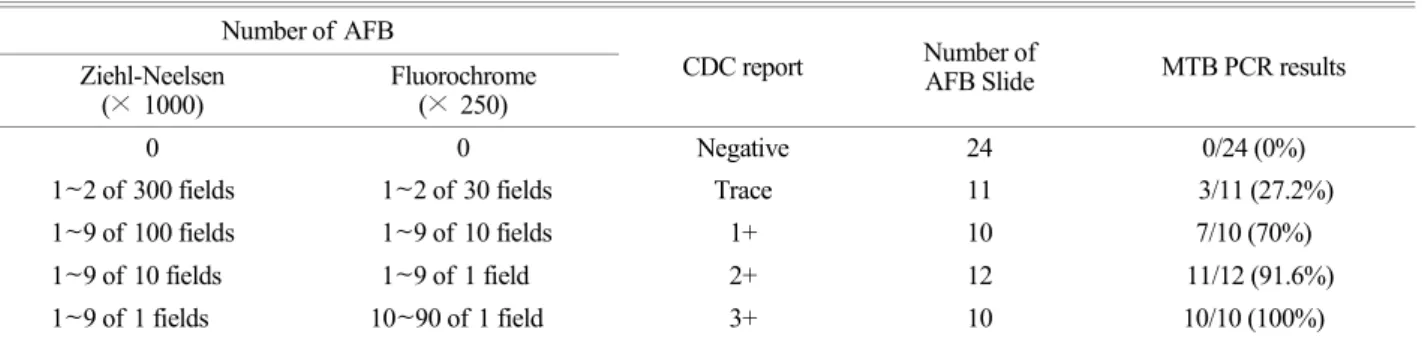
Table 1. MTB PCR results with AFB stained slides Number of AFB

CDC report Number of

AFB Slide MTB PCR results Ziehl-Neelsen

(× 1000)

Fluorochrome (× 250)

0 0 Negative 24 0/24 (0%)

1~2 of 300 fields 1~2 of 30 fields Trace 11 3/11 (27.2%)

1~9 of 100 fields 1~9 of 10 fields 1+ 10 7/10 (70%)

1~9 of 10 fields 1~9 of 1 field 2+ 12 11/12 (91.6%)

1~9 of 1 fields 10~90 of 1 field 3+ 10 10/10 (100%)

'Number of AFB' indicates number of stained bacteria under designated microscopic fields. 'CDC report' indicates categories defined by center for disease control USA. 'Number of AFB Slide' indicates stained sputum slides numbers used for PCR analyses. 'MTB PCR results' indicates positive percentage of MTB amplification.

Fig. 1. Real-time PCR for MTB detection in slide specimens.

For real-time PCR assays, the Real MTB-ID

®

kit using the multi-probe real-time PCR TaqMan

®

was employed and were conducted with CFX-96 real-time PCR system (Bio-Rad, USA).

For amplification, 10 μL of 2× Thunderbird probe qPCR mix (Toyobo, Japan), 3 μL of primer and TaqMan

®

probe mixture, 5 μL of template DNA, and 2 μL ddH

2

O were added into a PCR tube. FAM (fluorescein) and ROX

TM

dyes were applied to detect MTB DNA and Mycobacteria spp. (Myc), respectively.

Cy5 dye was the internal control for the real-time PCR reaction.

(3)

In Korea, it is estimated that more than half of MTB patients exhibit no clinical symptoms and TB patients who showed drug-resistance are increasing (Korean Institute of Tuber- culosis, 2009). Isoniazid (INH) and rifampin (RIF) are con- ventional antibiotics used for combinatorial therapy, but resistance toward these antibiotics is increasing. Therefore, selection of susceptible antibiotics is becoming important for early phase treatment of latent TB patients (Moore et al.,

1997; Frieden et al., 1993). For fast and accurate detection of TB and selection of antibiotics, current drug-susceptibility test (DST) for TB may not be adequate because it generally requires more than three weeks of culture (Quy et al., 2003).

Up to date, many researchers have reported DNA-based methods for TB detection and antibiotics selection, such as polymerase chain reaction (PCR) and real-time PCR (Bang et al., 2011; Cho et al., 2013; Lee et al., 2015). The DNA- based methods have produced quite comparable results with those from bacterial culture methods (Bang et al., 2011;

Gous et al., 2015; Munkhdelger et al., 2013; Pai and Schito, 2015).

Here we evaluated applicability of the DNA-based detec- tion methods toward sputum slides for detection of MTB DNA and confirmation of molecular DST. Sixty-seven slides provided by The Korean Institute of Tuberculosis were grouped based on their AFB staining results: 24 negative, 11 trace, 10 AFB 1+, 12 AFB 2+, and 10 AFB 3+ (Table 1).

DNA was purified from the slides using Trizol reagent following the manufacturer's protocol. Briefly, 200 μL of Trizol was dropped on the slides and was scraped into a tube twice. The purified DNA was used as template for PCR amplification of MTB-exclusive sequence (MTB amplicon) with MTB-ID v3

®

(M&D, Korea). There was no amplifi- cation of the MTB sequence in all of the AFB negative slides.

Among the 11 trace slides, three slides (27.2%) produced the MTB amplicon. The 32 slides of AFB 1+ and AFB 2+

produced 70% and 91.6% MTB amplicons, respectively.

All of the AFB 3+ slides produced 100% MTB amplicons (Table 1). Thus, production of the MTB amplicon and AFB positive score correlated well. To compensate the known drawbacks of conventional PCR methods, real-time PCR method called Real-time MTB-ID

®

(M&D, Korea) was applied to the same purified DNA. Both of the PCR and the real-time PCR methods amplified the same gene of the MTB. The real-time PCR method showed higher sensitivity:

there was no amplification in the AFB negative slides; all of the trace and AFB positive slides, regardless of positive intensity, produced a MTB-positive signal and the Myco- bacterium species (Myc) signal (Fig. 1). Next, the DNA samples were used to examine molecular antibiotic suscep- tibility with reverse blot hybridization assay (REBA) MTB- Fig. 2. REBA for detection of antibiotic resistant AFB in stained

slides. The REBA MTB-MDR

®

kit is composed of 13 probes for wild-type (WT) sequences, 6 probes for the mutated (MT) sequences known for isoniazid (INH) and rifampin (RIF) resistance, one probe for MTB and one probe for mycobacterial species (Myc). Hybrid- ization process between the PCR products that contain biotin at their 5' end and the probes immobilized on a membrane was carried out according to the manufacturer's instructions. Briefly, denatured PCR products in 2X SSPE (150 mM NaCl, 10 mM NaH

2

PO

4

, 1 mM EDTA), 0.1% SDS were incubated with REBA MTB-MDR membrane strips at 50℃ on a Mini-Incubation Tray (Bio-Rad) for 30 min. After washing twice with 2X SSPE, 0.5% SDS at 65℃

for 10 minute, the strips were incubated with streptavidin conju-

gated with alkaline phosphatase in 2X SSPE, 0.5% SDS at ambient

temperature, after which they were washed with 50 mM Tris · HCl

(pH 7.5), 150 mM NaCl. The hybridized amplicons carrying biotin

tag were detected by incubating the strips with nitro blue tetra-

zolium (NBT) and chloride and 5-bromo-4-chloro-3-indolyl phos-

phate (BCIP) in 100 mM Tris · HCl (pH 9.5), 100 mM NaCl, 50

mM MgCl

2

. (U: Unknown specimens, Rv: M. tuberculosis H37Rv)

(4)

- 27 -

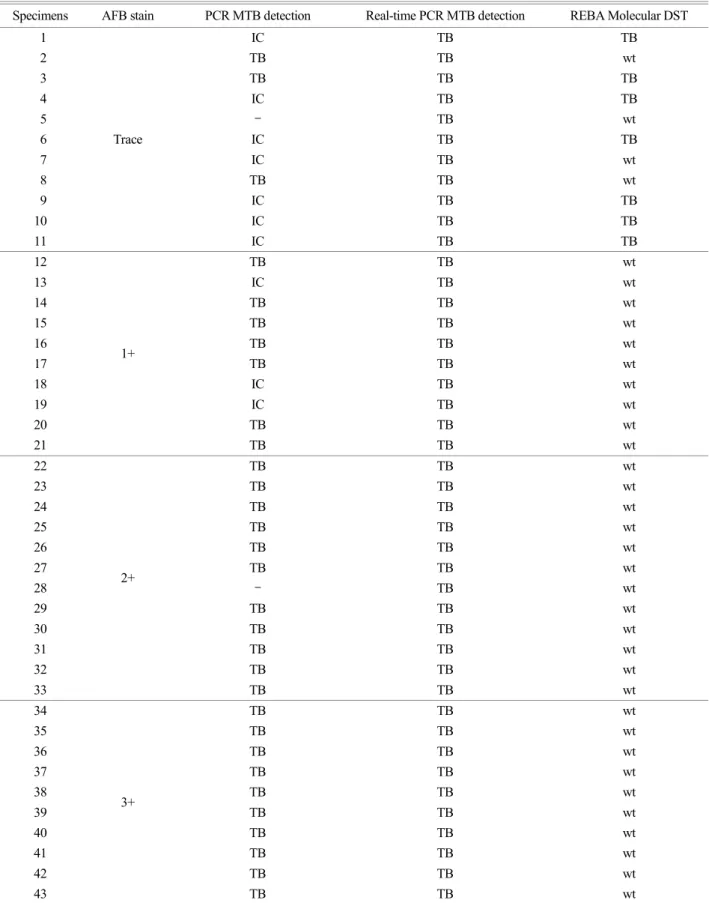
Table 2. The results of MTB detection and antibiotic resistance results from the AFB slide specimens using molecular diagnostic methods Specimens AFB stain PCR MTB detection Real-time PCR MTB detection REBA Molecular DST

1

Trace

IC TB TB

2 TB TB wt

3 TB TB TB

4 IC TB TB

5 - TB wt

6 IC TB TB

7 IC TB wt

8 TB TB wt

9 IC TB TB

10 IC TB TB

11 IC TB TB

12

1+

TB TB wt

13 IC TB wt

14 TB TB wt

15 TB TB wt

16 TB TB wt

17 TB TB wt

18 IC TB wt

19 IC TB wt

20 TB TB wt

21 TB TB wt

22

2+

TB TB wt

23 TB TB wt

24 TB TB wt

25 TB TB wt

26 TB TB wt

27 TB TB wt

28 - TB wt

29 TB TB wt

30 TB TB wt

31 TB TB wt

32 TB TB wt

33 TB TB wt

34

3+

TB TB wt

35 TB TB wt

36 TB TB wt

37 TB TB wt

38 TB TB wt

39 TB TB wt

40 TB TB wt

41 TB TB wt

42 TB TB wt

43 TB TB wt

'IC' indicated that only amplified internal control DNA by PCR reaction. '-' indicated did not showed any amplicon by PCR reaction. 'TB'

indicated that amplified and detected MTB DNA. 'wt' indicated that detected MTB DNA without any mutation related antibiotic resistance.

(5)

- 28 - MDR

®

(M&D, Korea). The entire purified DNA from the trace and AFB positive slides were determined susceptible like MTB H37Rv, a standard MTB strain susceptible to antibiotics (Fig. 2). These results were correlated with in- formation of the patient who are antibiotic susceptible.

Results for the 42 slides were summarized in Table 2.

Our results suggest that DNA purified from stained sputum slide might be useful for MTB detection, and MTB could be detected in short time with high sensitivity without bacterial culture, even, antibiotic susceptibility can be tested with DNA. Conclusively, AFB stained slides might be useful source for molecular detection and molecular drug suscep- tibility test of MTB.

Acknowledgements

The authors declare that they have no competing interests.

Conflict of interest

The authors declare that there is no conflict of interests.

REFERENCES

Bang H, Park S, Hwang J, Jin H, Cho E, Kim DY, Song T, Shamputa IC, Via LE, Barry CE 3rd, Cho SN, Lee H.

Improved rapid molecular diagnosis of multidrug-resistant tuberculosis using a new reverse hybridization assay, REBA MTB-MDR. J Med Microbiol. 2011. 60: 1447-1454.

Bates JH. Diagnosis of tuberculosis. Chest. 1979. 76: 757-763.

Cho E, Shamputa IC, Kwak HK, Lee J, Lee M, Hwang S, Jeon D, Kim CT, Cho S, Via LE, Barry CE 3rd, Lee JS. Utility of the REBA MTB-Rifa

®

assay for rapid detection of rifampicin resistant Mycobacterium tuberculosis. BMC infect Dis. 2013.

13: 478.

Dye CS, Schelle P, Dolin V, Pathania, Raviglione MC. Global burden of tuberculosis: estimated incidence, prevalence, and mortality by country. JAMA. 1999. 282: 677-686.

Frieden TR, Sterling T, Pablos-Mendez A, Kilburn JO, Cauthen GM, Dooley SW. The emergence of drug-resistant tuberculosis in New York City. N Engl J Med. 1993. 25: 521-526.

Gous N, Scott LE, Khan S, Reubenson G, Coovadia A, Stevens W.

Diagnosing childhood pulmonary tuberculosis using a single sputum specimen on Xpert MTB/RIF at point of care. S Afr Med J. 2015. 105: 1044-1048.

Griffith DE, Aksamit T, Brown-Elliott BA, Catanzaro A, Daley C,

Gordin F, Holland SM, Horsburgh R, Huitt G, Iademarco MF, Iseman M, Olivier K, Ruoss S, von Reyn CF, Wallace RJ Jr, Winthrop K. Infectious Disease Society of America. An official ATS/IDSA statement: diagnosis, treatment, and pre- vention of nontuberculous mycobacterial diseases. Am J Respir Crit Care Med. 2007. 175: 367-416.

Heo R, Kim YS. The rapid drug susceptibility testing of Myco- bacterium tuberculosis by GenoType

®

MTBDRplus in con- taminated specimen. Biomed Sci Lett. 2013. 19: 303-337.

Kent P, Kubica G. Public Health mycobacteriology. A guide for the level III laboratory. US Public Health Service. Washington DC. 1985: 57-68.

Korean Institute of Tuberclusosis. Current situation of MDR-TB and XDR-TB in Korea. 2009.

Kumar V, Abbas Ak, Fausto N, Mitchell RN. Bobbins Basic Pathology (8

th

Ed): Saunders Elsevier. 2007.

Lee YS, Kang MR, Jung H, Choi SB, Jo KW, Shim TS. Per- formance of REBA MTB-XDR to detect extensively drug- resistant tuberculosis in an intermediate-burden country. J Infect Chemother. 2015. 21: 346-351.

Lew WT, Lee EG, Kwon DW, Kim SJ, Hong YP, Kim JB. The fate of intractable tuberculosis cases under national tuberculosis programme. Tuberc and Resp Dis. 1995. 42: 11-18.

Moore M, Onorato IM, McCray E, Castro KG. Trends in drug- resistant tuberculosis in the United States, 1993-1996. JAMA.

1997. 10: 833-837.

Munkhdelger J, Mia-Jan K, Lee D, Park S, Kim S, Choi Y, Wang H, Jeon BY, Lee H, Park KH. Performance of quantitative real-time PCR for detection of tuberculosis in granulomatous lymphadenitis using formalin-fixed paraffin-embedded tissue.

J Exp Biomed Sci. 2013. 19: 153-157.

Pai M, Schito M. Tuberculosis diagnostics in 2015: landscape, priorities, needs, and prospects. J Infect Dis. 2015. 211: S21 -28.

Quy HT, Lan NT, Borgdorff MW, Grosset J, Linh PD, Tung LB, van Soolingen D, Raviglione M, Cô NV, Broekmans J. Drug resistance among failure and relapse cases of tuberculosis: is the standard re-treatment regimen adequate? Int J Tuberc Lung Dis. 2003. 7: 631-636.

Tenover FC, Crawford JT, Huebner RE, Geiter LJ, Horsburgh CR, Good RC. The resurgence of tuberculosis: is your laboratory ready? J Clin Microbiol. 1993. 31: 767-770.

WHO. Global Tubercluosis control report. 2010.

Woods GL. Molecular techniques in mycobacterial detection. Arch

Pathol Lab Med. 2001. 125: 122-126.

수치

Table 1. MTB PCR results with AFB stained slides  Number of  AFB
Table 2. The results of  MTB detection and antibiotic resistance results from the AFB slide specimens using molecular diagnostic methods  Specimens  AFB stain  PCR MTB detection  Real-time PCR MTB detection  REBA Molecular DST

참조

관련 문서

Preliminary Study of IR Sensor Equipped Drone-based Nuclear Power Plant Diagnosis Method using Deep Learning. Ik Jae Jin and

We suggest that it will be helpful for diagnosis, treatment and prevention of adverse drug reaction through known causative drug and clinical

To investigate the levels of mismatch repair proteins, such as MSH2, MSH6, MSH3, MHL1, and PMS2, in young, intermediate and senescent CCD-18Co and IMR90 cells,

 Often found connected to other molecules on the outsides of cells --- cellular recognition, cell signaling, cell

They also showed significantly improved cell migration and proliferation with respect to negative control in the scratch - wound healing assay using confluent monolayers

The aim of this study was to examine the effects and mechanisms of the new metformin derivative HL156A in human multidrug-resistant cancer cell lines (FADU/PTX,

2) Electronics and information technology: smaller ICs on-a-chip, faster computers, increased memory / quantum bits to store more data in smaller computers /

 Chemical physics is a sub-discipline of chemistry and physics that investigates physicochemical phenomena using techniques from atomic and molecular physics and