Study on Influence of Rotor Temperature Variation on the Performance of Maximum Torque Per Amp Control Strategy
Chun-Ki Kwon
1*1Department of Medical IT Engineering, Soonchunhyang University
단위 전류당 최대 토크 제어기 성능에 미치는 로터 온도 변화의 영향에 대한 연구
권춘기
1*1순천향대학교 의료IT공학과
Abstract Rotor temperature variation is a significant issue in the design of induction motor controls. In the literature, numerous studies have mentioned significant performance degradation due to rotor temperature variation unless it is taken into account. However, those studies have mainly focused on field-oriented control in terms of tracking performance. There was little research about the influence of rotor temperature variation on performance particularly in the case of optimal controls such as maximum torque per amp (MTPA) control strategy.
This work investigates how to affect the performance of maximum torque per amp (MTPA) control strategy as rotor temperature varies in time. To this end, investigation was carried out in two ways to see whether the objective of MTPA control strategy is achieved regardless of rotor temperature variation. It is to produce a desired torque with the minimum possible stator current at the same time. Laboratory experiment shows that tracking performance and maximum torque per amp condition is significantly affected by rotor temperature variation as rotor temperature varies, thus ending up with performance degradation of MTPA control.
요 약 회전자 온도 변화는 유도 전동기 제어기 설계에 있어서 중요한 쟁점이다. 문헌에서, 수많은 연구들이 회전자
온도 변화를 고려하지 않는다면, 그에 기인한 심각한 성능 저하를 언급해왔다. 하지만, 이러한 연구들은 추종 성능 관 점에서 주로 Field-oriented 제어기에 초점을 두고 있으며, 단위 전류당 최대 토크 제어기와 같이 최적 제어의 경우에
서의 성능에 미치는 회전자 온도 변화의 영향에 대한 연구는 전무하다.
본 연구는 회전자 온도가 시간에 따라 변화함에 따라, 단위 전류당 최대 토크 제어기의 성능에 어떻게 영향을 미치는
지를 조사한다. 이를 위해, 두 가지 방법으로 단위 전류당 최대 토크 제어기의 목적이 성취되는 지를 점검한다. 즉,
요구되는 토크를 발생시키면서 동시에 최소 가능한 고정자 전류를 필요로 하는 것이다. 실험실 실험결과는 추종 성능
과 단위 전류당 최대 토크 조건이 회전자 온도가 변화함에 따라 심각한 영향을 받으며, 결과적으로 단위 전류당 최
대 토크 제어기의 성능저하를 초래함을 보여준다.
Key Words : Maximum torque per amp control, Rotor temperature variation
This work was supported by Soonchunhyang University Research Fund-20080150
*Corresponding Author : Kwon, Chun-Ki(chunkikwon@ sch.ac.kr)
Received August 2, 2009 Revised (1st September 24, 2009, 2nd November 9, 2009) Accepted November 12, 2009
1. Introduction
Rotor temperature variation is a significant issue in the
design of induction motor controls, particularly in the case of optimal controls [1-3]. In the literature, numerous studies have mentioned significant performance
degradation due to rotor temperature variation unless it is taken into account.
However, those studies have mainly focused on field-oriented control having constant flux level in terms of tracking performance [4-7]. There was little research about the influence of rotor temperature variation on performance particularly in the case of optimal controls such as maximum torque per amp (MTPA) control. In fact, influence of rotor temperature variation on MTPA control strategy has not been demonstrated, in whose condition the flux varies significantly. This control is favorable in terms of inverter losses and nearly optimal in terms of efficiency [8] since it is to produce a desired torque with minimum possible current (maximum torque per amp condition).
Thus, this work investigates influence of rotor temperature variation on the performance of MTPA control strategy in terms of tracking performance and maximum torque per amp condition. Herein, the laboratory experiment shows significant performance degradation of MTAP control as rotor temperature varied.
In consequence, rotor temperature variation is shown to have a significant influence on the performance of the maximum torque per amp control in terms of both tracking performance and maximum torque per amp condition.
2. Alternate QD Induction Machine Model (AQDM)
Good mathematical model and its accurate parameter identification for induction machines are important for predicting machine performance and for designing control schemes, especially for control algorithms that are sensitive to model parameters [1-3]. Since flux in an MTPA control based drive varies along with torque commands, the performance of MTPA control based on the classical qd model is questionable which has been widely used and should be effective under condition flux level is constant. In this work, alternate qd model(AQDM) is used since it was shown to provide achievement of maximum torque per amp condition as well as good tracking performance to open loop MTPA control strategy [9-10]. In this section, AQDM will be described briefly.
Additional details on the model and nomenclature are set forth in [11-12].
[Fig. 1] Steady-state equivalent circuit of AQDM model
The steady-state equivalent circuit representing the AQDM in [12] is shown in Fig. 1. The functional forms of machine parameters for AQDM parameters, which are stator and rotor leakage inductances, the absolute inverse magnetizing inductance, and the rotor admittance, are as follows:
Lls = lsl (a constant) (1) Llr = lrl1+lrl2 / (1+(lrl3 • λm)lrl4) (2) Γm(λm)=m1 - m2•λm + em3•(λm-m4)
+em5•(λm-m6) (3)
Y
r(s) = y
a1y
τ1s+1 + y
a2y
τ2s+1 + y
a3y
τ3s+1
(4)The test system for this work utilizes a 4-pole, 460 V, 50 Hp, 60 Hz, delta-connected squirrel cage induction machine. Using the methods set forth in [10], the machine parameters of AQDM for the test induction machine are listed in [Table 1].
[Table 1] Resultant parameters Lls (• ) Γm (• ) ls1 9.1e-4 H m1 6.79e0 H-1
Llr (• ) m2 6.62e-1 (HVs)-1 lr1 1.4e-4 H m3 5.03e0 (HVs)-1
lr2 4.2e-3 H m4 1.85e0 Vs
lr3 7.35e-1 (Vs)-1 m5 8.68e-1 (HVs)-1
lr4 2.59e0 m6 1.29e-1 Vs
Yr (• )
ya1 5.65e0 Ω-1 yτ1 3.21e-2 s/rad ya2 4.40e-2 Ω-1 yτ2 4.78e-4 s/rad ya3 3.17e-3 Ω-1 yτ3 8.76e-8 s/rad
With this resultant parameters, MTAP control strategy can be obtained using the procedure set forth in [9]. The structure of this control strategy is such that root-mean-square magnitude of the stator current Is and slip frequency ω*s are expressed as functions of the commanded torque, T*e. The resultant MTPA control laws derived for the test induction machine may be expressed as
I*s(T*e)= 0.102(T*e)-6.41(T*e)0.0110
+7.79(T*e)0.152 (5) ω*s(T*e) = 1.27 + 0.00443 (T*e)1.15 (6)
3. MTPA Control Performance at a Certain Rotor Temperature
In order to investigate the influence of rotor temperature variation on MTPA control, consider the performance of an induction machine with an MTPA control strategy as at same rotor temperature as possible.
The configuration for the induction machine drive is depicted in Fig. 2. The induction machine was assumed to be driven at a speed of 900 rpm and the torque command was selected to vary linearly from 10 Nm to 200 Nm in 20 steps.
[Fig. 2] The configuration of the voltage source current controlled inverter-fed induction machine drive used
To show the performance of MTPA control, tracking ability and maximum torque per amp condition was
50 100 150 200
0.94 0.96 0.98 1 1.02 1.04 1.06
Torque command, T e* (Nm)
Measured torque / torque command
0.9 times ωs* given by (6) 1.0 times ωs* given by (6) 1.1 times ωs* given by (6)
[Fig. 3] Te/T*e versus torque command, T*e, by the MTPA control
investigated. For tracking ability, the electromagnetic torque is measured at ω*s. As for maximum torque per amp condition where the electromagnetic torque at ω*s is maximum compared to its neighbors, two slip frequencies 0.9 times and 1.1 times ω*s was selected as neighbors and electromagnetic torque was measured at each slip frequency. Fig. 3 depicts torque divided by commanded torque, Te/T*e, versus commanded torque T*e. The torque (hereinafter, called torque estimate) was estimated by a torque estimator, which was shown to be highly accurate when an induction machine is rotating at moderate to high speeds [13-14]. All of the measured torque was obtained possibly at same rotor temperature(near 43 ℃). The dashed line with dots (●), dotted line with (+), and dash-dotted line represents Te/T*e at ω*s, Te/T*e at 0.9 times ω*s , and Te/T*e at 1.1times ω*s, respectively.
Therein, the measured torque tracks the commanded torque very closely. For some low reference torques, the highest values of Te/T*e are obtained at 0.9 times ω*s
given by (6). However, the difference between Te/T*e at 0.9 times ω*s given by (6) and Te/T*e at ω*s given by (6) for this range is very small.
4. Sensitivity Study of Rotor Temperature Variation on MTPA Control Performance
In order to see how rotor temperature have an influence on MTAP control performance, the performance of the MTPA control with the commanded torque of 150 Nm (marked in box) in Fig. 3 was selected because it is
an ideal case. The resultant torque by the MTPA is the commanded torque. In addition, resultant torque is larger than torque measured at any other slip frequency at the same time (maximum torque per amp condition was satisfied). Herein, the induction machine is driven at a speed of 900 rpm at a torque command of 150 Nm.
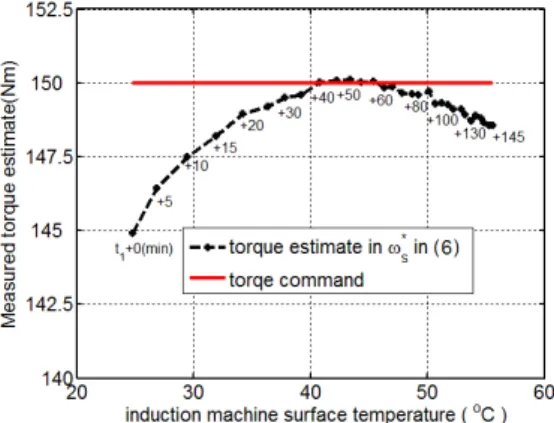
(a) Measured torque estimates at optimal slip frequency ω*s
(b) Maximum torque per ampere condition [Fig. 4] Effect of temperature on torque with T*e =150 Nm
using the MTPA control strategy based on (5)-(6)
Fig. 4 illustrates the effect of temperature on the electromagnetic torque. Trace (a) illustrates the measured electromagnetic torque estimate versus surface temperature of a point on the stator of the test induction machine, which was measured using a Fluke 65 infrared thermometer. The time at which each data point was taken relative to the beginning of the study is designated
where is the time in minutes. The torque estimate and the surface temperature of the test induction machine
were measured every 5 minutes. It is shown in trace (a) that the variation of the measured electromagnetic torque estimate at the same operating condition is significant as stator temperature of the test induction machine rises. As can be seen, as the stator surface temperature (and presumably rotor temperature) rises, the torque estimate increases, reaches a maximum, and then decreases. At maximum torque point (near 43 ℃ ), the measured torque estimate is very close to the commanded torque.
This observation results from the discrepancy between the rotor resistance used to design MTPA control strategy and the actual rotor resistance of the test induction machine due to temperature variation.
In the Fig. 4 trace (b), the measured torque estimate at the optimal slip frequency command, ω*s, in (6) is compared with two additional sets of torque estimate measurements taken at 110 % and 90 % times ω*s. Then with ωs=ω*s, it can also be seen that as the study proceeds in time, eventually the slip frequency command of 110 % of ω*s yields the most torque estimate, which implies that the maximum torque per amp condition at ω*s in (6) is not achieved. However, for some temperature region, around at 43 ℃, maximum torque per ampere condition is in fact achieved at the estimate optimal slip frequency command ω*s defined by (6).
These observations lead to the conclusion that to avoid the degradation in the performance of MTPA control strategy due to rotor temperature variation, rotor temperature variation should be taken into account in design of the MTPA control strategy.
5. Conclusion
This work justified the need for taking into account rotor temperature variation in induction machine control, especially, in the case of optimal control such as MTPA control.
It was experimentally shown that maximum torque per amp condition was not satisfied, ending up with sub-optimal performance in MTPA control unless rotor temperature variation is taken into consideration. The observation made in this work may lead to the conclusion that new MTPA control should be designed in a way that rotor temperature variation should be taken into
consideration.
References
[1] C. Gonzalez, J. Arribas, and D. Prieto, "Optimal Regulation of Electric Drives with Constant Load Torque", IEEE Transaction on Industrial Electronics, Vol. 53, No. 6, pp. 1762-1769, December, 2006.
[2] P. Famouri and J. J. Cathey, "Loss Minimization Control of an Induction Motor Drive", IEEE Transaction on Industry Applications, Vol. 27, No. 1, pp. 32-37, January/February, 1991.
[3] O. Wasynczuk, S. D. Suhdoff, K. A. Corzine, J. L.
Tichenor, P. C. Krause, I. G. Hansen, and L. M. Taylor,
"A Maximum Torque Per Ampere Control Strategy for Induction Motor Drives", IEEE Transaction on Energy Conversion, Vol. 13, No. 2, pp. 163-169, June, 1998.
[4] B. Karanayil, M. F. Rahman, and C. Grantham, "Online Stator and Rotor Resistance Estimation Scheme Using Artificial Neural Networks for Vector Controlled Speed Sensorless Induction Motor Drive", IEEE Transaction on Industrial Electronics, Vol. 54, No. 1, pp. 167-176, February, 2007.
[5] A. B. Proca and A. Keyhani, "Sliding-Mode Flux Observer With Online Rotor Parameter Estimation for Induction Motors", IEEE Transaction on Industrial Electronics, Vol. 54, No. 2, pp. 716-723, April, 2007.
[6] F. Zidani, M. S. Nait-Said, M. E. H. Benbouzid, D.
Diallo, and R. Abdessemed, "A Fuzzy Rotor Resistance Updating Scheme for an IFOC Induction Motor Drive", IEEE Power Engineering Review, pp. 47-50, November, 2001.
[7] S. Halasz, B. T. Huu, and K. Veszpremi, "Rotor Time Constant On-line Identification For Field Oriented AC Drive", Proceedings of the IEEE International Symposium, Vol. 2, pp. 654-659, July, 1995.
[8] P. C. Krause, O. Wasynczuk, S. D. Sudhoff, Analysis of Electric Machinery and Drive Systems, IEEE Press, 2002.
[9] C. Kwon and S. D. Sudhoff, "An Improved Maximum Torque Per Amp Control for Induction Machine Drives", in 20th Annual IEEE Applied Power Electronics Conference and Exposition, pp. 740-745, March, 2005.
[10] C. Kwon and S. D. Sudhoff, "A Genetic Algorithm Based Induction Machine Characterization Procedure
with Application to Maximum Torque Per Amp Control", IEEE Transactions on Energy Conversion, Vol. 21, No. 2, pp. 405-415, June, 2006.
[11] S. D. Sudhoff, D. C. Aliprantis, B. T. Kuhn, and P. L.
Chapman, "An Induction Machine Model for Predicting Inverter-Machine Interaction", IEEE Transactions on Energy Conversion, Vol. 17, pp. 203-210, June, 2002.
[12] S. D. Sudhoff, P. L. Chapman, D. C. Aliprantis, and B. T. Kuhn, "Experimental Characterization of an Advanced Induction Machine Model", IEEE Transactions on Energy Conversion, Vol. 18, pp. 48-56, March, 2003.
[13] P. L. Jansen and R. D. Lorenz, "A Physically Insightful Approach to the Design and Accuracy Assessment of Flux Observer for Field Oriented Induction Machine Drives", IEEE Transactions on Industry Applications, Vol. 30, No. 1, pp. 101-110, January/February, 1994.
[14] J. Kim, J. Choi, and S. Sul, "Novel Rotor Flux Observer Using Observer Characteristic Function in Complex Vector Space for Field Oriented Induction Motor Drives", IEEE Transactions on Industry Applications, Vol. 38, pp. 1334-1443, September/October, 2002.
Chun-Ki Kwon
[Regular member]• Feb. 1994 : Korea Univ., Electrical Engineering, ME
• Aug. 2005 : Purdue Univ., Electrical Engineering, PhD
• Jul. 2006 ∼ Feb. 2008 : Hyundai Motor Company, Senior
Engineer
• Feb. 2008 ∼ current : Soonchunhyang Univ. Dept. of Medical IT Engineering, Full-time Instructor
<Research Interests>
Control and modeling of electric machines. and medical engineering such as rehabilitation devices