pISSN 2288-0585⋅eISSN 2288-6850
Assessment of Efflux Activity Using H33342 Accumulation in Tigecycline-Resistant Acinetobacter baumannii
Clinical Isolates
Choon-Mee Kim1*, In Sun Choi2*, Sook Jin Jang2, Na-Ra Yun3, Dong-Min Kim3, Donghoon Lim4, Young-Joon Ahn5, Seong Ho Kang2, Geon Park2, Dae Soo Moon2
1Premedical Science, College of Medicine, Chosun University, Departments of 2Laboratory Medicine,
3Internal Medicine, 4Urology, 5Medical Education, College of Medicine, Chosun University, Gwangju, Korea
Background: Tigecycline resistance has emerged re- cently and has shown diverse mechanisms. The aim of this study was to assess the role of efflux activity in tigecycline resistance in 120 clinical isolates of A.
baumannii using two methods: the H33342 accumu- lation assay and adeB real-time reverse transcriptase polymerase chain reaction. In addition, we analyzed the correlation between the expression level of adeB and H33342 accumulation level.
Methods: A. baumannii clinical isolates was divided into tigecycline-resistant (49 strains), intermediate (40 strains), and susceptible (31 strains) groups. The H33342 accumulation was measured in the absence or presence of the efflux pump inhibitor carbonyl cya- nide 3-chlorophenylhydrazone (CCCP). Real-time RT- PCR was performed to determine the relative ex- pression of the adeB gene in A. baumannii clinical isolates.
Results: The level of H33342 accumulation in the re- sistant group was relatively lower than those in the other groups. The addition of CCCP caused a sig- nificantly increased fold change in H33342 accumu-
lation in the tigecycline-resistant group. Significant difference in the fold change level in H33342 accu- mulation was found between tigecycline-susceptible and resistant isolates. Those findings support the role of efflux pumps of which substrates are H33342 in the resistance of tigecycline. Significant differences in the relative expression levels of adeB were shown between tigecycline-susceptible and resistant groups also.
Conclusion: The results showed that several efflux pumps of which substrates were H33342 can contrib- ute to tigecycline resistance. The adeB overexpression can also contribute to tigecycline resistance. It is possible that efflux pumps other than adeB efflux pumps contribute to tigecycline resistance because there was no correlation between fold change level in H33342 accumulation and adeB expression level.
(Ann Clin Microbiol 2017;20:90-96)
Key Words: Acinetobacter baumannii, Efflux pump in- hibitor, Tigecycline
90
Received 30 June, 2017, Revised 30 August, 2017, Accepted 13 September, 2017
Correspondence: Sook Jin Jang, Department of Laboratory Medicine, College of Medicine, Chosun University, 309 Pilmun-daero, Dong-gu, Gwangju 61452, Korea. (Tel) 82-62-220-3259, (Fax) 82-62-232-2063, (E-mail) [email protected]
*Choon-Mee Kim and In Sun Choi contributed equally to this work as 1st authors.
ⓒ The Korean Society of Clinical Microbiology.
This is an Open Access article distributed under the terms of the Creative Commons Attribution Non-Commercial License (http://creativecommons.org/licenses/by-nc/4.0) which permits unrestricted non-commercial use, distribution, and reproduction in any medium, provided the original work is properly cited.
INTRODUCTION
Acinetobacter baumannii has successfully become a sig- nificant nosocomial agent worldwide, essentially because of its ability to survive in the hospital environment, and its propensity to rapidly acquire antibiotic resistance mechanisms [1]. In addi- tion to its high capacity to acquire new genetic determinants, overproduction of efflux pumps with broad substrate specificity
has been shown to be associated with multidrug resistance (MDR) in A. baumannii [2,3]. The resistance-nodulation-cell di- vision (RND) systems are the most prevalent efflux pump sys- tems in multidrug-resistant A. baumannii. Among three RND type efflux pumps, overexpression of AdeABC constitutes a ma- jor mechanism of multiresistance in A. baumannii [2].
Tigecycline, a glycylcycline antibiotic, retains activity against a broad range of both gram-positive and gram-negative bacteria
that includes methicillin-resistant Staphylococcus, vancomycin- resistant Enterococcus, and A. baumannii multidrug-resistant isolates [4]. However, tigecycline resistance in A. baumannii has emerged recently. It is reported that tigecycline nonsusceptibility in A. baumannii isolates has been associated with over- expression of a variety of efflux pumps. Among them, the ac- tive efflux pump AdeABC appeared to play important roles in the tigecycline resistance of A. baumannii [5].
Rapid assessment of efflux pump activity is important be- cause increased expression of chromosomal genes for efflux systems plays a major role in multidrug resistance (MDR) [2].
Fluorescent dyes, such as ethidium bromide and the bis-benza- mide dye Hoechst 33342 (H33342), are substrates of efflux pump systems, and can act as reporters of efflux activity. The H33342 accumulation assay is a cheap, relatively rapid, sensi- tive and specific test for MDR [6]. It has been used for the as- sessment of cellular permeability and efflux activity in Salmonella enterica and Escherichia coli [6,7]. H33342 accu- mulation has also been used in A. baumannii to assess the con- tribution of efflux activity to antibiotic accumulation [8,9].
Addition of the efflux pump inhibitor, carbonyl cyanide 3-chlor- ophenylhydrazone (CCCP), which dissipates the proton motive force required by several efflux pumps, causes a significant in- crease in H33342 accumulation, suggesting reduced efflux pump activity due to the inhibition of active efflux [9]. Although it was used effectively to assess efflux activity between several strains of bacteria including S. enterica, E. coli and A. bau- mannii [6,9], it is hard to find out studies using it as an assess- ing tool of efflux activity in a lot of clinical strains of A.
baumannii.
In this study, we assessed the role of the efflux system using H33342 accumulation in tigecycline resistance in 120 clinical isolates of A. baumannii, including 49 tigecycline-resistant, 40 intermediate, and 31 susceptible strains. We also investigated the effect of the relative expression of the RND efflux pump adeB gene on tigecycline resistance in A. baumannii clinical isolates. In addition, we analyzed the correlation between the expression level of adeB and H33342 accumulation levels.
MATERIALS AND METHODS
1. Bacterial isolates and growth conditions
A total of 120 A. baumannii clinical isolates were collected from January 2012 to December 2015 at Chosun University Hospital for use in this study. Bacterial identification was per-
formed using the VITEK 2 system (bioMérieux, Marcy l'Etoile, France). Thereafter, species identification was confirmed by gyrB multiplex PCR and blaOXA-51-like PCR [10,11]. Antimicr- obial susceptibility for tigecycline was also determined using the VITEK 2 system. The 120 A. baumannii clinical isolates were divided into 3 groups, 49 (40.8%) tigecycline-resistant, 40 (33.3%) tigecycline-intermediate, and 31 (25.8%) tigecy- cline-susceptible strains. These strains were isolated from spu- tum (72 isolates), open pus (15 isolates), whole blood (13 iso- lates), catheterized urine (6 isolates), random urine (5 isolates), endotracheal intubator (4 isolates), central venous catheter tip (2 isolates), CSF (1 isolate), bile juice (1 isolate), and bronchial washing (1 isolate). We selected two A. baumannii tigecy- cline-susceptible clinical isolates, 15136S and 15986S, and three A. baumannii tigecycline-resistant clinical isolates, 17296R, 18167R, and 18997R, for the H33342 accumulation assay, to determine an incubation time showing unchanged fluorescence accumulation. A. baumannii ATCC 19606 were used as refer- ence strains. Bacterial strains were grown at 37oC in Luria–
Bertani (LB) broth and agar (Difco Laboratories, Detroit, MI, USA). The study was approved by the Ethics in Human Research Committee of Chosun University Hospital (chosun non2016-003).
2. H33342 accumulation assay
The H33342 accumulation assay was carried out as described by Richmond et al. [9], with the following modifications.
Logarithmic phase cells were adjusted to an optical density at a wavelength of 600 nm (OD600) of 0.5, and then transferred to wells of a black 96-well plate (Corning, Amsterdam, The Netherlands). Wells were inoculated with 180 μL of each cul- ture, with or without 50 μM carbonyl cyanide 3-chlor- ophenylhydrazone (CCCP) and then 2.5 μM H33342 was add- ed to each well. Four replicates of each strain were analyzed per column. The plate was transferred to a fluorescence microplate reader (SpectraMax Gemini XPS; Molecular Devices, Sunnyvale, CA, USA), and fluorescence was measured at 37oC, by using excitation and emission filters of 355 nm and 460 nm, respectively. Each experiment was repeated twice. Heat-killed A. baumannii cells served as a positive control. The heat-killed cells rapidly accumulated H33342, and showed the maximal flu- orescence level. The H33342 accumulation ratio was calculated by dividing the amount of H33342 accumulation in the presence of CCCP by the amount of H33342 accumulation in the absence of CCCP. It reflects the fold change in H33342 accumulation in
Fig. 1. Pattern of H33342 accumulation (A) and the H33342 accumulation ratio (B) over a 70 min incubation period with 6 Acinetobacter baumannii isolates, including ATCC 19606, 2 tigecycline-susceptible (15136S, 15986S), and 3 resistant (17296R, 18167R, 18997R) strains. The H33342 accumulation ratio reflects the fold changes in H33342 fluorescence accumulation after addition of CCCP, relative to basal level without CCCP addition. The error bars represent the standard error of the mean. Abbreviations: H33342, Hoechst 33342; CCCP, carbonyl cyanide 3-chlorophenylhydrazone.
the presence of CCCP and that in the absence of CCCP.
3. Real-time reverse transcriptase polymerase chain reaction
We performed real-time reverse transcriptase PCR (real-time RT-PCR) to examine the relative expression of the adeB gene in A. baumannii clinical isolates. We obtained DNase-treated RNA from logarithmic phase cells (OD600 of 0.6) using a High Pure RNA isolation kit (Roche, Mannheim, Germany). The cDNA was synthesized with SuperScript VILO Master Mix (Invitrogen, Carlsbad, CA, USA) using random primers accord- ing to the manufacturer’s instructions. Real-time RT-PCR assays were performed using a CFX96 Real-Time System (Bio-Rad, Hercules, CA, USA) with an iTaq Universal SYBR Green Supermix (Bio-Rad) according to the user’s guide. For the re- al-time RT-PCR amplification, the following PCR program was used: 1 cycle at 95oC for 5 minutes, 40 cycles at 95oC for 15 seconds, and 60oC for 30 seconds.
In each real-time RT-PCR run, a negative control (reaction mixture without cDNA) was included. RNA controls without re- verse transcription were also included to confirm the absence of contaminating DNA in the samples. The rpoB gene was used as a housekeeping gene to normalize the expression of the target adeB gene. For real-time RT-PCR of the adeB gene, we used adeB-Q-for (5′-gatatcttgaatctgaaagtcatgg-3′) and adeB-Q-rev (5′- caaagatggtcgtccgttataac-3′) as the forward and reverse primers.
For the rpoB gene, we used rpoB-for-1 (5′-ctcactatggtcgtgtttgtc- 3′) and rpoB-rev-2 (5′-ccaagaaaccgaagtcattcg-3′). The normal- ized expression of adeB was calibrated using the expression of
A. baumannii ATCC 19606, which was assigned a value of 1.0.
All experiments were performed in triplicate. We considered a threshold cycle (Ct; the lowest cycle number to produce a de- tectable fluorescent signal) value of 38 as the cut-off for a neg- ative result in real-time PCR [12].
4. Statistical analysis
Statistical differences between each comparison group were determined using Student’s t-test in the H33342 accumulation assay and adeB relative expression analysis. SPSS statistics 21 program (IBM Corp., Armonk, NY, USA) was used for the stat- istical analyses. P values of <0.05 were considered statistically significant.
RESULTS
To determine the appropriate time to measure H33342 accu- mulation, we observed the change in level over the time period of the assay in six representative strains of A. baumannii, in- cluding ATCC 19606 reference strain, two A. baumannii tigecy- cline-susceptible clinical isolates (15136S and 15986S), and three tigecycline-resistant clinical isolates (17296R, 18167R, and 18997R). The level of H33342 accumulation rapidly increased in the early stage, but was not significantly changed 50 min af- ter the addition of H33342 in six strains, which means it had reached a steady state. Therefore, we selected 50 min as the op- timum time to measure H33342 accumulation in the A. bau- mannii clinical isolates. The level of H33342 accumulation of
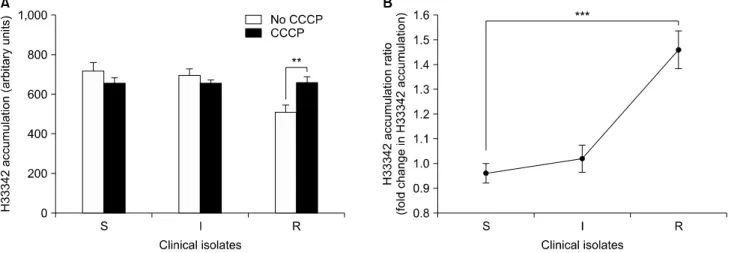
Fig. 2. Comparison of the mean values of H33342 accumulation in the presence and absence of CCCP (A) and the H33342 accumulation ratio (B) of tigecycline-susceptible (S), intermediate (I), and resistant (R) groups in 120 Acinetobacter baumannii clinical isolates at 50 min of exposure (steady state). The error bars represent the standard error of the mean. **P<0.001; ***P<0.0001. Abbreviations: H33342, Hoechst 33342;
CCCP, carbonyl cyanide 3-chlorophenylhydrazone.
Fig. 3. Relative expression of the efflux pump gene, adeB, deter- mined by real-time reverse transcriptase PCR in 31 tigecycline- susceptible (S), 40 intermediate (I), and 49 resistant (R) Acinetobacter baumannii strains. The normalized expression of adeB was calibrated with the expression of A. baumannii ATCC 19606. The error bars represent the standard error of the mean. *P<0.05.
ATCC 19606 and both tigecycline-susceptible strains was higher than that of the three resistant strains at steady-state (Fig. 1A).
The addition of CCCP, an efflux pump inhibitor, caused a sig- nificant increase in the level of H33342 accumulation only in the tigecycline-resistant strains. The fold change in H33342 ac- cumulation between the presence of CCCP and the absence of CCCP was lower in the tigecycline-susceptible isolates (15136S and 15986S) than in the three tigecycline-resistant isolates (17296R, 18167R, and 18997) (Fig. 1B).
We measured the mean values of H33342 accumulation at steady state (50 min) of the tigecycline-susceptible, inter- mediate, and resistant groups of 120 clinical isolates. The mean fluorescence of tigecycline-susceptible, intermediate groups and resistant group were 717.0±42.7, 694.0±32.4, and 510.3±33.8, respectively. Addition of CCCP caused a significant increase of fluorescence in the tigecycline-resistant A. baumannii group (P<0.001), but not in the susceptible and intermediate groups.
The mean fluorescence of the tigecycline-resistant A. baumannii group increased from 510.3±33.8 to 659.7±25.9 in the presence of CCCP (Fig. 2A). The mean fold change in H33342 accumu- lation was 1.46±0.076 for the tigecycline-resistant group, and 0.96±0.04 and 1.02±0.054 for the susceptible and intermediate groups, respectively. Significant difference in fold change level of H33342 accumulation was found between tigecycline-suscep- tible and tigecycline-resistant group (P<0.0001) (Fig. 2B).
We measured the mean values of the relative expression of adeB by real-time RT-PCR in tigecycline-susceptible, inter- mediate, and resistant groups. All 120 clinical isolates of A.
baumannii showed positive results for real-time RT-PCR of
adeB gene (Ct value range: 13.23 to 28.18). The mean relative expression values of adeB of tigecycline-susceptible, inter- mediate, and resistant groups were 10.60±1.33, 14.19±1.19, and 15.39±1.33, respectively. The median relative expression values of adeB of tigecycline-susceptible, intermediate, and resistant groups were 9.24, 18.35, and 22.0, respectively. We found sig- nificant difference in adeB expression level between tigecy- cline-susceptible and tigecycline-resistant group (P<0.05) (Fig. 3).
When we analyzed the correlation between the expression level of the RND efflux pump adeB gene and H33342 accumu- lation levels in 120 A. baumannii clinical isolates, we could not
find any correlation between fold change level in H33342 accu- mulation and adeB expression level.
DISCUSSION
Treatment of A. baumannii has become a major concern in hospital settings due to the wide dissemination of multi- drug-resistant strains. Overexpression of efflux pumps in A.
baumannii is a common mechanism of multidrug resistance in this nosocomial pathogen [2].
The H33342 accumulation assay was introduced to estimate the contribution of active efflux pumps to antimicrobial resist- ance in Salmonella Typhimurium strains [6]. The H33342 accu- mulation assay was also used to assess the roles of efflux pumps in antimicrobial resistance in A. baumannii clinical isolates [9].
We utilized the H33342 accumulation assay to assess efflux activity in 120 A. baumannii clinical isolates. In this study, the tigecycline-susceptible and intermediate groups showed rela- tively higher H33342 accumulation than the tigecycline-resistant group at steady-state. The addition of efflux pump inhibitor CCCP caused a statistically significant increase in H33342 accu- mulation only in the tigecycline-resistant group. These findings suggest the role of efflux activity in tigecycline resistance based on the following explanations: 1) the strains belonging to the ti- gecycline-resistant group showed low H33342 accumulation due to effective expulsion of H33342 by active efflux pumps; and 2) increased H33342 accumulation with the addition of CCCP only in the tigecycline-resistant group supports the role of efflux in tigecycline-resistance in that group.
The addition of efflux pump inhibitors (EIs) highlighted the contribution of various efflux pumps to antimicrobial resistance in a variety of bacteria [6,9,13]. The addition of PAβN, which inhibits RND transporters, resulted in increased H33342 accu- mulation, i.e. reduced levels of efflux [9]. Whalen et al. [13] re- ported that 3,4-dibromopyrrole-2,5-dione, an inhibitor of RND transporters, decreased the minimum inhibitory concentrations (MICs) of various antibiotics, and also increased the intracellular accumulation of H33342 in wild-type, but not in trans- porter-deficient strains. Opperman et al. [7] reported MBX2319, a novel pyranopyridine inhibitor, had potent activity against RND efflux pumps, and also increased intracellular accumu- lation of H33342 in wild-type, but not AcrAB-TolC-deficient strains. As described above, the addition of CCCP in A. bau- mannii AYE reference strain caused a significant increase in H33342 accumulation, suggesting reduced efflux [9]. In that
study, the adeB mutant showed increased H33342 accumulation, indicative of reduced activity compared to the parental strain.
Moreover, the addition of CCCP caused a significant increase (P<0.05) in the level of H33342 accumulation for all 6 clinical isolates tested [9].
The AdeABC pump is present in approximately 80% (53% to 97%) of A. baumannii clinical strains [2,14]. Our study showed the presence of the adeB gene in all 120 A. baumannii clinical isolates. Deng et al. [5] reported that the positivity rate of adeB was 84.4% (54/64) for tigecycline-nonsusceptible A. baumannii (TNAB) isolates, and 80% (8/10) for tigecycline-susceptible A.
baumannii (TSAB) isolates. These results were contrary to an earlier result showing that adeABC genes were present in MDR isolates, and not in susceptible isolates [15].
It is reported that reduced susceptibility to tigecycline appears to be mediated in part by active efflux systems, including AdeABC. In this study, the mean relative expression of the adeB gene of tigecycline-susceptible, intermediate, and resistant groups was 10.60±1.33, 14.19±1.19, and 15.39±1.33, respectively.
We found significant differences in the levels of adeB relative expression between tigecycline-susceptible versus tigecycline-re- sistant groups (P<0.05). Therefore, it seems possible that adeB overexpression may contribute to tigecycline resistance.
Deng et al. [5] reported that the mean expression level of the adeB gene in 64 TNAB clinical isolates was 29-fold higher than that in 10 TSAB isolates. Peleg et al. [16] identified 40-fold and 54-fold increases in adeB expression in the two TNAB isolates compared to that in a TSAB isolate. Although we do not know the exact cause of the large differences in adeB expression level between our strains and Deng’s, several factors may contribute the differences between them. In contrast to Deng’s strains, col- lected for 1 year, our strains, randomly collected for almost 4 years, may have relatively diverse results, which may explain the difference between them. In addition, we suspect the differ- ent features of the test strains, including resistance determinants harbored in each strain, biological state, strain distribution in tested bacteria, characteristics of prevailing or endemic clones in each region or country, the housekeeping gene or control strain used for calibration of adeB relative expression, and the meas- urement method, condition or equipment etc., may explain the differences in adeB relative expression. Such a difference was also observed in the reported incidence of adeB overexpression.
Yoon et al. [17] reported significant adeB overexpression in 76.9% (10/13) of TNAB clinical strains containing the adeB gene. Correlation between adeB overexpression and reduced
susceptibility to tigecycline was observed in 5/40 (12.5%) MDR A. baumannii clinical isolates [18]. Rumbo et al. [14] reported that reduced susceptibility to tigecycline was associated with overexpression of different efflux pump genes, such as AdeABC or AdeIJK, or the presence of TetA efflux pumps, according to the tested clone.
No correlation between the expression level of the RND ef- flux pump adeB gene and fold change of H33342 accumulation was found in 120 A. baumannii clinical isolates. Although we don’t know the reason for that, it may be related to the differ- ence in the number of involved efflux pumps resulting in each determinant. Any efflux pumps, of which the substrates include H33342, may exert influence on the H33342 accumulation levels. Because H33342 accumulation levels may be determined by the combined activity of a variety of efflux pumps including adeB, it could not be correlated with the single adeB gene ex- pression level.
The limitation of the present study is that the overall per- spective for contribution factor to tigecycline resistance could not be obtained because this study is focused on H33342 accu- mulation assay and the relative expression of the adeB gene.
Therefore, it may be necessary to undertake further study to closely evaluate their correlation by measuring other relevant factors together. The study may encompass another RND sys- tem or a variety of efflux pump genes which may contribute the tigecycline resistance.
In conclusion, our study showed that efflux activity, assessed by H33342 accumulation assay, may contribute to tigecy- cline-resistance in A. baumannii clinical isolates. However, there was no correlation between the H33342 accumulation ratio and adeB expression level.
ACKNOWLEDGMENTS
This study was supported by research fund from Chosun University, 2016.
REFERENCES
1. Dijkshoorn L, Nemec A, Seifert H. An increasing threat in hospitals: multidrug-resistant Acinetobacter baumannii. Nat Rev Microbiol 2007;5:939-51.
2. Coyne S, Courvalin P, Périchon B. Efflux-mediated antibiotic resistance in Acinetobacter spp. Antimicrob Agents Chemother 2011;55:947-53.
3. Yoon EJ, Chabane YN, Goussard S, Snesrud E, Courvalin P, Dé E, et al. Contribution of resistance-nodulation-cell division efflux
systems to antibiotic resistance and biofilm formation in Acinetobacter baumannii. MBio 2015;6:e00309-15.
4. Reid GE, Grim SA, Aldeza CA, Janda WM, Clark NM. Rapid development of Acinetobacter baumannii resistance to tigecycline.
Pharmacotherapy 2007;27:1198-201.
5. Deng M, Zhu MH, Li JJ, Bi S, Sheng ZK, Hu FS, et al. Molecular epidemiology and mechanisms of tigecycline resistance in clinical isolates of Acinetobacter baumannii from a Chinese university hospital. Antimicrob Agents Chemother 2014;58:297-303.
6. Coldham NG, Webber M, Woodward MJ, Piddock LJ. A 96-well plate fluorescence assay for assessment of cellular permeability and active efflux in Salmonella enterica serovar Typhimurium and Escherichia coli. J Antimicrob Chemother 2010;65:1655-63.
7. Opperman TJ, Kwasny SM, Kim HS, Nguyen ST, Houseweart C, D'Souza S, et al. Characterization of a novel pyranopyridine inhibitor of the AcrAB efflux pump of Escherichia coli. Antimicrob Agents Chemother 2014;58:722-33.
8. Magnet S, Courvalin P, Lambert T. Resistance-nodulation-cell division-type efflux pump involved in aminoglycoside resistance in Acinetobacter baumannii strain BM4454. Antimicrob Agents Chemother 2001;45:3375-80.
9. Richmond GE, Chua KL, Piddock LJ. Efflux in Acinetobacter baumannii can be determined by measuring accumulation of H33342 (bis-benzamide). J Antimicrob Chemother 2013;68:1594- 600.
10. Lee MJ, Jang SJ, Li XM, Park G, Kook JK, Kim MJ, et al.
Comparison of rpoB gene sequencing, 16S rRNA gene sequencing, gyrB multiplex PCR, and the VITEK2 system for identification of Acinetobacter clinical isolates. Diagn Microbiol Infect Dis 2014;78:29-34.
11. Feizabadi MM, Fathollahzadeh B, Taherikalani M, Rasoolinejad M, Sadeghifard N, Aligholi M, et al. Antimicrobial susceptibility patterns and distribution of blaOXA genes among Acinetobacter spp. isolated from patients at Tehran hospitals. Jpn J Infect Dis 2008;61:274-8.
12. Kim HS, Kim DM, Neupane GP, Lee YM, Yang NW, Jang SJ, et al. Comparison of conventional, nested, and real-time PCR assays for rapid and accurate detection of Vibrio vulnificus. J Clin Microbiol 2008;46:2992-8.
13. Whalen KE, Poulson-Ellestad KL, Deering RW, Rowley DC, Mincer TJ. Enhancement of antibiotic activity against multidrug- resistant bacteria by the efflux pump inhibitor 3,4-dibromopyrrole- 2,5-dione isolated from a Pseudoalteromonas sp. J Nat Prod 2015;
78:402-12.
14. Rumbo C, Gato E, López M, Ruiz de Alegría C, Fernández- Cuenca F, Martínez-Martínez L, et al. Contribution of efflux pumps, porins, and β-lactamases to multidrug resistance in clinical isolates of Acinetobacter baumannii. Antimicrob Agents Chemother 2013;57:5247-57.
15. Li XZ and Nikaido H. Efflux-mediated drug resistance in bacteria:
an update. Drugs 2009;69:1555-623.
16. Peleg AY, Adams J, Paterson DL. Tigecycline efflux as a mechanism for nonsusceptibility in Acinetobacter baumannii.
Antimicrob Agents Chemother 2007;51:2065-9.
17. Yoon EJ, Courvalin P, Grillot-Courvalin C. RND-type efflux pumps in multidrug-resistant clinical isolates of Acinetobacter baumannii: major role for AdeABC overexpression and AdeRS mutations. Antimicrob Agents Chemother 2013;57:2989-95.
18. Bratu S, Landman D, Martin DA, Georgescu C, Quale J.
Correlation of antimicrobial resistance with beta-lactamases, the OmpA-like porin, and efflux pumps in clinical isolates of
Acinetobacter baumannii endemic to New York City. Antimicrob Agents Chemother 2008;52:2999-3005.
=국문초록=
Tigecycline 내성
Acinetobacter baumannii
임상 분리주들에서 H33342 축적에 의해 측정된 유출펌프 활성의 평가조선대학교 의과대학 1의예과, 2진단검사의학교실, 3내과학교실, 4비뇨기과학교실, 5의학교육학교실 김춘미1, 최인선2, 장숙진2, 윤나라3, 김동민3, 임동훈4, 안영준5, 강성호2, 박 건2, 문대수2
배경: Tigecycline 내성이 최근 부상하고 있고 tigecycline 내성과 관련된 기전은 다양하다. 본 연구에서는 A. baumannii의 임상 분리주 120주에서 H33342 축적 분석법과 adeB 유전자의 실시간 역전사 효소 중합 효소 연쇄 반응법의 두 방법을 사용하여 tigecycline 내성에 있어서 유출펌프 활성의 역할을 평가하고자 하였다. 또한 adeB 유전자의 발현 수준과 H33342 축적 수준 사이의 상관 관계를 분석 하였다.
방법: A. baumannii 임상 분리주들은 tigecycline 내성(49주)과 중간내성(40주), 및 감수성(31주)군으로 분류하였다. H33342 축적수준은 유출 펌프 억제제인 carbonyl cyanide 3-chlorophenylhydrazone (CCCP)를 첨가하기 전과 후에 각각 측정하였다.
A. baumannii 임상 분리주들에서 adeB 유전자의 상대적인 발현을 결정하기 위해 실시간 역전사 효소 중합 효소 연쇄 반응법이 수행되었다.
결과: Tigecycline 내성군에서의 H33342 축적 수준은 다른 군들의 축적수준보다 상대적으로 더 낮았다. Tigecycline 내성 군에서 H33342 축적 수준은 CCCP를 첨가 한 후 크게 증가된 변화값(fold change)을 보였다. Tigecycline 감수성군과 내성 군간에 H33342 축적수준의 변화값은 유의한 차이를 보여주었다. 이러한 소견들은 유출 펌프의 기질들 중에 H33342가 포함되어 있는 유출펌프들이 tigecycline 내성에 역할을 한다는 것을 뒷받침해준다. 또한 tigecycline 감수성군과 내성군 간에 adeB 유전자의 상대적인 발현 수준에 유의한 차이가 나타났다.
결론: 이들 연구결과들은 H33342가 기질인 여러 유출 펌프가 tigecycline 내성에 기여할 수 있음을 보여 주었다. 또한 adeB 유전자의 과발현이 tigecycline 내성에 기여할 수 있다는 것을 보여준다. H33342 축적의 변화값 수준과 adeB 유전자 발현 수준간에는 상관 관계가 없었기 때문에 adeB 유출 펌프 이외의 유출 펌프가 tigecycline 내성에 기여할 수 있다고 보는 것이 가능하다. [Ann Clin Microbiol 2017;20:90-96]
교신저자 : 장숙진, 61452, 광주시 동구 필문대로 309 조선대학교 의과대학 진단검사의학교실 Tel: 062-220-3259, Fax: 062-232-2063 E-mail: [email protected]