Clarithromycin-Based Standard Triple Therapy Can Still Be Effective for Helicobacter pylori Eradication in Some Parts of the Korea
We evaluated the antibiotic resistance rates and eradication rates of clarithromycin based triple therapy from 2005 to 2010 retrospectively. In addition, we investigated the mechanism of clarithromycin resistance in Helicobacter pylori strains isolated from Korean patients. Two hundred and twelve strains of H. pylori were isolated from 204 patients. H.
pylori ATCC 43504 was used as the standard strain. The eradication rates of H. pylori from 2005 to 2010 were 89.3%, 82.6%, 86.3%, 87.7%, 81.8%, and 84.2%, respectively. Total eradication rate was 84.9%. DNA sequences of the 23S RNA gene in clarithromycin- resistant strains were determined. The resistance rates of H. pylori to amoxicillin,
clarithromycin, metronidazole, tetracycline, ciprofloxacin, moxifloxacin, and levofloxacin were 9.0%, 8.5%, 36.3%, 0%, 14.2%, 14.2%, and 14.2%, respectively. The multidrug resistance rate of H. pylori was 16.5%. Sequence analysis of clarithromycin-resistant strains showed an A2144G mutation in 8 of 14 strains (57.1%), a T2183C mutation in 5 of 14 strains (35.7%), and double mutations of both A2144G and T2183C in 1 of 14 strains (7.1%). In the present study, triple therapy may still be an effective eradication therapy for H. pylori infections in Korea. The A2144G and T2183C mutations are mainly present in clarithromycin-resistant isolates.
Keywords: Helicobacter pylori; Clarithromycin Resistance; Minimum Inhibitory Concentration
Kyu-Hyun Yoon, Sung Woon Park, Sang Wook Lee, Beom Jin Kim, and Jae Gyu Kim
Division of Gastroenterology, Department of Internal Medicine, Chung-Ang University College of Medicine, Seoul, Korea
Received: 10 January 2014 Accepted: 26 May 2014 Address for Correspondence:
Jae Gyu Kim, MD
Division of Gastroenterology, Department of Internal Medicine, Chung-Ang University College of Medicine, 102 Heukseok-ro, Dongjak-gu, Seoul 156-755, Korea
Tel: +82.2-6299-3147, Fax: +82.2-6299-1137 E-mail: [email protected]
http://dx.doi.org/10.3346/jkms.2014.29.9.1240 • J Korean Med Sci 2014; 29: 1240-1246
INTRODUCTION
Helicobacter pylori is a curved, microaerophilic, Gram-negative bacterium that was isolated in 1983 from the stomach biopsy specimens of patients with chronic gastritis (1). The bacterium colonizes the human gastric mucosa, and the infection can per- sist for decades. H. pylori infection is recognized as a causal fac- tor of chronic gastritis, peptic ulcers, and gastric cancer (2). The World Health Organization has declared H. pylori as a class I carcinogen. H. pylori colonization should be eradicated in pa- tients with peptic ulceration because eradication not only ac- celerates ulcer healing but also prevents long-term ulcer relapse.
Treatment regimens consisting of a proton pump inhibitor (PPI) and a combination of 2 or more antibiotics, including amoxicil- lin and clarithromycin, are highly effective; however, recently, drug resistance has become a significant clinical problem for the management of H. pylori infections. Reports from Korean patients have shown a continuous increase in primary resistant strains for several antibiotics such as clarithromycin, amoxicil- lin, metronidazole, tetracycline, and fluoroquinolones (includ- ing ciprofloxacin and moxifloxacin) from 1987 to 2003 (3). Con- sistent with these findings, eradication rates for first-line therapy have decreased to less than 75% in Korea (4). Resistant strains
of bacteria hinder successful eradication because treatment of H. pylori infection is usually initiated on an empirical basis. In- formation about the status and changes in H. pylori resistance to antibiotics is of the utmost importance for designing success- ful treatment strategies. Clarithromycin resistance reduced effi- cacy of clarithromycin-based triple therapy by over 50% (5). The rates of eradication were 97% for clarithromycin-susceptible strains and 0% for clarithromycin-resistant strains in Korean patients (3). Therefore, clarithromycin resistance is a prime con- cern for clinicians who treat patients infected with H. pylori. Mat- suoka et al. (6) first reported that mutations in 23S rRNA are as- sociated with clarithromycin resistance in H. pylori. Point mu- tations in 2 positions (A2143G or A2144G) are the most com- monly reported mutations in clarithromycin-resistant H. pylori isolates (6). However, little information is available regarding the antibiotic minimum inhibitory concentrations (MICs) for H.
pylori isolates and the mechanism of clarithromycin resistance in Korea. Therefore, we studied H. pylori isolates obtained from Korean patients with the following objectives: 1) to determine the antibiotic resistance rates of H. pylori and the distribution of MICs for amoxicillin, clarithromycin, metronidazole, tetracy- cline, ciprofloxacin, moxifloxacin, and levofloxacin, 2) to evalu- ate the efficacy of clarithromycin-based triple therapy in H. py-
lori eradication and 3) to detect mutations in 23S rRNA of clar- ithromycin-resistant H. pylori isolates from Seoul, Korea.
MATERIALS AND METHODS Patients and H. pylori Strains
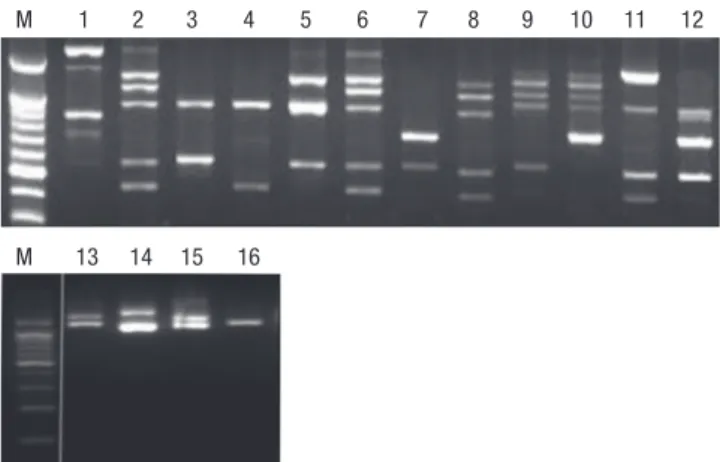
Two hundred and twelve strains of H. pylori were isolated from 204 patients attending Chung-Ang University Yongsan Hospi- tal. None of the patients had been administered antibiotics, PPI, or non-steroidal anti-inflammatory drugs during the preceding 3 months. The patients had a mean age of 52.5 ± 14.5 yr (115 men, 89 women) and were diagnosed with one of the following; gas- tritis (n = 119), gastric ulcer (n = 26), duodenal ulcer (n = 41), combined gastric and duodenal ulcer (n = 15), and stomach cancer (n = 3) (Table 1). Different fingerprints of randomly am- plified polymorphic DNA obtained by polymerase chain reac- tion (PCR) were observed in the paired strains obtained from the gastric antrum and body of 8 patients (Fig. 1).
The H. pylori strains were cultured for 4 days under micro- aerobic conditions (5% O2, 10% CO2, and 85% N2) as previously described (7). All stock cultures were stored in brucella broth supplemented with 15% glycerol and 10% fetal bovine serum at -196°C. These preparations were thawed and subcultured for the subsequent experiments.
Determination of Antibiotic MICs
The MIC values of amoxicillin (Sigma Chemical Co., St Louis, MO, USA), clarithromycin (Abbott Laboratories, Abbott Park, IL, USA), metronidazole (Sigma), tetracycline (Sigma), cipro- floxacin (Sigma), moxifloxacin (Sigma), and levofloxacin (Sig- ma) against H. pylori isolates were confirmed 3 times in tripli- cates using the serial 2-fold agar dilution method as described previously (3, 8). Briefly, bacteria were subcultured on Mueller- Hinton agar that was supplemented with 5% defibrinated sheep blood for 48 hr. The bacterial suspension, adjusted to McFar- land no. 2 (6 × 10⁸ colony-forming units/mL), was inoculated directly onto each antibiotic-containing agar dilution plate. Af- ter 72 hr of incubation, the MIC of each antibiotic was deter- mined. Quality control was performed using H. pylori ATCC 43504 (8). Resistant breakpoints of MICs for amoxicillin, clar- ithromycin, metronidazole, tetracycline, and fluoroquinolones
(ciprofloxacin, moxifloxacin, and levofloxacin) were defined as
> 0.5, > 1.0, > 8.0, > 4.0, and > 1.0 µg/mL, respectively (8, 9).
Efficacy of clarithromycin-based triple therapy for H. pylori eradication
The retrospective study was conducted for the evaluation of era- dication rate of clarithromycin-based triple therapy at Yongsan Hospital in Seoul, Korea. We included all patients that were re- ceived H. pylori eradication and performed to determine if H.
pylori had been successfully eradicated between 2005 and 2010.
The definition of H. pylori eradication success was as follows: 1) negative result in urea breath test (UBT) or 2) negative result in both rapid urease test and histology after eradication therapy.
Restriction fragment length polymorphism (RFLP) and DNA sequencing analysis
H. pylori genomic DNA was extracted as previously described (10). Oligonucleotide primers (sense, 5´-CCACAGCG ATGTG- GTCTCAG-3´; antisense, 5´-CTCCATAA GAGCCAAAGCCC-3´) were used to detect mutations in the 23S rRNA gene that result- ed in clarithromycin resistance. The PCR profile consisted of 35 cycles of denaturation for 1 min at 94°C, annealing for 1 min at 55°C, and extension for 1 min at 72°C. Amplicons (424 bp each)
Table 1. Baseline characteristics of subjects
Items Findings
No. of patients (strains) 204 (212)
Age (Mean ± SD, yr) 52.5 ± 14.5
Men:women (men %) 115:89 (56.4)
Disease GU:DU:GDU Stomach cancer Gastritis
26:41:15 3 119
GU, gastric ulcer; DU, duodenal ulcer; GDU, combined gastric and duodenal ulcer.
Table 2. Prevalence of antibiotic resistance among H. pylori isolates from Korean pa- tients
Antibioctics % of resistant strains (No. of resistant strains/total strains)
Amoxicillin 9.0 (19/212)
Clarithromycin 8.5 (18/212)
Metronidazole 36.3 (77/212)
Tetracycline 0 (0/212)
Fluoroquinolone* 14.2 (30/212)
*Fluoroquinolone (ciprofloxacin, moxifloxacin, or levofloxacin) : The values of three are same. Resistant breakpoints of MIC were defined as > 0.5 µg/mL for amoxicillin,
> 1.0 µg/mL for clarithromycin, > 8 µg/mL for metronidazole, > 4 µg/mL for tetra- cycline, and > 1.0 µg/mL for ciprofloxacin, moxifloxacin, and levofloxacin.
M 1 2 3 4 5 6 7 8 9 10 11 12
M 13 14 15 16
Fig. 1. Representative PCR-RAPD fingerprints of 8 pairs of H. pylori strains isolated from antrum and body. Lane M is a 100-bp ladder. Lanes 1 & 2, 3 & 4, 5 & 6, 7 & 8, 9 & 10, 11 & 12, 13 & 14, 15& 16 show the different DNA profiles.
Fig. 2. Distributions of antibiotic MICs for H. pylori. Two hundred and twelve strains were examined from 2005 to 2008. MICs were determined by the agar dilution method. The MICs of amoxicillin (A), clarithromycin (B), metronidazole (C), tetracycline (D), ciprofloxacin (E), moxifloxacin (F), and levofloxacin (G) are shown. The dotted line indicates the break point of each antibiotic.
% of H. pylori isolates
0.125 0.25 0.5 1 2 4 8 16
100
80
60
40
20
0
Levofloxacinin
% of H. pylori isolates
0.0625 0.125 0.25 0.5 1 2 4
100
80
60
40
20
0
Amoxicillin
% of H. pylori isolates
0.0625 0.125 0.25 0.5 1 2 4 8 16
100
80
60
40
20
0
Clarithromycin
% of H. pylori isolates
0.5 1 2 4 8 16 32 64 128 100
80
60
40
20
0
Metronidazole
% of H. pylori isolates
0.125 0.25 0.5 1 2 4 8
100
80
60
40
20
0
Tetracycline
% of H. pylori isolates
0.125 0.25 0.5 1 2 4 8 16
100
80
60
40
20
0
Ciprofloxacin
% of H. pylori isolates
0.125 0.25 0.5 1 2 4 8 16
100
80
60
40
20
0
Moxifloxacin A
C
E
G
B
D
F of the 23S rRNA gene were digested with either BsaI (New Eng-
land BioLabs, Beverly, MA, USA) for 14 hr at 50°C or BbsI (New England BioLabs) for 14 hr at 37°C to detect the A2144G and A2143G mutations, respectively (10). Digested fragments were separated on a 1.5% agarose gel and viewed on a Gel Doc XR system (Bio-Rad Laboratories, Hercules, CA, USA).
Sequencing was performed with nonrestricted PCR products that were purified using Promega gel clean-up system (Promega Co, Madison, WI, USA). Purified PCR products were sequenc ed directly using the BigDye terminator sequencing kits and ABI PRISM 3730XL Analyzer (Applied Biosystems, Foster City, CA, USA).
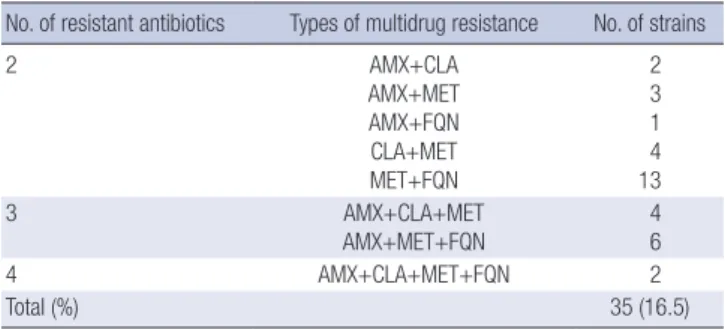
Table 3. Prevalence of multi-drug resistant H. pylori strains
No. of resistant antibiotics Types of multidrug resistance No. of strains
2 AMX+CLA
AMX+MET AMX+FQN CLA+MET MET+FQN
2 3 1 4 13
3 AMX+CLA+MET
AMX+MET+FQN
4 6
4 AMX+CLA+MET+FQN 2
Total (%) 35 (16.5)
The most common multi-drug resistance was to metronidazole and levofloxacin. AMX, amoxicillin; CLA, clarithromycin; MET, metronidazole; TET, tetracycline; FQN, fluoro- quinolone (ciprofloxacin, moxifloxacin, or levofloxacin).
Table 4. Baseline characteristics of subjects that 833 patients were evaluated, who had received H. pylori eradication therapy from 2005 to 2010
Items Findings
No. of patients 833
Age (Mean ± SD, yr) 55.3 ± 13.0
Men:women (men %) 539:294 (64.7)
Disease GU:DU:GDU Stomach cancer Gastritis
234:315:47 5 209
GU, gastric ulcer; DU, duodenal ulcer; GDU, combined gastric and duodenal ulcer.
Fig. 3. The eradication rate of H. pylori in Chung-Ang University Yongsan Hospital. A total of 833 patients were evaluated, who had received H. pylori eradication therapy from 2005 to 2010. P for trend of eradication rate = 0.516.
Eradication rate (%)
2005 2006 2007 2008 2009 2010 Total 100
80
60
40
20
0
89.3 82.6 86.3 87.7
81.8 84.2 84.9
Statistics
Statistical analysis was performed using the SPSS software ver- sion 18.0 (SPSS Inc., Chicago, IL, USA). Trend analyses were car- ried out using the chi-square for the percentages of eradication of each year.
Ethics statement
The study protocol was approved by the institutional review board of Chung-Ang University College of Medicine (IRB No.
10-070-10-20). Informed consent was waived by the board.
RESULTS
Prevalence of antibiotic resistance and determination of MICs
Amoxicillin, clarithromycin, metronidazole, tetracycline, and fluoroquinolone (ciprofloxacin, moxifloxacin, and levofloxacin) resistance rates were 9%, 8.5%, 36.3%, 0%, and 14.2%, respec- tively (Table 2). Additionally, the antibiotic MICs are shown in Fig. 2. These MIC values of amoxicillin, clarithromycin, metro- nidazole, tetracycline, and fluoroquinolones were ranged from 0.0625 to 4 µg/mL, from 0.0625 to 16 µg/mL, 0.5 to 128 µg/mL, from 0.125 to 4 µg/mL, and from 0.125 to 16 µg/mL, respectively.
Multidrug resistance (MDR) of H. pylori
Thirty-five of 212 strains (16.5%) were resistant to at least 2 anti- microbial agents (exhibiting MDR) (Table 3). The most common
MDR was to levofloxacin plus metronidazole. Resistance to 3 and 4 drugs were observed in 10 (4.7%) and 2 (0.9%) strains, re- spectively.
Eradication Rate of Clarithromycin-based Triple Therapy A total of 833 patients were evaluated, who had received H. py- lori eradication therapy from 2005 to 2010 in Chung-Ang Uni- versity Yongsan Hospital. The patients had a mean age of 55.3
± 13.0 yr (539 men, 294 women) and were diagnosed with one of the following; gastritis (n = 209), gastric ulcer (n = 234), duo- denal ulcer (n = 315), combined gastric and duodenal ulcer (n = 47), and stomach cancer (n = 5) (Table 4). The eradication rates of H. pylori from 2005 to 2010 were 89.3%, 82.6%, 86.3%, 87.7%, 81.8%, 84.2%, respectively. Total eradication rate was 84.9%, and there was no statistical difference between eradica- tion rates by year (Fig. 3).
PCR Amplification and Sequence Analysis of the 23S rRNA Gene for Mutations that Result in Clarithromycin
Resistance
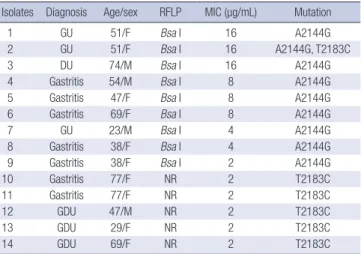
Only 14 of the 18 clarithromycin-resistant strains were evaluat- ed due to technical difficulties associated with the H. pylori cul- ture. The A2144G mutation in the 23S rRNA gene was detected in 8 of the 14 clarithromycin-resistant strains (57.1%) by BsaI digestion of the PCR products (Fig. 4); the PCR products of these strains were not digested with BbsI, revealed a A-to-G mutation at position 2144 (A2144G) (Fig. 4). Sequencing of 5 clarithromy- cin-resistant strains (35.7%), whose PCR products were not di- gested by BsaI and BbsI, revealed a T-to-C mutation at position 2183 (T2183C). Sequencing of 1 strain whose PCR product was digested by BsaI revealed A2144G and T2183C mutations (7.1%) (Fig. 4). The MICs for the A2144G mutant strains ranged from 2 to 16 µg/mL (Table 5). The MICs for the T2183C mutants were relatively low (MICs = 2 µg/mL).
Fig. 4. Restriction fragment length polymorphism analysis of 23S rRNA amplicons: (A) digestion with BsaI and (B) digestion with BbsI. The A2144G mutations are observed in lanes 1 to 2, but not in lanes 3 to 5. Note that the A2143G mutation detected by digestion with BbsI was not detected in any of the strains studied. Lanes 3 to 5 reveal the T2183C mutation, as assessed by DNA sequencing. Lane M, 100 bp DNA size markers (indicated to the left of the gels in base pairs); lane C, H. pylori ATCC 43504; lane 1 to 5, clarithromycin-resistant H. pylori strains.
BsaI digestion A2144G mutation
1.4 kb 1 kb 700 bp 400 bp 300 bp
M C 1 2 3 4 5 C´ 1´ 2´ 3´ 4´ 5´
A2144G, T2183C double mutation
BbsI digestion
A B
Table 5. PCR-RFLP pattern and mutations in 14 clarithromycin-resistant isolates Isolates Diagnosis Age/sex RFLP MIC (µg/mL) Mutation
1 GU 51/F Bsa I 16 A2144G
2 GU 51/F Bsa I 16 A2144G, T2183C
3 DU 74/M Bsa I 16 A2144G
4 Gastritis 54/M Bsa I 8 A2144G
5 Gastritis 47/F Bsa I 8 A2144G
6 Gastritis 69/F Bsa I 8 A2144G
7 GU 23/M Bsa I 4 A2144G
8 Gastritis 38/F Bsa I 4 A2144G
9 Gastritis 38/F Bsa I 2 A2144G
10 Gastritis 77/F NR 2 T2183C
11 Gastritis 77/F NR 2 T2183C
12 GDU 47/M NR 2 T2183C
13 GDU 29/F NR 2 T2183C
14 GDU 69/F NR 2 T2183C
DU, duodenal ulcer; GU, gastric ulcer; GDU, combined gastric and duodenal ulcer;
MIC, minimal inhibitory concentration; NR, non restriction; PCR, polymerase chain re- action; RFLP, restriction fragment length polymorphism.
DISCUSSION
The National Committee for Clinical Laboratory Standards (NC- CLS) has not established an official breakpoint for amoxicillin resistance in H. pylori isolates. Nevertheless, many reports have provisionally defined the cut-off value as an MIC higher than 0.5 µg/mL (11, 12). In the present study, the prevalence of amox- icillin resistance was 9%. This rate was found to be similar to that (9.1%) found in H. pylori isolated from 99 Koreans who lived in Gyeonggi, Kangwon province and Busan in 2008 (12).
The prevalence of clarithromycin MICs > 1 µg/mL was 8.5%
in our study. This rate was higher than that (5.1%) reported from our hospital in 2001 (10). The prevalence of clarithromycin resis- tance in H. pylori strains isolated from Korean patients in Seoul National University Hospital increased from 2.8% (MICs ≥ 1 µg/mL) in 1994 to 13.8% (MICs ≥ 1 µg/mL) in 2003 to 32.5%
(MICs > 1 µg/ml) in 2008 (3, 12). Moreover, there were differ-
ences in the rates of resistance to clarithromycin in 3 institutes located in Gyeonggi (32.5%), Kangwon province (12.5%), and Busan (42.1%), even though, by post-hoc analysis, there was no statistically significant difference between the rates in the 3 re- gions (12). These results may suggest both a tendency towards increasing resistance and regional differences in resistance to clarithromycin. The clarithromycin resistance rate found at Hal- lym University Chuncheon Hospital in Kangwon province was closer to our result. Our institute is a localized secondary refer- ral hospital, but Seoul National University Hospital is a national referral institute. Therefore, the antibiotic resistance rates ob- served in our institute may be lower than those observed in the Seoul National University Hospital. The threshold of resistance at which clarithromycin should not be used, or a clarithromy- cin susceptibility test should be performed, is 15%-20% (13).
The Maastricht IV/Florence Consensus Report recommends that PPI-clarithromycin-amoxicillin or metronidazole regimens be used as first-line therapy in populations with less than 15- 20% clarithromycin resistance (13). Therefore, clarithromycin based triple therapy could be used as the first-line therapy in our hospital.
The NCCLS has not designated an official breakpoint for met- ronidazole resistance in H. pylori isolates. The prevalence of met- ronidazole MICs > 8 µg/mL in H. pylori isolated from our insti- tute was 54.4% in 2001 (10). Metronidazole is widely prescribed for infections (e.g., parasitic or those of the female genitourinary tract) in Korea, and the growing use or abuse of this inexpensive drug may have contributed to the elevated MICs. In the present study, the prevalence of metronidazole resistance was 36.3%. A recent multicenter study has shown a decreased resistance rate (19.2%) (12). Although sample size, technical problems with the agar dilution test, regional differences, and socioeconomic status may account for these differences, the recent H. pylori resistance to metronidazole in Korea is reduced as compared to that reported by previous studies (10, 12). The Maastricht III Con-
sensus Report recommends treatment with PPI-clarithromy- cin-metronidazole in populations with less than 40% metroni- dazole resistance (14); however, metronidazole may still be less effective in Korea due to the relatively high resistance rate.
Primary resistance to tetracycline is rare. We used a recent provisional breakpoint of > 4 µg/mL and found no tetracycline resistant strain (0%). These results contrast sharply with the re- sistance rates of 12.3% (MICs ≥ 4 µg/mL) in 2003 and 15.2%
(MICs > 4 µg/mL) in 2008 (12). Thus, further study is necessary to clarify tetracycline resistance in Korean patients.
Fluoroquinolones have been proposed as components of tri- ple PPI-based regimens (4, 5). In particular, fluoroquinolones have been used in second-line therapy for H. pylori eradication in Korea (5). The NCCLS has not designated an official break- point for fluoroquinolone resistance in H. pylori isolates; how- ever, a provisional breakpoint of > 1 µg/mL has been proposed (9, 12). We found resistance rates to be 14.2% for ciprofloxacin, moxifloxacin, and levofloxacin on the basis of this breakpoint.
This rate is lower than 21.5% (MICs ≥ 1 µg/mL) found in 2003 and 23.2% (MICs > 1 µg/mL) found in 2008 (9, 12).
In the present study, 35 of 212 H. pylori strains (16.5%) exhib- ited MDR to 2 or more antimicrobial agents. This rate was lower than that (47.7%) for H. pylori isolated from Korean patients in 2003 (15). The resistance rate (0.9%) to both amoxicillin and clar- ithromycin was much lower than that (6.2%) of H. pylori isolat- ed from Korean patients in 2003 (15). The eradication rate of H.
pylori was about 85% according to data from our institute that was collected from 2005 to 2010 (Fig. 3). And P for trend of erad- ication rate by year did not show statistical difference (P = 0.516).
On the basis of these results, the clarithromycin-based triple therapy that includes amoxicillin and clarithromycin may still be an effective regimen against H. pylori in some parts of Korea.
These results may be appear to contrast to that of other studies that show high H. pylori resistance rate to clarithromycin and low eradication rate. However, there are several reports that the prevalence rates of antibiotic resistance in H. pylori have varied widely according to geographical regions (16, 17). There is Ko- rean report concerning institutional difference of antibiotic re- sistance of H. pylori strains (18). Hallym University Chuncheon Hospital in Kangwon province reported the similar H. pylori re- sistance rate to clarithromycin. However, several institutes re- ported higher H. pylori resistance rate. The variety of eradication rate according to region was reported in Korea (20-22). A Kore- an study recently performed by Kim et al. (24) in 2011 showed high eradication rate (89.2%). Therefore, regional differences in antibiotics resistance and eradication rate may be present in Korea. In future, large well conducted nationwide study should be designed to investigate regional differences in antibiotics re- sistance.
Clarithromycin is one of the most useful antibiotics for treat- ing H. pylori infections. Therefore, early detection of clarithro-
mycin resistance before treatment is very important. Evaluation of 23S rRNA mutations in clarithromycin-resistant H. pylori was suggested to detect of clarithromycin resistance before treat- ment. After 23S rRNA mutations in clarithromycin-resistant H.
pylori were first reported (23), point mutations (A to G at 2,143 and 2,144) were subsequently confirmed by other investigators (6, 24). Moreover, the A2142G mutation has been reported (25) along with several other rare mutations such as A2143C (24), T2183C (10), T2717C (26), and T2182C (27). Additionally, both A2116G and A2142G have been reported (28). These mutations reduced the affinity of clarithromycin for the 23S ribosomal com- ponent, resulting in impaired activity against H. pylori (3).
In the present study, the A2144G mutation in the 23S rRNA gene was detected in 8 of 14 clarithromycin-resistant strains (57.1%). Sequencing of 5 clarithromycin-resistant strains (35.7%), of which PCR products were not digested with BsaI or BbsI, re- vealed a T-to-C mutation at position 2183 (T2183C). Sequenc- ing of a strain whose PCR products were digested with BsaI re- vealed both A2144G and T2183C mutations (7.1%). Mutations such as T2183C and T2245C are generally do not contribute to drug resistance (6). However, our study showed T2183C muta- tions in clarithromycin-resistant H. pylori strains.
In summary, antibiotic resistance rates in the present study were appropriate for the use of a clarithromycin based triple therapy for the eradication of H. pylori. An A2144G mutation was present in the 23S RNA gene of clarithromycin-resistant bacteria. Moreover, a T2183C mutation was shown in clarithro- mycin-resistant H. pylori, and the observation of 1 double mu- tation can be of interest for further studies. Therefore, we con- clude that a clarithromycin based triple therapy that includes clarithromycin is a still effective eradication therapy against H.
pylori infections in some parts of Korea. Nationwide surveillance of antibiotic resistance is important for evaluating the growing problem of antibiotic resistance.
DISCLOSURE
All authors have no conflicts of interest to disclose.
ORCID
Kyu-Hyun Yoon http://orcid.org/0000-0002-0252-6386 Sung Woon Park http://orcid.org/0000-0003-0576-9786 Sang Wook Lee http://orcid.org/0000-0001-9762-6998 Beom Jin Kim http://orcid.org/0000-0003-4846-1423 Jae Gyu Kim http://orcid.org/0000-0002-4841-9404
REFERENCES
1. Unidentified curved bacilli on gastric epithelium in active chronic gas- tritis. Lancet 1983; 1: 1273-5.
2. NIH Consensus Conference. Helicobacter pylori in peptic ulcer disease:
NIH Consensus Development Panel on Helicobacter pylori in Peptic Ul- cer Disease. JAMA 1994; 272: 65-9.
3. Kim JM, Kim JS, Jung HC, Kim N, Kim YJ, Song IS. Distribution of anti- biotic MICs for Helicobacter pylori strains over a 16-year period in pa- tients from Seoul, South Korea. Antimicrob Agents Chemother 2004; 48:
4843-7.
4. Cheon JH, Kim N, Lee DH, Kim JW, Hwang JH, Park YS, Kim JM, Suh SO, Jung HC, Song IS. Trial of moxifloxacin-containing triple therapy after initial and second-line treatment failures for Helicobacter pylori in- fection. Korean J Gastroenterol 2005; 45: 111-7.
5. Dore MP, Leandro G, Realdi G, Sepulveda AR, Graham DY. Effect of pre- treatment antibiotic resistance to metronidazole and clarithromycin on outcome of Helicobacter pylori therapy: a meta-analytical approach.
Dig Dis Sci 2000; 45: 68-76.
6. Matsuoka M, Yoshida Y, Hayakawa K, Fukuchi S, Sugano K. Simultane- ous colonisation of Helicobacter pylori with and without mutations in the 23S rRNA gene in patients with no history of clarithromycin expo- sure. Gut 1999; 45: 503-7.
7. Kim JM, Kim JS, Jung HC, Song IS, Kim CY. Virulence factors of Helico- bacter pylori in Korean isolates do not influence proinflammatory cyto- kine gene expression and apoptosis in human gastric epithelial cells, nor do these factors influence the clinical outcome. J Gastroenterol 2000; 35:
898-906.
8. National Committee for Clinical Laboratory Standards. Performance standards for antimicrobial susceptibility testing; seventeenth informa- tional supplement. Available at http://www.microbiolab-bg.com/CLSI.
pdf [accessed on 1 January 2014].
9. Kim JM, Kim JS, Kim N, Jung HC, Song IS. Distribution of fluoroquino- lone MICs in Helicobacter pylori strains from Korean patients. J Antimi- crob Chemother 2005; 56: 965-7.
10. Kim SJ, Kim JG, Jung K, Hong YH, Kim JH, Jung HR, Kwon JH, Yang YH, Kim HJ, Do JH, et al. Antimicrobial resistance rate of Helicobacter pylori isolates and detection of mechanism of clarithromycin resistance. Kore- an J Med 2001; 61: 470-8.
11. Kato S, Fujimura S, Udagawa H, Shimizu T, Maisawa S, Ozawa K, Iinu- ma K. Antibiotic resistance of Helicobacter pylori strains in Japanese chil- dren. J Clin Microbiol 2002; 40: 649-53.
12. Kim JY, Kim N, Kim SJ, Baik GH, Kim GH, Kim JM, Nam RH, Kim HB, Lee DH, Jung HC, et al. Regional difference of antibiotic resistance of Helicobacter pylori strains in Korea. Korean J Gastroenterol 2011; 57:
221-9.
13. Malfertheiner P, Megraud F, O’Morain CA, Atherton J, Axon AT, Bazzoli F, Gensini GF, Gisbert JP, Graham DY, Rokkas T, et al. Management of Helicobacter pylori infection: the Maastricht IV/ Florence Consensus Re- port. Gut 2012; 61: 646-64.
14. Malfertheiner P, Megraud F, O’Morain C, Bazzoli F, El-Omar E, Graham D, Hunt R, Rokkas T, Vakil N, Kuipers EJ. Current concepts in the man- agement of Helicobacter pylori infection: the Maastricht III Consensus Report. Gut 2007; 56: 772-81.
15. Kim JM, Kim JS, Jung HC, Kim N, Song IS. Antibiotic resistance of Heli-
cobacter pylori isolated from Korean patients in 2003. Korean J Gastro- enterol 2004; 44: 126-35.
16. Mégraud F. Helicobacter pylori antibiotic resistance: prevalence, impor- tance, and advances in testing. Gut 2004; 53: 1374-84.
17. Kato M, Yamaoka Y, Kim JJ, Reddy R, Asaka M, Kashima K, Osato MS, El-Zaatari FA, Graham DY, Kwon DH. Regional differences in metroni- dazole resistance and increasing clarithromycin resistance among Heli- cobacter pylori isolates from Japan. Antimicrob Agents Chemother 2000;
44: 2214-6.
18. Kim N, Kim JM, Kim CH, Park YS, Lee DH, Kim JS, Jung HC, Song IS.
Institutional difference of antibiotic resistance of Helicobacter pylori strains in Korea. J Clin Gastroenterol 2006; 40: 683-7.
19. Choi YS, Cheon JH, Lee JY, Kim SG, Kim JS, Kim N, Lee DH, Kim JM, Jung HC, Song IS. The trend of eradication rates of first-line triple thera- py for Helicobacter pylori infection: single center experience for recent eight years. Korean J Gastroenterol 2006; 48: 156-61.
20. Chung JW, Lee GH, Han JH, Jeong JY, Choi KS, Kim do H, Jung KW, Choi KD, Song HJ, Jung HY, et al. The trends of one-week first-line and second- line eradication therapy for Helicobacter pylori infection in Korea. Hepa- togastroenterology 2011; 58: 246-50.
21. Chung WC, Lee KM, Paik CN, Lee JR, Jung SH, Kim JD, Han SW, Chung IS. Inter-departmental differences in the eradication therapy for Helico- bacter pylori infection: a single center study. Korean J Gastroenterol 2009;
53: 221-7.
22. Kim JY, Kim N, Park HK, Jo HJ, Shin CM, Lee SH, Park YS, Hwang JH, Kim JW, Jeong SH, et al. Primary antibiotic resistance of Helicobacter pylori strains and eradication rate according to gastroduodenal disease in Korea. Korean J Gastroenterol 2011; 58: 74-81.
23. Versalovic J, Shortridge D, Kibler K, Griffy MV, Beyer J, Flamm RK, Tana- ka SK, Graham DY, Go MF. Mutations in 23S rRNA are associated with clarithromycin resistance in Helicobacter pylori. Antimicrob Agents Che- mother 1996; 40: 477-80.
24. Occhialini A, Urdaci M, Doucet-Populaire F, Bébéar CM, Lamouliatte H, Mégraud F. Macrolide resistance in Helicobacter pylori: rapid detection of point mutations and assays of macrolide binding to ribosomes. Anti- microb Agents Chemother 1997; 41: 2724-8.
25. García-Arata MI, Baquero F, de Rafael L, Martín de Argila C, Gisbert JP, Bermejo F, Boixeda D, Cantón R. Mutations in 23S rRNA in Helicobacter pylori conferring resistance to erythromycin do not always confer resis- tance to clarithromycin. Antimicrob Agents Chemother 1999; 43: 374-6.
26. Fontana C, Favaro M, Minelli S, Criscuolo AA, Pietroiusti A, Galante A, Favalli C. New site of modification of 23S rRNA associated with clarithro- mycin resistance of Helicobacter pylori clinical isolates. Antimicrob Agents Chemother 2002; 46: 3765-9.
27. Khan R, Nahar S, Sultana J, Ahmad MM, Rahman M. T2182C mutation in 23S rRNA is associated with clarithromycin resistance in Helicobacter pylori isolates obtained in Bangladesh. Antimicrob Agents Chemother 2004; 48: 3567-9.
28. Hultén K, Gibreel A, Sköld O, Engstrand L. Macrolide resistance in Heli- cobacter pylori: mechanism and stability in strains from clarithromycin- treated patients. Antimicrob Agents Chemother 1997; 41: 2550-3.