pISSN: 0378-6471⋅eISSN: 2092-9374
http://dx.doi.org/10.3341/jkos.2014.55.8.1174
Original Article
정상안압녹내장에서 당뇨 유무에 따라 분석한 안토시아노사이드, 은행잎추출물의 치료 효과
The Effect of Anthocyanoside and Ginkgo Biloba Extract on Normal-Tension Glaucoma According to Presence of Diabetes
이용우⋅최철영⋅배정훈⋅김준모
Yong Woo Lee, MD, Chul Young Choi, MD, Jeong Hun Bae, MD, Joon Mo Kim, MD
성균관대학교 의과대학 강북삼성병원 안과학교실
Department of Ophthalmology, Kangbuk Samsung Medical Center, Sungkyunkwan University School of Medicine, Seoul, Korea
Purpose: This study was performed to evaluate the effect of anthocyanoside and ginkgo biloba extract (GBE) in patients with normal tension glaucoma (NTG), according to the presence of diabetes mellitus (DM).
Methods: A chart review of patients with normal tension glaucoma was retrospectively analyzed. All patients underwent a Humphrey visual field (HVF) test and logarithm of the minimal angle of resolution best-corrected visual acuity (log MAR BCVA) was measured over a 6 months period. Changes in mean deviation (MD), pattern standard deviation (PSD) of visual field and log MAR BCVA were compared among anthocyanoside, GBE and no medication (control) groups. Patients were divided according to the presence of DM.
Results: A total of 406 NTG patients, including 151 DM patients, were included in the present study. MD was improved in the an- thocyanoside and GBE groups, but not in the control group. PSD was not significantly different in all groups. BCVA was improved in the anthocyanoside group, but deteriorated in the control group. The results were similar in patients with or without DM. The generalized linear model demonstrated that systemic medication affected changes in visual indices.
Conclusions: The results from the present study suggest that anthocyanoside and GBE may be helpful for improving visual func- tion in some patients with NTG regardless of their DM status.
J Korean Ophthalmol Soc 2014;55(8):1174-1179
Key Words: Anthocyanoside, Diabetes mellitus, Ginkgo biloba extract, Normal tension glaucoma
■Received: 2014. 2. 14. ■ Revised: 2014. 3. 24.
■Accepted: 2014. 7. 17.
■Address reprint requests to Joon Mo Kim, MD
Department of Ophthalmology, Kangbuk Samsung Medical Center, #29 Saemunan-ro, Jongno-gu, Seoul 110-746, Korea Tel: 82-2-2001-2250, Fax: 82-2-2001-2262
E-mail: [email protected]
* This research was supported by the Medical Research Funds from Kukje Pharma Ind. Co., Ltd.
ⓒ2014 The Korean Ophthalmological Society
This is an Open Access article distributed under the terms of the Creative Commons Attribution Non-Commercial License (http://creativecommons.org/licenses/by-nc/3.0/) which permits unrestricted non-commercial use, distribution, and reproduction in any medium, provided the original work is properly cited.
정상안압녹내장은 정상 범위의 안압에도 불구하고 특징 적인 녹내장성 시신경 손상과 시야 결손이 있는 녹내장의
한 형태이다.1 정확한 병인이나 기전은 아직 밝혀지지 않았 지만 상대적으로 높은 안압에 의해 생긴다는 기계적 이론 과 혈류의 감소로 생긴다는 허혈성 이론이 제시되고 있다.2 하지만 안압 강하제를 통하여 안압을 하강시켜준 후에도 일부 환자에서는 녹내장성 시야 결손이 진행되는 경우가 있기 때문에 최근에 녹내장 치료에 있어서 다른 방면으로 의 접근이 대두되고 있다.3-6
당뇨에 있어서 반응성산소의 과도한 생성 및 불완전한 정화는 안과적 영역에서도 다양한 질환에 중요한 역할을 할 것이라고 생각되고 있다.7-9 녹내장에 있어서도 당뇨는 위험인자로 고려되고 있으며, 정확한 기전은 밝혀지지 않
Table 1. Characteristics of all patients
DM (-) (n = 255)
DM (+) (n = 151)
Total (n = 406) Sex
Male 156 109 265
Female 99 42 141
Age (years) 51.23 ± 12.91 55.13 ± 11.54 52.68 ± 12.55
Mean follow-up (months) 23.74 ± 11.33 27.23 ± 16.77 25.04 ± 13.69
Intraocular pressure (mm Hg) 13.86 ± 3.10 13.84 ± 2.99 13.85 ± 3.06
Blood pressure (mm Hg)
Diastolic 76.70 ± 8.57 78.63 ± 8.68 77.49 ± 8.65
Systolic 118.77 ± 11.51 123.74 ± 12.78 120.62 ± 12.22
Fasting blood sugar (mg/dL) 97.66 ± 12.04 118.14 ± 28.77 109.11 ± 25.07
Hypertension (%) 55 (21.6) 62 (41.1) 131 (31.3)
Values are presented as mean ± SD.
DM = diabetes mellitus.
았으나 생화학적 경로의 변화나 산화 스트레스 증가, 혈관 내피세포의 자가조절능력 장애 등이 가능한 기전으로 제안 되고 있다.10,11
최근 Bilberry의 추출물의 주성분인 Anthocyanoside나 은 행잎 추출물(Ginkgo biloba extract, GBE) 제제의 복용이 녹 내장 환자에서 시기능의 개선에 도움이 된다는 보고가 있 었다.6,12 하지만 과거의 연구들에서는 녹내장 환자들의 시 기능 개선에 있어서 Anthocyanoside나 GBE의 효과를 전신 질환에 따라 나누어 분석한 보고는 없었다. 녹내장 환자들 의 치료에 상기 제제들을 사용할 때 당뇨 등의 전신질환 여 부가 또 하나의 고려해야 할 요소가 될 수 있다.
이에 저자들은 Anthocyanoside나 GBE를 복용한 정상안 압녹내장 환자들의 임상경과를 당뇨 유무에 따라 나누어 분석해 보았다.
대상과 방법
본 연구는 강북삼성병원 연구윤리심의위원회의 승인을 거쳐 진행하였다. 2005년 1월부터 2013년 12월까지 강북삼 성병원 안과 외래에 내원한 정상안압녹내장 환자를 대상으 로 후향적 의무기록 분석을 시행하였다. 양안에 정상안압 녹내장을 진단받은 경우 우안을 대상으로 선정하였다.
모든 환자는 초진 시 내과적, 안과적 병력 청취 및 교정 시력, 전안부 및 안저검사, 앞방각검사, 험프리 자동시야검 사, Red-free 시신경섬유층촬영, 입체시신경촬영, 빛간섭단 층촬영을 시행하였다. 모든 환자에게서 이완기, 수축기 혈 압과 공복혈당을 측정하였고, 고혈압이나 당뇨를 진단받지 않은 환자 중 혈압이나 공복혈당이 정상범위가 아닌 경우 에는 순환기내과 혹은 내분비내과 전문의에게 의뢰하여 고 혈압이나 당뇨 여부를 결정하였다.
골드만압평안압계를 이용하여 오전 9시에서 오후 5시 사
이에 2시간 간격으로 측정한 안압이 1회라도 21 mmHg 이 상이거나, 스넬렌 시력으로 0.6 이하인 경우, 당뇨망막병증 을 포함한 활동적 안 질환이 있는 경우, 유리체내 약물 주 사를 포함한 안과적 수술력이 있거나 시야검사에 협조가 안 되는 경우는 제외하였다. 12개월 이상 경과 관찰을 하지 않았거나 적절한 병력청취, 시력검사, 시야검사가 시행되지 않은 환자도 제외하였다.
총 406명의 환자가 포함되었으며 이 중 당뇨를 진단받지 않 은 환자는 255명, 당뇨를 진단 받은 환자는 151명이었다. 두 군 을 전신약제 복용 여부에 따라 타겐-에프®정(Vaccinium myr- tillus extract 170 mg/T, 국제약품)을 1정씩 하루 2회 복용한 anthocyanoside군, 기넥신-에프®정(Gingko biloba extract 80 mg/T, SK케미칼)을 1정씩 하루 2회 복용한 GBE군, 아무것도 복용하지 않은 대조군으로 나누어 치료 결과를 분석하였다.
모든 환자에게 적절한 녹내장 안약 치료를 병행하였으며 정기적인 경과 관찰을 시행하면서 매 방문 시 교정시력, 골 드만압평안압, 시야 검사를 시행하였다.
시야 검사는 HVF analyzer (Carl Zeiss Meditec, Dublin, CA, USA)를 이용하여 30-2 SITA 표준 알고리즘으로 시행되 었다. 분석에 사용한 자료는 첫 6개월 이내에 시행한 믿을 만 한 2회의 시야 검사 수치들의 평균과 마지막 6개월 동안 시 행한 믿을 만한 2회의 시야검사 수치들의 평균을 사용하였다.
모든 시야검사는 한 명의 익숙한 검사자에 의해 실시되었다. 각 군의 시야검사상 MD (Mean deviation), PSD (Pattern standard deviation) 값과 교정시력(logMAR)을 치료 전후로 비교하였고, 추가적으로 전신적, 안과적 요소들과 치료 결과 의 연관성을 일반화선형모형을 이용하여 분석하였다. 통계 는 SPSS ver. 18.0 (Inc., Chicago, IL, USA)를 사용하였다.
결 과
Table 2. Patient characteristics and baseline data of treatment group
DM (-) (n = 255) DM (+) (n = 151)
Control (n = 80)
Anthocyanoside (n = 76)
GBE
(n = 99) p-value Control (n = 36)
Anthocyanoside (n = 83)
GBE
(n = 32) p-value Sex (%)
Male 48 (60.0) 40 (52.6) 68 (68.7) 0.094† 25 (69.4) 62 (74.7) 22 (68.8) 0.747†
Female 32 (40.0) 36 (47.4) 31 (31.3) 11 (30.6) 21 (25.3) 10 (31.3)
Age (years) 50.86 ± 16.48 53.61 ± 9.55 49.71 ± 11.68 0.134* 56.11 ± 11.43 55.95 ± 11.47 51.91 ± 11.62 0.205* Follow-up (months) 22.34 ± 9.77 24.41 ± 11.72 24.36 ± 12.17 0.409* 24.22 ± 13.54 28.47 ± 17.26 27.41 ± 18.71 0.449* BP (mm Hg)
Systolic 119.34 ± 12.32 120.72 ± 10.96 116.82 ± 11.05 0.073* 123.11 ± 13.50 123.89 ± 11.75 124.06 ± 14.76 0.943* Diastolic 77.81 ± 7.50 77.20 ± 9.44 75.41 ± 8.59 0.147* 79.64 ± 9.73 78.66 ± 8.28 77.41 ± 8.58 0.573* FBS (mg/dL) 94.38 ± 8.54 101.59 ± 15.83 96.12 ± 9.05 0.052* 120.83 ± 26.57 118.08 ± 29.50 115.59 ± 29.94 0.789* Hypertension (%) 18 (22.5) 22 (28.9) 15 (15.2) 0.086† 11 (30.6) 41 (49.4) 10 (31.3) 0.071† IOP (mm Hg) 14.16 ± 3.20 13.29 ± 3.00 14.05 ± 3.07 0.157* 14.83 ± 2.85 13.54 ± 3.09 13.50 ± 2.69 0.199* MD (dB) -3.953 ± 4.788 -4.868 ± 5.393 -4.861 ± 5.334 0.451* -4.451 ± 4.490 -6.234 ± 7.116 -5.760 ± 4.929 0.351* PSD (dB) 3.726 ± 3.044 4.611 ± 3.930 4.629 ± 4.029 0.205* 4.798 ± 3.259 5.155 ± 3.750 5.909 ± 4.389 0.467* Log MAR BCVA 0.077 ± 0.110 0.076 ± 0.096 0.063 ± 0.087 0.535* 0.090 ± 0.148 0.110 ± 0.234 0.100 ± 0.185 0.568* Values are presented as mean ± SD.
DM = diabetes mellitus; GBE = ginkgo biloba extract; BP = blood pressure; FBS = fasting blood sugar; IOP = intraocular pressure; MD
= mean deviation; PSD = pattern standard deviation; log MAR BCVA = logarithm of the minimal angle of resolution best corrected visual acuity.
*One-way ANOVA; †Chi-square test.
Table 3. Best-corrected visual acuity (BCVA), visual field indices with treatment group
DM (-)(n = 255)
Control (n = 80) Anthocyanoside (n = 76) GBE (n = 99)
Baseline Follow-up p-value* Baseline Follow-up p-value* Baseline Follow-up p-value* MD (dB) -3.953 (±4.788) -4.156 (±5.567) 0.654 -4.868 (±5.393) -4.102 (±5.209) 0.005 -4.861 (±5.704) -4.013 (±5.360) 0.001 PSD (dB) 3.726 (±3.044) 4.068 (±3.097) 0.154 4.611 (±3.930) 4.494 (±3.943) 0.438 4.629 (±4.029) 4.367 (±4.068) 0.118 log MAR BCVA 0.077 (±0.110) 0.131 (±0.238) 0.022 0.076 (±0.096) 0.057 (±0.082) 0.024 0.063 (±0.087) 0.054 (±0.092) 0.206 DM (+)
(n = 151)
Control (n = 36) Anthocyanoside (n = 83) GBE (n = 32)
Baseline Follow-up p-value* Baseline Follow-up p-value* Baseline Follow-up p-value* MD (dB) -4.451 (±4.490) -4.261 (±4.436) 0.561 -6.234 (±7.116) -5.043 (±6.008) 0.003 -5.760 (±4.929) -4.460 (±4.914) 0.025 PSD (dB) 4.798 (±3.259) 4.708 (±3.409) 0.668 5.155 (±3.750) 4.818 (±3.694) 0.053 5.909 (±4.389) 6.030 (±4.353) 0.735 log MAR BCVA 0.090 (±0.148) 0.130 (±0.181) 0.005 0.110 (±0.234) 0.091 (±0.154) 0.011 0.100 (±0.185) 0.103 (±0.233) 0.809 Values are presented as mean ± SD.
DM = diabetes mellitus; GBE = ginkgo biloba extract; MD = mean deviation; PSD = pattern standard deviation; log MAR BCVA = logarithm of the minimal angle of resolution best corrected visual acuity.
*Paired sample t-test.
전체 406명 중 남자가 265명, 여자가 141명이었으며, 평균 연령은 52.68 (±12.55)세, 평균 경과관찰은 25.04 (±13.69)개 월이었다(Table 1).
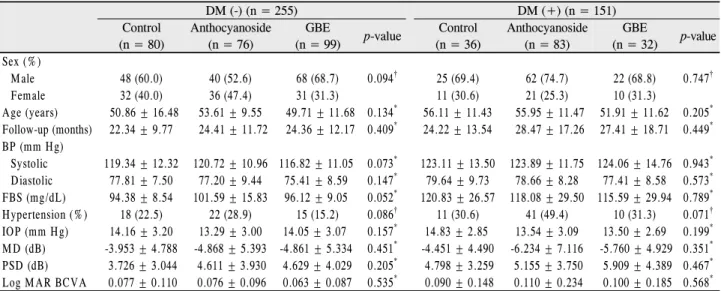
당뇨가 없는 255명 중 대조군은 80명, Anthocyanoside군 은 76명, GBE군은 99명이었으며, 당뇨를 진단받은 환자는 151명의 환자 중 대조군은 36명, Anthocyanoside군 83명, GBE군 32명이었다. 각 군별로 남녀 성비와 연령, 경과 관 찰 기간, 혈압, 공복혈당, 고혈압 유병률에는 유의한 차이가 없었다. 치료 전 기저 안압과 시야검사의 MD, PSD 값, 교 정시력 모두 치료군 간의 유의한 차이를 보여주지 않았다 (Table 2).
당뇨가 없는 환자에서 시야검사의 MD 값은 대조군은 유 의한 변화를 보여주지 않았으나(p=0.654), Anthocyanoside
군에서는 -4.868 (±5.393)에서 -4.102 (±5.209)로 향상되었 고(p=0.005), GBE군은 -4.861 (±5.704)에서 -4.013 (±5.360) 로 향상되었다(p=0.001). PSD 값은 대조군, Anthocyanoside 군, GBE군 모두 유의한 변화를 보여주지 않았다(각각 p=0.154, 0.438, 0.118). 교정시력(logMAR)은 대조군에서 0.077 (±0.110)에서 0.131 (±0.238)로 악화되었으나(p=0.022), Anthocyanoside군은 0.076 (±0.096)에서 0.057 (±0.082)로 호전되었고(p=0.024), GBE군은 유의한 변화를 보여주지 않 았다(p=0.206) (Table 3).
당뇨가 있는 환자에서 시야검사의 MD 값은 대조군의 경우 유의한 변화를 보여주지 않았으나(p=0.561), Anthocyanoside 군은 -6.234 (±7.116)에서 -5.043 (±6.008)으로, GBE군은 -5.760 (±4.929)에서 -4.460 (±4.914)으로 향상되었다(각각
Table 4. Generalized linear model of general and ocular variables and changes in visual indices (after-before)
Changes of MD Changes of PSD Changes of log MAR BCVA
p-value Coefficient p-value Coefficient p-value Coefficient
Sex (Female) 0.818 1.118 0.477 0.801 0.772 1.007
Age 0.002 0.948 0.063 0.545 0.389 0.999
Anthocyanoside 0.019 2.904 0.001 0.382 <0.001 0.913
Ginkgo biloba extract 0.037 2.958 0.063 0.545 0.004 0.932
Hypertension 0.471 1.350 0.308 0.762 0.345 1.019
Diabetes 0.051 2.184 0.120 0.672 0.121 0.971
Intraocular pressure 0.228 1.076 0.533 0.976 0.590 1.002
MD = mean deviation; PSD = pattern standard deviation; log MAR BCVA = logarithm of the minimal angle of resolution best corrected visual acuity.
p=0.003, 0.025). PSD 값은 당뇨가 없는 환자와 마찬가지로 대조군, Anthocyanoside군, GBE군 모두 유의한 변화를 보여 주지 않았다(각각 p=0.668, 0.053, 0.735). 교정시력(logMAR) 은 대조군의 경우 0.090 (±0.148)에서 0.130 (±0.181)으로 악 화되었으나(p=0.005), Anthocyanoside군은 0.110 (±0.234) 에서 0.091 (±0.154)로 호전되었고(p=0.011), GBE군은 유의 한 변화를 보여주지 않았다(p=0.809) (Table 3).
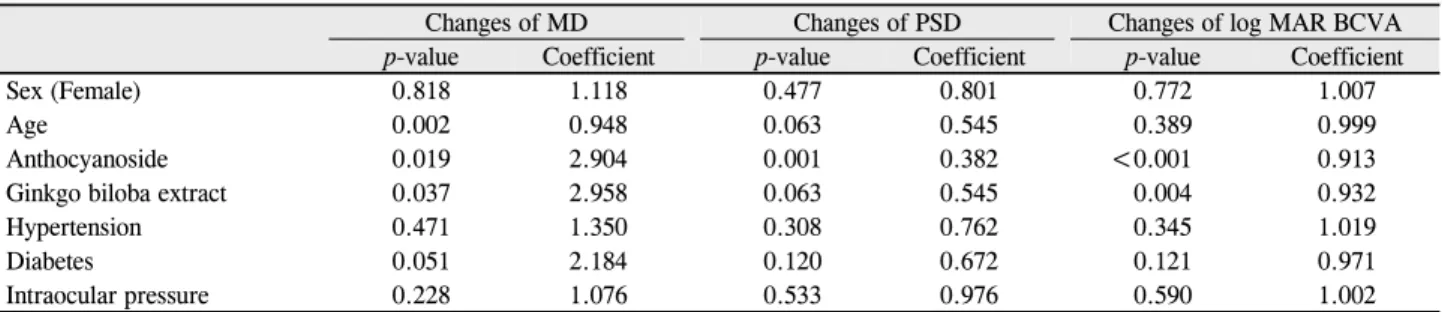
추가적으로 성별, 연령, 복용 약물, 고혈압, 당뇨, 안압의 요소들이 MD, PSD 값, 교정시력에 미치는 영향을 분석하 기 위하여 일반화 선형 모형을 산출하였다. MD 값의 변화 에 영향을 미치는 것은 연령(p=0.002)과 Anthocyanoside 복 용(p=0.019), GBE 복용(p=0.037)이었으며 PSD 값의 변화 에 영향을 미치는 것은 Anthocyanoside 복용(p=0.001)이었 고, 교정시력의 변화에 영향을 미치는 것은 Anthocyanoside 복용(p<0.001)과 GBE 복용(p=0.004)이었다(Table 4).
고 찰
녹내장의 대표적인 모집단 기반 연구인 OHTS (Ocular Hypertension Treatment Study)나 CNTG (Collaborative Normal-Tension Glaucoma Study Group)의 연구에서 보면 고안압 환자에서 안압을 충분히 낮추어도 녹내장으로 전환 되기도 하며, 녹내장 환자의 안압을 충분히 낮추어도, 진행 이 줄어들긴 하지만, 일정환자는 여전히 녹내장이 진행하 는 것으로 보고하고 있다. 이러한 사실로 보아 일부 녹내장 환자에서는 안압 하강 이외에 추가적인 치료가 필요하다는 것을 시사한다고 할 수 있다.3,4
우리의 연구 결과에서 보면 Anthocyanoside나 GBE의 복 용이 정상안압녹내장 환자 일부에서 시기능의 향상에 도움 을 줄 수 있는 것으로 나타났다. 이런 결과는 당뇨를 진단 받은 환자와 그렇지 않은 환자 모두에서 같은 결과를 보여 주었다. 시야검사의 MD 값은 대조군에서 유의한 차이가 없었으나 Anthocyanoside 치료군과 GBE 치료군에서는 호
전되었고, PSD 값은 세 군에서 모두 의미 있는 차이는 없 었으나, 교정시력은 대조군에서 유의하게 악화된 반면 Anthocyanoside군에서는 유의하게 호전되었다. 특히 이런 결과는 회귀분석을 통하여 Anthocyanoside나 GBE의 복용이 유의한 효과를 가져올 수 있다는 것을 확인할 수 있었다.
이전의 몇몇 연구들에서 Anthocyanoside나 GBE의 혈류개선 효과에 대한 보고를 하였었다. 동물연구에서 Anthocyanoside 가 미세혈관의 혈류와 간질액의 재배치를 통하여 혈류개선 의 이득을 준다는 보고가 있었다.13 Bilberry 추출물을 복용 한 47명의 환자에서 족부의 미세혈류 정체를 감소시키는 효과를 보고하기도 하였었다.14 하지의 정맥부전 환자에서 정맥의 미세혈류순환과 림프 순환에 도움을 준다는 보고도 있었다.15
GBE가 안구 혈류 순환을 호전시킨다고 보고한 연구들도 있었다. 정상인 11명에서 GBE를 하루 120 mg씩 이틀간 복 용 후 안압이나 혈압의 변화 없이 안동맥의 이완말기혈류 속도가 향상됨을 보고한 연구가 있었으며,16 같은 용량으로 4주간 복용 후 시신경유두 주위의 미세혈류속도, 혈류량, 부피의 증가를 보고한 바 있었다.17 또 다른 연구에서는 정 상안압녹내장 환자에서 하루 160 mg씩 4주간 복용 후 시신 경유두 주위의 혈류량, 혈류속도의 증가를 보여준 보고도 있었다.18
몇몇 연구에서는 Anthocyanoside와 GBE의 항산화 작용에 대한 보고도 있었다. 건강한 쥐를 대상으로 Anthocyanoside 복 용이 항산화 효소의 활성과 발현에 영향을 미친다는 보고가 있었다.19 GBE는 직접 유리기포촉제(radical scavenger)로 작 용을 하며,20 미토콘드리아의 산화 손상을 막아주고 역할을
하고,21,22 신경 보호 효과와23 저밀도지방단백의 산화를 막
아주는 기능을 가지고 있다.24
녹내장 환자에서 Anthocyanoside나 GBE가 도움이 될 수 있는 또 다른 가능성으로 인지기능의 향상에 도움이 된다 는 것이다.25 대뇌소혈관허혈이 녹내장 환자에서 더 빈번하 다는 보고가 있었으며,26,27 Anthocyanoside나 GBE의 복용
이 이런 허혈을 개선함으로써 시력이나 시야검사 지표에도 도움을 줄 수 있다고 생각할 수 있다.28
기전은 명확하지 않지만 Anthocyanoside와 GBE의 항염증 작용에 대한 보고도 있었다.29 이를 토대로 Anthocyanoside와 GBE의 시기능 개선 효과를 보여준 몇몇 연구들이 있었다.
Lee et al30은 Anthocynoside 복용이 근시 환자에서 대비감도와 임상증상의 개선을 향상시켜준다고 보고하였다. Quaranta et al31은 GBE를 복용한 정상안압녹내장 환자에서 4주 후 시 야검사 지표의 향상을 보여준다고 하였다. Kim et al32은 황반 부종을 동반한 비증식당뇨망막병증 환자에서 Anthocyanoside 를 12개월 동안 복용 후 대비감도가 호전된다고 보고하였다.
그리고 42명의 정상안압녹내장 환자에서 GBE를 80mg씩 하루 2회 복용하여 시야 이상의 진행을 늦출 수 있다고 보 고한 연구도 있었다.12
최근 저자의 연구에서는 정상안압녹내장 환자 332명을 대상으로 Anthocyanoside와 GBE 복용 후 교정시력과 시야 검사의 MD 값이 유의하게 증가하였음을 보고한 바 있다.6 이 결과를 토대로 녹내장의 병태생리에 직간접적으로 영향 을 미칠 수 있는 당뇨의 유무에 따라 임상 결과의 차이가 있 는지를 더 많은 환자 수를 대상으로 분석을 하게 되었다. 본 연구 결과 당뇨의 진단 여부와 상관 없이 Anthocyanoside와 GBE는 임상적으로 시기능을 향상시킬 수 있는 것으로 나 타났다. 이는 앞선 연구들에서 보여준 혈류개선 혹은 항산 화 효과가 당뇨 환자 혹은 비 당뇨 환자에만 국한되지 않고 작용할 수 있다는 것을 시사하고 있다.
본 연구의 제한점으로는 후향적 의무기록 분석으로서 당 뇨를 진단받은 환자에서 대조군과 GBE 치료군이 상대적으 로 적었다는 점이다. 또한 약을 복용하면서 체내 혈중농도 를 측정하지 못하였다는 단점도 있다. 추후 이런 점을 보완 하여 체내 혈중농도와 시기능 개선의 효과를 전향적으로 알아보는 것이 도움이 될 것이라고 생각한다.
결론적으로 우리의 연구 결과는 정상안압녹내장 환자에게 있어 당뇨가 있는 사람과 없는 사람 모두 Anthocyanoside와 GBE가 시기능의 개선에 도움이 될 수 있다는 것을 보여주었 다. 이 결과는 녹내장 환자 진료 시 전신질환을 고려하여 혈액순환 개선제와 항산화제를 처방하는 데 참고가 될 것 이라고 생각한다.
REFERENCES
1) Levene RZ. Low tension glaucoma: a critical review and new material. Surv Ophthalmol 1980;24:621-64.
2) Coleman AL. Glaucoma. Lancet 1999;354:1803-10.
3) Comparison of glaucomatous progression between untreated pa- tients with normal-tension glaucoma and patients with therapeuti- cally reduced intraocular pressures. Collaborative Normal-Tension
Glaucoma Study Group. Am J Ophthalmol 1998;126:487-97.
4) Kass MA, Gordon MO, Gao F, et al. Delaying treatment of ocular hypertension: the ocular hypertension treatment study. Arch Ophthalmol 2010;128:276-87.
5) Krupin T, Liebmann JM, Greenfield DS, et al. A randomized trial of brimonidine versus timolol in preserving visual function: results from the Low-Pressure Glaucoma Treatment Study. Am J Ophthalmol 2011;151:671-81.
6) Shim SH, Kim JM, Choi CY, et al. Ginkgo biloba extract and bil- berry anthocyanins improve visual function in patients with nor- mal tension glaucoma. J Med Food 2012;15:818-23.
7) Marra G, Cotroneo P, Pitocco D, et al. Early increase of oxidative stress and reduced antioxidant defenses in patients with un- complicated type 1 diabetes: a case for gender difference. Diabetes Care 2002;25:370-5.
8) Reunanen A, Knekt P, Aaran RK, Aromaa A. Serum antioxidants and risk of non-insulin dependent diabetes mellitus. Eur J Clin Nutr 1998;52:89-93.
9) Vessby J, Basu S, Mohsen R, et al. Oxidative stress and antioxidant status in type 1 diabetes mellitus. J Intern Med 2002;251:69-76.
10) Higginbotham EJ. Glaucoma in specific high risk racial and ethnic groups. In: Higginbotham EJ, Lee DA, eds. Management of diffi- cult glaucoma: a clinician's guide. Boston: Blackwell Scientific Inc., 1994.
11) Mitchell P, Smith W, Chey T, Healey PR. Open-angle glaucoma and diabetes: the Blue Mountains eye study, Australia. Ophthal- mology 1997;104:712-8.
12) Lee J, Sohn SW, Kee C. Effect of Ginkgo biloba extract on visual field progression in normal tension glaucoma. J Glaucoma 2013;
22:780-4.
13) Colantuoni A, Bertuglia S, Magistretti MJ, Donato L. Effects of Vaccinium Myrtillus anthocyanosides on arterial vasomotion.
Arzneimittelforschung 1991;41:905-9.
14) Ghiringhelli C, Gregoratti L, Marastoni F. [Capillarotropic action of anthocyanosides in high dosage in phlebopathic statis]. Minerva Cardioangiol 1978;26:255-76.
15) Bratman S, Kroll D. Clinical evaluation of medicinal herbs and other therapeutic natural products. Rocklin, Calif.: Prima Lifestyles, 1999.
16) Chung HS, Harris A, Kristinsson JK, et al. Ginkgo biloba extract increases ocular blood flow velocity. J Ocul Pharmacol Ther 1999;15:233-40.
17) Lee DJ, Ahn HB, Rho SH. The effect of Ginkgo biloba to retinal microcirculation. J Korean Ophthalmol Soc 2002;43:1522-7.
18) Park JW, Kwon HJ, Chung WS, et al. Short-term effects of Ginkgo biloba extract on peripapillary retinal blood flow in normal tension glaucoma. Korean J Ophthalmol 2011;25:323-8.
19) Hassimotto NM, Lajolo FM. Antioxidant status in rats after long-term intake of anthocyanins and ellagitannins from blackberries.
J Sci Food Agric 2011;91:523-31.
20) Stefanovits-Bányai E, Szentmihályi K, Hegedus A, et al. Metal ion and antioxidant alterations in leaves between different sexes of Ginkgo biloba L. Life Sci 2006;78:1049-56.
21) Eckert A, Keil U, Kressmann S, et al. Effects of EGb 761 Ginkgo biloba extract on mitochondrial function and oxidative stress.
Pharmacopsychiatry 2003;36 Suppl 1:S15-23.
22) Eckert A, Keil U, Scherping I, et al. Stabilization of mitochondrial membrane potential and improvement of neuronal energy metabo-
= 국문초록 =
정상안압녹내장에서 당뇨 유무에 따라 분석한 안토시아노사이드, 은행잎추출물의 치료 효과
목적: 당뇨 유무에 따라 정상안압녹내장 환자에서 Anthocyanoside 제제 및 Ginkgo Biloba Extract (GBE) 제제를 복용하는 환자들의 치료 효과를 분석해 보고자 하였다.
대상과 방법: 2005년 1월부터 2013년 12월까지 강북삼성병원 안과 외래에 내원한 정상안압녹내장 환자를 대상으로 후향적 의무기록 분석을 시행하였다. 모든 환자들은 6개월 간격으로 교정시력과 시야 검사를 시행하였으며, 당뇨 유무에 따라 나누어 Anthocyanoside 를 복용한 환자군과 GBE를 복용한 환자군 그리고 둘 다 복용하지 않은 대조군의 교정시력과 시야 검사 지표를 비교 분석하였다.
결과: 총 406명 중 당뇨를 진단받지 않은 환자는 255명(대조군 80명, Anthocyanoside군 76명, GBE군 99명), 당뇨를 진단받은 환자는 151명(대조군 36명, Anthocyanoside군 83명, GBE군 32명)이었다. 치료 후 시야검사상 MD 값은 Anothocyanoside군과 GBE군에서 호전되었다. PSD 값은 세 군에서 모두 유의한 변화를 보여주지 않았다. 교정시력은 대조군에서 악화되었으나, Anthocyanoside군에 서는 향상되었다. 이런 결과는 당뇨가 없는 환자와 있는 환자 모두 동일하였으며, 일반화선형모형 분석에서 전신약제 복용이 시기능 에 유의한 영향을 미치는 것으로 나타났다.
결론: 정상안압녹내장 환자에서 Anthocyanoside와 GBE는 당뇨의 유무에 상관없이 시기능의 호전에 도움을 줄 수 있는 것으로 나타났다.
<대한안과학회지 2014;55(8):1174-1179>
lism by Ginkgo biloba extract EGb 761. Ann N Y Acad Sci 2005;1056:474-85.
23) Hirooka K, Tokuda M, Miyamoto O, et al. The Ginkgo biloba ex- tract (EGb 761) provides a neuroprotective effect on retinal gan- glion cells in a rat model of chronic glaucoma. Curr Eye Res 2004;28:153-7.
24) Yan LJ, Droy-Lefaix MT, Packer L. Ginkgo biloba extract (EGb 761) protects human low density lipoproteins against oxidative modification mediated by copper. Biochem Biophys Res Commun 1995;212:360-6.
25) Kleijnen J, Knipschild P. Ginkgo biloba for cerebral insufficiency.
Br J Clin Pharmacol 1992;34:352-8.
26) Stroman GA, Stewart WC, Golnik KC, et al. Magnetic resonance imaging in patients with low-tension glaucoma. Arch Ophthalmol 1995;113:168-72.
27) Kim M, Park KH, Kwon JW, et al. Retinal nerve fiber layer defect and cerebral small vessel disease. Invest Ophthalmol Vis Sci 2011;
52:6882-6.
28) Ritch R. Potential role for Ginkgo biloba extract in the treatment of glaucoma. Med Hypotheses 2000;54:221-35.
29) Tsoyi K, Park HB, Kim YM, et al. Anthocyanins from black soy- bean seed coats inhibit UVB-induced inflammatory cyloox- ygenase-2 gene expression and PGE2 production through regu- lation of the nuclear factor-kappaB and phosphatidylinositol 3-kin- ase/Akt pathway. J Agric Food Chem 2008;56:8969-74.
30) Lee J, Lee HK, Kim CY, et al. Purified high-dose anthocyanoside oligomer administration improves nocturnal vision and clinical symptoms in myopia subjects. Br J Nutr 2005;93:895-9.
31) Quaranta L, Bettelli S, Uva MG, et al. Effect of Ginkgo biloba ex- tract on preexisting visual field damage in normal tension glaucoma. Ophthalmology 2003;110:359-62; discussion 362-4.
32) Kim ES, Yu SY, Kwon SJ, et al. Clinical evaluation of patients with nonproliferative diabetic retinopathy following medication of an- thocyanoside: multicenter study. J Korean Ophthalmol Soc 2008;
49:1629-33.