39(3) : 218 222 (2008)
218
은행엽엑스 제제의 기준 및 시험법과 규격 설정
김승현1·김대현1·박진호1·오미현2·조창희2·백주현2·조정희2·김태범3·이기용3·김영중3·성상현3,
*
1㈜엘컴사이언스생명과학연구소
,
2식품의약품안전청생약평가부생약제제과,
3서울대학교약학대학Development of the Standard Analytical Methods for Ginkgo biloba Leaf Extract
Seung Hyun Kim
1, Dae Hyun Kim
1, Jin-Ho Park
1, Mi Hyune Oh
2, Chang Hee Cho
2, Ju Hyun Baek
2, Jung Hee Cho
2, Tae Bum Kim
3, Ki Yong Lee
3, Young Choong Kim
3and Sang Hyun Sung
3,*
1
Institute for Life Science, Elcom Science Co. Ltd., Seoul 151-742, Korea
2
Department of Herbal Medicines Evaluation, Division of Herbal Medicinal Products, Korea Food & Drug Administration, Seoul 122-704, Korea
3
College of Pharmacy, Seoul National University, Seoul 151-742, Korea
Abstrac
t
−This study was carried out to establish standard analytical methods for Ginkgo biloba leaf extract. Ginkgo fla- vonoids, terpene lactones, ginkgolic acids were employed as reference compounds for analytical method. Analytical method of US Pharmacopoeia was adopted for flavonoids and terpene lactones, and a new method was developed for ginkgolic acids.
Analytical methods established in this study could be applied to a reasonable and unified quality control of G. biloba leaf extract.
Keywords −
Ginkgo biloba leaf extract, standard analytical method
은행나무
(
Ginkgo biloba)
의잎은행엽은혈관및혈류장애
,
노인성치매의치료,
뇌기능장애예방,
집중력강화,
항염증
,
항알러지등에가장널리사용되고있는생약중하나이다
.
1-2) 은행엽엑스의대표적인성분에는ginkgo flavone glycosides, terpene lactones, proanthocyanidine, ginkgolic acids
등이 있다.
3-4)Ginkgo flavone glycosides
와terpene lactones
가유효성분으로간주되며, ginkgolic acids
는알러지반응을일으키기때문에5)독일약전등에서는은행엽엑 스중의
ginkgolic acids
의함량을5.0 ppm
이하로제한하고있다
.
우리나라에서은행엽엑스제제는단일제및복합제를포함하여
376
품목이허가되어있을정도로널리사용된다.
최근생약에대한관심증가와생약을원료로한제제시장 규모의확대로유럽등지로부터생약제제및생약엑스의수 입이급증하고다양한제제가유통되고있는추세이다
.
이에따라혈행개선을목적으로현재국내에서널리사용되 는은행엽엑스또한해외로부터수입이증가하고있지만각
제제업체별로대한약전외의약품등기준
,
독일약전등각기다른규격을적용하고있다
.
기준이다양하고품질관리체계가상이하기때문에저품질원료의수입가능성을배제 할수없고규격이비합리적인경우도많아일정한약효또 한기대하기어려운실정이다
.
따라서빈용되고있는은행엽엑스의원료의약품에대한합리적이고효율적인통일된 규격이필요한상황이다
.
이에본연구에서는다양한은행엽엑스를확보한후규격비교를통하여이에대한가장합 리적이고타당한규격을설정하여통일된기준을마련함으 로써은행엽제제의약효를기대함과동시에안정적인품질 관리를돕는데목적을두었다
.
재료 및 방법
실험재료 −본연구에사용한은행엽엑스는국내에유통 되고최종의약품에서실제사용되는원료의약품을각제 조사로부터확보하여사용하였다
.
시약 및 기기 −
Ginkgo flavonoid
표준품인quercetin, kaempferol, isorhamnetin
과terpene lactone
표준품인*교신저자(E-mail):[email protected] (FAX):82-2-877-78594
bilobalide, ginkgolide A, B, C
는Sigma
사(
미국)
를사용하였으며
ginkgolic acid
는Schwabe
사(
독일)
로부터제공받았다
. HPLC
분석을 위한 용매는Samchun chemical
사의HPLC
급용매를사용하였고그외시료추출과분석을위한시약은분석용특급또는
1
급시약을사용하였다. HPLC system
은Rheodyne (
미국)
의injector-ASI-100 automated sampler injector, Dionex (
독일)
의photodiode array detector (UVD 340U)
및pump-P680 (Dionex,
미국)
으로구성되었다
. Evaporative Light Scattering Detector
는Polymer Laboratories (
미국)
의PL-ELS2100
을사용하였다.
Ginkgo flavonoid의 각 규격에 따른 비교 및 검액과 표 준액의 조제 −
KPC (Korean Pharmaceutical Codex), DAB (Deutsches Arzneibuch)
및USP (United States Pharmacopoeia)
의각약전에따른방법을이용하여규격을비교하였다
.
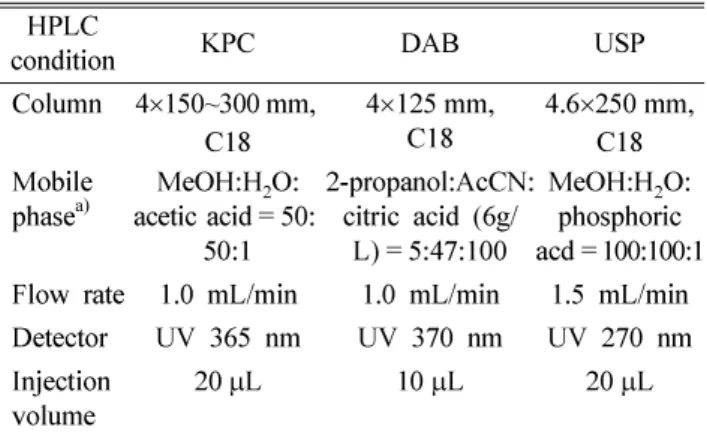
6-8)각약전에따른분석방법은
Table I
에나타내었다.
은행엽엑스와
ginkgo flavonoid
의검액및표준액의조제는각약전규격에따라시행하였다
. KPC
방법의검액은시료0.15 g
을메탄올
40 mL
에녹이고메탄올을추가하여50 mL
로맞춘뒤여과한후여액
10 mL
를뚜껑있는갈색용기에넣고1.5 mol/L
염산10 mL
를넣어제조하였다. 95
oC
에서1
시간reflux
후냉각하고메탄올로20 mL
되게하여검액으로하였다
.
표준액은quercetin, kaempferol
및isorhamnetin
각각5 mg
을메탄올50 mL
에녹여사용하였다. DAB
방법의검액은시료
200 mg
을50 mL
메스플라스크에넣고메탄올20 mL
로녹인후,
묽은염산15 mL
와증류수5 mL
를넣고메탄올로
50 mL
가되게한후이용액10 mL
를10 mL
갈색유리병에넣고부틸탄성고무막과알루미늄덮개로밀봉하 여
25
분동안중탕용기속에서가열하고20
oC
로냉각시켜사용하였다
.
표준액은quercetin
표준품10 mg
을 메탄올20 mL
에녹이고묽은염산15 mL
와증류수5 mL
를넣고메탄올로
50 mL
가되게하였다. USP
방법의검액은시료0.3 g
을환류장치가있는250 mL
플라스크에넣고추출용매
(
알콜:
증류수:
염산= 50:20:8) 78 mL
를넣어열탕수조에서
135
분간reflux
한후식혀서증류수로100 mL
가되도록 맞추어사용하였다
.
표준액은quercetin 0.125 mg/mL, kaempferol 0.125 mg/mL, isorhamnetin 0.03 mg/mL
의농도로제조하여사용하였다
.
Terpene lactone의 각 규격에 따른 비교 및 검액과 표 준액의 조제 −각약전및분석법에따른방법은
Table II
와같이나타내었다
.
은행엽엑스terpene lactone
의검액및표준액의조제는
DAB, USP
규격과이두가지분석방법을기본으로하여변형된방법을적용하였다
.
9-13)DAB
방법에서는
25 mL
비커에시료120 mg
을넣고인산염완충액(pH 5.8) 10 mL
을넣고녹였다.
이를인산염완충액(pH 5.8) 5 mL
로2
회씻은15g
규조토여과보조제로채워진0.15×30 mm
의크로마토그래프용관에충진하였다
. 15
분방치후ethyl acetate 100 mL
로 추출하여 이 추출액을 수욕상(4 kPa, 50
oC)
에서증발농축하고잔류물을이동상2.5 mL
에녹여검액으로사용하였다
.
표준액은benzyl alcohol 30 mg
을이동상에녹여
100 mL
가되게하였다. USP
방법에서는 시료120 mg
을뚜껑이있는유리병에넣고용매(
메탄올:
증류수= 9:1) 10 mL
를넣어녹이고이것을밀봉해서90
oC
에서30
분간가열한후혼합하였다
.
이를다시30
분간가열한후실온에서냉각시켜검액으로사용하였다
.
표준액은bilobalide, ginkgolide A, B
및C
를 메탄올에녹여각각0.5, 1, 2, 4, 8 mg/mL
의농도로만들어사용하였다. USP
와DAB
방법에기초하여새로운
HPLC
분석법을개발하여앞의두방법과비교하였다
.
표준액과검액은일반적인HPLC
분석용시료조제방법에따라일정량을정량하여메탄올로녹인후희 석하고여과하여사용하였다
.
Ginkgolic acid의 각 규격에 따른 비교 및 검액과 표준 액의 조제−각약전에따른분석방법은
Table III
에나타내었다
.
은행엽엑스와ginkgolic acid
의검액및표준액의조제는
DAB, USP
규격과이두가지규격에기초하여본연구를통해개발된방법을적용하였다
.
14-16)DAB
방법에서는Table I.
HPLC conditions for ginkgo flavonoid HPLC
condition KPC DAB USP
Column 4
×150~300 mm,
C18 4
×125 mm,
C18 4.6
×250 mm, Mobile C18
phase
a)MeOH:H
2O:
acetic acid = 50:
50:1
2-propanol:AcCN:
citric acid (6g/
L) = 5:47:100
MeOH:H
2O:
phosphoric acd =100:100:1 Flow rate 1.0 mL/min 1.0 mL/min 1.5 mL/min Detector UV 365 nm UV 370 nm UV 270 nm Injection
volume 20
µL 10
µL 20
µL
a)MeOH: 메탄올; AcCN: 아세토니트릴
Table II.
HPLC conditions for terpene lactone HPLC
condition DAB USP Modified
method Column 4
×250 mm,
C18 4.6
×250 mm,
C18 4.6
×250 mm, Moblie C18
phase
a)THF:MeOH:
H
2O = 10:20:75
A:H
2O, B:MeOH gradient
A:H
2O, B:MeOH gradient Flow rate 1.0 mL/min 1.0 mL/min 1.0 mL/min
Detector RID ELSD ELSD
Injection
volume 100
µL 15
µL 8
µL
a)THF: tetrahydrofuran; MeOH: 메탄올
시료
1 g
를25 mL
비커에넣고,
증류수10 mL
를넣고5
분간흔들어섞었다
.
이것을분액깔대기에넣고비커를5 mL
로씻은물도같이분액깔대기에넣어그혼합액을
ethyl
acetate 10 mL
로4
회추출하였다.
이것을각각증류수5 mL
로
2
회씻고 물층은버리고여과한후수욕상에서증발농축하고이를메탄올
2 mL
에녹였다.
표준액은ginkgolic acid
표준품
6.25 mg
을메탄올50 mL
에녹이고이액1 mL
를취해메탄올로
50 mL
가되게하여사용하였다. USP
방법에서는시료
0.5 g
을10 mL
용량플라스크에넣고8 mL
메탄올로녹인후물로
10 mL
가되게하여검액으로사용하였다
.
표준액은ginkgolic acid
를메탄올로녹여0.25
µg/mL
농도로제조하였다
.
새로운방법에서는시료1 g
을50%
에탄올수용액
50 mL
에녹인후chloroform 50 mL
로1
회추출하여수용액층과유기층을분리하고수용액층에에탄올
10 mL
를가한후chloroform 50 mL
로재차추출하였다.
수용액층은버리고유기층용액을혼합한후농축하고남은 농축잔사를메탄올
5 mL
에녹여검액으로사용하였다.
표준액은
ginkgolic acid
표준품6.25 mg
을달아각각메탄올50 mL
에녹이고이액1 mL
를취해메탄올로50 mL
가되게하여사용하였다
.
결과 및 고찰
각 기준 및 시험법에 따른 ginkgo flavonoid 분석 결과 −
KPC
방법의경우HPLC
크로마토그램상에서피크의분리가양호하고
, quercetin, kaempferol
및isorhamnetin
세가지표준품을사용하여시료에서도이세가지화합물을확 인할수있었다
.
시료전처리방법이비교적간단하지만실험결과제시된염산농도와가수분해시간으로는충분히 당이가수분해되지않아기준치
(22.0~27.0%)
보다모든분석시료의함량이낮은것으로나타났다
. DAB
방법은시료분석법이간단하고분석결과각시료의함량이기준에적합하였 다
.
하지만일반적으로사용되는컬럼이아닌4×125mm
컬럼을사용하며
,
표준품으로quercetin
만사용하고,
시료중kaempferol
과isorhamnetin
이HPLC
크로마토그램상에서하나의피크로중첩되어나타나므로각각의
flavonoid
를정확하게확인할수없었다
. USP
방법에서는전처리시간이오래걸리지만
HPLC
크로마토그램상에서시료중quercetin, kaempferol
및isorhamnetin
세가지물질의피크가뚜렷이분리되었고분석결과함량이기준에적합한것으로나타났다
.
각기준및시험법에따른함량평가결과와HPLC
크로마토그램은각각
Table IV
와Fig. 1
에나타내었다.
Table III.
HPLC conditions for ginkgolic acids HPLC
condition DAB USP Modified
method Column 4
×125 mm, C18 4.6
×50 mm,
C8 4.6
×250 mm, Moblie C18
phase
a)A:85%
phosphoric acid solution:AcCN:
H
2O = 0.3:30:70 B:85%
phosphoric acid solution:AcCN=
0.3:100
A:0.01%
solution of phosphoric acid
in H
2O B:0.01%
solution of phosphoric acid
in AcCN gradient
MeOH:H
2O:85
% phosphoric acid solution
= 910:80:5
Flow rate 1.2 mL/min 1.0 mL/min 1.5 mL/min Detector UV 310 nm UV 210 nm UV 210 nm Injection
volume 200
µL 100
µL 50
µL
a)MeOH: 메탄올; AcCN: 아세토니트릴
Table IV.
Ginkgo flavonoids contents estimated by each method
Sample DAB (%) KPC (%) USP (%) Ginkgo flavonoids A 26.68 12.94 26.76
B 24.56 13.72 25.23
C 24.35 10.81 24.13
Fig. 1.
Ginkgo flavonoids HPLC chromatogram of samples of
KPC method (A), DAB method (B) and USP method (C)
각 기준 및 시험법에 따른 terpene lactone 분석 결과 −
USP
방법에서는bilobalide, ginkgolide A, B
및C
의네가지표준품각각에대하여검량선을작성하였다
.
분석결과 각 시료의 총
terpene lactone
의 함량과bilobalide, ginkgolide A, B
및C
각각의 함량이 기준(
총terpene lactone 5.4~12.0%, bilobalide 2.6~5.8%, ginkgolide A, B
및
C 2.8~6.2%)
에적합하였고,
시료전처리도비교적간단하였다
.
또한ELSD
검출기를사용하기때문에DAB
방법에서사용하는
RID
에비해검출기의감도,
재현성및편의성이좋을뿐아니라피크분리도도양호하였다
. DAB
방법에서는시료를작은오픈컬럼을사용하여추출하기때문 에전처리가복잡하고시간이많이소요되었고
RID
검출기를사용하기때문에감도와재현성이좋지않았다
.
또한함량기준
(
총terpene lactone 5.0~7.0%, bilobalide 2.6~3.2%, ginkgolide A, B
및C 2.8~3.4%)
이매우좁아기준에적합한결과를얻기가어려웠다
.
뿐만아니라benzyl alcohol
을표준품으로사용하기때문에은행엽
terpene lactone
의실제표준품인
bilobalide, ginkgolide A, B
및C
을구입을통해쉽게확보할수있는현재의상황과맞지않으며분리도도 좋지않은결과를보였다
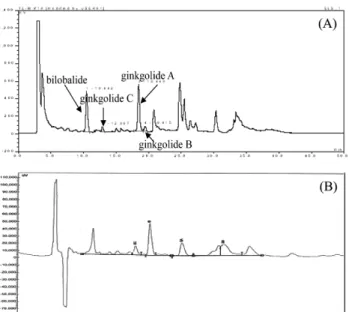
. Fig. 2
는USP
와DAB
방법에따른
HPLC
크로마토그램을나타낸것이다. USP
방법에서좋은분리및분석능을보인
HPLC-ELSD
분석법을활용하고시료전처리를보다간소화하기위해일반적인
HPLC
분석용시료조제법을적용하여새로운분석법을개발하고자하
였다
.
그러나이분석법의경우USP
방법에서보다분리능이떨어지고각각의시료에대해일관성있는함량결과를 얻기어려웠기때문에
terpene lactone
의분석에는USP
방법이더적합한것으로판단된다
.
각 기준 및 시험법에 따른 ginkgolic acid 분석 결과−
DAB
방법에서는분석용 시료조제 과정이복잡하고ginkgolic acid
피크가80
분이후에검출되어검출시간이지나치게길며
HPLC
크로마토그램상에서두피크만확인되었다
. USP
방법에서는 일반적으로 사용되지 않는4.6×50 mm, C8
컬럼을사용해야하고표준품은HPLC
크로마토그램상에서두개의피크로확인되지만시료에서는 이들이확인되지않았다
.
때문에이두가지방법을기초로일반적으로많이사용되는
4.6×250 mm, C18
컬럼을이용하여새로운분석법을개발하고자하였다
.
새로개발된분석법에서는분리능을높이기위해인산을포함한이동상을 사용하였고검액중
ginkgolic acid
의함량을높이기위해chloroform
으로추출하는전처리과정을거치도록하였다.
비교적복잡하지않은전처리방법및상용컬럼을사용하
기때문에분석이용이할뿐만아니라분석결과
HPLC
크로마토그램에서
ginkgolic acid
피크 분리능이 개선되어Fig. 2.
HPLC chromatograms of samples analyzed by USP method (A) and DAB method (B), respectively
Fig. 3.
Ginkgolic acids HPLC chromatogram of standards of
DAB method (A), USP method (B), new method (C) and a
sample of new method (D)
ginkgolic acid ,
및을모두확인할수있었다.
시료중에서도세가지표준품이모두확인되어은행엽엑스
ginkgolic acid
의분석법으로USP
나DAB
방법의문제점을개선할수있었다
. (Fig. 3)
결 론
은행엽엑스중
ginkgo flavonoid
분석을위해서는시료의HPLC
크로마토그램에서quercetin, kaempferol
및isorha-
mnetin
이뚜렷이분리되고적합한함량기준을제시한USP
방법이적절한것으로판단되었다
. Terpene lactone
의경우함량기준에적절하고검출기의감도
,
재현성및편의성이좋으며분리도도양호한
USP
방법이가장적합한것으로나타났다
. Ginkgolic acid
의분석을위해서는기존의USP
및
DAB
방법을개선하여새로운분석법을개발하였다.
이방법을통해복잡한전처리과정중생길수있는오차가능 성을줄이고상용컬럼을사용하여분석이용이하도록하 였고
ginkgolic acid
의분리능및분석능을개선할수있었다
.
이상의결과는KPC
에반영되어은행엽엑스시험법이수정되었다
.
수정된내용에따른규격은총ginkgo flavonoid
배당체
(quercetine
배당체, kaempferol
배당체 및isorha- mnetin
배당체의 총량으로서,
평균분자량756.7)
로서22.0~27.0%,
총terpene lactone [bilobalide (C
15H
18O
8), ginkgolide A (C
20H
24O
9), B (C
20H
24O
10)
및C (C
20H
24O
11)
의총량으로서
]
은5.4~12.0%
를함유하여야하며,
총terpene lactone
의양중에서
bilobalide (C
15H
18O
8)
는2.6~5.8%, ginkgolide A (C
20H
24O
9), B (C
20H
24O
10)
및C (C
20H
24O
11)
의 총량은2.8~6.2%
를각각함유한다.
본연구를통해확립된은행엽엑스의분석법및함량규격은국내에서사용되는은행엽엑 스원료및제제에대한기준및시험법및규격으로활용됨 으로써이들의효율적인품질관리에기여할것으로기대된다
.
사 사
본연구는
2007
년도식품의약품안전청용역연구개발과제의연구개발비지원
(07092
생약안304)
에의해수행되었으며이에감사드립니다
.
인용문헌
1. Chung, H. S., Harris, A., Kristinsson, J. K., Ciulla, T. A., Kagemann, C. and Ritch, R. (1999) Ginkgo biloba extract increases ocular blood flow velocity. J. Ocul. Pharmacol.
Ther.,
15: 233-240.
2. Persson, J., Bringlv, E., Nilsson, L. G., and Nyberg, L. (2004) The memory-enhancing effects of Ginseng and Ginkgo
biloba in healthy volunteers. Psychopharmacology ,
172: 430- 434.
3. Dubber, M. J. and Kanfer, I. (2005) The simultaneous deter- mination of selected flavonol glycosides and aglycones in Ginkgo biloba oral dosage forms by high-performance liquid chromatography-electrospray ionisation-mass spectrometyr.
J. Pharm. Biomed. Anal.,
37: 723-731.
4. De Feudis, F.V. (1991) Ginkgo biloba Extract (EGb 761):
Pharmacological activities and clinical applications. Paris, France, Elsevier.
5. Hausen, B.M. (1998) The sensitizing capacity of ginkgolic acids in guinea pigs. Am. J. Contact Dermat. ,
9: 146-148.
6.
식품의약품안전청(2007)
대한약전외의약품등기준, 1165- 1166.
7.
식품의약품안전청(2007)
대한약전외의약품등기준(KPC)
개정에따른생약
(
한약)
제제의규격설명회참고자료, 30- 35, 46-52.
8. The United States Pharmacopeial Convention (2007) United States Pharmacopoeia, 937-938.
9. Lichtblau, D., Berger, J. M. and Nakanishi, K. (2002) Effi- cient extraction of ginkgolides and biloblide from Ginkgo biloba leaves. J. Nat. Prod .,
65: 1501-1504.
10. Deng, F. and Zito, S. W. (2003) Development and validation of a gas chromatographic-mass spectrometric method for simultaneous identification and quantification of marker compounds including bilobalide, ginkgolides and flavonoids in Ginkgo biloba L. extract and pharmaceutical preparations.
J. Chromatogr. A ,
986: 121-127.
11. Ding, C., Chen, E., Zhou, W. and Lindsay, R. C. (2004) A Method for extraction and quantification of ginkgo terpene trilactones. Anal. Chem .,
76: 4332-4336.
12. Mustafa, O., Brendan, M. and Pei, C. (2007) Comparison of the terpene lactones and flavonoids contents in G. Biloba commercial samples and the NIST standard reference mate- rials using LC/UV/MS. J. Food Drug Anal .,
15: 55-62.
13. Mesbah, M.K., Khalifa, S. I., El-Gindy, A and Tawfik, K.A.
(2005) HPLC determination of certain flavonoids and ter- pene lactones in selected Ginkgo biloba L. phytopharma- ceuticals. Farmaco. ,
60: 583-590.
14. Fuzzati, N., Pace, R. and Villa, F. (2003) A simple HPLC-UV method for the assay of ginkgolic acids in Ginkgo biloba extracts. Fitoterapia ,
74: 247-256.
15. Zhang, X., Ouyang, Z., Yang, K., Chen, J. (2003) Isolation and HPLC analysis of ginkgolic acid. Zhong Yao Cai ,
26: 557-559.
16. Van Beek, T. A. and Wintermans, M. S. (2001) Preparative isolation and dual column high-performance liquid chro- matography of ginkgolic acids from Ginkgo biloba . J. Chro- matogr. A ,
930: 109-117.
(2008년 7월 14일 접수)